Dancing in the end times

And so here we find ourselves, finally, on the cusp of a great turning in solar time, the fabled 12-21-12.  It is a dark, wet, windy, wild morning here in the hills of western Massachusetts.

Since I started this blog back in the summer of 2011, with the optimistic URL “bethechange2012,” I have found many others who have beckoned to me like beacons of strength and inspiration on my somewhat lonely path of inquiry and discovery.

In the early days of Transition Times my own light was quite tentative and often overwhelmed with fear and distress, the product of my dawning realization of the tremendous gravity of the situation in which we find ourselves.

We cannot pretend to each other that the news is good for humanity, any more than for the rest of the living beings on the planet.

These are the transition times: the end of a long era of existence, as the ancient Mayan shamans rightly foresaw, and the beginning of something new.

I cannot and will not shy away from diving into the heart of the wreck that is our human civilization on this planet in the early 21st century.  Exposing what I find there is part of my mission with this blog.

However, it is also my purpose to be a channel and a beacon of hope for others who are searching for  meaning in these troubled times we live in.

We are all caught up in a vortex much greater than any individuals among us could produce, an accelerating forward surge that is hurtling humanity, and the planet we share with so many other life forms, towards a new era.

We cannot know what this means for each of us as individuals.  But I am coming to realize that the most important thing we can be doing in these transition times is to serve each other, and the other beings on the planet, as a form of shelter and anchor in the storm.

I will close with an image taken on one of my many thoughtful rambles over the past few months.  To me it represents the planet calling to me, and to all of us who love her, to continue to push back against the forces that would despoil and blight her.

The rocks, earth and waters of the Earth remind us that geological time is slow and very, very long.  Our dance on the planet as humans is so brief.  Let us enjoy our time here passionately, and turn our dancing to good works.

Benedict Pond, Monterey, November 2012

Benedict Pond, Monterey MA, November 2012

Something is rotten in the state of higher education: time for change!

Higher education today is like a feudal castle, with the King living in opulence, his knights doing well as long as they serve the king faithfully, and the servants toiling away in perpetual bondage.

President Shirley Ann Jackson of Rensselaer Polytechnic Institute in Troy, NY, is the highest paid private college president in the land

President Shirley Ann Jackson of Rensselaer Polytechnic Institute in Troy, NY, is the highest paid private college president in the land

Thoughts of Elsinore are rising to mind today because of a new report detailing just how wealthy those academic Kings are: The Chronicle of Higher Education reports that “In 2010, 36 private-college presidents earned more than $1 million,” and among the 493 presidents surveyed at private American colleges with budgets exceeding $50 million, the median compensation was $396,649.”

In contrast, a recent American Association of University Professors survey found the average faculty salary at American institutions of higher education to be $82,000—but this average is pulled way down by the inclusion of “instructors” in the mix, for whom the average salary was $47,000.

Tenured faculty, in the Elsinore analogy, would be the nobles of the realm, the knighted vassals who serve the King in the castle, and are richly rewarded for their allegiance.

They are supported by a legion of staff, including graduate teaching assistants and adjunct faculty, whose salary falls behind the cost of living a little more each year.

And then there are the serfs in the system, whose labor supports it all: the students and their parents, many of whom are forced into a new kind of debt bondage to attain the gold ring of that vaunted college degree—paying ever-increasing tuition, and ever-increasing taxes as well.

What would make young Hamlet really moody these days is the growing recognition that the college degree just isn’t worth what it used to be.

Kevin Carey, director of the education policy program at the New America Foundation, cites Academically Adrift, the damning study by Richard Arum and Josipa Ruksa, which “found that many students at traditional colleges showed no improvement in critical thinking, complex reasoning and writing, and spent their time socializing, working or wasting time instead of studying.”  And then, he adds, there are all the students who enter college but never end up graduating, often because the price is too high or the academic work too dull.

At the graduate level, too, there is a sense of crisis.

According to Chronicle of Higher Education reporter Stacey Patton, “The student-debt problem, coupled with the dearth of jobs, has sparked a national conversation about whether going to graduate school is worth it.”

At the Council on Graduate Schools annual meeting this month, Patton reports, the buzz was about whether it’s “unethical to keep admitting students to programs and training them for jobs that don’t exist while they are racking up piles of debt only to risk finding university employment as just an adjunct, or obtaining some other low-wage job for which a graduate degree is not necessary, or ending up on food stamps.

Poor Hamlet, who just wanted to go back to Wittenberg and bury himself in philosophy!

These days, the humanities are particularly beleaguered, with leaders among the humanities professoriate having to constantly deliver pep talks to the rank and file on why what we’re doing matters.

“We should keep telling our students (and their parents) that ‘doing the humanities’ prepares them generally in a way no narrow occupational degree can,” says Rosemary Feal, Executive Director of the Modern Language Association.

“When we say the word research,” she continues, “most people don’t think of the humanities, and they have trouble recognizing the product as useful. It’s true that “doing the humanities” doesn’t produce scientific knowledge that can, say, cure cancer. But it can yield imaginative works on cancer like Susan Gubar’s Memoir of a Debulked Woman and Mary Cappello’s Called Back: My Reply to Cancer, My Return to Life that change people’s lives.”

It’s interesting that when pressed to think of humanities work that “changes people’s lives,” Feal points to two memoirs as examples.

As someone who is currently writing a memoir, and who has studied personal narrative since my dissertation (entitled Hybrid Encounters: Postcolonial Autobiographies of the Americas), I have to agree with Feal that personal narratives have great educational value.

Human beings have been sitting around campfires telling stories since we first began to use language.

We have always learned by listening to our elders hand down traditional stories, and inventing new ones.

The tragedy of Hamlet, for example, was Shakespeare’s reworking of the older Scandinavian tale, and it illustrates vividly the dangers of puffed up pride, greed and ruthless ambition.

The desire of Claudius for wealth and power blinds his moral sense, and in killing his brother, marrying his sister-in-law, and plotting to kill his nephew, he sets the stage for the total destruction of the royal house of Elsinore, leaving it ripe for the plucking of the neighboring Prince, Fortinbras, who is as decisive and aggressive as Hamlet is moody and tentative.

In our current educational landscape, the Fortinbras army waiting in the wings might be robotic: the legions of online courses that are swiftly breeching the walls of Castle Academe.

Online learning has the potential to be as revolutionary as the rise of industrial capitalism back in the 19th century.  Suddenly the educational territory cannot be entirely controlled by the King in his castle, although to be sure he is dispatching his Knights left and right to try to secure his boundaries—every day brings word of new online learning consortiums or treaties being signed in the scramble to lock down the goldmines of higher learning.

But what kind of educational model are those Kings of Academe trying so hard to protect and secure?

The kinds of subjects that lend themselves best to MOOC virtual classrooms (that’s Massive Open Online Courses, for those new to the territory) are those that can be taught by lecture and multiple-choice exams.

But does young Hamlet, or any other thoughtful, creative young person, really want to be lectured to and tested on canned, pre-recorded knowledge?

Wouldn’t he rather be engaged in a dialogue with his elders, or a dynamic, free-ranging conversation among his peers and their mentors?

Online technology does have the power to help open up multiple conversational platforms.  Since the advent of the internet, we humans are conversing globally in ever-expanding ways, and the price of admission to the conversation is fairly low: a computer and an internet connection is all you need, for starters, to get into the game.

But to succeed in this brave new social landscape, you do need competence with those familiar old tools of the humanities trade: the ability to read and analyze critically; the ability to write and speak with precision and thoughtfulness; the ability to sort through, understand and analyze the massive amounts of complex data that are thrown at us every day through the media.

The Kings of Academe must not lose sight of this bedrock mission of higher education in their rush to consolidate their hold on the online learning market.

The old model of having students physically living on a campus with their professors on the outskirts may not hold up in the 21st century, other than at a few of the most fabulously wealthy castles like Harvard, Yale and Princeton.

Is it worth having students and their parents bury themselves in debt to afford the tuitions that keep brick-and-mortar campuses running?

Maybe not.

But in this transition time, let’s make sure we hold on to what’s best in the old system, while getting rid of what no longer works.

I am all for increasing the horizontal democratization of learning, which is the promise of online education, as long as it doesn’t lead to the pauperization of the professoriate, the students and their parents, all toiling beneath bloated administrators.

It’s possible that we may be able to transition to what is now being called “blended learning” environments, rather like today’s distance MFA programs, which convene students for intensive sessions four times a year, but otherwise have them working in small online learning groups facilitated by a professor.

But it’s also possible that it may be time for some really profound change.  What if, instead of having to choose between Elsinore and Wittenberg, young Hamlet could reject both these traditional poles and instead strike off on his own, relying just on his own creativity, wits and drive?

What if he could access the maps, equipment and tools he needed to succeed from other entrepreneurs like himself, free agents circulating their skills in the grand market of online ideas?

Maybe massive fortunes wouldn’t be made this way, but isn’t it becoming painfully clear that the growth and accumulation model of economics is crashing and burning these days, going down like Claudius under the weight of its own greed?

A new kind of barter system might work just as well or better, if the goal were happiness and productivity, rather than frantically making enough cash to stay ahead of the debt collectors.

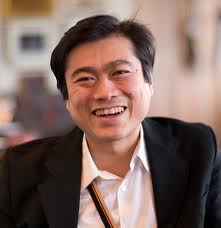
Joi Ito

Joi Ito

I am excited by the vision of Joi Ito, the dynamic new director of MIT’s influential Media Lab program.  Ito, profiled in a recent issue of WiredUK magazine, wants to break down the castle walls of academe, and get students and their professors out into the streets where the action is.

“In the old days,” he told WiredUK,  “being relevant was writing academic papers. Today, if people can’t find you on the internet, if they’re not talking about you in Rwanda, you’re irrelevant. That’s the worst thing in the world for any researcher.”

At the Media Lab, it’s not about students passively sitting and taking in a professor’s canned words of wisdom.  Instead, posses of students and professors work together in the labs and out on the streets to find creative solutions to real-world problems.

“By opening up the Media Lab,” WiredUK reports, “Ito hopes to move closer towards his goal of  ‘a world with seven billion teachers,’ where smart crowds, adopting a resilient approach and a rebellious spirit, solve some of the world’s great problems.

“His is a world of networks and ecosystems, in which unconstrained creativity can tackle everything from infant mortality to climate change.

“‘We want to take the DNA [of the lab], the secret sauce, and drop it into communities, into companies, into governments,’ he says. ‘It’s my mission, our mission, to spread that DNA. You can’t actually tell people to think for themselves, or be creative. You have to work with them and have them learn it themselves.’”

Ito has just placed his finger on the prime value of education at any level: helping young people learn how to think for themselves and be creative.

Young Hamlet had that gift, which is why he was able to escape the clutches of Claudius and maintain his own principles in even the poisonous atmosphere of Elsinore.

Laertes, whose poisoned sword kills both Hamlet and himself, is the other kind of student: the kind easily influenced by a corrupt mentor like Claudius into playing foul in the quest for personal gain.

In this day and age, we need to be teaching our young people not only to be creative problem-solvers, but also to be ethical, principled human beings who are willing to take risks and stand up for what is right and just—even if this means foregoing easily attainable blood money.

The Media Lab’s Ito has observed that “a lot of the kids at the Media Lab today don’t want to make more money, don’t want to become immortal, they just want to figure out how to fix this unhealthy system we have. There are lots of kids who are not happy with this massive consumerism, this unsustainable growth, but who have really smart science and technology values. That’s a type of person we can draw into what I think will become a movement.”

What kind of movement? A creative commons movement (Ito, by the way, was one of the founders of Creative Commons and the Mozilla Foundation), in which some of the key principles would be, in Ito’s words: “Encourage rebellion instead of compliance”; “Practice instead of theory”; ” Constant learning instead of education”; “Compass over map.”

Exactly the kind of principles that Hamlet employed to successfully navigate Elsinore—until he was undone by the treachery of Claudius and Laertes.

But get a billion young Hamlets–and Ophelias!–going, and there will be no stopping them.

“In the old days,” Ito told WiredUK,  “you needed hundreds of millions of dollars and armies of people to do anything that mattered. Today a couple of kids using open-source software, a generic PC and the internet can create a Google, a Yahoo! and a Facebook in their dorm room, and plug it in and it’s working even before they’ve raised money.

“That takes all the innovation from the centre and pushes it to the edges — into the little labs inside the Media Lab; inside dorm rooms; even inside terrorist cells. Suddenly the world is out of control — the people innovating, disrupting, creating these tools, they’re not scholars. They don’t care about disciplines. They’re antidisciplinary.”

This kind of talk, as Duke University professor Cathy N. Davidson observes, has many traditional educator-types quaking in their boots.

Tenured faculty tend to be rather complacent as a group, since their jobs are assured for life—unless, that is, their institutions fail.  The truth is that we are in a sea-change time when many of the weaker institutions of higher learning are likely to be weeded out.

We have, right now, a fantastic opportunity now to break out of what Davidson calls the “Fordist, production-line compartmentalizations and hierarchies of knowledge,” including ossified disciplines and stifling pedagogical models.

Those of us within the profession now need to be tunneling from within towards the freedom of creative expression that we and our students so desperately need.

Every discipline has a role to play, but only to the extent that we allow the disciplinary walls to become permeable, fostering the free germination of potent new ideas.

In the fresh air that will then begin to circulate in the musty corridors of academe, we will be able to hear rumors of the coming of a better world.

Honoring the wisdom of Native Americans on Thanksgiving

Before I understood the real history behind the American tradition of Thanksgiving, I used to just innocently enjoy the chance to gather with family and friends to share a delicious meal.

I believed the story taught to me in grade school, about how the Pilgrims and their Native hosts sat down to a feast together, and lived happily ever after.

Such innocence, once lost, is impossible to recapture.

Now I know that the same Pilgrims who gave thanks for their delivery from starvation by the generous Native people of the region that would come to be known as New England would be the ones to turn on their benefactors and do their utmost to exterminate them.

My own ancestors were still fighting their own battles back in Europe at this time, but as an American, this is a shameful legacy that I need to confront and acknowledge.

As I wrote in my Thanksgiving post last year, the holiday of Thanksgiving should really be more of a day of atonement than a celebration of abundance, especially as we begin to realize that the abundance of food and natural resources that Americans have enjoyed over the past 500 years is not endless.

As we hit up against the limits to growth predicted years ago by Donella Meadows and others, we must recognize that the Native peoples who were so unceremoniously shoved aside during the Conquest of the Americas had so much more to offer Europeans than corn, squash, beans and turkey.

Indigenous worldviews, the world over, privilege balance over growth and accumulation, and this is the wisdom we need to pay attention to now.

Some argue that such a conservative position would not support the kind of technological innovation in which Europeans have excelled.

But I would ask whether our technological innovations have succeeded in making us happy as a culture, or as individuals within our culture?

Isn’t it true that the vast majority of our technological inventions have been used to foment and practice ever-more violent warfare?

Even our vaunted advances in medicine are primarily used, these days, to try to heal us from the sicknesses and imbalances our own technological inventions have afflicted upon us, by the poisoning of our food, air, water and earth with toxic chemicals and the byproducts of burning fossil fuels.

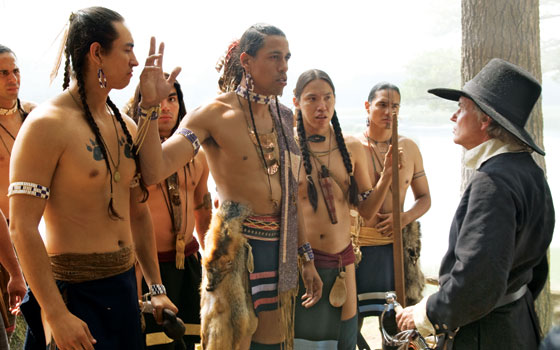
This image, from the PBS series “American Experience,” depicts members of the Wampanoag tribe meeting a white settler.

Before the Pilgrims landed in Massachusetts and started their inexorable push west, the indigenous people living here were happy, healthy, strong and long-lived.  They enjoyed the abundant food stocks of the ocean, rivers and forests, and lived in harmony with the land.

Yes, there were territorial skirmishes, but there were also strong intertribal councils and confederations, in many cases led by matriarchs who valued peace and did not want to lose their sons and grandsons to needless warfare.

This Thanksgiving, I give thanks that the Native peoples of this continent are still with us, despite all the brutality visited upon them by the European conquerors.

This Thanksgiving, I pray that all Americans begin to honor indigenous people as they deserve to be honored, by giving credence to the Native value of harmony with the Earth, and actually trying to live it.

Once in a blue moon: thoughts on death and the hereafter

It’s a clear, warm night, breezy and calm with a languorous quality to the air.  A night for strolling arm in arm along the surging beach; a night for hiking to the top of the mountain to gaze out at the moonlit landscape below.

It’s a blue moon night, the second full moon of the month–a rare occurrence, like a leap year, that feels like a gift of cosmic significance.

Such a night makes me want to take a chance and send out into the world some ideas that I have been holding close, not daring to share for fear of—of what?  Being scoffed at or ignored, I suppose.

But once in a blue moon, it’s important to reach beyond those fears and write from the heart.

So here it is.

***

On this quiet, moonlit night, I am thinking about death.

Every near-death experience describes a peaceful opening up to the light in the seconds after death—a state of rapture, a sense of leaving the body with all its frailties behind and moving into a new state of consciousness.

If death is just a transition into a different relation to matter and spiritual consciousness, then it is not something to be afraid of.  It is a change, but not a negative one, except to the extent that we remain attached to those we love and our dear, familiar places.

No other being on the planet frets so over death as does humankind.  All others simply pass, unworried, into the next stage of existence, whatever it may be.

If there is no reason to fear or worry about our individual deaths, then maybe there is no reason to fear or worry about the coming planetary cataclysm.

All of us living beings on the planet now will simply transition into whatever comes next, as we have many many times before in our cosmic journey from stardust to our current terrestrial physical forms.

Even the fear that we have of destroying our planet to such an extent that it will become unlivable is not tenable.  I don’t believe we could do such a thorough job of destruction as to make the environment completely and irrevocably toxic.

It may take millennia, but eventually, as it has in the past, the Earth will regenerate and give birth to new life forms.

And we, because we are part and parcel of this ecological sphere, will be part of those too.

Just as now we “remember” our past as sea creatures through the saltiness of our blood and the way we are able to swim underwater in our mother’s wombs, we will in some way retain the traces of our time as humans on the planet.

Hopefully the traits that have proven so destructive and psychotic will not persist: our violence, our fears and insecurities, our short-sightedness, our competitiveness, our greed.

It is possible that we are now living through a blue moon period of a much greater magnitude than just one lunar cycle.

Once in a blue moon, a dominant species—like the dinosaurs—collapses.  It is our fortune, for better or worse, to be living through this rare epoch, the last days of a closing era—and unlike the dinosaurs, to be conscious of what is taking place as it happens.

Of course, once in a blue moon, too, a species is able to pull back from the brink of extinction and keep going a while longer.

 ***

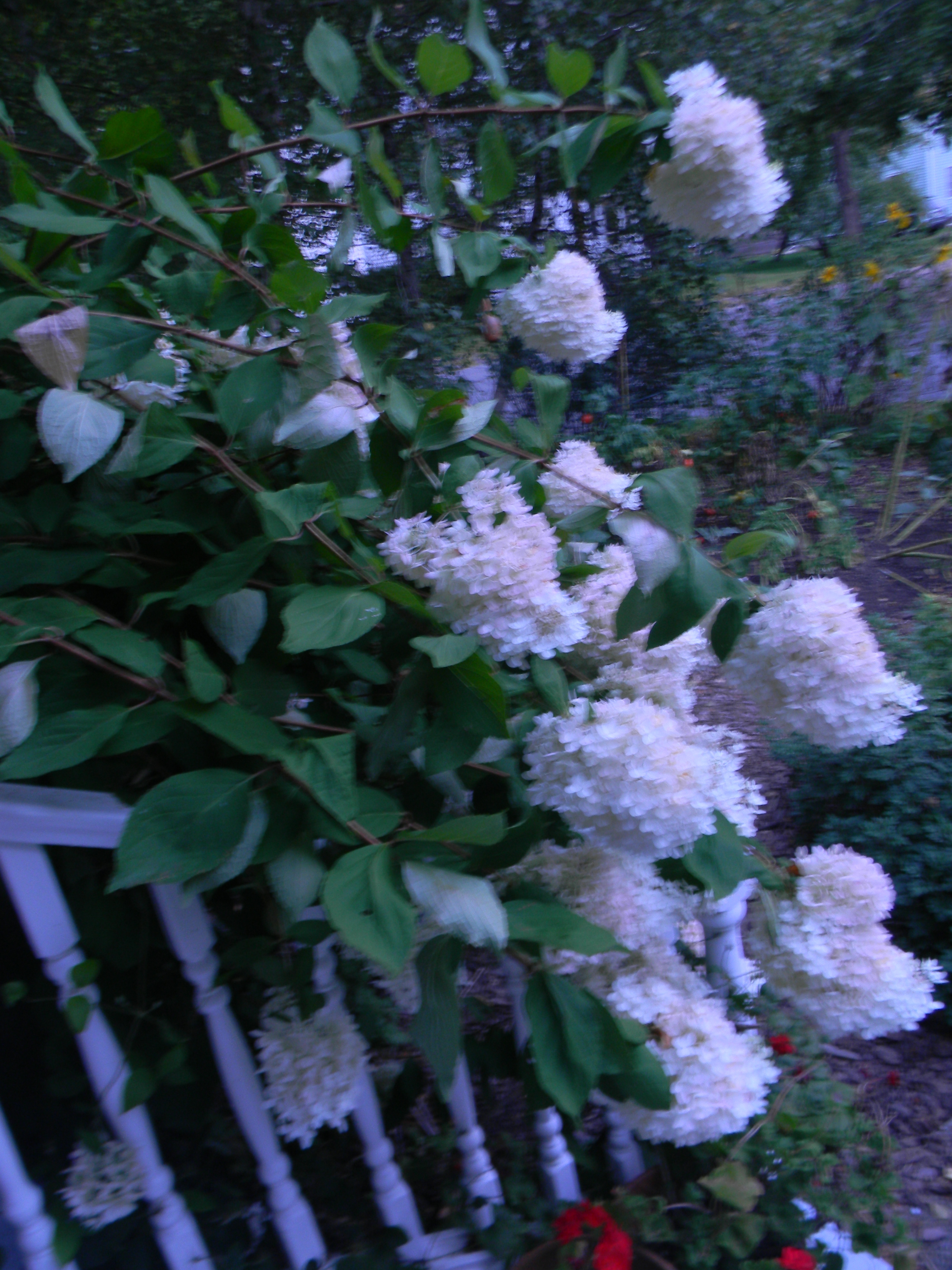
On this blue moon evening, I pay loving homage to the white hydrangeas glowing in the dusky interlude between sunset and moonrise.  The perky round sunflowers, the curly purple kale standing stiff and tall in my garden, the pulsing background chorus of crickets—I gather them round in a loving embrace and give thanks for this quiet blue moment, however long it may last.

Taking the Leap into a Better World

Lately I’ve been feeling like I am straddling two banks that are rapidly moving away from each other, leaving me performing ever more of a balancing act in the middle of a rushing stream.

One foot is still hanging on to the familiar dry land on which I was born and bred: the safe, predictable world of a privileged existence within the capitalist empire, where every problem has a technological solution, all needs are met, and there is nothing really to worry about, beyond what to have for dinner, or where to go on the next vacation.

This is the world in which I am a true-blue Democrat, I pay my taxes without question, and I work hard in expectation of an eventual pleasant retirement.

But I also have a foot in quite another realm, one that is still quite foreign to most of my peers.

In this other, parallel universe, security and predictability are rapidly becoming a thing of the past, as the weather turns ever more erratic, leading to food shortages and a survivalist mentality.  Clashes between unarmed protesters and heavily armed police are common, with the protests mainly concerning lack of basic food and supplies.

No one knows where this is all heading, but it does not appear to be anywhere positive. The elites have hidden themselves away in their own privately funded strongholds, and other than the military folks it does not seem that anyone is really in charge.

Most people I know are clinging to the first bank, even though it’s beginning to seem ever more unstable, as if beset by internal tremors that are slowly but surely breaking it up. They are positioned like Walter Benjamin’s Angel of History, looking resolutely backward, away from the chaos of the future.

I don’t know why I am unable to join them in their denialist party.  It sure looks like a good time.

But having become aware of the crisis through which we’re living, I can’t just turn a switch and pretend I don’t know what’s going on. The second bank is like a mirage that is slowly coming into focus, no matter how much I try to turn away and not look.

I’ve spent long enough studying narratives of social upheaval and moments of violent crisis to know one when I see it coming.

A recent article in the New York Times Sunday Review provided an unusual window into the curious calm before the storm of all-out societal dissolution—in this case, the unfolding Syrian civil war.

The author, Janine di Giovanni, begins with a series of questions: “What does it feel like when a war begins? When does life as you know it implode? How do you know when it is time to pack up your home and your family and leave your country? Or if you decide not to, why?”

When does life as you know it implode?

When is it time to pack up and leave?

Where can we go to find safety?

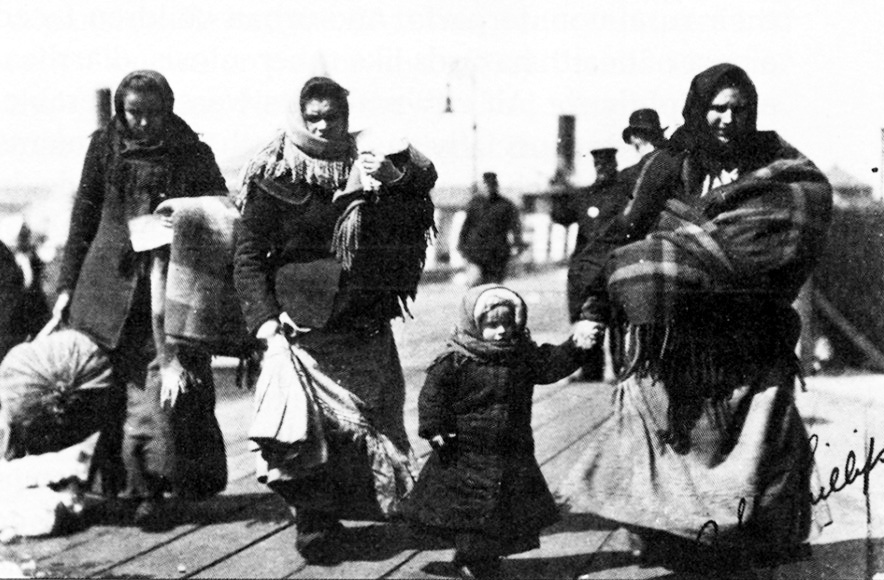
Eastern European immigrants entering New York

These are questions that my ancestors asked, back in the 19th century Europe of ever-narrowing restrictions and ever-more-violent pogroms.  I am here because they had the courage and the foresight to get away to safety before it was too late.

But now the safely cushioned existence that so many of us have enjoyed here in the U.S. and other privileged enclaves on the planet is threatened by a crisis of our own making.

We didn’t realize that everything about our lifestyle, politics and ideology would contribute to the downfall not just of American empire, but of human civilization itself.

We didn’t realize what a deadly game we were playing.

But we can no longer plead ignorance.

Unlike our predecessors, we 21st century folk are going to have a very hard time finding any place to go that is safe, where we can ride out the climate shocks unscathed.

We can’t run, we can’t hide from the environmental shocks that are only just beginning to hit. 

We have to stay and see this through.

What that will mean I am not sure.  In part it depends on how many of us wake up now and begin to take some proactive steps towards reorganizing our society, before we’re reduced to reactive crisis control.

Our political system is locked in a kind of stasis from which there does not seem to be any forward movement possible—just endless round and round and round.

We must move forward—grow, evolve, adapt—if we are to survive.

Today I caught a glimmer of something new that may be the early stages of the kind of change we need to successfully weather the coming storms.

The International Organization for a Participatory Society (IOPS) is an emergent (or is it insurgent?) movement to create a decentralized, highly participatory catalyst for urgent social change.

It’s not clear yet whether it will be a flash in the pan or an idea whose time has come.

So far it has just over 2,000 members worldwide.

Including me.

Maybe it’s time to stop straddling both banks.  Time to take the leap and jump fully into new territory, both feet on the ground.

Celebrating the DIY Mom on Mother’s Day

Although I feel it’s my duty to write a celebration of mothers on Mother’s Day, every time I think about what I might write for this post, all that comes up in my mind is a kind of lament.

Becoming a mother was definitely the best thing I’ve done in my life.  When I look at my two big, handsome, talented boys, I am thrilled beyond measure with the knowledge that I nurtured them in my womb for nine months, I gave birth to them, I did all the loving labor a mother must do to successfully bring children up from helpless infants to strong, independent young men.

My boys setting sail

So where does the lament come in?

Shift to a small, smothered voice: I just wish I hadn’t had to do so much of it all by myself.

I suppose I am writing the lament of the single mom, or the “do-it-all” mom, the mom who doesn’t get much help or support from her partner in bringing up baby.

Even when I was married, I did the lioness’s share of the household and child care labor, while also bringing home a paycheck that grew in time to be the larger portion of the family bacon.

My marriage foundered on my partner’s inflexibility when it came to the idea of a man doing housework, and my exhaustion and resentment over having to do it all.

In addition to working two demanding jobs for nine years straight, while also publishing two books and organizing a major annual conference and doing all the other extra labor of being a fulltime academic, I also did all the shopping, cooking, laundry, cleaning and yard work; all the supervising of homework and staying involved with my children’s schools through parent-teacher meetings, volunteer work and car pooling; I made sure all the medical appointments were taken care of, I did all the bill-paying and taxes, and if there was anything left over for a small vacation or a purchase for the house, I handled that too.

I am sure this is sounding very familiar to all those single and DIY moms out there, right?  We know the list could go on and on.

My own mom did all that household stuff too, but without the added pressure of bringing home the paycheck.

It’s probably my traditional upbringing, where my dad went out to earn the money and my mom stayed home to run a smooth, highly functioning household and do her creative work on the side, that makes me feel like having to play both roles myself is somehow too much.

I should be able to do it all with grace and good cheer, without getting crabby with my children or frustrated when things don’t go quite as planned.

That’s what a mother does, right?

At least I can take some comfort in knowing I am not alone.

There were some 10 million single moms in the U.S. as of 2010, and the number keeps climbing.

This Mother’s Day, I want to give a big shout-out to all of us single moms, and the DIY moms who may someday decide that enough is enough, and go down the single mom route.

We need to keep our chins up and not let the pressures, obligations and yes, sacrifices of our position get us down.

We have to just do our best, and not beat ourselves up when we get overwhelmed.

We must remind ourselves that we are doing the most important work in this nation, bringing up the next generation to take their place responsibly and soberly in the difficult social and environmental landscape we must confront together.

I love this picture of me because I look the way I feel: as weathered, but as solid, as the rock behind me

Grassroots heroism: what we need now

The image that stays with me most from the blockbuster superhero action film The Avengers is not the thrilling climax when the hero uses all his power to wrest a nuclear missile away from its collision course with Manhattan and up into space, where it explodes a waiting battleship of nasty intergalactic invaders—although that was pretty thrilling I have to admit, especially in 3-D!  Man, that movie packs some powerful special effects!

But no, what really struck me were the scenes of ordinary human beings on the ground, dressed in their regular 21st century civilian clothing, sipping their lattes and strolling about midtown Manhattan one moment, and the next moment being terrorized from above by sinister alien rampaging monsters and soldiers.

Without Captain America, the Black Widow, the Incredible Hulk and the other heroes, all those people would certainly have been totally destroyed within minutes—and not just by the aliens, but by “friendly fire” as well.

This scene resonates with me on two levels.

On the one hand, it goes to show yet again how quickly an apparently normal, peaceful morning can turn to nightmare when militarized violence shows up unexpectedly.

And on the other hand, it underlines how deeply dependent we human beings are on the idea of the charismatic leader, the savior, the hero who will leap into action and save the day for us.

This has been true since ancient times, and it appears to be cross-cultural: every culture has its heroic myths and legends, in which men and women with superhuman strengths and powers do battle with dark forces on behalf of the rest of humanity.

Watching politicians of The Avengers decide to send a nuclear missile to destroy the entire city in order to kill off these alien soldiers, an order that their general resists but an ordinary pilot obeys, I am uncomfortably reminded of how much danger we are probably all in, every day, thanks to decisions made by the men in charge, who sit in remote splendor in faraway bunkers like the gods on Mount Olympus of old.

I want to see a movie made that points the way to a different model of heroism.

Instead of the superhero, David against Goliath type tale, I want to see, on the big 3-D screen with all the lavish special effects and brilliant actors, a tale that celebrates the ordinary heroism of people on the ground, who—understanding the danger of militarism and the mechanized violence that pervades human civilization, from agriculture to energy to education and entertainment—come together to offer whatever skills, talents and gifts they have to the common pool of resistance.

In this movie, the human beings would not cower on the ground while the battle of the titans raged overhead; they would not sink to their knees before the might of an alien invader; they would not follow blindly wherever the men with guns and uniforms told them to go.

Instead they would use the power of their collective will and determination to demand a change of course, and insist that it happen.

What I want to see celebrated on the big screen is the kind of grassroots resistance that we saw on the ground this past year in Egypt and other Arab Spring hotspots, or in the General Assemblies and protests of the Occupy movement.

Egyptian women protest in Cairo, April 2011

It is happening already in real life.  Hollywood and Marvel Comics, maybe it’s time to break with the fixation on the past and try a new story.

Loving Earth

To save the Earth, we must fall in love with her, writes Robert Koehler, taking his inspiration from the work of Charles Eisenstein, author of Sacred Economics.

Koehler and Eisenstein say that in the trajectory of human evolution, we have been locked in the selfish adolescent phase for a long, long time, just seeking to take what we need from our Earth mother, without thought of giving much in return, or of the reality of finite limits.

When we fall in love, Eisenstein says, “perfect selfishness falls apart as the self expands to include the beloved within its bounds.”

I remember falling in love like that as an adolescent, and as a young adult too.

It’s true that when you’re in love, the boundaries between the self and other dissolve, and you exist in a harmonious utopia of mutual beneficence.

But at least for most of us fallen humans, that kind of all-encompassing love doesn’t last forever.

It can’t.  It’s too intense.  Eventually the first ecstatic glow fades and the angelic beloved assumes normal, human proportions, with all the associated warts and odors and quirks of behavior and thought that our human bodies and minds possess.

What happens to love then?

If we are compatible for the longterm, the initial heady crush transforms into a much more solid platform of respect, shared interests, and deep concern for each other.  We care about each other, we enjoy being together no matter what we’re doing, and we respect each other’s views, goals, and talents.

We become partners in the truest sense of the word.

Is it necessary to go through the romantic, boundary-dissolving “falling in love” stage to get to the mature relationship of partnership?

In our culture, we believe it to be.  Our young people, tutored by every aspect of media and pop culture, assume that being swept away with love is a pre-requisite to successful marriage.

And yet how many of their parents, who followed that same script, ended up in bitter divorce fights?

Although I understand the intent behind Koehler’s and Eisenstein’s valorization of “falling in love” as a model for the depth of passion needed to fuel successful environmental action on behalf of the Earth, I am not convinced that this is the right message to be sending.

Young people today may still harbor romantic dreams, but they live day-to-day in a casual hook-up culture that prides itself on separating sexual enjoyment from commitment.

Fifty percent of their parents have made the journey from early romance to disillusioned divorce.

Another 25% or so of adults are either unhappily married, or unhappily single.

The “falling in love” model thus hits home with too few Americans to be effective as a rallying call for environmental action, and it is too limited a metaphor for the depth and breadth of passion that we must summon now to be effective Earth stewards and activists.

Instead we must love with the unconditional devotion of a mother for her child, with the sincere, selfless wish to see that new life grow and prosper and move forward beyond us.

We must love the Earth with the intensity of devotion that recognizes that for her to thrive, it may be necessary for us to part.

Earth has loved us with this kind of pure altruism all these many years of human emergence.  Now, as in the terrifying story of The Giving Tree, she has given so much that she has practically sacrificed herself entirely.

Nothing we can do to the Earth will wreck her forever.  Forever is a long, long time, in geologic terms.

But there is still time to shift from heedless destruction to the kind of loving tending that the Earth herself has modeled for us all these years.

There is still time to develop the kind of deeply caring reciprocal partnership that will last a lifetime, and beyond.

Bill McKibben, our environmental Pied Piper, is at it again

Bill McKibben

You gotta admire Bill McKibben. And you gotta wonder, where the frack does the guy get his indefatigable energy??

Off he goes again this week, starting a new campaign to protest hydraulic fracking in Ohio—you know, the state where natural gas drill rigs caused manmade earthquakes.

I think we all have a pretty good idea of how bad it is to have flammable toxic fumes coming out of your water faucets, earthquakes rumbling in your backyard, and tons of toxic waste building up above and below ground level.

Fracking sucks and we know it. It must be stopped. The question is, are we going to follow Pied Piper Bill to Ohio to occupy the Statehouse and make our demands known?

No doubt there will be plenty of Ohioans and even ardent out-of-state environmentalists who rally to the call, just as they did last summer when Bill led them down to Washington DC for sit-ins to protest the Keystone XL.

That battle did score some points, although more recently it seems that the southern portion of the titanic pipeline is going to be built after all, another huge investment in 20th century thinking and technology that can lead us in one direction only: over the nearest cliff.

***

In the Grimm fairytale, “The Pied Piper of Hamelin,” the town suffers from a plague of rats, which only the Pied Piper can solve.  When the town councilmen refuse to give the Piper his just reward for destroying all the rats, he takes his revenge, leading all the children of the town into a mountain cave, from which they are never recovered.  The moral of the story: don’t cheat the Piper!

Today the rats we suffer from are precisely the fossil fuel industry and their military-industrial, Big Ag, Big Finance brethren, which are, as in the Grimm story, destroying our homeland and eating us alive.

Even if Bill McKibben could lead all those rats into the river, we would still be left with the greedy councilmen, our politicians, who would very likely continue playing by the old rules, and would bring further disasters upon us.

When the Piper wanted to punish the town fathers, he did so not by attacking them directly, but by attacking their children.

Truly, there can be nothing worse than being forced to watch your children suffer and die.

Sometimes I think that the only way the rich and privileged are going to listen to reason and stop their destructive, world-killing ways is if they are forced to confront the reality of what their children will have to live with in the future, because of the lifestyles they themselves are living now.

I say “they” but I should be saying “we,” because I certainly have participated in this destructive lifestyle my whole life.  We humans, especially privileged Americans and Europeans, have been the rats that have been destroying the global village for decades now.

Unlike rats, though, we humans generally respond to reason.  We can be persuaded to change our ways, especially if we can be made to understand that the future survival of our precious children is at stake.

What sort of tune would the Piper need to play to change the hearts and minds of the frackers, for example?  Or the loggers, or the tar sands extractors, or the nuclear power plant engineers?

Bill McKibben has been tireless in his efforts to hit the right notes to attract enough people to follow him—not over a cliff or into a mountain tomb, but into a sustainable future.

You gotta admire the guy.  You gotta think—maybe I should get on that bus for Ohio.

Cupid, you devil–go home!

I find it really poignant that so many people are Googling “love” and turning up my Valentine’s Day blog post on how I was very happy, last February, to be awash in family love, even though romantic love was absent from my life.

That my Valentine’s Day post is the single most popular post on Transition Times is just evidence of how many people are yearning for love, and happy to find affirmations that there are alternatives to the stereotypical “and they lived happily ever after.”

As the 50% divorce rate in the U.S. attests, very few of us live happily ever after.

For the other 50% who stay married, well—I would like to know how many of you folks consider yourselves truly happy.

My guess is that something like 25% of the people who dutifully marry in their twenties find themselves compatible enough to live happily ever after.

So what does that mean for the institution of marriage?

Is it good enough that a quarter of those who marry in their prime child-bearing years are likely to stay together through the rigors of raising children?

What are the alternatives?

Unfortunately, in our society, there are few alternatives.  Women of means can choose to have children via artificial insemination or surrogate motherhood, without needing the fathers in the picture.

But this is the exception, not the norm.

For most mothers, having the financial, emotional and practical support of fathers (or co-parents, in the case of lesbian couples) is essential.

Raising children is hard.  Raising them alone is much harder.  I can say this with conviction since I’ve been a single mother since 2009, and going it unofficially on my own for longer than that.

For the most part, divorcing women tend to argue hard for custody of our children. We can’t imagine being separated from the little ones we once carried in our bellies—even when they’ve become big hulking teenagers.  They are ours in a way that must be honored.

And yet…they are their father’s children too.  It never ceases to amaze me how fathers can be so casual about their offspring.  They will insist on custody to stick it to their divorcing spouses, but for the most part they don’t have the emotional attachment to their children that we women have.  Or if they do, it is something they are willing and able to forego if need be.

Please correct me if I’m wrong, guys—this is just what I’ve perceived from very unofficial observations of my own family and friends.

All this to say that those who are avidly reading my Valentine’s Day post should be aware that my feelings about love are very complicated indeed.

I love my children.  I love my parents.  I love my brother and his family.  My ex-spouse?  Well, I am grateful to him for the good times we shared, including bringing our two boys into the world.

I wish we could have survived as a couple.

And I am ready to move on.