May Day Mutiny: Radical Transformation Rises

Today is our “spring forward” day in the U.S., when we move the clocks forward an hour thus “losing an hour” in the morning, but gaining an additional hour of light at the end of the day.

It’s a beautiful sunny day here in Massachusetts, with birds singing their love songs in the trees, and the sap rising steadily in the thick sugar maple forests.

It’s hard to feel gloomy or pessimistic on a day like today, with our great source energy, the Sun, shining so brilliantly and steadily down on us.

Even contemplating the social landscape, it seems that there are reasons to be hopeful.

Last night I attended a brilliant one-act play by a Bard College at Simon’s Rock senior, sensitively and with almost painful honesty focusing on the relationship between a pair of best friends, 15-year-old girls, as one of them goes through a secretive, excruciating home abortion.

At the talk-back after the play, the author, who also played the lead, said she wrote the play because it was so clear to her that young women’s voices need to be heard more broadly in the theatrical world—not just as love objects written by men.

To me this is a hopeful sign, because as more women’s voices find their way into the great collective unconscious of the human public sphere, they will have an impact on the way we think and act as a social body.

The shame, secrecy and psychic anguish felt by the lead character of the play is so unnecessary, as is the fact that although it took two to implant that fetus, the other teen parent, the guy, was entirely absent from the drama that followed.

If young men were more aware of what an abortion entails, I dare say that many of them would be more responsible in doing their part to avoid pregnancy until they were ready to assume the mantle of fatherhood.

If high school sex ed included sessions on abortion the way drivers’ ed includes sessions on the consequences of driving drunk, complete with graphic images and re-enactments, abortion might become a rarity, and having teen sex without contraception as stigmatized as driving a bunch of friends home from a party dead drunk.

***

I am feeling hopeful today too because yesterday I read Tidal 2, the second journal put out by a group calling itself Occupy Theory.

The journal, entirely web-based, includes articles by Judith Butler and Gayatri Spivak, written in as accessible a voice as I have ever heard those two formidable theorists muster.

It also includes articles by unnamed CUNY Graduate Center students on a variety of issues, as well as a wealth of other interesting short pieces and vivid photos and artwork of the Occupy movement.

Judith Butler

Butler makes the excellent point, in reference to the call by the political/media establishment for “a list of demands,” that “the appeal or demand that sought to be satisfied by the existing state, global monetary institutions, or corporations, national or transnational, would be giving more power to the very sources of inequality, and in that way aiding and abetting the reproduction of inequality itself.”

Instead, Butler calls for a movement for “radical equality,” the achievement of which would require “the making of new institutions,” rather than trying to push existing institutions to change radically while still maintaining their social dominance.

She also envisions an Occupy strategy that would be strategically “episodic and targeted,” rather than the sitting-duck encampment strategy of last fall.

Gayatri Chakravorty Spivak

Such a strategy might build on the historical model of the General Strike, as Gayatri Spivak discusses in her contribution to Tidal 2.

The General Strike, as undertaken by Gandhi against the British, “has always been special because it is undertaken by those who suffer, not by morally outraged ideologues,” Spivak says.  “It is by definition non-violent…though the repressive apparatus of the state has used great violence against the strikers. Although the results are transformative, the demands are usually focused on laws….If one sees the connection between the General Strike and the Law, one realizes that this is not legal reformism, but a will to social justice….Unlike a party, a general strike refuses to cooperate until things change.”

Tidal 2 ends with a bold call for a General Strike on the symbolically important day of May 1, 2012, May Day.

I have no doubt that it will happen, and that it will be big.

I am sure police forces across the world are already planning their own strategies.

The truth is that if the 99%, “those who suffer” from the structural inequality of globalized capitalism, were to come out in large enough numbers on May Day, and refuse to go home until those in power began a serious dialogue on transformative, institutional change that included the retooling of our political, social and environmental systems for 21st century realities—the truth is that we might actually get somewhere.

Somewhere new, somewhere joyful, somewhere beyond the bruising, gridlocked, decrepit and corrupt politics that currently has our entire planet in a stranglehold.

The social and political elites who have inherited the 20th century reins of power and do not want to let go need to be made aware that they are driving us all over a cliff with their refusal to summon the political will and the technological know-how to adapt to anthropogenic global heating.

They must be made to understand that they and their children will go down with the rest of us!

That is the one blind spot in this issue of Tidal 2: there is very little mention of the impact of climate change and human overpopulation on the carrying capacity of the planet.

This awareness shows up more in metaphor than head-on, but metaphor is powerful too.

At one point, the anonymous authors of Tidal 2 describe the 1% as the captain of a ship “who steers while we shovel coal and  swab decks.  He seems to have us headed towards a typhoon.

“The captain stares at the impending doom on the horizon and grins ecstatically.  He’s clearly thrilled to be captain.  He faces down a storm that we can only wincingly glance at with one squinting eye, and he jabbers incessantly about hope and destiny.  We realize that he does not see as a normal person, by passively receiving light through his pupils.  Rather he uses his eyes offensively to project what he wants to see on the world.  He has become so practiced at his fantasia that he can no longer recognize what we, cringing on deck, see as certain catastrophe.”

Well, my friends, it is time to stop cringing on deck.

Mutiny is justified if the captain is a raving maniac and the alternative to mutiny is catastrophe.

On this sunny day, let’s pledge to take a great leap forward this spring, take charge and steer ourselves into safer waters.

See you on May Day.
Cupid, go home!

It’s fascinating to me that the Transition Times blog post that has gotten the most attention, by far, is “There’s more to love than Cupid and his arrows,” my Valentine’s Day 2012 post, which has been read hundreds of times since February 14.

Of course, people are always interested in love and romance.  And this is a positive, peaceful essay about being very thankful for the love I have in my life through my parents and children, to the point where I’m not missing romantic engagement.

Truly, I’m not.

There has been a spate of articles lately about so-called “singletons,” men and women who choose to remain happily single.

Some of the articles fret that such people may have troubles as they age, since they have no companions to help care for them.  A recent New York Times Room for Debate series, “Being Alone Together,” explored both sides of the issue, with many of the writers arguing that solitude has significant benefits.

I am not living alone; I am living with my two teenage sons at the moment.  I have to say that I do enjoy the rare times when I have the house to myself, and have no one but myself to please.

When I was in my early twenties, before I married, I lived on my own in Greenwich Village while I studied as a graduate student at NYU.  Although I had never felt confined or fettered while I lived with my parents, the freedom of living alone was fantastic, as was the convenience of living so close to the NYU campus and the stimulation of the Village.

But nevertheless, during those years I felt a tremendous pressure to marry, to have children—to paraphrase Mrs. Ramsay in Virginia Woolf’s To the Lighthouse.

Did it come straight from my ovaries?

It wasn’t like my parents were pushing me at all. But I felt a kind of insecurity about being single, like I was lacking or missing something. I was incomplete.

In those days, the 1980s, there was a lot of talk about how if you didn’t find a mate in your twenties or early thirties, you’d be over the hill and never find one.  Believe it or not!  Stories of unhappy women in their forties abounded—women who had never been married, and were totally, miserably fixated on finding the ever-elusive Mr. Right.

Although I was living alone and perfectly content with my life, I still felt like it was temporary, and I’d better be constantly on the look-out for the man who would come along to complete me and open the door to my real adult life, which could only begin with those wedding vows.

Now, on the other side of two decades of marriage and a divorce, I am once again single and enjoying the freedom, this time without that little Cupidlike imp sitting on my shoulder warning me that I’d better focus on love and get myself hitched.

I have young friends getting married now and of course I wish them much happiness and fervently hope that they will be better marriage partners than my ex and I were for each other.

But I have to say, from my current vantage point it seems rather miraculous that one’s chosen mate at age 25 could still be the perfect partner at age 50.  What an amazing feat to grow together so harmoniously that you still complement and satisfy each other after so many years of married life.

I know it happens; I have witnessed it for myself with others.

I just suspect it’s the exception, not the norm.

I have no illusions about finding—or being–such an exceptional partner in the next chapter of my life.

And you know what?  That’s just fine.

Sparking Creativity at the 2012 Berkshire Festival of Women Writers

It’s finally snowing in Massachusetts!  My afternoon meetings were cancelled, and I can settle in by the fire and enjoy the peaceful quiet that always descends when we hunker down under a good New England snowfall.

This gives me a welcome chance to share something positive for a change with my blog readers.

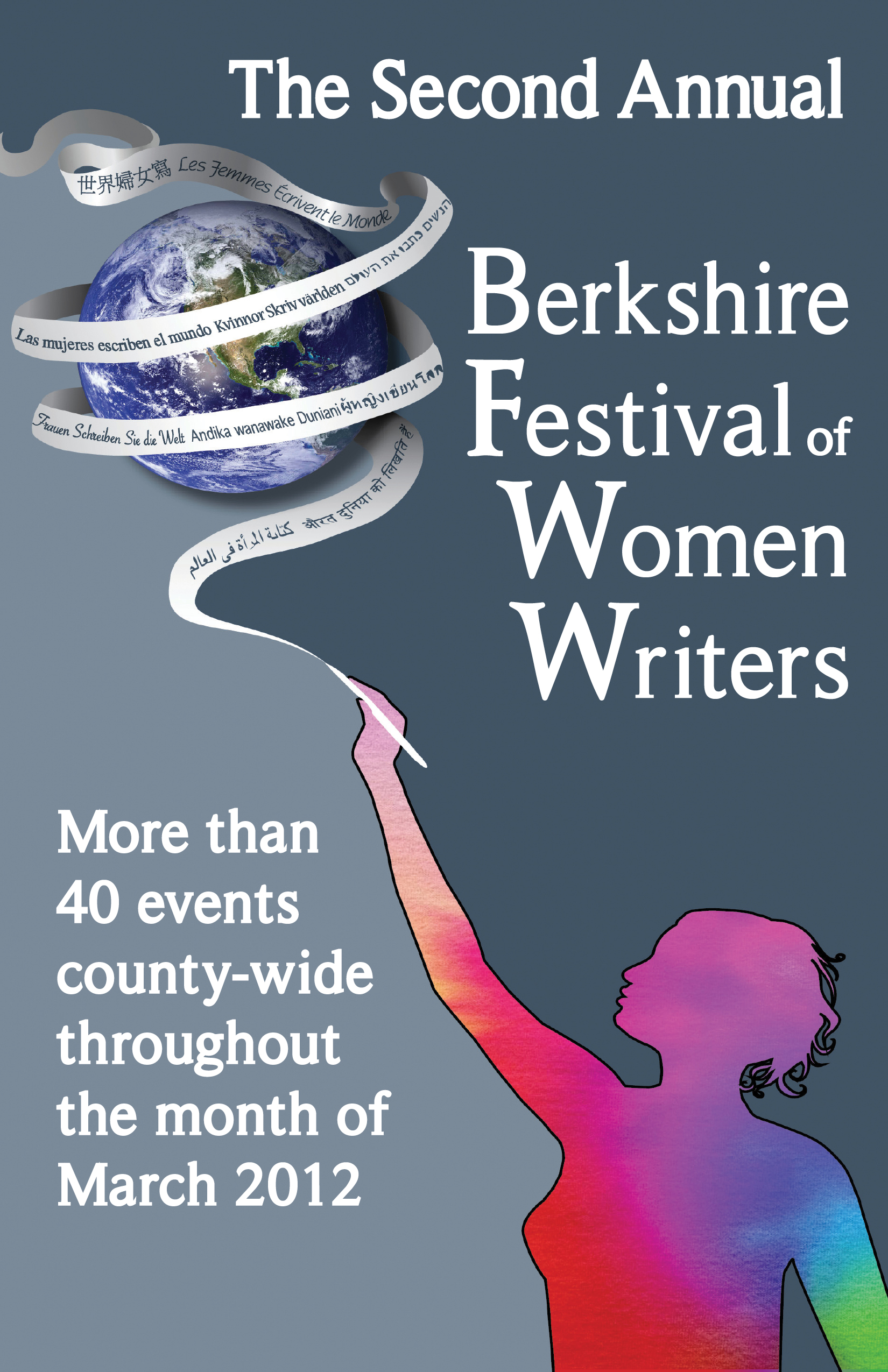
Tomorrow is the opening of the 2012 Berkshire Festival of Women Writers, a month-long celebration of the talents of local and regional women writers, taking place at venues from one end of Berkshire County to the other, with nearly 100 women participating.

I’ve been working over the past year with a dedicated local committee on planning and organizing this event, which is sponsored by Bard College at Simon’s Rock with the generous support of 11 Local Cultural Councils and many other donors, businesses and individuals, all listed on our website under “sponsors.”

This will be our second annual Festival, but it’s an event that grows out of the decade of annual conferences I organized at Bard College at Simon’s Rock in observance of International Women’s Day, co-sponsored by Berkshire Women for Women Worldwide, the Women’s Fund of Western Massachusetts, the Women’s Interfaith Institute and many other collaborators.

I’ve been at this a while.

Organizing events like these takes an extraordinary amount of energy, focus and commitment.  If you’ve ever organized a wedding, you have some idea of what’s involved–although for our conferences and Festivals, we’ve also had to do a fair amount of fundraising, which hopefully is not the case for wedding planners!

There always comes a point in the process where I bury my face in my hands and feel like crying, out of sheer exhaustion, “Why am I doing this to myself?!!”

After all, no one ever asked me to take on this extra commitment, year after year.

And sometimes I wonder whether anyone would notice if I stopped.

But then that low point passes, the brochure or Program comes back from the printers and starts to make its way in the world, the press inquiries pick up and I start hearing the oohs and ahhs of appreciation from participants and audience members, and I remember what it’s all about.

For women writers, in particular, it can be hard to find opportunities to come together and share our talents and achievements with each other and the larger world.

Hannah Fries

This weekend is the big AWP (Association of Writers and Writing Programs) conference in Chicago, and many women writers will be in attendance there, including one of our Festival organizers and participants, Orion Magazine editor Hannah Fries.  But that is a big, competitive event, which can be overwhelming for writers who are just starting out, or who just write for the personal satisfaction of it.

The Berkshire Festival of Women Writers is purposefully low-key and non-competitive.  We organizers wanted to create a broad, inclusive platform for all kinds of women writers, of all ages, backgrounds, and stages in their writing careers.  If you browse the Festival listings, you’ll see a few names you’ll probably recognize, like Francine Prose and Ruth Reichl, but many more whose fresh, innovative voices might not be heard publicly this year without the space provided by our Festival.

I also sometimes ask myself why I continue to focus on women writers in my classes, events organizing and in my own writing.

Lately I have been moving from a longstanding focus on global women’s rights to a broader human rights perspective, still with a strong interest in gendered human rights issues.  Although the goal for any social justice activist is to put herself out of business, it still seems important to me to draw attention to voices who might not otherwise be heard–and the 50% of us who are women are disproportionately represented among those quieter voices.

The participants and audiences who will be gathering at the 40 Festival events scheduled daily throughout the month of March will  together generate a host of collaborative creative sparks that will go shooting out like fireworks, energizing all of us and giving us new strength and determination to meet the challenges of the coming year, whether at our writing desks or in other areas of our lives.

I certainly hope that just as women always turn out to listen to and learn from writers who happen to be men, men will also be among the audiences at all of our Festival events.

In these sobering times, we need all the chances we can get to come together and fan the flames of our community and our creativity.  Let the Festival begin!

Hope springs eternal in our Garden of Earthly Delights

Today I was fortunate to attend a slide lecture by a truly talented photographer, Tanya Marcuse, an alum of Bard College at Simon’s Rock who has been teaching there for the past decade.  She showed images from her current project, “Earthly Delights,” and talked about her process of composing and selecting these images.

Photo credit Tanya Marcuse

Tanya explained how she drew her inspiration from the famous triptych by Hieronymus Bosch, “The Garden of Earthly Delights“, in which images of love and beauty are juxtaposed with macabre scenes of suffering and death.

How strange that the odd, carefully painted fantasies of a medieval Dutchman should be the inspiration for the secular landscape portraits of a thoroughly modern contemporary photographer!

And yet as Tanya talked about her work, I understood her fascination with the strange contradictions of human existence, still so potent despite the five centuries between Bosch’s artistic vision and her own.

We are loving creatures, and yet no one can hate more powerfully than we can.

We worship beauty, and yet we create ugliness.

We wish to be admired, and yet we do shameful things.

We revere life, and yet we, like all living forms, are inexorably moving towards death.

The insight that Tanya offers us through her images is that even in death there is life.  Even in the ugliness of decay there is beauty.

Hers is a powerful message of hope, shared through beautiful art that cuts a blazing path through these dark times.

All things must pass, George Harrison crooned.  All things must pass away.

But in our Garden of Earthly Delights, our lovely, perishable, indestructible planet, all things will rise again, too.

Photo credit: Tanya Marcuse

There is hope and a shred of security in that knowledge.

Planetary Superbowl

So it’s Superbowl Sunday in the US, a day that millions of Americans look forward to for months.  I am always amazed at the passion with which sports fans engage in following teams, and I often think: if only we could harness that energy, dedication and drive and put it towards more important things like saving the planet, why, we’d do just that, right away!

If even a fraction of the money spent on sports teams, sports telecasting, sports advertising and sports merchandise were put towards improving children’s education, nutrition and health worldwide, we’d make giant strides towards achieving the Millennium Development Goals.

If we could get fans to analyze climate and biodiversity statistics the way they analyze the minutia of sports wins and losses, what a brain trust we could call upon to solve the pressing environmental problems of our time!

In the 21st century, the same goes for video game aficionados.  When I hear teenage boys talking with such enthusiasm about the latest iteration of World of War or Grand Theft Auto, I think wistfully that if only they were as engaged with the real, natural world as they are with these violent artificial environments, their incredible warrior energy could be channeled to such positive purposes.

No amount of wishful thinking is going to change the fact that testosterone and aggressive energy go together.  But aggressive energy does not have to be used to hurt people or destroy animals and the environment. Aggressive energy does not have to be hierarchical, meaning that I can only raise myself up by pushing you down.

The truth is that the multiple crises that are staring us in the face right now need aggressive, bold tactics to solve.  Putting the brakes on global heating, shifting to renewable energy, ending our romance with biochemically engineered agriculture and halting the deforestation of the great lungs of our planet will take all the creativity, ingenuity and yes, aggressive, take-charge energy that we can muster as a species.

It will also take something that the testosterone-fueled among us are less proficient at: collaboration, negotiation, cooperation.  That’s where we women come in.

I recently noticed a tweet from Desmond Tutu to Nick Kristof, two men for whom I have the highest admiration, in which the archbishop said to the journalist that if women were given more political power, the world would be a safer, more peaceful place.

Absolutely.  But what is really needed is an androgynous fusion of the best of masculine and feminine attributes.

We need our menfolk to fight for our species, and indeed our entire planetary ecosystem, with the same kind of enthusiastic passion that they lavish on sports and video games.

And we need our womenfolk to insist on getting engaged at every level of politics, business and education, not as token men, but true to our own deepest, estrogen-driven instincts for nurturing communities and societies.

On this Superbowl Sunday, I call on Americans to think about the bigger picture.  How important will it be which team wins or loses once climate change starts taking us all down?

The power of words for a world in crisis

So what am I, a Ph.D. in comparative literature with years of teaching experience in global women’s literature, gender studies and media studies, doing writing and thinking so much about the environment?

Why am I spending time blogging rather than diligently writing research-based articles for peer-reviewed academic journals?

I entered grad school part-time in 1984, first in English, and then in Comparative Literature.  Why those fields?

As an undergraduate, I started out wanting to major in environmental studies, but was soon turned off by the level of statistical empiricism required by my biology professors.  Having always loved to read and write, I gravitated towards English, and ended up interning for the local newspaper and becoming somewhat of a prodigy cub reporter.  I went on to work as a reporter for a daily newspaper, then a staff writer and editor for trade publications in New York City.

After a while, I missed the excitement of the classroom, began taking a class or two at night, and was soon drawn into the orbit of the comparative literature department at NYU, where things were really hopping in the late 1980s and early ’90s.  It was the time of the culture wars; of deconstruction and post-structuralist theory; of post-colonialism and eco-criticism and Marxist feminism.  It was an exciting time to be a budding scholar, learning to talk the talk and walk the walk.

And now here I am at mid-career, looking back and wishing that I hadn’t allowed myself to be discouraged from environmental studies so easily.

These reflections are spurred by the lead article in today’s Chronicle of Higher Education, about the Modern Language Association convention, which starts today in Seattle.  I’ve already written about why I’m not there, and reading today’s Chronicle article, I don’t feel too sorry to be missing this year’s conference.

The article, by Stacey Patton, presents a pretty bleak picture of the field of languages and literature–a picture I recognize only too well.  Enrollments in literature classes are at record lows, and many leading voices in the field are being called upon to explain just why an education in the humanities is of continued value in the 21st century.

The Chronicle article quotes James Donelan, a lecturer in English at the University of California at Santa Barbara: “We have been going about our business as if the study of literature were self-justifying, and that making an overt case for its relevance to society was somehow too mundane a task for us….The immediate consequence of this attitude is that we’re losing undergraduate majors and financial support at a terrifying rate, and the far-reaching consequence is that anti-intellectualism and a general lack of empathy are running rampant in civic life.”

Meanwhile, as many as 70% of English department faculty nationwide are so-called “contingent” faculty–hired as adjuncts, on a semester-to-semester basis, often earning minimum wage or less despite their doctorates and their publications.  As one angry commenter (evidently an adjunct English teacher) put it, “I for one will not encourage ANYONE to be an English major.  I will teach them their required composition classes for their OTHER majors because I know those majors will actually change their financial lives and allow them to support their families and move out of poverty.  This IS an elitist profession filled with elitist ivory tower ‘folks.’  Everybody knows it; that’s why the numbers in this field are dropping so much.  Get real.  Stop b.s.ing and face what is really going on.”

Yeah.  So we have an anti-intellectual student body, most of whom are highly resistant to reading books at all; combined with a demoralized and exploited faculty.  Although things are somewhat different at my college, it’s impossible to ignore what’s going on in the field as a whole.

And although some literature professors may be willing to put time and energy into justifying why it’s essential that we continue to study so-called “high literature,” like Shakespeare, Milton, Dante,  and Joyce–or even Pynchon, Rushdie, and Roth–I am not.

Egyptian author, doctor and activist Nawal El Saadawi

My whole career has been dedicated to the kind of literature that provides windows into the real material conditions of people living on the margins of society–people outside of the ivory tower, whose voices are rarely heard in the American classroom.  My own personal canon includes Rigoberta Menchu, Wangari Maathai, Buchi Emecheta, Gloria Anzaldua, Audre Lorde, Paula Gunn Allen, Shirin Ebadi, Nawal El Saadawi, Mahasweta Devi, Malalai Joya, Vandana Shiva, and many others, few of whom would be familiar to most of the scholars gathered at the MLA this year.

These writers have taught me, above all, to listen.  They’ve taught me to be aware of the intractability of my own privileged social conditioning, and to work hard at overcoming the elitist worldview into which I was born and raised.  And many of them have shown me again and again how in a patriarchal culture women are lumped together with Nature as commodified resources to be managed and controlled.

I never wanted to be a scientist.  My interest in environmental studies sprang from my love and reverence for the natural world, which was so strong in me as a child, and my horror at learning what human beings were doing to the flora and fauna of our planet.

Knowing what I know now about the dire urgency of the manmade threats to our ecological systems on Earth, I cannot sit by and write yet another academic essay on literary theory and disembodied “texts.”

Yes, I care about the sad state of English and literary studies in the academy.  But we’ve doomed ourselves, each of us, by the short-sighted and self-centered decisions we’ve made as individuals and as institutions.  If students today see reading books as irrelevant, and if administrators see English professors as expendable, well…who should we blame but ourselves?

As we hurtle into the 21st century with its multiple crises of climate, ecology and economics, I find myself  still reading, still writing, and circling back around to where I began, in environmental studies, where I will do all I can to use the power of the written word to ignite the social changes we so desperately need.

In narratives of women and the natural world, I have found my home–and my voice.

Talking ’bout revolution on New Year’s Eve

New Year’s Eve puts some people in a rah-rah kind of mood, and others get pensive and reflective.  Although I’ve done my share of partying in the past, this year I’m feeling pretty subdued.

The rainy weather outside doesn’t help matters.  Yes, we’ve got a cold nasty rain going on this year in New England–not a snowflake in sight on December 31.

And it’s depressing to open my email inbox and find hordes of outstretched hands from excellent NGOs, begging for last-minute donations.

As someone who has often been in the position of asking for donations to fund various initiatives I’ve worked on, I know that these end-of-year gifts can literally make or break a small organization.  They’re the lifeblood that keeps so many worthy causes alive.

Of course, we all know that if we give to these organizations we can write down our taxable income and give less to the federal government, and many people take satisfaction in being able to direct their giving, instead of sending it into the amorphous federal pool to be redistributed according to the whim of our so-called representatives in Congress.

So why am I resisting giving this year?

I am just irritated with the system that starves worthy social and environmental causes while lavishly feeding the maw of the military industrial complex.

I am irritated that the Democratic Party keeps asking me for small donations of $15 or $25, sums that actually matter to me, sad to say–while at the same time courting the big corporate interests whose millions of campaign spending will control the election.

I am irritated that no matter how much each of us gives, it’s never enough to solve the problems that face us.

And I’m beginning to think that money is not the answer.

It’s such a revolutionary thought, and yet once out of the box it seems so clear.

Just as giving a dollar to a beggar on the street may help that poor guy get through one more night, but does nothing to solve the bigger problems that landed him on the street in the first place, throwing money at the dozens of worthy charities that are hunting us all down today is simply not going to effect the kind of deep systemic change our society and our world needs.

It’s not about money.

Yes, it’s true that corporate money has corrupted our political system.  But just as fighting violence with more violence only escalates the conflict, trying to fight big money with more money will accomplish nothing because we’re still allowing the guys with the deep pockets to set the agenda.  We’re being reactionary, and our thinking, along with our dollars, stay inside the established sociopolitical framework.

In the coming year, we need to quiet down the ambient noise in our minds–the shouting, the screams, the piteous begging, the brash hawking of wares, the political sloganeering–and do some deep thinking about the ways in which we have been limited by the system we grew up in.

It’s time to re-establish our priorities, as individuals, as a nation, and as a global society.  Throwing good money after bad accomplishes nothing when the values that drive the system are warped and destructive.  We’ve got to go deeper in our approach to change.

Yes, I’m talking about revolution this New Year’s Eve.  Not reform.  I’m talking about going all the way, because we’re at an economic and ecological breaking point now.

We have little to lose, and so much to gain by decisive action.  Think about it.

Seeking balance in a bipolar holiday season

I have felt quite bipolar this Christmas season.

On the one hand, I have been going through all the familiar routines and patterns that I have observed at this time of year since earliest childhood: the planning, the extra shopping and cooking, the merry-making with friends and family, the sharing of gifts, especially for the children.  This is the way my parents always celebrated the winter solstice–not with any religious context, but simply as a festive time to light candles and keep a warm hearth against the winter dark and chill, bringing friends and family into the circle of friendship and good cheer, and exchanging gifts almost as a way of symbolizing the abundance accomplished in the previous year, and hoped for in the future.

On the other hand, I can’t escape the awareness of how well this playbook suits the capitalist economic model, which is relentlessly undermining the very abundance it seeks to enshrine, by pushing both the social system and the environment so hard that both are threatened with collapse.

The social conditioning that has made Christmas such a huge secular orgy of buying and exchanging gifts is very hard to break. If you don’t participate, you castigate yourself as a Scrooge, a boring wet blanket.  And you get depressed, too, because everyone else seems to be celebrating and having fun, while you–through your own perverse insistence on non-conformance–are off in a corner, worrying about the end of the world.

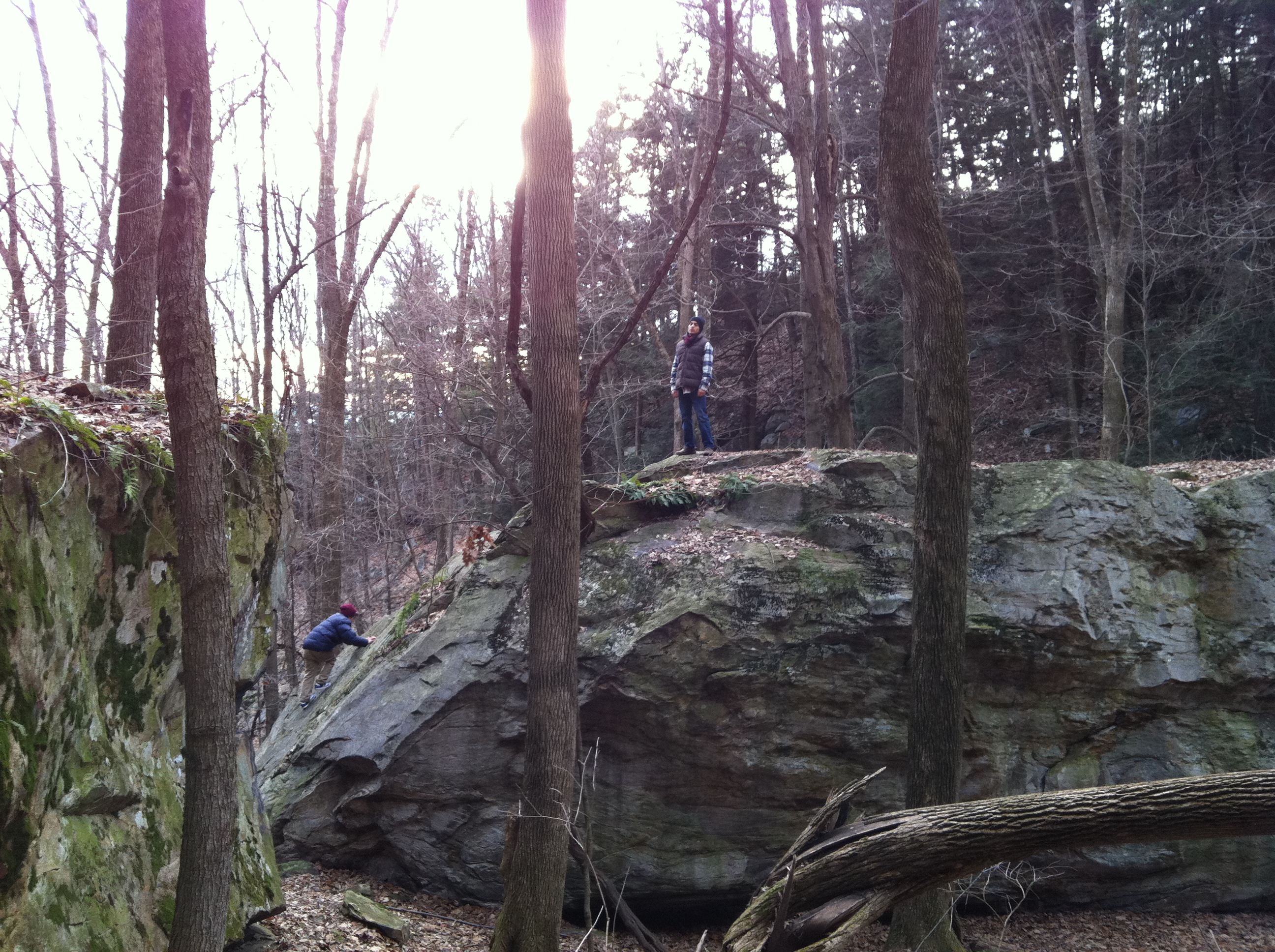
Yesterday, after opening presents by the tree and eating a cheery holiday brunch, my kids and I went for a long walk up the mountain that I can see from my front porch, the one over which the sun rises every morning.  Almost at our destination, we came through a narrow ravine in which several huge, craggy, beautifully colored boulders were scattered.

One presented one of those  classic overhangs that we know were used as sheltered campsites by indigenous hunters for millennia before the arrival of the Europeans.  Others were balanced with amazing precision, creating deep caves that we dared not explore in this season of hibernating bears.

There was an unmistakeable sense of age in that gathering of stones. Squinting my eyes, I could imagine the great glacier that had retreated down the mountainside, gouging out the flat ravine through which we now walked, and leaving the huge boulders scattered in its wake.  I could also imagine an even earlier time, when the rocks had been home to myriads of fish, with giant squid sleeping in the caves, instead of snoring bears.  Those great rocks have seen so much earthly history, standing majestically on their mountainside, unmoved by the shallower destinies of the flora and fauna that root on them or pass them by.

For a moment, putting my hand on the cold rough stone, my inner turmoil was calmed by a strong apprehension of the longer view of life on Earth.

It’s true that our current way of life, complete with its winking strings of colored lights powered by huge, dirty, out-of-sight mines, will not persist much longer.  Not with 7 billion people ravaging the globe like a swarm of ravenous locusts.

But these ancient stones have seen upheavals far more intense than what is currently on the horizon.  They have survived as silent witnesses to many cycles of destruction and regeneration.  They will be there, still silently bearing witness, after homo sapiens has become just another level on the fossil record of the planet.

There is strange comfort in this.

I still have every intention of trying to save our species–and so many other current inhabitants of Earth–by advocating for a transition from fossil fuels to renewables, and a shift from a civilization based on endless competitive growth to one based on collaborative stewardship of a steady state economy and a healthy, fully bio-diverse ecosystem. In my second half of life, this is the cause to which I will dedicate myself, second only to seeing through my job as a parent and giving my kids as strong a start as possible with which to face our uncertain future.

But somehow it helps to stave off despair, knowing that no matter how badly we may fail as a species, the planet will endure, and find new ways of prospering, new ways of combining the building blocks of creation into wondrous, miraculously beautiful and clever forms.

That knowledge forms a peaceful ledge on which to perch, between the bipolar swings of the season.  You’ll find me on this perch for the next week or so, quietly collecting my energy and my will for the struggles ahead.


De-coupling our wagons from the locomotive of global capitalism

There is a clear spectrum of response to the urgency of the environmental and economic challenges that face us.

On the one end is the Deep Green Resistance movement, calling for a complete take-down of industrialized civilization, violently if necessary (and it would be necessary, of course–industrial civilization won’t go down without a fight, unless it’s wiped out by natural disasters).

On the other end are those who believe we will be able to find our way into a sustainable world order via technology, ie, renewable energy sources that will keep the capitalist engines burning bright.

On this spectrum, I would have to locate myself somewhere in the middle.  While I see the necessity of deindustrialization, I don’t really want to live through the violent havoc a strong de-civ movement would cause.

But I know things can’t go on as they have been.  We must shift from an economic model built on endless growth to one that seeks to maintain a steady state, both for human societies and for the natural world (as if there were a separation between these two).

We must also shift from the capitalist system of accumulated wealth for the few based on the commodified labor of the masses, to a system in which people’s labor is more directly connected to their well-being, and wealth is not allowed to concentrate in a few disproportionately powerful, distant hands.

The only movement I’ve found so far that is actively working to accomplish a vision similar to what I’ve sketched out above is the Transition Town movement.  The brainchild of UK visionary activist Rob Hopkins, the movement describes itself as follows:

“The Transition Movement is comprised of vibrant, grassroots community initiatives that seek to build community resilience in the face of such challenges as peak oil, climate change and the economic crisis.

“Transition Initiatives differentiate themselves from other sustainability and “environmental” groups by seeking to mitigate these converging global crises by engaging their communities in home-grown, citizen-led education, action, and multi-stakeholder planning to increase local self reliance and resilience.

“They succeed by regeneratively using their local assets, innovating, networking, collaborating, replicating proven strategies, and respecting the deep patterns of nature and diverse cultures in their place.

“Transition Initiatives work with deliberation and good cheer to create a fulfilling and inspiring local way of life that can withstand the shocks of rapidly shifting global systems.”

What appeals to me about the Transition Town movement as a strategy for change is that it’s locally based and collaborative.  The first step is getting to know your neighbors, finding out what skills you can share, and taking stock of how you can prepare intelligently to cope with whatever environmental and economic shocks may lie ahead in our future.  It doesn’t dictate a one-size-fits-all model, but rather gives communities credit for being smart enough to figure out their own, locally adapted solutions.

As a society, America seems to be in collective denial about the reality of climate change.  We don’t want to hear that if we continue down the path of capitalist growth based on fossil fuels, the planet will heat up past the point where we could expect life as we know it to continue.  We don’t want to put the pieces together, because if we do, we will be forced to face the fact that we need to change. 

If we could accept this fact, we could begin to talk seriously about directions to take to make that change happen.  It would be nice if we could count on our world leaders to step up and face the challenge squarely, in a concerted effort.  But given the reality of global politics, still based on competition and armed power struggles, it seems very unlikely that we can look to the United Nations, or individual national governments, for the kind of decisive leadership we need now.

So we need to turn to each other, on the local level, and begin asking, as the Transition Town movement envisions, what can we do right here, together, to become more resilient?  What resources do we have, right here, that are not dependent on current systems of international or long-distance national trade?  How can we plan together for a sustainable future?

In a way, it’s an effort to de-couple our personal wagons from the locomotive of capitalist growth, which is proving so destructive to everything in its path, and seems to be on the verge of careening out of control.

I’ve been hearing a fair amount of fear expressed about “going backwards.” When people imagine stepping down from the capitalist growth model, they picture having to give up modern conveniences like advanced medical technologies, ready access to electricity, indoor plumbing, etc.

It doesn’t have to be that way.  We have to work on developing new ways of generating those conveniences, that are less destructive to the planet (the technological fix) and also work swiftly to dismantle those features of industrial civilization that are throwing our whole ecological system out of balance (de-industrialization).

The Transition Town movement calls this “the great re-skilling” approach.  We need to remember older, more sustainable ways of doing things, while also keeping the best of new technologies and learning how to apply them in smarter, more efficient and ecologically sound ways.

There are over 100 full-fledged Transition Town initiatives in the U.S., and hundreds more worldwide, along with many start-up groups forming all the time.  Although all of us seem to have so much to do, and so little time these days, this is really a movement we need to be focusing on now to prepare for the decade ahead.

Given the lack of effective top-down leadership, should we really be wasting our time worrying about national elections, for example?  Or bothering to go to international conferences on climate change?

Or is the smarter thing to do to begin, quietly and with determination and hopeful good cheer, to make our own preparations for a very different sort of future, in our own transition towns?

Call to Action in Dark Times

This time of year in New England is cold and dark: short days and long, starry nights.  As the planet wheels towards the winter solstice, human beings, for thousands of years, have huddled around fires and turned to storytelling as a bridge back to warmth and the coming of springtime.

It’s no different now, except that now most of us burn oil for our heat, and hang up strings of electric lights to symbolize the return to light.  We watch movies, read books or play video games instead of listening to clan storytellers.

In America, as in much of the world, the dominant religious stories of this time of year have to do with keeping hope and faith alive in dark times.  Jews remember, with the lighting of the Menorah candles, the preservation of their faith in the 2nd century BCE, after the destruction of the Second Temple; Christians celebrate miraculous birth of Jesus Christ, the Redeemer who would bring the word of God to the people.

All of the traditional religious stories document a continuing human saga of light against dark, with light representing life and good energy, while dark represents death and possible danger.

More contemporary mystics also point to human life as a struggle between the forces of light and the forces of darkness.

Rudolf Steiner, for example, the influential psychic who reported many out-of-body experiences where he made direct contact with metaphysical beings, routinely talks about angels and demons in his copious writings, with angels representing the good forces of light and life, and demons being the dark forces of destruction.  Freud too, in a more secular register, described Eros and Thanatos as primal human drives that align along the same lines: light/life/love, dark/death/hatred.

Is there something to all this?

In a scientific age, it’s hard to write with a straight face about angels and demons.  We are trained to see them as figures of speech, metaphors for empirically definable natural phenomena.  To whit: Human beings tell stories about angels and miraculous births at the darkest time of year as a metaphorical way of talking about the winter solstice and the return to light.

Yes.  But there have always been persistent voices telling us that this is not just metaphorical.  That there really are forces of dark that are destructive and forces of light that represent goodness, and that human beings, as the most self-aware sentient beings on the planet, are able to recognize the grand struggle between Good and Evil playing out in our psyches, and on our battlefields.

For instance, take Derrick Jensen‘s latest book, Dreams, in which he talks about his growing belief that there are metaphysical realms that human beings access in dreams, and that in the dream world there are “sides”: the side of life and the side of death and destruction.  As humans, we have a choice, Jensen says; we can choose which gods to worship, those who represent the life-giving energies of the planet, or those who represent the blood-sucking zombies that are leading us down the capitalist/imperialist road to doom.

Even further out along the spectrum of contemporary metaphysical thinkers is Alex Kochkin, who has been sending out dispatches through email and Web for some time now, warning that the end times are coming.  One could mistake Kochkin for an Armageddon-spouting Christian fundamentalist, except that, like Jensen and Steiner, he has no religious scaffolding framing his ideas.

All of these thinkers agree with indigenous shamans the world over that there is much more to human beings than our physical bodies, and that we can interact with higher powers through individual psychic work–paying attention to our dreams, meditating, being open to the realms of human consciousness where, they say, we can connect with what Steiner called “higher worlds.”

Alex Kochkin: “”You” are the result of a portion of your larger being extending something of itself into this level of density. In this case, it is a human bio-vehicle that comes equipped with basic firmware and an operating system. Flawed as the whole package may be, it is still a viable and valuable way for individuations of The All of Creation to reach into its own deepest recesses, even those that have become overwhelmed by the disease of the Dark.”

Derrick Jensen gives the “disease of the Dark” more concrete names: capitalism, imperialism, and the science that justifies and extends the reach of these destructive ideologies that have, since the advent of the Industrial Revolution, been rapidly reducing bio-diversity and inexorably altering our eco-system.

Jensen recalls the Aztec sacrifices to their gods, and speculates that we too are unthinkingly making sacrifices to our contemporary gods of Science and Capitalism.

This is an idea that one of my mentors, Rigoberta Menchu, suggested years ago, talking about how destructive the Euramerican ideologies and technologies have been to the natural world and indigenous peoples: “I often wonder why people criticize the Aztecs for offering human sacrifices to their gods when they never mention how many sons of this America, Abia Yala, have been sacrificed over five hundred years to the god Capital,” Menchu said in her second testimonial, Crossing Borders.

Whether or not there are “higher powers” involved in the life-and-death battles we are seeing played out at ever-accelerating speed in these dark times, it is true that we human beings are the ones with the power to change the course of events we have set in motion.  The fish and the birds and the great bears cannot change what is happening to their environments because of human short-sightedness and greed.  The ancient forests that have stood for thousands of years cannot withstand the bulldozer and the chain saw.  The river that has flowed for eons cannot resist the concrete dam.

Only we have the power of reversing the “disease of the Dark.”  If there are higher powers involved, they are not going to do it for us–they will only work through us.

Which stories are we listening to now as we huddle around our mechanical fires?  The old stories of dominion and destruction, “manifest destiny” and technological prowess leading to “progress” have held sway long enough.  It’s time to listen to stories that are older and wiser than the Judeo-Christian myths, stories that remind us of our deep connection to the natural world that sustains us.

Let every candle lit this solstice season be a call to action on behalf of the life energies of this planet.  And then, let us act, before it’s too late.