Challenging rape culture

In my Gender Studies class this week, we’ve been talking about “rape culture.”  It’s a term that’s bandied about somewhat cavalierly on college campuses, and is probably much less familiar out in the ordinary workaday world.

Well, wake up world.  Rape culture is here.  And it doesn’t need the ironic scare quotes.  It’s real, and it’s not funny at all.

You know you’re living in a rape culture when women’s bodies are suggestively displayed, commodified, in sexually enticing poses obviously intended for the male gaze.

In the culture of rape, “no” means “try harder” and it’s always the woman’s fault if she doesn’t like what’s going on.  Stupid bitch, if she didn’t want it, she shouldn’t have worn those heels/had that drink/come to the party.

Rape culture sanctions violence when necessary to overcome resistance.  She was asking for it, anyway.

Rape culture oppresses dissenting men, too.  Men who fail to conform to the code of dominant masculinity are “faggots,” and being called out as anything akin to feminine–pussy, for example–is the worst insult you can throw at a guy.

Lately I’ve been realizing that rape culture extends a lot further than women’s bodies.  It’s also responsible for the prevailing attitudes towards our environment–our Mother Earth.

Not for nothing are both Mother Earth and Mother Nature gendered female.

Some patriarchal cultures manage to respect Mother Nature while still maintaining a stranglehold on her female children.  For instance, in Chinua Achebe’s Things Fall Apart, which I’m re-reading now for another class, the all-powerful Oracle of the Hills, a goddess, is interpreted by a priestess whose pronouncements no men dare question.  This doesn’t stop the protagonist, Okonkwo, from beating up his wives on a regular basis.

In Judeo-Christian and Islamic cultures, the patriarchy dispenses with goddesses.  Or at least, goddesses of the truly powerful, fearsome kind.

In Euramerican cultures, we have sex goddesses, who exist to pleasure their men.  Islamic cultures shroud their women in veils, but towards the same end: women exist to please their men.

The explosive growth of the international pornography industry, in which it is still rare for women’s pleasure to be of any interest at all, bears testimony to the extent to which rape culture rules.

In 2006, the pornography industry had larger revenues than Microsoft, Google, Amazon, eBay, Yahoo, Apple and Netflix combined–and it’s only grown in the past five years.

Porn is a vast unregulated jungle.  It’s not all bad.  But some of it is really terrible.  Some of it is sexualized violence–rape–thinly veiled as entertainment.

Yes, the girls get paid.  But many studies have shown that female porn stars often come from sexually abusive childhoods, or are teen runaways, or are lured into the trade through drug addiction and prostitution.

In Euramerican porn, women exist to give men pleasure.  Doesn’t matter if they get fucked over in the process.  Doesn’t matter if all that’s left in the end is a hollow shell.  There’s always another slut waiting in line.

Yeah.  It hurts me to talk like this, but I want to convey the mind-set of this industry.

And then I want you to think about how this mind-set translates to the Euramerican assault on the environment, our Mother Earth.

Or the sub-prime loan scandal (it’s Occupy Foreclosures Day, after all).  Fuck’em over, make a profit and move on.  All that matters is the bottom line, baby.

Sometimes it seems as though the more powerful actual women become in real life–ie, successful at playing the formerly all-male games of education and career–the more frantically obsessive men’s consumption of pornography becomes.  The power they miss in real life, they can find acted out for them in porn fantasies.

But the environment is another story.  Mother Earth is not going to play men’s games–that is, she doesn’t care to beat them at their own game.  When she starts to resist, the game will be over.

In porn, women go along with the game for a variety of reasons.  Generally speaking, women do it to survive.

Likewise, women collude with the patriarchy in the rape of the Earth because it’s just easier to go along than to resist.  And the lifestyle has been pretty comfortable over the last 50 years, hasn’t it.

I would like to see a frank discussion of the connections between rape culture as played out in porn and rape culture as played out between humans and the environment.

We need to acknowledge that there is a serious problem in both the private and the public realms (along these lines, we are just beginning to see confessions of “sex addiction” hit the media.  How about “fossil fuel addiction”?).

The problem is a symptom of much deeper ills in human social relations, which transgress the usual boundaries of race, class, gender & nation.

Why are porn and energy extraction biggest, the fastest growing industries in the world?

What does it mean to live in a rape culture?  Who benefits, and who loses?

Most importantly, how can a rape culture be transformed?  And what is our alternative vision?

My vision is this:

The one-sided model of domination and extraction (“getting some”) needs to shift to a dialogic model of sustainable mutual pleasure.

Human beings should serve in a steward relation to our Mother Earth, tending and enriching her in exchange for the nourishment and pleasure she can afford us.

Likewise, sex should not be about domination and debasement, but about mutual pleasure and uplift.

In these transition times, such a transformative shift should be possible, if each of us begins with our own selves, our own backyards, and lets the ripples of range move outward.

Let it be so.

Who’s Afraid of Women’s Writing?

Last night I participated in a panel discussion on Virginia Woolf and Margaret Mead called “Who’s Afraid of Women(‘s) Writing,” with Bard College of Simon’s Rock colleagues Maryann Tebben and Asma Abbas.

We were talking about how women’s writing is often oppositional, representing an outsider’s point of view to male-dominated mainstream discourse, whatever the discipline.

One of the students in the audience asked whether women’s writing would therefore always be reactionary, simply responding to the dominant rather than staking new ground.

I have been thinking about that question all day, off and on.

What I answered at the time was that while women’s writing is often a response to the dominant discourse, it also goes off in its own directions, which are not simply reactions to the mainstream, but rather true departures.

Of course, all writing occurs in dialogue with other writers, so even a departure is part of a larger conversation.  But I do believe that women, as outsiders, have something unique to contribute to any conversation.

Indeed, it is staggering to think of how impoverished literature, philosophy, history and all the other disciplines have been (and still are) in cultures where women have not been allowed to add our voices to the chorus.

Worst of all is that so few people (read: men) even noticed our absence.

I can recall so many times when have I had to fight for the inclusion of texts by women in our General Education curriculum at Simon’s Rock, arguing with colleagues who could say, with a sad shake of the head, that it was just too bad that women had never written any great, canonical literature.  For the past 20 years, out of the 16 required texts in our Gen Ed canon, which stretches from Gilgamesh to Achebe, only three are by women–though as of this year, after much lobbying, the ratio has finally improved slightly.

First deny women literacy and keep those few who do manage to become literate tightly locked in the private realm.  Then look back over history and note complacently that, as Woolf has the “odious Mr. Tansley” tell the artist Lily Briscoe in To The Lighthouse, “women can’t write, women can’t paint.”

In our time and place, young women now outnumber young men in higher education, and no one would dare to argue that women are innately less intelligent and talented than men.

But still, women in the U.S. earn 78 cents on the male dollar, for a variety of reasons, including the fact that we still shoulder more responsibility for housework and child care even when we work fulltime.

Women are still valued more highly as ornaments and service workers than as autonomous creative agents, and we still have to struggle harder to make our voices heard, especially if what we have to say is not what the mainstream wants to hear.

In To the Lighthouse, Lily Briscoe worries that her painting will be rolled up and thrown under a couch to gather dust.  Today, women still seem to have less self-confidence than men, perhaps because we’ve absorbed the prevailing ethos that considers a strong woman to be a “ball-breaker” or a “bitch on wheels.”

As MaryAnn Baenninger, President of the College of St. Benedict, wrote in a recent piece in The Chronicle of Higher Education, studies continue to show thatwomen underestimate their abilities and express lower levels of self-confidence than their abilities suggest. Men overestimate their abilities and express higher levels of confidence than their abilities warrant. This difference arrives with them as first-year students and leaves with them as seniors. When I talk about this, or I hear researchers describe this finding, the audience always chuckles (boys will be boys, after all).”

Baenninger concludes that while American women “have access to just about every educational opportunity and every career…access doesn’t guarantee outcomes. A gendered culture, mostly in unconscious ways, limits women’s expectations for themselves and our expectations for them.”

In other words, our gender role conditioning as women too often tends to silence us, while amplifying the voices of our brothers.

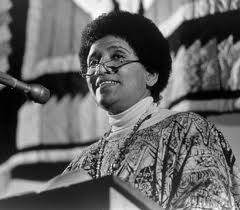
Soon after the great poet Audre Lorde was diagnosed with the cancer than would eventually kill her, she gave an address at the 1977 Modern Language Association annual convention in Chicago, called “The Transformation of Silence into Language and Action,” later published in the collection Sister Outsider.

In thinking back over her life, she said, “what I most regretted were my silences.”

“In the cause of silence,” she continued, “each of us draws the face of her own fear–fear of contempt, of censure, or some judgment….But most of all we fear the visibility without which we cannot truly live….That visibility which makes us most vulnerable…is also the source of our greatest strength.

“Because the machine will try to grind us into dust anyway, whether or not we speak.  We can sit in our corners mute forever while our sisters and our selves are wasted, while our children are distorted and destroyed, while our earth is poisoned; we can sit in our safe corners mute as bottles, and we will still be no less afraid.”

What we need to do, she said, is to “learn to work and speak when we are afraid in the same way we have learned to work and speak when we are tired.  For we have been socialized to respect fear more than our own needs for language and definition, and while we wait in silence for that final luxury of fearlessness, the weight of that silence will choke us.”

So many women today are still feeling the same fear and insecurity Lorde wrote about in 1977.  So many of us will go through our entire lives not daring to utter the truths we can hardly bring ourselves to acknowledge even in our most private thoughts.

In the same way that the richness of the Earth is diminished every time a species is lost, no matter how small and seemingly insignificant to the bigger ecological tapestry, the great canvases of literature, philosophy, science and all the other disciplines are impoverished and dulled when 50% of the population is not enthusiastically welcomed into the conversation.

Yes, we women can have our own conversations, outside the male-dominated mainstream.  There’s always “women’s writing.”  But what we should really be striving for is what Virginia Woolf called “androgynous writing,” where the masculine and feminine energies are brought together in a fecund explosion of cross-pollinating difference.

As Lorde put it so memorably in another of her important essays, “The Master’s Tools Will Never Dismantle the Master’s House,” “Difference must not be merely tolerated, but seen as a fund of necessary polarities between which our creativity can spark like a dialectic.  Only then does the necessity for interdependency become unthreatening.”

Maybe there will come a time when interdependency and androgyny will be the accepted standard of gender relations.  Until then, we still need to meet periodically and consider questions like “Who’s Afraid of Women’s Writing?” and why? and at what cost?


Honoring Native Americans on Thanksgiving

Thanksgiving in the U.S. is about gathering together with friends and family and giving thanks for being able to stuff oneself with a huge meal.

It’s one of the most important holidays of the American capitalist religion, second only to “Christmas.”

Its founding myth is the fateful meal shared by the indigenous peoples of Massachusetts with the starving English Pilgrims.  The Pilgrims “gave thanks” at that meal for the generosity of their hosts, and thus was born the tradition of a November Thanksgiving feast.

To my way of thinking, Thanksgiving should actually be a day of atonement marked by fasting, in the spirit of Yom Kippur, Lent or Ramadan.

We Euramericans should be reflecting and repenting on this day for the way our ancestors turned on their Native hosts, once the time of starvation was past.

We repaid their kind welcome with a shameful record of stealing, swindling, enslavement, displacement and deliberate infection.

We waged vicious war that slaughtered children and old people along with warriors both male and female.

We occupied their lands without a second thought, and proceeded to cut the primeval forests to make room for our livestock, roads and cities.

This pattern started with the Puritan Pilgrims in Massachusetts, and spread inexorably West, all the way to California and Texas, where indeed the brutal work had already been begun by the Spanish.

I don’t really expect Americans to give up the tradition of the jolly Thanksgiving feast.

But we do need to be mindful of the real historical background behind the custom of gathering to celebrate with family and friends.

American Thanksgiving is a holiday that honors the spirit of sharing the bounty.  When we dig into that heaped plate today, we should be giving thanks to the rich Earth that has nourished human beings for millennia, and for the Native peoples of this continent, who learned how to live in harmony with the flora and fauna of this place, cultivating the first corn, beans and squash, and craftily culling the abundant indigenous turkeys.

And we should pause in our feast to reflect on the ignoble history that unfolded after that original Thanksgiving in Plymouth MA, where America repaid her hosts not with honor, but with persecution, scorn and hate.

In the act of repentance springs redemption.  The indigenous people of this continent are not gone–they are alive and well and living among us.  Let us raise a glass to them today and give them the honor and thanks they deserve.

Wamponoag leader Massasoit

Dispatch from Washington DC: On History and the Human Spirit

In Washington DC this weekend, I couldn’t help but be impressed by the majesty and wealth of the buildings and institutions spread out grandly in the heart of the city.

The many museums of the Smithsonian, all of which are free, boast what must be the best-displayed, best-run, most impressive set of collections to be found in such concentrations anywhere.  They are a reminder of what American wealth and ingenuity can accomplish, when tax dollars are put to good use!

But there is a darker side on display in the museums too, which links back to the political establishment and the way the reality of this country has never quite lived up to our ideals.

At the Museum of Natural History there is a remarkable exhibit, funded by David Koch no less, on the origins of the human species.  The scale of human evolution is made quite clear: our ancestry reaches back millions of years, but homo sapiens as we know ourselves today is a young species, a mere footnote to the huge sweep of terrestrial mammalian existence.

In that very short period of time, we have managed to wipe out millions of other species, many of them also present the museum in stuffed form, or as skeletons, or—in the case of the butterfly and insect exhibit—as specimens locked behind glass.

Most of that destruction occurred since the 1950s, when the American corporate capitalist assault began in earnest, with chemical warfare-style agriculture, the razing of the forests, the strip mines, and the suburban sprawl.

The Museum of American History tells more of this sad story, albeit inadvertently, in an unspoken subtext.  The transportation exhibit is the biggest and best I’ve ever seen, but makes no mention of how the invention of the combustion engine paved the way for human destruction of wildlife and wild lands on a vast and unprecedented scale.

The huge exhibit on the military history of the United States, from the American Revolution to Afghanistan, brilliantly illustrates the military development of the country, from our start as “rebels” fighting against heavy taxation by the King, through the trench warfare of World War I, the ignoble nuclear bombing of Hiroshima and Nagasaki, to Vietnam and beyond.

The exhibits are lavish and beautifully curated, but the untold story is the staggering waste of human life, treasure and creativity, drawn to the service of Thanatos, Freud’s famous “death instinct.”

The American Indian Museum, built like a sandstone mesa with its prow defiantly facing the U.S. Capitol, reminds us that the human spirit has many facets, and it’s hard to keep Eros down.

From the ashes of near annihilation by savage Euramerican military forces, as well as the ravages of disease and cultural tyranny, the native tribes of North America built this beautiful museum as a testament to the resilience and creativity of their peoples, as well as their South American brethren, who are also represented at the museum.

This is no monument to vanished cultures, but rather a tribute to peoples who have survived, proud and independent and eager to tell their stories and preserve their cultures for the future.

In Washington DC I found much to be proud of, and also many reminders of the shamefulness of our history over the past 235 years of our official existence as a nation.

Time is a funny thing—it certainly seems like history has been speeding up in the past 50 years, as our technological innovations continue to connect, concentrate and expand our collective knowledge base at an exponential rate.

What happens between now and November 2012, the next Presidential election, could have the power to radically change the course of history yet again.  The key seems to lie in those restive crowds turning out in ever larger droves under the Occupy banners.

Will we be creative and innovative enough as a people to reinvent ourselves as a nation truly dedicated to life, liberty and the pursuit of happiness—not just for the 1%, and not just for human beings, but for all the magnificent living beings, flora and fauna, with whom we have shared this planet since we all first emerged out of the frozen wastelands of the Holocene thousands of years ago?

What do Derrick Jensen and George Washington Have in Common?

Derrick Jensen was speaking to the Occupy Oakland and San Francisco folks today, and I had hoped to catch the livestream, but ended up missing it.  I did find, however, a video from about a month ago, when Jensen spoke to Occupy DC via Skype.

True to form, Jensen told the crowd that when people ask him whether he’s calling for the overthrow of the U.S. Government, ie, real revolution, he answers that “this question comes far too late.

“For the government was long since overthrown.  And those who overthrew it are known as Exxon Mobil, British Petroleum, Halliburton, Monsanto, ADM, WalMart, Massey, Goldman Sachs, Citibank.

“They are the real governors, and the United States Government is a wholly owned subsidiary brought to you by McDonalds, Pfizer and Lockheed Martin.

“So then you can ask, am I advocating the overthrow of the corporations?  Am I advocating the overthrow of the corporate state?

“To which I will say hell yes!”

For someone like me who came of age in the 1970s and 80s, it’s very hard to imagine a world without corporations.  How would we get our stuff?  What would I type on if there was no Apple?  How would we communicate without Google, Facebook or WordPress, not to mention Twitter?

And of course, how would any of these products see the light of day without the industrial supply lines that go from oil extraction to factory production to tanker ships to retail store?

Well, somehow for the vast majority of human history, your ancestors and mine managed to live and procreate and die just fine without any corporate help or interference.

I’m no Luddite: I love my computer, car, cell phone and dishwasher just as much as the next American.

But somewhere along the way to the bank, we ceded far too much power to these corporations. Derrick Jensen has it right when he says that “a government worth a good goddamn” should answer to human beings, not corporations.

And not just to human beings, but to all of the beings on our planet who are fading away day by day–at the rate of 200 extinctions a day, as Jensen never tires of reminding us.

Will we join the polar bears and the wolves and the rhinos in fading away quietly into the night when our time comes, as it surely will if we do nothing to stop the steamroll of oil-driven climate change?

Or will we stand up now and demand that our government obey its mandate to be of the people, by the people, and for the people, recognizing that what is good for the people is what is good for the earth as an ecological system?

Jensen closed his talk in DC on a positive and galvanizing note:

“When the government becomes destructive of life, liberty and the pursuit of happiness, it is the right of the people to alter or abolish it.  It is long past time we made full use of our rights.”

Just like our colonial-era forebears, we have the right to throw off the yoke of oppressive government to found a better system.

The Occupy movements are the advance guard of what needs to be a massive campaign of civil disobedience and relentless pressure on the government to listen to us, the people–not them, the corporations.

We celebrate those rabble-rousers, Washington and Jefferson, as national heroes.  Let’s get behind today’s rabble-rousers and turn the corner into a new era.  It can’t happen too soon.

An older form of Deep Green Resistance rises from the rainforest. Euramericans, ignore this at your peril.

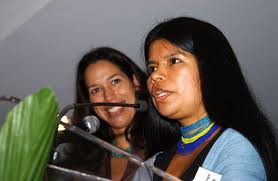
If you want to see something really inspiring, watch and listen to Patricia Gualinga, an Achuar woman from the Ecuadorian rainforest, talking about how her people are standing firm on the frontlines of the siege of the forest by multinational oil extraction companies.

Listening to this indigenous activist, you see shades of all the millions of indigenous peoples around the world who lived in harmony with their environment, respecting and sustainably stewarding their lands.

To say that this balance was altered when the Europeans began their voyages around the world is not to blame or guilt-trip.  It is simply to speak the truth.

To say that the European Enlightenment period, which gave us Manifest Destiny, “I think therefore I am,” the closing off of the commons and the capitalist drive to resource exploitation, was actually a time of deepening darkness, is simply to pronounce the self-evident.

While we contemporary heirs to this 500-year history may be individually blameless, collectively we have been bystanders who have followed the paths of least resistance and allowed the destruction of our planet to proceed apace.

The Pachamama Alliance, on whose behalf Patricia Gualinga spoke last week, is an unusual partnership between Euramericans and these South American indigenous survivors, warriors who are defending the great Amazonian rainforest, the dynamic lungs of the Southern Hemisphere, against rapacious encroachers.

We need another alliance like this between the peoples of the far North and those Euramericans who know that destroying the Canadian boreal forests would be equally catastrophic.

The Pachamama Alliance has developed a powerful model of collaboration across the boundaries of nationality and race in the service of a higher vision of earth-based spiritual activism.

This is a vision that needs to grow exponentially in the coming years.

For too long we have been held captive by the media-induced trance of relentless growth and consumerism.  It’s time to break the spell and allow the pendulum of human evolution on this planet to swing back to balance.

To do this, we need to listen to new voices, heed new calls.  We Euramericans have had our shot at leading the world our way.  It has been a disaster.

It’s time to cede the stage to our indigenous sisters and brothers, and try following their lead for a change.  This is a whole new level of Deep Green Resistance, based on creation rather than destruction.

 It’s time to co-create a new story with the indigenous peoples of the planet, who still know how to live harmoniously with the natural world.

Listen to the Pachamama story, and then it’s up to you–what comes next?  What role will YOU play?

Activists circle the White House; Obama plays golf

Mainstream media reports that some 8,000 people showed up in Washington D.C. today to link hands around the White House to protest the Keystone XL pipeline and the development of the Alberta boreal forest (aka “tar sands”).

The energy and determination of this crowd is wonderful. But It’s heartbreaking to learn that President Obama “missed most of the protest while he played golf at Fort Belvoir in Virginia.”

Last week I went for a walk on a golf course near my home, and was reminded again of how terrible these private parks are for the environment.

If lawns are destructive monocultures, just imagine the exponential scale of the golf mono-lanscape: acres and acres of closely cropped, artificially bright green  turf, with not a single broad-leaved plant to be seen.

Golf parks are anathema to butterflies and other insects, of course, since they are regularly treated with pesticides and herbicides.  They suck up precious water for a use that is 100% non-necessary: a pleasant game for the 1%.

I admit it, golf courses are one of my pet peeves.  I have never liked them, and never will.  So I suppose it was a sort of trigger to hear that Obama was off golfing this afternoon, instead of paying his respects to the thousands of activists streaming into Washington to communicate with him–the man we sent to represent us in the White House.

He is not the first American President to dodge attempts by the citizenry to communicate our wishes.  I think of President Bush off on his ranch while activists like Cindy Sheehan, whose son Casey died in the Iraq War, tried to send him an anti-war message.

Mr. President, if your citizens make the effort to go all the way to Washington DC to speak with you, I think the least you could do is show up.  We are depending on you to make the right decision on the tar sands/pipeline issue, which is clearly NO PIPELINE, and no development of the boreal forest.

We expect you to make a decision in favor of the health and well-being of your citizens.  Instead of investing in tired, dirty old energy platforms like oil and pipelines, we should be investing in solar and geothermal.  We need an Apollo Project for renewable energy, and we need it now!

Sure, you deserve your R&R on a Sunday afternoon, Mr. President.  But if you make the wrong call on this issue, those luxurious golf courses you enjoy may soon be relics of the wasteful bygone days.

Future social historians might point to golf as one of the many foolish 20th century habits that left us crouching bewildered in the 21st century in the midst of a full-blown climate crisis.

You’re the Decider now, Mr. President.  We are expecting you to make the right decision–for your precious children, and ours.

Challenging the culture of (white male) entitlement: Come on, Occupy, let’s do it!

I spent several hours today listening to a friend tell me, with much anger, sadness and frustration, the story of how her marriage of more than 20 years has crumbled.

Then I went up to see my son’s soccer game, and could not bring myself to say more than “hello” to my own ex-husband, who chose freedom and autonomy over his 25-year relationship with me, and the satisfaction of living in the same house as our children.

When I got home, I checked the Occupy Wall Street website and found a statement from the “sexual assault survivors team,” describing and condemning the recent attack on a female protester by a man who apparently already had a record of sexual assault.

I also got a blog post from a student in my gender studies class, about an organization called About Face, which strives to get viewers to question the fashion industry norm of presenting emaciated women as “beautiful.”

What connects these dots?

A culture in which men feel more interested in following their own selfish desires for personal fulfillment (aka, sexual fulfillment) than in upholding their roles as fathers and husbands.A society that makes it easy for them to choose this route: why struggle to please a demanding wife when you can have sex with someone else with no strings attached?

A society that tells women that the more pale, limp and weak-looking they appear, the more beautiful they are in the eyes of men.

A society where women have to be guarded, even at protests that supposedly entertain no gender disparity, because there could be sexual predators around any corner.

A society that makes it terribly difficult for women to find independent means to self-respect.

Too often, in previous revolutions, women have supported the movement but found that the men in charge were not willing to give women’s issues equal footing with class issues.

If the young men and women of the Occupy movements are serious about creating true social change, they must put the issue of entitlement squarely on the table.

Not just the entitlement of the 1%, but specifically male entitlement, and white entitlement.

We will not be able to bring a new social structure into being unless we hit these areas of privilege and entitlement head on.

And no, we are not substituting women’s empowerment for men’s.

We are after another world entirely, in which gender, class and race are not the arbiters of power.  In which power flows from the collective wisdom of the group, rather than top-down in hierarchical fashion.

The Occupy movements are on to this shift with the general assemblies and the consensual mode of decision-making.  Breaking with the gendered conditioning of Western society, which gives men all the power, all the time, is not going to be easy.  But if anyone could achieve it, it’s the young men and women of the Occupy movements.

I want to see these young people make this an explicit focus of their movements.  Because otherwise, on a certain level, it’s just business as usual, no matter if the masters of Goldman Sachs come out to lick your boots.

Change the disrespectful attitude of men towards women, and you REALLY change the world.

Let’s give it a try, and see what happens.  Things could not get much worse, and they could get a whole lot better if men and women worked together for the good of ALL.

Sweet stirrings of a new world: fringe politics overturning the barricades

The venerable social critic Hendrik Hertzberg of The New Yorker contrasts the Tea Party with the Occupy movement in this week’s magazine, and finds the Occupy movement lacking in precisely what has made the Tea Party so strong: a willingness to get involved in (and take money from) the established American political parties.

“Occupy Wall Street and the Tea Party are both protest movements, not interest groups,” Hertzberg says, “and while both are wary, or claim to be, of established political figures and organizations, each welcomes their praise, if not their direction. Both have already earned places in the long, raucous history of American populism. But only one, so far, has earned a place in the history of American government.”

Are we supposed to be proud that the Tea Party has “earned” an infamous place as the launching pad for the new cadre of rightwing Republican zealots who have spent their time in Congress obstinately shooting down and stampeding every effort by President Obama and the Democrats to steer this nation towards a more compassionate and forward-looking political stance?

In its few years of existence, the Tea Party has happily wormed its way into the main arteries of American political power.  Hertzberg offers an apt metaphor of this tea as a new wonder drug, “injected into the scarred veins” of the GOP, which has quickly become addicted to this mainlined source of entranced, stupified frenzy.

“Now the Democrats are hoping the drug might be available as a generic,” Hertzberg continues, eying the Occupy movement as a way to enliven its own moribund political base.

I firmly hope that the Occupy movement does not allow itself to be used in this way by the political establishment, and I think it’s a reasonable, if remarkable, hope.

Remarkable because for so long Americans have been asleep, indifferent or unaware of what Hertzberg calls “the astounding growth of what can fairly be called plutocracy.”

Why it took so long for the sleeping giant of American popular opinion to wake up is a question for historians of the turn of the 21st century to ponder.

Why is it that Americans have been voting against their own class interests so long?  Why is the persistent myth of American equality, liberty and justice for all so teflon-coated?

We all want to believe that our country represents the moral high ground in the world, and that our leaders in government are as invested in upholding our idealism as we are.

Our public education system, which is responsible for the education of a great portion of the 99%, aids and abets this self-delusion by giving students the most doctrinaire and uncritical version of American history and civics, and teaching docility and proficiency at standardized testing above all.

Our media doesn’t help much; with the exception of a few poorly funded but stalwart independent outlets, the vast social landscape of contemporary media is focused at best on distraction, and very often on outright deception.

Under the pressures of this kind of social conditioning, it’s remarkable that the young idealists in the Occupy movement have had such success in galvanizing the country to wake up, shake ourselves, and stare around us with new eyes.

Hertzberg obviously intends his column as a signpost for the Occupy movement, pointing towards Washington D.C. as a more important battleground than Wall Street.  “Ultimately, inevitably, the route to real change has to run through politics,” he concludes; “the politics of America’s broken, god-awful, immutably two-party electoral system, the only one we have.”

Here is a glaring example of the kind of civics mis-education that has made our country so hard to reform over the years.

Who says our political system is limited to two parties?  Or at least, to the two parties we have now?

The Republicans and the Democrats have shown themselves to be chronically unable to lead this country out of the morass of special interests and ruthless corporate-driven capitalism that has bulldozed right over our cherished ideals of equality, not to mention the sacred ecological web that forms the real foundation of all our wealth and prosperity.

The Occupy movements are showing their intelligence in shying away from engagement with the established political system.  If anything, their political allies are more likely to be found in those perennial political organizations that have always camped out on the fringes of our electoral parks: the Green Parties or the Rainbow Coalitions.

Remember Ralph Nader, for example?  Remember how Big Media colluded with the established parties in denying so-called “outside” candidates a seat at the table at the televised Presidential debates?

This year the Ralph Naders of the political world have suddenly swelled their ranks dramatically, but without the figurehead of a single leader at the head of the crowd.  As Nader knows only too well, one man at the head of a true opposition movement is open to all the slings and arrows that the establishment can muster.  Even Gore and Kerry have felt the force of the muddy vomit pitched their way out of the far-right Republican swampland.

Far better for the Occupy movements to stay plural and collective, strong in the anonymity of the multitudes.  Those of us who are serious about doing more than simply rearranging the deck chairs on the great hulking Titanic of American politics realize that “America’s broken, god-awful, immutably two-party electoral system” is exactly what has to go.

OK, Hendrik, it may be the only one we HAVE HAD, but now the veil has been torn down, the people are awake, and we realize that another world is possible.  As Arundhati Roy famously put it, “on a clear day, I can hear her breathing.”

That clear day has dawned.

Fighting for Change with Hearts Wide Open

The environmental philosopher Kathleen Dean Moore looks out at the Occupied social landscape and sees “The Big One”–a movement that will bring all the disparate struggles of our society together on common ground, and effect deep, lasting, structural changes.

“The lines that connect climate change to jobs to the environment to education to health to justice are strong and undeniable,” she says. “The time has passed for an environmental movement. The time has passed for a climate change movement. The time has passed for isolated grassroots movements. We stand on ground that trembles with tectonic movement. Along the straining fault lines of our civilization, we feel the forces building for justice, sanity, and lasting ecological and cultural thriving.”

She’s certainly right that isolated movements are not going to change the world. That’s what’s been so great about the Occupy movements–they’ve been widespread and inclusive,a big big tent spread out over a lot of ground, coast to coast.

As Moore says, the moral ground of the Occupy movements is quite simple and clear: “it’s wrong to wreck the world.”

That’s something I knew instinctively as a child, as most children do.  Part of the great tragedy of our society has been the way we slowly deaden and numb the compassionate, empathic instinct of our children, teaching them to ignore pain and injustice, to just keep walking and mind their own business.

I know that’s what I was taught as a privileged young American growing up in a deeply unequal, unjust and exploitative society.  I know now that it was wrong.

And thanks to Occupy Wall Street and the other Occupy movements, I am beginning to know what to do about it.

We need to stop going about our business as usual, and relearn how to see and feel suffering and inequity.

We need to think outside the box of our normalized capitalist assumptions, making well-being rather than profit the goal of human effort.

We need to make protecting our planetary home our highest priority, because without a healthy environment, we will never build a healthy society, and things are so far gone that bringing back ecological balance will take everything we’ve got.

One of the reasons that revolutions are almost always carried out by the young is because they are closer to the instinctual compassion of their childhoods.

If only the stuffed shirts in Congress and in corporate office buildings all over America could remember what it was like to live with their hearts wide open, we might start to see the great boulder of social change really start to pick up steam.