Hope, Struggle, Dream, Persist: A Mantra for Dark Times

It is the day after Halloween, the Day of the Dead, and the day before my birthday.  It is one of the darkest days of the year, and a week from now, when American standard time “falls back,” it will seem darker still.

I was born in 1962, just after the Cuban Missile Crisis, as the Civil Rights movement and the Vietnam War began to pick up steam.  Each decade of my life has been marked by war and conflict, by a struggle between the forces of ruthless global capital, and the push-back from those who valued peace and a more equitable sharing of resources.

In my nearly half a century of life, I have witnessed a sharp decline in the ecological health of this planet.  Great flocks of many different types of birds have dwindled to a few sad outliers.  Clouds of multi-colored butterflies and swarms of busily working bees have vanished.  Delicate native wildflowers in the woods have been overrun by voracious invasive weeds, and the woods themselves have been overrun by a stampede of cookie-cutter tract housing in suburb after ugly suburb.

In my time, cancer has become a terrible epidemic, followed closely by diabetes and heart disease.  We humans have been sickened, just like the wild creatures, by the heedless spread of chemical treatments, pesticides, herbicides, fungicides, fertilizers, preservatives, additives and so many other toxins in our diet, soil, air and water.

What is there to celebrate on this birthday, the last in my fifth decade?

I look to my ancestors for hope and guidance, as is traditional on the Day of the Dead.

I see my Grandma Fannie, who believed in the power of the word, and practiced it by writing poems and stories that kept the wisdom of her Yiddish forebears alive.

I see my Grandma Mildred, who raised three kids, hosted and entertained her extended family frequently, and worked fulltime for a salary as well, year after year.  In her retirement she began the work she loved most of all, volunteering in her local public elementary school helping kids learn to read.
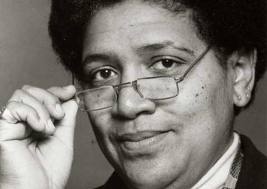
I see the ancestors I claim as kindred spirits, even though we do not share a blood relation: Gloria Anzaldua, who stands there arms akimbo telling me to “put my shit on paper,” no matter what the obstacles; and Audre Lorde, who reminds me constantly that “none of us is free as long as one of us is still shackled.”

As the Scorpio moon wheels overhead and I make my way to bed on my birthday eve, I can celebrate my own place as a link in this chain of strong women who spent their time on Earth trying to make it a better place for those who come after.

This has been a tough half-century, a period of decline and crisis in many ways.  It is a dark time.  But still the lights continue to shine defiantly: young people gather to Occupy the common ground and revive the dream of social equality; a Monarch butterfly sips a last meal at my butterfly bush before spiraling up to find the trade winds down to Mexico; the sun rises once again.

On this Day of the Dead, life goes on.  And while life goes on, we must hope and struggle for our children and their children, and the young creatures all over this planet that are being born today.  For their sakes, we must continue to work for a better future, and insist on our right to dream, and to make our dreams manifest.

This is my birthday mantra: hope, struggle, dream, persist, hope, struggle, dream, persist, endure.  And again.

Scary Halloween Statistic: 7 Billion People on the Earth by Oct 31, 2011

If you’ve never seen the Worldomters clock ticking, it’s worth a click.

Watching those numbers spin by brings home how very fast the human species is multiplying, especially when you consider the following chart, which shows how recent this population explosion really is.

No wonder we’ve got a sustainability problem!

Population control has gotten a bad name in recent years, and justifiably so.  It cannot and should not be imposed upon women by force, as it has too often in the past.

But study after study has shown that when women are educated and respected in society, birth rates go down.

Want to slow down that worldometer population clock?  Start by educating girls and opening up career opportunities for them after graduation.

Educate a girl and save the planet?  Might not be hyperbole after all.

Is there an “American Spring” around the corner?

You have to admit my blog is aptly named.  Each day brings new evidence that we are living through a speeded-up period of rapid change.

Was it only a few short months ago that we were stuck in the August doldrums of Congressional gridlock, in which the Republicans seemed to have a total stranglehold on the nation’s very lifeblood, our Treasury?

Was it only a few short weeks ago that the first Occupy Wall Street protesters arrived on the scene, the vanguard of what has now become an international political movement that just might have the power to challenge the two-party American oligarchy?

The deep distrust and disappointment Americans feel in our government is represented in a new NY Times/CBS News poll published tonight.

Get this: only 9% of those polled approve of the way Congress is doing its job.

Only 10% say they trust the American government to do what’s right for its people.

 These are dreadful numbers, especially when compared with the 46% of those polled who said they believe the views of the Occupy Wall Street protesters reflect the views of most Americans.

The urgent question becomes, will this dissatisfaction with our government and strong identification with the protest movement lead to actual sociopolitical change?

In one of my classes we are reading Allan G. Johnson’s book Privilege, Power & Difference, which seeks to understand why those with social privilege so rarely lend their support to any movement that might upset the status quo, even when they profess to be sympathetic with the goals of social equality.

Johnson says that all of us, but especially the privileged, tend to follow the path of least resistance.  Our society is set up in such a way that the paths of least resistance all favor the privileged, making it very hard for anyone to rock the boat.

But, he says, if we are aware of the ills of social inequality and do nothing about it, we will become “like the person who loses the ability to feel pain and risks bleeding to death from a thousand tiny cuts that go unnoticed, untreated and unhealed” (124).

I think that many of us privileged folks have indeed become numb to the harsh realities of our social system, which we have come to accept as natural, like the weather or the usual background noise of civilization.

That this callousness is wounding in ways we are hardly aware of is less obvious, but it comes out in the deep malaise of privileged American society: our tendency to depression, self-destructive behaviors, and underlying rage.

We are living through a moment in time when it is just possible that the privileged will wake up and decide that enough is enough.  That is the hope and the lure of the 99% movement.

There are a lot of privileged people in that 99%: educated, wealthy people, who have a lot to gain, in material terms, by not rocking the boat–but who, it seems, are doing some real soul-searching right now about taking the right path, instead of the path of least resistance.

Think about it: only 10% of Americans think Congress is doing a good job.  If that isn’t a mandate for change, I don’t know what would be.

Everything is speeded up these days.  Even last night’s solar storm, which caused spectacular aurora borealis displays all over North America, apparently hit Earth eight hours faster than predicted, and spread out much further over the U.S. than usual–visible all the way down in the Deep South.

Could it be that we will have our own “American Spring” in 2012?

WHY NOT???

Resisting the Vampires

This morning in class we were talking about the third essay in Nietzsche’s The Genealogy of Morals, in which one of the dominant metaphors is that of sickness and health.

Nietzsche argues that an “ascetic priest”, who tends the masses through religion, science, politics or any kind of dogmatism, acts as physician to the sufferer, but “he first has to wound; when he then stills the pain of the wound he at the same time infects the wound–for that is what he knows to do best of all, this sorcerer and animal-tamer, in whose presence everything healthy necessarily grows sick, and everything sick tame” (Kaufman, 1989, 126).

In other words, those who try to manipulate the masses (or the herd, in Nietzsche’s terminology), do so by wounding, and then claiming to have the cure–but the cure perpetuates the wound.

As with so much of Nietzsche, this seems remarkably prescient to me.  Take cancer, for example.  I have received many requests from people who are “walking for the cure” or “running for the cure.”  I never support these efforts, because I don’t believe we should be looking to cure to cancer through technological research.  The cure for most cancers lies upstream, as Sandra Steingraber pointed out more than a decade ago in her book Living Downstream.  In other words, we should be looking for ways to prevent cancer, not to cure it.

Preventing cancer doesn’t require a sorcerer or a physician.  It requires resisting the agro-industrial complex, which has saturated our food supply with synthetic chemicals.

The makers of chemical fertilizers, pesticides, fungicides and GMO seeds, all of which make us sick, are in cahoots with the medical industrial complex that now seeks our help in funding “the cure.”  Not to mention the pharmaceutical industry and the insurance companies, which have also been making out like bandits on the sickness of the masses.

Nietzsche wasn’t necessarily talking about literal sickness, but his model can be applied to our contemporary situation, in which social leaders, be they in advertising or the food industry, first lead us into sickness, and then claim (through pharmaceuticals and technology) to have the cure–but the cure is only a further sickness (radiation or chemotherapy, anyone?) that continues to make us dependent on the master, the physician/scientist, for life itself.

There is a way out of this.  Call it biodynamic farming, or permaculture, or localized organic farming, or what have you…the idea is to liberate ourselves from the tyranny of industrial agriculture, and go back to a simpler time, not very long ago, when the journey from farm to table did not involve chemical additives, feedlots or genetic modification.

Standing up for the cure may seem like a noble endeavor, but I’d like to propose something even better: standing up for health.  If we look further upstream and get at the root problems of the sickness, we won’t need to be looking for a cure.

Sad news for the pharmaceutical industry, but too bad!  Those vampires have fed on our blood long enough.

But what can we DO?

It’s not enough to simply lament the disappearance of species, or the poisoning of the air, water and soil of the planet.  The urgent question of our time is WHAT TO DO ABOUT IT?  How can any of us–how can I–act to staunch the hemorrhage and resuscitate this dying patient, our planet, before it’s too late?

Let’s review the options.

There is political reform, through various channels: appealing to our duly elected representatives and/or supporting environmental groups that lobby these politicians and try to pressure the relevant federal and state agencies charged with protecting the “natural resources” of our country.

I have to say that I am quite skeptical of this approach, which doesn’t seem to have worked at all in the 40 years or so since I first became a Ranger Rick reader and aware of the environmental movement.

Things have gotten much worse for the natural world in my lifetime, despite all the efforts of big, well-funded groups like the National Wildlife Federation, the Sierra Club, the Nature Conservancy, or even Greenpeace, the most radical of them all. Greenpeace is the most willing to go out on a limb to protect species and habitat, but its actions have failed to make the kind of global difference we need.

There is international peer pressure to do the right thing–conventions, treaties and protocols.  Even as I type these words, I inwardly despair.  From Kyoto onward, the U.S. has been the bully who refused to play nice in the community of nations whenever it’s come to putting the common good before the holy Free Market.

There is actually going around the blowing up the worst aspects of civilization, like dams, power plants, cell towers and chemical plants, as the proponents of Deep Green Resistance advocate.  Eco-terrorism, anyone?

Or there’s crowd power of the Occupy Wall Street variety, which certainly seems right now to hold the most promise.  ‘Never doubt that a small group of thoughtful, committed citizens can change the world. Indeed, it is the only thing that ever has,” Margaret Mead said.

But how to convince those crowds that the fate of seals, bees and goldfinches–not to mention the oceans and the boreal forests of North America–is actually more important than the injustices of economic inequality here in the U.S.?

Of course, it’s all important.  I have several friends who are on unemployment now and having serious trouble finding jobs.  If the Tea Party had their way, unemployment itself would be a thing of the past, a quaint relic of the old New Deal.  We can’t let these radical conservatives shred our social safety net, and we do need to start creating jobs again–green jobs, of course.

But there is no single issue more urgent than climate and environmental health, because if our climate goes haywire and our life support systems here on Earth fail, folks, we are all going down with the ship.

How to convey this to the crowds who are willing to turn out to protest economic injustice, but give it a miss when the issue is global warming?  How to convince people that what we should be demanding as we flood the squares and Main Streets of our country are well- subsidized options to reduce our energy consumption?

Doesn’t sound very glamorous, but the truth is that there’s nothing more important to be fighting for right now than subsidies to install solar roof tiles, like they’ve been doing in Europe for a decade already; and solar hot water heaters; and geothermal ducts for large buildings; and affordable green tech cars.

As Mark Hertsgaard and others have been saying, it’s not enough to make individual green lifestyle decisions, like recycling or composting or turning out the lights when you leave the room.  These individual actions are all well and good, but they’re not going to make the dramatic change we need to get our climate back into shape.

For the kind of change that will save the polar bears and the walruses and the coral, we need our government to step up and protect the interests of its people.  Not the interests of the corporations which have collectively driven our planet to the brink of ruin with their shortsighted greedy ethos of extraction and exploitation.

Government by the people, for the people.  And for the environment that sustains these people in a web of life that includes all living beings on this planet.

How to say this in a way that will light up the imaginations of the 99% and ignite an unstoppable movement for change?

I will keep trying.  What more can I do?

Our planet, ourselves: we must wake up to the destruction, before it’s too late

First the honey bee population crashed.  Then it was the bats, dying by the millions in their caves during the winter hibernation, of a strange white fungal infection.

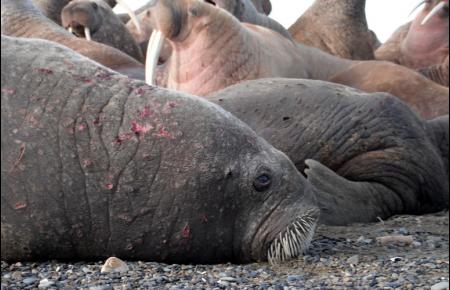
Now marine mammals, including walruses and ringed seals, are turning up dying on the beaches of Alaska and the far north.  Unidentified skin lesions and sores are the visible evidence of an unknown disease that is ravaging them.

Meanwhile, climate change is causing unprecedented surges in the populations of destructive insects like pine borers, which are killing off millions of acres of forests around the world.

I could go on, and on, and on.

Truly, Derrick Jensen is not exaggerating when he says that human civilization is killing our planet.

Last weekend I watched the new film “End:Civ,” by Franklin Lopez, based on Jensen’s book Endgame.  I had put off watching it for several weeks, because I knew it how upsetting it would be, and sure enough, it was disturbing, to say the least.

For me the hardest-hitting part of the film was about human beings’ casual tolerance of cruelty; our willingness to stand by, indifferent, as our fellow travelers on this planet are systematically hunted or poisoned or displaced to extinction.

Part of this detachment of ours may be rooted in the way we tell the stories of how these deaths occur.  We talk about “colony collapse disorder,” for example, rather than narrating the way that entire hives of bees–which are highly evolved, communicative insects–fail to return to the hive one day.

They get lost out there–maybe due to cell phone waves or other forms of chemical interference, we don’t really know–and never come home.  Imagine this happening on a global scale, a whole species of productive, social insects lost, one by one, by the million.

In the same way, it’s far easier to talk about “cancer victims” en masse than to live through the suffering death of your own loved one.  How many vibrant, creative, hardworking people have we lost to cancer the last ten years?  In the last year?  In the last month?  Wangari Maathai and Steve Jobs, to name two famous, very recent cancer victims.  The list goes on and on and on.

But still we remain passive.  We may mourn the disappearance of the honeybees or the songbirds, but we don’t make the effort to connect the dots and come to a true understanding of the extent to which our way of life has been poisoning our planet since the advent of industrialization, and especially since the beginning of the 20th century, which is when synthetic chemical production really took off.

Before she died of cancer, Rachel Carson managed to break through the wall of indifference and make the case against DDT.  Thanks to her efforts, the bald eagle and many other birds have rallied and come back from the brink of extinction.

It’s amazing how resilient life is.  If human civilization would just back off and give our natural systems on the planet a chance, they would heal themselves, and go back to providing the healthy ecological web that made our success as a species possible.

Our planet, ourselves.  We need to understand, in the deepest and most urgent possible terms, that we cannot dissociate ourselves from the poisoning and destruction that is being visited on the forests, oceans, swamps and grasslands of this planet.

The “Wall Street Awakening” cannot be only about jobs, about fixing a broken economy and continuing on our merry path of global domination and “resource extraction.”  The analysis has to go deeper than that, and the change has to be much more dramatic.

All the jobs in the world won’t bring back the walruses or the ringed seals or the polar bears.  What use will jobs be when the ocean is a giant dead zone, and industrial agriculture collapses?  Will we be worrying about jobs when the forests that provide our oxygen are all gone?

We need to focus on what’s important and go all the way this time.  As I keep saying, our future depends on it.  And I am not exaggerating.

An urgent message for the global elites: change is coming, like it or not!

America’s ‘Primal Scream’ – NYTimes.com.

It’s always nice to wake up and see the very thoughts I was writing last night trumpeted in the Sunday Review of the NY Times.  Nick Kristof cites many of the same statistics I did to make his case that income inequality is not only real, but “a cancer on our national well-being.”  

But where he ends his column wondering whether the movement will persist “once Zuccotti Park fills with snow and the novelty wears off,” I believe things are only going to get more intense as we move into this winter of discontent.

For one thing, there’s climate change looming over us.  Check out today’s big story on the fact that this imperative issue has lost traction in the U.S., even as most of the rest of the world is moving aggressively to regulate carbon emissions and develop more sustainable technologies.

It seems that the elites driving our economy believe that we can continue our comfortable insulated ride in the plush American Caddy, and let the plebes outside the walls of our national gated community deal with the unpleasantness.

How quickly we forget the major blizzard in New York City last year, or Hurricane Irene bearing down on the whole East Coast.  Climate change is only going to intensify in the coming years unless we get serious about it fast.  The natural disasters it will cause will cost far more than action to curb emissions proactively.

Unlike Nick Kristof, I don’t believe our society has a choice about whether or not to change.  We will be changing, like it or not.  The question is, will we change in an orderly fashion, through regulation and innovation that puts the common good ahead of the greedy goals of the men behind the tinted windows of those chauffeured limousines?

To me, this is what the Occupy protests are about.  The 99% are sick and tired of shouldering all the costs of our industrial capitalist way of life–the debt bondage, the toxic chemicals making us sick, the decimation of our environment wreaking havoc with our climate, the fading of the American dream–while a few fat cats sit pretty on top of the heap and enjoy the spoils.

I have news for you, global elites.  You can’t escape the impartial justice of climate change.  You should have realized by now that you will reap what you sow: if you seed our agriculture, air and water with toxic chemicals, you and your children will get cancer just like the rest of us.  If you continue to deforest the Earth at the current rate, you too will be gasping for oxygen along with the poorest inhabitants of what used to be a boreal forest.


Hiding behind police barricades in your plate-glass towers will only get you so far.  In the long run, it’s no way to live.

Come on out into Liberty Plaza with the rest of us, and let’s work together for a better life for all–while there’s still time.

What President Obama and Eve Ensler have in common

President Obama did something really, really good this week.  He sent 100 Special Ops military “advisors” to Central Africa to help local government forces get rid of the Lord’s Resistance Army, a group of crazed, vicious thugs who have been terrorizing people in four countries for as long as many in the region can remember.

The New York Times reports: “For more than two decades, the Lord’s Resistance Army (LRA) has murdered, raped and kidnapped tens of thousands of men, women and children in central Africa,” Mr. Obama wrote in a letter to Congress announcing the military deployment. “The LRA continues to commit atrocities across the Central African Republic, the Democratic Republic of the Congo and South Sudan that have a disproportionate impact on regional security.”

You don’t even want to know what kind of atrocities he’s talking about.  Joseph Kony and his men are depraved, sick torturers, rapists and murderers who have been at it so long that I doubt they can ever be rehabilitated.  They are part of a long cycle of violence in Africa that begins with the kidnapping or luring in of young children, boys and girls, who are then drugged, beaten and raped into total submission to the authority of the adults, and grow up indoctrinated into the lifestyle of terror.

For an inside story, read Ismael Beah’s memoir A Long Way Gone, or the chapter in my anthology African Women Writing Resistance by former girl child soldier China Keitetsi, whose memoir Child Soldier is available in an e-book edition.

I can’t help but think that there is an element of racism in the fact that it’s taken so long for the international community to unite behind the mission of bringing true security to Central Africa (including the Democratic Republic of Congo, where some of the worst human rights violations in the world are taking place daily, with women and girls disproportionately targeted.)

When Bosnian men were massacred, people thrown out of their homes, and women and girls imprisoned in rape camps by the Serbs, the Clinton Administration waged an all-out war to stop it.  All that and more has been happening in the DRC and neighboring countries for decades.  Decades.

Eve Ensler has done a tremendous amount to get the word out about the impact of all this violence on women, not just in Africa but throughout the world.  I particularly admire her because she has used art as the medium for her outspoken calls for solidarity and resistance with victims of rape and violence–starting with “The Vagina Monologues,” and moving on through a host of books and plays.

She’s also used digital media to get her word out and build a global movement to end violence against women, and I don’t think anyone does it better–check out her website, vday.org, to see for yourself.

Eve Ensler is a great example of a woman of privilege who has used all of her talents and gifts to reach out and help others–and not through begging, cajoling or guilt-tripping, either, but through the sheer power of her spoken and written word.

President Obama has the power to send in the military, and it’s good he’s at least taken the first step in that direction.

We ordinary people have power too, more than we often realize.  We can open our eyes to what’s really happening in our towns, our country and our world, and then allow our hearts to show us the way to action for positive social change.

There is no more urgent task for each of us in our lifetimes.  This is what we came here to do.

From brooms of resistance to guerilla tactics…let’s keep it going!

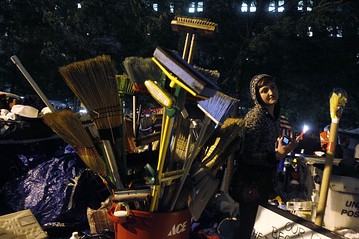
Congratulations to the Occupy Wall Streeters for making weapons out of mops and brooms and holding off the Bloomberg eviction forces!  A major victory!  I wonder when was the last time Bloomberg held a broom–probably so long ago he couldn’t conceive of such a strategy of resistance.

Looking out on this rainy, cool morning, I can’t help but wonder what’s going to happen when the cold winds of winter start to blow.  Those of us supporting this movement from the comfort of our homes don’t want to see the protesters getting frostbite out by the Wall Street bull!

I saw a great suggestion this morning: why not turn the Occupy movement into a guerilla resistance, with daily occupations happening in designated strategic sites all over the country, the occupiers called in via cell phones and social media?  A movement like this would have the flexibility of motion, and would be able to respond to current events.

It could also be fun–like the spontaneous street parties that often happen in European cities, with the partiers called in by cell phone.

Now almost a month old, the Occupy movement has done an outstanding job of waking up this nation.  Let’s keep the momentum going even as the cold winds of winter begin to blow.

Citigroup’s CEO Says He’d Be Happy to Talk With Wall Street Protesters

Pandit Says He’d Be Happy to Talk With Wall Street Protesters – Businessweek.

I think the Occupy Wall Street folks should take him up on his offer to talk!  But he should go down to the park just like everyone else, and meet the people at Liberty Plaza.  It would be a thrill for him, I’m sure, to rub elbows with the common folk, and hear his voice amplified by thousands of sets of vocal cords!

The article says that “Pandit also confirmed that Citigroup would make a profit in the third quarter, the bank’s seventh profitable quarter in a row since losing a total of $29.3 billion during 2008 and 2009. The bank may post earnings of $2.49 billion, according to a survey of 14 analysts surveyed by Bloomberg.”

I’d like to politely suggest that this income should be fully taxed….