Songs of Freedom in New York

I can hardly bear to watch this video, but I feel compelled to share it.  You need to know what is being done in your name.

The right to peaceful protest?  The right to dissent?  Right.

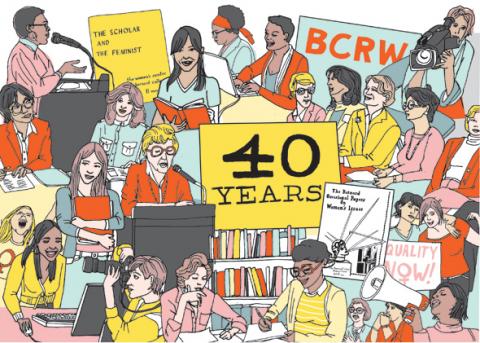
Meanwhile, up in another part of New York, I was at a conference this weekend celebrating “40 Years of Feminist Activism and Scholarship” at the Barnard Center for Research on Women.  Here all was decorous and polite–no protesters, no cops, no tight handcuffs or people being pulled down the sidewalk by their feet.

Instead we discussed “issues of translocation” in the Latino diaspora, and how there is a need for social theorists to serve as translators, transcultural workers, and border-crossers of all kinds.  Unfortunately, this information was presented in a kind of high-level theoretical drone that sucked the lifeblood out of the topic. When the presenter began to read us the annotated table of contents of her new anthology, I had to get up and leave.

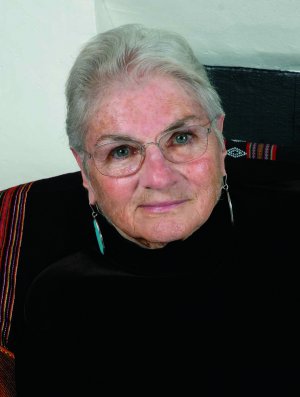
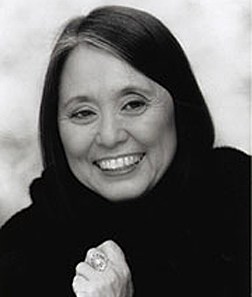
Fortunately, the panel I had organized, on “Living and Working in the Borderlands,” was up next, and it kicked us in to a whole different register.  Margaret Randall read poetry that wrenched us into the heart of the dangerous, shifting borders between past and present, safety and terror, life and death.

“They say you are not at home/until you have lived in a house/through all four seasons./What they don’t say is/you are never at home/when a part of that home/has been taken.” —As If the Empty Chair: Poems for the Disappeared, p. 20

Ruth Irupe Sanabria followed, reading her powerful poems about growing up in the long, sick shadow of the terror that marred her childhood in Argentina during the Dirty War.  Reading a poem about how the violence visited on her parents, political prisoners during the war, was reenacted in her own childhood, Ruth choked up, and I could not help but think of the first-trimester fetus curled in her womb, choking as well in this legacy of pain.

Finally the youngest of us spoke, my current B.A. student Michelle Gonzalez, who described her struggles to come to turns with all the jagged fault lines that mark her own identity.  Her honest self-exploration led us into a thoughtful, engaged discussion with the audience on how one’s location in the borderlands, whether chosen or imposed, can be both a spur and a hindrance to creative freedom.

There is a temptation to see a continuum in this, a continuum of creative protest going from the poet who writes in the blood of her own passion to the passionate young protester who is not afraid to put her body on the line and submit to the manhandling of the police.

One thing for sure is that the kind of jargon-laden social theory expressed in the keynote speech seems more and more clearly to be completely beside the point.  What is the good of talking about people’s struggles for freedom, self-determination and dignity in words they would not understand, on a platform to which they will never have access?

There is a reason that song lyrics continue to resonate with the young.  We may not all read poetry, but most of us do listen to music.  Simple, direct, powerful words are the ones that will stay with us, and perhaps even move us to action.

What songs do you hum to give yourself the courage to go on?  What songs might break through the spell of the men in blue and remind them who they are supposed to be working for?

I’ll end with the voice of a martyr for political freedom, Victor Jara, savagely murdered by the Chilean goon squad while still valiantly trying to sing his songs of peace:

It’s up to us now to keep his song alive.

Activist strategies for the times we live in: Flying under the radar

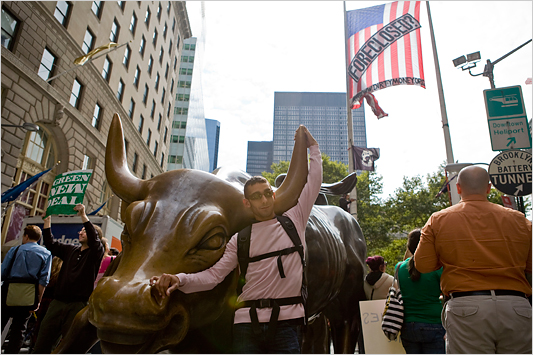
Josh Haner/The New York Times)

Some good old-fashioned protesting went on in lower Manhattan today, with folks coming out to tell the Wall Street tycoons and corporate elite that they do not rule unopposed.

Protests like these are a good thing, like online petitions and letters to Congressmen or to the editor.  But they’d have to get a lot bigger and fiercer to really create change–as they did in Egypt and other parts of the Middle East in the past year.  Things have to get ugly.  People have to get hurt.  It’s so much easier to just stay home and try to make the best of it.

I am really doing a lot of puzzling lately over what kind of protest movement would be most effective for the times we live in.  On a spectrum from the riots in London to the dignified sitdowns in front of the White House this fall, it seems like something inbetween is likely to get the most attention.

But it has to be a BIG movement.  The powers that be will not listen to a few hundred protesters, or even a few thousand.  It has to be big and national and coordinated, like the Civil Rights protests were.  Although there are a few movements going on now that are national, or even international–for example, Moving Planet, scheduled for next Saturday–there’s still nothing on the horizon that has anywhere near the draw power of, say, Monday night football.

So maybe protests are not the way to go, at least not until people are really hungry and desperate, at which point it might be much too late for any kind of harmonious transition to a new planetary paradigm.

Margaret Wheatley, whose work with the Berkana Institute I admire greatly, thinks that we need to think about leadership in a different way than we’re used to.  Instead of waiting for a charismatic leader–say, the next Martin Luther King Jr.–to step up and lead us all to sweeping changes, we need to think smaller and more locally, focusing on what we ourselves can accomplish within our own spheres.

“The process that creates change in the world is quite straightforward,” she says. “We notice something that needs to be changed. We keep noticing it. The problem keeps getting our attention, even though most people don’t notice that there’s even a problem. We start to act, we try something. If that doesn’t work, we try a different approach. We learn as we go. We become very engaged with the issue, spending more and more time on it. We become exhausted by our efforts, but still we keep going. The issue keeps calling to us. Any time we succeed, no matter how small the success, we gain new energy and resolve. We become smarter as we learn more about the issue and understand it better. We become more skillful at tactics and strategies. As we persevere, and if we are successful, more people join us. Sometimes we remain as just a small group, sometimes we give birth to a movement that involves tens of thousands, perhaps millions, of people.

“This is how the world always changes. Even great and famous change initiatives begin this way, with the actions of just a few people, when “some friends and I started talking.” Including those efforts that win the Nobel Peace Prize.”

So maybe each of the few hundred protesters gathered in New York City should go home to their own communities and continue to agitate locally against corporate monopolies and the stranglehold of Wall Street on Main Street.

Maybe someone decides to find out more about local currencies like BerkShares, and starts a movement to create a local currency or a time bank in her town.

Someone else decides to work with young people in his town to create a community garden that will bring fresh produce into the elementary school cafeteria.  Another group goes home and decides to file for a license for a low-power radio station, like WBCR-LP here in the Berkshires.

What we need now are a million local actions, all animated by the desire for community resilience, collaboration and service to the common good.  Put together, they’d make up a mighty movement for change.  But for now, I think they’ll be more effective staying small, local and under the radar.

Who needs those riot police coming around anyway?

On Becoming a Statistic

I have never felt like such a statistic as I do now.

As of the past few months, I have lost a job, and the health insurance that went with it; gotten divorced and become a single mom; and so suddenly found myself the proud possessor of a mortgage I can no longer afford.

The full catastrophe.

I take some small measure of comfort from the knowledge that it is not just me.  Women have been hit harder in this recession than men, and single women, especially single moms, worst of all.

“In today’s economic and political climate, women are being dealt a triple blow,” says Anika Rahman, President and CEO of the Ms. Foundation for Women. “Indeed, what was once termed a ‘mancession’ is now a ‘womancession.’ Women are losing jobs faster than men because of drastic cuts in areas like education and health care where they make up the majority of the workforce. As the majority of state and local public-sector workers, women are affected most by attacks on public-sector unions. And women suffer most from cuts to social services because they’re more likely to be poor and care for children and the elderly.”

As a matter of fact, the job I lost was in the public education sector. I taught for nine years at SUNY Albany as a Lecturer in Humanities (ie, a salaried professor on a three-year renewable contract), and I was a member of the union, United University Professionals (UUP).  Because it is very difficult for the university to fire individual union members who have been performing well in their jobs, the administration decided, in the interests of saving money, to terminate my entire program, an innovative first year “living & learning” community that had just been shown by external reviewers to have positively impacted students’ success rate at the university.

The administrators I talked with about the program termination made no bones about the fact that it made better financial sense for them to fire a salaried worker like me and hire a few adjunct professors instead.  Why would you pay someone a living wage and benefits when you can get away with paying someone else a pittance with no benefits?

Sadly this is the state of our higher education system these days.  At least 50% of college and university teachers are now adjunct; at many places, including Harvard and my alma mater, New York University, some 70% of the professors are employed on an adjunct basis.

And we’re not talking about graduate students; we’re talking about people with doctorates, who have worked very hard and spent a lot of time and money to attain the highest degree in their discipline, now reduced to working on a semester-to-semester contract, generally for about $4,000 a course (much less at community colleges), with no benefits.  And no end in sight.

So here I am, living in a house I love bought just before the housing bubble burst, when I was married to a man with a decent job, and working two jobs myself–a house that my current income will not cover.  I am lucky that I have the other job to fall back on; but because I worked two jobs all those years, I am still only part-time at Bard College at Simon’s Rock.  I have two teenage children to support, financially and emotionally, at a time when I myself feel like the one needing support.

There is no doubt that I am one of the lucky ones.  Coming even this close to the edge makes me empathize all the more with the millions of Americans, especially women, who are having to roll with the punches of unemployment and economic contraction.

The stresses on the family are huge.  How many men and women are turning up at the doctors’ office begging for anti-depressants to help them get through the day, or drinking too much, or simply zoning out in front of the TV set in order to escape a crushing reality?  Domestic violence is on the rise; so is suicide.

Listening to the political debate over jobs infuriates me because the whole discussion is so superficial.  We need more than a “stimulus” in our society.  We need more than “shovel-ready” jobs.  We need more than an extension of unemployment benefits, or even a restructuring of our tax system.

What we need is to put the soul back into our social relations.  We need to think deeply, as a society, about our priorities and goals.  Do we really want to become a society where the elite managers live in luxury and ease behind heavily guarded gates, while the masses toil miserably on the edge of ruin, and the prison populations grow ever larger, serving the function of Scrooge’s infamous “workhouses”?

We live in a country, and a world, that is rich in natural resources and talented people.  With proper stewardship, there could be enough for everyone to enjoy a decent existence on this planet, a life lived in dignity, with meaning and reward found in service to the common good.

Where is the social movement that will mobilize people like me to stand up and insist on a better future?  Who will throw the spark that ignites the fire for change?

9/11–Let’s Get Real!

All right, I have to say it.  I find the coverage of the 9/11 10-year anniversary nauseating.

The way we are collectively wallowing in our victimhood, while at the same time celebrating our oh-so-macho response to being attacked.

The way so few voices are talking about the reasons for the anger that launched those pilots at the US; the money that funded them; the horrendous aftermath of the attack, in which we rattled our sabers, swore vengeance against the “axis of evil,” and started a war in Iraq that cost hundreds of thousands of people their lives.

The way we aren’t talking about the corporate capitalist policies of exploitation and greed that led to widespread misery in the places where Al Qaeda operatives like to hide, places where starving parents opt to send their sons to the madrassa so they can eat, not knowing or caring what kind of indoctrination may be occurring between bites.

The way we aren’t talking about the indoctrination our children are getting here in our schools, through the sanitized version of the 9/11 story, in which the U.S. is always the good cop, policing the rest of the world in a superior and politically correct manner.

No one ever mentions anything about our status as the largest military operation in the world and the largest exporter of guns and military hardware—the biggest fomenter, therefore of violence on the planet.  How could we naively expect that this violence would not come home to roost?

And now those same policies of profit-seeking callousness have reached their limit in the natural world, and the violence we have wreaked on our environment can and will return to bite us—in fact, it is already visible in the erratic weather patterns of global warming, leading to natural disasters and food instability even here in the heart of Empire.

Instead of the obsessive repetition of schizophrenic patriotic self-congratulation alongside whining victimhood, we aren’t we talking about what really matters: moving forward in a way that radically changes the culture, both national and international, that produced 9/11?

Until we begin to have this forward-looking conversation, in which all the cards are put on the table and no credible way out of the morass of violence, greed and destructive exploitation is ignored, we will be stuck in a sick Groundhog Day of our own making, with no way to stop the repetitive madness.

I don’t know about you, but I want to wake up to a new day.

9/11 beyond the hype: What are YOU going to do about it?

Someone asked me today, What do you remember about 9/11?

I remember that at the moment the Twin Towers were hit, I was walking down to the Simon’s Rock College Center from the parking lot, on my way to my morning class—Sophomore Seminar.  It was a gorgeous September day, cool and bright.

My first indication something was wrong was inside the College Center, where there was a strange aura of people scurrying around, consulting with each other in the halls.  I quickly caught on to what at first seemed like a malicious rumor: a plane had hit the World Trade Center.  An accident?

But then no—a second plane had hit.  And the building was on fire.  People were jumping out of windows.  It was a terrorist attack.  Another plane had been hijacked.

And so, within an hour, the whole ghastly event unfolded.  The world that had seemed so safe, predictable and sane to me just minutes earlier, rocked crazily on its axis.

I met my students in the classroom, told them the news, and we all went over to the Lecture Center to watch CNN on the big screen.  The beautiful sunny day faded into the darkness and virtual screenlight.  The towers, falling over and over.  The people, jumping out of the flames to their deaths.

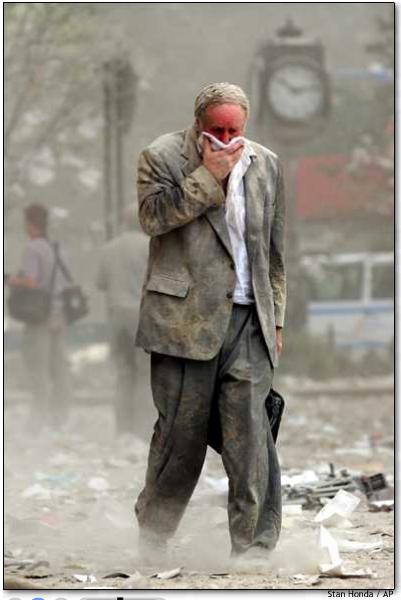
The firefighters, covered with eerie white ash.  The streams of people walking uptown, away from the Towers, like refugees leaving the scene of a genocide.

Manhattan is my hometown.  I have many memories of visiting the Twin Towers.

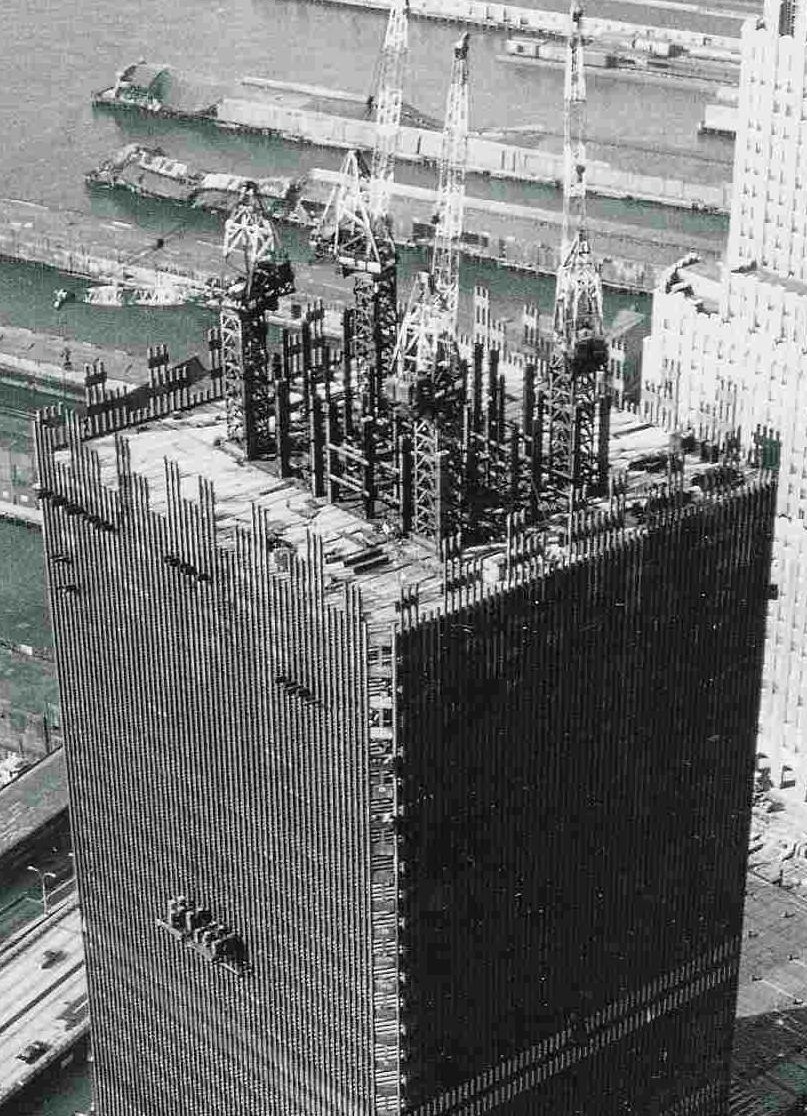
As a child, I remember when they were built, two identical towers rising on the skyline, bristling with huge cranes rendered tiny by distance.  I remember riding the elevator to the observation deck, the sick, scary feeling in my stomach as the elevators accelerated to a speed I didn’t want to fully imagine.

The wind up there, laden with the faint salty tang of the nearby sea; the tourists pointing cameras at the Statue of Liberty, or uptown at the rows of orderly buildings broken up by the green oasis of Central Park.

I have very fond memories, too, of eating dinner at Windows on the World, and the even more exclusive Cellar in the Sky, restaurants that my parents took me to for special occasions, like my 20th birthday.  At Cellar in the Sky, in addition to the fabulous food, you would get a different exclusive wine for each of seven prix fixe courses, ending up with a deep snifter of fine cognac with dessert.  We would leave the restaurant tipsy and glowing with a sense of well-being, the animal satisfaction of being relaxed and truly well-fed.

All gone, after 9/11.

What I lost on 9/11 was far more than just a physical place holding pleasant memories.  I lost my naïve belief that bombings and terrorist attacks only happened somewhere else in the world, never in my hometown.  I lost my sense of privileged aloofness from the rest of the world.

Mind you, by 2001 I was already a college professor, had already finished a dissertation that focused on personal narratives by human rights survivors from Latin America and the Caribbean, as well as North America.  I should not have been so naïve.

But somehow, until the Towers crumbled, it did not fully hit home to me how inevitable it was that the arrogance of American imperialism abroad would boomerang back around to hit us.

And it certainly did not occur to me that this strike would be used to initiate a regime of “homeland security” that brought our country closer to fascism than we had ever come before.

Ten years later, I am still feeling the pain that spread out from Ground Zero like the low ringing of a gong.  It is the pain of all of the peoples exploited by American-led capitalist imperialism, for whom World Trade is synonymous with oppression.  It is the pain of the widows, widowers and orphans, left not only by the terrorist strikes, but also by the ensuing vengeful wars in Iraq and Afghanistan.

The pain only deepens as I begin to understand the extent to which the effects of Western imperialism have hurt the natural world, and destabilized the delicate ecological balance that has made our planet so fruitful.

9/11 hurt America, yes.  But America has been a leader in a global assault on our planet, on a scale that dwarfs the Al Qaeda strike.

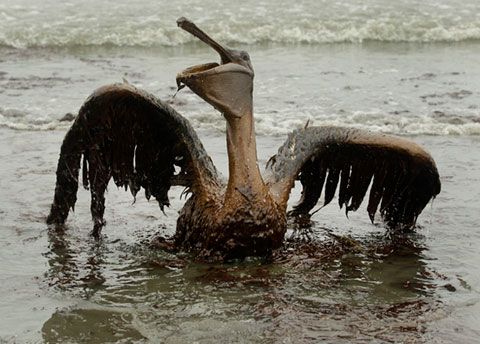
 I would never support Al Qaeda, or its methods.  But neither can I support American-led corporate capitalism, with its chemicals and clear-cutting, its cowboy swagger as regards regulation, that has inflicted us with BP-style disasters replaying again and again in excruciating, devastating slow-motion.


What I lost on 9/11 was the sense that none of this had anything to do with me as an individual.

9/11 launched me on a difficult period of self-reflection, in which I realized the extent to which my own privilege as a member of the ruling elites had blinded me to my complicity in the oppressive system that spawned the anger that led to the World Trade Center attacks.

Once you realize your own complicity, you can either wallow in unproductive guilt, or you can roll up your sleeves and resolve to do whatever you can to make a change for the better.

History has shown us that it is the insiders–the wives, sisters and daughters of the masters of the universe—who have tremendous power over the men who love them.  In our day and age, women too can be “masters”—that is, members of the ruling class who control our society.

I think the question for us, ten years after 9/11, is a simple one.  What are you going to do about it?  Are you going to support the status quo, which may benefit you and your family greatly, but which ultimately leads to greater social instability, through political and environmental vulnerability?

Or are you going to be a change agent, someone who is not afraid to speak truth to power and insist on positive change?

On 9/11, there is no more important question to be asking ourselves.

Labor Day 2011: in which we watch capitalism dig its own grave, and plant the seeds for a better world

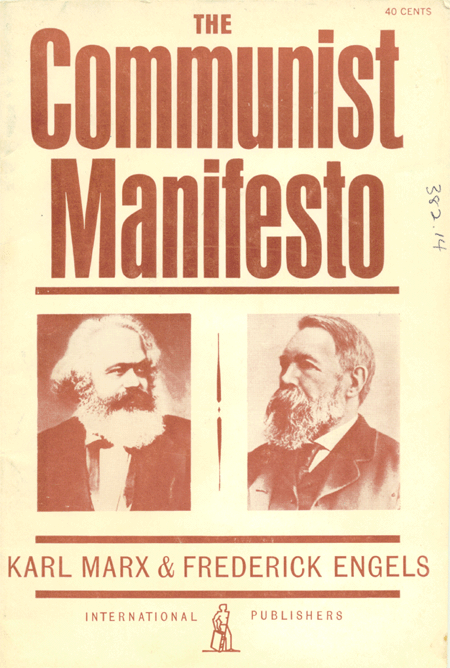
On Labor Day, my students and I discussed “The Communist Manifesto” by Marx & Engels.  We found the Manifesto remarkably prophetic, describing corporate globalization to a T long before either word had been invented, as well as the recurring, ever-more-destructive cycles of boom and bust that Marx predicted would cause capitalism to “dig its own grave.”

We talked about how Marx didn’t envision the final limit to growth being the carrying capacity of our planet, and how the climate crisis may be what finally does the job of sending capitalism over the edge.

But no one could muster much enthusiasm for Marx’s conviction that the proletariat–ie, working folks–would then rise, take over, and make the world a better place.

Looking at the disastrous social experiments in the USSR, China and Cuba, it’s hard to put much credence in Communism as a viable alternative.

It’s also hard to imagine that a social system led by the working class would automatically be any better than the one we have now, dominated by the technocrats and financiers. We’re all human, after all.

Human in our failings–but also human in our creative power to envision new possibilities.

We finished off Labor Day at Simon’s Rock yesterday by having the whole Sophomore class gather to watch “Metropolis,” a visionary film that shows how a young man from the ruling elite is moved by love to become the “heart” that joins the “head”–the technocratic elite–and the “hands,” the workers who actually do the physical labor that makes the vision a reality.

In the allegory of the film, this young, well-educated man provides the missing link, compassion, that can heal a society that has become terribly unhappy in its alienation–the coddled rulers as unhappy, apparently, as the oppressed workers.

It has always been the case that the educated elite have a powerful role to play in social change, if our action springs from the heart.  To survive the coming cataclysms of the 21st century, humanity is going to need all its technological prowess, joined with the age-old wisdom of the peoples who have never embraced western “civilization,” who still know how to make subsistence a happy and healthy way of life.

Head, hands and heart, joining in the common goal of survival.

There are groups now who are forming these kinds of alliances and working actively to create the path towards a sustainable future.  For instance, the Pachamama Alliance, and all the groups who worked on creating the Earth Charter.

The only way capitalism is likely to survive climate change is if the economic elites crack down on the masses with military power–mind controlling hands in heartless fashion. We’re seeing that happen now in various smaller countries in the world.

As a strategy for global domination, I don’t think it will work–it just takes too much in the way of resources.

How much better it would be to have a blueprint for planetary survival based on heart, growing out of our deep love for the natural world that created us and continues to sustain us, despite all we have done and continue to do to destabilize and destroy her.

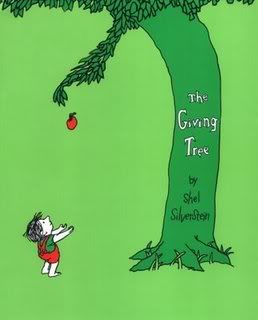
The Giving Tree is my least favorite book in the world, and I can’t imagine why parents continue to buy it for their children.  Let’s write a new book in which instead of destroying our giving tree, our planet, we nourish her and watch her grow with delight.

Let capitalism step off into the grave.  And let a new world be born, in love, light and laughter.

What happened to the Obama we elected?

If you won’t do it, Mr. President, we will!

Women + Men = Change

The other day I, along with many thousands of others I’m sure, got an email from Jean Shinoda Bolen, the psychologist and activist–author of Goddesses in Everywoman, Urgent Message from the Mother, The Millionth Circle and many other books, most of them arguing that women have a special role to play in healing the world, and urging us to get busy.

This recent email said precisely that, but with a concrete focus: Jean is advocating that the United Nations support a Fifth World Conference on Women, as a follow-up to the Fourth World Conference held back in 1995, in Beijing.  Activists have been calling for another conference since 2004–when the hope was to mark the decade in 2005 with another big event by and for the women of the world.

At this point, we’ll be lucky to get the 5WCW, as insiders call it, in 2015.  But Jean’s letter brought up some deeper questions for me.

As I dutifully signed the online petition, I wondered whether it was really worth the time, effort and money it would take to create another major world conference on women again, UN-style.  Of course, now we have UNWomen, the new and much more powerful agency for women, headed up by the fabulous Michelle Bachelet.

But still–here come the deeper questions.

  • Do women really have some special role to play in peace-making and nurturing civil society, which would be strengthened for us by getting together in a symbolic–and also very real, remember the mud in Beijing?–conference on this scale?
  • If the men aren’t there in the meeting halls with us, will they be fully invested in whatever resolutions are brought forth?
  • Can women accomplish profound, lasting social change on our own, without bringing the men along with us?

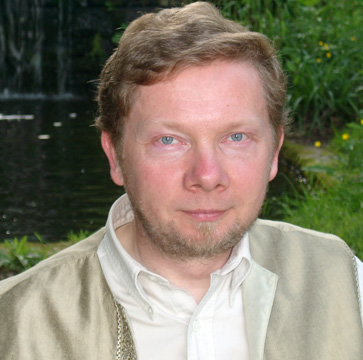
Back to Eckhart Tolle for a moment.  I was struck while reading A New Earth that he, like so many other philosophers, seems to see women as fundamentally different from men.  He’s pretty unequivocal about it:

“Although women have egos, of course, the ego can take root and grow more easily in the male form than in the female.  This is because women are less mind-identified than men.  They are more in touch with the inner body and the intelligence of the organism where the intuitive faculties originate.  The female form is less rigidly encapsulated than the male, has greater openness and sensitivity toward other life-forms, and is more attuned to the natural world.

“If the balance between male and female energies had not been destroyed on our planet, the ego’s growth would have been greatly curtailed.  We would not have declared war on nature, and we would not be so completely alienated from our Being” (155).

He goes on to talk about the Inquisition and witch-burnings, and the ways in which, in all the major world religions, “women’s status was reduced to being child bearers and men’s property.  Males who denied the feminine even within themselves were now running the world, a world that was totally out of balance.  The rest is history or rather a case history of insanity….In time, the ego also took over most women, although it could never become as deeply entrenched in them as in men” (156-57).

The post-structuralist feminist in me says “whoa, Eckhart!  You’re claiming essentialism here, that women are essentially, that is, really and fundamentally different than men. Feminist philosophers have resisted this because so much oppression happened because women were said to be fundamentally different than (and lesser than) men. Do we really want to go there again?”

But then there are many older feminist camps, including the “goddess within” folks like Jean Bolen–and Audre Lorde, and Alice Walker, and Gloria Anzaldua, my heroines–who would be greatly cheered to hear this kind of admission coming out of a man like Eckhart.  He only talks about it for a couple of pages, and he makes a curious move of deflecting guilt onto “the ego,” which is oddly personified–see for yourself:

“Who was responsible for this fear of the feminine that could only be described as acute collective paranoia?  We could say: of course, men were responsible. But then why in many ancient pre-Christian civilizations such as the Sumerian, Egyptian and Celtic were women respected and the feminine principle not feared but revered?  What is it that suddenly made men feel threatened by the female?  The evolving ego in them.  It knew it could gain full control of our planet only through the male form, and to do so, it had to render the female powerless” (156).

This almost sounds like an angels and demons scenario, with demons, acting through “the ego” in each one of us, working to gain ascendancy, and being more successful in “the male form” than in women–because we women are more intuitive?  Or at least, we used to be, before the ego got to us too?

Eckhart finishes up his brief discussion of the differences between men and women on an upbeat note, saying that “because the ego was never as deeply rooted in woman, it is losing its hold on women more quickly than on men” (157).

And presumably, that means that he’d agree that women should step up and take a leadership role in helping humanity out of its current crises (environmental, economic, social) into “a new Earth.”

I think I’d have to agree.  But is convening thousands of women from all over the world in a physical place on Earth the way to go?  Or would it be a better strategy to focus on empowering women where we are, and maybe trying to do more with technology to link us so we can share strategies and become collectively empowered?

Just thinking about the amount of paper that would have to be shuffled at the United Nations to make a big women’s conference happen; and the amount of jet fuel and other resources that would have to be spent to get everyone into that one physical arena, makes me wince.

I’d rather see a series of smaller conferences, all happening simultaneously all over the world, linked by teleconferencing, with extensive, easily accessible video archives produced for later consultation.

And although these conferences would be led by women, I’d like to see men there in the audience too–and even at the podium, if they come to the microphone with their feminine half fully engaged.

Women do have something special to offer the world, but just as we need to activate our masculine side to become warrior leaders for change, we need men at our sides with their nurturing, peacemaking sides ascendant.

If we could manifest this vision, we could change the world.  For the better.

Being the change….

In many thoughtful circles around the world, Eckhart Tolle is a familiar figure.  His philosophy is encapsulated in the title of his first book, The Power of Now: it’s about the importance of living in the present, as opposed to the future and the past.  Having gotten that far in his thinking, it seemed simple enough, and I didn’t bother to read the book; nor did I pick up his latest book, A New Earth: Awakening to Your Life’s Purpose, although I was intrigued by the connection in the title between individual realization and changing the world.  Was he giving us a new version of the old adage “Be the change you want to see?”

Still, I gave it a miss until my brother, a businessman who generally has had little use for mystical reflection, began talking it up and telling me it was a must-read, that it had really made him think and act in new and positive ways.  So I brought A New Earth with me to Nova Scotia, and read it immediately following Mark Hertsgaard’s Hot.

No two books could be more different.  Hertsgaard is also talking about “a new Earth,” but his focus is on changing external reality: shifting from fossil fuels to renewables, building dykes and levees against rising waters, winning over hearts and minds so that more people commit to the struggle to keep global warming from getting to the catastrophe point, which, Hertsgaard reminds us constantly, is not far away.

Tolle, on the other hand, is entirely focused on changing internal reality: changing the way we human beings think and experience our lives.  He believes that collectively, human thought patterns can affect the external world.

“The dysfunction of the egoic human mind, recognized 2,500 years by the ancient wisdom teachers and now magnified through science and technology, is for the first time threatening the survival of the planet….A significant portion of the earth’s population will soon recognize, if they haven’t already done so, that humanity is now faced with a stark choice: evolve or die” (21).

Tolle spends a lot of time in the book explaining what he means by “the egoic mind.”  Basically, it’s the competitive, material, greedy, selfish human mindset: the mindset that gave rise to brutal colonialism and exploitative capitalism; that corrupted Marx’s concept of communism into Stalinism, Maoism and Castroism; the mindset that has categorized, subordinated and persecuted people based on their skin color, religion or ethnicity; that has made the last 5,000 years a non-stop series of wars, and has steadily exterminated millions of species on this planet.

For Tolle, it’s not a matter of shifting to some new ideology—it goes much deeper than that.  “What is arising now is not a new belief system, a new religion, spiritual ideology or mythology.  We are coming to the end not only of mythologies but also of ideologies and belief systems.  The change goes deeper than the content of your mind, deeper than your thoughts.  In fact, at the heart of the new consciousness lies the transcendence of thought, the newfound ability of rising above thought, of realizing a dimension within yourself that is infinitely more vast than thought” (21).

This dimension within us seems to be what mystics throughout the ages have tried to name—it has gone by names like “the soul,” “the spirit,” “the divine,” representing our connection to something greater than our limited human bodies.  Tolle’s methods of accessing this “new consciousness” are familiar to anyone who has even a passing knowledge of Buddhism, and indeed he draws frequently on references from Buddhist thinkers, from Siddhartha on down.  Meditate; focus on the present moment, using the breath as an anchor; when your thoughts wander to past or present, bring them back gently but firmly to the present.  Be comfortable with uncertainty; don’t insist on limiting self-definitions; drop the habitual role-playing and be authentic with everyone you meet.  Stop focusing on negative emotions, pain and violence.  Recognize your fundamental connection with all-that-is, and stop trying to control everything.

Tolle calls unhappiness “a disease on our planet” (213).  The only way for us to become happier as a species, which will automatically translate into a more balanced and sustainable future for our planet as a whole, is for humans to come to “accept the present moment and find the perfection that is deeper than any form and untouched by time.  The joy of Being, which is the only true happiness, cannot come to you through any form, possession, achievement, person or event—through anything that happens.  That joy cannot come to you—ever.  It emanates from the formless dimension within you, from consciousness itself and thus is one with who you are” (214).

OK, the skeptic in me says—sounds good, Eckhart, but do you really want me to believe that if all 7 billion of us were to start meditating and finding our inner Being, which is to say our connection with the source energy that animates our planet and our universe, we could undo the millennia of human destructiveness, including the current climate challenges?

On the other hand, isn’t that what materialists like Hertsgaard and McKibben are talking about too—recognizing how humans are an integral part of the ecological web of our planet, and acting out of this awareness?  We are not here to dominate and exploit the planet, we are here to play our parts in the great dance of life.

Cruelty, hatred and willful, excessive destruction are uniquely human—we are the only beings on this planet that engage in this kind of negative behavior.  Eckhart Tolle is right that there are more and more people arising now who recognize this behavior for the sickness it is, and are changing—starting with themselves, and moving out into the world.

Tolle’s great insight is that if we were to allow ourselves to connect with the source energy of the planet—the divine spark, the soul, the spirit that animates us and our world—we would become incapable of cruelty and brutality.  We would have evolved to another level of consciousness.  Tolle is clear about this: we must evolve, or die out as a species. 

On an individual level, there do seem to be growing numbers of people out there who recognize our fundamental connection to the web of life, and the need to change our ways of living to bring ourselves into a harmonious relationship with our environment.  However, on a larger societal level, we remain imprisoned by old structures that arose in the 18th and 19th centuries, and keep us treading the same old destructive rut.  Property rights, human superiority over animals, human comfort and consumption as an unquestioned priority, the profit imperative, the recourse to violence as a response to any challenge…all these old structures (Tolle would call them “thought-forms”) are then supported and strengthened by laws and political systems developed ages ago, that keep us knotted firmly into place.

We may be able to change individually, but how will these structures change?  History has shown that major changes like constitutional amendments, national boundaries and systemic political overhauls have come about only through violence and upheaval.  Can it really be that this time the collective power of enough of us sitting around focusing on the present and finding our inner connection to Being will do the trick?

Certainly I agree with Tolle that we would be happier if we lived more in the present moment, and were motivated by the joy of Being, rather than the egoistic desire for fame and fortune.  I just wonder whether we might get so lost in meditating that we fail to notice the tsunami that’s about to sweep us away.  Or maybe that is still being too old-school: worrying about the future, and failing to realize that the end of our human body is not a cause for grief, but rather a return to the energetic source of our planet, a cause for celebration.

Hmmm.

Let a billion ordinary heroes bloom!

Mark Hertsgaard dedicates his book Hot: Living Through the Next Fifty Years on Earth to his young daughter, Chiara, born in 2005 as the snowball of climate change began picking up momentum.  Perhaps because he has her constantly in mind as he’s working on the book, he does something science writers rarely do: he begins his book by invoking fairy tales, and returns to them several times as he goes along.

Science writers are usually at great pains to be empirical—that is, to convince us, by their impeccable sources and detailed documentation, that what they’re telling us is true.  Hertsgaard does this, of course: there are the usual obligatory paragraphs of statistics, drawn from unimpeachable sources like the Intergovernmental Panel on Climate Change, or the various climate experts he interviews.  But for me some of the strongest, most memorable passages in the book are the ones where he relies on the imaginative power of fairy tales to get his message across.

In his very first chapter, he goes back to the psychologist Bruno Bettelheim, who analyzed fairy tales in his book The Uses of Enchantment, concluding that children learn from fairy tales that “’a struggle against severe difficulties in life is unavoidable, is an intrinsic part of human existence.’ But, Bettelheim  continues, ‘if one does not shy away, but steadfastly meets unexpected and often unjust hardships, one masters all obstacles and at the end emerges victorious’” (Hertsgaard, 16).

The first fairy tale Hertsgaard writes about is E.T.A. Hoffman’s “The Nutcracker,” with which his daughter Chiara fell in love as a young toddler.  “After seeing The Nutcracker ballet onstage, Chaira began acting out the story at home.  She invariably cast herself as Clara; her mother or I was assigned to play the godfather, the prince, or both.  One day, after she and I had played the game for about the three hundreth time, I got distracted.  To my half-listening ears, the music seemed to indicate the start of the battle scene, so as the prince I began to brandish my sword.  A puzzled look appeared on Chiara’s face.  It took her a moment to realize that her father was confused.  She looked up and carefully explained, ‘No, Daddy.  It is still the party.  The danger is not here yet.’”

Hertsgaard tells this charming personal story to illustrate his point that “the party, so long and pleasurable, that gave rise to global warming is…still underway.”  For most of us, the danger does not yet seem real, so it’s hard to feel the urgency to change our lifestyles, which are after all so comfortable, familiar and, let’s face it, fun, at least for the upper crust.  Hertsgaard goes back again to the fairy tale model some pages later to put out a call for “thousands of ordinary heroes to step forward and fight for our future,” to tame the many-headed hydra of climate change.

This call echoes that of Philip Zimbardo, the Stanford psychologist who gained prominence as a young professor in the 1970s by conducting the infamous Stanford prison experiment, where he showed that if put into the right circumstances, the most ordinary young men will become fascist torturers.  After the Abu Ghraib scandal broke, Zimbardo was called upon to explain how those ordinary American soldiers could have engaged in such horrific sadistic acts.  But by then his own focus had shifted.  Zimbardo is now much more interested in examining how it is that ordinary folks step up and become heroes, because he too is convinced that our society is gravely in need of “thousands of ordinary heroes” to turn things around.

When I was about eight years old, a very powerful revelation of the destructiveness of humanity prompted me to start writing my first story.  It happened like this. We always arrived at our country house at night, and the next morning I would always get up around sunrise and go out, with great excitement, to see what was happening in the natural landscape I loved so much.

On this May morning, I was shocked to see, at the bottom of the driveway, piles of maple branches, their small, bright green, new leaves withering on the ground, sap oozing out of the cut branches—a holocaust of new life.  Shocked and upset, I raced back home to tell my mother what had happened.  I expected that she would be upset too, but instead she calmly explained, “The power company must have come to trim branches along the lines.” That was all there was to it; there was nothing to be done and it wasn’t worth getting upset over.  Her response just infuriated me more, and out of that fury my first story was born.

It was about a wood nymph named Estrella, who set out on a quest to save her forest from human destruction.  I wrote about the council of animals and forest spirits that decided that such a quest must be undertaken, and I wrote about Estrella setting off with two animal companions.  But beyond that the story petered out, because I could not imagine a solution to the problem; I couldn’t think of how a wood nymph and some animals could stop humans with chain saws.  At that age I was reading my way through all of the Lang fairytale collection, so you’d think I would have been able to invent some powerful magic to do the trick.  But I wanted a “real” solution.  I knew that the problem I was dealing with was no fairytale, it was very much of this world, and I wanted to solve it…I just didn’t know how.

Now I am realizing that in order to accomplish the deep changes necessary to create a human society that values life and harmony more than domination and destruction, the old heroic quest model will not suffice.  Like Hertsgaard and Zimbardo, I know now that we can’t wait for a hero or a charismatic leader to take up the challenge and make everything right.  We need the kind of small-scale, unheralded acts, made daily by people all over the world, not because they expect to become famous and marry into royalty at the end, but because they are committed to living harmoniously with the ecological world of which we humans are a part; because they value life, and want to live their values.

Towards the end of Hot, Hertsgaard invents his own fairytale, which I hope he actually produces as an illustrated children’s book—it’s wonderful!  I won’t give it away here, other than to observe that it’s about how a whole village worked together to throw off tyranny and create a more sustainable, joyful place to live.  There is no clever young boy outwitting the giant; no princess standing fast in the face of a dragon.  Just ordinary people—in this case, ordinary young people, since  the children lead the way—standing up to do what’s right.

Fairytales may be fiction, but as Bettelheim and so many other analysts have realized, they point the way to deep truths.  I’ll have more to say on the importance of telling new stories in future posts.  For now, let a billion ordinary heroes bloom!