Warriors for the Planet

Another summer, another war. I wonder how many summers there have been in the last 5,000 years when human beings were not occupied with killing each other?

Correction: not “human beings,” “men.”

Let’s be frank: even though there may be women in the armed forces of many countries now, war still remains a masculine activity and preoccupation. The women who serve as soldiers must adhere to the masculine warrior code and become honorary “bros,” for whom the worst insult is still be called a “girl” or a “pussy.”

AnneBaring_A_lgI have been reading Anne Baring’s magisterial book The Dream of the Cosmos, in which she gives a detailed account of the shift, around the time of Gilgamesh, from the ancient, goddess- and nature-worshipping “lunar cultures” to the contemporary era of solar, monotheistic, warrior-worshipping cultures.

In her elaboration of this shift, I read the tragedy of our time, enacted over and over again all over the planet, and not just by humans against humans, but also by humans against the other living beings with whom we share our world. I quote at length from Baring’s remarkable book:

Gilgamesh-187x300“The archetype of the solar hero as warrior still exerts immense unconscious influence on the modern male psyche, in the battlefield of politics as well as that of corporate business and even the world of science and academia: the primary aim of the male is to achieve, to win and, if necessary, to defeat other males. The ideal of the warrior has become an unconscious part of every man’s identity from the time he is a small child.

“With the mythic theme of the cosmic battle between good and evil and the indoctrination of the warrior went the focus on war and territorial conquest. War has been endemic throughout the 4000 years of the solar era. The glorification of war and conquest and the exaltation of the warrior is a major theme of the solar era—still with us today in George W. Bush’s words in 2005: ‘We will accept no outcome except victory.’ This call to victory echoes down the centuries, ensuring that hecatombs of young warriors were sacrificed to the god of war, countless millions led into captivity and slavery, countless women raped and widows left destitute. It has sanctioned an ethos that strives for victory at no matter what cost in human lives and even today glorifies war and admires the warrior leader. This archaic model of tribal dominance and conquest has inflicted untold suffering on humanity and now threatens our very survival as a species.

2014-06-15-Mission

“The cosmic battle between light and darkness was increasingly projected into the world and a fascination with territorial conquest gripped the imagination and led to the creation of vast empires. It is as if the heroic human ego, identified with the solar hero, had to seek out new territories to conquer, had to embody the myth in a literal sense and as it did so, channel the primitive territorial drives of the psyche into a Dionysian orgy of unbridled conquest, slaughter and destruction. We hear very little about the suffering generated by these conquests: the weeping widows, the mothers who lost sons, the orphaned children and the crops and patterns of sowing and harvesting devastated and disrupted by the foraging armies passing over them, the exquisite works of art pillaged and looted….The long chronicle of conquest and human sacrifice, of exultation in power and the subjugation of enemies might truly be named the dark shadow of the solar age” (118;124).

Like Baring, I see our time as a critical era in the long history of homo sapiens on the planet. There is still hope that enough of us will be able to detach ourselves from the pressures and busyness of our lives—will become conscious of what is happening to the planet and human civilization writ large—will understand that there are other ways to relate to each other and to the Earth, ways that will seem increasingly possible and obvious once we focus on them and begin to put our energies into manifesting our visions of a creative, collaborative, respectful mode of being.

Baring ends her disturbing chapter on the ascendancy of the solar warrior culture with a hopeful quote from The Passion of the Western Mind by Richard Tarnas, from which she springs into her own positive vision of the potential of our time.

“’We stand at the threshold of a revelation of the nature of reality that could shatter our most established beliefs about ourselves and the world. The very constriction we are experiencing is part of the dynamic of our imminent release. For the deepest passion of the Western mind has been to reunite with the ground of its being. The driving impulse of the West’s masculine consciousness has been its quest not only to realize itself, to forge its own autonomy, but also, finally, to recover its connection with the whole, to come to terms with the great feminine principle in life; to differentiate itself from but then rediscover and reunite with the feminine, with the mystery of life, of nature, of soul. And that reunion can now occur on a new and profoundly different level from that of the primordial unconscious unity, for the long evolution of human consciousness has prepared it to be capable at last of embracing the ground and matrix of its own being freely and consciously.’

“As this deep soul-impulse gathers momentum, the ‘marriage’ of the re-emerging lunar consciousness with the dominant solar one is beginning to change our perception of reality. This gives us hope for the future. If we can recover the values intrinsic to the ancient participatory way of knowing without losing the priceless evolutionary attainment of a strong and focused ego, together with all the discoveries we have made and the skills we have developed, we could heal both the fissure in our soul and our raped and vandalized planet” (130-131).

My heart aches for the suffering of the innocent civilians trapped in the crossfire in Gaza this summer, and for the grieving families of the passenger plane heinously shot down by warriors who were either poorly trained or just plain evil.

I am heartsick when I think about the holocaust that is overtaking living beings on every quadrant of our planet as humans continue to ravage the forests and seas, to melt the poles with our greenhouse gases, and to poison the aquifers and soil with our chemicals.

The last Polar Bear

This is where the solar cultures, with their “great” warrior kings, have led us. And yet, as Baring says, they have also presided over the most amazing advances in science and technology that humans have ever known in our long history on the planet.

We don’t need or want to go back to the simple innocence of ancient lunar societies. We don’t have to bomb ourselves back into the Stone Age.

What we need is to go forward, wisely and joyously, into a new phase of consciousness, in which the masculine warrior spirit is used for protection and stewardship rather than destruction, and the Earth is honored as the Mother of all that she is.

Never let anyone tell you it can’t be done. It is already happening.

Will All The Good Fathers Please Stand Up?!

It’s Father’s Day 2014, and I am distraught when I look out into the world and see the ascendancy of the kind of distorted, testosterone-driven style of masculinity that is antithetical to good fatherhood.

A good father, in my book, uses his strength, wisdom and social capital to protect and empower his own and others’ children. He is rational and clear-thinking, but also not afraid to own his emotional side, to display his loving, nurturing nature. He is constructive in his social engagements, and tries to think ahead to ensure that his family, and by extension his society, will be as safe and prosperous in the future as they are currently, under his wing.

A good father uses his physical strength, or picks up weapons, only in defense of himself and his loved ones.

A good father would never harm a defenseless child, or send one deliberately into harm’s way.

So who are these men and boys who are gang-raping innocent women in Egypt; gang-raping and then lynching teen girls in India; going on mass-murder sprees in the United States; and sending yet another generation of boys into ideologically driven wars in the Middle East?

Who are these men who are kidnapping and brutalizing whole schools full of young girls in Nigeria; shooting in the head girls whose only crime is to want an education; kidnapping and holding as sex slaves innocent teenagers who comply out of terror?

I know, and you know, that there are a lot of good men out there. We all know many good fathers, brothers, husbands, friends.

These good men are the ones who, as New York Times columnist Charles Blow wrote recently, need to stand up and insist that the aggressive, punishing, domineering style of masculinity has no place in the 21st century.

Masculine strength, absolutely. But it should be the strength of a benevolent patriarch, using his power to nourish and strengthen others.

Screen-shot-2013-12-16-at-4.18.49-PMAlthough I know President Obama has disappointed many, I still hold him up as an example of a good man: a good father, who works tirelessly to improve the world that his young daughters will be entering in the coming years, and a good leader, who has been doing the best he can to reach out a helping hand to those who need it—students, the elderly, immigrants, women. I doubt any one of us who landed in his shoes in Washington D.C. could do it better, so who are we to criticize?

On this Father’s Day, I salute all the good dads out there, including my own, and I implore you: use your social capital and power to condemn violence and destructiveness; to model and promote the peaceful, nurturing, kind human relations that the world needs now.

Of school shootings, misogyny and the dream of gender equality

The lovely Commencement at my institution this weekend was shadowed, for me at least, by the latest school shooting—the psychotic Californian kid who blew away six other kids in a highly premeditated murderous vendetta against young women who, he claimed, refused to cooperate with his sexual fantasies.

The shootings have prompted millions of social media postings and propelled the issue of misogyny on to the front page of The New York Times and many other staid bastions of male-dominated media, which only pay attention to the most sensationalized of crimes against women.

The latest high-profile cases of campus sexual assault have provoked outrage from women and the men who respect them. Young women are refusing to be muzzled by their colleges, filing lawsuits recently bolstered by the Federal government, which has ordered colleges and universities to get their act together and stop the sexual harassment and assault of women by men—or face Federal Title IX lawsuits.

Yes, imagine that—singling out women for assault on a college campus is actually a Federal crime. That this should come as a surprise is a measure of how very normalized the sexual targeting and bullying of women has become.

 ***

Lately I have been thinking a lot about how much one’s physical body matters. In an ideal world, it should not matter what kind of genitalia or hormonal make-up you’re born with. Men and women may be differently abled, but we are certainly equal in our potential for positive contributions to our society and planet.

However, we do not live in an ideal world. We live in a highly cultured world where, unfortunately, the dominant messages young people receive about what it means to be masculine and feminine are highly differentiated.

We all know the stereotypes. Manly men are strong, dominant, powerful—leaders, speakers, do-ers in the public sphere of business, government, finance, medicine, media. Womanly men are compliant, nurturing, sweet—homemakers, caregivers, do-ers in the private realm of the home and family.

Kids absorb these messages like sponges, often uncritically, especially when these are the norms they see around them in the real-life environments of their families and schools.

To live the stereotype of the manly man, a man has to distinguish himself from being a “sissy,” “pussy,” or “girl” by putting females in their place. Woman are there to serve, whether it’s mom getting dinner and doing the laundry, or a hook-up partner giving a blow job. Women wear those skimpy clothes because they “want some,” and they like men who are aggressive in “getting some.” They like the attention of catcalls and fondles. After all, the girlie-men are nerds and they never get the pretty girls.

UnknownWelcome to the imaginal landscape of the stereotypical teenage boy, reinforced by thousands of video game sessions played, movies and TV episodes watched, comedy routines and talk radio listened to.  Even in the cartoon world of super-heroes, female heroes have to wear swimsuits and show a lot of skin.

Girls inhabit a parallel universe for the most part, a soft, rosy pink-imbued landscape where romance still takes the form of a gentle, courtly but powerful knight on a white charger who will make everything all right.

Is it any wonder that when these two universes collide on college campuses, mighty rumbles and explosions result?

 ***

So to those delightful, earnest young men who keep telling me that gender is just a social construction, that discrimination against women is historical, in the past, and that today women don’t need any special attention or bolstering—I have to shake my head sadly and say simply, “I wish that were the case.”

The casual disrespect of and disregard for women runs deep and wide in our culture. For young women, it often wears the venomous face of sexual assault. For women of child-bearing age, it’s about being culturally encouraged to stay home with the kids in a career environment that is entirely un-family-friendly, resulting in effective career sabotage of women on a society-wide scale. For older women it’s about ageism in a youth-obsessed society, where it’s assumed that if you haven’t “made it” by the time you’re 40, it’s because you’re mediocre and don’t have what it takes.

Women of all ages suffer from the arrogance of the male-dominated cultural oligarchy (otherwise known by that loaded term, “the patriarchy”) that assumes that women are under-represented in Western intellectual history because they never did anything important enough (and weren’t intelligent enough to do anything important enough) to merit representation.

We got a recent example of this unthinking cultural misogyny in the two most recent New York Times columns by David Brooks, entitled “Great Books I & II,” where in all of written history the only female author who made it on to his great books list was the one who forced herself to write under a male pseudonym in order to be taken seriously: George Eliot.

 ***

There has never yet been a mass shooting by a woman. Women are far more likely to be self-destructive, turning the razors against their own arms and legs, or starving themselves as anorexics. It’s the boys who turn their rage outward, bringing down innocent people before they turn the gun to their own disturbed heads.

The truth is that both boys and girls in our culture need a lot more support than most of them get. We need to start combating the ugliness of gender stereotyping early, long before the girls start trying to conform to unrealistic body image expectations, and boys start thinking of purchasing the all-too-easy-to-obtain shotguns and pistols.

Because we live in a patriarchy, girls and women still do need extra support and encouragement to raise their voices against discrimination and cultural sabotage, to insist on equal treatment and respect in every social sphere.

We are an imitative species—we learn by observation. Every adult should be conscious of the need to set a good example for the young people in our lives, and that includes the adults—mostly men at the moment—who control that incredibly powerful educational system, the media.

Boys and girls need to see men and women relating to each other in responsible, respectful ways, in the media and in the flesh. If we could accomplish this, then maybe we could cry victory and declare unnecessary the need for Title IX and affirmative action protection of women, as well as the kinds of work I do in support of women and girls through my teaching, writing and activism.

I hope that day does come soon…it’s clearly not here yet.

Who’s Got the Balls to Take the Porn Industry On?

Could it be that the pornography industry has something to do with women’s continuing struggle for equality and respect?

Brig. General Jeffrey Sinclair

Brig. General Jeffrey Sinclair

So it would seem from the case of Brig. General Jeffrey Sinclair.

It was not surprising to learn that a military judge accepted General Sinclair’s strategy of pleading guilty to lesser charges in exchange for the dismissal of far more serious counts, including violent sexual assault, that could have put him behind bars for life.

According to the New York Times,  “General Sinclair formally pleaded guilty to mistreating his former mistress — an Army captain — as well as disobeying a commander’s order not to contact her, misusing his government charge card, and using demeaning and derogatory language about female staff officers.”

In exchange, military prosecutors dropped the more serious charges that “General Sinclair twice sexually assaulted his former mistress by forcing her to have oral sex, threatened to kill her and her family if she revealed their affair, and engaged in consensual but “open and notorious” sex with her in a parking lot in Germany and on a hotel balcony in Arizona. Those charges could have led to life in prison for and registration as a sex offender, if convicted.”

You have to dig deeper into this unsavory story to discover that General Sinclair learned his technique for violent fellatio from the thousands of violent pornographic photographs and videos he had stored—against military orders—on his computers and other devices in Afghanistan.

Prosecutors initially tried to get that nasty porn admitted as evidence in court, but the judge refused to allow it, saying it could “taint the jury’s outlook on the trial.”  The jury, let it be noted, consisted of five generals.  All men.

In the Army, it’s illegal to possess pornography while on deployment.  It’s illegal to engage in adultery.  It’s certainly illegal for a superior officer to force a soldier to have sex.  According to the Captain, whose identity is being withheld, General Sinclair “grabbed her by her neck and shoulder and forced her to perform fellatio….It happened again some days later, she said. This time, he stopped only when she threatened to scream.”

This is precisely the kind of case that Senator Kirsten Gillibrand’s landmark legislation, which aimed to take the trying of sexual assault cases out of the hands of the military, was designed to address.

Imagine how this case would be different if instead of a colonel as judge and five generals as jury (judge and jury all-male), the court case was tried by a civilian judge and a jury composed of 12 men and women who were not in any way beholden to the military.

Illustration by Jerry McJunkins; fayobserver.com

Illustration by Jerry McJunkins; fayobserver.com

Of course, even civilian rape and sexual assault cases are notoriously hard to successfully prosecute.  Men still get away with minimal sentences as victims are blamed with “leading him on” or “asking for it.”  Some 97% of rapists never even spend a day in jail.

In the Sinclair case, the Captain is being caricatured as a typical “jealous mistress” who blew the whistle on the General as revenge for his inability to make any commitment to her.

But really—would any woman, let alone an Army Captain, put herself through the torments of a sexual assault trial merely for revenge?

She may not realize it now, but in refusing to be browbeaten into silence she is standing up for every military woman and every civilian woman who has had to bite her tongue and comply with abusive behavior from men with greater social status and privilege.

But the deeper question that deserves to be asked here is why it’s OK for violence againt women to be represented through violent pornography, such as that possessed by the General.

Defenders of the porn industry insist that: a) a penchant for watching violent porn doesn’t imply a desire to carry it out in real life and b) porn is just acting—it’s not real.

Tell that to the porn starlet whose throat has been bruised and battered through violent fellatio.  Tell that to the girl who is forced to have sex from behind while her head is dunked repeatedly in a toilet.  Tell that to the girl whose anus is torn apart as three men gang-bang her—“only acting,” of course.

Is this too harsh for you to read?  Does it offend your sensibilities?

I’m sorry, but I am of the opinion that if something is too horrible for us to read about, it’s too horrible for us to permit to go on in actuality.

From violent porn to factory farming, from mountaintop removal to sex slavery and lab animal torture—if it’s so bad we have to avert our eyes, then it’s so bad we have to do something about it.

I salute the tearful Captain who testified valiantly in that military courtroom, knowing that every man in the room hated her for daring to tell the truth.

Our military women deserve better.  All women deserve better!  The violent porn industry is a pus-filled abscess seething below the sight lines of society.

If we want to get a handle on why women continue to be disrespected, the multi-billion dollar porn industry would be a good place to start an inquiry.  Who’s got the balls to take those bastards on?

**The upshot, 3-20-14: the General got a very gentle slap on the wrist.  Are we surprised?  Hell no!  It is almost impossible to convict on sexual assault, at least as long as the judges and juries are all-male, with the opinion that “boys will be boys” and “she led him on….”  GRRRR!!!!!

Bypassing the Old Boys’ Club

As we move exuberantly into the second half of the 2014 Berkshire Festival of Women Writers, my mind is sparkling with memories of the powerful, indeed heart-stopping moments that have already taken place at Festival events this season.

DSCN4609Grace Rossman extending a powerful poetic hand to the drowning Ophelia in so many girls today; Ruth Sanabria impersonating both her mother and the fascist regime that unjustly imprisoned her in a fierce poem about the impossibility of stamping out the love between mother and daughter; Kate Abbott celebrating the cultural diversity of the Berkshire hills as she works quietly and steadily to make it more visible; Barbara Bonner eloquently describing the spirit of generosity that seeks and needs no recompense.

The list could go on, and it will, as the Festival continues to unfold day by day this month, and throughout the year in the on-going readings, workshops and writers’ circles that will be taking place under the Festival banner.

This is important work we’re doing together at the Festival—creating multiple entry points and platforms for women writers to step into the spotlight and shine.

The truth is, such opportunities are still all too rare for women writers, and creative women more generally.

Overall17-316x173At the end of February, just in time for Women’s History Month, the non-profit, all-volunteer group VIDA published its annual Count, revealing the continuing disparity between men’s and women’s voices in literary and upscale magazines and journals.

Overall14-316x173I invite you to take a look for yourself: the results show clearly that in literary circles (think The New Yorker, the Times Literary Supplement, The New Republic, The Atlantic, the London Review of Books, The Nation and the New York Review of Books), the old boys’ club is alive, well and holding steady at an average of 75% male voices represented in their pages over the past year.

The same is true in the film industry, the theater industry, and in the television industry. 

It’s the same in book publishing, which may be one reason why women are so interested in exploring new opportunities for self-publishing and self-promotion.

publishing_quadrant1222These days in publishing, it’s like the Berlin wall coming down—gates thought to be invincible are simply crumbling away, with their keepers revealed in all their flabby ordinariness.

Having spent far too much of my life not even trying to take myself seriously as a writer because I knew exactly how high the odds were stacked against my success, I’m excited about the DIY spirit of the new publishing landscape.

I’ve got a book that’s almost ready to launch, and buoyed by the lively, can-do spirit of the Berkshire Festival of Women Writers, I’m thinking seriously about bypassing the old boys’ club entirely and taking responsibility myself for getting my words out into the world.

No more sitting on the sidelines complaining that “they won’t let us in!”  No more waiting to be asked to dance.  No more hiding my light for fear it won’t be appreciated.

BFWW-square-logo-2014If all of us women started supporting each other and working collaboratively to create the opportunities we all need to shine, we could change the creative cultural landscape for the better, turning those red and blue pie charts a lovely shade of purple.

What a beautiful world it would be!

Bringing home the bacon and frying it up too: homage to mother-work

Jenny Laird reading on opening night of the 2014 Berkshire Festival of Women Writers

Jenny Laird reading on opening night of the 2014 Berkshire Festival of Women Writers

The theme of last Saturday’s opening night event at the Berkshire Festival of Women Writers, Out of the Mouths of Babes: An Evening of Mothers Reading to Others, was “What do mothers make?”

The answers provided by the evening’s presenters–all women at various stages of their lives–were various, but there was a common theme: mothers make families, mothers make relationships, mothers make community.

Historically, in most societies this has been the primary role given to women—to serve as the emotional heart of families, to make the meals and make the homes that lead to strong, centered communities.

These days, in American society at least, women are expected to do all this and also be successful in their professional lives.  Only the wealthiest American families can afford to have a stay-at-home parent.

In most households I know, especially among people at mid-life or younger, both parents are working hard at their jobs and also trying to sustain a healthy home life.  And in most families I know, it still falls disproportionately to women to keep those home fires banked and burning bright.

We live in a society that measures personal success by income, but puts no monetary value on homemaking, parenting and elder care.

So all those hours that women put in to keeping our families and communities strong and healthy “don’t count.”  The nation sends a pretty clear message through our Social Security retirement system, for example, telling parents and caregivers that the work we do in our homes is an unacknowledged and unrewarded second shift.

Erika Nelson, Nichole Dupont and Michelle Gillett were among those who read work responding to the question posed by host Suzi Banks Baum, "What do mothers make?"

Erika Nelson, Nichole Dupont and Michelle Gillett were among those who read work responding to the question posed by host Suzi Banks Baum, “What do mothers make?”

A recent Pew study showed that 40% of all American households with children under 18 are now headed by women who are the sole or primary breadwinners for the family.  These women are bringing home the bacon and frying it up for their families—and arranging childcare, helping with homework, and doing all the regular home maintenance too, after their “work day” is done.

And then we wonder why so many children and teenagers are struggling with mental health, including ADD, eating disorders, addictions of all kinds, depression and lack of motivation.  We wonder why women are still not gaining equal representation at the highest levels of politics and business.  We wonder why so many women step off the leadership track in their thirties, when the mothering pressure is greatest, or “opt” to choose career paths that give them some precious flex-time.

It’s time to take a clear-eyed look at a society that squeezes everything it can out of mothers as workers and doesn’t recognize or value parenting and homemaking as the essential work it is.  Is this really the kind of society we want to call home?

I end with a quote from one of my favorite writers, Aurora Levins Morales:

“Ours was the work they decided to call unwork.”

Passionate Selfies

Why is it that girls are still being encouraged to take up less space, while boys are encouraged to bulk themselves up?

In my gender studies courses at Bard College at Simon’s Rock, we inevitably spend a fair amount of time talking about the insidious influence of the media on both girls’ and boys’ self-image.

Girls receive the message that the ideal girl is thin and pale, with long blonde hair and big blue eyes.  She’s sexy but not threatening—if she’s smart, she doesn’t flaunt it the way she does her big boobs and shapely legs.

Boys, on the other hand, are rewarded for being assertive and athletic.  It’s a good thing if they take up a lot of space in the room as well as a lot of airtime in any social context.

It is no coincidence that girls are disproportionately affected by eating disorders like anorexia and bulimia—psycho-somatic illnesses marked by a distortion of one’s self-image and a manic desire to become smaller.

Girls with these eating disorders imagine themselves to be fat, a horrible three-letter word, no matter how waif-thin they starve themselves into becoming.  Bulimics binge-eat and then purge, vomiting up their meal before it can be converted to the dreaded fat on their bodies.

Anorexics just starve themselves, and often add demanding exercise regimens to the mix to make good and sure they won’t be fat.

Meanwhile, boys abuse protein powders loaded with steroids to make themselves bigger and more muscular.

Yesterday I went to see a screening of the new short film “Selfie,” made right here in Great Barrington MA by filmmaker Cynthia Wade and photographer Michael Crook, who spent a week in our local high school talking about body image and self esteem with teenage girls.

Unknown-3The girls were encouraged to take “selfies” (ie, smart-phone pictures) of themselves, daring to focus in on the parts of their faces that they liked the least.

One girl complained of the roundness of her face, another of her bushy hair, another of her red cheeks, another of her prominent nose.

But through guided discussions about body image and beauty, and the process of creating a photo show of their “selfies” and video-taped interviews of themselves and their mothers for the film, they were made more aware of how superficial it is to obsess over the places where their own human faces fall short of the air-brushed ideal.

Obviously many agree, since the film is in the process of going viral on You-Tube, with nearly a million views in the past few weeks.  The 3-minute version is up to nearly 5 million views!

Unknown-4Beauty is so much more than what we can see, the girls and the film audience concluded.  It is not about conforming to some pre-established, often totally unrealistic ideal.  How boring would it be if every girl looked like Barbie, and every boy looked like Ken?

Yesterday’s New York Times discussed the “Selfie” film, along with a new trend among adolescent girls to share “uglies,” that is, selfies that are deliberately staged to portray the self-photographer as “ugly.”

The Times seemed to think this was an advance—that girls who were unafraid to show themselves making “ugly faces” into the camera were more liberated, less browbeaten by media stereotypes.

To me, a much more profound advance would be represented by girls whose “selfies” were not about their physical appearance at all.

What if women and girls channeled all that nervous energy over how we look into our work in the world instead?

Following the screening of “Selfies,” Berkshire International Film Festival Director Kelley Vickery presented the short film SEPIDEH, which created quite a buzz at the 2014 Sundance Film Festival.  Made by Danish director Berit Madsen, the film is a documentary that follows the life of the titular teenager, an Iranian girl who grows from a young girl obsessed with Albert Einstein into a woman engaged to be married and heading to university to study astronomy.

Unknown-2In the film, Sepideh wears a hijab and no make-up.  She’s much more interested in studying and star-gazing than in making herself attractive in conformity with some pre-established ideal.

Her passion for learning and her determination to achieve her goals are paramount.  And in the end, these shining characteristics succeed in attracting to her a suitor who has every intention of helping her become the outstanding woman she is meant to be.

So should it be for every young woman.  Teenage girls should be focused on zeroing in on their passions, defining their goals, and going after them.

What could be more beautiful than a girl who knows what she wants, is fully ignited with a sense of purpose, and is pursuing her dreams at full tilt?

In the Body of the World: Cancer as Catalyst for Revolution

Eve Ensler

Eve Ensler

I have been reading Eve Ensler’s incredibly powerful cancer memoir, In the Body of the World, with my students this week.  We watched Ensler’s 2010 TED Talk, “Suddenly My Body,” given while she was still practically bald from the chemo treatments; and you could have heard a pin drop in the room, everyone was so swept away by Ensler’s passionately delivered paean to the intricate interconnections between the individual body and what she later came to call “the body of the world.”

This is a concept I have most often heard expressed in Buddhist circles.  Thich Nhat Hanh and the Dalai Lama talk about “inter-being,” and how it is egotistical, arrogant, androcentric and just plain wrong for human beings to imagine that we are somehow separate, over and above other livings beings on the planet.

Joanna Macy

Joanna Macy

Joanna Macy, extending Arne Naess’ concept of the “ecological self,” uses the body as a metaphor to describe the futility of imagining ourselves as immune from the destruction we are wreaking on our planet.

The concept of the “ecological self,” Macy says, is important now because “moral exhortation does not work.  Sermons seldom hinder us from following our self-interest as we conceive it.

“The obvious choice, then, is to extend our notions of self-interest.  For example, it would not occur to me to plead with you, ‘Don’t saw off your leg.  That would be an act of violence.’ It wouldn’t occur to me (or to you) because your leg is part of your body.  Well, so are the trees in the Amazon rain basin.  They are our external lungs.  We are beginning to realize that the world is our body” (World as Lover, World as Self, 157).

Eve Ensler has spent much of her life recovering from violence (she was a sexually assaulted and battered by her father as a child), bearing witness to violence against other women and girls, and creating powerful creative works, organizations and movements to end violence against women and girls.

And yet, she says, it was not until the jolt of realizing that her body had been invaded by cancer that she was able to overcome her ingrained alienation from her own body, born of the dissociation that was a survival tactic in her childhood.

Once she allowed herself to become fully connected with her body, it was but a short step to see the cancer in her uterus as symbolic of the much greater cancers of over-consumption and unsustainable growth afflicting the body of the world.

“Cancer is essentially built in our DNA, our self-destruction programmed into our original design—biologically, psychologically.  We spend our days, most of us consciously or unconsciously doing ourselves in.  Think building a nuclear power plant on a fault line, close to the water.  Think poisoning the Earth that feeds us, the air that lets us breathe….We are a suicidal lot, propelled toward self-eradication” (194).

But as Ensler discovers how fiercely she wants to live, to survive the cancer, she realizes that human beings are propelled as much toward life as toward death.  In a further twist of Freud’s insight into the immortal battle between Eros and Thanatos, she realizes that love is the answer—a fierce, unstoppable love for the battered, assaulted but still beautiful Earth, our mother, our home, our self.

Like Eve Ensler, I have spent much of my life focusing on the stories of women, and working to empower women to speak our truths and change the world for the better.

As I ponder the way forward now, in these end times of environmental tragedy, I am wondering whether women have a special role to play in bringing about the kind of radical social change that we need to survive into the future.

City of Joy openingEnsler uses the City of Joy, which she worked so hard to build in Bukavu, DRC (with the help of women all over the world contributing through the V-Day infrastructure), as a model for the kind of new life-giving, life-enhancing community that the world needs now.

It’s a City of Women, founded on the following ten principles:

1. TELL THE TRUTH

2. STOP WAITING TO BE RESCUED; TAKE INITIATIVE

3. KNOW YOUR RIGHTS

4. RAISE YOUR VOICE

5. SHARE WHAT YOU’VE LEARNED

6. GIVE WHAT YOU WANT THE MOST

7.  FEEL AND TELL THE TRUTH ABOUT WHAT YOU’VE BEEN THROUGH

8. USE IT TO FUEL A REVOLUTION

9. PRACTICE KINDNESS

10. TREAT YOUR SISTER’S LIFE AS IF IT WERE YOUR OWN

These seem like sound principles on which to base any human community, and particularly one founded on ashes, corpses and pain, as is the case in the Congo (but isn’t almost every human society founded, as Marx said, on blood?).

Women stay for six months at the City of Joy, during which they recover their physical and mental health with all kinds of therapies, participate in skills training, and get ready to return to their homes as leaders who can become change agents for peace and sanity in one of the most brutal and brutalized regions of the planet.

I know that there can be no lasting change that doesn’t also include men.  There can be no “City of Women” that survives past a single generation.

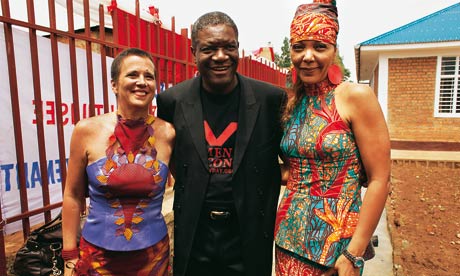
Eve Ensler, Dr. Denis Mukwege and Christine Deschryver, co-founders of the City of Joy.  Dr. Mukwege is a Congolese gynecologist who has operated on hundreds of women and girls left incontinent by tears in their vaginas due to violent rape.

Eve Ensler, Dr. Denis Mukwege and Christine Deschryver, co-founders of the City of Joy. Dr. Mukwege is a Congolese gynecologist who has operated on hundreds of women and girls left incontinent by tears in their vaginas (fistulas) due to violent rape.

I also know that it is important to recognize and acknowledge righteous anger at those responsible for all the destruction and violence.

We have to speak the truth that in the Congo, as on Earth overall, it has been men, acting with the blessing of our patriarchal religious, political, legal and social structures, who have been responsible for the machines, technologies and brutalities that have been so destructive to individual women and men, as well as to the environment without which we cannot live.

Women have often been complicit and have enjoyed the fruits of industrialization.  Women, especially privileged women, have gone along for the ride.

But it was never the vision of women that created the weapons and bulldozers, the chain saws and cars, the nuclear power plants and oil rigs.  All of those implements were envisioned, created and deployed by the men in charge of human society—especially the Europeans and their colonized offshoots—these last few centuries.

We can’t know now whether it would have been different if women had been allowed education and access to the board rooms and laboratories and congressional chambers where society-changing decisions got made, particularly during the crucial two centuries of industrialization.

We can’t change the past.  We can only look forward and, as mandated in the City of Joy’s Guiding Principles, “stop waiting to be rescued, tell the truth, and use it to fuel a revolution.”

eve-ensler-approved-photo_193x290[1]At death’s door, Eve Ensler realized that human beings and the world we have so profoundly altered are now at the threshold of a new era.

“What is coming is not like anything we have known before,” she says. “Your dying, my dying, is necessary and irrelevant and inevitable.  Do not be afraid, no, death will not be our end.  Indifference will be, disassociation will be, collateral damage, polar caps melting, endless hunger, mass rapes, grotesque wealth.

“The change will come from those who know they do not exist separately but as part of the river….You worry about germs and stockpile your herbs, but they will not save you, nor will your fancy house or gated villages.  The only salvation is kindness.  The only way out is care” (214).

I would like to quote the entire last chapter of Ensler’s remarkable memoir, but I won’t—just go buy the book and read it for yourself.  And then, as she says, “let us turn our pain to power, our victimhood to fire, our self-hatred to action, our self-obsession to service” (216).

Unknown-1Women, it’s time for us to rise and give birth to a new human relationship with the planet and with each other.  It’s past time.

Men are most welcome to join us in this life-saving mission, as long as they are men in touch with their feminine side, their life-giving, nurturing, relational side.

All of us humans possess both masculine and feminine energies and traits.  What we need now is balance.  Balance within each one of us that can become a catalyst for the balance our planet so desperately needs.

1billion-home-india

PS: Check out this TED Talk by Eve from just before she came down with cancer, talking, miraculously, about the importance of the “girl cell” in both men and women.

The jig is up for military sexual assault

No fewer than 26,000 sexual assaults were reported by U.S. military service men and women in the year 2012 alone.

You read that right.

According to The New York Times, “Pentagon officials said nearly 26,000 active-duty men and women had responded to the sexual assault survey. Of those, 6.1 percent of women and 1.2 percent of men said they had experienced sexual assault in the past year, which the survey defined as everything from rape to “unwanted sexual touching” of genitalia, breasts, buttocks or inner thighs.

“From those percentages, the Pentagon extrapolated that 12,100 of the 203,000 women on active duty and 13,900 of the 1.2 million men on active duty had experienced some form of sexual assault.”

These numbers are simply unacceptable, especially when contrasted with the small number of sexual assault cases that were officially reported (ie, not via anonymous survey)–3,374—and the abysmal rate of actual conviction: only 238 assailants were convicted in 2012.

Lt. Col. Krusinski; booking photo

Lt. Col. Krusinski; booking photo

Most embarrassing for the military brass was the arrest last Sunday of the officer in charge of sexual assault prevention programs for the Air Force, Lt. Col. Jeffrey Krusinski, who was accused of having sexually assaulted a woman he did not know in a parking lot.

Way to lead, Air Force!  Just when we thought the Tailhook scandal was becoming a distant memory.

I’m glad to see that some members of Congress—especially the women—are hopping mad and on the case, as today’s column from Maureen Dowd details.

Women who put their lives on the line to serve in the U.S. military deserve nothing but respect from their superiors and peers.

The question is, how is the military going to re-program its entire culture, from raw recruit to brigadier general, who have been raised to believe that “all women (and all gay men) want it,” that might makes right, and that superior officers can act with impunity towards those under their command?

How is the military—and, indeed, American culture at large—going to counter the billion-dollar American porn industry, that thrives on presenting women as objects of desire, yes, but also as objects of violence?

The truth is that what we’re seeing in military culture is just the tip of the iceberg of a much more deeply-rooted cultural problem.

Just as the military stood up to become the model for racial integration in the 1970s, it must now trailblaze the path to gender equality for us in the second decade of the 21st century.

Women who are now going to serve in combat, just the same as men, should not have to worry about “friendly fire” from male supervisors and peers.

To be honest, the idea of women breaking glass ceilings in the military does not thrill me.

I’d rather women work to create and broker non-violent institutions and solutions to problems.

But there is no excuse, ever, for sexualized violence against women or men.

The Lt. Col. Krusinskis of the world need to get their rocks off some other way, and the old-boy networks that have stood in the way of change on this issue have got to go.

Senator Kirsten Gillibrand, Democrat of New York, plans to introduce legislation that would take the adjudication of sexual assault cases outside of a victim’s chain of command. According to the New York Times editorial board, which supports the measure, “It would end the power of senior officers with no legal training but lots of conflicts of interest to decide whether courts-martial can be brought against subordinates and to toss out a jury verdict once it is rendered.”

President Obama said the right thing in response to the Krusinski arrest scandal, but it remains to be seen whether he can follow up his words with actions.

“If we find out somebody’s engaging in this stuff, they’ve got to be held accountable, prosecuted, stripped of their positions, court-martialed, fired, dishonorably discharged — period,” Mr. Obama said.

Got that, all 26,000 of you who committed sexual assault last year?

The jig is up.

Learning from mass murder: we must pay attention to our young men

If this past week had been written up as a movie script, I would have rejected it as totally over-the-top, beyond belief.

Two young Chechen immigrants successfully wreak mayhem and turn a city upside down with their improvised explosive devices, in the very same week that the U.S. Senate Republicans successfully beat back a bill designed to stiffen background checks for gun purchases.

Gabrielle Giffords

Gabrielle Giffords

The beautiful, brave Gabrielle Giffords publishes an impassioned piece in The New York Times, condemning the cowardly Senators who put the interests of the National Rifle Association over and above the interests of the American people.

Meanwhile, down in Texas, an explosion in a chemical fertilizer factory flattened a whole neighborhood, killing at least 15 people and injuring more than 200.  The cause of the blast is still unknown.

And the whole middle section of the country was inundated by heavy rains, storms and severe floods.

Fire, air, earth and water, all the elements seem to be drawn into an intensified dance these days, speeded up along with the 24-hour news cycle.

As the bizarre manhunt for the two Chechen bombers unfolded, and the whole country went into virtual “lockdown” in sympathy with the people of Boston and eastern Massachusetts, it felt like we were suddenly waking up to find ourselves in Baghdad.  Things like that don’t happen here.

Until they do.

boston-bomber-suspect-dzhokhar-tsarnaev I don’t have TV in the house, so I got most of my information on the situation in Boston from print media and radio.  But even the few pictures I saw were enough to convey the sense that the official response to these boys’ stupid act of random violence was hugely disproportionate.

Against a lone 19-year-old kid, thousands of law enforcement officers of every stripe were deployed, in full riot gear, toting rifles, traveling around the deserted streets in armored vehicles.

The kid was presumed to be “extremely dangerous.”

How dangerous could one kid be?

I understand that the concern was that he might have had a bomb or a suicide vest that he could detonate at the very end.

But that is not the way the story went.  In the end, he came out with his hands up, just one stupid, confused kid who surrendered to the police without a peep.

His life is over.

Ours will go on.

In the wake of this latest act of violence within our own borders, we need to take a good hard look at the role of the U.S. as a fomenter of violence, both at home and abroad.

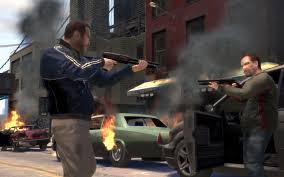
Unknown-1 Not only is the U.S. the largest exporter of arms and weaponry in the world, but we are also the biggest developer of violent video games worldwide, the ones I am betting those Chechen boys loved to play.

Why should we expect that we can promote violence by all kinds of channels, and remain immune to it within our own borders?

What goes around comes around.

If we were serious about wanting peace and security, we would start by radically shifting our focus from creating implements of destruction—be they chemical fertilizers, assault weapons or games that encourage violence—to waging peace.

Waging peace—what would that look like?

One of the most urgent tasks is to change the way young men are socialized.

Let us not for a moment forget that every single act of mass violence that has taken place here in the U.S.—every single mass shooting, every single bombing—has been the work of young men.

Young men are do-ers.  They have heroic dreams—and in Western culture, it’s the young men who can slay the dragon or vanquish the ogre who are considered heroic.

We can honor and nourish that warrior spirit in our young men in ways that celebrate heroes who use their strength and talents productively, to safeguard ordinary people.

I suspect that Dzhokhar Tsarnaev is someone who would have made an excellent warrior for good.  He was obviously smart, resourceful and could handle himself well under great pressure.

For reasons as yet unknown, he–like Newtown gunman Adam Lanza, Norway gunman Anders Breivik, Aurora, Colorado gunman James Holmes and so many other young men whose names stand for infamous mass murders—chose to walk on the dark side.

We need to be paying attention to the accelerating rate of these crimes.  They are a sign of the dark times we are living through.

Those of us who believe in peace must recommit ourselves to raising our own internal lights higher, beacons for others to rally around.  Those of us who have the great responsibility of raising the next generation of young men—parents, teachers, employers, mentors—must recognize the tremendous importance of our task.

In the past thirty years, there has been a great deal of attention paid to rethinking the way we socialize young women.  This is definitely essential work.  But we forget about our young men at our own peril.