Love in the end times

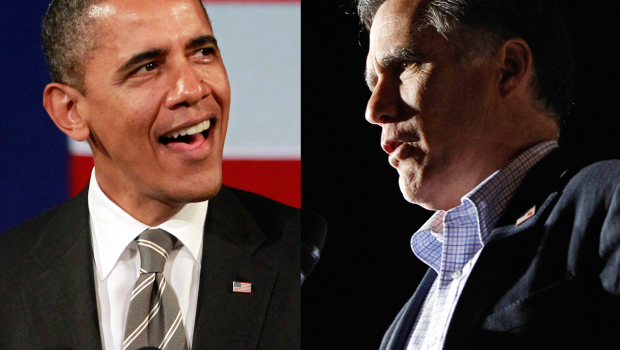
The political horserace in American politics has begun, with both Presidential candidates running full-tilt but ponderously towards each other like armored knights on horseback, wielding the lances of millions of dollars’ worth of attack ads and backed up by slick, smart campaign pages.

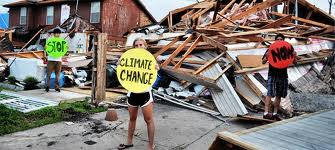
Meanwhile, it continues to be hot, hotter and unbearably hot here in the Northeast.  It was a blessing to wake up this morning to a brief soaking rain, breaking weeks of drought.

But there is no way to fool myself into hoping that things will go back to normal, weather-wise.

As many people have been saying lately, this is the new normal.

Just as we’ve gotten used to a political climate in which it’s normal for a Presidential candidate to hide his tax returns, refuse to comment on moving his millions into off-shore tax havens, and totally repudiate everything he once stood for in order to lick the shoes of his political bosses, we’re going to have to get used to a climate that lurches from one extreme to another–from blizzards to heat waves, from floods to droughts.

Those extremes also characterize the new economic normal.  These days, I’m having trouble convincing myself that the global economy that has been built up over my lifetime, since the end of World War II, is ever going to be able to function in such a way as to provide security and prosperity for the majority of the world’s people.

Maybe it never did.  There has always been a vast underclass of the disenfranchised, for whom globalization was just another name for displacement, oppression and exploitation.

The difference is that now we’re seeing a huge spike in the ranks of the poor right in the heart of what used to be called the First World—right in our backyards.

For a middle-class earner like me, it is getting harder and harder to make ends meet, and there are no substantial raises or bonuses in sight.

For the millions who are unemployed or under-employed or scraping by with under-the-table jobs in the informal economy, this new normal has got a distinctly  Dust Bowl feel to it.

Jill Stein and Cheri Honkala

The Occupy encampments have faded away, victims perhaps of effective police surveillance, infiltration and undermining.  The only Presidential candidate who has any new ideas to offer about improving the economy is the one we never see or hear on prime time, Green Party candidate Jill Stein, along with her running mate Cheri Honkala.

Most people aren’t saying much about the panic that runs like a live wire through their interior lives.

We are trying to enjoy this hot summer in the usual ways: going to the beach, having barbecues with friends and family, taking in a nice air-conditioned movie now and then.

But every once in a while a voice will break through our heat-addled stupor, crying to us to Wake up, wake up, before it’s too late!!

So, for example, we hear marine scientist Roger Bradbury shouting out from the Opinion Pages of the New York Times today, telling us to pay attention now, in these crucial last years before the planet’s entire coral reef ecosystem collapses, setting off a chain reaction of events that may very well include the starvation of millions of people, particularly in the tropics, who depend on the ocean for food.

Bleached coral

“Overfishing, ocean acidification and pollution are pushing coral reefs into oblivion,” Bradbury says. “What we will be left with is an algal-dominated hard ocean bottom, as the remains of the limestone reefs slowly break up, with lots of microbial life soaking up the sun’s energy by photosynthesis, few fish but lots of jellyfish grazing on the microbes. It will be slimy and look a lot like the ecosystems of the Precambrian era, which ended more than 500 million years ago and well before fish evolved.”

Bradbury advocates “an enormous reallocation of research, government and environmental effort” towards the “ecological engineering” necessary “to make the economic structural adjustment that communities and industries that depend on coral reefs urgently need.”

Even though Bradbury aims to be pragmatic and forward-thinking with his wake-up call, I still wonder if he’s living in a dream world.

Governments and the United Nations can’t even agree on basic protocols to begin to cut carbon emissions and pump up our renewable energy industries.  They don’t appear to give a damn about the hundreds of millions of poor, hand-to-mouth folk who are already being hard hit by climate change pressures, and they are not even willing to act when it comes to trying to assure the safe passage of the elites into the Anthropocene, air conditioners and all.

What should we be doing in these end times?  Where should we be putting our energies?

Not in the political side show of the Presidential race.

Not in the mindless distractions of our media-saturated cultural environment.

No, I believe we need to do two things above all as the world warms and our precious days of “normal” existence come to a close.

One: stay close to friends and family; strengthen the bonds of community.  We will be needing each other more than ever in the times ahead.

Two: Try to stay in the present moment as much as possible.  We humans are very good at casting our minds forward into the future, but in this case, the scenarios are only going to be pushing our panic buttons.  It’s important to stay calm and focused.

Tend the parts of the earth you can reach.  Keep your love flowing.

Governor Deval Patrick of MA Gives Exclusive Interview on WBCR-LP

How cool is it to have the Governor of Massachusetts stop by the small offices of WBCR-LP, Berkshire Community Radio in Great Barrington to give a one-on-two interview with local amateur radio show hosts Graham and Barbara Dean?

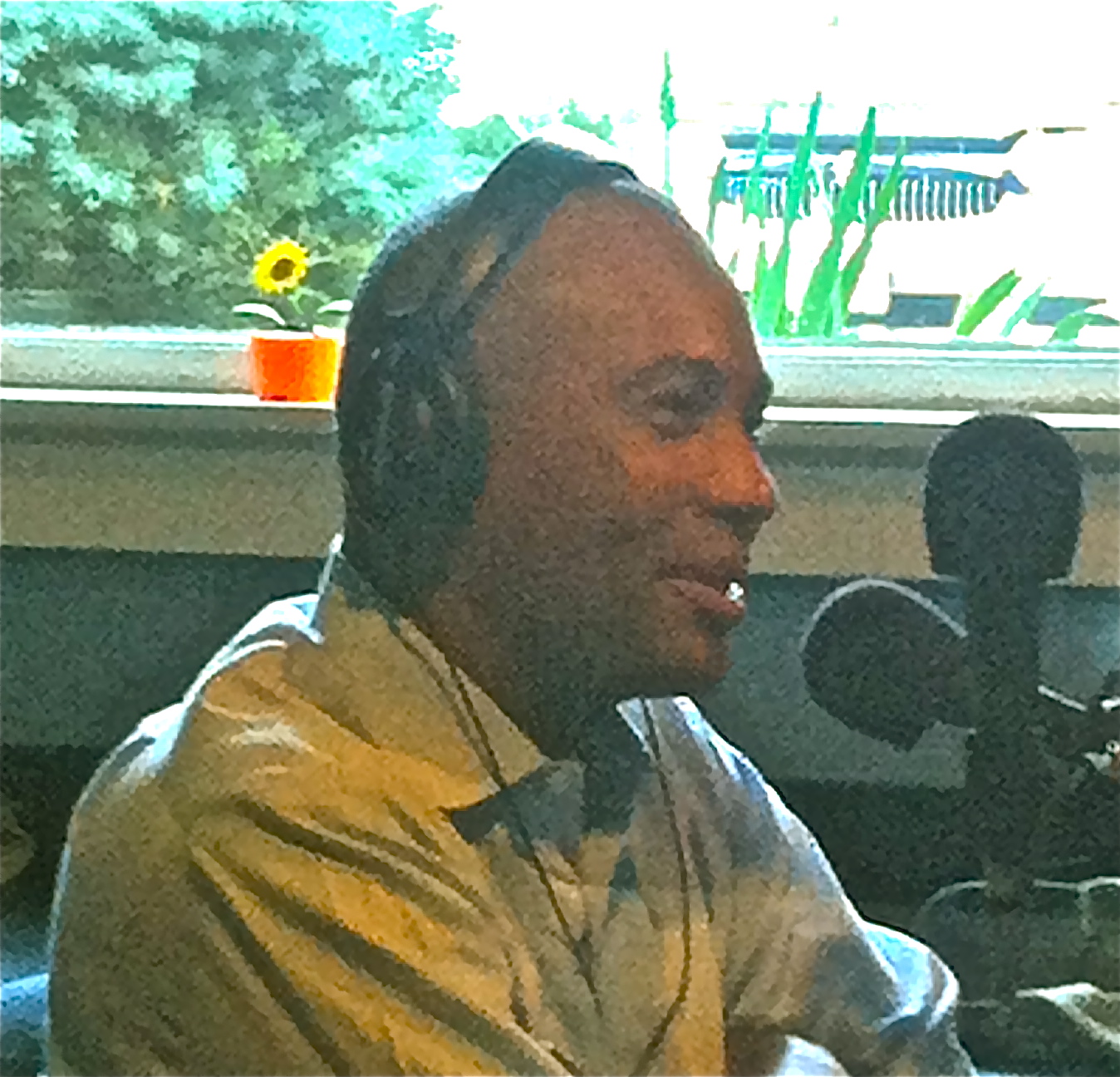
Governor Deval Patrick takes questions from Graham and Barbara Dean in the studio of WBCR-LP FM on July 3, 2012

It was citizen journalism at its finest.  Barbara, having met Governor Deval Patrick at another event, simply asked him if he would be a guest on her radio show.

He said sure, she followed up with his staff, and the rest is history!

The half-hour interview will be rebroadcast and streamed on July 11 on the Deans’ show, Common Sense Songs, between 8 and 10 p.m.

The Governor had a lot to say about the hot topics of health care affordability, education, and labor relations.

Calling himself a “labor man,” because of his childhood experience of how his mother’s life improved dramatically when she got a job at the U.S. Postal Service and joined the union, the Governor was also positive about teachers and their union, saying that the secret to an effective partnership with teachers is “respect.”

Lots of politicians talk about respecting teachers, but their actions say otherwise.

Massachusetts Governor Deval Patrick at WBCR-LP, Great Barrington

Governor Patrick seems to be different.

Under his leadership, new emphasis has been put on “bringing a culture of innovation into every school” by empowering and supporting teachers who have new ideas about how best to meet the needs of their students.

“The question is, how do we tailor education to meet kids where they are,” the Governor said, recalling his own “great public education on the South Side of Chicago.  I had inspiring teachers, who loved me and loved teaching and were thinking about educating the whole child.”

He also talked about the importance of focusing on the “whole person” when it comes to health care, and he was justifiably proud of his record in making Massachusetts one of the most progressive states in the country in terms of health care reform.

“Rather than limiting ourselves to the usual choice between doing nothing and going all the way to a single payer system, we made a decision here in Massachusetts to pick a third option, a hybrid, private, market-focused solution in which we require everyone to buy insurance, but we subsidize them if they can’t afford it,” he said.

Under the Governor’s leadership, premium growth in the state has gone from 16% per year to less than 1% increase in the past year.

It made me proud to be a citizen of Massachusetts to watch Governor Deval Patrick taking the time to give a serious, thoughtful interview on our hometown low-power radio station.

As Barbara Dean reminded the Governor at the outset of the interview, he is only the fourth African American to be elected Governor of an American state.

I am glad to be among the many who gave him my vote, and I rest easier knowing he is on the job in Boston, working for ordinary people like me.

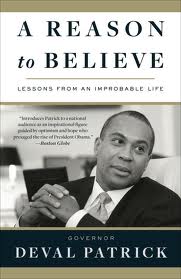
Deval Patrick just published a memoir, Reason to Believe: Lessons from an Improbable Life, and an e-book, Faith in the Dream: A Call to the Nation to Reclaim American Values.  Youthful politicians who publish memoirs often have their eye on moving up the political ladder.

I hope that Patrick has the stamina and courage to keep moving on and up in American politics.  We need more strong men like him to come forward and stand for integrity and social justice in American politics.


Grassroots heroism: what we need now

The image that stays with me most from the blockbuster superhero action film The Avengers is not the thrilling climax when the hero uses all his power to wrest a nuclear missile away from its collision course with Manhattan and up into space, where it explodes a waiting battleship of nasty intergalactic invaders—although that was pretty thrilling I have to admit, especially in 3-D!  Man, that movie packs some powerful special effects!

But no, what really struck me were the scenes of ordinary human beings on the ground, dressed in their regular 21st century civilian clothing, sipping their lattes and strolling about midtown Manhattan one moment, and the next moment being terrorized from above by sinister alien rampaging monsters and soldiers.

Without Captain America, the Black Widow, the Incredible Hulk and the other heroes, all those people would certainly have been totally destroyed within minutes—and not just by the aliens, but by “friendly fire” as well.

This scene resonates with me on two levels.

On the one hand, it goes to show yet again how quickly an apparently normal, peaceful morning can turn to nightmare when militarized violence shows up unexpectedly.

And on the other hand, it underlines how deeply dependent we human beings are on the idea of the charismatic leader, the savior, the hero who will leap into action and save the day for us.

This has been true since ancient times, and it appears to be cross-cultural: every culture has its heroic myths and legends, in which men and women with superhuman strengths and powers do battle with dark forces on behalf of the rest of humanity.

Watching politicians of The Avengers decide to send a nuclear missile to destroy the entire city in order to kill off these alien soldiers, an order that their general resists but an ordinary pilot obeys, I am uncomfortably reminded of how much danger we are probably all in, every day, thanks to decisions made by the men in charge, who sit in remote splendor in faraway bunkers like the gods on Mount Olympus of old.

I want to see a movie made that points the way to a different model of heroism.

Instead of the superhero, David against Goliath type tale, I want to see, on the big 3-D screen with all the lavish special effects and brilliant actors, a tale that celebrates the ordinary heroism of people on the ground, who—understanding the danger of militarism and the mechanized violence that pervades human civilization, from agriculture to energy to education and entertainment—come together to offer whatever skills, talents and gifts they have to the common pool of resistance.

In this movie, the human beings would not cower on the ground while the battle of the titans raged overhead; they would not sink to their knees before the might of an alien invader; they would not follow blindly wherever the men with guns and uniforms told them to go.

Instead they would use the power of their collective will and determination to demand a change of course, and insist that it happen.

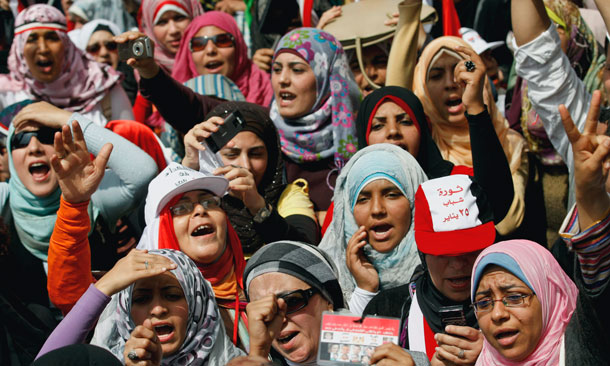
What I want to see celebrated on the big screen is the kind of grassroots resistance that we saw on the ground this past year in Egypt and other Arab Spring hotspots, or in the General Assemblies and protests of the Occupy movement.

Egyptian women protest in Cairo, April 2011

It is happening already in real life.  Hollywood and Marvel Comics, maybe it’s time to break with the fixation on the past and try a new story.

Help Wanted: Strong Leadership on Climate Change, Starting Immediately

Now if only President Obama could show the same leadership on climate change as he has just demonstrated on the divisive same- sex-marriage issue.

The same narrow-minded interests that made same-sex marriage such a boogeyman for the President are also controlling the GOP-dominated boardrooms of Big Oil, from Mr. Cheney on down.

These people seem to be motivated by one thing only: the bottom line.  And they seem to be able to think only as far as a quarter or two ahead.

They don’t see that they are driving us as fast as possible over a cliff from which there will be no recovery.  Or maybe they see, but just don’t care.

It was with great appreciation that I opened up The New York Times Opinion pages today and saw the indefatigable James Hansen offering the lead op-ed, once more displaying his vision and leadership in 1) insisting that the comfortable NYT readers pay attention to the imminent and grave threat of climate change, and 2) offering a practical solution for bringing about the swift change of course we need to avert disaster.

Those of us who have been thrown into gloom by the prospect of Canada scraping down the boreal forest to exploit their tar sands will be somewhat heartened by the strong language Hansen uses to condemn this approach to “solving” the peak oil crisis.

Alberta, Canada: from boreal forest to tar sand devastation

“Canada’s tar sands, deposits of sand saturated with bitumen, contain twice the amount of carbon dioxide emitted by global oil use in our entire history. If we were to fully exploit this new oil source, and continue to burn our conventional oil, gas and coal supplies, concentrations of carbon dioxide in the atmosphere eventually would reach levels higher than in the Pliocene era, more than 2.5 million years ago, when sea level was at least 50 feet higher than it is now. That level of heat-trapping gases would assure that the disintegration of the ice sheets would accelerate out of control. Sea levels would rise and destroy coastal cities. Global temperatures would become intolerable. Twenty to 50 percent of the planet’s species would be driven to extinction. Civilization would be at risk.”

This is not some crazy Armageddon-spouting evangelical talking here.  This is James Hansen, senior scientist and director of the NASA Goddard Institute for Space Studies.

The way to head off this catastrophic scenario, as Hansen and many other scientists have been telling us now for at least a decade, is to reduce our use of fossil fuels.

It’s not rocket science, it’s common sense, and Hansen has an easy, no-nonsense solution for forcing Americans to change our ways and start doing what we have to do to save our planet and our civilization.

“We should impose a gradually rising carbon fee, collected from fossil fuel companies, then distribute 100 percent of the collections to all Americans on a per-capita basis every month. The government would not get a penny,” Hansen says. “This market-based approach would stimulate innovation, jobs and economic growth, avoid enlarging government or having it pick winners or losers. Most Americans, except the heaviest energy users, would get more back than they paid in increased prices. Not only that, the reduction in oil use resulting from the carbon price would be nearly six times as great as the oil supply from the proposed pipeline from Canada, rendering the pipeline superfluous, according to economic models driven by a slowly rising carbon price.”

As Hansen observes, in practice what we have been doing is just the opposite: “instead of placing a rising fee on carbon emissions to make fossil fuels pay their true costs, leveling the energy playing field, the world’s governments are forcing the public to subsidize fossil fuels with hundreds of billions of dollars per year. This encourages a frantic stampede to extract every fossil fuel through mountaintop removal, longwall mining, hydraulic fracturing, tar sands and tar shale extraction, and deep ocean and Arctic drilling.”

These subsidies must stop.

Canada and the US must stop playing poker with the future of our children and our planetary epoch.

All of us, from President Obama and Prime Minister Harper right on down to each one of us ordinary folks who drive cars, heat our houses and run our air conditioning, need to stop pretending that business-as-usual can continue any longer.

To Avert Climate Change Disaster, Connecting the Dots Must Go Viral

As of 8:30 a.m. EST this morning, 10,000 Facebook folks had already “liked” the new 350.org “Connect the Dots” campaign, which encourages people around the world to connect the dots between climate change and extreme weather.

That’s a good number of “likes.” But what we really need is for the concept to go viral, the way the Kony 2012 campaign did a few weeks back.

It will require the attention of millions of people, particularly those in the driver’s seat of climate change—that’s you and me, my fellow Americans—to turn this global heating juggernaut around.

Lately I can’t seem to stop asking myself why it is that so few people I know are willing to focus their attention on the crucial issues of our time: climate change, the chemical poisoning of our environment, the steadily accelerating wave towards what scientists call “the sixth great extinction event on Earth.”

I often feel like Cassandra of Troy, who was able to see disaster in the future of her beloved community, but was under a curse, imposed by the god Apollo, of never being believed or listened to.

It’s not so much that people don’t believe what’s coming (although we certainly have our share of climate change deniers in the U.S.)—it’s that they just don’t want to hear it.  They don’t want to know.

Maybe this is simply the animal in us coming out.  Like my peaceful dog, who sleeps by my side without any thought or concern for the future, we humans focus on the immediate tasks at hand—making a living, bringing up children, keeping the house clean, exercising, shopping, planning birthday parties, you name it—and we get so wrapped up in all that busyness that we are able to blot out the daily dying screams of millions of birds and animals, the rip and tear of millions of acres of forest going down before the chain saw and bulldozer, the sobbing of millions of children who go to bed hungry every night, the ever-increasing militarization of our world civilization, and the sinking knowledge that those in control of all those weapons and surveillance systems do not stand for good.

Sometimes I really envy my friends and neighbors who are able to cheerfully ignore what’s going on in the background, and focus on making the best of each day they’re given.

Sometimes I think that’s what I should be doing too.

Why torment myself with the constant awareness of spiraling crisis, especially if I can’t do anything about it anyway?

But there’s the rub.  I do have something to offer to the fight to connect the dots and raise the necessary momentum to push Americans, potentially the most powerfully innovative, can-do people on earth, off their couches and out into the trenches of turning this crisis around.

I have my voice, which thanks to the internet can be amplified around the world and swelled into a great chorus that cannot be ignored.

Over the last few years, I have made a study of change agents—otherwise known as activists.  I know full well that every single one began as I am beginning, just sitting with the burning knowledge that things are not right, and that change is possible.

The great Bill McKibben began his climate change work in his classroom, working with a group of tech-savvy college students who realized that the Web could be used to raise awareness about the necessity of keeping carbon emissions to under 350 ppm in order to head off extreme and irrevocable climate change.

In 2007, Bill and his students launched the first iteration of 350.org and were off and running, using the incredible tools of social media to connect people, places and events all over the world.

This is the thing.  We have the ability, as never before, to see the Earth as a whole system; to understand that every creature and community on the planet is vital to the functioning of the whole and has the right to a peaceful, prosperous life.

We as humans have the ability to distinguish between right and wrong, and we know full well that the damage we are causing with our reckless, destructive, indifferent ways is wrong.

We need people from all over the world, but especially Americans and Europeans, who have been responsible for so much of the damage, to come down on the side of right, on the side of life, on the side of justice.

Yes, it’s going to mean making lifestyle changes.

Yes, it’s going to take some focused attention on the local, national and international levels.

But if we do nothing—if we continue in our unconcerned merry ways, too busy and distracted to get involved—then we will wake up one morning facing some much more severe lifestyle changes.

One morning it will be us waking up to a howling tornado flattening our town, or a raging flood sweeping away our Main Street, or an oil slick blackening our local beach, or a spike in food prices that makes even the basics no longer affordable.

It’s time to connect the dots, people, and pay attention.  Add your voice to mine, and let’s go viral with a campaign for a sustainable planetary future that cannot be ignored.

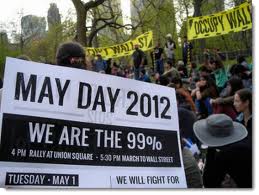
May Day: Here, There and Everywhere

A reader asks why I did not stay home from work and join the May Day protests today, and I feel like this question deserves a serious response.

Partly, I have always had a phobia about crowds, and never willingly put myself into a crowd situation.  I don’t even like to go to an agricultural fair, or a peaceful parade.  In my Manhattan youth, crowds and violence often went together, or at least crowds and the fear of violence.  I am a wimp.

Partly, I felt like I could do more good in my classroom today than anonymously out on the streets.  It is the last full week of classes at my institution; students are finishing up projects that need response and guidance.  If I didn’t show up to work today, it would throw a monkey wrench in the plans I made for a graceful and productive ending to our semester together.

Partly, I don’t have any beef against my own employer, so not showing up for work today would affect the wrong target, while making no difference at all to the intended target, the 1%.

I guess the biggest reason I felt like my presence was expendable to today’s protest is because no one would notice if I was or was not out there on the street, but I would definitely be missed from my classroom.

However, in at least one of my two classes today, I did spend some time talking about May Day and the reasons for the protest.

I was surprised to learn that very few of my students had any clue as to what May Day signified to the labor movement, or why the protests today were taking place.

I don’t know why I assumed that my students would be more politically aware than I was at their age.

Turns out, few of them even realized there were going to be significant protests today, much less what they were all about.  Some also had their doubts as to whether the Occupy approach was likely to be effective.

Well, I pressed them, if occupying public spaces is not an effective means of protest, what would be more effective?  Joining a political campaign?  Writing a letter to the editor?

No one had an answer to that, but I could see the wheels turning.

And that’s why I am glad I decided to stay at work today.  At least with this one small group of students, I was able to foreground these historic May Day protests in their minds, and ask some questions that no one else probably would have asked them today.

Maybe as a result they will be paying attention to the news in a different way, and thinking more concretely about how the issues blazoned across all those posters and banners are relevant to their own particular lives.

Whether working on the small canvas, in the classroom, or the big canvas, out in the street, we are working together to build up the necessary momentum to blast our way to a better world.


Which Side Are You On?

So here we sit on the eve of May Day 2012, and there is an eerie calm-before-the-storm kind of feeling.

The mainstream media is still doing its best to pretend that nothing out of the ordinary is going on.

The only May-Day related event reported in the NY Times today was that a lawsuit was filed in federal court to keep police from using “pen” barricades to hold demonstrators against their will.

Apparently news of the remarkable energy, creativity and defiant spirit showed by the Occupy movement in the countdown to May Day is not fit to print, ie, not important to the intended audience of The Times.

But if you move over to Twitter and search #Occupy, #OccupyWallSt, or #MayDay, you get a whole different picture of what’s going on.

Instead of the nose-in-the-air ho-hum of the fat-cat NY Times, suddenly you’re plunged into a hum of activity, down on the ground with a million twittering mice running around energetically, purposefully and thoughtfully.

There is @OccupyColleges calling for a student strike to protest the debt-bondage of student loans.

#OWS is trumpeting the latest total of 135 U.S. cities where general strikes have been organized for tomorrow.

The Nation, Democracy Now, and Truthout are publishing advance stories preparing for what’s coming.

The media landscape itself bears evidence of the huge and widening gap between the 1%-dominated old guard, napping on its laurels, and the feisty up-and-at-‘em new media webizens, who are vigilant and unafraid to welcome in something new and different.

For make no mistake, the General Strike planned for tomorrow is something new.

International Workers Day has not been celebrated in the U.S. for a long time.  In fact, during most of my lifetime it was demonized as a Communist holiday, which you’d be unpatriotic–unAmerican!–to take seriously.

We’ve come a long way in a very short time.

Thanks to the Occupy movement, being a worker, rather than a boss, is no longer a sign of personal shortcomings, as in: what’s wrong with you, that you’re still only earning minimum wage, bub?  You dumb or something?

Likewise, the Occupy Foreclosures movement has taught us that it’s not that we were stupid to apply for that tempting mortgage, it’s that the banks were predatory and sleazy to talk us into it.

Thanks to the Occupy movement, the onus has shifted to the 1% to prove that what they’re doing is responsible and for the good of all, rather than motivated by naked greed and self-interest.

The rapacious vulture Capitalism that has dominated the U.S., and hence the world, since the end of World War II has been exposed, and there is no going back.

It may be true that many of the strikers are motivated by self-interest rather than pure altruism.  They want jobs, along with affordable housing, education and health care.

But it’s also true that the Capitalist masters of the universe have lost control of the ship and can no longer pull levers to make jobs and other social benefits magically appear.

Unless, that is, the ultra-rich 1% can be persuaded to part with a fair portion of their loot.

History shows that when the gap between the haves and have-nots widens too far, something snaps and the mob takes over to reset the balance.  Think the American, French and Haitian Revolutions.  Think the Communist takeovers of Russia and China.

When it happens, it isn’t pretty.  Haven’t those in power learned their lesson?  Don’t they realize that they can only push the 99% so far before all the police barricades in the world won’t be able to hold us back?

I don’t think we’ve hit that snapping point yet.  But May Day 2012 is going to be something to watch, and something to participate in, too, if the spirit moves you.

Me, I’ll be teaching my classes this May Day, but with a tip of my hat to what’s going on down at the barricades in New York and all across the country.

And you?  Where will you be on this historic International Worker’s Day?

“Which side are you on, boys, which side are you on?”

(AP Photo/John Minchillo)

From Big Tobacco to Big Corn: the time to stand up for the right to health is NOW

Two years ago, I was taking multiple steroid inhalers every day for asthma, which began in the aftermath of a couple of bouts of pneumonia, and was always accompanied by typical seasonable allergy issues—coughing, sneezing, runny nose.

In the summer of 2010, in addition to the usual asthma and allergy symptoms, I also came down with a severe intestinal infection, requiring antibiotics to overcome.

When, in the wake of the course of antibiotics, my digestion was still troubled, I decided to experiment and see if removing gluten from my diet made any difference.

Lo and behold!  After just a month without gluten, my intestinal issues made huge progress.  And even more impressively–and completely unexpectedly–my asthma and allergies also disappeared.

When, after a while, I also decided to give up meat, except for the occasional small portion of chicken, the results were nothing short of miraculous.

Longstanding feelings of intestinal bloating disappeared overnight.  Bleeding hemorrhoids totally cleared up.  And the asthma and allergies, which had sometimes been so severe that I ended up in the ER begging for more drugs, were gone for good.

This remarkable shift in my own personal health, as a result of giving up meat and gluten, really makes me wonder.

Why is it that the gluten-free market is one of the fastest growing packaged food sectors right now?

Why are so many of us getting sick from our food supply?

Could it have something to do with the fact that most of our nation’s food supply is produced by industrial agriculture, relying on GMO seeds, as well as herbicides, fungicides, and pesticides in the growing process, not to mention all kinds of preservatives once the corn and wheat is on its way to the table?

I am heartened by the news that hundreds of thousands of farmers and consumers are pressuring the USDA to reject Dow AgroScience’s 2,4,D-resistant corn.

It is high time that all of us stood up to Big Ag and said enough is enough!  Why should we have to spend top dollar to buy organic, when the truth is that all food should be produced in an organic and sustainable manner?

Big Ag will reply that it would be too expensive to produce tons of corn, wheat and soybeans–not to mention beef and pork– organically.

But you know what?  Being sick is very expensive.  Health care is a huge drain on our national economy, as anyone who has been paying attention knows.

Could it be that the industrial agriculture/pharmaceutical/insurance conglomerates actually want a sick populace?

Imagine the outrage if that story were to break.

Imagine if it were proven that the incredible spike in autistic children is due to pesticide poisoning.

Imagine if we could prove that the asthma epidemic in this country is due to auto-immune problems generated by toxic food.

Imagine if we could nail the chemical companies for the explosive growth in cancers, diabetes and heart disease!

I don’t think this is far-fetched at all.

In fact, it’s low-hanging fruit for a cadre of well-trained lawyers with the guts to go up against the big bad guys.

In our parents’ generation, it happened with Big Tobacco.

The evidence is staring us in the face.

What are we waiting for?

Nuclear famine: the future that must never happen

“I am convinced that nuclear weapons must be abolished. Their use in a military conflict is unthinkable; using them to achieve political objectives is immoral.”

Who said this?  Not your average peacenik hippie.  Not even a pie-in-the-sky anti-war activist.

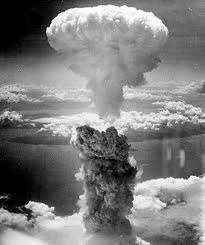
No, it was Mikhail Gorbachev who called for the total abolishment of nuclear weapons, in a recently released report by the renowned International Physicians for the Prevention of Nuclear War (IPPNW) and its US affiliate, Physicians for Social Responsibility (PSR).

A-bomb on Nagasaki

The report is grimly entitled “Nuclear Famine: A Billion People at Risk—Global Impacts of Limited Nuclear War on Agriculture, Food Supplies, and Human Nutrition.” Its lead author, Dr. Ira Helfand, draws upon new modeling evidence showing that  “even the relatively small nuclear arsenals of countries such as India and Pakistan could cause long lasting, global damage to the Earth’s ecosystems andthreaten hundreds of millions of people….It would not cause the extinction of the human race, but it would bring an end to modern civilization as we know it.”

Even a limited nuclear exchange would affect the production of staple foods like corn and rice worldwide. “Significant agricultural shortfalls over an extended period would almost certainly lead to panic and hoarding on an international scale, further reducing accessible food,” the report says.

It is hard to get a handle on how to stop the steam roller of global carbon consumption, which in itself is a recipe for disaster.

Nuclear weapons, by contrast, are controlled by nation states, and can be precisely counted.

Nuclear weapons can be disabled and destroyed.

There is no sane reason for the U.S. and the U.S.S.R. to maintain hundreds of nuclear warheads ready to go at a moment’s notice.

That 20th century Cold War mentality has to be consigned to the dustbin of a very dangerous, outmoded and counterproductive history.

Imagine what would be possible if instead of investing billions of dollars in nuclear weapons each year, those funds were invested in renewable energy sources, sustainable agriculture, and devising methods of increasing human health and welfare while also creating a sustainable human footprint on the planet.

There is so much to protest these days, and nuclear weapons seem beyond the ken of most ordinary citizens.

But these are our lives the generals are gambling with.

We need a concerted people’s movement to insist that the time of nuclear weaponry has come and gone.

We vote for peace and life. Tell me, Mr. Politician, are you going to vote against us?

The question your grandchildren will ask: Where were you on May Day 2012?

Although you’d never know it from following the mainstream media, there are big plans afoot for this year’s May Day.

The global General Strike of the 99% called for May 1 is gaining steam as we move into the final days of preparation.

It’s going to be big.  It’s going to be loud.  It is meant to be an unsettling reminder to the 1% of how much their privilege depends on the cooperation and docility of the 99%.

What if everyone just decided to go on strike with their credit card interest payments?  Their student loan interest payments?  Their mortgage interest payments?

What if everyone decided to redirect their energies to revitalizing local economies, forming their own credit cooperatives, issuing their own currencies, reinstating barter and time banks, growing their own food?

What if everyone just opted out of the huge, unwieldy and oppressive structures that corporate globalization has imposed on us?


I am reminded of the Leo Lionni story about the snail who was so entranced with his creative power to build an ever bigger and more intricate shell that eventually he was pinned down by the enormous, gaudy fruits of his labors and had to abandon that monster shell and start anew, humbly admitting that bigger was not better.

Collectively, and with Americans in the lead, human civilization has created a monster that now holds us captive.

Collectively, we can work together to shift course and rebuild a more humane society where the wealth we generate with our creativity and hard work is shared fairly and is not used to destroy our beautiful planetary home.

It is true that the Obama administration has tried to move things in this direction, in important areas like health care and finance reform.  I believe Obama’s heart is in the right place, but he is held captive like all the rest of us by a rigid system created by the 1% to pander to the 1%.

When even our Supreme Court has been coopted to represent the super-elite above the vast majority of Americans, as was quite evident in the Citizens United decision, it becomes clear that working through the system is like swimming in place, swimming against an overwhelming tide.

So we need to try something different.  We are essentially at the same breaking point our American founding fathers were at back in the 1770s, when they knew that the only way they could move forward was to get the King’s boot off their necks—and the only way to do that was to fight.

I don’t want to see another armed revolution or civil war on American soil.  I am a pacifist through and through.

That’s why I support the concept of the General Strike as a peaceful way to withdraw from the system and remind the elites that the gears of their privilege won’t turn without the grease of our labor and cooperation.

This May Day, wherever you are, whatever you’re doing, take up the gauntlet Thoreau threw down back in 1849 in his famous essay on civil disobedience: “Let your life be a counter-friction to stop the machine.”