Hope springs eternal in our Garden of Earthly Delights

Today I was fortunate to attend a slide lecture by a truly talented photographer, Tanya Marcuse, an alum of Bard College at Simon’s Rock who has been teaching there for the past decade.  She showed images from her current project, “Earthly Delights,” and talked about her process of composing and selecting these images.

Photo credit Tanya Marcuse

Tanya explained how she drew her inspiration from the famous triptych by Hieronymus Bosch, “The Garden of Earthly Delights“, in which images of love and beauty are juxtaposed with macabre scenes of suffering and death.

How strange that the odd, carefully painted fantasies of a medieval Dutchman should be the inspiration for the secular landscape portraits of a thoroughly modern contemporary photographer!

And yet as Tanya talked about her work, I understood her fascination with the strange contradictions of human existence, still so potent despite the five centuries between Bosch’s artistic vision and her own.

We are loving creatures, and yet no one can hate more powerfully than we can.

We worship beauty, and yet we create ugliness.

We wish to be admired, and yet we do shameful things.

We revere life, and yet we, like all living forms, are inexorably moving towards death.

The insight that Tanya offers us through her images is that even in death there is life.  Even in the ugliness of decay there is beauty.

Hers is a powerful message of hope, shared through beautiful art that cuts a blazing path through these dark times.

All things must pass, George Harrison crooned.  All things must pass away.

But in our Garden of Earthly Delights, our lovely, perishable, indestructible planet, all things will rise again, too.

Photo credit: Tanya Marcuse

There is hope and a shred of security in that knowledge.

Climate refugees–who’s next?

This week it was reported that thousands of people of the Tarahumara indigenous group, who live in the Sierra Madre range in northwest Mexico, have been coming down out of the mountains to seek food aid, because after two years of severe drought, coupled with unusual cold this winter, they are reaching their breaking point.  Faced with starvation, they have become climate refugees.

The Tarahumara are known in Mexico for their incredible endurance in long-distance running.  They are a proud people who have held themselves aloof from modernized Mexican culture, still keeping their ancient traditions of weaving, hunting and farming.  They still speak their ancestral language, and they have always been able to take care of themselves.

Until now.

In what is sure to be a trend in the coming years, it is the people who live furthest out on the margins of Empire who are affected first and most harshly by climate change.  People living on South Sea atoll islands or on the Arctic tundra are already seeing the effects of the rising seas and thawing permafrost.  Mountain people who depend on glacial melt for their freshwater are coming up dry.

We here in the heart of modern Western civilization are still feeling no pain.  In fact, I can’t count how many people have grinned at me this week as they celebrated the lovely spring weather we’re having in January—in the fifties, Farenheit, in midwinter.

Yes, it’s just grand—until summer comes and we’re still 40 degrees above normal, roasting at 120 degrees F on a typical August day.

In Mexico, the severe drought has left some two million people without access to potable water and basic food supplies, and authorities say they expect the situation to worsen.

This is bad enough, but it gets worse:

“The drought, which has been compounded by freezing temperatures, has already pushed up the cost of some produce, including corn and beans….But government officials have said they do not expect the price of exports to be affected.”

I am sure all readers of that NY Times article were reassured to hear that the cost of their imported avocados, tomatoes and other vegetables will be unaffected.  Who cares that corn and beans, the staff of life for millions of Mexicans, will cost poor people more?  That’s their problem!

Until it becomes ours.  If corn and beans become unaffordable in Mexico, and sustenance farming is no longer an option in a drought-stricken landscape, what comes next?  You guessed it, illegal emigration al Norte.  What other choice do these people have but to take the risk of trying to cross the border?

Up here, anti-immigrant fervor continues to burn.  Just this week House Republicans passed a law seeking to deny cash refunds under the child tax credit to anyone filing tax returns using “individual taxpayer identification numbers” rather than Social Security numbers.

Most of the people filing taxes without Social Security numbers are hardworking Latino immigrants who are paying taxes even though their earnings are at or below the poverty level.  Their children, many of whom are American-born citizens, will pay the brunt of their parents’ loss of the child care tax credit.

But really–who cares? Who gives a good goddamn if the poor can eat?  Just so long as we can still buy gleaming fresh produce year-round, and no one messes with our electricity or gasoline, let the rest of the world go to hell.

In case you couldn’t tell, I’m being sarcastic.  Seriously, this arrogant attitude is only going to be able to go so far.  Today’s climate refugees, tomorrow’s undocumented workers, are the harbinger of what may very well befall all of us as the climate keeps spinning out of control.

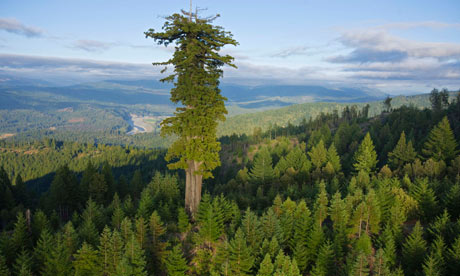
Just as in our forests, it is often the oldest, most majestic trees that are under the greatest strain from climate change, our oldest, proudest ethnic groups are also under tremendous strain now.  The Tarahumara managed to survive the Spanish Conquest, the Mexican Revolutionary War and the Industrial Revolution…but if they can no longer grow crops in their homeland, they must move or die.

Indigenous people like the Tarahumara have the best chance of actually surviving a catastrophic climate shift, because they still know how to live a low-consumption lifestyle, close to the earth.  We would do well to learn from them, and other indigenous groups worldwide, while their cultural traditions are still intact.

Those of us still enjoying the luxuries of Empire should be cognizant that for us too, it’s only a matter of time.

Seeking balance in a bipolar holiday season

I have felt quite bipolar this Christmas season.

On the one hand, I have been going through all the familiar routines and patterns that I have observed at this time of year since earliest childhood: the planning, the extra shopping and cooking, the merry-making with friends and family, the sharing of gifts, especially for the children.  This is the way my parents always celebrated the winter solstice–not with any religious context, but simply as a festive time to light candles and keep a warm hearth against the winter dark and chill, bringing friends and family into the circle of friendship and good cheer, and exchanging gifts almost as a way of symbolizing the abundance accomplished in the previous year, and hoped for in the future.

On the other hand, I can’t escape the awareness of how well this playbook suits the capitalist economic model, which is relentlessly undermining the very abundance it seeks to enshrine, by pushing both the social system and the environment so hard that both are threatened with collapse.

The social conditioning that has made Christmas such a huge secular orgy of buying and exchanging gifts is very hard to break. If you don’t participate, you castigate yourself as a Scrooge, a boring wet blanket.  And you get depressed, too, because everyone else seems to be celebrating and having fun, while you–through your own perverse insistence on non-conformance–are off in a corner, worrying about the end of the world.

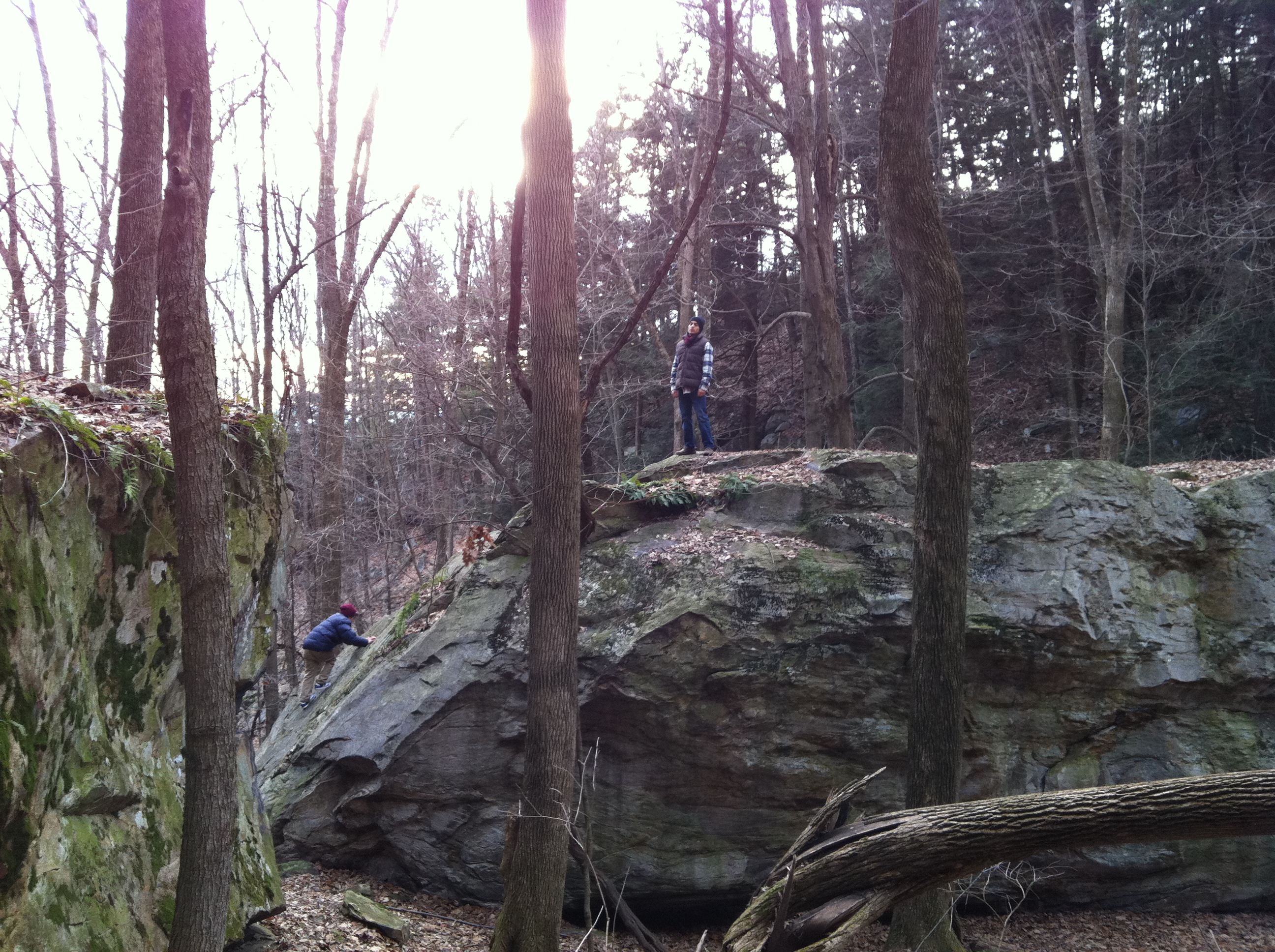
Yesterday, after opening presents by the tree and eating a cheery holiday brunch, my kids and I went for a long walk up the mountain that I can see from my front porch, the one over which the sun rises every morning.  Almost at our destination, we came through a narrow ravine in which several huge, craggy, beautifully colored boulders were scattered.

One presented one of those  classic overhangs that we know were used as sheltered campsites by indigenous hunters for millennia before the arrival of the Europeans.  Others were balanced with amazing precision, creating deep caves that we dared not explore in this season of hibernating bears.

There was an unmistakeable sense of age in that gathering of stones. Squinting my eyes, I could imagine the great glacier that had retreated down the mountainside, gouging out the flat ravine through which we now walked, and leaving the huge boulders scattered in its wake.  I could also imagine an even earlier time, when the rocks had been home to myriads of fish, with giant squid sleeping in the caves, instead of snoring bears.  Those great rocks have seen so much earthly history, standing majestically on their mountainside, unmoved by the shallower destinies of the flora and fauna that root on them or pass them by.

For a moment, putting my hand on the cold rough stone, my inner turmoil was calmed by a strong apprehension of the longer view of life on Earth.

It’s true that our current way of life, complete with its winking strings of colored lights powered by huge, dirty, out-of-sight mines, will not persist much longer.  Not with 7 billion people ravaging the globe like a swarm of ravenous locusts.

But these ancient stones have seen upheavals far more intense than what is currently on the horizon.  They have survived as silent witnesses to many cycles of destruction and regeneration.  They will be there, still silently bearing witness, after homo sapiens has become just another level on the fossil record of the planet.

There is strange comfort in this.

I still have every intention of trying to save our species–and so many other current inhabitants of Earth–by advocating for a transition from fossil fuels to renewables, and a shift from a civilization based on endless competitive growth to one based on collaborative stewardship of a steady state economy and a healthy, fully bio-diverse ecosystem. In my second half of life, this is the cause to which I will dedicate myself, second only to seeing through my job as a parent and giving my kids as strong a start as possible with which to face our uncertain future.

But somehow it helps to stave off despair, knowing that no matter how badly we may fail as a species, the planet will endure, and find new ways of prospering, new ways of combining the building blocks of creation into wondrous, miraculously beautiful and clever forms.

That knowledge forms a peaceful ledge on which to perch, between the bipolar swings of the season.  You’ll find me on this perch for the next week or so, quietly collecting my energy and my will for the struggles ahead.


De-coupling our wagons from the locomotive of global capitalism

There is a clear spectrum of response to the urgency of the environmental and economic challenges that face us.

On the one end is the Deep Green Resistance movement, calling for a complete take-down of industrialized civilization, violently if necessary (and it would be necessary, of course–industrial civilization won’t go down without a fight, unless it’s wiped out by natural disasters).

On the other end are those who believe we will be able to find our way into a sustainable world order via technology, ie, renewable energy sources that will keep the capitalist engines burning bright.

On this spectrum, I would have to locate myself somewhere in the middle.  While I see the necessity of deindustrialization, I don’t really want to live through the violent havoc a strong de-civ movement would cause.

But I know things can’t go on as they have been.  We must shift from an economic model built on endless growth to one that seeks to maintain a steady state, both for human societies and for the natural world (as if there were a separation between these two).

We must also shift from the capitalist system of accumulated wealth for the few based on the commodified labor of the masses, to a system in which people’s labor is more directly connected to their well-being, and wealth is not allowed to concentrate in a few disproportionately powerful, distant hands.
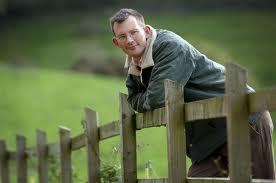
The only movement I’ve found so far that is actively working to accomplish a vision similar to what I’ve sketched out above is the Transition Town movement.  The brainchild of UK visionary activist Rob Hopkins, the movement describes itself as follows:

“The Transition Movement is comprised of vibrant, grassroots community initiatives that seek to build community resilience in the face of such challenges as peak oil, climate change and the economic crisis.

“Transition Initiatives differentiate themselves from other sustainability and “environmental” groups by seeking to mitigate these converging global crises by engaging their communities in home-grown, citizen-led education, action, and multi-stakeholder planning to increase local self reliance and resilience.

“They succeed by regeneratively using their local assets, innovating, networking, collaborating, replicating proven strategies, and respecting the deep patterns of nature and diverse cultures in their place.
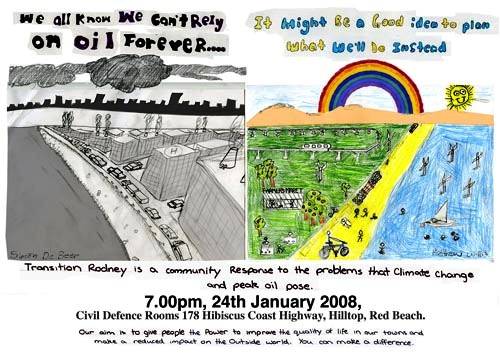
“Transition Initiatives work with deliberation and good cheer to create a fulfilling and inspiring local way of life that can withstand the shocks of rapidly shifting global systems.”

What appeals to me about the Transition Town movement as a strategy for change is that it’s locally based and collaborative.  The first step is getting to know your neighbors, finding out what skills you can share, and taking stock of how you can prepare intelligently to cope with whatever environmental and economic shocks may lie ahead in our future.  It doesn’t dictate a one-size-fits-all model, but rather gives communities credit for being smart enough to figure out their own, locally adapted solutions.

As a society, America seems to be in collective denial about the reality of climate change.  We don’t want to hear that if we continue down the path of capitalist growth based on fossil fuels, the planet will heat up past the point where we could expect life as we know it to continue.  We don’t want to put the pieces together, because if we do, we will be forced to face the fact that we need to change. 

If we could accept this fact, we could begin to talk seriously about directions to take to make that change happen.  It would be nice if we could count on our world leaders to step up and face the challenge squarely, in a concerted effort.  But given the reality of global politics, still based on competition and armed power struggles, it seems very unlikely that we can look to the United Nations, or individual national governments, for the kind of decisive leadership we need now.

So we need to turn to each other, on the local level, and begin asking, as the Transition Town movement envisions, what can we do right here, together, to become more resilient?  What resources do we have, right here, that are not dependent on current systems of international or long-distance national trade?  How can we plan together for a sustainable future?

In a way, it’s an effort to de-couple our personal wagons from the locomotive of capitalist growth, which is proving so destructive to everything in its path, and seems to be on the verge of careening out of control.

I’ve been hearing a fair amount of fear expressed about “going backwards.” When people imagine stepping down from the capitalist growth model, they picture having to give up modern conveniences like advanced medical technologies, ready access to electricity, indoor plumbing, etc.

It doesn’t have to be that way.  We have to work on developing new ways of generating those conveniences, that are less destructive to the planet (the technological fix) and also work swiftly to dismantle those features of industrial civilization that are throwing our whole ecological system out of balance (de-industrialization).

The Transition Town movement calls this “the great re-skilling” approach.  We need to remember older, more sustainable ways of doing things, while also keeping the best of new technologies and learning how to apply them in smarter, more efficient and ecologically sound ways.

There are over 100 full-fledged Transition Town initiatives in the U.S., and hundreds more worldwide, along with many start-up groups forming all the time.  Although all of us seem to have so much to do, and so little time these days, this is really a movement we need to be focusing on now to prepare for the decade ahead.

Given the lack of effective top-down leadership, should we really be wasting our time worrying about national elections, for example?  Or bothering to go to international conferences on climate change?

Or is the smarter thing to do to begin, quietly and with determination and hopeful good cheer, to make our own preparations for a very different sort of future, in our own transition towns?

The Silence of the Bees

Usually during the holidays I catch the frenzied good cheer from everyone else and wind myself up to make merry.  This year, I just can’t seem to find the spark.

Maybe it’s a case of SAD (seasonable affective disorder).  Maybe it’s the fact that it’s the first holiday after my divorce was finalized, and that new reality is sinking in.  Maybe it’s the gloomy state of the economy, which is certainly negatively affecting my financial outlook.

But I think it goes deeper and broader than these personal issues.

I feel like I’m grieving, but not for any one person.  I’m grieving for the loss of my future, and all of our futures.  Even as I stoutly maintain that we can’t give up hope, and we need to keep fighting, there is something in me that keens, heartbroken, for the huge loss that we all face.

It’s already started, the great dying-off.

I keep remembering a certain perfect May morning in my childhood, when I waded out into the deep, fragrant grass under the old, half-wild apple trees, which were glorious in full pink-and-white bloom.  I lay in a grassy nest under one of the trees–no worries about ticks and Lyme disease in those days–looking up at the blossoms outlined against the startling blue of the sky.  The petals rustled gently in the breeze, and the sound of thousands of busy buzzing honey bees filled the air.  Watching carefully, I could see the bees moving from blossom to blossom, carrying their saddlebags full of bright golden pollen.  My heart swelled with the sheer joy of being alive in that moment, a part of the humming life of that orchard on that beautiful spring day.

Flash forward to last spring, when I went out into the same old orchard on another lovely May morning, and was aghast to realize that not a single bee was working the blossoms of the tree.  The silence was frightening, like the desolate silence of a wasteland, though visually it all looked very much the same.

This is just one small example of so many countless instances of the glorious richness of life on our planet, profoundly and irrevocably being silenced.

So yes, I am grieving.  And I am angry.  And I do not know the best way to try to head off the end that seems so inevitable now.

Sometimes it feels like I’m living in a sci-fi movie, where everything seems so hopeless, the bad guys are winning…and then at the last moment, the heroes sweep in and save the day.  I want to believe that we can be those heroes.  Perhaps it will be like the TV series “Heroes,” where many of us who are preparing ourselves now for the fight will come together and really be able to make a difference.

But I don’t count on it.  Because, in large part, the “bad guys” are us.  We’re doing this to the planet.  The laptop I type on is part of the problem, the electric lights I just strung up on my porch are part of the problem, the car I drive is part of the problem.

What would it mean, really, to stop being one of the bad guys?  To become one of the vast army of everyday heroes needed to save this planet?

I keep asking this question, and I will keep asking it until the answer becomes clear.  I feel I am taking some sort of step in the right direction just by asking the question in this public forum, seeking out like-minded people who may have answers I could not come to on my own.

I know we need each other now, more than ever.  The old individualist way of doing things is part of the problem.  Interconnection should be the buzzword of the second decade of this century.  As the planet heats up, our survival will depend on our being able to cooperate and collaborate on adapting to the new, much harsher environment.


 Sometimes I have moments of hysteria, when I feel like I’ve been diagnosed with a terminal illness, and need to decide how I want to spend my last days.  Maybe this isn’t so hysterical after all…this may be a rather sober assessment of the way things stand.

Of course, we are all living under a life sentence, all the time!  But I no longer feel I can count on living into old age, dying a natural death.  Saving for retirement seems like a pipe dream, left over from a 20th century mindset that no longer makes sense.

The only  antidote I know for the grief and depression born of full apprehension of the reality of our very bleak and uncertain future is simply this: carpe diem, seize the day.

Unless we ordinary heroes come together to create a mighty and unstoppable wave of change very soon, the planet will heat up beyond our comfort zone, causing severe weather that will send us floods, famine, conflict and extinctions on a biblical scale.

Yes, ultimately the planet will regenerate, and new forms of life will emerge.  But we will not be here to play our part–to love, appreciate, tend and respect the other living beings on Earth.

It is too soon to give in to grief.  I will shake it off, rouse myself, continue as long as I can to stand up and be counted among the opposition to the terrible destruction that our way of life has visited on so many others on this planet.

Meet me out in the apple orchard, listening for the bees….

From occupations to manifestations: Arundhati Roy imagines another world

I was excited to find in my inbox today an interview with one of my favorite women writers of resistance, Arundhati Roy.

Roy may be most famous for her novel, The God of Small Things, but I am most moved by her political writings.  She is the one who coined that very popular saying, which became a motto of the World Social Forum in the 1990s: “Another world is not only possible, she is on her way.  On a quiet day, I can hear her breathing.”

She has been a shrewd and no-holds-barred critic of transnational corporate capitalism for decades now, long before it became a trendy position to take.

As she wrote in An Ordinary Person’s Guide to Empire, “So much of what I write, fiction as well as non-fiction, is about the relationship between power and powerlessness and the endless, circular conflict they’re engaged in.”

Since she’s been thinking about these issues for so long, it’s not surprising that the comments she made to Arun Gupta, published today in The Guardian,” are right on target.

“I don’t think the whole protest is only about occupying physical territory, but about reigniting a new political imagination.

“I don’t think the state will allow people to occupy a particular space unless it feels that allowing that will end up in a kind of complacency, and the effectiveness and urgency of the protest will be lost.

“The fact that in New York and other places where people are being beaten and evicted suggests nervousness and confusion in the ruling establishment.

“I think the movement will, or at least should, become a protean movement of ideas, as well as action, where the element of surprise remains with the protesters.

“We need to preserve the element of an intellectual ambush and a physical manifestation that takes the government and the police by surprise.

It has to keep re-imagining itself, because holding territory may not be something the movement will be allowed to do in a state as powerful and violent as the United States.”

This certainly speaks to the question that has been worrying at me all day today, as news spread of the violent evictions of Occupy encampments in L.A. and Philadelphia.
Once the physical encampments are gone, will the movement die away?
Or can it keep bubbling up in guerilla fashion, as I advocated in an earlier piece on this blog, like the spontaneous street parties of European cities, that materialize, stage an intervention, and then vanish before they can be contained?
Also, what role will the internet continue to play over the winter?  Perhaps we should be moving from a stage of “occupations” to a new stage of “manifestations,” where the focus will be not on resistantly occupying a physical territory, but on proactively gathering, both virtually and actually, to manifest a new vision of social relations.
In the Guardian interview, Roy ends by pointing to indigenous people, and people who live close to the land, as key mentors in the days and months and years ahead.
As climate change and environmental degradation accelerates,  Roy says, “we are going to confront a crisis from which we cannot return. The people who created the crisis in the first place will not be the ones that come up with a solution.
“That is why we must pay close attention to those with another imagination: an imagination outside of capitalism, as well as communism. We will soon have to admit that those people, like the millions of indigenous people fighting to prevent the takeover of their lands and the destruction of their environment – the people who still know the secrets of sustainable living – are not relics of the past, but the guides to our future.”
There are many of us who are now waking up to the certain knowledge that the leaders we thought were our trusty guides have been taking us on a joy ride to nowhere, ending up barreling towards a cliff.
There have been those all along who have refused to go along for the ride, who have maintained their independent imaginations and worldviews despite intense efforts by the corporate capitalist world to beat them down.
Those are the people we need to heed now–if, as Roy says, we want to learn “the secrets of sustainable living” and survive.  And if, of course, they’ll have us.

Honoring Native Americans on Thanksgiving

Thanksgiving in the U.S. is about gathering together with friends and family and giving thanks for being able to stuff oneself with a huge meal.

It’s one of the most important holidays of the American capitalist religion, second only to “Christmas.”

Its founding myth is the fateful meal shared by the indigenous peoples of Massachusetts with the starving English Pilgrims.  The Pilgrims “gave thanks” at that meal for the generosity of their hosts, and thus was born the tradition of a November Thanksgiving feast.

To my way of thinking, Thanksgiving should actually be a day of atonement marked by fasting, in the spirit of Yom Kippur, Lent or Ramadan.

We Euramericans should be reflecting and repenting on this day for the way our ancestors turned on their Native hosts, once the time of starvation was past.

We repaid their kind welcome with a shameful record of stealing, swindling, enslavement, displacement and deliberate infection.

We waged vicious war that slaughtered children and old people along with warriors both male and female.

We occupied their lands without a second thought, and proceeded to cut the primeval forests to make room for our livestock, roads and cities.

This pattern started with the Puritan Pilgrims in Massachusetts, and spread inexorably West, all the way to California and Texas, where indeed the brutal work had already been begun by the Spanish.

I don’t really expect Americans to give up the tradition of the jolly Thanksgiving feast.

But we do need to be mindful of the real historical background behind the custom of gathering to celebrate with family and friends.

American Thanksgiving is a holiday that honors the spirit of sharing the bounty.  When we dig into that heaped plate today, we should be giving thanks to the rich Earth that has nourished human beings for millennia, and for the Native peoples of this continent, who learned how to live in harmony with the flora and fauna of this place, cultivating the first corn, beans and squash, and craftily culling the abundant indigenous turkeys.

And we should pause in our feast to reflect on the ignoble history that unfolded after that original Thanksgiving in Plymouth MA, where America repaid her hosts not with honor, but with persecution, scorn and hate.

In the act of repentance springs redemption.  The indigenous people of this continent are not gone–they are alive and well and living among us.  Let us raise a glass to them today and give them the honor and thanks they deserve.

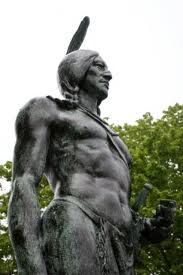
Wamponoag leader Massasoit

An older form of Deep Green Resistance rises from the rainforest. Euramericans, ignore this at your peril.

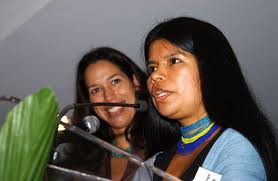
If you want to see something really inspiring, watch and listen to Patricia Gualinga, an Achuar woman from the Ecuadorian rainforest, talking about how her people are standing firm on the frontlines of the siege of the forest by multinational oil extraction companies.

Listening to this indigenous activist, you see shades of all the millions of indigenous peoples around the world who lived in harmony with their environment, respecting and sustainably stewarding their lands.

To say that this balance was altered when the Europeans began their voyages around the world is not to blame or guilt-trip.  It is simply to speak the truth.

To say that the European Enlightenment period, which gave us Manifest Destiny, “I think therefore I am,” the closing off of the commons and the capitalist drive to resource exploitation, was actually a time of deepening darkness, is simply to pronounce the self-evident.

While we contemporary heirs to this 500-year history may be individually blameless, collectively we have been bystanders who have followed the paths of least resistance and allowed the destruction of our planet to proceed apace.

The Pachamama Alliance, on whose behalf Patricia Gualinga spoke last week, is an unusual partnership between Euramericans and these South American indigenous survivors, warriors who are defending the great Amazonian rainforest, the dynamic lungs of the Southern Hemisphere, against rapacious encroachers.

We need another alliance like this between the peoples of the far North and those Euramericans who know that destroying the Canadian boreal forests would be equally catastrophic.

The Pachamama Alliance has developed a powerful model of collaboration across the boundaries of nationality and race in the service of a higher vision of earth-based spiritual activism.

This is a vision that needs to grow exponentially in the coming years.

For too long we have been held captive by the media-induced trance of relentless growth and consumerism.  It’s time to break the spell and allow the pendulum of human evolution on this planet to swing back to balance.

To do this, we need to listen to new voices, heed new calls.  We Euramericans have had our shot at leading the world our way.  It has been a disaster.

It’s time to cede the stage to our indigenous sisters and brothers, and try following their lead for a change.  This is a whole new level of Deep Green Resistance, based on creation rather than destruction.

 It’s time to co-create a new story with the indigenous peoples of the planet, who still know how to live harmoniously with the natural world.

Listen to the Pachamama story, and then it’s up to you–what comes next?  What role will YOU play?

Hope, Struggle, Dream, Persist: A Mantra for Dark Times

It is the day after Halloween, the Day of the Dead, and the day before my birthday.  It is one of the darkest days of the year, and a week from now, when American standard time “falls back,” it will seem darker still.

I was born in 1962, just after the Cuban Missile Crisis, as the Civil Rights movement and the Vietnam War began to pick up steam.  Each decade of my life has been marked by war and conflict, by a struggle between the forces of ruthless global capital, and the push-back from those who valued peace and a more equitable sharing of resources.

In my nearly half a century of life, I have witnessed a sharp decline in the ecological health of this planet.  Great flocks of many different types of birds have dwindled to a few sad outliers.  Clouds of multi-colored butterflies and swarms of busily working bees have vanished.  Delicate native wildflowers in the woods have been overrun by voracious invasive weeds, and the woods themselves have been overrun by a stampede of cookie-cutter tract housing in suburb after ugly suburb.

In my time, cancer has become a terrible epidemic, followed closely by diabetes and heart disease.  We humans have been sickened, just like the wild creatures, by the heedless spread of chemical treatments, pesticides, herbicides, fungicides, fertilizers, preservatives, additives and so many other toxins in our diet, soil, air and water.

What is there to celebrate on this birthday, the last in my fifth decade?

I look to my ancestors for hope and guidance, as is traditional on the Day of the Dead.

I see my Grandma Fannie, who believed in the power of the word, and practiced it by writing poems and stories that kept the wisdom of her Yiddish forebears alive.

I see my Grandma Mildred, who raised three kids, hosted and entertained her extended family frequently, and worked fulltime for a salary as well, year after year.  In her retirement she began the work she loved most of all, volunteering in her local public elementary school helping kids learn to read.

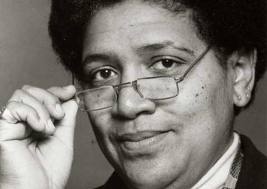
I see the ancestors I claim as kindred spirits, even though we do not share a blood relation: Gloria Anzaldua, who stands there arms akimbo telling me to “put my shit on paper,” no matter what the obstacles; and Audre Lorde, who reminds me constantly that “none of us is free as long as one of us is still shackled.”

As the Scorpio moon wheels overhead and I make my way to bed on my birthday eve, I can celebrate my own place as a link in this chain of strong women who spent their time on Earth trying to make it a better place for those who come after.

This has been a tough half-century, a period of decline and crisis in many ways.  It is a dark time.  But still the lights continue to shine defiantly: young people gather to Occupy the common ground and revive the dream of social equality; a Monarch butterfly sips a last meal at my butterfly bush before spiraling up to find the trade winds down to Mexico; the sun rises once again.

On this Day of the Dead, life goes on.  And while life goes on, we must hope and struggle for our children and their children, and the young creatures all over this planet that are being born today.  For their sakes, we must continue to work for a better future, and insist on our right to dream, and to make our dreams manifest.

This is my birthday mantra: hope, struggle, dream, persist, hope, struggle, dream, persist, endure.  And again.

Climate Change Blues: The one thing the 100% of us have in common is that we can’t afford to ignore the weather!

President Obama, venturing outside during last night’s storm, called the weather “less than ideal” for trick-or-treating.

What an understatetment.

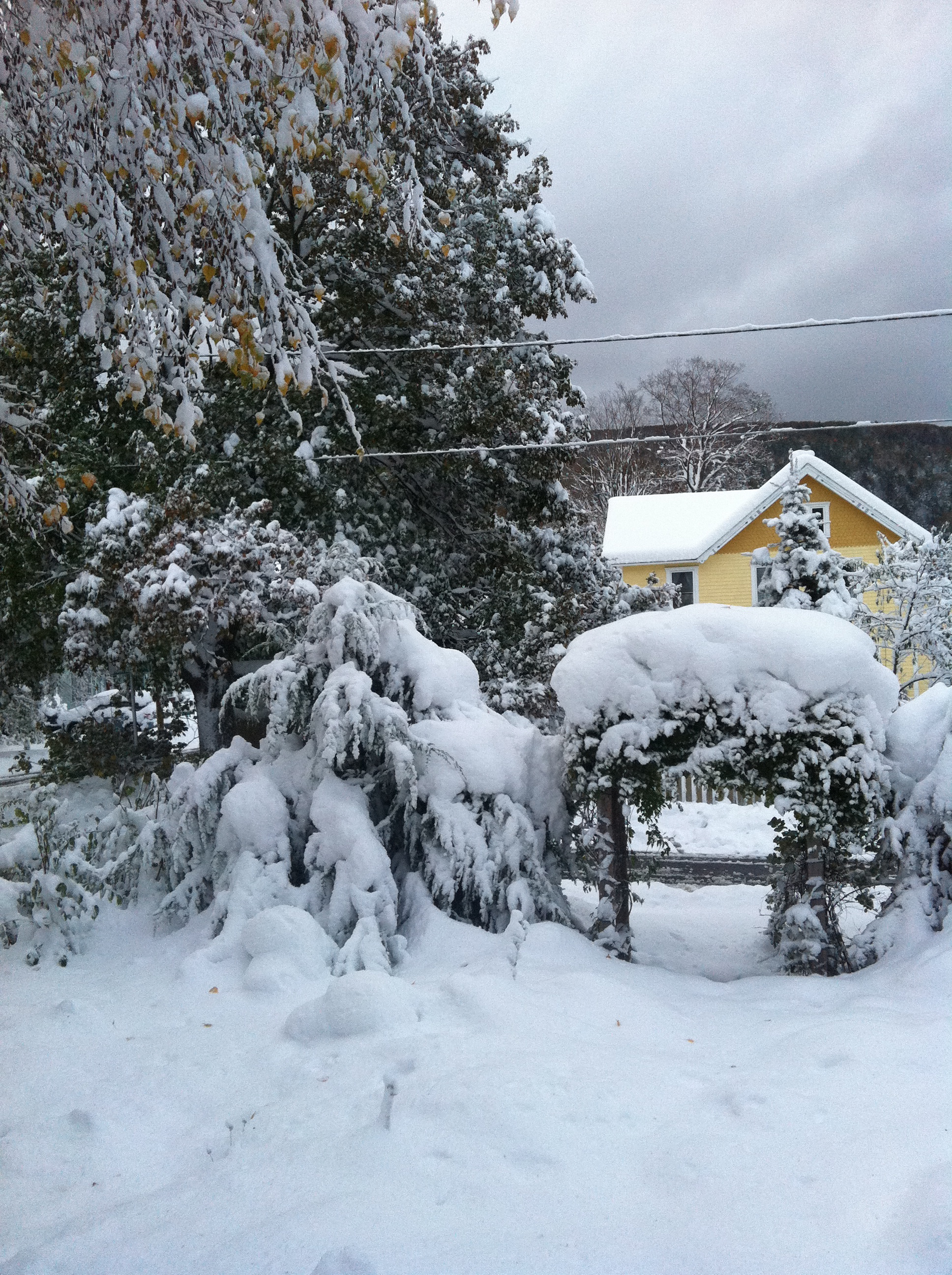
Here’s what it looks like at my house in western Massachusetts this morning:

All those trees in the background are tall maples, bent over with the weight of snow on their leaves.  So far no big limbs have snapped, but that could change any moment, and many of them are hanging over an outbuilding and my car….

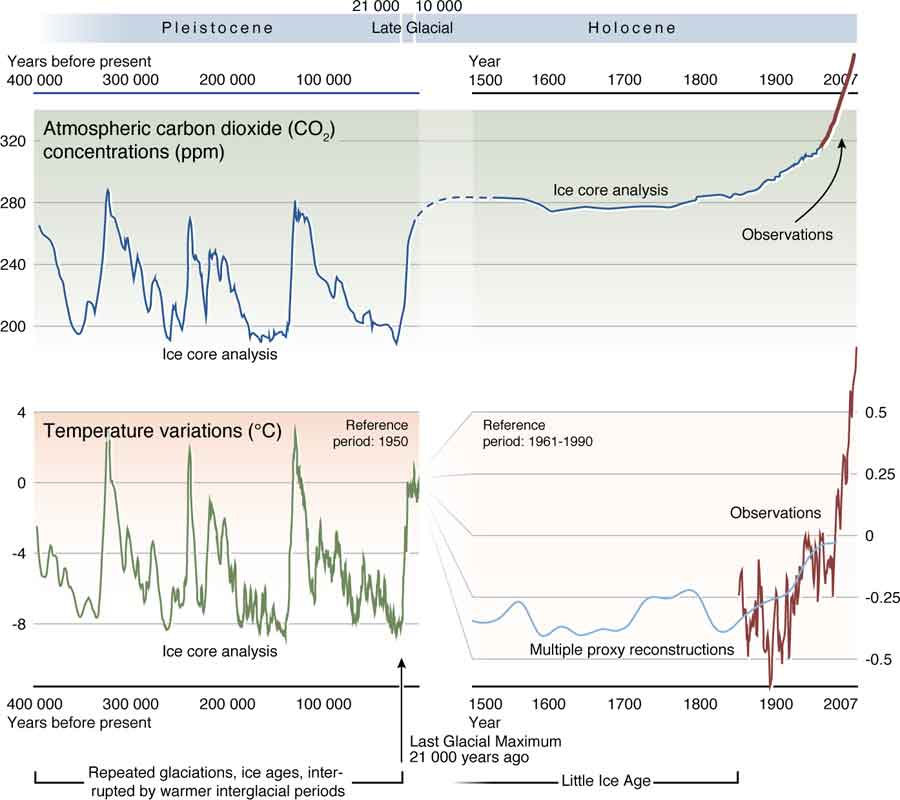
So the question we should all be asking this morning is whether this freak October snowstorm is just an aberration, or if it’s part of a developing and accelerating pattern of climate change.

Yes, there have been October snowstorms before.  But has there been a three-month period before with record high temperatures (August), record rainfall (September), a hurricane hit to the entire East Coast (Irene) AND a record-breaking snowstorm?

Not being a meterologist, I can’t answer this question, but I’d sure like to know.

One thing I do know is that if we don’t start reducing carbon emissions, weather events like this are going to become more frequent and more severe.  This is not “Day After Tomorrow” hysteria, this is scientific truth.

So again, the question becomes, what can we DO?

Well, next weekend in Washington DC there will be an action at the White House; the plan is to assemble enough people to make a linked-arms ring around the White House, in the hopes of persuading President Obama to stand with the people on the anti-tar sands extraction, anti-Keystone pipeline issue, rather than with the energy corporations.

You can hear actor Mark Ruffalo explain it here:

My hope is that weather events like last night’s “freak” snowstorm will raise people’s awareness about the reality of climate change, and how it will affect all of us–our food supply, our physical security, our ability not just to carry on as usual, but to carry on at all.

All of us–the rich, the poor, the inbetween–the 100% of us, and not just in the US but in the world, are already feeling the effects of manmade climate change.  We’ll be feeling it increase exponentially in the coming months and years.

So all of us need to step off the path of least resistance and start demanding government support for a huge Apollo Project-style transition to sustainable energy and a serious commitment to energy conservation.

If you can’t get to Washington DC next Sunday for the demonstration at the White House, you can be part of the virtual ring that will surround the people on the ground there, and build support wherever you are for the movement for responsible and caring stewardship of our Earth.

We cannot afford to ignore these issues any longer.