Responding to Racism or Sexism: The Transformation of Silence into Language and Action, Again and Again

I shouldn’t be surprised that once again the ugly specter of racism and unacknowledged privilege is raising its head on my own little campus community.

It happens almost every year like clockwork, generally in the fall semester around this time, and usually involving freshmen who are still in the process of adjusting to the new, often more racially/ethnically/socially diverse culture in which they have suddenly landed.

Understandably, people of color who have had to put up with racism and white privilege all their lives get angry when it turns up, in all its crude arrogance, here in our campus home as well.

One angry response leads to another angry retort, onlookers begin to take sides, and before you know it the campus is in an uproar, with some calling for apologies, others calling for calm, and the majority just plain mad and not willing to take it anymore.

I want to talk about anger.

As a woman, albeit a white woman, I know something about how members of subordinate groups are not supposed to respond with anger to actions by members of dominant groups.  We are supposed to keep our cool, to turn the other cheek, seek the higher ground, not stoop to their level.

So we pretend we didn’t hear that cutting remark, muttered just loud enough to be audible.  We pretend we didn’t want to go to that party anyway—the one to which our invitation somehow got lost in the mail. Above all, we don’t respond directly to provocation, because that will just give them an excuse to keep going, and make the whole situation worse—not for them, but for us.

So the anger, unexpressed, gnaws at us, sitting in the pit of our stomachs as unmetabolized bitterness that threatens to choke us when, at unexpected moments, its bile rises into our throats.
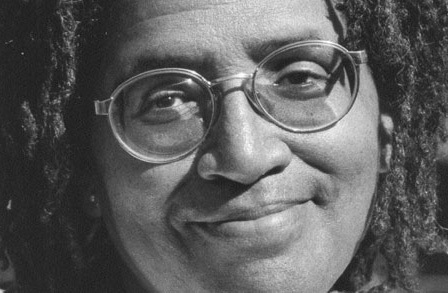
Audre Lorde

As a woman, I have felt this bitter resentment.  And yet as a white woman, I have also felt the other side, the ignorant innocence of privilege.  Growing up in a racist society, I did, as Audre Lorde famously put it, accept racism “as an immutable given in the fabric of [our] society, like eveningtime or the common cold” (“The Uses of Anger,” Sister Outsider, 128).

I didn’t think to question why there were no African American families living in my apartment building on the Upper East Side of Manhattan—other than, of course, the live-in maids who could be seen going in and out of the service entrance or trundling laundry down the service elevator. None of the doormen or elevator men were people of color either—most were Irish, like our superintendent, or perhaps German or Scandinavian.

I didn’t think to question why there were hardly any African Americans or Latinos in my public elementary school, or in the selective public high school I attended, Hunter College High School.  When I got to college, it was the same, and again, I was incurious, complacent.

When you grow up this way, in an insular environment of privilege, it is possible to be deluded into thinking that this is just the way the world is.  No one in my whole upbringing encouraged me to ask the kinds of questions that might have made me see the how the fabric of my existence was shot through with deep-seated, longstanding racism.  No one talked about it.  It just was, and since for me that privileged life was very comfortable, I had no incentive to rebel against it.

It was reading that eventually opened my eyes to how the other half (or, globally speaking, two-thirds) lives.

When I happened upon Lorde’s autobiography, Zami: A New Spelling of My Name, and read about how she too had gone to Hunter College High School, the only Black girl in a sea of white, and how hard that was for her in so many ways, I began to see my experience there through her outsider’s eyes.  I began to question the way I had lived in a vacuum of privileged blindness for so long.

Lorde’s essay on “The Uses of Anger” is one I go back to again and again.  The sentence that continues to resonate powerfully with me is this:

“I am not free while any woman is unfree, even when her shackles are very different from my own” (132).

Listening to Audre Lorde with an open heart, I understood why she was angry at the racist structures into which she was born and bred.  I knew I was not responsible for creating those structures, into which I too had been born and bred, but I did have the power to question them, and to ally myself with those who were working to change them.

When it comes to racism and other forms of identity-based oppression, it really is true that ‘you’re either with us or against us.”  There’s no way to hide behind a façade of neutrality.  To say nothing when someone drops a racial slur or pinches a woman’s behind is to become an accomplice to that act.  In these situations, silence is itself a form of tacit consent.

Audre wrote about that too, in an essay called “The Transformation of Silence into Language and Action.”

I often reread these lines when I am feeling fearful of speaking out on an issue I care about:

“We can sit in our corners mute forever while our sisters and our selves are wasted, while our children are distorted and destroyed, while our earth is poisoned; we can sit in our safe corners as mute as bottles, and we will still be no less afraid….We can learn to work and speak when we are afraid in the same way we have learned to work and speak when we are tired.  For we have been socialized to respect fear more than our own needs for language and definition, and while we wait in silence for that final luxury of fearlessness, the weight of that silence will choke us….it is not difference which immobilizes us, but silence.  And there are so many silences to be broken” (42-44).

As an ally with some measure of privilege, one of the best things I can do to advance the goal of a just society is to speak up when I see racism or sexism or any other form of discrimination taking place.  And not just speaking to my friends, but speaking up in public, inviting and sometimes even provoking a sustained conversation, with the aim of promoting greater awareness and understanding.

The flashpoint for the current unrest on my campus was a white male student challenging the validity of the school holding a campus-wide teach-in known as “Diversity Day,” in which students, staff and faculty organize workshops around issues related to the politics of identity.  Originally, Diversity Day was entirely a student-organized event, held on an extracurricular basis to compensate for a perceived lack of attention to non-white-western-male culture and experience in the curriculum.  The founding students lobbied hard, and ultimately successfully, to have their effort institutionalized by having classes cancelled, with all students required to attend at least two workshops during the day.

Whenever a revolutionary gesture becomes institutionalized, it loses some of its spark, and maybe this is an event that needs to continue to evolve.

But only someone who was ignorant of the extent to which discrimination and structural identity-based limitations continue to affect women and people of color in this country could argue in good faith that it was not worthwhile to spend some time discussing these issues one day out of the school year.

Of course, many students will take classes in sociology, anthropology, gender studies or ethnic studies and go a lot deeper. But those are often the students who already have an inkling that all is not well for subordinate groups.

It is the most privileged who are often the least aware of how systems of privilege operate, and therefore the least likely to elect to take classes in these topics.  These are the students who are most likely to benefit from being required to attend two eye-opening workshops on Diversity Day.

At many of these workshops, people of privilege will be asked to confront W.E.B. Dubois’s famous question in The Souls of Black Folk, “How does it feel to be a problem?”

Robert Jensen

Robert Jensen, one of the finest anti-racist, anti-sexist writers and educators I know, says that in the 21st century, “the new White People’s Burden is to understand that we are the problem, to come to terms with what that really means, and act based on that understanding.  Our burden is to do something that doesn’t seem to come naturally to people in positions of unearned power and privilege: Look in the mirror honestly and concede that we live in an unjust society and have no right to some of what we have” (Jensen, The Heart of Whiteness: Confronting Race, Racism and White Privilege, 92).

The next step, he says, is to “commit to dismantling white supremacy as an ideology and a lived reality”—not because it’s hurting other people, but because, as Lorde recognized, “none of us is free while some of us are still shackled.”

Or, as Alice Walker put it, “We care because we know this: The life we save is our own.”

Hats Off to the Central Park Rape Victim

The gutsy 73-year-old woman who was raped by a drifter in Central Park last week has been on my mind since I first heard about her.

The assailant has been caught, and it turns out he has a history of raping and murdering elderly women, going back to the 1980s.

The mystery is why a man like that was let out of jail.  We keep kids in prison for minor drug infractions, but we let a psycho rapist and murderer out on parole and allow him to drift across state lines without supervision?

Like so many other homeless people, he ended up drifting around in Central Park, and according to the victim, whose name is being withheld to protect her privacy, he had it in for her because a couple of weeks earlier she photographed him masturbating in a lonely section of the park.

The Ramble, Central Park

She was a birder who wandered the park with her binoculars and camera around her neck, in the wooded section known as “the Ramble,” which I remember well from my own youthful ramblings.  I would never set foot in the park alone without my big dog beside me, though.  I knew better than that.  And if I ever saw anyone looking suspicious, I made a beeline for the nearest police officer.  Growing up in Manhattan, you knew you always had to be on guard.

The birdwatcher probably took his picture to identify him to the police, because she did report his obscene public activity to a park ranger.  Unfortunately, her warning was ignored.

Now, after she was pushed down in the bushes and raped in broad daylight, the police aren’t ignoring her anymore.  Thanks to her alert vigilance, she was able to pick her assailant out of a police line-up just a day or so after the crime occurred.

Knowing as much as I do about sexual assault and its psychological effects (I teach a course in Gender & Violence) I have to say I am very impressed with the cool demeanor of this victim.

No hysterics or undue shame—this woman is speaking out, and in the process setting a model for other women to follow.

Rape statistics in the US are pretty ugly.

  • Every two minutes, someone in the US is being sexually assaulted.  Each year there are nearly 208,000 sexual assault in the US
  • 54% of rapes are never reported, and 97% of rapists will never spend a night in jail
  • 80% of victims are under 30, 44% under 18
  • 38% of rapists are a friend of acquaintance of the victim

So the most recent Central Park rape was unusual on every score: the victim was an elder, the rapist was unknown to her, and most important, she marched right out of the shrubbery where she’d been raped and reported it to the police.

In your more typical rape case, a young woman may not want to report the crime because a) it’s embarrassing; b) she would have to undergo invasive evidence-gathering; c) she might be afraid that the rapist, if not arrested, would retaliate against her; d) it’s common knowledge that rape trials are long and intense, and rarely result in conviction.

All this is true.  But it’s also true that if more than half of rape victims do not report the crime or press charges, then that allows the assailants to proceed with cocky impunity.

I don’t think that was part of the picture with David Albert Mitchell, the Central Park birder’s assailant.

He was just a dangerously unbalanced, violent man who has obviously been failed by the criminal justice system.  He should never have been granted parole.

But many rapists circulate in our society much more suavely, preying on young women and girls without necessarily even realizing that what they’re doing is wrong.

In a culture where violent pornographic videos are easily available on the internet, and violence against women is a common ingredient in music videos and Hollywood films as well, it is not hard to see how a young man could get the impression that violating a woman is just another way to prove one’s manhood.

More of us older women have to stand up and say no to this violence.

For quite some time, my heroine in this work has been Eve Ensler, whose V-Day organization has been incredibly successful in channeling women’s creativity and righteous passions into educational anti-violence work.

I don’t yet have a name or a face to put on the 73-year-old Central Park rape victim, but I want her to know she’s my heroine too.

All we’ve seen of the victim so far

Gale Force: A Republican Tragedy

It seems entirely appropriate to me that the Republican National Convention should coincide with a hurricane.

Those crazy libertarians are a gale force until themselves, threatening to blow the center right out of our democratic republic.

Let’s all spin out to an each-man-for-himself anarchy, they cackle with glee!

Who needs Medicaid, Medicare, food stamps, unemployment compensation, tax breaks for the middle class?

Just as long as the billions for the military keep pouring in unhindered, the right to bear arms remains unobstructed, women are kept pregnant and barefoot and gay marriage is outlawed, all will be well.

And let’s build a few more prisons while we’re at it, shall we?  Ryan might add dourly, echoing his more famous counterpart Scrooge.  Are there no workhouses?

While the hurricane rages outside the convention center, the GOP celebrants within will be feasting like vultures on the carrion remains of our once-noble country.

FDR will be rolling over in his grave as the New Deal goes up in smoke.

But the message of the wind and flooding outside is unmistakeable, and has been declaimed in tragic tones for many a century now:

To-morrow, and to-morrow, and to-morrow, 


Creeps in this petty pace from day to day 


To the last syllable of recorded time, 


And all our yesterdays have lighted fools 


The way to dusty death. Out, out, brief candle!


Life’s but a walking shadow, a poor player 


That struts and frets his hour upon the stage 


And then is heard no more: it is a tale 


Told by an idiot, full of sound and fury, 


Signifying nothing.

How many heads will roll in the 21st century tragedy of our America?

Who will be left, Horatio-like, to tell the tale of woe?

Blow winds, blow!

I foresee that as in Shakespeare—or the Bible—it will take a storm of catastrophic magnitude to shake our rotten political timbers to their foundations, and pave the way for a new dawn.

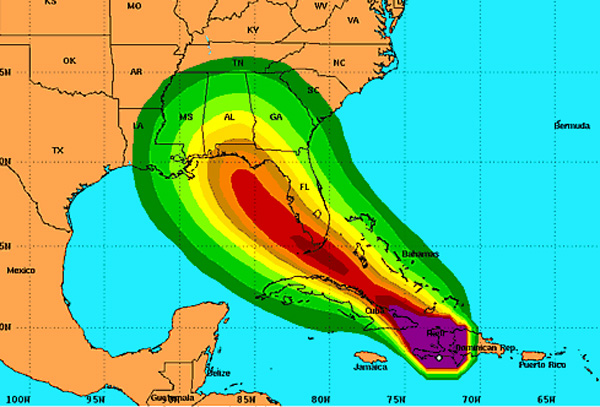
Predicted path of Tropical Storm Isaac as of Aug. 25, 2012

Taking the Leap into a Better World

Lately I’ve been feeling like I am straddling two banks that are rapidly moving away from each other, leaving me performing ever more of a balancing act in the middle of a rushing stream.

One foot is still hanging on to the familiar dry land on which I was born and bred: the safe, predictable world of a privileged existence within the capitalist empire, where every problem has a technological solution, all needs are met, and there is nothing really to worry about, beyond what to have for dinner, or where to go on the next vacation.

This is the world in which I am a true-blue Democrat, I pay my taxes without question, and I work hard in expectation of an eventual pleasant retirement.

But I also have a foot in quite another realm, one that is still quite foreign to most of my peers.

In this other, parallel universe, security and predictability are rapidly becoming a thing of the past, as the weather turns ever more erratic, leading to food shortages and a survivalist mentality.  Clashes between unarmed protesters and heavily armed police are common, with the protests mainly concerning lack of basic food and supplies.

No one knows where this is all heading, but it does not appear to be anywhere positive. The elites have hidden themselves away in their own privately funded strongholds, and other than the military folks it does not seem that anyone is really in charge.

Most people I know are clinging to the first bank, even though it’s beginning to seem ever more unstable, as if beset by internal tremors that are slowly but surely breaking it up. They are positioned like Walter Benjamin’s Angel of History, looking resolutely backward, away from the chaos of the future.

I don’t know why I am unable to join them in their denialist party.  It sure looks like a good time.

But having become aware of the crisis through which we’re living, I can’t just turn a switch and pretend I don’t know what’s going on. The second bank is like a mirage that is slowly coming into focus, no matter how much I try to turn away and not look.

I’ve spent long enough studying narratives of social upheaval and moments of violent crisis to know one when I see it coming.

A recent article in the New York Times Sunday Review provided an unusual window into the curious calm before the storm of all-out societal dissolution—in this case, the unfolding Syrian civil war.

The author, Janine di Giovanni, begins with a series of questions: “What does it feel like when a war begins? When does life as you know it implode? How do you know when it is time to pack up your home and your family and leave your country? Or if you decide not to, why?”

When does life as you know it implode?

When is it time to pack up and leave?

Where can we go to find safety?

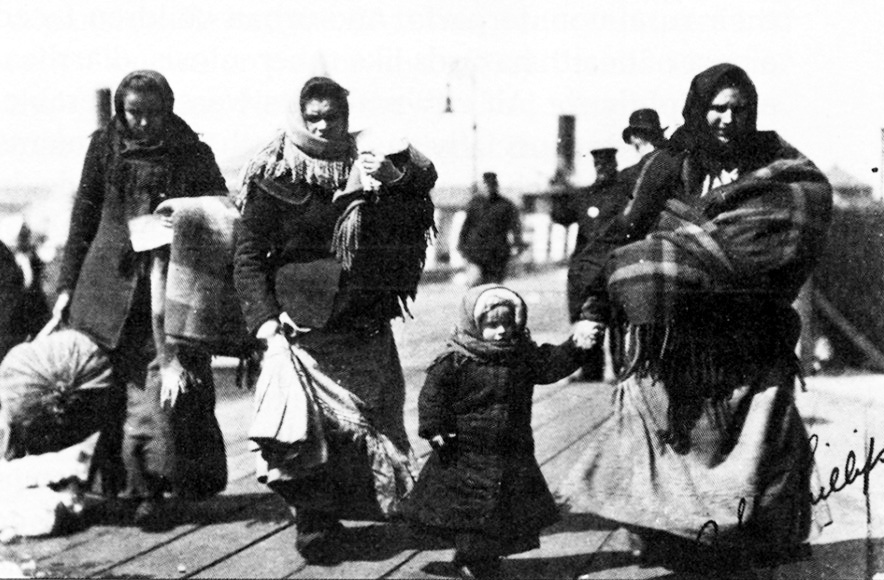
Eastern European immigrants entering New York

These are questions that my ancestors asked, back in the 19th century Europe of ever-narrowing restrictions and ever-more-violent pogroms.  I am here because they had the courage and the foresight to get away to safety before it was too late.

But now the safely cushioned existence that so many of us have enjoyed here in the U.S. and other privileged enclaves on the planet is threatened by a crisis of our own making.

We didn’t realize that everything about our lifestyle, politics and ideology would contribute to the downfall not just of American empire, but of human civilization itself.

We didn’t realize what a deadly game we were playing.

But we can no longer plead ignorance.

Unlike our predecessors, we 21st century folk are going to have a very hard time finding any place to go that is safe, where we can ride out the climate shocks unscathed.

We can’t run, we can’t hide from the environmental shocks that are only just beginning to hit. 

We have to stay and see this through.

What that will mean I am not sure.  In part it depends on how many of us wake up now and begin to take some proactive steps towards reorganizing our society, before we’re reduced to reactive crisis control.

Our political system is locked in a kind of stasis from which there does not seem to be any forward movement possible—just endless round and round and round.

We must move forward—grow, evolve, adapt—if we are to survive.

Today I caught a glimmer of something new that may be the early stages of the kind of change we need to successfully weather the coming storms.

The International Organization for a Participatory Society (IOPS) is an emergent (or is it insurgent?) movement to create a decentralized, highly participatory catalyst for urgent social change.

It’s not clear yet whether it will be a flash in the pan or an idea whose time has come.

So far it has just over 2,000 members worldwide.

Including me.

Maybe it’s time to stop straddling both banks.  Time to take the leap and jump fully into new territory, both feet on the ground.

Work-life balance is not just a women’s issue

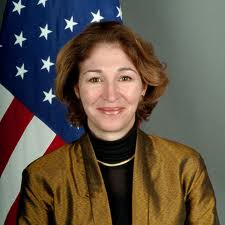
Anne Marie Slaughter

I decided to bite my tongue and wait to see the reaction to the recent Atlantic Monthly cover story by Anne Marie Slaughter on women and the work-life balance—I knew as soon as I started reading it that it would set off a firestorm of commentary, and I have not been disappointed.

Slaughter, in case you have not been following this story, is a Princeton University professor and dean, who was drafted into the State Department by Hillary Clinton and worked there for two stressful years.  She wrote the article after returning to the snug harbor of Princeton, where, thanks to the flex time allowed by the higher ranks of academia, she is far better able to manage her professional and family commitments.

Slaughter’s main point in writing seems to be that our society needs to adapt itself better to the needs of working women. She calls for more women to get into leadership positions in business and government, and make workplace and policy changes that will make parenting and working outside the home more manageable.

Lori Gottleib, in a blog post on the Atlantic site, has little patience for Slaughter’s hand-wringing over the travails of long hours outside the home.

“The real problem here isn’t about women and their options,” she says. “The real problem is that technology has made it possible to work 24/7, so that the boundary between work and our personal lives has disappeared. Our cubicles are in our pockets, at the dinner table, next to our beds and even next to our children’s beds as we’re tucking them in. In many households, one income isn’t enough, and both men and women have to work long hours — longer hours than ever before — to make ends meet…. The problem here is that many people work too much — not just women, and not just parents.”

Hallelujah and amen to that, Lori!

For myself, I know the only way I can give myself some true down time is to get myself to a place where there is no wireless and no way to plug in my computer—ie, camping, hiking or at the beach—although even there I’ve caught myself using my iPhone to check messages or text people on the fly.  It’s been years—YEARS—since I’ve been unplugged for more than a day.

I can imagine a scenario where our society benevolently decides to use technology to allow more people to work from home, which will make things easier for parents in some ways, but will result in all of us becoming wired-in cogs in the capitalist machine, never really getting any time to ourselves unless we are able to set our own firm boundaries, something that most of us have trouble doing.

I agree with Professor Slaughter that family-friendly workplace policies are needed. I especially appreciated her anecdote about how when she was Dean at Princeton she always made a point of announcing at faculty meetings that she had to go home to have dinner with her family, to give other women permission to do the same without guilt or embarrassment.

But I share Lori Gottlieb’s sense that for most of us parents, the pressures of making a living are simply getting to be inhuman.

At the Strategies for a New Economy conference I attended a few weeks ago, several sessions dealt with the possibility of transitioning to a shorter work week.  This was the focus of a 2010 report by the New Economics Foundation, which argues for a 21-hour work week.  “There is nothing natural or inevitable about what’s considered ‘normal’” working hours today,” the authors write. “Time, like work, has become commodified – a recent legacy of industrial capitalism. Yet the logic of industrial time is out of step with today’s conditions, where instant communications and mobile technologies bring new risks and pressures, as well as opportunities. The challenge is to break the power of the old industrial clock without adding new pressures, and to free up time to live sustainable lives.”

The report’s authors suggest that “to meet the challenge, we must change the way we value paid and unpaid work. For example, if the average time devoted to unpaid housework and childcare in Britain in 2005 were valued in terms of the minimum wage, it would be worth the equivalent of 21 per cent of the UK’s gross domestic product.”

Imagine if we could invent a society where housework and childcare actually “counted” for something in real economic terms?

Imagine if parents were actually rewarded for spending quality time with their children, for doing all the time-intensive work it takes to raise healthy, productive, happy kids who will become healthy, productive, happy adults?

What if we spent less money on anti-depressants, stimulants and treadmills, and instead gave ourselves room to breathe, and time to relax?

No society can hope to survive without the good work being done by mothers and fathers, unpaid and unsung, day and after day and year after year.

This should not be just a women’s issue.  If more fathers got involved in the day-to-day nitty-gritty of parenting—unglamorous and tedious as it sometimes can be—there would be twice as much impetus to make the changes Slaughter is calling for.

How about it, Dads?

Help Wanted: Change Agents in Academe

The stars seem to be aligning behind a strong push towards online learning in the world of American higher education.  Today’s lead op-ed piece in The New York Times, by Jeff Selingo, editorial director of the Chronicle of Higher Education, echoes the Chronicle’s recent interview with educational philanthropist Bill Gates, who has been funding innovative approaches to maximizing the potential of technology in higher ed, without sacrificing educational quality.

Bill Gates

Both Gates and Selingo are focused on interventions that can improve outcomes for students, and thus for American employers down the line.  Even the best universities, Gates says, “often only have a 60-percent completion rate. And the average university will have something like a 30-percent completion rate. So you have an immense amount of wasted resource, and students who end up with a big loan and sort of a negative experience in terms of their own self-confidence.”

Gates wants to see how technology can be used to improve completion rates for students, as well as to improve their academic experience while going through the educational process, and his foundation is searching for “change agents” to accomplish this mission.

Innovators are sorely needed, because it certainly is true, as Selingo points out, that “higher education is a conservative, risk-averse industry,” which has been putting far more attention into capital campaigns for physical improvements than into serious efforts to develop and integrate new technologies.  Even my own graduate alma mater, New York University, known in many ways as an innovator, is persisting in its focus on bricks and mortar expansion with its hotly debated NYU2031 plan.

“We bet on the change agents within the universities,” Gates says. “And so, various universities come to us and say, We have some ideas about completion rates, here are some things we want to try out, it’s actually budget that holds us back from being able to do that. People come to us and say, We want to try a hybrid course where some piece is online, some piece is not, and we’re aiming this at the students that are in the most need, not just the most elite. So that’s who we’re giving grants to, people who are trying out new things in universities.”

I hope the Gates Foundation is also interested in supporting smaller liberal arts colleges like my current employer, Bard College at Simon’s Rock, which was founded as an innovative early college for high school students ready to accelerate past the last two years of high school, right into the college experience.

As someone who did just that myself, leaving the prestigious Hunter College High School in Manhattan after 10th grade to earn my B.A. in four years at Simon’s Rock, I know this is a model that works. It also worked for my son, who also earned his B.A. in four years at Simon’s Rock after completing 10th grade at our local high school.

It was good to hear Gates affirm the continuing importance of small-group discussions as a method of learning, because that is the pedagogical style we value highly and do so well at Simon’s Rock.

“Having a lot of kids sit in the lecture class will be viewed at some point as an antiquated thing,” he said. “On the other hand, having a bunch of kids come into a small study group where peers help each other, where you can explain why you’re learning these various topics, that will be even more important.”

With the advent of giant open-source lectures made widely available by the most prominent universities, Gates predicts that higher education will have to form consortia to consolidate lecture offerings, rather than having the same courses taught hundreds of times across the country (and the world) by different professors, some of whom may not be the greatest of lecturers.

But I don’t believe we will ever find a substitute for the excitement of small group learning, sitting in a circle and sharing ideas with a skilled, knowledgeable and enthusiastic facilitator.

It’s possible that some of that small-group learning may be able to transition to online video chat rooms, and this is something I’d love the Gates Foundation to fund me and other collaborators to explore!

I can imagine a hybrid learning environment, in the not-too-distant future, in which a student living at home can take a lecture from a Harvard professor in the morning, meet in an online chat room with another instructor in the afternoon to discuss the lecture topic (as I used to do in person with undergraduates when I worked as a graduate teaching assistant at NYU), and perhaps come to campus twice a semester for intensive face-to-face classes culminating in final projects that would be shared and evaluated, leading to the awarding of course credit.

Already there are consortia forming to discuss how to begin to allow students to earn degrees by patching together courses from various institutions, something most colleges and universities currently permit in a limited way.

Gates is right that this kind of innovation is threatening to the status quo of higher ed, where each college and university sees itself in competition with the others for the best students, and administrators tend to be more focused on admissions and tuition than on completion rates and outcomes.

Collaboration and sharing of resources may mean that some of the weaker institutions will fall by the wayside—but this is already happening as it becomes increasingly apparent that the old residential, four-year, very expensive approach is unsustainable for any but the most heavily endowed institutions, who continue to attract students from the wealthiest families in the world.

I agree with Bill Gates that if we faculty and administrators dig in our heels and refuse to roll with the oncoming waves of technological innovation, we’ll be bowled over and blown away.

But the techies can’t make this educational revolution work without the expertise of seasoned faculty and administrators, so it’s our responsibility to insist on pedagogical quality while encouraging innovation, in order to accomplish our mission of giving the most possible students the best possible education at the lowest possible cost, in a sustainable model that will allow our students—and our institutions—to thrive and grow into the 21st century.

Hocus, Pocus, Focus

I don’t know if it’s that I’m moving ever nearer to that psychologically significant boundary line between my forties and my fifties (I’ll turn 50 in November), or that summer is upon us here in the Northeast, or that I am on circuit overload, but this week I just haven’t been able to get up a good head of steam for a substantial blog post, and thus have stayed silent.

It’s been quite a while since a whole five days have gone by without my posting a single word.

It’s not that I’m not thinking.  And I am certainly keeping abreast of events out in the wide world.

But instead of the steady churning of thoughts and the relentless input of news raising my hackles and prompting me to send another blog-post-bottle out into the high internet seas, I just feel like pulling the covers over my head and rolling over for another hour of sleep.

I find myself longing for a silent weekend retreat, in which I had no access to the internet or phone, and no one around who expected me to speak or respond.

If I could have some good quiet time, maybe I could focus my thoughts, ideas and projects, and figure out which of them are worth carrying with me, and which can be jettisoned.

Perhaps that goes with the time of life I’m in, where every moment seems precious and limited, and you know that you really don’t have that much time to accomplish everything you came here to do in this lifetime.

If I could just figure out where to pour my energies and talents, I have no doubt that I could be very successful—with my success measured not necessarily in money or goods, but in positive impact on the planet.

That is what I am most trying to figure out right now.  Where should I be funneling my limited time and energy?

Generally speaking, there seem to be four spheres in which I am operating at all times, simultaneously:

  • the very up-close-and-personal realm, where my thoughts revolve around such mundane but important matters as my responsibilities to my two sons and the rest of my family, endless house and garden maintenance issues, and how I’d like to reconnect with such-and-such friend next week;
  •  the professional realm, where I am wondering what the outcome will be of my current contract review, feeling guilty because I am months behind in the essay I promised an anthology editor a year ago, pondering how to teach my classes scheduled for the fall, and wishing that I had the drive to get up at 5 a.m. and work on my book project;
  • the broader community, regional and national realm, where I am thinking about how to encourage the adoption of solar panels in my town, wondering about the impact of the new immigration legislation on friends and students, and concerned about the prospect of rabid Republicans gaining control of all three centers of power in Washington, and wondering how I can support both the Democrats and their more radical critics, whose platform is much closer to my heart;
  •  and then there’s the planetary realm, where I see with such pain the big picture of how destructive human beings are to every other life form on Earth, and ask myself how long it will be before the planet gives a big methane burp and sends us all to over-heated hell.

Is it any wonder, with all this (and much more!) churning through my mind day after day, that I end up just wanting to tune out and sit on my porch with a glass of wine on a summer evening and CHILL OUT?

I envy people who can focus all their energy in any one of these spheres.

I seem to be an incorrigible multitasker, and I know it’s not particularly healthy for me, or productive for my goals.

If there is one thing I really want to work on in the coming decade of my fifties, it’s learning how to prioritize tasks, concentrate my energy and GO!

Rio+20: Fiddling While Earth Burns

I am having trouble summoning any enthusiasm over the upcoming Rio+20 UN Conference, which will begin on June 20.

When you go to the conference website, everything sounds so benign, forward-looking and responsible.  For example, talking about food security, the conference framers call for the promulgation of sustainable agriculture, meaning “the capacity of agriculture over time to contribute to overall welfare by providing sufficient food and other goods and services in ways that are economically efficient and profitable, socially responsible, and environmentally sound.”

It sounds marvelous.  But we all know that during the last 20 years, since the first Earth Summit in 1992, industrial agriculture has only gotten bigger and badder, more focused on profit at the expense of social responsibility or environmental stewardship.

Food security for the majority of people on the planet has become a pipe dream, and even the most privileged of us are growing increasingly vulnerable to disruptions in food supplies caused by climate change, monoculture and the superweeds and superbugs that have developed resistance to our chemicals.

I was not surprised to find in my inbox this morning an eloquent position paper from La Via Campesina, seeing right through the rosy language of the “sustainable development” engineers to recognize that “beneath the deceptive and badly intentioned term “green economy”, new forms of environmental contamination and destruction are now rolled out along with new waves of privatization, monopolization, and expulsion from our lands and territories.”

Here is how La Via Campesina, which represents indigenous and peasant farmers worldwide, but particularly in South America, sees the “green economy”:

“The green economy does not seek to reduce climate change or environmental deterioration, but to generalize the principle that those who have money can continue polluting. Up to now, they have used the farce of purchasing carbon bonds to continue emitting greenhouse gases. They are now inventing biodiversity bonds. This is to say, businesses can continue destroying forests and ecosystems, as long as they pay someone to supposedly conserve biodiversity somewhere else. Tomorrow they may invent bonds for water, natural “views”, or clean air.”

I am afraid that this analysis is right on target.  The whole premise of the REDD agreements, under which communities were to be paid for conserving their forests, has only resulted in a land rush to purchase the forests so as to collect the international funding.  And to add insult to injury, REDD has allowed the destruction of virgin forests and replanting of, say, palm oil plantations, to “count” as forest conservation.

So the international capitalists make out like bandits, and the local people who have lived peacefully and harmoniously in the forests for thousands of years suddenly find themselves given the boot.

In the first anthology I edited, Women Writing Resistance: Essays on Latin America and the Caribbean (South End Press, 2004), I included an essay by Rigoberta Menchu, the 1992 Nobel Peace Prize winner from Guatemala, who has become a major voice for global indigenous rights and environmental stewardship.  The essay describes Menchu’s unofficial visit to the Earth Summit in Rio in 1992.

Rigoberta Menchu Tum

“I had gone to find out what their idea of the earth, plants and nature might be, and what I found was a commercial version of ecology,” she said.  “There were T-shirts with tigers, lions and parrots painted on them, and plastic bags with animals’ faces.  It was a case of businessmen making money out of the environment.”

Although Menchu ended on a more hopeful note back in the ‘90s when this essay was first published, I have no doubt that today she is less optimistic, given the way events have played out over the past 20 years.  It is no exaggeration to say that the capitalist assault on the natural world combined with the human population overload of the planet has brought us to the brink of civilization collapse.

The calm, rationalist language of the Rio+20 architects reveals no sign of awareness of the dire state of the planet.  They seem to have constructed their conference materials in an air-conditioned bubble, through which the voices of the billions of ordinary people on the ground cannot penetrate.

La Via Campesina is calling for a return to small-scale agriculture as the solution to the Earth’s problems. They argue that a relocalization of agriculture is necessary, with indigenous and peasant farmers given cooperative control over their lands, as it was for the thousands of years preceding our own unfortunate era.

We will never get the diplomats, technocrats and financial oligarchs in the air-conditioned conference halls to agree to such a simple, unprofitable solution to food security.

But the feedback loops that have made our planet stable since the last Ice Age are now becoming severely disrupted, and so Earth may take matters into her own hands, forcing a relocalization in which only those who still remember how to subsist in small groups close to the land will be able to survive.

Is this the great transition prophesied by the Mayans long ago?  The end of the age of technocratic capitalism, and the return to a simpler way of life?

Global meetings such as Rio+20 should be occasions for making plans, together with the small-scale farmers on the ground all over the world, for intelligent transitions to truly sustainable communities. There is still time to prepare for the coming ecological shocks so as to prevent mass misery.

Instead, governments are using this precious time to build up armies and police forces to ensure the control of ever-shrinking resources by the wealthy, and selling small-scale arms to local gangs to encourage violence and terror outside of the gated communities of the rich nations.

This is a strategy that keeps us all in line—we in the wealthy nations are terrified of the violence we see outside our borders, and so we docilely do as we are told, which is to say, continue to participate in the aggressive policies that are bringing us all to ruin.

I see the twin monsters of the weapons and the chemical industries as the most destructive forces on our planet today.  If these two industries could be stopped, and their destructive products destroyed, imagine what a different world we’d be living in.

We may not be able to put those evil genies back into the bottle ourselves.  But the planet will take care of it, sooner or later.

Right now, it’s looking like it’s going to be soon.

If I had been asked to speak at Commencement….

This is what I would have said:

It’s become a cliché to say that every day is the first day of the rest of your life, and yet like most clichés this one holds truth to it.

When you walk down that aisle today holding your B.A. diploma, achieving a goal which you have worked towards for many years, you will be stepping into your adulthood with all the rights and privileges, but also all the responsibilities that this maturity brings.

The year 2012, long prophesied as a time of great change and transition, is not an easy time to be reaching adulthood.

I don’t have to tell you that times are tough economically, or that our planetary environment is facing its own severe shifts due to anthropogenic global heating.  You have probably heard tell of a “sixth great extinction event” on the horizon, if climate change projections continue unabated on their current course, causing the heating and acidification of the oceans and resulting drought, floods and violent storms on land.

Most of us “know” about these issues the same way we “know” that toxic chemicals in our food, water, air and household products cause cancer.

We do our best not to think about it too much, because thinking about it just makes us scared and depressed, and what can we do about it, anyway?

I want to suggest to you, as you step out into the world this afternoon with your newly minted B.A., that you are stepping into an unprecedented opportunity to do more than any previous human generation has ever done.

It is not an exaggeration to say that you have the opportunity to turn this great Titanic of an earthship around, sailing her away from the iceberg and into safer waters.

There have been “greatest generations” before now.  But their challenges have been far less global and all-encompassing than the challenges we face now.

Now it’s not just a nation or even a group of nations that are faced with disaster.  It is the entire globe, human civilization writ large, which could in fact be toppled if the earth gives a great climatic shrug of her shoulders and goes back to the evolutionary drawing board.

Even the most sober earth scientists are predicting that if we do not change our habits of carbon emission, the resulting global heating will make the world uninhabitable for some 90% of current species on the planet by the year 2050, including 90% of current human populations.

I lay this out for you starkly not to depress you on what should be a happy and auspicious day, but to impress upon you the importance of the decisions you will be making and actions you will be taking in the coming years.

While it is true that lifestyle changes of individuals can only have limited effect on climate change, they are a start.  We can choose to support alternative energy whenever and however possible.  We can choose to push our elected representatives to shift subsidies and incentives away from fossil fuels and towards renewables.  We can encourage sustainable agricultural practices in our own communities and through our consumer choices.

What I would ask of you above all is to stay informed and engaged with these issues as you move forward into adulthood, and seize all opportunities to push governments and corporations to do the right thing not just for the bottom line or the national interest, but for the good of our planetary home and her current life forms, including humanity.

I am not proud of the condition of the world that my generation is now handing off to you.  I am not proud of what I and my cohort have allowed to happen on our watch.

The past cannot be undone.  But the future is yours to shape.

Don’t be afraid to try out completely new ideas. Listen to your dreams, listen to your intuition.  Be alert, be thoughtful, be creative.  Tune out the background buzz that will try to lull you into complacency and inaction.

I hope that when it’s your turn to witness your children stepping out into their adulthood, you will be able to be proud of the world you have created for them.

Truly, their future is in your hands.

No More Leave it to Beaver

In the lively “Room for Debate” series in this week’s New York Times, provocatively entitled “Motherhood vs. Feminism,” the piece I like best is the one by Annie Urban, who reminds us that “it’s about parenting, not mothering.”

“Too often the discussion about women’s choices (stay at home, go back to work) ignores the role of fathers. To achieve meaningful equality, we need to push for a society that values fathers who strike a balance between their career and their family life too. Women shouldn’t have to be equally uninvolved parents to reach their goals; they should be able to ask their spouses to step up too.”

Hear hear, Annie!

Amazingly, she was the only one of the seven women columnists commenting on Elisabeth Badinter’s slamming indictment of “attachment mothering” who thought to look to the fathers.

Is it because for the six other women, the fathers are so absent from the parenting landscape that their input is immaterial?

Erica Jong, who describes herself as a “zipless gran,” is the only one to point out that the intensive, at-home parenting required of the “attachment” model “takes resources”: “An affluent mom who doesn’t need to earn can afford co-sleeping, making pure food, using cloth diapers and being perfectly ecological,” Jong rightly observes.

She doesn’t say, but it’s easy to assume, that such a mom is supported by a hardworking spouse.  The unspoken assumption about fathers, unchanged since the Leave it to Beaver days, rears its head: the primary function of a father is to pull in the bucks.

But times have changed. For mothers who must work to keep our kids in food and shelter, short-cuts are necessary, and juggling too many responsibilities becomes a fine art. Should I miss the cocktail party after work today, where all the important networking takes place, or should I pick my kid up from day care in time for dinner and a relaxed bedtime story?

How about calling dad to pitch in here? Why can’t he do the bedtime story so mom can go to her cocktail party and chat up the boss?

In my experience, the answer to such a query is too often a flat no—you handle it, honey.  And so she will, making those tough choices day after day, doing the best she can.

It is no accident that women still earn 77 cents on the male dollar.  The other 23 cents go to our unpaid, unsung attention to mothering and family care of all kinds.

Elisabeth Badinter says we should get over our obsession with the “voluntary servitude” of mothering and go play the career game with the boys, giving it all we’ve got.

I’d rather see a kinder, gentler scenario, in which parents, both male and female, work together to balance the conflicting demands of work and child care.

As a society, we could encourage this in a material way by acknowledging the value of parenting via Social Security and other benefits.

By dint of hard struggle we have enshrined the concept of family leave and parental leave in law, but we could do a lot more to support parents through the difficult years when so much is demanded of them on the home front while they are also in their prime career-building years.

Instead, our society seems to be pushing women back into the unpaid homemaker roles, by sinking our efforts to balance career and mothering under the weight of guilt, frustration and sheer exhaustion.

Do we really want to focus the bright minds and creative spirits of 50% of our population exclusively on issues of breast-feeding, diaper rash and what to have for dinner?

Do young men really want to return to the good old days of being the sole provider for a houseful of dependents?

Feminism needs to demand that fathers fully engage in the struggle to make parenting a joyful, cooperative stage of life, rather than a gendered minefield.

And mothers and fathers need to insist on the social support they deserve for the valuable labor they perform every day, both in the home and outside of it.