What are we waiting for? Violence and climate change in our brave new world.

Finally, in the Sunday New York Times, a report giving empirical evidence of what we already knew intuitively, that climate change leads to violence, and that it’s going to get worse as the planet continues to warm.

For a couple of years now I’ve had a haunting premonition that violence is going to come even to the comfortable, beautiful corner of the world where I live.

We saw how fast tempers flared when Hurricane Sandy created gas shortages down in the New York metropolitan area.

What happens when our industrial food supply starts to fail, given the inevitable and already-occurring wildfires, droughts, tornados and floods?

When people get hungry, survival-of-the-fittest kicks in, and it will take serious riot police to keep order when the supermarkets run out of food.

The authors of the new report say that their findings “are particularly important for what they imply about the future. Many global climate models project global temperature increases of at least 3.6 degrees Fahrenheit (2 degrees Celsius) over the next half-century. Our results imply that if nothing changes, this rise in temperature could amplify the rate of group conflicts like civil wars by an astonishing 50 percent in many parts of the world — a frightening possibility for a planet already awash in conflict.”

Frightening indeed. What to do with this new knowledge?

The authors urge political leaders to “call for new and creative policy reforms designed to tackle the challenge of adapting to the sorts of climate conditions that breed conflict — for instance, through the development of more drought- and heat-resistant agricultural technologies.”

I hardly think that the answer lies in agricultural engineering.

In the time we have left before chaos sets in we should be re-localizing agriculture, setting up distributed energy networks and re-learning the old arts of drying, salting, canning and cold storing agricultural products.

Indian Line CSA, one of the first in the nation

Indian Line CSA, one of the first in the nation

We should also be disarming our civilian population and focusing on creating strong community networks of mutual support.

For all our cleverness, humans are just primitive beasts when our bellies are empty—primitive beasts armed, at least in Fortress America, with deadly assault weapons.

The nightmares of the Congo, Somalia and Sudan, not to mention Afghanistan, Syria and Iraq, could easily start up here too, when food is scarce and sectarian violence begins to flare.

The truth is that we can’t rely on national and international leaders to undertake meaningful “policy reforms”—not when they are being held hostage by Big Carbon, Big Ag, Big Chemical/Pharma and Big Finance.

Delusional these corporate giants may be, but they will be going down with the ship holding fast to their belief in the value of limitless human economic growth, stable climate be damned.

We who believe that another world is possible need to hold fast to our own belief that the world won’t end when those giant glass towers in financial districts worldwide go down.

We can build that new world—not through technology and arms, but through community and collaboration.  Bottom-up, not top-down.

It’s true: we are the ones we’ve been waiting for.  And given the impending climate crisis, there’s no point in waiting anymore.

Harvesting at Indian Line Farm, Berkshire County MA

Harvesting at Indian Line Farm, Berkshire County MA

Queer Visions of a Better World

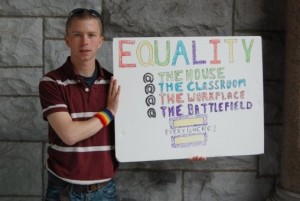
Bradley Manning at work

Bradley Manning at work

The news this week that Private Bradley Manning had come out as Chelsea made me think first that truth is way stranger than fiction, and second that it makes perfect sense that one of the most courageous warriors of our time would be a queer woman.

Gloria Anzaldua, who has been one of my heroines since I first read her seminal work Borderlands/La frontera back in the 1980s, always insisted that queer folk have a special role to play in bringing about a change in human consciousness—moving us from the patriarchal mold of the past 5,000 years or so to what she called “a new mestiza consciousness,” a much more holistic, inclusive, planetary awareness.

Anzaldua extended Virginia Woolf’s famous statement, in her anti-war tract Three Guineas, that “as a woman, I have no country.  As a woman, I want no country.  As a woman, my country is the whole world,” giving it a new queer mestiza twist:

Gloria Anzaldua

Gloria Anzaldua

“As a mestiza I have no country, my homeland cast me out; yet all countries are mine because I am every woman’s sister or potential lover.  (As a lesbian I have no race, my own people disclaim me; but I am all races because there is the queer of me in all races.)  I am cultureless because, as a feminist, I challenge the collective cultural/religious male-derived beliefs of Indo-Hispanics and Anglos; yet I am cultured because I am participating in the creation of yet another culture, a new story to explain the world and our participation in it, a new value system with images and symbols that connect us to each other and to the planet.  Soy un amasamiento, I am an act of kneading, of uniting and joining that not only has produced both a creature of darkness and a creature of light, but also a creature that questions the definitions of light and dark and gives them new meanings.”

Because queer folk have lived in their own bodies this awareness of being more—more than meets the eye, more than can be limited by any label or category—Anzaldua believed that they would be able to lead the way towards a new human civilization founded not on dominance and subordination, not on hierarchies of value, not on black-and-white binary systems, but on synthesis and what she called “a tolerance for contradictions, a tolerance for ambiguity.”

Some, like Anzaldua herself, would be called upon to become what she called nepantleras, boundary crossers and bridge builders who would go through the wounds and pain of traumatic life experiences to access courage and wisdom to lead others into a new awareness of human potential.

Chelsea Manning is such a nepantlera.

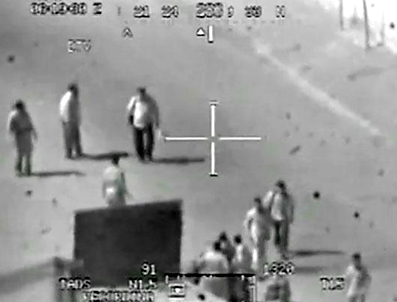
Several years ago, in a class I offered on human rights, my students and I watched, horrified, a recently leaked video called “Collateral Damage,” which clearly showed a group of American soldiers in a helicopter searching out and gunning down unarmed Iraqi civilians who were simply talking together on a quiet, sunny, bombed-out village street.

Still image from the Wikileaks Collateral Damage video--before the machine guns started

Still image from the Wikileaks Collateral Damage video–before the machine guns started

The language the soldiers used as they hunted down their targets was straight out of a violent video game, which is probably where they had learned the shoot-em up skills they displayed.  But this was no game.  Of the several men who lost their lives that day, one was a journalist on assignment for the Western media, armed only with his digital camera.

My students and I agreed that we needed to know that this kind of behavior was taking place under the banner of the American flag.  Keeping us in the dark about the reality of what was happening in Iraq, at the cost of enormous sums of taxpayer monies, was a violation of the rights of every American citizen in whose name this war was being fought.

Many obviously agree: the clip “Collateral Damage” has now been viewed more than 14 million times on You-Tube. Only because of the courage of Chelsea Manning and Julian Assange of Wikileaks, both now branded political heretics, did we find out this information.

imagesWe like to think that America is a free country, but it turns out that our freedom has very carefully regulated borders and boundaries.  We are free to dissent as long as we have a permit.

The World Wide Web knows no such boundaries.  It is truly a queer space, a space that has room for every kind of human activity and belief.  In exercising her freedom to circulate information on the Web, Chelsea Manning ran afoul of those who would try to dam the flow, controlling access to knowledge.

Some insist that it is essential that knowledge be controlled, in the name of national security, counter-terrorism, American interests, etc, etc.

It’s past time to start asking questions about whose interests are really served by restricting the free flow of information.

Are we going to become another China, where all individual freedoms are subordinate to the will of the State?  Has it already happened?

What all totalitarian states have eventually learned is that the more human beings are repressed, the more our will to resist is strengthened.

In this country, for the past few decades, our attention has been dulled by the opiates of the entertainment media, consumerism and drugs of many kinds.  A majority of us have slipped without even realizing it into a new form of labor bondage, in service to the almighty Bank, by whose credit and in whose debt we live.

During this time, the military-industrial-financial-media corporate conglomerates have grown huge and menacingly well-armed, to the point where it seems almost impossible that those of us who dare to imagine another way of living—another way of relating to the planet and to each other—might prevail.

We must not allow our vision of a better world to be limited by those who are currently in power.

We must insist on the freedom of the World Wide Web as a queer space for those who understand that “our country is the whole world.”

Chelsea Manning, I salute you!  You had the courage to shine a light into the dark corners of our government, no matter the consequences, and now you courageously step into the full measure of your own identity.

May we each learn to be so bold.

We are the Albatross

Lately I have been wondering how on earth it was possible to live without plastic.

I’m not even talking about marvelous inventions like disposable contact lenses, PVC piping, or neoprene wetsuits.

I’m just thinking about my kitchen routine, and how much I rely on—and take for granted—a never-ending stream of plastic wrap, plastic bags, and plastic containers as I go about my daily business.

I am so habituated to using plastic that I really had to ponder a while on the question of alternatives, until finally I remembered glass.  Of course, my grandmothers must have had a big shelf full of glass jars that they washed and re-used to store food in.

I also remembered that back in the 1980s, when I visited my in-laws in Mexico, I was surprised to see that they did not have any plastic wrap or boxed plastic bags in their kitchen.  They put things like cold cuts on plates, covered with another plate.  They left their leftover soups, stews and rice in the cooking pots, and placed them in the refrigerator with the lids on.

It also astounded me to see that in that household of seven, with numerous friends and relatives always dropping in for a meal, there was no trash container in the kitchen.  My mother-in-law saved plastic bags that she got when she went, once every couple of weeks, to the supermarket, and used these to collect the small amount of garbage that accumulated day to day.  Their little dog ate most of the food scraps, and they just didn’t generate that much of any other kind of garbage.

Why?

Because they bought their meat and produce from the little market down the street, carrying it home in their heavy-duty mesh bags (once made of straw, by the 1980s these were made of plastic threads).  My mother-in-law had a round wire egg basket that she’d bring to the market to refill.  The poultry would come from the butcher stand wrapped in paper, and rice or beans would come in brown paper bags.

There was just hardly any packaging.  And packaging, I’ve come to realize, is what generates most of the kitchen garbage in an ordinary American household like mine.

Here in Canada, we are mandated to separate our garbage carefully.  The bottles, cans and plasticized paper containers go in one bin, the paper and cardboard in another, and the compostable items in a small bin under the sink.  Then there’s the “trash.”  That’s the one where all the miscellaneous plastic packaging and used plastic bags go, and it tends to be the most bulky.

Since I watched the marvelously poignant and persuasive film BAG IT a few weeks ago (shout out to my friend and neighbor Anni Crofut for making us dinner and sitting us down to watch the film!), I have not been able to look at plastic trash in the same way.

The film starts from a simple question: why on earth would we use as our primary disposable material an indestructible synthetic chemical known to be an endrocrine disrupter and carcinogen?

And yet we do, over and over, in vast quantities.  We buy our drinks in plastic bottles and toss the empties in the trash.  We walk out of the superstore with carts piled high with groceries packed into small plastic bags.  We bring home our carrots in one plastic bag, our potatoes in another, and if they don’t come pre-bagged, we pull off a plastic bag from the conveniently placed roll and fill it ourselves.

Most of these bags will be dumped into the trash bin by the next day, and we’ll put them out of our houses in bigger plastic trash bags, and not give another thought to what may become of them next.

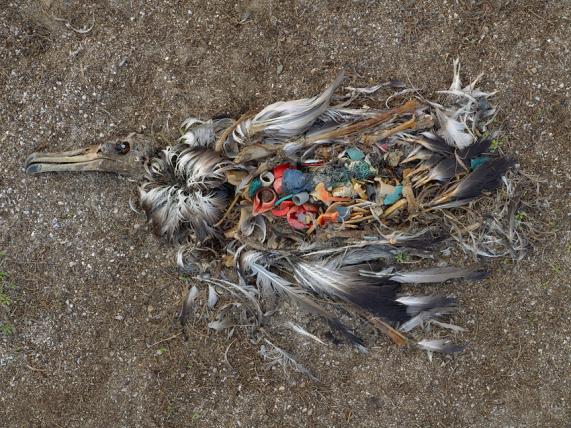
Some of our plasticized culture is being used to build huge land-fill mountains visible from space.  But a lot more of it is ending up in the oceans, where it becomes an indigestible, non-degradable part of the food chain.

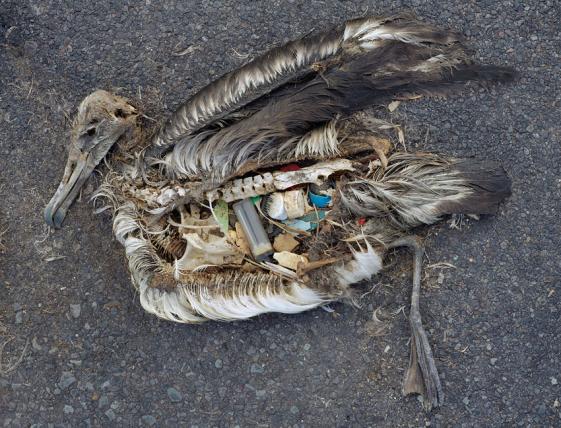
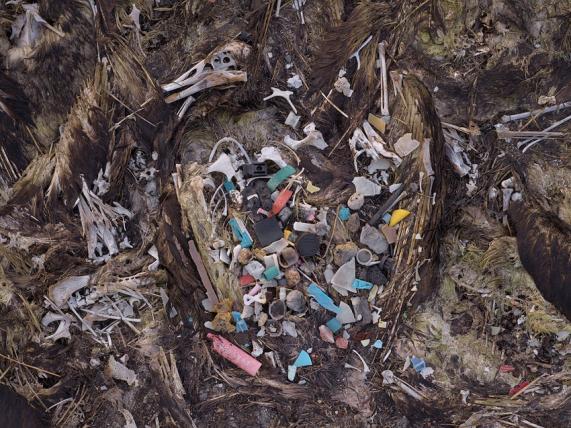
These photographs by artist Chris Jordan, of dead albatross on Midway Atoll, near Hawaii, tell a tragic story.
 chrisjordan7

chrisjordan2

chrisjordan1

Look a little deeper into what’s happening to our thoughtless use and disposal of plastic, and you’ll learn about the vast gyres of rotating plastic trash out in the oceans, some as big as the state of Texas.

You’ll discover that the chemicals that compose plastic are gyrating around in human blood streams and fat as well, causing cancer and hormonal malfunction. 

American plastics are exported all over the world.  My Mexican mother-in-law now has plastic wrap and plastic bags in her kitchen, and if the plastics industry had its way, so would households from Azerbaijan to Zimbabwe and beyond.

Plastic is a fabulous, miraculous material and of course it’s not something we can imagine of doing without.  But there is such a thing as compostable plastic, made of  plant-derived chemicals that do break down again.

IMG_2956IMG_2954Once the Canadian government mandated that compost had to be disposed of in compostable bags, manufacturers like Glad stepped right up and began producing the necessary product.

It’s not even much more expensive than petroleum-based plastic bags—this box of 20 bags sells for $2.99 here in Nova Scotia, and I bet if I shopped around I could find them for less.

This is an issue where ordinary consumers can have a big impact.

We can remember to bring our reusable bags to the grocery store, including the small bags or containers for produce and bulk foods.

We can wean ourselves off plastic bottles for drinks, except on those unavoidable occasions, like in airports where we’re not allowed to bring in our own bottles of water or other liquids.

We can be much more thoughtful about our use of plastic wrap and other disposable plastics in the kitchen.

We can talk with our friends and families like my friend Anni did with me, trying to gently raise awareness.  We can even bring it up with our local government officials and see if we can get local ordinances passed banning plastic bags in supermarkets.

I am proud to say that the little town of Great Barrington, MA, where I live, is one of the first towns in the country to do just that.

The plastics industry would like nothing better than for everyone to use as much plastic as we possibly can, and throw it away just as fast.  What happens to the trash is not their concern.

But if we care about the health of our oceans, airs and land, as well as the very chemistry of our bodies, it is our concern.

And we have more power than we realize.  The fossil fuel industry depends on the docile cooperation of all of us fossil fuel addicts.  Sometimes I really think that there’s some kind of conspiracy going on between the fossil fuel, agri-chemical, pharmaceutical and insurance industries, who act as a giant many-tentacled cabal that sucks us in, addicts us to their products, and then watches complacently as we become sick and dependent on expensive tests and treatments.

We do not have to fall for this any longer!  It’s not hard to eat healthy, it’s not hard to bring your own bags to the supermarket, it’s not hard to ride your bike or at least decide to purchase a hybrid car next time around.

IMG_3145 copyWhat is hard is to isolate yourself from a contaminated natural world.  It simply can’t be done.  Our land, oceans and air are an extension of us.  We are the world, the world is us, as Joanna Macy recognized long ago.  That’s why we have to be concerned about what’s happening with the plastic trash in the oceans, or the greenhouse gases in the air, or the toxic chemicals in the soil.

The bottle caps and syringes that the poor albatross is carrying around may be bigger and easier to see, but the truth is that each of us carries an unbearable burden of toxins in our own bodies every day.

And we’re doing it to ourselves, by our own unconscious collaboration with the industries that are sickening us and our world.

It’s time to say ENOUGH, disengage ourselves from the herd, and stand up for what we know is right.  Be the change.  Be the change.

R.O.I.—From Mother Earth’s P.O.V.

imagesPeter Buffett, one of billionaire Warren Buffett’s sons, published a brave, thoughtful op-ed piece in the New York Times the other day.  In it, Buffett takes to task what he calls “the Charitable-Industrial Complex,” the philanthropic crowd who piously seek to save the world, as long as the R.O.I. is sufficiently rosy and the status quo is not upset.

Buffett knows he sounds like a class traitor here as he proffers this description of “Philanthropic Colonialism” (his term):

“As more lives and communities are destroyed by the system that creates vast amounts of wealth for the few, the more heroic it sounds to “give back.” It’s what I would call “conscience laundering” — feeling better about accumulating more than any one person could possibly need to live on by sprinkling a little around as an act of charity.

“But this just keeps the existing structure of inequality in place. The rich sleep better at night, while others get just enough to keep the pot from boiling over. Nearly every time someone feels better by doing good, on the other side of the world (or street), someone else is further locked into a system that will not allow the true flourishing of his or her nature or the opportunity to live a joyful and fulfilled life.”

Buffett says he’s “really not calling for an end to capitalism; I’m calling for humanism…. It’s time for a new operating system,” he declares. “Not a 2.0 or a 3.0, but something built from the ground up. New code.”

Buffett says that philanthropy should be dedicated to  “trying out concepts that shatter current structures and systems that have turned much of the world into one vast market. Is progress really Wi-Fi on every street corner? No. It’s when no 13-year-old girl on the planet gets sold for sex. But as long as most folks are patting themselves on the back for charitable acts, we’ve got a perpetual poverty machine.

“It’s an old story,” he concludes; “we really need a new one.”

Yes.  And philanthropy is not the only sector of our society that needs to reinvent itself.

Although I respect Buffett for his willingness to sound what will be taken as a heretical note in his own social circles (at one point he adds self-consciously “now I’m going to upset people who are wonderful folks and a few dear friends”), I don’t think he goes far enough.

I don’t want to see a merely “humanist” social system, I want to see humans develop an ecological understanding of our place and role on the planet.

I want us to repudiate our colonialist mindset, which persists not only in our tendency to give “humanitarian aid” with one hand while seizing economic control of a country’s most valuable resources with the other, but also in predatory capitalism at home and abroad—the debt bondage that the majority of people on the planet who buy into the system find themselves lashed to, laboring to pay the bank without ever being able to accumulate enough capital, social or financial, to buy their way into the promised land of security and ease.

The “new story” I’d like to see us live by would rewrite human attitudes towards other animals, insisting on the rights of every living being on this planet to a decent life.

That doesn’t mean a pig needs a condo with a swimming pool, but she does need enough space to breathe and move around in, healthy food and a clean, sanitary living environment.  Her wastes need to be disposed of the same way human wastes are—not sent into the rivers to create dead zones the size of states out in the sea.

100_2435Every aspect of the planet, from trees to minerals to water to fossil fuels, should be seen as precious resources to be safeguarded and cherished for the good of all who rely on them, not merely as sources of income for the few who sit on the boards or own stock in the mega-companies that develop, extract, exploit, and sell before moving on, leaving the devastated land as “collateral damage”— someone else’s problem.

The question is, how to get through to the corporate titans who are very happy with the status quo?

These are the folks who live their whole lives in such a fabulous cocoon of wealth and privilege that they have the illusion that they and their families can remain entirely insulated from the shocks of our poisoned, over-populated, over-heated planet.

If even in their philanthropy these people are thinking in terms of R.O.I., it must be a totally foreign concept to them to imagine conducting business in terms of gross social gain rather than gross individual profit.

Andrew Harvey, in his book The Hope: A Guide to Sacred Activism, recounts a lunch conversation he had with one such business tycoon, “the head of a major agribusiness corporation.”  The businessman chews Harvey out for being a “naïve do-gooder” who does not understand how the real world functions.

“Most of you that I have met truly believe that if the CEOs—like me, for instance—really knew what harm their corporate policies were doing, they would rend their Armani suits, fling out their Rolex-wreathed arms, burst into tears and change.  This is madness and shows how little you dare to know about what is really going on.  And how can you even begin to be effective until you understand what you are up against?

Of course, the businessman then enlightens Harvey on what he and other “naïve do-gooders” are up against in the quest to change the world for the better.

“You are up against people like me,” the man says.  “I know exactly what my company is doing and what devastation it is causing to thousands of lives.  I should know; I am running it.  I know and I do not care.  I have decided I want a grand gold-plated lifestyle and the perks and jets and houses that go with it and I will do anything—bend the law, have people ‘removed,’ bribe local governmental officials, you name it—to get what I want.  I know, too, that none of my shareholders care a rat’s ass what I do or how I do it, providing I keep them swimming in cash.”

I thought of this blunt, self-satisfied description of the view from the top of the capitalist heap when I read recently about how the American electricity industry is responding to the rising popularity of home-based solar panels.

images-1Rooftop solar panels are being compared to cell phones, which, if you remember, created a major sea change in the telecom industry.  In the end, the telecom giants made out like bandits, after initially having spent a lot of money and political capital to try to put the brakes on what was perceived as a threat to the traditional landline phone system.

Today it’s the turn of the electricity industry, which is terrified of losing market share if every homeowner can make their own energy on their own roof.

If homeowners are no longer paying the fees that subsidize the public grid, industry officials argue sanctimoniously, how will this public system be maintained?

No where in the New York Times article about this, which appeared in the Business section, was there any mention of the broader social, global benefits of distributed solar electric generation as compared to fossil fuels or nuclear electric sources.

No mention of the many reasons why every government on the planet should be encouraging homeowners and businesses to convert their energy sources to solar, along with wind, hydro and geothermal, just as fast as they possibly can.

When are the CEOs who are so busy buying off Congressional delegations and creating expensive self-advertising campaigns going to realize that what they really need to be worrying about is not thrifty homeowners taking advantage of tax incentives to install solar panels, but the mega-storms, wildfires and floods that will be coming our way every year, increasing in intensity the longer we wait to make up our minds, as a global society, to give up our addiction to fossil fuels?

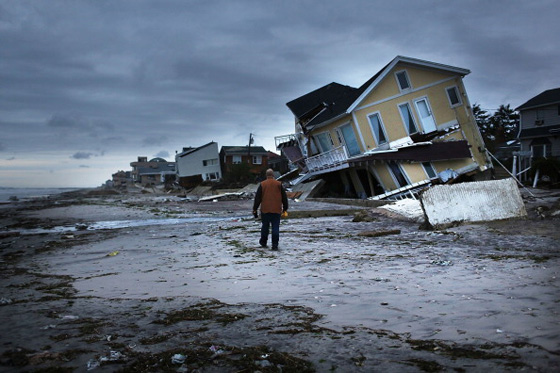
hurricane-sandy-damage

Apparently most human beings can only be swayed by self-interest.

OK—we can work with that.  It’s quite clear that it’s in the interests of every human being on the planet to develop a sustainable relationship with our Mother Earth.

If we don’t, she will just give a great shrug of her climatic shoulders and be done with us.

Where will the R.O.I. be then?

Being the change–beyond hope, beyond fear

Every time I write an exhortatory post like the last one, I imagine my readers getting to the end and clucking their tongues in frustration.

“OK, we get it, now the is time to act—but what does she want us to DO?  Doesn’t she have any practical suggestions on what to do in this terrible transition time?  Isn’t she going to lead by example?”

Well, yeah.  In relentlessly focusing my attention, and by extension my readers’ attention, on the frightening facts of environmental degradation–from climate change to toxic pollution to the precipitous decline of millions of species—I am doing something.  It may not be much, but at least it’s better than sticking my head in the sand and ignoring the gathering storm, or selfishly trying to live it up as long as possible—let the band play on!

There are many things I dream of doing, but right now simply cannot.

I cannot build myself an environmentally sustainable, off-the-grid house, nor can I pick myself up and move to an eco-village at this time.

I cannot spend all my time sitting in trees to protest logging or marching on Washington D.C. to protest inaction on climate change.

I cannot devote myself 100% to environmental communications work.

And I can’t wave my wand and stop the poles from melting, or make all the toxic chemicals just go away.

What I can do is take the strengths I’ve been given, in writing and communicating, and use them to try to spread awareness among others, in the hope that the little ripple I may be able to start will grow to a mighty wave of positive change.

***

I need to think more about this question of hope, though.

Margaret Wheatley

Margaret Wheatley

Lately I’ve been reading and re-reading Margaret Wheatley’s latest book, So Far From Home, in which she talks, rather surprisingly, about the need for activists to move beyond hope.

The problem with hoping for change, she says, is that “fear is the constant, unavoidable companion of hope. What this simply means is that I hope for a certain outcome and I’m afraid I won’t get it. I hope for a certain result and I’m fearful it won’t happen. This is the way that hope and fear are wedded together….So, it might be that the road to fearlessness is only found by giving up hope. By giving up outcomes, by giving up goals.”

This is a challenging idea.  If we give up on goals, doesn’t it mean that we give up, period?  That we just bow our heads in resignation and accept the anthropogenic destruction of our planet as inevitable?

Not according to Wheatley.

Quoting from Thomas Merton, who says that we need to “concentrate not on the results but on the value, the rightness, the truth of the work itself,” Wheatley gently asks:

“What if we could offer our work as a gift so lightly, and with so much love, that that’s really the source of fearlessness? We don’t need it to be accepted in any one way. We don’t need it to create any certain outcome. We don’t need it to be any one thing. It is in the way we offer it, that the work transforms us. It is in the way we offer our work as a gift to those we love, to those we care about, to the issues we care about. It is in the way we offer the work that we find fearlessness. Beyond hope and fear, I think, is the possibility of love.”

Could this be a kind of answer to those skeptics who would take me to task for writing about environmental issues without doing enough to be the change I want to see?

By giving myself to this work of raising the alarm, motivated by my deep love for the planet and my awareness of the inter-being of all her denizens, am I doing the work I came here to do in this lifetime?

The truth is that I don’t have much hope, anymore, that we will be able to “save the world.”  Nevertheless, I keep on writing, because writing is my way of working through and releasing myself from fear.

Having spent a lot of my life in fear, and having come to know it intimately, I can say with some authority that fear is a useless, paralyzing emotion.  Fear holds us back, it pinions our wings, it pushes us to do things we will later regret.

What we need, Wheatley says, is the clarity that resides beyond fear and its twin sister, hope.  The clarity that comes with knowing that since our time is going to come sooner or later, what’s important is how we spend each one of our days.

We need to do the work we came here to do, as well as we can, without expecting reward or recognition, without depending on external acclaim or tangible, material successes.

Beyond hope, beyond fear, I will keep going on, day to day, raising my children, doing my teaching and writing, enjoying beauty, pleasure and loving-kindness as they cross my path, and conjuring them myself in the way I live my life.  In that sense, yes, I will be the change.
100_2487 copy

World on fire

I had to dig deep into the New York Times, my usual go-to source for “all the news that’s fit to print,” to find any mention of this weekend’s train explosion in the province of Quebec, not far from the Maine border.

canada-floater-articleLarge

Lac-Megantic on fire July 6, 2013

I knew about it only because here in Canada it’s at the top of the headlines, with Prime Minister Stephen Harper taking the time this Sunday to journey to the small town of Lac-Megantic, where the disaster occurred, to size up the situation and offer his condolences.

Officially, so far, five have been confirmed dead, with scores still missing; Lac-Megantic, pop. 6,000, is said to look like a war zone, with black fumes rising from the burning crude oil carried by the 73-car train.

This on a weekend when temperatures in the Canadian Maritimes soared to record-breaking heights, and harmful algal blooms worldwide choked out marine life along all the coasts.

91fb3c94-086c-4470-a98e-23ec4ff993d8-460x276

Algae bloom on the Yellow Sea in China, July 2013

Astoundingly, at least one Canadian pundit responded to the burning crude and the smoldering township by calling for increased building of pipelines!

Another columnist, in the very same newspaper that reported on Nova Scotia’s unprecedented heat wave, had the nerve to call for more drilling and fracking for oil and natural gas on land and sea in the province.

If there are no more fish in the sea, we can at least extract the last of the fossil fuels, eh?

It’s time to get a grip, people.

What we need is not more oil and gas, but more wind and solar.

We need clean sources of energy, and we need to lower our consumption dramatically.

The window of possibility is smaller and tighter than most of us care to realize.

The tipping point is upon us.

This is not another action movie, a “White House Down”-style disaster flick, ending with the good guys reliably saving the day.

As we saw with the Arizona fires the other day, even the most hot-shot of heroes can go down in a blaze of glory when the fires burn out of control.

Do we really want to wait until the entire world is going up in flames, literally and figuratively speaking, before we act?

This is not a rhetorical question.  And the answer, I believe, is NO.  We can’t afford to sit on our hands any longer.

The time to act is NOW.

Which Side Are You On?

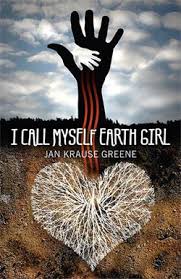
imagesFor the past few nights I have been putting myself to sleep by reading an advance copy of my friend Jan Krause Greene’s new novel, I Call Myself Earth Girl.

It’s not exactly a feel-good bedtime story, dealing as it does with rape, environmental disaster, death and bereavement.

But it’s also about empathy and love, between family members and also on a worldwide scale.

In Greene’s vision, the Earth and its denizens can be saved from catastrophe by mindful attention to what really matters: affirming life, both our own and that of the unborn generations to come.

Not since Starhawk’s 1994 masterpiece The Fifth Sacred Thing have I come across a book that so clearly matches my own waking nightmare of the terrible times that await us in the future, if we do not succeed in changing our ways now.

Let’s face it: it is possible that the kind of violence afflicting resource-starved places like Afghanistan, Syria and Somalia will become the norm in much more of the world, as climate instability creates food shortages and accelerates the pace of natural disasters beyond our capacity to recover.

America is a tinderbox just waiting to go off.  Imagine what would happen if suddenly it was not possible to go down to the supermarket and get your week’s worth of groceries?

Such a scenario is more or less unthinkable to people like me, who have grown up cradled by the richest breadbasket in the world.

We are only beginning to realize the costs that have come with our cornucopia: the destruction of the virgin prairies in the Midwest, the poisoning of the earth, water and air with chemical fertilizers, pesticides and herbicides; the grotesque factory farms of livestock and fish; the genetic alteration of seeds; the destruction of local farming by the huge predatory monster of American-style factory farms.

We have grown fat on these practices.  And now it’s time for us to accept responsibility for the outcomes of our heedlessness.

Those of us alive today have the privilege, and the responsibility, of presiding over what could very well be the end times for human civilization.

It’s somewhat analogous to the end times of specific human cultures, like the Greeks, the Romans, the Egyptians, the Ottomans, the great Chinese dynasties….except that this time, we’re not just talking about the end of a single culture, we’re talking about the demise of humanity as a species.

It is possible to imagine, as Jan Krause Greene did, that our lush green planet could turn brown from environmental disaster, provoking a culture of armed militias surviving by means of ruthless violence—with women, as always, at the bottom of the heap.

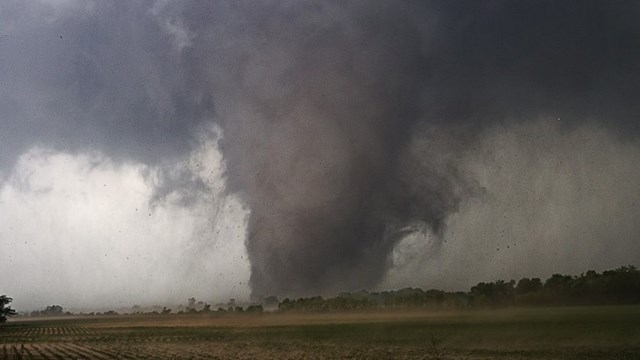
Tornado bearing down on Moore, OK; May 21, 2013

Tornado bearing down on Moore, OK; May 21, 2013

It is already happening—just not yet here, in the gated community we call America.

Can we wake up in time to forestall total, worldwide environmental melt-down?

In the past week we had a deadly two-mile-wide tornado in Oklahoma, and the Russian science station in the Arctic Circle had to be evacuated because the ice was melting at an unprecedented rate.

Here in New England we are expecting temperatures in the 30s Farenheit this weekend—way below normal for what should be the start of the growing season.

What’s next?

We don’t know.  But I take heart from local initiatives like the rehabilitation of the long-dormant Great Barrington Fairgrounds into a vibrant community-supported agriculture site.

We are going to have to re-localize agriculture if we want to survive the shocks of the 21st century.  We need to re-imagine not just agriculture, but community along with it.

As I Call Myself Earth Girl shows well, the antidote to violence and fear is love and empathy.

We still have a choice. Which way will you turn?  Which side are you on?  How far will you go to protect the planet and the generations to come?

fifth-sacred-thing

The jig is up for military sexual assault

No fewer than 26,000 sexual assaults were reported by U.S. military service men and women in the year 2012 alone.

You read that right.

According to The New York Times, “Pentagon officials said nearly 26,000 active-duty men and women had responded to the sexual assault survey. Of those, 6.1 percent of women and 1.2 percent of men said they had experienced sexual assault in the past year, which the survey defined as everything from rape to “unwanted sexual touching” of genitalia, breasts, buttocks or inner thighs.

“From those percentages, the Pentagon extrapolated that 12,100 of the 203,000 women on active duty and 13,900 of the 1.2 million men on active duty had experienced some form of sexual assault.”

These numbers are simply unacceptable, especially when contrasted with the small number of sexual assault cases that were officially reported (ie, not via anonymous survey)–3,374—and the abysmal rate of actual conviction: only 238 assailants were convicted in 2012.

Lt. Col. Krusinski; booking photo

Lt. Col. Krusinski; booking photo

Most embarrassing for the military brass was the arrest last Sunday of the officer in charge of sexual assault prevention programs for the Air Force, Lt. Col. Jeffrey Krusinski, who was accused of having sexually assaulted a woman he did not know in a parking lot.

Way to lead, Air Force!  Just when we thought the Tailhook scandal was becoming a distant memory.

I’m glad to see that some members of Congress—especially the women—are hopping mad and on the case, as today’s column from Maureen Dowd details.

Women who put their lives on the line to serve in the U.S. military deserve nothing but respect from their superiors and peers.

The question is, how is the military going to re-program its entire culture, from raw recruit to brigadier general, who have been raised to believe that “all women (and all gay men) want it,” that might makes right, and that superior officers can act with impunity towards those under their command?

How is the military—and, indeed, American culture at large—going to counter the billion-dollar American porn industry, that thrives on presenting women as objects of desire, yes, but also as objects of violence?

The truth is that what we’re seeing in military culture is just the tip of the iceberg of a much more deeply-rooted cultural problem.

Just as the military stood up to become the model for racial integration in the 1970s, it must now trailblaze the path to gender equality for us in the second decade of the 21st century.

Women who are now going to serve in combat, just the same as men, should not have to worry about “friendly fire” from male supervisors and peers.

To be honest, the idea of women breaking glass ceilings in the military does not thrill me.

I’d rather women work to create and broker non-violent institutions and solutions to problems.

But there is no excuse, ever, for sexualized violence against women or men.

The Lt. Col. Krusinskis of the world need to get their rocks off some other way, and the old-boy networks that have stood in the way of change on this issue have got to go.

Senator Kirsten Gillibrand, Democrat of New York, plans to introduce legislation that would take the adjudication of sexual assault cases outside of a victim’s chain of command. According to the New York Times editorial board, which supports the measure, “It would end the power of senior officers with no legal training but lots of conflicts of interest to decide whether courts-martial can be brought against subordinates and to toss out a jury verdict once it is rendered.”

President Obama said the right thing in response to the Krusinski arrest scandal, but it remains to be seen whether he can follow up his words with actions.

“If we find out somebody’s engaging in this stuff, they’ve got to be held accountable, prosecuted, stripped of their positions, court-martialed, fired, dishonorably discharged — period,” Mr. Obama said.

Got that, all 26,000 of you who committed sexual assault last year?

The jig is up.

Earth Day 2013: Looking Disaster in the Eye

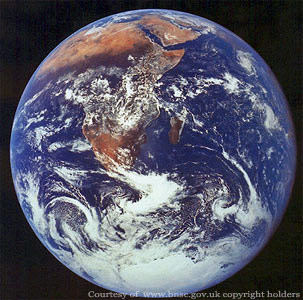
earthI was consumed with a great yearning when I heard last week, amidst all the sturm und drang of the Boston Marathon bombing and manhunt, that a twin sister of our lovely Earth had been discovered on the other side of the cosmos.

She is so far away—1,200 light years—that it is very unlikely any earthlings will ever visit her.  Not unless we can figure out how to bend time and space, like the tesseract imagined by Madeleine L’Engle in A Wrinkle in Time.

But just knowing she’s there—and that there may be many more planets like her, like us, out there in the universe—is comforting somehow, as we watch our own Earth being consumed by paroxysms of manmade violence and natural destruction.

It has been hard to focus on Earth Day 2013 with all the crazy human disasters going on.

But as the sun rises this morning on yet another day on Earth, I want to salute our battered, beautiful planet, our ever-giving Mother who asks nothing in return from her children, other than that they fulfill their own destinies.

It remains to be seen whether human beings—particularly of the male variety—can overcome our tendency to aggression and change the course of our destiny from its current suicidal path.

We are smart enough to know what is going wrong with our relationship to our Mother Earth, and we also know how to fix it.

Can we summon the moral imperative and the will to stop the violence, stabilize the climate, control our population growth, and enter a peaceful, prosperous New Age on Earth?

I wonder how the inhabitants of Earth’s distant sister have managed.  Perhaps if there are highly evolved inhabitants there they are even smarter than humans.  Perhaps they never fell from their Garden of Eden.

How much easier it is to do things right the first time, rather than deal with the mess of making them right again after catastrophe.

On this Earth Day, we must look disaster in the eye, and vow to overcome it.  Our Mother deserves no less.

IMG_1974 copy

Learning from mass murder: we must pay attention to our young men

If this past week had been written up as a movie script, I would have rejected it as totally over-the-top, beyond belief.

Two young Chechen immigrants successfully wreak mayhem and turn a city upside down with their improvised explosive devices, in the very same week that the U.S. Senate Republicans successfully beat back a bill designed to stiffen background checks for gun purchases.

Gabrielle Giffords

Gabrielle Giffords

The beautiful, brave Gabrielle Giffords publishes an impassioned piece in The New York Times, condemning the cowardly Senators who put the interests of the National Rifle Association over and above the interests of the American people.

Meanwhile, down in Texas, an explosion in a chemical fertilizer factory flattened a whole neighborhood, killing at least 15 people and injuring more than 200.  The cause of the blast is still unknown.

And the whole middle section of the country was inundated by heavy rains, storms and severe floods.

Fire, air, earth and water, all the elements seem to be drawn into an intensified dance these days, speeded up along with the 24-hour news cycle.

As the bizarre manhunt for the two Chechen bombers unfolded, and the whole country went into virtual “lockdown” in sympathy with the people of Boston and eastern Massachusetts, it felt like we were suddenly waking up to find ourselves in Baghdad.  Things like that don’t happen here.

Until they do.

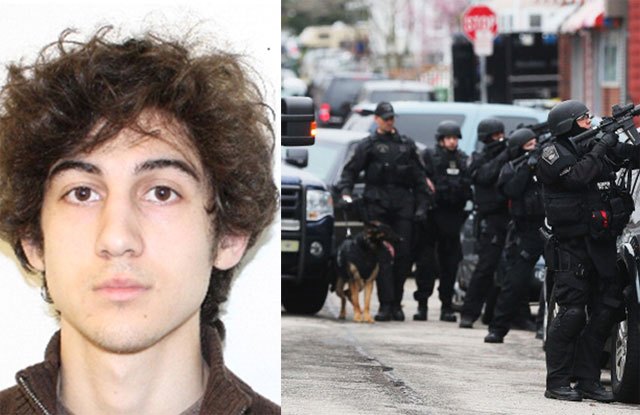
boston-bomber-suspect-dzhokhar-tsarnaev I don’t have TV in the house, so I got most of my information on the situation in Boston from print media and radio.  But even the few pictures I saw were enough to convey the sense that the official response to these boys’ stupid act of random violence was hugely disproportionate.

Against a lone 19-year-old kid, thousands of law enforcement officers of every stripe were deployed, in full riot gear, toting rifles, traveling around the deserted streets in armored vehicles.

The kid was presumed to be “extremely dangerous.”

How dangerous could one kid be?

I understand that the concern was that he might have had a bomb or a suicide vest that he could detonate at the very end.

But that is not the way the story went.  In the end, he came out with his hands up, just one stupid, confused kid who surrendered to the police without a peep.

His life is over.

Ours will go on.

In the wake of this latest act of violence within our own borders, we need to take a good hard look at the role of the U.S. as a fomenter of violence, both at home and abroad.

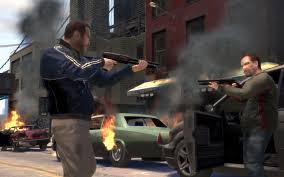
Unknown-1 Not only is the U.S. the largest exporter of arms and weaponry in the world, but we are also the biggest developer of violent video games worldwide, the ones I am betting those Chechen boys loved to play.

Why should we expect that we can promote violence by all kinds of channels, and remain immune to it within our own borders?

What goes around comes around.

If we were serious about wanting peace and security, we would start by radically shifting our focus from creating implements of destruction—be they chemical fertilizers, assault weapons or games that encourage violence—to waging peace.

Waging peace—what would that look like?

One of the most urgent tasks is to change the way young men are socialized.

Let us not for a moment forget that every single act of mass violence that has taken place here in the U.S.—every single mass shooting, every single bombing—has been the work of young men.

Young men are do-ers.  They have heroic dreams—and in Western culture, it’s the young men who can slay the dragon or vanquish the ogre who are considered heroic.

We can honor and nourish that warrior spirit in our young men in ways that celebrate heroes who use their strength and talents productively, to safeguard ordinary people.

I suspect that Dzhokhar Tsarnaev is someone who would have made an excellent warrior for good.  He was obviously smart, resourceful and could handle himself well under great pressure.

For reasons as yet unknown, he–like Newtown gunman Adam Lanza, Norway gunman Anders Breivik, Aurora, Colorado gunman James Holmes and so many other young men whose names stand for infamous mass murders—chose to walk on the dark side.

We need to be paying attention to the accelerating rate of these crimes.  They are a sign of the dark times we are living through.

Those of us who believe in peace must recommit ourselves to raising our own internal lights higher, beacons for others to rally around.  Those of us who have the great responsibility of raising the next generation of young men—parents, teachers, employers, mentors—must recognize the tremendous importance of our task.

In the past thirty years, there has been a great deal of attention paid to rethinking the way we socialize young women.  This is definitely essential work.  But we forget about our young men at our own peril.