Taking up arms against a sea of troubles

marathon-explosion-people-on-sidewalkIn the wake of the Boston Marathon bombing this week, like everyone else I’ve been thinking again about violence.

I am not a total pacifist. I do think that there are some situations in which violence is the only sane route to follow.

I could never be one of those Buddhists who try to send loving-kindness to their torturer.  Sometimes I even have trouble “turning the other cheek” if someone has offended me.

I am a Scorpio: I hold grudges, I brood, I sometimes lash out (though mostly in fantasy, very rarely in real life).

I am very sensitive to oppression, injustice and abuse—although sometimes this sensitivity manifests as a willed numbness, a deliberate refusal to see, because if I allowed myself to really take in all the oppression, injustice and abuse that saturates our planet daily, I would drown in my own howling depression and the guilt of not doing enough to combat it.

To combat it.  The verb choice there, which came out instinctively, is not innocent.

Is it possible to combat the violence of oppression, injustice and abuse without using violence?

What does sending tong-len or turning the other cheek accomplish besides emboldening one’s opponent to ever more impunity?

I believe there are times and occasions where violence is the only answer and the right answer to oppression, injustice and abuse.

But that is quite a different kind of violence from what happened in Boston this week.

Random violence that breaks into a festive, sunny day and kills and maims innocent bystanders is a totally different form of violence than the measured, carefully aimed violence of righteous resistance.

0415-boston-marathon-bomb-13Bombs loaded with nails and bb pellets, set off low in a dense crowd, are calculated to inflict maximum damage on soft exposed flesh and limbs.

Did whoever set those bombs enjoy the panic that ensued, the blood in the streets, the shock, the horror?

I can only imagine this perpetrator as a sadist, because unlike with the 9/11 attack or even the bombing of the Federal Building in Oklahoma City, there isn’t any apparent symbolism in this attack that makes any sense.

I can understand rage against the U.S. Government, and against the World Trade Center.  Although I could never condone killing innocent people in the service of that rage, I can at least see and comprehend the mindset that saw such collateral damage as instrumental in making a larger statement.

But what possible message could be sent through killing athletes and sports enthusiasts on the streets of an ordinary American city like Boston?

I wish the perpetrator would come forward and stand behind this act of violence.  I want to try to understand the motive, the fury that could have prompted such a carefully calculated crime.

I am not naïve; I know there are many very good reasons that people all over the world hate the U.S. and Americans.

And there are good reasons for Americans ourselves to be angry at our society and government, with its ever-increasing inequality, its investment in environmentally destructive policies and products, its build-up of weapons at the expense of the services that citizens have a right to expect and demand.

There is a staggering amount of oppression, injustice and abuse in the world, not just by people against people, but also by people against the natural world—and thus there is a hell of a lot to be angry about—and even to take up arms about.

But setting off bombs on a street crowded with families and athletes?

That is just more senseless violence–meaningless, useless, a squandering of lives and of anger that could be much more appropriately focused and channeled.

Yes, sometimes violence is necessary, sometimes it’s a good thing.

But the violence we are seeing on at ever-increasing rate here in the U.S. is an empty, hollow kind of violence; the violence of a sadist kid who likes to pull the wings off flies.

And worst part of it is, we seem to be on a roll with it.  Our young people entertain themselves with violent movies and video games; our military-industrial complex continues to grow with ever more sophisticated means to inflict violence abroad; our chemical and industrial destruction of the environment continues unabated.

We live in a violent world of our own making.

Can we who believe in peace, harmony and justice make things right without taking up arms ourselves?

I wish I knew the answer.

Sparks fly around the table–of the seminar room or the lunchroom

There’s something seriously wrong when the dominant methods of education do not foster the skills most valued by potential employers.

In a recent spate of op-ed pieces in The New York Times, pundits have explored this disconnect, which seems to be grower wider as we advance into the 21st century.

David Brooks, making a distinction between what he calls “technical knowledge” and “practical knowledge,” says that online education is good for transmitting and measuring students’ mastery of technical knowledge, but does little for helping students gain the practical knowledge they’ll need to be successful in the workplace.

“Practical knowledge is not about what you do, but how you do it,” Brooks says. “It is the wisdom a great chef possesses that cannot be found in recipe books. Practical knowledge is not the sort of knowledge that can be taught and memorized; it can only be imparted and absorbed. It is not reducible to rules; it only exists in practice.”

Brooks points to the college seminar as one of the important incubators of important workplace skills, and as someone who teaches exclusively in seminar style, I agree with him.  The college seminar is where students learn how to listen to each other, build on each other’s ideas, articulate their own ideas clearly and concisely, and take away crucial insights that they’ll use to construct their more fully elaborated written papers (which in the workplace might be called briefs or reports).

But Brooks and I part company when he suggests that seminars should be used as laboratories for the dissection of intellectual exchange.  He thinks that a smart use of online education technology would be “to take a free-form seminar and turn it into a deliberate seminar….Seminars could be recorded with video-cameras, and exchanges could be reviewed and analyzed to pick apart how a disagreement was handled and how a debate was conducted. Episodes in one seminar could be replayed for another. Students could be assessed, and their seminar skills could be tracked over time.”

Deep groan.  This sounds like a perfect recipe for a disastrous seminar in which students—and faculty–would be made to feel increasingly self-conscious, where the delight of the “free-form” exchange of ideas would degenerate into a stilted, scripted, uber-careful caricature of what a seminar should be.

Occasionally taping a seminar and analyzing it might be fruitful, especially in one of those inevitable groups where the dynamics are terrible and everyone, by mid-semester, wants to just crawl under the table and hide. But making the focus of the semester the “how” rather than the “what” seems like a terrible idea.

It’s also in sharp contrast to the most cutting-edge ideas of how to spur human innovation and creativity, which lord knows we desperately need as the 21st century advances.

In his own recent column on education, NY Times columnist Tom Friedman interviewed Harvard education specialist Tony Wagner, also looking for ways that educational practices could better connect to workplace imperatives. According to Wager, who just wrote a book called Creating Innovators: The Making of Young People Who Will Change the World, “because knowledge is available on every Internet-connected device, what you know matters far less than what you can do with what you know. The capacity to innovate — the ability to solve problems creatively or bring new possibilities to life — and skills like critical thinking, communication and collaboration are far more important than academic knowledge. As one executive told me, ‘We can teach new hires the content, and we will have to because it continues to change, but we can’t teach them how to think — to ask the right questions — and to take initiative.’ ”

Critical thinking, asking the right questions, and taking initiative are indeed what should be taught at every level of education, from kindergarten to college and beyond.  Interestingly, Wagner also points to another important goal of education, which is to motivate students to want to learn.

“Young people who are intrinsically motivated — curious, persistent, and willing to take risks — will learn new knowledge and skills continuously,” Wagner says. “They will be able to find new opportunities or create their own — a disposition that will be increasingly important as many traditional careers disappear.”

Unfortunately, in our current education environment, where passing standardized tests becomes a goal in itself, keeping kids engaged is a serious challenge.

I saw this myself when I taught at a large state university, where the students were much more interested in finding the best watering holes for their weekend parties than in any of their classes.

As Friedman reports: “We teach and test things most students have no interest in and will never need, and facts that they can Google and will forget as soon as the test is over,” said Wagner. “Because of this, the longer kids are in school, the less motivated they become. Gallup’s recent survey showed student engagement going from 80 percent in fifth grade to 40 percent in high school.”

Wagner’s solution is to re-imagine the classroom, and the educational system, so that teachers are focused on “teaching the skill and will to learn and to make a difference and bring the three most powerful ingredients of intrinsic motivation into the classroom: play, passion and purpose.”

That is a tall order, really, and it has to do not just with the classroom, but also with the dining room table—with what happens at home, in students’ family environment.  How to inspire passion and persistence in students who are being reared on smash-em up video games?  How to foster critical thinking and collaboration in students who come from plugged-in families who rarely spend much quality time together?

Somewhat paradoxically, it appears that it’s precisely in web-based interactive technology companies like Google, Facebook, Yahoo and others that the qualities of human innovation and creativity are most dogged sought.

And how are they trying to foster these skills among their workers?

Google350x233By going back to good old-fashioned lunchroom tables, at which, it appears, the unstructured back and forth of ideas is what prompts the greatest leaps in creative thinking.  Just like that other good old-fashioned table, the one in the college seminar room!

In a New York Times article provocatively entitled “Engineering Serendipity,” Greg Lindsay points to a recent study in which “researchers at Arizona State University used sensors and surveys to study creativity within teams.” The study found that “employees who ate at cafeteria tables designed for 12 were more productive than those at tables for four, thanks to more chance conversations and larger social networks. That, along with things like companywide lunch hours and the cafes Google is so fond of, can boost individual productivity by as much as 25 percent.”

If our best, most innovative companies most value creative, collaborative thinking, which is best fostered in face to face interactions, why in the world is K-12 education focused on teaching technical knowledge measured by standardized tests, while higher education is flocking to online learning, which isolate students in front of their computer screens?

Give me the old-fashioned seminar table any day, with a smart, dedicated teacher and a roomful of students who are absolutely forbidden to use their computers or phones or tablets for the duration of the class session! Give us some provocative material to discuss, and just watch the creative sparks fly!

“Our lives begin to end the day we become silent about things that matter.”

So OK, having slept fitfully and woken up resigned to accepting the basic premise that it is unlikely that the world as I have always known it will continue into the foreseeable future…what then?

How do I spend my one wild and precious life on the planet?

I am quite clear that I want to put my time, talents and energies into doing my best to head off catastrophe for the natural world.

But this often feels like trying to stick my finger in a huge roaring dyke of bad news—how can I, a small and ordinary person, make a difference for the trees and animals and birds and bees that I so want to protect?

All I can say is that making the attempt is better than giving up.

My gift has always been writing, and so I am using that gift to try to reach out to others, in the hope that if many of us, in our small, ordinary lives, can join our voices together, the resulting chorus could indeed change the world.

I am continually amazed at how the technological innovation of the World Wide Web has facilitated the meeting of minds and the catalyzing of movements.  There has never been a better moment for human progress and connected intellectual growth.

I wake up with a new thought, write it down and send it out into the gushing waters of the internet, where, within the hour, it will be read by someone living on the other side of the planet, who will bat it back to me with comments that will cause me to see the idea from a whole new perspective.  All within the space of an hour! How remarkable is that?

But sadly, it is precisely our reliance on and success with technology that is causing our demise, from simple overpopulation to the poisoning of our environment.

This is the challenge of our time: to very quickly learn to adapt to our rapidly changing climate, and to find environmentally sustainable ways to hang on to our positive technological inventions.

I believe it can be done, which is why I am totally invested in the challenge of waking people up and getting them engaged in fighting the good fight to make our epoch, which many call the Anthropocene, a positive transition to a better human relationship with the Earth, rather than a nightmare ending in the dark night of extinction.

If we were to shift our resources from weapons of destruction–guns, bombs and missiles, chemical poisons, and ever-bigger drills, earth-movers and chain saws—to implements of cultivation and the harmless harvesting of the bounty of our natural world, what a huge difference that would make!

People say that over-population will continue no matter what, but I know from years of studying women’s issues worldwide that when women are educated and respected in a society, they have fewer children.

Between fewer children in the developing world, a lower rate of consumption in the developed world, and the invention of new technologies that act in harmony with nature rather than against her, we could transform our planet within a generation or two.

J.R.R. Tolkien’s classic fantasy The Lord of the Rings is looking more and more prophetic, and it’s surely no accident that the films have come out now, to appeal to the current generation of young people.

We are the ones who must enter the fight to hold off the dark forces of Mordor, in order to preserve the happy, healthy lives in the Shire that all humans are meant to live.

tumblr_m9hm5vDG2h1qzhkvho1_500Today is the anniversary of Dr. Martin Luther King Jr.’s assassination, and I invoke his memory to remind us that although it is true that by ourselves each one of us is puny and limited, it is also true that if we pool our resources and act together we have tremendous power.

We must each start by determining what gifts we can bring to the table of this new movement, and then start where we are, doing what we can, and sharing our insights and passions by all the channels of communication that are open to us, from talking face to face with friends and neighbors to sending our ideas out into the World Wide Web.

Now is the time, and we are the ones we’ve been waiting for.

I will close with two quotes from Dr. King:

“Our lives begin to end the day we become silent about things that matter.”

“If you can’t fly then run, if you can’t run then walk, if you can’t walk then crawl, but whatever you do you have to keep moving forward.”

Amen, brother.

Morning pages for humanity…and the Earth

Julia Cameron

Julia Cameron

This week, in preparation for Julia Cameron’s presentation at the Berkshire Festival of Women Writers, I have been doing quite a bit of thinking about creativity.

Cameron’s great insight, back in the late 1980s when she was doing the teaching that led to her blockbuster creativity self-help guide The Artist’s Way, was that human beings are all naturally creative.  We just tend to get “blocked” by our upbringing, and need to work on ourselves in a systematic way to unlearn bad habits of self-doubt and defeatism, so that our creative juices can flow freely out into the world.

One question I wish I’d asked Julia at her lecture last night at Kripalu is this: I wonder whether women have any particular creative challenges, different from those faced by men?

The Artist’s Way does not seem to draw any distinction. Cameron uses the gender-neutral term “creatives” and her examples are drawn from the experiences of both men and women.

And yet it seems to me that women are particularly susceptible to the kind of distraction, hyperactive multi-tasking and withering self-doubt that Cameron says are anathema to artists.

One woman in the audience at Cameron’s lecture described herself as “frantic,” or maybe she said “panicked,” facing such a huge to-do list of projects she’d like to accomplish that she was paralyzed by the enormity of it all.

Julia’s response was characteristically calm and pragmatic: slow down, write your morning pages faithfully, ask for guidance from your higher self, and be patient—it will come.

This is certainly good advice for anyone who wants to accomplish creative goals, but it seems especially relevant for me, and all the busy women like me who so often do not take the time out for ourselves, to recharge our own creative batteries.

Cameron’s “morning pages” are deliberately unfocused.  They are not meant to be a to-do list, or an outline for a project, or a mission statement.  They are simply meant to provide a regular, rhythmic opening for the creative spirit, which Cameron clearly conceptualizes as coming from a higher source.

“I learned to turn my creativity over to the only god I could believe in, the god of creativity,” she says in The Artist’s Way, “the life force Dylan Thomas called “the force that through the green fuse drives the flower.”

By allowing ourselves the time and space to be open to the creative life force that gave birth to us, we are allowing ourselves to become channels through which those creative juices can flow out into the world, manifesting all in kinds of ways, depending on our particular gifts.

As Cameron said last night, this can sound a bit “woo-woo.”

But the life force is in a way the final frontier for human understanding, the one mystery we still have not been able to penetrate via science.

We argue about when life begins—at conception?  in utero?  at birth?—and we recognize that there seems to be much more to the universe than we can measure with our physical senses or scientific instruments.

We know in an intuitive way that when we are “in the flow,” allowing ourselves to be creative channels, things can start happening that seem entirely beyond our control, and not at all coincidental.

Julia Cameron calls this synchronicity: “we change, and the universe furthers and expands that change….It is my experience both as an artist and as a teacher that when we move out on faith into the act of creation,” she says, “the universe is able to advance.”

The thing is that not all creations are equal.

Human creativity is not always a good thing.

It’s fair to say that over the past 500 years, since the Catholic Inquisition began its war on the older, nature-based religions and the European powers began their colonial assault on the rest of the world, the dominant paradigm of human creativity on the planet has been materialistic, channeled by our rulers into paths shaped by greed and lust.

Domination and aggression have driven the leading edges of human invention: we have proven very adept at creating guns, machinery and synthetic chemicals, haven’t we?

We have also created a might-makes-right philosophy that has literally bulldozed away any impediments to the harnessing of the natural resources of our planet, including the vast majority of humankind, in the service of short-term gain for the elite.

But at the same time, human creativity has always flowered anew, with each new generation having the potential to choose a different way of channeling that divine universal flow.

We stand at a juncture in history when it seems that the planet is poised to hit the evolutionary reset button, sweeping human beings away to make room for the emergence of new physical vessels for its irrepressible life force.

I believe there is still time for human beings to come to our collective senses and begin to shape our creative output into inventions and ethical paradigms that support and enhance life, rather than torture and destroy it.

I worry about the role the media plays today in limiting and predefining children’s creative imagination.  Little children who used to spend hours playing pretend games, making up elaborate stories complete with visualizations and acting, now spend those same hours playing violent video games or passively watching commercial television, with its monotonous message that consumption equals happiness.

But I take heart from the teenagers I teach, who continually show themselves able to see through the mesmerizing power of the media and think creatively for themselves.

We human beings all need to be doing our “morning pages” in these crucial final years of the modern era, seeking to tap into the “pure positive energy of the universe” and open ourselves to the possibility of different, more harmonious and balanced creative forms.

Because I believe that women have an important role to play in this shift, I am totally dedicated to the work I’m undertaking in this month’s Berkshire Festival of Women Writers, opening up lots of opportunities for women to share their creative visions.

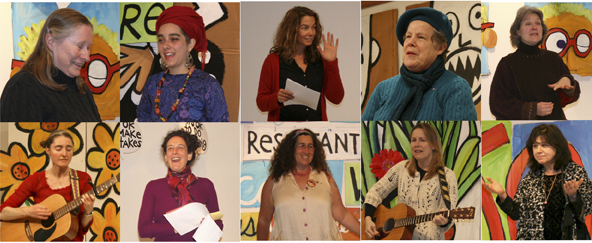
Women sharing their creative visions at the Deb Koffman open mic in Housatonic, MA

Women sharing their creative visions at the Deb Koffman open mic in Housatonic, MA

This is not just about women writers patting each other on the back and trying to advance our individual careers.

This is about women forming what Julia Cameron unabashedly calls “Sacred Circles” to propel humanity beyond the destructive domination-and-extraction model of the human relationship to our Mother Earth.

Next year’s Festival will have a special focus on women, creativity and environmental sustainability, to help us train our focus on the most urgent matter at hand: the destruction and contamination of the planet, with the resulting drastic climate change shifts that are coming in this century no matter what we do now.

Women and men worldwide need to rise to this challenge with every ounce of our creative energies.  On this International Women’s Day, 2013, I call on women, especially, to make a commitment to using our creative power for the good of the planet and all her denizens.

Holding the Fort for the Humanities

Michael Berube

Michael Berube

In a recent address to the American Council on Graduate Schools, out-going Modern Language Association president Michael Bérubé argues trenchantly that American graduate education in the humanities is in a state of crisis, and in urgent need of structural revision.

But to my mind, he does not go nearly far enough in his thinking.

“Graduate programs in the humanities have been designed precisely to replenish the ranks of the professoriate; that is why they have such a strong research component, also known as the dissertation,” Bérubé says.

But “the overall job system in the humanities has been in a state of more or less permanent distress for more than 40 years,” with doctoral programs “producing many more job candidates than there are jobs; and yet this is not entirely a supply-side problem, because over those 40 years, academic jobs themselves have changed radically. Of the 1.5 million people now employed in the profession of college teaching, more than one million are teaching off the tenure track, with no hope or expectation of ever winding up on the tenure track.”

So, he asks, how can we, in good conscience, continue to encourage students to enter graduate programs in the humanities, knowing the grim future that awaits most of them?

Bérubé reminds us that “the study of the humanities is more vibrant, more exciting, and (dare I say it) more important than it was a generation ago….The sheer intellectual excitement of the work, whether it is on globalization or subjectivity or translation or sustainability or disability, is one thing. This work is so valuable—and it offers such sophisticated and necessary accounts of what “value” is.

“And yet when we look at the public reputation of the humanities; when we compare the dilapidated Humanities Cottage on campus with the new $225-million Millennium Science Complex (that’s a real example, from my home institution); when we look at the academic job market for humanists, we can’t avoid the conclusion that the value of the work we do, and the way we theorize value, simply isn’t valued by very many people, on campus or off.”

Unfortunately, Bérubé doesn’t bring up the deeper questions about why our society currently values science and business so much more highly than the humanities.

Why is it that professors in the humanities make a fraction of what professors in business, law or science earn?

Why is it that academic programs in the humanities are under constant threat of the budget ax, while programs in business and science continue to attract huge inputs of resources?

Is it any surprise that students take a look at the depressed adjunct faculty in their dingy offices and take the nearest exit for the shiny new science building?

To me it’s pretty obvious: in our capitalist society, the academic fields that are most highly valued are those that create the possibility of more profit—with profit crudely conceived of as dollars in the bank.

My work in the field of comparative literature over the past 20 years, for example, has little to show for it in terms of money in the bank.

I’ve been focused on bringing the voices of marginalized or lesser-known women writers and activists to wider audiences within and outside of the Ivory Tower, because I believe that the perspectives offered by these women writers bring important, under-recognized and certainly under-valued ideas to the intellectual table.

For example, writers I study, like Rigoberta Menchu (technically not a “writer,” as her texts are transcriptions of her oral testimony), Vandana Shiva, Audre Lorde and Gloria Anzaldua, have been arguing for many years that human society must begin to honor our differences and value our interconnections with each other and with the natural world, in order to create a just and sustainable society.

Lorde, long ago, recognized that the “masters” are interested in keeping the oppressed divided, competitive, fighting with each other for the crumbs.  She urged us to think outside the box, “for the master’s tools will never dismantle the master’s house.”

The truth is that the humanities are dangerous ground for the “masters” of Euramerican society, because it is in the various academic terrains of the humanities that moral and human values are debated and interrogated.

It is no accident that critiques of capitalism itself, along with capitalist tools like elitism, militarism and globalization, have found their strongest purchase in the humanities.

Humanists who follow the lines of intellectual inquiry stretching back to the dawn of human written traditions and forward into the speculative reaches of science fiction and futurism, often find ourselves thinking outside the box of the current capitalist structures into which we have been born and indoctrinated to accept.

The moral questions raised in many humanities classrooms are themselves alternatives to “the master’s tools,” and they have the potential to dismantle the master’s house.

That is why, I believe, the humanities are currently being starved and derided by the masters.

That is why adjuncts in the humanities are being paid less than a living wage, discouraging the best and brightest from choosing that educational and career path—unless they are independently wealthy.

Bérubé ends his speech by suggesting that graduate programs in the humanities need to begin to combine the traditional focus on research, writing and teaching with the development of skills and connections that can help Ph.D.s secure good jobs outside of the professoriate, since he does not foresee any change to the current trend of an overwhelmingly low-paid, adjunct humanities workforce.

He points to the “digital humanities” as a prospect, since highly trained academics who can translate their knowledge into digital formats are more likely to find work in business, publishing or media.

I wish he would think a bit more radically.

As one of the humanities thought leaders of our time, I would like to see him come out and say that the deep questions of the humanities–questions about society, ethics and social and ecological justice–are precisely the ones that we need to be asking most urgently today, whether the masters like it and support it or not.

I know, up close and personal, how hard it is to wage this lonely battle, watching all the honors and riches going to colleagues who are willing to do the masters’ bidding more compliantly.

Sure, biotechnologists and creative financiers are going to get more funding and more accolades than someone like me, who studies ethics via personal narratives by little-known women writers.

But in the long run—or what is increasingly, in our era of climate change, seeming like the short run!—I believe that the wisdom these women have to offer will be more important than the latest patent on bio-engineered corn, or the most ingenious restructuring of debt derivatives.

Humanities education is one of the last outposts of oppositional thinking within the Academy.

Let’s hold our positions with honor, knowing that even if the material rewards are scant, we do get to keep our integrity, and do our best on behalf of the planet and all its denizens.

Looking for Valentinaville….

So far, my number one, all-time most popular blog post on Transition Times has been my 2012 Valentine’s Day post, “There’s More to Love than Cupid and His Arrows,” which was read by nearly 30,000 people worldwide in the past year.

In that post, I reflected on how the Valentine’s Day celebration of love could and should extend to more than just romantic love—we should celebrate family love, I said, the kind of love that runs “like molten gold at the core of a happy family like mine.”

A year later, and still without a romantic attachment this Valentine’s Day, I feel no different—but my thoughts on this issue are more defined.

marilyn-monroe-diamonds-gentlemen-prefer-blondes-blonde-movieIn American culture, and I am sure in many other cultures around the world, it is viewed as a shortcoming to be without a romantic partner.

To be alone, without a significant other on Valentine’s Day, is a source of shame.

Well to hell with that, especially for mature women!

I see so many women my age, midlife or older, without partners.

Is this just an American phenomenon?  I wish my non-American friends would chime in and let me know.

Here in the States, the divorce rate is astronomical, and we seem to have a surfeit of single women—either the 30- to 40-something put-career-first-and-never-married cohort, or the 40- to 50-something just-couldn’t-take-it-anymore divorced group.

And then at the upper edge of the age scale, there are the 70-something widows, too.

For men in all of these age groups, there are plenty of women to choose from.

After all, it’s not unusual for a man of 60 to take up with a woman 20 years his junior.

But when was the last time you heard of a woman of 60 partnering with a 40-year-old man?

For heterosexual women, the field narrows considerably as we age.

And the risks grow.  Why would I, as a 50-year-old, really want to take up with a man twenty years my senior?

If I were to enter the dating market now, I’d be lucky to find a guy my age to partner with.  Most guys my age are looking for younger women, and they don’t seem to have any trouble finding a match.

On Valentine’s Day, 2013, I’d like to affirm the fact that women don’t need romantic love to be happy.

I’d like to suggest that women be more appreciative of the love and support we get from each other, and from all kinds of non-romantic attachments.

In the old days, women who sought to avoid marriage ensconced themselves in nunneries, and had a pretty good life there (check out the life of Sor Juana for an example).

I am wondering if today we need a modern form of the nunnery, a place where women of a certain age could go to live full, empowered, mutually supportive lives free from the pressure of romantic attachments.

Maybe we should found such an institution, and call it Valentinaville.  Just for us.

Why waste away in Margaritaville when we can be happy in Valentinaville?

MOOCs for the Masses

imagesThe automation of education is one of the big issues of the early 21st century, and in the halls of higher education, where I hang out, it’s very controversial.

The leaders of small colleges like mine are watching nervously as the big boys jump on the MOOC bandwagon, throwing their immense resources behind the development of sophisticated online learning platforms designed to serve hundreds of thousands of students at a clip.

So far these courses are not available for actual degree credit, but the accrediting corps is not far behind, busily working on the conceptual architecture needed to award students college credit no matter which institution’s logo is on the screen.

Once this is fully operational, students will be able to work towards a college degree in patchwork fashion, taking math and science courses from MIT, liberal arts from Yale, and philosophy from Princeton along the way to their shiny new 21st century B.A.

The minute the technical hurdles to this system are worked out, the floodgates of online learning are going to open for real.

Those who are skeptical of the quality of online learning argue that even video conferencing, now widely available through Adobe Connect or Google Hang-out platforms, cannot match the electricity of ideas exchanged face to face, facilitated by a well-trained, talented instructor.

This is the argument used by small liberal arts colleges like mine to justify the continued emphasis on bricks-and-mortar institutions, and there is truth it, as long as the class sizes are small and the instructors are not only knowledgeable, but also  skilled at facilitating discussion.

But let’s be honest: most American students do not have the benefit of attending small liberal arts colleges, because the small student/teacher faculty ratio is incredibly expensive to maintain.

LectureHallHaving spent nearly a decade teaching on a State University of New York campus, I can attest that most undergraduates there sit in large lecture halls where they watch powerpoint shows narrated by a teacher down at the podium.  That is, when they bother to go to class.

There is no question that such lectures could be more easily and cheaply delivered online, sparing the professor the travails of explaining Chemistry 101 yet again to another generation of yawning, surfing students.

Big institutions are now getting excited about “flipping the classroom,” meaning: the student watches the lecture on her own time, as homework, and then comes into the classroom for a discussion about the material.

My question, as a higher education insider, is: who is going to lead that discussion?

My guess is it will be graduate students and adjunct professors doing the discussion leading, as it has been for many years already with tenure-track professors who give the lectures and leave the work of actually interacting with students to their teaching assistants.

The ramifications of this for higher education as a field of employment remain to be seen.  For the moment, most people who are thinking about online learning are much more focused on the students (the “clients”) than on the labor issues involved.

Clearly, a professor who can teach 100,000 students at a time is going to be offering a lot more value to the institution than a professor who teaches 20 students at a time, especially if at least a percentage of those thousands of online learners start to pay for credits towards a degree.

As the century goes on, we’re going to see fewer tenure-track professors and a lot more adjuncts.  The field was going this way anyway; online learning is just going to put the trend on hyperdrive.

Faculty advocates in higher education need to be focusing on the issue of a living wage for adjunct professors now, because once American adjuncts are competing with part-timers all over the world, we’re going to see the out-sourcing of American education bigtime, with unpredictable results.


Meanwhile, globalization cheerleaders like Tom Friedman are waxing enthusiastic about the idea of beaming lectures by Harvard professors to remote locations around the world.

“For relatively little money,” Friedman said in a recent column, the U.S. could rent space in an Egyptian village, install two dozen computers and high-speed satellite Internet access, hire a local teacher as a facilitator, and invite in any Egyptian who wanted to take online courses with the best professors in the world, subtitled in Arabic.”

Yes, this would be globalization with gloves on, and certainly far better than spreading American-style ideology at gun and loan-point, as we did in the 20th century.

MOOCs are already opening up the previously hallowed halls of the best American institutions of higher education to new, worldwide audiences.

As Friedman reports, the head of the new Harvard/MIT online platform EdX, Anant Agarwal, said that “since May, some 155,000 students from around the world have taken edX’s first course: an M.I.T. intro class on circuits. ‘That is greater than the total number of M.I.T. alumni in its 150-year history,” he said.’”

In the next few years, we’re going to see online learning take off bigtime, as more and more students clamor for the opportunities it affords, and higher education leaders perceive the huge benefits in cost savings that will result from not having to house all the students they serve.

We’re going to see more and more students living at home with Mom and Dad right through their undergraduate years, whether it’s here in the U.S. or, as Friedman imagines, in some Egyptian village.

From the point of view of the average student, the one who would not in any case be able to afford or get into a selective liberal arts college, this may be for the best.  Certainly it would be better to live at home a few more years than to incur heavy debt burdens for the privilege of living on campus.

Students and their parents are already viewing education in increasingly utilitarian terms; as they contemplate getting on the B.A. track they want to know What can I do with this degree? What jobs will it prepare me for?

They’re looking for the most practical, value-added route to the goal—a secure, interesting, well-paying career.

images-1There are always going to be elite undergraduate colleges ready to give a premium, face-to-face educational experience to those who can pay for it, just the way there are still deluxe prep schools available even though most Americans go to the public high school down the road.

Faculty at these colleges will continue to teach small classes, where students are encouraged to be creative, critical thinkers, to question authority, to write papers rather than take tests, and to get to know each other both in and outside of class.

Just as future queen bees are given a far richer diet than future worker bee, there will be different educational strokes for different folks.

The real question, as we enter the MOOC era, is whether education will continue to serve as a vehicle for social mobility, as it did so strongly in the 20th century, or whether we’ll have online learning for the masses and bricks-and-mortar for the elite, with the gap between the two growing ever wider.

Women in Combat: Honoring the Androgynous in Human Nature

U.S. Marine Corps soldier

U.S. Marine Corps soldier

Hearing that the U.S. military is finally going to allow women in combat is something akin to hearing that the Berlin Wall came down.  Something that had seemed so fixed and immovable is all of a sudden just…not…there.

The military led the way in racial integration back in the 1970s, and it is finally showing its willingness to get with the times and become a leader on gender equality as well.

That’s good!

So why don’t I feel like celebrating?

It’s true that women were already on the frontlines, doing dangerous work without the training or the equipment, and, importantly, without earning the credit.

And it’s no secret that the quickest way to advance in the military is to be recognized as a brilliant combat veteran.

Women who never officially saw combat were always held back at promotion time.

So in that regard, this is going to be very positive change that will help put many more fine women soldiers into the promotion pipeline.

In terms of wanting to do everything possible to generally increase women’s equality of opportunity and compensation, the broad example of the military, with its huge payroll, will make a difference.

So why am I feeling ambivalent?

I guess this just feels like one more example of women joining the male-dominated status quo and living up to patriarchal models and expectations, rather than women being able to bring our own different-but-equal perspectives to bear on the playing field.

Does “equality” mean that women have to conform to the social structures into which we were born and bred, which have always been, at least as far as any of us can remember, male-dominated?

This question has been the subject of extensive, impassioned debate among feminists over the past 20 years or so, ever since I entered the fray in the late 1980s.

Are women “essentially” different from men, or are we all humans, the same inside, just with different bodily accessories?

It is dangerous, assert many feminists, to argue that there is something essentially different about men and women, especially if you want to argue that men are essentially more aggressive and competitive, while women are essentially more nurturing and collaborative.

To assert this puts us just one step away from saying that women make better teachers and nurses and mothers, while men make better soldiers and stockbrokers and lawyers.

No feminist would want to say that, at least not while we live in a patriarchal society that puts a much greater value on soldiers, stockbrokers and lawyers than on people in the caretaking, nurturing professions.

Having pondered this long and hard over many years, I am convinced that gender identity is not an either/or proposition, but rather a spectrum.

That is, we are not 100% women or 100% men, but have some of the characteristics of both, to differing degrees. Depending on our social context, we move ourselves along the spectrum, seeking approval and rewards.

We all have it in us to call on whichever side of our nature, the masculine or the feminine, is most needed in the moment.

Women can be socialized to become tough soldiers, just as men can be socialized to become tender, loving fathers.

It’s no accident that mama bears have the reputation of being the most fearsome creature on earth if their cubs are endangered; I know as a mother I have felt an incredible level of aggression rising in me when I’ve felt my little ones threatened.

Yes, women can fight.

We can kill.

We can take orders, and we can dish them out, too.

But I hope that by fully integrating the military, from top to bottom, we will begin to have a subtle effect on the culture.

I hope that just as women in the military are encouraged to cultivate their masculine sides, they may also begin to allow and encourage men to let their feminine sides show up for duty a little more often.

We are learning slowly that winning wars is not just about overwhelming force, shock and awe; it’s more importantly about winning hearts and minds, about making a lasting positive impact in a territory that we are forced to occupy militarily.

Without this crucial component to war-making, the peace will never last.

As someone who is deeply non-violent, I believe that the purpose of war should  always be to create the conditions for long-lasting and productive peace.

Women and men in military service who honor the full spectrum of their gendered natures, from masculine warrior to feminine peacemaker, will best be able to make this vision a reality.

Seeking solidarity in the environmental justice movement

Source: BBC

Source: BBC

It’s hard to wrap my mind around 129 degrees Farenheit, a temperature so hot that meteorologists have had to add a new color to the heat spectrum to represent it.

The pictures coming out of Australia this week have been nightmarish.

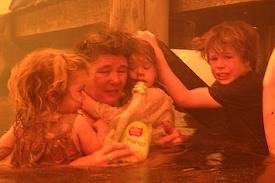
You’ve probably seen them too: the charred sheep, the family taking desperate shelter under a dock while ash and sparks fly around them, the huge red sandstorm wall looming over the ocean.

This is the push-back of Mother Earth.

There is only so far you can push her, and 2012 seems to have been the threshold beyond which there can be no further illusion of business as usual continuing.


Family in Tasmania seek shelter from wildfires

Family in Tasmania seek shelter from wildfires

Even some of the most hard-nose politicians are getting it now: I was heartened to hear Governor Andrew Cuomo of New York speak of the urgent need to plan for climate change disasters in his State of the State speech this week.

But he is still on the fence as far as fracking New York goes, which shows he has yet to fully put two and two together.

Two and two cannot equal two, Mr. Cuomo.

In other words, you can’t continue to expand the fossil fuel industry and not expect the blowback of climate change to worsen.

A lot of people are getting this now.

Not the ones who have their heads so deeply buried in the technology sands that all they can think about is the excitement of the next app, MOOC or tablet.

Not the ones who are riding the current stock market wave to scary new heights, buoyed by who knows what fictitious understanding of the relationships between real people and real goods—referred to in finance-speak as “market shares” and “bundled securities.”

Not the 1%, still sitting comfortably above it all, looking down on the disturbances below like vultures surveying the activities of scurrying mice.

But down here at ground level, people are starting to look at each other and know, even without speaking, not only that things are wrong, but that we cannot rely on others to make it right.

Wildfires are killing thousands of sheep in Australia

Wildfires are killing thousands of sheep in Australia

That can be the only explanation for the sudden groundswell of support for the Idle No More movement, which, just like Occupy, tapped into the resistance of ordinary people to the bulldozers of global capitalism, now coming to a forest or a farm field near you.

The lure of short-term gains has led many a politician, businessman, landowner or Native tribe down the daisy path of signing off on legislation and leases giving Big Fossil Fuel the right to do whatever the hell they want.

But we’re wising up now.

Toxic wastes from Texaco-Chevron are poisoning people and animals alike in Ecuador

Toxic wastes from Texaco-Chevron are poisoning people and animals alike in Ecuador

We look at the way Chevron left Ecuador when it was done extracting all the oil it could, and we listen to the story of how relentlessly their lawyers fought against giving even the least amount of their vast profits towards reparations for the toxic environment they created, and we know we could be next.

Now they’re coming right here in the Northeast—in the watersheds of New York and Pennsylvania, buying up those fallow farm fields and bringing in their huge fracking drills.

They’re down in Texas, building the first leg of the proposed transAmerican oil pipeline that will bring the dirty sludge of tar sands oil down to the Gulf of Mexico refineries, crossing over aquifers and farmland, by cities and pristine national parks.

And they’re up in Alberta with their giant bulldozers and dump trucks, razing the fragile boreal forest to get at the oozing tar underneath.

But in all these places, people are stirring.  People are rising in protest.  People are seeing that the short-term gains from these destructive fossil-fuel driven industries are going to quickly burn up, driving the stock market temporarily higher only to set up an even bigger crash in the future; keeping our homes warm and light today, only to set up bigger and worse climate-related disasters down the road.

Tree-sitters in Texas

Tree-sitters in Texas

A few brave souls have been sitting in the trees in Texas to block the pipeline, a resistance strategy pioneered in the 1990s when Julia Butterfly Hill sat in Luna, a giant California redwood, for more than a year to keep the loggers from cutting her and her neighbors down.

The First Nations are on the march in Canada in a movement that is spreading like wildfire across the world, protesting the poisoning of the environment by the fat cats in boardrooms who arrogantly believe that they exist on another plane, a modern-day Mount Olympus that is impervious to the environmental destabilization they are wreaking on the world.

Students are rolling out an urgent campaign to get their college and university trustees to divest their portfolios from the fossil fuel industry.

Thanks to the World Wide Web, these efforts can be beamed across the globe instantly, refracted and amplified through the networks of hundreds of millions of kindred spirits worldwide.

The dissenting power of the many that Hannah Arendt wrote of back in the late 20th century has never been more powerful, in part because resistance can now take place virtually.

We don’t have to go out and brave the guns and tear-gas, although probably in the end it will have to come to that.

We can build our networks at home, working quietly but steadily until they are so big that to arrest us all would be, as Marx predicted, to undermine the capitalist structure itself—throw all the workers in jail, and who’s going to do the work?

Idle No More protesters on Highway 401 in London, Ont., in December.  THE CANADIAN PRESS/Dave Chidley

Idle No More protesters on Highway 401 in London, Ont., in December.
THE CANADIAN PRESS/Dave Chidley

Right now all of these protest movements are disparate, each working on their own perceived goals.  What I hope to see in the coming year is more solidarity, more recognition that we’re all really fighting the same grand battle to keep our planet from being so devastated that it can no longer support life as we know it.

Life will continue on Earth, there is no doubt of that.  But whether humans, elephants, songbirds and frogs will be able to persist on a super-heated planet is quite uncertain.

It is imperative that we build an unstoppable grassroots movement to prevail on our elected representatives to represent the people rather than the corporations, and do what’s right.

How many catastrophic hurricanes, out-of-control wildfires, drought-stricken fields, bleached out corals will it take before we make use of our power as denizens of the world and say NO MORE?

images-1

Idle No More: Exposing the Suicidal Cult of Global Capitalism

Once again we are seeing how the democratic power of social media can thwart the efforts of the state political apparatus to keep the people in line.

This time it’s happening in Indian Country, beginning in northernmost Canada and spreading like wildfire through social media networks down south and out into the broader world.

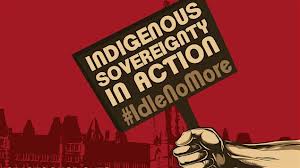
The movement is called Idle No More, and it was started by a coalition of four indigenous and non-indigenous women from Saskatchewan—Sylvia McAdam, Jess Gordon, Nina Wilson and Sheelah Mclean—who decided last fall that enough was enough with the steady assault on the environment and protections for First Nations lands in Canada.
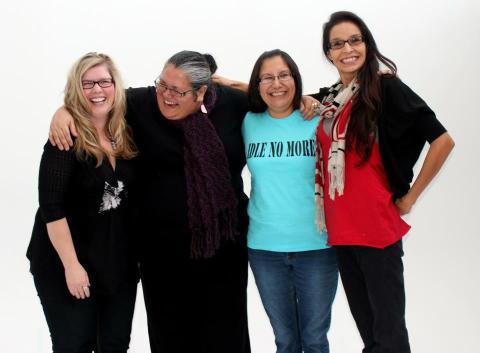
Idle No More Founders

Idle No More Founders

Taking specific aim at an omnibus bill in the Canadian Parliament, known as Bill C45, the women began teach-ins and protests around their homes in northern Canada.  Word spread quickly across North America and beyond via social media channels, and a global solidarity movement was born.

Idle No More protest in Toronto last month

Idle No More protest in Toronto last month

According to the Idle No More website, this is what happened:

 Bill C45 brings forward changes specifically to the Indian Act that will lower the threshold of community consent in the designation and surrender process of Indian Reserve Lands. 

Sheelah McLean reminds us that the bill is about everyone.  She says “the changes they are making to the environmental legislation is stunning in terms of the protections it will take away from the bodies of water – rivers and lakes, across the country.”  She further adds, “ how can we not all be concerned about that?”

The Idle No More efforts continued in Alberta with an informational meeting held at the Louis Bull Cree Nation.  The organizer for that event, Tanya Kappo, took to Twitter and Facebook to help generate awareness on the matter as the passage of Bill C45 was imminent. 

Kappo says, “the people in our communities had absolutely no idea what we were facing, no idea what plans Stephen Harper had in store for us.”  The events leading up to the National Day of Action have been focused on bringing awareness to people in First Nations communities and the rest of Canada. 

Jess Gordon says, “The essence of the work we are doing and have been doing will remain a grassroots effort, and will continue to give a forum to the voices of our people.”

When Bill C45 was brought to the House of Commons for a vote, First Nations leaders demonstrated that they are hearing these voices loud and clear.  They joined the efforts against Bill C 45 and went to Parliament Hill where they were invited into the House of Commons by the New Democratic Party. 

However, they were refused entry.  This refusal to allow First Nations leadership to respectfully enter the House of Commons triggered an even greater mobilization of First Nation people across the country. 

Nina Wilson says, “what we saw on Parliament Hill was a true reflection of what the outright disregard the Harper Government has towards First Nation people.”

With the passage of Bill C45, Idle No More has come to symbolize and be the platform to voice the refusal of First Nations people to be ignored any further by any other Canadian government.
Unknown

Yesterday I happened to catch a call-in program on the CBC (Canadian Broadcasting Co.) on the Idle No More protests, which have apparently taken most Canadians by surprise.  The host interviewed a representative of the Canadian environmental protection agency, and it was shameful to listen to the way he sputtered when asking whether the bill in question really would result in damaged waters and fisheries.

Although he refused to come out and say it, the short answer was clearly, “Yes.”

As always, for mainstream politicians and businessmen the lure of short-term profits outweighs longterm planning for the health and welfare of the planet and her denizens.

Some of the callers on the CBC program displayed evident racism in their attitudes towards the Native peoples behind the Idle No More protests, which have blockaded railways and highways in recent weeks, in an effort to gain the attention of the Canadian prime minister, Stephen Harper.

Attawapiskat Chief Theresa Spence

Attawapiskat Chief Theresa Spence

One Native Chief, Theresa Spence, has been on a hunger strike for nearly a month now, her immediate goal simply being an audience with Mr. Harper and a chance to present the First Nations case.  Harper has finally agreed to meet with Spence and other chiefs, on January 11, 2013, one month after she started her hunger strike.

Spence is a controversial figure in this movement, which began with a grassroots coalition and has displayed some reluctance to let the indigenous chiefs steal the thunder.

There have been rumors of corruption among the chiefs, including Spence herself, who has just now, conveniently enough, been subjected to a humiliating government audit of her finances.

It’s not clear whether all the chiefs are truly after the protection of the environment, or if they just want to have their fair share of the economic action when it comes to the rapid development of Canada’s northern territories.

What is clear is that the immense land and resource grab in the Americas, which began with the colonial conquests and has continued to the present day, provides short-term financial gains for the few—mostly non-indigenous corporations and financiers—while the majority of Native peoples languish in poverty, sitting on environmentally devastated lands.

Aerial view of Alberta tar sands development, aka the destruction of the Alberta boreal forest. (Global Forest Watch Canada)

Aerial view of Alberta tar sands development, aka the destruction of the Alberta boreal forest. (Global Forest Watch Canada)

In case after case worldwide, rapacious corporations sweep in, negotiate favorable leases on the land, extract the resources and move on, leaving behind a toxic, degraded landscape and a broken people.

Now we have finally come to the time when it is becoming obvious that the damage that is being wreaked on people and their environments in specific parts of the world is not just “their own problem.”

As the founders of the Idle No More movement correctly perceived, if the waters of Canada are not protected, it will affect all Canadians, not just the First Nations folk who sit closest to those waterways.

If the boreal forests of northern Canada are razed, it will affect the entire planet, just as the steady destruction of the rainforests in the southern latitudes is inexorably destabilizing our climate worldwide.

It appears that our politicians only understand the language of dollars and cents.  In New York and New Jersey now, a serious discussion is underway about how to pay for the cost of adapting to the climate change that almost everyone sees now as inevitable.

Yes, we have to adapt, we have to mitigate the damage by changing the way we develop our coastlines.

But we also have to adapt our mindsets when it comes to “development of natural resources”—a green-washed euphemism for what has really been “the wholesale destruction of the planet.”

This is as true for the destruction of the boreal forests of Canada as it is for the fracking of the Marcellus Shale in the U.S.

If the real costs of this kind of destructive “development” were added up, no sane financier or politician would be able to support such a suicidal undertaking.

If our politicians and business leaders want to commit hari-kari by reckless short-term myopic thinking, good riddance to them.

But they have no right to take the rest of us along with them.

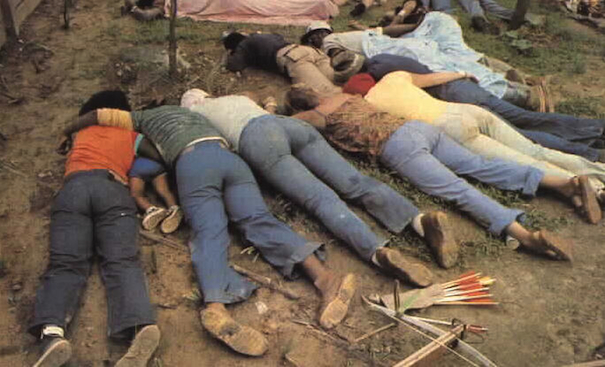
It reminds me of suicide cults like the infamous one in Jonestown, Guyana, in the 1970s.  A whole group of people was so taken in by the charismatic leadership of their guru, Jim Jones, that they obeyed his order to commit ritual suicide.

Victims of the Jonestown suicide cult

Victims of the Jonestown suicide cult

In our case, it’s the entire global capitalist leadership that has us all in thrall. We have been seduced, charmed and entranced by the siren call of “development,” which has given mainstream North Americans—the ones who agree to play by the rules—the benefits of a comfortable lifestyle.

The hidden underbelly of this lifestyle—the environmental destruction, the extermination of thousands of species annually, the annihilation of entire groups of indigenous peoples worldwide, the irrevocable destabilization of our climate—is now coming into view, thanks in large part to the democratization of the media through the World Wide Web.

I continue to believe that when ordinary, good-hearted people understand their own role in this planetary destruction, they will stand up and insist, like the four women who founded Idle No More, that enough is enough.

The question is, how far will we be willing to go to insist that our leaders respect our values and stop dragging us down the road to ruin?

How far will we have to go?

“Never doubt that a small group of thoughtful, committed citizens can change the world. Indeed, it is the only thing that ever has.”

–Margaret Mead