World War III Has Begun: Which Side Are You On?

Although you wouldn’t know it from scanning the front pages of the mainstream media, a major battle in what Bill McKibben has called World War Three, the war to save the planet from human destruction, has been going down in Indian Country for the past six months.

Thousands of Native Americans, members of a whole host of tribes, have gathered at Standing Rock, North Dakota, to protest the North Dakota Access Pipeline (#NoDAPL), which was sited by the Army Corps of Engineers to run dangerously close to the Missouri River and the Standing Rock Reservation.

But as the protesters say, they are not just defending Indian country, they are defending everyone who relies on the Missouri for water—and not just humans but all life.

If there is anyone to look back at this turbulent period in human history on Earth—now coming to be known as the Anthropocene—they will surely wonder at the suicidal tendency of human civilization in the 20th and early 21st centuries.

Why, they will ask, would such an intelligent species willingly—even enthusiastically—engage in the poisoning of its waterways and underground water resources; the destruction of its forests; the chemical contamination of its soils and oceans; the overheating of its precious atmosphere by relentless burning of fossil fuels? Why would humans put so much of their intelligence and technological prowess into developing ever more lethal weapons of mass destruction, used to bludgeon each other? Why would they preside blithely over the extinction of millions of other species, the vicious ripping of the great ecological web of life on Earth?

Why indeed?

I know it’s hard for any of us to escape the clutter of our everyday lives, with the constant pressures and worries that beset us on the personal level. But this is precisely what is being asked of us now.

The courageous defenders out at Standing Rock dropped their ordinary lives to be part of the historic encampment protesting the stranglehold of the oil companies on our waterways and our lands. They are fighting in the courts, through the media, and most importantly with their physical presence, standing up to the bulldozers, the attack dogs and the pepper spray.
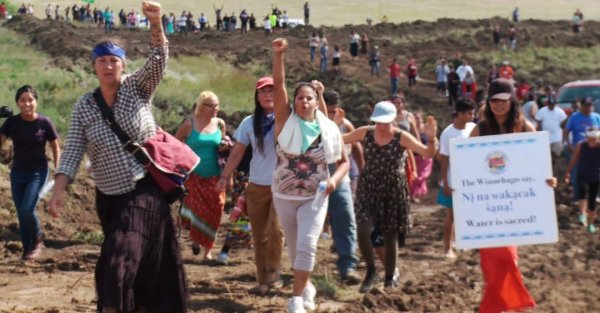
dakota

Image source: Democracy Now!

This is what McKibben’s World War Three looks like—it’s already begun. It will be fought locally, as communities and individuals wake up to the implications of the destruction and decide that hell no, they won’t take it any more.

pipeline_line_map

Oil and gas pipelines in the U.S. Image source: https://projects.propublica.org/pipelines/

In my own corner of the world, we are under assault from General Electric, wanting to create toxic waste dumps right in the middle of our small rural towns. We have a gas pipeline being constructed, despite vehement protests, through a pristine old-growth state forest. We have oil tanker trains running constantly right through our communities. Despite a thriving organic and biodynamic farm renaissance, we still have far too many pesticides, herbicides and fungicides being used locally, and too many trees being cut down.

I have been thinking and writing for some time now about how important it is to align the personal, political and planetary in our own lives and in the way we relate to the world around us. On all three of these levels, 21st century American life is way out of balance.

It is time to focus, each one of us, on using our brief lifetimes to create balance and harmony on Earth. Sometimes the way to harmony leads through protest and discord, as is happening now in Standing Rock. Sometimes it can be as simple as choosing to support local, low-impact agriculture rather than industrial agriculture. Leaning on our political representatives to move faster on policy that will shift our society to renewable energy is key.
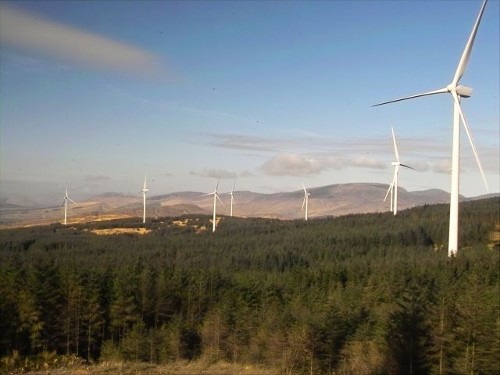
rolling-hills

Wind farm in Ireland. Source: http://www.iwea.com/_wind_information

There are so many ways to get involved in this War for the Planet, many of them quite peaceful. The important thing is to get off the sidelines. Get involved. Feel the potential of this moment—it’s literally a make or break period for the future of humanity on Earth, and many other living beings too.

The brave defenders at Standing Rock are reminding us that we are all “natives” of this Earth, and we all have a stake in protecting her. Which side are you on?

14184457_10154517767299394_1637715510123189394_n

From Orlando to Dallas and beyond: dreaming of a homeland to be proud of

The weather here in Nova Scotia has been stormy, but that’s nothing compared with the storms sweeping across my homeland, the USA. I write the word “homeland” with an inner cringe…can I really call this violent place home? Home is supposed to be a place of refuge; a sanctuary. I feel that about my island home here in Canada, but when I contemplate going back across the border, I can’t avoid an instinctive sense of fear and foreboding.

According to the astrologers, Mars is in Scorpio now—pretty potent times, when the god of war meets the sign known for intensity around death and sexuality. That might have “explained” the tragedy in Orlando. But the steady beat of innocent Black folks being gunned down by law enforcement officers for misdemeanors—or no crime at all—cannot be explained by anything except a racist society full of trigger-happy cops.

And this latest episode in Dallas defies any explanation. I am not satisfied with the official story, that a single sniper was able to kill five cops and injure several more people before being cornered in a parking garage. I have not seen any convincing evidence proving that the young man they killed in the garage with a “robot bomb” was in fact the sniper they were looking for. Eventually I assume they will show the forensic evidence linking the bullets found in the bodies to Micah Johnson’s gun, but even that kind of evidence could be trumped up.

I fear that this young veteran, handily dead, could be taking the fall for a sinister conspiracy aimed at further destabilizing the country and giving the police permission to “get tougher.” Which seems to mean, use more of their military surplus equipment against their own homeland citizens.

I read an article by an ex-cop who said 15% of cops are good people who would never commit a racist act; 15% are racists just waiting for an opportunity to strike; and 70% are just ordinary folks, susceptible to the prevailing culture in their community and police force.

Those percentages are probably about right when applied to the U.S. population at large, too. Clearly what needs to be worked on is the prevailing culture—the structural racism, the structural elitism, the deck stacked against the poor, no matter the color of their skin, and the way it’s becoming almost impossible to climb out of poverty if you’ve been born into it.

This bigger picture is what can be so hard to get from the media, which converts everything into sound-bites, “status updates,” or even, lord help us, tweets. Everything moves so fast, we are kept busy just trying to stay abreast of what’s going on, with little time or energy for contemplation.

Meanwhile, out there beyond the personal and political, the planet herself is getting ever more out of balance. The floods, the wildfires, the toxic algae blooms, fungi killing off amphibians and bats, the sudden death of entire populations of birds, reindeer and seals…it’s all part of the bigger picture of a planet gone deeply awry.

The more I think about it, the more convinced I am that the violence and political mayhem we are seeing in the world is connected to the inner turmoil in human beings. We are the consciousness of the planet. We alone among all species are able to understand history and predict the future. We know the consequences of our actions and we live and die according to moral codes.

All of us who are sick at heart in these days of horrendous violence at home must understand that what we are seeing in the U.S. is just a pale echo of the massive violence Americans have inflicted on people in other countries (from Vietnam to Iraq, from El Salvador to Afghanistan and on and on), as well as—on an even bigger scale—on other living beings on the planet, from iconic creatures like elephants and lions on down to coral, fish and butterflies, not to mention all the beautiful members of the plant kingdom.

Since we have allowed the arming of our civilian population with military-style weapons, our country is turning into the same kind of war zone  experienced by people in other countries, and animals everywhere.

And more of us are becoming infected with that conflictive kind of consciousness, dominated by fear and its twin, aggression. The inner landscape mirrors the outer landscape, with devastating consequences for those caught in the crossfire.

Neither fear nor aggression will get us where we need to go, as individuals, as a society, or on the global scale. Nor does moral exhortation seem to have much effect. The only real solution has to be the deep, structural one: redirecting our resources away from weapons and war, towards education, well-being and an economy that gives every human being the opportunity to live a peaceful, satisfying life.

You may say this is utopian. “You may say I’m a dreamer, but I’m not the only one.” There are many economists who understand that we have a choice whether or not to base our global livelihoods on the death-and-aggression-focused military-industrial complex, or on “right livelihood,” the kind of activities and industries that make people happy, well and fulfilled, and at the same time protect and care for our planet and the myriad other creatures who live here too.

While honoring all those—and there are so many—who have fallen prey to our violent culture, we must keep in mind the bigger picture, and the magnitude of what is at stake. The violence perpetrated against Black people at home is the same violence being perpetrated against so many others, in all the places in the world where we sell and deploy our vaunted American military weapons and expertise.

Let’s dare to imagine a future in which Americans are famous and respected not for the size of our military budget, but for our leadership in stabilizing our planet and making it a safe, prosperous home for everyone. We can do it. And we must.

rainbow


Ebola & Islamic Extremism: An Ounce of Prevention is Worth a Pound of Cure

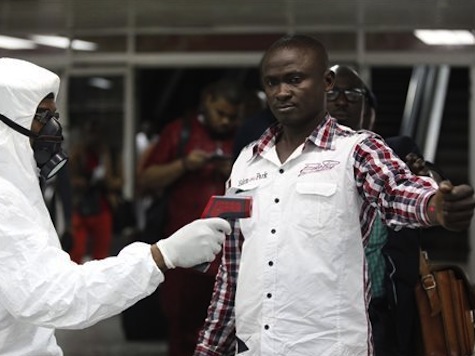
airport Ebola screening

Airport Ebola screening

Although American officials are making lots of reassuring noises about screening passengers coming from West Africa for signs of the dreaded Ebola virus, the truth is that the only way to totally safeguard against the spread of the disease is to close our borders entirely. And I don’t see that happening anytime soon.

Talk about an unexpected side effect of globalization. Goods and services spread around the globe at the stroke of a keyboard or the roar of a jet engine, but the same mechanisms we celebrate as having pumped up the global economy also, potentially, have a darker side.

What was it Marx said about the bourgeoisie digging its own grave?

I keep hearing the undertone, in the media reporting on Ebola, of the “blame-the-victim” complaint, “What’s wrong with these people? Why are they living in such poverty? Why don’t they have doctors, nurses, hospitals? Look how their squalor is putting us all at risk?!”

There is truth to this. The poor folks in Liberia, Guinea and Sierre Leone, former colonies of the U.S., France and Great Britain, respectively, have not managed to modernize their societies. This is due to a number of factors, including corrupt leadership (strongmen often propped up by the Western powers), violent civil wars (armed by Western weapons manufacturers and distributors), and banana republic-style economies where Western corporations rule by extraction, extortion and exploitation, without giving anything back in taxes, infrastructure or education for the local people.

This is where the West has made its big mistake. How could we in the so-called developed world be so naïve as to think that we could ignore the poverty and suffering of other parts of the globe without that poverty and suffering coming back to haunt us?

Liberian child soldier

Liberian child soldier

If we had invested in schools, medical facilities and housing in Liberia, instead of sending endless supplies of assault rifles and ammunition, we would not be worrying about Ebola now.

Likewise, if we had invested in education and economic development in the Middle East, instead of relying corrupt warlords to keep the population in line, we would not be dealing with a seemingly endless morphing insurgency of Taliban-Al Quaeda-Islamic State terrorists.

It really is true that an ounce of prevention is worth a pound of cure.

In a globalized society, pretending that vast disparities of wealth don’t matter is just plain stupid. Imagining that a vicious virus can be contained by airport thermometer checks is as ridiculous as imagining that an international terrorist network can be stopped by a few fly-by bombings.

The world’s leaders need to take a lesson from Malala Yousefzai, the 17-year-old girl who won the 2014 Nobel Peace Prize for her steadfast insistence, even after nearly having her head blown off by the Taliban, that girls should be educated.

Malala Yousefzai, winner of the 2014 Nobel Peace prize

Malala Yousefzai, winner of the 2014 Nobel Peace prize

Study after study has shown that when a society educates and empowers women, it becomes more economically successful and more politically stable.

Ellen Johnson Sirleaf, President of Liberia

Ellen Johnson Sirleaf, President of Liberia

This week, in my African Women Writing Resistance class, I’ve been reading and discussing the autobiography of Ellen Johnson Sirleaf, President of Liberia and first woman head of state in modern Africa.

Sirleaf, who won the Nobel Peace Prize in 2011, has been in the news a lot lately, begging for help in containing the spread of Ebola and warning grimly of the consequences of international inaction.

She came to office vowing to take her country back from the warlords and reintegrate child soldiers, to educate girls and boys and build a sustainable economy. She’s made great strides, but the stark pictures of the pathetic state of the nation’s health care infrastructure make it clear how far Liberia, like other poor African nations, still has to go.

The bottom line is this: if we want safety, we have to build towards it, step by step, from the ground up. We can’t ignore poverty and then get mad when impoverished sick people dare to infect us, or when desperate people turn to radical Islam as a way out of their misery.

Child worker on Firestone rubber plantation in Liberia

Child worker on Firestone rubber plantation in Liberia

There is no excuse, in our globalized world, for the dramatic disparities of wealth and poverty that exist today. Those of us lucky enough to live comfortably in the U.S. or Europe should be using our privilege to advocate for those less fortunate.

Not just out of altruism. Out of self-preservation, too.

If we had been helping Liberia and other West African nations build good social infrastructure, instead of extracting profits from diamonds, rubber and gun sales, we would not be worrying about the spread of Ebola today.

If we had been educating children in Syria, Yemen and Iraq instead of supporting corrupt dictators and ignoring the plight of ordinary people, we would not be facing the spread of Islamic extremism today.

How many innocent humans will have to die before we begin to understand that simple adage? An ounce of prevention is worth a pound of cure.