Earth Day 2013: Looking Disaster in the Eye

earthI was consumed with a great yearning when I heard last week, amidst all the sturm und drang of the Boston Marathon bombing and manhunt, that a twin sister of our lovely Earth had been discovered on the other side of the cosmos.

She is so far away—1,200 light years—that it is very unlikely any earthlings will ever visit her.  Not unless we can figure out how to bend time and space, like the tesseract imagined by Madeleine L’Engle in A Wrinkle in Time.

But just knowing she’s there—and that there may be many more planets like her, like us, out there in the universe—is comforting somehow, as we watch our own Earth being consumed by paroxysms of manmade violence and natural destruction.

It has been hard to focus on Earth Day 2013 with all the crazy human disasters going on.

But as the sun rises this morning on yet another day on Earth, I want to salute our battered, beautiful planet, our ever-giving Mother who asks nothing in return from her children, other than that they fulfill their own destinies.

It remains to be seen whether human beings—particularly of the male variety—can overcome our tendency to aggression and change the course of our destiny from its current suicidal path.

We are smart enough to know what is going wrong with our relationship to our Mother Earth, and we also know how to fix it.

Can we summon the moral imperative and the will to stop the violence, stabilize the climate, control our population growth, and enter a peaceful, prosperous New Age on Earth?

I wonder how the inhabitants of Earth’s distant sister have managed.  Perhaps if there are highly evolved inhabitants there they are even smarter than humans.  Perhaps they never fell from their Garden of Eden.

How much easier it is to do things right the first time, rather than deal with the mess of making them right again after catastrophe.

On this Earth Day, we must look disaster in the eye, and vow to overcome it.  Our Mother deserves no less.

IMG_1974 copy

Confronting taboos: death and the afterlife, American-style

It is one of those unspoken social contracts that Americans won’t say anything to each other that might indicate any doubt that life as we know it will continue.

If you dare to bring up the subject of climate change, with its attendant erratic weather, major storms, sea-level rises, wildfires and crop losses, people roll their eyes and change the subject.

If you voice any doubt that the economy—local, national and global—will recover, you are dismissed as a negative Pollyanna, and again, the subject is changed.

If you were, just hypothetically, to express the opinion that our increasing reliance on digital technology might have the quality of an unhealthy addiction, and to worry aloud at the effect that all that unrelenting screen time is having on the current generation of tiny tots, you are dismissed as a raving Luddite.

Nobody talks about the fact that both of our political parties are thoroughly corrupt, and our Supreme Court even more so.

No one mentions the disappointment so many of us feel with President Obama, who has proven himself incapable of effectively standing up to Beltway politics—if indeed that was ever his goal.

We are living through a massive period of collective denial of social and physical reality, with no exit in sight from the crazy funhouse we inhabit, with its motto, “Everything is going to be OK” blazoned on every door.

It’s about time we accepted the fact that everything is not going to be OK.

Not by a long shot.

I have been a little bit quieter than usual this past month, with my attention turned to the Berkshire Festival of Women Writers, but I have been paying attention nonetheless to what’s going on in the world.

The elephants of Africa are under siege and conservationists are now using the E-word to describe their future.

American bees are dying off at record rates due to pesticide poisoning, which is now not only killing the adults, but also the larva of the bee colonies.

The ice at the poles continues to melt at an accelerated rate, while down in Australia it was by far the hottest summer on record.

Just this week, record rainfall brought flooding to Argentina that killed scores of people.

There will be no escape from the severe weather that our degenerating climate system will wreak upon all of us.

As retiring climate scientist James Hansen has testified over and over, we are already at the tipping point from which there will be no return to what was “normal” for the past 10,000 years.

I totally understand the impetus to denial, because really, what can any of us do about all this?

What should we be doing?

Marching on Washington DC?  Setting up survivalist camps in the wilderness?  Sabotaging pipelines and coal-fired power plants?  Buying hybrid vehicles and solar panels?

Damned if I know.

I am on a list-serve that broadcasts a newsletter written by Alex Kochkin, who focuses more on the spiritual side of our current crisis on Earth.  Kochkin insists that we should not be wasting time worrying about the physical issues here on the planet, but instead should be focusing our attention on getting ready for our transition into the spiritual realm—in other words, for death.

Kochkin predicts that there will be a massive die-off of humanity in the coming years, but he casts this in positive terms, as a necessary cleansing that will enable the Earth to reboot and start on yet another spiritual and evolutionary journey.

Believing firmly in a nonphysical afterlife, he is unafraid of death.

This is so counter-cultural that it gives me pause.

Unafraid of death?  Really?

Our culture is so fixated on avoiding death at all costs that it is hard to wrench my mind around to another way of seeing things.

11857232-life-after-death-religious-concept-illustrationWhat if death were just a transition to another (non-physical) stage of existence?

What if it were in fact the best thing that could happen to our planet if the majority of human beings transitioned out of physical existence?

What if the tenacity with which we Americans hold on to our lives was entirely misplaced?

What if instead of focusing all of our technical and intellectual know-how on physical survival, we began to focus on learning more about the non-physical realms that we have so far relegated to the backward precincts of religion, New Age quackery, and woo-woo tales of near-death experiences?

There is a noticeable trend in popular culture reflecting an uptick in interest in explorations of the spiritual/non-physical dimensions.  From Harry Potter to Twilight and beyond, we have a fascination with stories that can take us beyond the bounds of ordinary physical reality.

So strong is the cultural taboo on discussing this seriously that it is hard for me to push the “publish” button and let this blog post out in the world.

But another part of me rebels and is just done with listening to the soothing murmur of the mainstream: don’t worry, dear, everything is going to be OK….

No, everything is not going to be OK.  Just like the elephants and the bees and the polar bears, human beings are going to face a massive die-off due to the changes in our climate system, and soon.

It is that, above all else, that we should be preparing ourselves for.  How? I am not sure.  But one thing is certain: insisting that all will be well, despite all the evidence to the contrary, is just silly and delusional.

It’s time to wake up.

Morning pages for humanity…and the Earth

Julia Cameron

Julia Cameron

This week, in preparation for Julia Cameron’s presentation at the Berkshire Festival of Women Writers, I have been doing quite a bit of thinking about creativity.

Cameron’s great insight, back in the late 1980s when she was doing the teaching that led to her blockbuster creativity self-help guide The Artist’s Way, was that human beings are all naturally creative.  We just tend to get “blocked” by our upbringing, and need to work on ourselves in a systematic way to unlearn bad habits of self-doubt and defeatism, so that our creative juices can flow freely out into the world.

One question I wish I’d asked Julia at her lecture last night at Kripalu is this: I wonder whether women have any particular creative challenges, different from those faced by men?

The Artist’s Way does not seem to draw any distinction. Cameron uses the gender-neutral term “creatives” and her examples are drawn from the experiences of both men and women.

And yet it seems to me that women are particularly susceptible to the kind of distraction, hyperactive multi-tasking and withering self-doubt that Cameron says are anathema to artists.

One woman in the audience at Cameron’s lecture described herself as “frantic,” or maybe she said “panicked,” facing such a huge to-do list of projects she’d like to accomplish that she was paralyzed by the enormity of it all.

Julia’s response was characteristically calm and pragmatic: slow down, write your morning pages faithfully, ask for guidance from your higher self, and be patient—it will come.

This is certainly good advice for anyone who wants to accomplish creative goals, but it seems especially relevant for me, and all the busy women like me who so often do not take the time out for ourselves, to recharge our own creative batteries.

Cameron’s “morning pages” are deliberately unfocused.  They are not meant to be a to-do list, or an outline for a project, or a mission statement.  They are simply meant to provide a regular, rhythmic opening for the creative spirit, which Cameron clearly conceptualizes as coming from a higher source.

“I learned to turn my creativity over to the only god I could believe in, the god of creativity,” she says in The Artist’s Way, “the life force Dylan Thomas called “the force that through the green fuse drives the flower.”

By allowing ourselves the time and space to be open to the creative life force that gave birth to us, we are allowing ourselves to become channels through which those creative juices can flow out into the world, manifesting all in kinds of ways, depending on our particular gifts.

As Cameron said last night, this can sound a bit “woo-woo.”

But the life force is in a way the final frontier for human understanding, the one mystery we still have not been able to penetrate via science.

We argue about when life begins—at conception?  in utero?  at birth?—and we recognize that there seems to be much more to the universe than we can measure with our physical senses or scientific instruments.

We know in an intuitive way that when we are “in the flow,” allowing ourselves to be creative channels, things can start happening that seem entirely beyond our control, and not at all coincidental.

Julia Cameron calls this synchronicity: “we change, and the universe furthers and expands that change….It is my experience both as an artist and as a teacher that when we move out on faith into the act of creation,” she says, “the universe is able to advance.”

The thing is that not all creations are equal.

Human creativity is not always a good thing.

It’s fair to say that over the past 500 years, since the Catholic Inquisition began its war on the older, nature-based religions and the European powers began their colonial assault on the rest of the world, the dominant paradigm of human creativity on the planet has been materialistic, channeled by our rulers into paths shaped by greed and lust.

Domination and aggression have driven the leading edges of human invention: we have proven very adept at creating guns, machinery and synthetic chemicals, haven’t we?

We have also created a might-makes-right philosophy that has literally bulldozed away any impediments to the harnessing of the natural resources of our planet, including the vast majority of humankind, in the service of short-term gain for the elite.

But at the same time, human creativity has always flowered anew, with each new generation having the potential to choose a different way of channeling that divine universal flow.

We stand at a juncture in history when it seems that the planet is poised to hit the evolutionary reset button, sweeping human beings away to make room for the emergence of new physical vessels for its irrepressible life force.

I believe there is still time for human beings to come to our collective senses and begin to shape our creative output into inventions and ethical paradigms that support and enhance life, rather than torture and destroy it.

I worry about the role the media plays today in limiting and predefining children’s creative imagination.  Little children who used to spend hours playing pretend games, making up elaborate stories complete with visualizations and acting, now spend those same hours playing violent video games or passively watching commercial television, with its monotonous message that consumption equals happiness.

But I take heart from the teenagers I teach, who continually show themselves able to see through the mesmerizing power of the media and think creatively for themselves.

We human beings all need to be doing our “morning pages” in these crucial final years of the modern era, seeking to tap into the “pure positive energy of the universe” and open ourselves to the possibility of different, more harmonious and balanced creative forms.

Because I believe that women have an important role to play in this shift, I am totally dedicated to the work I’m undertaking in this month’s Berkshire Festival of Women Writers, opening up lots of opportunities for women to share their creative visions.

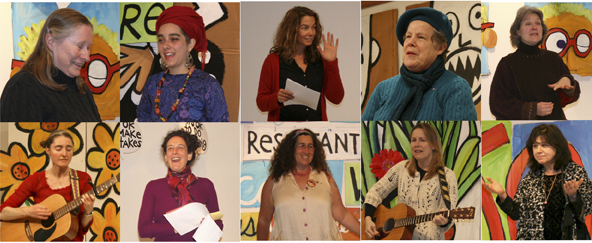
Women sharing their creative visions at the Deb Koffman open mic in Housatonic, MA

Women sharing their creative visions at the Deb Koffman open mic in Housatonic, MA

This is not just about women writers patting each other on the back and trying to advance our individual careers.

This is about women forming what Julia Cameron unabashedly calls “Sacred Circles” to propel humanity beyond the destructive domination-and-extraction model of the human relationship to our Mother Earth.

Next year’s Festival will have a special focus on women, creativity and environmental sustainability, to help us train our focus on the most urgent matter at hand: the destruction and contamination of the planet, with the resulting drastic climate change shifts that are coming in this century no matter what we do now.

Women and men worldwide need to rise to this challenge with every ounce of our creative energies.  On this International Women’s Day, 2013, I call on women, especially, to make a commitment to using our creative power for the good of the planet and all her denizens.

Will the Eagle and the Condor Land Together in the New Millennium?

At the Peace and Justice Studies Association annual conference, held this week at Tufts University with the theme “Anticipating Climate Disruption: Sustaining Justice, Greening Peace,” I presented a paper entitled “Changing the narrative and crafting alliances between Western and indigenous worldviews to create a sustainable global future.”

In it, I sketched out the standard Western triumphalist narrative of technological domination of Nature and the New World, starting with the voyages of Columbus and Darwin, continuing with the Manifest Destiny doctrine of the takeover of North America, and on into the present, where we continue to tell ourselves the story of living happily ever after in the brave new world established by the subduing and harnessing of the natural world, the routing of resistance, and the triumph of a technologically advanced global civilization.

Given that the premise of the conference theme anticipates serious climate disruption that will take the story to a very different, and much less rosy kind of conclusion, it’s clear that we need to start telling ourselves stories that reflect a different kind of understanding of our relation as humans to the natural world.

The kinds of stories we need to embrace are not new; in fact, they are ancient. I believe that the indigenous peoples left on the planet, who have survived the intense onslaught of Western culture over the past 500 years, are in the best position to survive the coming cataclysms, and to teach us how we can survive too. We just need to start listening to the stories they tell, rather than remaining spellbound by our own Western narratives.

I shared with the audience the voices and visions of two indigenous elders, Rigoberta Menchu Tum of Guatemala and Malidoma Some of Burkina Faso, who have both spent much of their adult lives reaching out to Westerners, trying to get us to see our relation to the natural world in a more holistic, less destructive way.

Rigoberta Menchu

Menchu, who won the Nobel Peace Prize in 1992 and ran for President of Guatemala in 2007, was a leader in the pan-indigenous drive to get the Declaration of the Rights of Indigenous Peoples ratified by the General Assembly of the United Nations, which it finally was in 2007.  She has worked tirelessly to promote the rights and improve the living conditions of the indigenous peoples in Guatemala, who are a majority in that country, but have little national political representation or power.

Central to Menchu’s political activism is her Mayan understanding of the importance of ecological balance.  “An indigenous people’s cosmovision is centered on their relationship with Mother Earth and Mother Nature,” Menchu says.  “In contrast, the majority of the world doesn’t give it a thought, doesn’t know what the source of life is.  They pollute the earth and do more and more damage.  One day the earth will exact a price for this disdain and destruction. When this happens, we will see that the earth is not just good and bountiful, it can also be vengeful.

“Indigenous people see Nature as a living mother, not as an inert organism that would allow itself to be destroyed,” she continues.  “All those who violate its laws must accept the consequences, because it is alive and will react. My grandfather always used to say that the day human beings violate our universe, they will receive signs and messages.  These messages will be very forceful, and will bring severe punishment.”

These words of Menchu’s come from her second book, Crossing Borders, in which she tried to reach out to the non-indigenous world with a challenge to the dominant narrative of “development,” which has been so terribly damaging not only to indigenous peoples, but to the ecological web of life itself. As she remarks bitterly in the book, “I often wonder why people criticize the Aztecs for offering human sacrifices to their gods while they never mention how many sons of this America…have been sacrificed over the past 500 years to the god Capital.”

These biting words would no doubt resonate with Dagara shaman Malidoma Somé, who was taken as a child by Catholic missionaries to be educated at their school some hundred miles from his village, and was not allowed to go home to visit his family or village for 20 years.

Malidoma Some

On the point of being sent to France to finish his Catholic education, he rebelled and ran away from the missionary school, somehow finding his way back to his village on foot, unaided.  Once there, he insisted that he be given the initiation he had missed out on, and he started on the path to becoming a traditional shaman, or healer.

His healing practice has taken the form of trying to reconnect Westerners with the indigenous knowledge that our culture long ago left behind and rejected as “primitive.”  Malidoma, whose name means  “he who makes friends with the stranger/enemy,” spends much of his time in the U.S. and traveling around the world, guiding groups of Westerners into a different kind of understanding of self, community, and natural world.

Both Menchu and Malidoma stress that they do not reject all of Western technology —just the way it has been used, and the narrative vision that guides and undergirds it.  “What indigenous and Western peoples have in common is the desire to understand the intricacies and complexities of the world we live in, and to harness the power of nature for certain practical purposes,” Malidoma says in his book The Healing Wisdom of Africa.

“Where we have taken different routes, however, is the context within which we have developed our technologies and the purposes for which we have used them.  In the West, technology is oriented toward industrial, commercial and military uses; among indigenous people, it serves to heal and help people remember and fulfill their purpose in life.”

Malidoma continues, “Individuals, as extensions of Spirit, come into the world with a purpose. At its core, the purpose of an individual is to bring beauty, harmony and communion to Earth.  Individuals live out their purpose through their work.  Thus the human work of maintaining the world, to indigenous people, is an extension of the work that Spirit does to maintain the pulse of nature.  The villager’s quest for wholeness is an extension of nature’s wholeness.”

Both Malidoma and Menchu describe a human relationship to the earth rooted not in dominion and conquest, but in a cyclical give and take that takes ecological balance as a core value.

I believe that theirs is the vision that must animate the narrative arc of our future as a species on the planet, if we are to survive the environmental challenges that are speeding towards us now.

The good news is that though you won’t find much about this in the mainstream media, there is a quiet but forceful movement building on several fronts that is heeding the call to craft a different kind of human life story.

There is the Transition Town movement, which is imagining communities that are less dependent on multinational corporations, and more interdependent as individuals and cooperatives working together to meet needs on the local level.  And there is the Pachamama Alliance, which I talked about in my Tufts presentation, which has been partnering with indigenous peoples to, as they put it, “change the dream” of Western-style domination, development and destruction.

The Pachamama Alliance is quite remarkable in that it sees itself as a solidarity movement guided by its indigenous partners, the Achuar and Shuar peoples of the Amazon rainforest in Ecuador.  It grew out of the connection with indigenous shamans established by John Perkins, who began in the 1990s to bring small groups of Americans and Europeans into the Andes and the rainforest to meet with indigenous shamans to learn a different way of understanding our relationship to the natural world.

Ecuador is one of the most beautiful places on earth, but is also one of the places that has been most devastated by the plundering of oil companies, specifically Texaco and Chevron.  Millions of acres of rainforest have been polluted by oil spills and the byproducts of unregulated drilling—and a landmark case has just been won against Chevron, ordering the company to pay $18 billion in damages to Ecuador for a clean-up.  The case is still in litigation, and meanwhile the people there are coming down with cancers and birth defects in astronomical numbers.  It is truly a place where you can see the worst conclusion of the Western narrative of development in action.

But it is also a place where another story is being told, and broadcast out into the world with increasing urgency.  It is a story that has been told by indigenous peoples of South America and beyond for hundreds of years.

According to the ancient prophecy of the Eagle and the Condor, which animates the work of the Pachamama Alliance, we are at a moment in history when the Eagle – representing intellect and the mind – and the Condor – representing wisdom and the heart – must come together to ensure the continued existence of humankind.

The human intellect and heart must realize that without the natural world we are nothing.  All the computers and synthetic chemicals and megawatts of electricity in the world will not enable us to survive in a world without plants and insects and animals.

It is that simple, and we know it scientifically, but we have not yet absorbed it in our hearts, and put our knowledge into practice in a different way of relating to the natural world.

So the question going forward, as Menchu so pointedly asked, is:

Will we sacrifice ourselves and most of the life forms currently on the planet to the great god Capital?

Or will we begin to understand wealth in a more balanced, ecologically sound way?

Will we have the strength to build a groundswell of resistance to the top-down hierarchies that hold such sway over our lives and the narratives we live by?

I believe we can do it.  I want to believe that we will.

All that solid melts in air: Labor Day reflections on Marx, Darwin and the need for new paradigms

As always around Labor Day, I am getting ready to talk with young people about some old, dead people: Darwin, Marx, Nietzsche, Freud, all of whom loom large in the curriculum of the General Education seminar required of sophomores at my college.

Rereading Darwin and Marx, who we’ll be discussing this week, it’s not hard at all to find ways to make these old thinkers, whose ideas are more than 100 years old now, relevant for our times.

Darwin

Darwin believed that life is a constant battle for limited resources, with the “struggle for existence” being entirely material, rather than spiritual.  When a dominant species overruns a weaker species, it is always for the best:

“It may be said that natural selection is daily and hourly scrutinizing, throughout the world, every variation, even the slightest; rejecting that which is bad, preserving and adding up that which is good; silently and insensibly working, whenever and wherever opportunity offers, at the improvement of each organic being in relation to its organic and inorganic conditions of life.”

He believed that humans are the highest, most important species, and that within the species men are higher than women, and white-skinned, “civilized” people are better than dark-skinned “savages.”  And implicit in his theory of natural selection is the ideology of Manifest Destiny: that strong, rich people got that way because they were “better” than poor, weak people.

It’s the logic that paved the way for the ruthless capitalist paradigm that presided over the industrial revolution of the late 19th and 20th centuries, along with the relentless search for new markets and new sources of raw materials: colonialism, imperialism, globalization.

Marx

Writing back in the mid-19th century, Marx was incredibly prescient.  His description, in “The Communist Manifesto,” of the process of colonial globalization could have been written last week:

The bourgeoisie has through its exploitation of the world market given a cosmopolitan character to production and consumption in every country…. All old-established national industries have been destroyed or are daily being destroyed. They are dislodged by new industries, whose introduction becomes a life and death question for all civilized nations, by industries that no longer work up indigenous raw material, but raw material drawn from the remotest zones; industries whose products are consumed, not only at home, but in every quarter of the globe. In place of the old wants, satisfied by the production of the country, we find new wants, requiring for their satisfaction the products of distant lands and climes. In place of the old local and national seclusion and self-sufficiency, we have intercourse in every direction, universal inter-dependence of nations. And as in material, so also in intellectual production. The intellectual creations of individual nations become common property. National one-sidedness and narrow-mindedness become more and more impossible, and from the numerous national and local literatures, there arises a world literature.

This actually doesn’t sound like much of a critique—Marx describes the positive side of capitalist globalization first.  But then he shows, with remarkable foresight, how the capitalists are unable to control the economic system they have created:

Modern bourgeois society, with its relations of production, of exchange and of property, a society that has conjured up such gigantic means of production and of exchange, is like the sorcerer who is no longer able to control the powers of the nether world whom he has called up by his spells….It is enough to mention the commercial crises that by their periodical return put the existence of the entire bourgeois society on its trial, each time more threateningly. In these crises, a great part not only of the existing products, but also of the previously created productive forces, are periodically destroyed. In these crises, there breaks out an epidemic that, in all earlier epochs, would have seemed an absurdity — the epidemic of over-production. Society suddenly finds itself put back into a state of momentary barbarism; it appears as if a famine, a universal war of devastation, had cut off the supply of every means of subsistence; industry and commerce seem to be destroyed; and why? Because there is too much civilization, too much means of subsistence, too much industry, too much commerce. The productive forces at the disposal of society no longer tend to further the development of the conditions of bourgeois property; on the contrary, they have become too powerful for these conditions, by which they are fettered, and so soon as they overcome these fetters, they bring disorder into the whole of bourgeois society, endanger the existence of bourgeois property. The conditions of bourgeois society are too narrow to comprise the wealth created by them. And how does the bourgeoisie get over these crises? On the one hand by enforced destruction of a mass of productive forces; on the other, by the conquest of new markets, and by the more thorough exploitation of the old ones. That is to say, by paving the way for more extensive and more destructive crises, and by diminishing the means whereby crises are prevented.

We have just lived through one of these episodic crises that Marx is talking about here—the bursting of the housing bubble, and the broad financial crisis that was generated by an over-reliance on debt.

The “enforced destruction of a mass of productive forces” is a nice way of saying “war”; and indeed, our adventures in Iraq and Afghanistan have kept the military-industrial complex humming, along with companies like Halliburton that snapped up all the rebuilding contracts.

Marx believed that the capitalist system would fail because it is structurally unable to support the needs of the masses.  It is built on inequality—on the Darwinian framework of the “struggle for existence” where might makes right, the strong survive and the weak perish, and the spoils of industry are concentrated tightly in the hands of a small dominant class, the bourgeoisie.

The modern laborer… instead of rising with the process of industry, sinks deeper and deeper below the conditions of existence of his own class. He becomes a pauper, and pauperism develops more rapidly than population and wealth. And here it becomes evident, that the bourgeoisie is unfit any longer to be the ruling class in society, and to impose its conditions of existence upon society as an over-riding law. It is unfit to rule because it is incompetent to assure an existence to its slave within his slavery, because it cannot help letting him sink into such a state that it has to feed him, instead of being fed by him. Society can no longer live under this bourgeoisie, in other words, its existence is no longer compatible with society.

Marx thought it inevitable that the middle class would sink into the proletariat as wealth became more and more concentrated in the hands of the few capitalists controlling government and industry.  And the proletariat, having nothing left to lose, would eventually rise up and seize power, overthrowing the capitalist system and instituting a new economic system, more truly “by the people, for the people.”

However, Marx was still a prisoner of his time as regards his understanding of humans’ relation to our natural environment.  He was not able to foresee that industrial growth, whether under the leadership of the bourgeoisie or the proletariat, would bump up against the carrying capacity of the planet, providing a natural (in Darwin’s terms) limit to growth.

Darwin would look out at what’s happening to our planet today, in the age of climate change, and see it quite dispassionately, as part of the process of natural selection. People in low-lying areas will have to migrate or die. We will figure out ways to adapt to our new climate reality, or we will be swept away.  The strong will survive, the weak will perish.

Marx, on the other hand, would be ranting about how the bourgeoisie have, in his own words, “dug their own graves,” and taken everyone along with them.  He would be calling for the international proletariat to rise up and fight for a better social system, in which labor is rewarded with well-being and the profits circulate among the many, rather than being concentrated in the hands of the few at the top.

We know with the power of hindsight that no Communist system has ever actually been successful at making people happy.

This is because the old hierarchical structures that have pervaded human civilizations for thousands of years still tend to creep back, no matter what name we give our socio-economic structure.

The challenge of our time is to envision a social structure that is horizontal, circular and interdependent, rather than vertical, linear and unidirectional.

A social structure in a harmonious give and take with the natural world, rather than one that only takes and takes to feed the maw of human industry.

Darwin may be right that the strong will survive and the weak will perish, but our concept of strength needs to change to meet our new reality.

Strength is not about domination and the ability to force others to bend, it is about cooperation and the ability to bring people and the natural world into productive harmony.

Black Elk

What we need now is a renaissance of indigenous tribal social systems, based on reverence for the natural world, and respect for one another.

Those people Darwin dismissed as “savages” may turn out to be the only ones who are able to survive in our new planetary epoch, as “All that is solid melts into air, all that is holy is profaned, and man is at last compelled to face with sober senses his real conditions of life, and his relations with his kind.”

 

Once in a blue moon: thoughts on death and the hereafter

It’s a clear, warm night, breezy and calm with a languorous quality to the air.  A night for strolling arm in arm along the surging beach; a night for hiking to the top of the mountain to gaze out at the moonlit landscape below.

It’s a blue moon night, the second full moon of the month–a rare occurrence, like a leap year, that feels like a gift of cosmic significance.

Such a night makes me want to take a chance and send out into the world some ideas that I have been holding close, not daring to share for fear of—of what?  Being scoffed at or ignored, I suppose.

But once in a blue moon, it’s important to reach beyond those fears and write from the heart.

So here it is.

***

On this quiet, moonlit night, I am thinking about death.

Every near-death experience describes a peaceful opening up to the light in the seconds after death—a state of rapture, a sense of leaving the body with all its frailties behind and moving into a new state of consciousness.

If death is just a transition into a different relation to matter and spiritual consciousness, then it is not something to be afraid of.  It is a change, but not a negative one, except to the extent that we remain attached to those we love and our dear, familiar places.

No other being on the planet frets so over death as does humankind.  All others simply pass, unworried, into the next stage of existence, whatever it may be.

If there is no reason to fear or worry about our individual deaths, then maybe there is no reason to fear or worry about the coming planetary cataclysm.

All of us living beings on the planet now will simply transition into whatever comes next, as we have many many times before in our cosmic journey from stardust to our current terrestrial physical forms.

Even the fear that we have of destroying our planet to such an extent that it will become unlivable is not tenable.  I don’t believe we could do such a thorough job of destruction as to make the environment completely and irrevocably toxic.

It may take millennia, but eventually, as it has in the past, the Earth will regenerate and give birth to new life forms.

And we, because we are part and parcel of this ecological sphere, will be part of those too.

Just as now we “remember” our past as sea creatures through the saltiness of our blood and the way we are able to swim underwater in our mother’s wombs, we will in some way retain the traces of our time as humans on the planet.

Hopefully the traits that have proven so destructive and psychotic will not persist: our violence, our fears and insecurities, our short-sightedness, our competitiveness, our greed.

It is possible that we are now living through a blue moon period of a much greater magnitude than just one lunar cycle.

Once in a blue moon, a dominant species—like the dinosaurs—collapses.  It is our fortune, for better or worse, to be living through this rare epoch, the last days of a closing era—and unlike the dinosaurs, to be conscious of what is taking place as it happens.

Of course, once in a blue moon, too, a species is able to pull back from the brink of extinction and keep going a while longer.

 ***

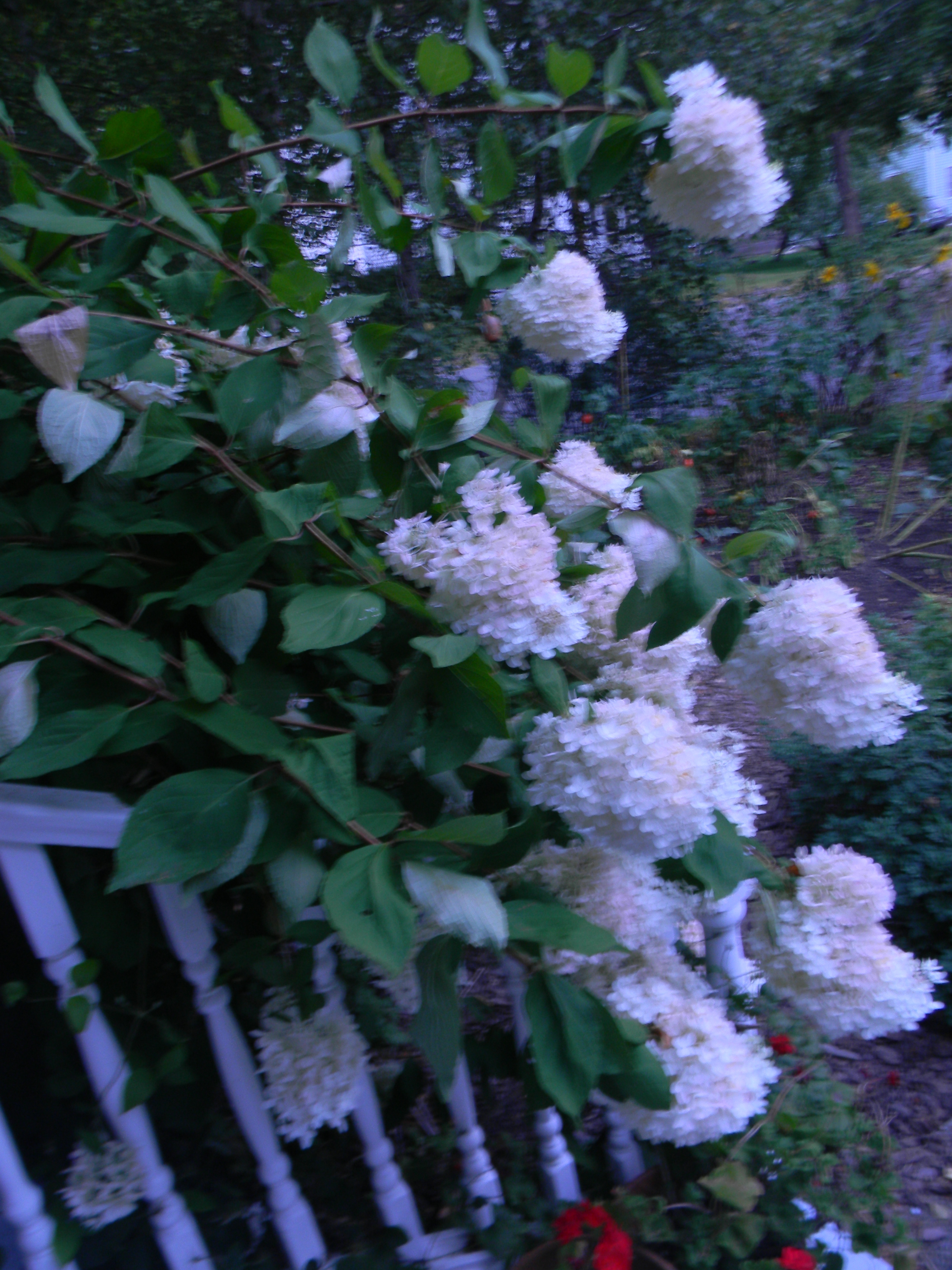
On this blue moon evening, I pay loving homage to the white hydrangeas glowing in the dusky interlude between sunset and moonrise.  The perky round sunflowers, the curly purple kale standing stiff and tall in my garden, the pulsing background chorus of crickets—I gather them round in a loving embrace and give thanks for this quiet blue moment, however long it may last.

Finding Hope in Heartbreak

There has been a steady beat of heart-breaking news lately from various fronts.  Did you hear that the flame retardants required by law to be sprayed on American sofas are highly toxic chemicals that continue to break down in your living room? And those sofas, by the way, if they’re the nice wood-framed ones from Ikea, are being made from irreplaceable 600-year-old trees.  When you lie on your sofa to breast-feed your baby, you’re getting a whopping dose of PCB-type chemicals, and your infant is too, since toxic chemicals pass right into breast milk.

Or maybe you caught the long article in the New York Times the other day about American zoos becoming Arks for modern-day Noahs, who have to choose which species to try to preserve and which to let go into extinction.  This was one of the most candid acknowledgements I’ve seen in the mainstream media of the explosive pace of extinctions occurring around the world, partly due to the loss of those ancient trees to logging.

And meanwhile, in my corner of the world, there was more bad weather—record heat in May, followed by violent electric storms, complete with hail and the threat of twisters, which knocked out my power last night, including permanent damage to my DSL box, leaving me without internet access this morning.

The relentlessness of this kind of information, combined with the evidence I can see before my eyes of climate change and the contamination of our landscapes, is like a steady drag on my spirit, a weight around my neck.

Even when I’m enjoying myself with friends and family, as I did this past weekend, I have one mental foot in the future, imagining a time when such happy, peaceful and bountiful gatherings will exist only in memory.

I am always giving myself silent pep talks, hanging on to the hope that we will accomplish the switch to renewable energy sources; that we will stop the deforestation and the industrial agriculture; that we will become responsible stewards of our home planet, rather than the armed pirates and chemical warriors that we have come to be in the last hundred years or so.

Joanna Macy

Lately I have been finding some comfort in Joanna Macy’s 1991 volume World as Lover, World as Self, reissued in 2007 by Parallax Press.  When I think of how oblivious I was back in 1991 about global heating and toxic contamination, I am amazed at Macy’s prescience.

Rather than simply bemoaning, or even exhorting her readers to change their ways before it’s too late, Macy offers us a way to understand and process what is happening to our world, principally through coming to the recognition that the traditional human individualist view of the self is a misconception.

“The crisis that threatens our planet, whether seen in its military, ecological or social aspect, derives from a dysfunctional and pathological notion of the self,” she says.  “It derives from a mistake about our place in the order of things.  It is the delusion that the self is so separate and fragile that we must delineate and defend its boundaries; that it is so small and so needy that we must endlessly acquire and endlessly consume; and that as individuals, corporations, nation-states or a species, we can be immune to what we do to other beings.”

In place of this, Macy draws on the work of systems theorists and ecological philosophers like Arne Naess, as well as the Buddhist notion of “inter-being,” to argue for a “greening of the self,” a way of self-understanding that recognizes our essential connectedness with all other life forms on our planet.

Arne Naess

Once we have understood that we are integrals parts in the living system of Earth, we should no longer have to appeal to human beings’ dubious moral sense to prompt a shift to a more sustainable way of living.  We can simply appeal to self-interest, Macy says.

“For example, it would not occur to me to plead with you, “Don’t cut off your leg.  That would be an act of violence.” It wouldn’t occur to me (or to you) because your leg is a part of your body.  Well, so are the trees in the Amazon rain basin.  They are our external lungs.  We are beginning to realize that the world is our body.”

One of the ideas I find most exciting about this part of Macy’s work is her application of the concept of “inter-being” to temporality.

“By expanding our self-interest to include other beings in the body of Earth, the ecological self also widens our window on time.  It enlarges our temporal context, freeing us from identifying our goals and rewards solely in terms of our present lifetime.  The life pouring through us, pumping our heart and breathing through our lungs, did not begin at our birth or conception.  Like every particle in every atom and molecule of our bodies, it goes back through time to the first spinning and splitting of the stars.

“Thus the greening of the self helps us to re-inhabit time and own our story as life on Earth.  We were present in the primal flaring forth, and in the rains that streamed down on this still-molten planet, and in the primordial seas. In our mother’s womb we remembered that journey wearing vestigial gills and tail and fins for hands. Beneath the outer layers of our neocortex and what we learned at school, that story is in us—the story of a deep kinship with all life, bringing strengths that we never imagined.  When we claim this story as our innermost sense of who we are, a gladness comes that will help us survive.”

When I think of my place in time and space in these terms, I do feel that gladness.  It is true that we are living through the sixth great extinction on the planet now.  It is true that we are producing and spreading contaminants in the air, water and soils that will last, some of them, for billions of years.

But the Earth has time.  And who knows, perhaps what we think of today as toxic waste can in time become the building blocks of new forms of life.  Our planet has shown itself to be remarkably adaptive.

Macy is unusual in working across disciplines and discourses that are generally kept apart, speaking fluently and persuasively in the tongues of sociology, systems theory, psychology, neurology, geology, ecology, theology, and even spirituality.  We are going to need the wisdom from all of these avenues of inquiry to begin to understand what will be happening to us in the coming years, as individuals, as a species, and as a part of the living fabric of Earth.

Perhaps that is what most distinguishes us most as human beings.  We want to understand.

And perhaps there is still a chance that if we can understand in time, we can, as Macy says, survive.

L’Chaim! This spring, let us commit ourselves to Life

Both Passover and Easter “celebrate” truly horrendous acts committed by men against men.

Passover commemorates how the Jews were spared by the grace of God from the Pharaoh’s evil plan to kill all first-born sons.  Easter celebrates the Resurrection of Christ after he was brutally martyred on the cross—a not-uncommon practice at the time.

Of course, both the Christian and the Jewish holidays also build on the much earlier pagan rites of Spring, the welcoming of warmth and rebirth after a season of winter.

I have to wonder why dominant human civilization has moved away from the earlier, simpler pagan celebrations, keyed to the natural world rather than to human doings and misdeeds.

Both Passover and Easter celebrate life—the lives of Jewish children, the miraculous resurrection of Christ, who gave his life in sacrifice for humanity.  Hence all the eggs, chicks and bunnies that populate the secular reinterpretations of these holidays, especially the American secular Easter.

Life is indeed something to be celebrated, as the Jewish cheer “L’Chaim!” proclaims.

Celebrated and protected.

As we move forward into the 21st century, into the auspicious year of 2012, let our aim be to reconnect with our prehistoric roots, to the simpler ages when we instinctively celebrated the return of the Light, the annual swing of our planet back towards the Sun.

For much too long, we have allowed religious politics to push us into conflicts and cruelties that do not serve the purpose of Life.  In claiming to worship the Divine, we actually find ourselves serving the dark side, the side of Death and Destruction.

I use these capital letters advisedly, to emphasize the symbolism inherent in all these word-concepts.

Beyond the symbolic realm there is the literal bedrock of reality.  We are hitting up against that reality now, as the patterns of power-hungry conflict, fueled by greed and a willingness to press on with destruction of the living world no matter the cost to systemic ecological health, play out with relentless precision.

This Easter and Passover season, let us do more than just toast to life.  Let us commit ourselves to the service of the divine spark animating our planet, which circulates without distinction through every blade of grass, every insect, and every human being.

It is only in our positive reciprocal commitment to Life that we can consider ourselves truly blessed.


Pleasure plus meaning equals happiness: homage to my mom

Maria Sirois

Yesterday I went to a Berkshire Festival of Women Writers workshop facilitated by psychologist and inspirational speaker Maria Sirois.  The workshop was called “Happiness: Writing as a Path to Positive Transformation,” and since I am always looking for ways to link all those terms—happiness, writing, path, positive, transformation—I was eager to see how Maria would lay it out for us.

I was not disappointed.  She quickly got the group writing about happiness, and not surprisingly, when I started freewriting about joy, it wasn’t long before I began writing about my childhood summers spent at my family’s country house…long, endless, happy weeks where my brother and I seemed to be perfectly in synch with our mother’s rhythm, where life was peaceful, idyllic and beautiful…the epitome of joy.

Later, when we went around the room and everyone shared a short bit of their freewriting, I was struck by how many of the women present (we were all women that day) associated joy with childhood, and with nature.

Many people shared moments of joy connected with childhood memories of trees—climbing trees, wandering in the forest, listening to the wind in the trees.  Others had written about communion with animals, or remembered ecstatic time spent by the ocean in childhood.

A small corner of my mother's garden

What I remembered was watching my mother dig a rock garden out of the cow pasture in which she and my father had built their small country house when I was 5 years old.  Here are the two sentences I wrote during the workshop, and shared aloud:

“My mother would be quietly exultant as her shovel and trowel revealed new curves or deep, smooth walls of rock, and at the end of a hot morning’s work she would stand, sweaty and red-faced with a fine layer of black earth coating her bare shoulders, drinking iced tea out of a tall green glass and surveying her landscape with a squinted sculptor’s eye.  The work progressed slowly, since it was all done by hand, just one small, determined woman with a strong back and great patience, tracing out the rock with hand tools and as much love as if she were carving out the sweet, benevolent face and voluptuous body of the Earth Mother herself.”

***

Later in the workshop, Maria shared with us a memorable formula for happiness.

Happiness, she said, is the balance of pleasure and meaning.

If life is all pleasure, it can feel empty and meaningless.  If it’s all meaning, then you’re working too hard.

But if you can find the right balance of pleasure and meaning, you can hit that sweet spot of joy, in which you thrive and grow like a well-cultivated garden.

Maria suggested that there is something about creativity itself that brings us to this sweet spot.

My mother, spending her summers relaxing with her children and turning her surroundings into a beautiful landscape sculpture, was drinking from that creative well.

For me there are various creative taps I draw from: writing, teaching, creating programs like the Festival, bringing people together in harmonious, productive alliances.

Platter and dinner by my mom!

My brother recently observed that our mother has always been a wonderful model of someone who is completely focused, passionate about and committed to her art—whether that art is tonight’s dinner, or her magnificent pottery, or her lovingly tended garden.

Since earliest childhood, it has always been clear to me that she put every ounce of creativity she possessed into everything she did—not for external recognition or praise, but just because it was the right way—the most pleasurable way—to approach any task at hand.

Pleasure plus meaning equals happiness.

It strikes me that although my mom has had her share of ups and downs, hers has been by and large a very happy life.

No wonder when Maria asked me to write about joy, I went straight to my primary teacher: Sue Browdy, my mom.

Dare to love

Like most people I know, I have just a very narrow sphere of knowledge that I’m willing to let penetrate my consciousness at any given time.

There’s so much I know but don’t want to know. So much I choose not to acknowledge.

It’s a form of self-preservation, because if I were to allow myself to really feel the unnecessary pain and suffering that floods our world like an endless terrorized scream into the night wind, all the time…I could not bear it.  I would go insane.

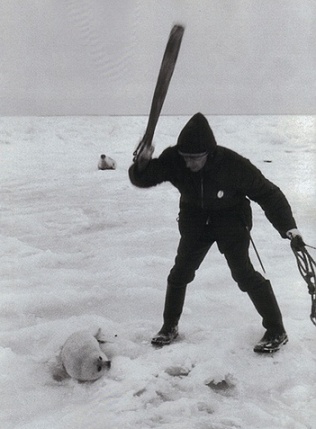
What prompts these reflections today is the news that hundreds of thousands of seal pups are drowning in the Gulf of St. Lawrence this season, after a straight run of disastrously warm winters where the pack ice on which harp seal moms give birth has been too thin to provide the shelter the pups need to survive.

Add to this the fact that the Canadian government, knowing full well that the harp seal populations are in dramatic decline due to global heating, is still going ahead with the annual seal pup hunt, allowing as many as 330,000 pups to be clubbed to death by hunters this season.

This despite the fact that Russia and the European Union, the principal clientele for seal fur, have banned imports this year.  Despite the fact, too, that a huge backlog of seal pelts is sitting in warehouses.

It’s one thing to kill animals for food. Human beings are carnivores, after all.  But killing for sport…killing for unnecessary furs…killing for no good reason makes me feel deeply ashamed of my species, and heartsick for the loss of life.

I don’t know what to do with these feelings.  Signing yet another online petition or sending yet another contribution to a Save the Seals campaign does not seem anywhere near adequate.

I am not capable of practicing tonglen, taking in the suffering and sending out lovingkindness to both the victims and the perpetrators, as Buddhists like Pema Chodrun recommend.  I can neither bear to take in the suffering, nor stomach sending anything akin to kindness to the perpetrators.

So I do what most people do.  I close my eyes.  I grow some kind of hard shell around my heart.  I choose, without even consciously realizing what I’m doing, to ignore news and information that will upset me.

I remember clearly that as a child, I was not yet capable of this degree of callousness.  I very rarely was exposed to any suffering, since I grew up in a very sheltered environment, but every so often something would manage to get through into my sweetly padded cocoon, and leave me gasping in empathetic pain.

Once I was standing outside on the lawn in front of the house, and a bird whizzed by me and flew straight into a window.  It fell to the ground, stunned.  I ran to it and picked it up, cradling its trembling body in my arms.  Its neck was probably broken…it died within an hour.  I held it and cried over it and mourned it so deeply that even now, so many years later, I still tear up thinking about the sorrow that small death called up in me.

I can’t live with that kind of sorrow all the time; I would be paralyzed with grief.  And so I compartmentalize.  I go about my business and actively avoid thinking about the thousands of seal pups dying today.  Or the wolf pups being poisoned by the Canadian government to clear out the boreal forest in preparation to extract oil.  Or the millions of songbirds and waterfowl killed each year by US federal government agencies because they get in the way of industrial agriculture or airplanes or golf courses.

Just for a moment, let’s dare to imagine what the world could be like if adults like me did not deliberately silence and smother our empathy for the creatures who need our help to survive.

Love might just be the most radical gift we could bring to the world.

What could be more potent than action fueled by love?  Do we dare?  Can we afford not to?