Call to Action in Dark Times

This time of year in New England is cold and dark: short days and long, starry nights.  As the planet wheels towards the winter solstice, human beings, for thousands of years, have huddled around fires and turned to storytelling as a bridge back to warmth and the coming of springtime.

It’s no different now, except that now most of us burn oil for our heat, and hang up strings of electric lights to symbolize the return to light.  We watch movies, read books or play video games instead of listening to clan storytellers.

In America, as in much of the world, the dominant religious stories of this time of year have to do with keeping hope and faith alive in dark times.  Jews remember, with the lighting of the Menorah candles, the preservation of their faith in the 2nd century BCE, after the destruction of the Second Temple; Christians celebrate miraculous birth of Jesus Christ, the Redeemer who would bring the word of God to the people.

All of the traditional religious stories document a continuing human saga of light against dark, with light representing life and good energy, while dark represents death and possible danger.

More contemporary mystics also point to human life as a struggle between the forces of light and the forces of darkness.

Rudolf Steiner, for example, the influential psychic who reported many out-of-body experiences where he made direct contact with metaphysical beings, routinely talks about angels and demons in his copious writings, with angels representing the good forces of light and life, and demons being the dark forces of destruction.  Freud too, in a more secular register, described Eros and Thanatos as primal human drives that align along the same lines: light/life/love, dark/death/hatred.

Is there something to all this?

In a scientific age, it’s hard to write with a straight face about angels and demons.  We are trained to see them as figures of speech, metaphors for empirically definable natural phenomena.  To whit: Human beings tell stories about angels and miraculous births at the darkest time of year as a metaphorical way of talking about the winter solstice and the return to light.

Yes.  But there have always been persistent voices telling us that this is not just metaphorical.  That there really are forces of dark that are destructive and forces of light that represent goodness, and that human beings, as the most self-aware sentient beings on the planet, are able to recognize the grand struggle between Good and Evil playing out in our psyches, and on our battlefields.
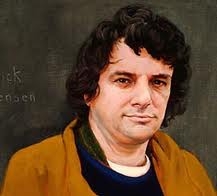
For instance, take Derrick Jensen‘s latest book, Dreams, in which he talks about his growing belief that there are metaphysical realms that human beings access in dreams, and that in the dream world there are “sides”: the side of life and the side of death and destruction.  As humans, we have a choice, Jensen says; we can choose which gods to worship, those who represent the life-giving energies of the planet, or those who represent the blood-sucking zombies that are leading us down the capitalist/imperialist road to doom.

Even further out along the spectrum of contemporary metaphysical thinkers is Alex Kochkin, who has been sending out dispatches through email and Web for some time now, warning that the end times are coming.  One could mistake Kochkin for an Armageddon-spouting Christian fundamentalist, except that, like Jensen and Steiner, he has no religious scaffolding framing his ideas.

All of these thinkers agree with indigenous shamans the world over that there is much more to human beings than our physical bodies, and that we can interact with higher powers through individual psychic work–paying attention to our dreams, meditating, being open to the realms of human consciousness where, they say, we can connect with what Steiner called “higher worlds.”

Alex Kochkin: “”You” are the result of a portion of your larger being extending something of itself into this level of density. In this case, it is a human bio-vehicle that comes equipped with basic firmware and an operating system. Flawed as the whole package may be, it is still a viable and valuable way for individuations of The All of Creation to reach into its own deepest recesses, even those that have become overwhelmed by the disease of the Dark.”

Derrick Jensen gives the “disease of the Dark” more concrete names: capitalism, imperialism, and the science that justifies and extends the reach of these destructive ideologies that have, since the advent of the Industrial Revolution, been rapidly reducing bio-diversity and inexorably altering our eco-system.

Jensen recalls the Aztec sacrifices to their gods, and speculates that we too are unthinkingly making sacrifices to our contemporary gods of Science and Capitalism.

This is an idea that one of my mentors, Rigoberta Menchu, suggested years ago, talking about how destructive the Euramerican ideologies and technologies have been to the natural world and indigenous peoples: “I often wonder why people criticize the Aztecs for offering human sacrifices to their gods when they never mention how many sons of this America, Abia Yala, have been sacrificed over five hundred years to the god Capital,” Menchu said in her second testimonial, Crossing Borders.

Whether or not there are “higher powers” involved in the life-and-death battles we are seeing played out at ever-accelerating speed in these dark times, it is true that we human beings are the ones with the power to change the course of events we have set in motion.  The fish and the birds and the great bears cannot change what is happening to their environments because of human short-sightedness and greed.  The ancient forests that have stood for thousands of years cannot withstand the bulldozer and the chain saw.  The river that has flowed for eons cannot resist the concrete dam.

Only we have the power of reversing the “disease of the Dark.”  If there are higher powers involved, they are not going to do it for us–they will only work through us.

Which stories are we listening to now as we huddle around our mechanical fires?  The old stories of dominion and destruction, “manifest destiny” and technological prowess leading to “progress” have held sway long enough.  It’s time to listen to stories that are older and wiser than the Judeo-Christian myths, stories that remind us of our deep connection to the natural world that sustains us.

Let every candle lit this solstice season be a call to action on behalf of the life energies of this planet.  And then, let us act, before it’s too late.
An older form of Deep Green Resistance rises from the rainforest. Euramericans, ignore this at your peril.

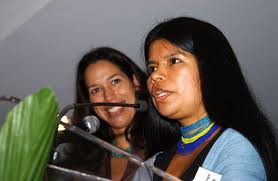
If you want to see something really inspiring, watch and listen to Patricia Gualinga, an Achuar woman from the Ecuadorian rainforest, talking about how her people are standing firm on the frontlines of the siege of the forest by multinational oil extraction companies.

Listening to this indigenous activist, you see shades of all the millions of indigenous peoples around the world who lived in harmony with their environment, respecting and sustainably stewarding their lands.

To say that this balance was altered when the Europeans began their voyages around the world is not to blame or guilt-trip.  It is simply to speak the truth.

To say that the European Enlightenment period, which gave us Manifest Destiny, “I think therefore I am,” the closing off of the commons and the capitalist drive to resource exploitation, was actually a time of deepening darkness, is simply to pronounce the self-evident.

While we contemporary heirs to this 500-year history may be individually blameless, collectively we have been bystanders who have followed the paths of least resistance and allowed the destruction of our planet to proceed apace.

The Pachamama Alliance, on whose behalf Patricia Gualinga spoke last week, is an unusual partnership between Euramericans and these South American indigenous survivors, warriors who are defending the great Amazonian rainforest, the dynamic lungs of the Southern Hemisphere, against rapacious encroachers.

We need another alliance like this between the peoples of the far North and those Euramericans who know that destroying the Canadian boreal forests would be equally catastrophic.

The Pachamama Alliance has developed a powerful model of collaboration across the boundaries of nationality and race in the service of a higher vision of earth-based spiritual activism.

This is a vision that needs to grow exponentially in the coming years.

For too long we have been held captive by the media-induced trance of relentless growth and consumerism.  It’s time to break the spell and allow the pendulum of human evolution on this planet to swing back to balance.

To do this, we need to listen to new voices, heed new calls.  We Euramericans have had our shot at leading the world our way.  It has been a disaster.

It’s time to cede the stage to our indigenous sisters and brothers, and try following their lead for a change.  This is a whole new level of Deep Green Resistance, based on creation rather than destruction.

 It’s time to co-create a new story with the indigenous peoples of the planet, who still know how to live harmoniously with the natural world.

Listen to the Pachamama story, and then it’s up to you–what comes next?  What role will YOU play?

Hope, Struggle, Dream, Persist: A Mantra for Dark Times

It is the day after Halloween, the Day of the Dead, and the day before my birthday.  It is one of the darkest days of the year, and a week from now, when American standard time “falls back,” it will seem darker still.

I was born in 1962, just after the Cuban Missile Crisis, as the Civil Rights movement and the Vietnam War began to pick up steam.  Each decade of my life has been marked by war and conflict, by a struggle between the forces of ruthless global capital, and the push-back from those who valued peace and a more equitable sharing of resources.

In my nearly half a century of life, I have witnessed a sharp decline in the ecological health of this planet.  Great flocks of many different types of birds have dwindled to a few sad outliers.  Clouds of multi-colored butterflies and swarms of busily working bees have vanished.  Delicate native wildflowers in the woods have been overrun by voracious invasive weeds, and the woods themselves have been overrun by a stampede of cookie-cutter tract housing in suburb after ugly suburb.

In my time, cancer has become a terrible epidemic, followed closely by diabetes and heart disease.  We humans have been sickened, just like the wild creatures, by the heedless spread of chemical treatments, pesticides, herbicides, fungicides, fertilizers, preservatives, additives and so many other toxins in our diet, soil, air and water.

What is there to celebrate on this birthday, the last in my fifth decade?

I look to my ancestors for hope and guidance, as is traditional on the Day of the Dead.

I see my Grandma Fannie, who believed in the power of the word, and practiced it by writing poems and stories that kept the wisdom of her Yiddish forebears alive.

I see my Grandma Mildred, who raised three kids, hosted and entertained her extended family frequently, and worked fulltime for a salary as well, year after year.  In her retirement she began the work she loved most of all, volunteering in her local public elementary school helping kids learn to read.

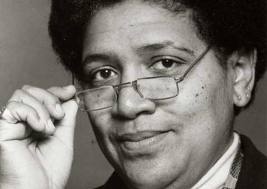
I see the ancestors I claim as kindred spirits, even though we do not share a blood relation: Gloria Anzaldua, who stands there arms akimbo telling me to “put my shit on paper,” no matter what the obstacles; and Audre Lorde, who reminds me constantly that “none of us is free as long as one of us is still shackled.”

As the Scorpio moon wheels overhead and I make my way to bed on my birthday eve, I can celebrate my own place as a link in this chain of strong women who spent their time on Earth trying to make it a better place for those who come after.

This has been a tough half-century, a period of decline and crisis in many ways.  It is a dark time.  But still the lights continue to shine defiantly: young people gather to Occupy the common ground and revive the dream of social equality; a Monarch butterfly sips a last meal at my butterfly bush before spiraling up to find the trade winds down to Mexico; the sun rises once again.

On this Day of the Dead, life goes on.  And while life goes on, we must hope and struggle for our children and their children, and the young creatures all over this planet that are being born today.  For their sakes, we must continue to work for a better future, and insist on our right to dream, and to make our dreams manifest.

This is my birthday mantra: hope, struggle, dream, persist, hope, struggle, dream, persist, endure.  And again.

Women + Men = Change

The other day I, along with many thousands of others I’m sure, got an email from Jean Shinoda Bolen, the psychologist and activist–author of Goddesses in Everywoman, Urgent Message from the Mother, The Millionth Circle and many other books, most of them arguing that women have a special role to play in healing the world, and urging us to get busy.

This recent email said precisely that, but with a concrete focus: Jean is advocating that the United Nations support a Fifth World Conference on Women, as a follow-up to the Fourth World Conference held back in 1995, in Beijing.  Activists have been calling for another conference since 2004–when the hope was to mark the decade in 2005 with another big event by and for the women of the world.

At this point, we’ll be lucky to get the 5WCW, as insiders call it, in 2015.  But Jean’s letter brought up some deeper questions for me.

As I dutifully signed the online petition, I wondered whether it was really worth the time, effort and money it would take to create another major world conference on women again, UN-style.  Of course, now we have UNWomen, the new and much more powerful agency for women, headed up by the fabulous Michelle Bachelet.

But still–here come the deeper questions.

  • Do women really have some special role to play in peace-making and nurturing civil society, which would be strengthened for us by getting together in a symbolic–and also very real, remember the mud in Beijing?–conference on this scale?
  • If the men aren’t there in the meeting halls with us, will they be fully invested in whatever resolutions are brought forth?
  • Can women accomplish profound, lasting social change on our own, without bringing the men along with us?

Back to Eckhart Tolle for a moment.  I was struck while reading A New Earth that he, like so many other philosophers, seems to see women as fundamentally different from men.  He’s pretty unequivocal about it:

“Although women have egos, of course, the ego can take root and grow more easily in the male form than in the female.  This is because women are less mind-identified than men.  They are more in touch with the inner body and the intelligence of the organism where the intuitive faculties originate.  The female form is less rigidly encapsulated than the male, has greater openness and sensitivity toward other life-forms, and is more attuned to the natural world.

“If the balance between male and female energies had not been destroyed on our planet, the ego’s growth would have been greatly curtailed.  We would not have declared war on nature, and we would not be so completely alienated from our Being” (155).

He goes on to talk about the Inquisition and witch-burnings, and the ways in which, in all the major world religions, “women’s status was reduced to being child bearers and men’s property.  Males who denied the feminine even within themselves were now running the world, a world that was totally out of balance.  The rest is history or rather a case history of insanity….In time, the ego also took over most women, although it could never become as deeply entrenched in them as in men” (156-57).

The post-structuralist feminist in me says “whoa, Eckhart!  You’re claiming essentialism here, that women are essentially, that is, really and fundamentally different than men. Feminist philosophers have resisted this because so much oppression happened because women were said to be fundamentally different than (and lesser than) men. Do we really want to go there again?”

But then there are many older feminist camps, including the “goddess within” folks like Jean Bolen–and Audre Lorde, and Alice Walker, and Gloria Anzaldua, my heroines–who would be greatly cheered to hear this kind of admission coming out of a man like Eckhart.  He only talks about it for a couple of pages, and he makes a curious move of deflecting guilt onto “the ego,” which is oddly personified–see for yourself:

“Who was responsible for this fear of the feminine that could only be described as acute collective paranoia?  We could say: of course, men were responsible. But then why in many ancient pre-Christian civilizations such as the Sumerian, Egyptian and Celtic were women respected and the feminine principle not feared but revered?  What is it that suddenly made men feel threatened by the female?  The evolving ego in them.  It knew it could gain full control of our planet only through the male form, and to do so, it had to render the female powerless” (156).

This almost sounds like an angels and demons scenario, with demons, acting through “the ego” in each one of us, working to gain ascendancy, and being more successful in “the male form” than in women–because we women are more intuitive?  Or at least, we used to be, before the ego got to us too?

Eckhart finishes up his brief discussion of the differences between men and women on an upbeat note, saying that “because the ego was never as deeply rooted in woman, it is losing its hold on women more quickly than on men” (157).

And presumably, that means that he’d agree that women should step up and take a leadership role in helping humanity out of its current crises (environmental, economic, social) into “a new Earth.”

I think I’d have to agree.  But is convening thousands of women from all over the world in a physical place on Earth the way to go?  Or would it be a better strategy to focus on empowering women where we are, and maybe trying to do more with technology to link us so we can share strategies and become collectively empowered?

Just thinking about the amount of paper that would have to be shuffled at the United Nations to make a big women’s conference happen; and the amount of jet fuel and other resources that would have to be spent to get everyone into that one physical arena, makes me wince.

I’d rather see a series of smaller conferences, all happening simultaneously all over the world, linked by teleconferencing, with extensive, easily accessible video archives produced for later consultation.

And although these conferences would be led by women, I’d like to see men there in the audience too–and even at the podium, if they come to the microphone with their feminine half fully engaged.

Women do have something special to offer the world, but just as we need to activate our masculine side to become warrior leaders for change, we need men at our sides with their nurturing, peacemaking sides ascendant.

If we could manifest this vision, we could change the world.  For the better.

Building resilience: the time to start is now

What we need to weather these tough times is resilience, and that seems to be a buzzword for this decade; many people I know are talking about strategies for building resilience these days–my friends Maria Sirois  and Amber Chand are both working on workshops to help people build resilience in troubled times.

Resilience is about taking what comes in life, good and bad, with equanimity.  Eckhart Tolle talks about this a lot–the importance of acceptance.  That is all very well for me to think about while sitting in a beautiful place on a beautiful sunny day with my family around me.  Much harder for someone in pain to be asked to simply accept what is.

Tolle and Buddhist teachers like Pema Chodron and so many others teach us that we need to practice acceptance in the good times, so that when hardship occurs, we’ll have the mental discipline and habit of being accepting–by which I think they mean not freaking out and panicking when things go wrong, focusing on the present moment through the breath, and finding the light that lives within us, no matter how dark our external circumstances may be.

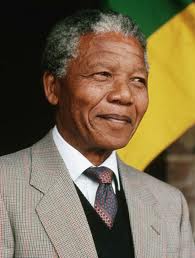
When you think of someone like Nelson Mandela, who managed to survive almost three decades in prison with his spirit, courage, and wisdom intact, you have to realize that this is more than just spiritual mumbo-jumbo.  How else could he have made it through unless he was able to access some deep inner well of equanimity and peace, an inner resilience that helped him get through each day of those terrible times, and emerge not only mentally sound, but ready to lead his country sanely and sagely.

Few of us will face the challenges that people like Nelson Mandela, Aung Sang Suu Kyi, or Mumia Abu Jamal have faced.  But every life has its dark periods, and right now humanity seems to be entering collectively into times that will test each one of us, and all of us as a society.

We shouldn’t wait until things turn rough to start building our own inner reserves of resilience and strength, and to reach out to others who are doing the same.  The time to start is now.