Which Side Are You On?

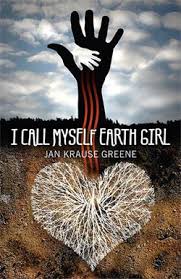
imagesFor the past few nights I have been putting myself to sleep by reading an advance copy of my friend Jan Krause Greene’s new novel, I Call Myself Earth Girl.

It’s not exactly a feel-good bedtime story, dealing as it does with rape, environmental disaster, death and bereavement.

But it’s also about empathy and love, between family members and also on a worldwide scale.

In Greene’s vision, the Earth and its denizens can be saved from catastrophe by mindful attention to what really matters: affirming life, both our own and that of the unborn generations to come.

Not since Starhawk’s 1994 masterpiece The Fifth Sacred Thing have I come across a book that so clearly matches my own waking nightmare of the terrible times that await us in the future, if we do not succeed in changing our ways now.

Let’s face it: it is possible that the kind of violence afflicting resource-starved places like Afghanistan, Syria and Somalia will become the norm in much more of the world, as climate instability creates food shortages and accelerates the pace of natural disasters beyond our capacity to recover.

America is a tinderbox just waiting to go off.  Imagine what would happen if suddenly it was not possible to go down to the supermarket and get your week’s worth of groceries?

Such a scenario is more or less unthinkable to people like me, who have grown up cradled by the richest breadbasket in the world.

We are only beginning to realize the costs that have come with our cornucopia: the destruction of the virgin prairies in the Midwest, the poisoning of the earth, water and air with chemical fertilizers, pesticides and herbicides; the grotesque factory farms of livestock and fish; the genetic alteration of seeds; the destruction of local farming by the huge predatory monster of American-style factory farms.

We have grown fat on these practices.  And now it’s time for us to accept responsibility for the outcomes of our heedlessness.

Those of us alive today have the privilege, and the responsibility, of presiding over what could very well be the end times for human civilization.

It’s somewhat analogous to the end times of specific human cultures, like the Greeks, the Romans, the Egyptians, the Ottomans, the great Chinese dynasties….except that this time, we’re not just talking about the end of a single culture, we’re talking about the demise of humanity as a species.

It is possible to imagine, as Jan Krause Greene did, that our lush green planet could turn brown from environmental disaster, provoking a culture of armed militias surviving by means of ruthless violence—with women, as always, at the bottom of the heap.

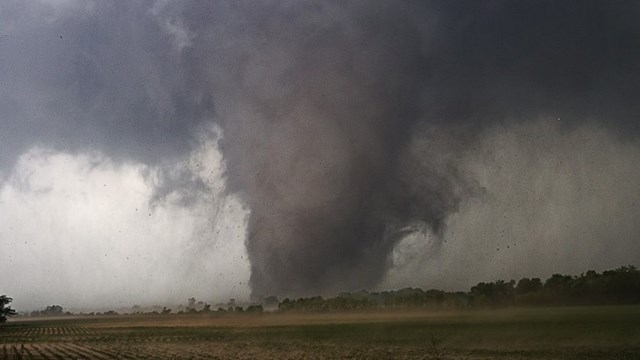
Tornado bearing down on Moore, OK; May 21, 2013

Tornado bearing down on Moore, OK; May 21, 2013

It is already happening—just not yet here, in the gated community we call America.

Can we wake up in time to forestall total, worldwide environmental melt-down?

In the past week we had a deadly two-mile-wide tornado in Oklahoma, and the Russian science station in the Arctic Circle had to be evacuated because the ice was melting at an unprecedented rate.

Here in New England we are expecting temperatures in the 30s Farenheit this weekend—way below normal for what should be the start of the growing season.

What’s next?

We don’t know.  But I take heart from local initiatives like the rehabilitation of the long-dormant Great Barrington Fairgrounds into a vibrant community-supported agriculture site.

We are going to have to re-localize agriculture if we want to survive the shocks of the 21st century.  We need to re-imagine not just agriculture, but community along with it.

As I Call Myself Earth Girl shows well, the antidote to violence and fear is love and empathy.

We still have a choice. Which way will you turn?  Which side are you on?  How far will you go to protect the planet and the generations to come?

fifth-sacred-thing

Intentional communities for the 21st century

Most of us today are living in in houses, villages or cities built in and for an earlier time.  Having become more resigned, in recent months, to the inevitability of climate change, with its attendant disruptions of life as we have known it, I am also now more aware of how essential it is that we begin to adapt if we wish to survive the coming cataclysms.

And that is a big IF.

I am not entirely sure that I have the will to survive, if surviving means living in deprivation with the constant threat of violence, as so many science fiction visions of our future have presaged.

That is why I have lately become so fascinated with questions of the hereafter, trying to peer beyond the transition of life into death, to see whether it might be true that some spiritual essence of us might persist beyond the loss of our physical body.

That remains an unanswered question for me, and for that reason it is still hard for me to go easily into the night of death.  Although I don’t want to live through the hard times that will come with climate change, I do have a desire, which grows stronger by the day, to do what I can to prepare for what is coming.

What does this mean, in a practical sense?

It means that I am thinking seriously about trying to connect with kindred spirits with whom to build a resilient community that is designed to meet the challenges of what will become our reality as the 21st century moves forward.

I should admit that I have always been leery of intentional communities, and my limited experience with them has not been very positive.

I was a member of a Waldorf educational community, as a parent, for more than a decade, and that chapter of my life ended badly—I had to pull my son out mid-stream, at the end of fifth grade, because his teacher was making him (and other classmates) miserable, and the school provided absolutely no framework for setting this bad situation right.  As parents, we were told to suck it up or leave, and many of us left.

Today, in my home here in the Berkshire mountains of western Massachusetts, I am a member of various communities, but none with whom I have developed the deep shared bonds of purpose and passion that I imagine would be necessary for a successful intentional community of the kind I am beginning to dimly envision.

What am I looking for?

IFIn some ways, it starts with dwelling.  We need to begin to dwell on the Earth in a sustainable way.  To do this right means we need to change the form of the houses we construct, the energy we siphon from planet and Sun, and the way we produce the food we consume.

The intentional community I imagine will have small, low-energy buildings set harmoniously into the landscape.  Energy will be supplied by geothermal, solar and wind or water, depending on the setting.  As much as possible of the community’s needs will be satisfied locally, using permaculture techniques and the cultivation of fruit and nut trees adapted to the environment.  I imagine chickens, goats, sheep and cows kept mainly for their milk products, and draft horses to plow and fertilize the fields.

I suppose I am envisioning something like what the Amish have held on to all these years, much to the derision of “modern” Americans.

eco-homes-1_1926535b

Might it be possible to adopt the low-tech subsistence model of the Amish (like subsistence farmers worldwide) without necessarily forgoing a) the connectivity of the World Wide Web and b) the freedom of thought and expression encouraged in modern society?

My fear about intentional communities, as they have so far been established, is that they tend to demand strict loyalty and conformism, to such a degree that creativity and growth is suppressed.

I am not willing to give up creative freedom in exchange for material security.

So I am wondering whether it might be possible to form an intentional community based on principles of energy sustainability and a subsistence (as opposed to accumulating or growth) economy, which did not at the same time limit its members creative freedom and growth?

If any models exist, I would appreciate it if readers would point me to them.

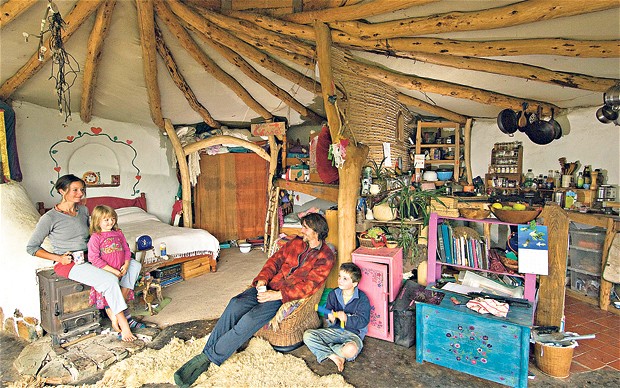
OLYMPUS DIGITAL CAMERAOne I have been thinking about recently is the Lammas Community, in Wales, which I especially love for its marvelous hobbit-style homes.  There are eco-villages throughout EuropeFindhorn is probably the best known—but I am less familiar with similar experiments here in the U.S.

Americans, here is our challenge: to create environmentally sustainable eco-villages that are explicitly designed to weather the climate and social shocks of the coming years, while also allowing for the social and creative free thinking that we have come to cherish at the turn of this century.


Can we achieve this?  Do we have time?  Do we have the will?  Can we afford not to?

Confronting taboos: death and the afterlife, American-style

It is one of those unspoken social contracts that Americans won’t say anything to each other that might indicate any doubt that life as we know it will continue.

If you dare to bring up the subject of climate change, with its attendant erratic weather, major storms, sea-level rises, wildfires and crop losses, people roll their eyes and change the subject.

If you voice any doubt that the economy—local, national and global—will recover, you are dismissed as a negative Pollyanna, and again, the subject is changed.

If you were, just hypothetically, to express the opinion that our increasing reliance on digital technology might have the quality of an unhealthy addiction, and to worry aloud at the effect that all that unrelenting screen time is having on the current generation of tiny tots, you are dismissed as a raving Luddite.

Nobody talks about the fact that both of our political parties are thoroughly corrupt, and our Supreme Court even more so.

No one mentions the disappointment so many of us feel with President Obama, who has proven himself incapable of effectively standing up to Beltway politics—if indeed that was ever his goal.

We are living through a massive period of collective denial of social and physical reality, with no exit in sight from the crazy funhouse we inhabit, with its motto, “Everything is going to be OK” blazoned on every door.

It’s about time we accepted the fact that everything is not going to be OK.

Not by a long shot.

I have been a little bit quieter than usual this past month, with my attention turned to the Berkshire Festival of Women Writers, but I have been paying attention nonetheless to what’s going on in the world.

The elephants of Africa are under siege and conservationists are now using the E-word to describe their future.

American bees are dying off at record rates due to pesticide poisoning, which is now not only killing the adults, but also the larva of the bee colonies.

The ice at the poles continues to melt at an accelerated rate, while down in Australia it was by far the hottest summer on record.

Just this week, record rainfall brought flooding to Argentina that killed scores of people.

There will be no escape from the severe weather that our degenerating climate system will wreak upon all of us.

As retiring climate scientist James Hansen has testified over and over, we are already at the tipping point from which there will be no return to what was “normal” for the past 10,000 years.

I totally understand the impetus to denial, because really, what can any of us do about all this?

What should we be doing?

Marching on Washington DC?  Setting up survivalist camps in the wilderness?  Sabotaging pipelines and coal-fired power plants?  Buying hybrid vehicles and solar panels?

Damned if I know.

I am on a list-serve that broadcasts a newsletter written by Alex Kochkin, who focuses more on the spiritual side of our current crisis on Earth.  Kochkin insists that we should not be wasting time worrying about the physical issues here on the planet, but instead should be focusing our attention on getting ready for our transition into the spiritual realm—in other words, for death.

Kochkin predicts that there will be a massive die-off of humanity in the coming years, but he casts this in positive terms, as a necessary cleansing that will enable the Earth to reboot and start on yet another spiritual and evolutionary journey.

Believing firmly in a nonphysical afterlife, he is unafraid of death.

This is so counter-cultural that it gives me pause.

Unafraid of death?  Really?

Our culture is so fixated on avoiding death at all costs that it is hard to wrench my mind around to another way of seeing things.

11857232-life-after-death-religious-concept-illustrationWhat if death were just a transition to another (non-physical) stage of existence?

What if it were in fact the best thing that could happen to our planet if the majority of human beings transitioned out of physical existence?

What if the tenacity with which we Americans hold on to our lives was entirely misplaced?

What if instead of focusing all of our technical and intellectual know-how on physical survival, we began to focus on learning more about the non-physical realms that we have so far relegated to the backward precincts of religion, New Age quackery, and woo-woo tales of near-death experiences?

There is a noticeable trend in popular culture reflecting an uptick in interest in explorations of the spiritual/non-physical dimensions.  From Harry Potter to Twilight and beyond, we have a fascination with stories that can take us beyond the bounds of ordinary physical reality.

So strong is the cultural taboo on discussing this seriously that it is hard for me to push the “publish” button and let this blog post out in the world.

But another part of me rebels and is just done with listening to the soothing murmur of the mainstream: don’t worry, dear, everything is going to be OK….

No, everything is not going to be OK.  Just like the elephants and the bees and the polar bears, human beings are going to face a massive die-off due to the changes in our climate system, and soon.

It is that, above all else, that we should be preparing ourselves for.  How? I am not sure.  But one thing is certain: insisting that all will be well, despite all the evidence to the contrary, is just silly and delusional.

It’s time to wake up.

Becoming part of Gaia’s cure, instead of what ails her

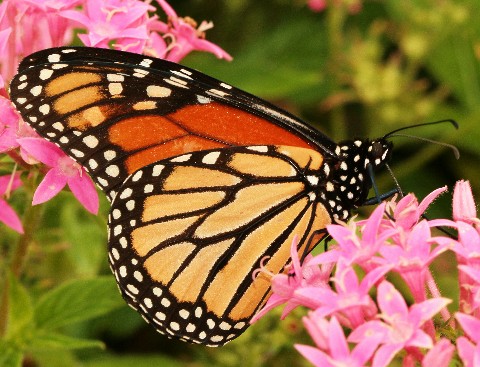
Milkweed-with-Monarch-ButterflyI will never forget one hot summer day when I was about eight years old, and a Monarch butterfly took it into its head to land on my arm and delicately lick up my sweat with its long, probing tongue.

I froze, wanting the Monarch to stay with me as long as possible, and watched with total fascination and delight as it balanced on my warm brown skin and enjoyed the salty treat I had to offer.

Eventually, with a graceful swish of its elegant wings, it rose up in the air and twirled off to land on a nearby stand of sweet-smelling pink milkweed flowers.

I felt blessed by the encounter, and ever after, when I see a Monarch I approach cautiously and respectfully proffer my arm, hoping to feel again the light touch of those fragile black legs and tiny tongue.

My childhood connection with Monarchs came to mind this week as I read the deeply disturbing news that “the number of monarch butterflies that completed an annual migration to their winter home in a Mexican forest sank this year to its lowest level in at least two decades, due mostly to extreme weather and changed farming practices in North America.”

Mexican conservation authorities report that “The area of forest occupied by the butterflies, once as high at 50 acres, dwindled to 2.94 acres in the annual census conducted in December,” which is “a 59 percent decline from the 7.14 acres of butterflies measured in December 2011.”

So now, along with the bats and the goldfinches and so many other species that I have known and loved in my 50 years on the planet, I must bid farewell to the Monarch butterflies too?

Carolyn Baker

Carolyn Baker

Trying to find a way to cope with the pervasive sense of grief I feel on a daily basis, I turned this week to the works of Carolyn Baker, who has self-published two books that have been striking a chord with thousands of people.

In 2009, she published Sacred Demise: Walking the Spiritual Path of Industrial Civilization’s Collapse, followed in 2011 by Navigating the Coming Chaos: A Handbook for Inner Transition.

Baker comes out of a psychology background, having served as a consulting psychotherapist for many years, but she draws on a wide range of sources that I too have been poring over in recent years, from Joanna Macy to Derrick Jensen to James Lovelock and many more.  Andrew Harvey, author of two books on “spiritual activism,” wrote the forward to her second book.

What all these folks have in common is the strong, level-headed recognition that human civilization is headed for a collapse.

The butterflies and the bats may be going first into the void, but we will not be far behind.

The current noise and controversy over questions like “to frack or not to frack,” “to build wind turbine generators or deep-sea oil rigs in the Arctic,” or “to erect solar arrays or thousand-mile oil pipelines” are just that—so much noise, which obscures our ability to focus on what is driving the debate on all these issues: the fact that our planet cannot and will not support 7 billion people at current levels of consumption.

James Lovelock

James Lovelock

The eminent eco-scientist James Lovelock, who, with Lynne Margulis, developed the theory of Earth as a complex living system he calls Gaia, has just published what may be his final book (he was born in 1919, making him now just seven years short of 100 years old).

Grimly titled The Vanishing Face of Gaia, Lovelock sadly predicts that global heating will force the die-off of much of humanity, and a retreat of the survivors to “lifeboat” places on the planet that will remain habitable on a subsistence basis for those able to live close to the land.

Lovelock uses the metaphor of disease to describe what is happening to our planet these days.  This passage is worth quoting in full:

“When we are first infected by fatal disease organisms, they grow in our bodies without our noticing.  We call this the incubation period, and it can be as long as several weeks.  Then at some stage in their growth, or in our bodily reaction to it, we feel unwell, with fever and pain.  Soon, a matter of hours with the most virulent influenza, homeostasis starts to fail and we collapse and die.  This is when physicians speak of massive organ failure.  In the whole course of fatal disease there is no tipping point but instead a downslide that starts imperceptibly and then grows ever steeper until we fall.

“We became the Earth’s infection a long and uncertain time ago when we first used fire and tools purposefully.  But it was not until about two hundred years ago that the long incubation period ended and the Industrial Revolution began; then the infection of the Earth became irreversible….

“The disease that afflicts the Earth is not just climate change—manifest by drought, heat, and an ever-rising sea.  Added to this there is the changing chemistry of the air and the oceans, and the way the sea grows acidic.  Then there is the shortage of food for all consumers of the animal kingdom.  As important is the loss of that vital biodiversity that enables the working of an ecosystem.  All these affect the working of the Earth’s operating system and are the consequences of too many people.  Individuals occasionally suffer a disease called polycythanemia, an overpopulation of red blood cells.  By analogy, Gaia’s illness could be called polyanthroponemia, where humans overpopulate until they do more harm than good” (232-33).

Lovelock sees the demise of the current terrestrial epoch as inevitable.  But he also reminds us that Gaia is a tough old planet, who has survived many other total collapses of biodiversity in her past.  “After every one of these catastrophes Gaia recovered, taking her own time—sometimes as long as millions of years,” Lovelock says.  “During these periods of convalescence there was always somewhere on Earth a refuge for living organisms, a place where the climate and the chemistry still favored life.  And so it surely will be when polyanthroponemia resolves” (235).

Lovelock faults our human tribalism and the selfish, competitive shortsightedness of a predator species for our current predicament, quoting the biologist E.O. Wilson, who said towards the end of his life, “How unfortunate that the Earth’s first intelligent social animal is a tribal carnivore” (239).

This is “our agonizing condition,” Lovelock says; “we have the intelligence to begin to expand our minds to understand life, the universe and ourselves; we can communicate and exchange our deep thoughts and keep them outside our minds as a permanent record.  We have all this but are quite unable to live with one another or with our living planet.  Our inherited urge to be fruitful and multiply and to ensure that our own tribe rules the Earth thwarts our best intentions” (240).

Lovelock ends his book by looking ahead to a mythical time in the future, when the survivors of the collapse of human civilization “evolve to become as beneficial a part of Gaia as were the photosynthesizers and the methanogens,” who “might serve within her as our brains do in each of us.  We would be an important part of what had become in effect an intelligent planet better able to sustain habitability” (248).

It is our duty, he says, as human beings living through these great Transition Times to ensure that enough of us survive to pass on our genes to the future, in the hopes that future iterations of human beings will overcome our tribalism and selfishness and put our remarkable creative intelligence to work for the good of the planet and all her denizens.

The question becomes then, what should we be doing now to prepare for the future that awaits?

This is where Carolyn Baker’s work becomes so important.  Navigating the Coming Chaos is nothing less than a workbook for inner and outer transition where the focus is on strengthening one’s resilience and connection with a sense of purpose and meaning in a world gone increasingly mad.

“I am not a survivalist,” Baker says.  “I have never believed that the prime objective in preparing for the Long Emergency is to remain alive.  None of us is enthusiastic about death, but we will all die.  To deny this fact and focus primarily on survival is to embrace the heroic perspective and, in my opinion, to miss the point….

“I believe that navigating a collapsing world will entail constant observation of various forms of death—the death of infrastructure, the death of abundance, the increasing absence of goods and services that we now take for granted, the death of institutions, the disappearance of employment and shelter, the increased scarcity of food and water, the death of landscapes and yes, the literal deaths of people and animals.  The collapse of industrial civilization and the lifestyle it has provided is a catastrophic death of a paradigm and a way of life.  While we may look ahead to the ultimate blessings unleashed by this death, it will nevertheless be traumatic to live through the magnitude of losses it will manifest.

“If, however, we can begin now to make friends with death, as the Buddhist tradition has taught for thousands of years, we may be better prepared emotionally and spiritually to navigate a civilization dying on myriad levels….

“Simply put, the essential question is not: How can I survive the collapse of industrial civilization?  But rather: Why am I here, right now, in this place, at this time, experiencing the end of the world as I and my species have known it? (166).

Much of Baker’s book, like Starhawk’s most recent book The Empowerment Manual, is dedicated to prompting self-reflection leading to the recognition of what we are here on this Earth to do—and how we can successfully work with other awakened humans to accomplish our purpose.

The biggest challenge seems to be how to learn to work together harmoniously with each other and with the other living elements of our planetary home.

Gaia callingFor me, it seems clear that what I need to be doing now is to rekindle the instinctive sense of kinship I had with the natural world as a little girl; to find ways to become a channel for the love I felt, and still feel, for the gaudy Monarch butterflies who sailed regally through the fields of my childhood.

Sooner or later I will be following them into oblivion. But let it not be before I’ve had a chance to do my utmost to wake up my fellow travelers on this planet to the state of emergency we now face, and to help create the community structures that will enable at least a critical few of us to survive into the distant future.

Morning pages for humanity…and the Earth

Julia Cameron

Julia Cameron

This week, in preparation for Julia Cameron’s presentation at the Berkshire Festival of Women Writers, I have been doing quite a bit of thinking about creativity.

Cameron’s great insight, back in the late 1980s when she was doing the teaching that led to her blockbuster creativity self-help guide The Artist’s Way, was that human beings are all naturally creative.  We just tend to get “blocked” by our upbringing, and need to work on ourselves in a systematic way to unlearn bad habits of self-doubt and defeatism, so that our creative juices can flow freely out into the world.

One question I wish I’d asked Julia at her lecture last night at Kripalu is this: I wonder whether women have any particular creative challenges, different from those faced by men?

The Artist’s Way does not seem to draw any distinction. Cameron uses the gender-neutral term “creatives” and her examples are drawn from the experiences of both men and women.

And yet it seems to me that women are particularly susceptible to the kind of distraction, hyperactive multi-tasking and withering self-doubt that Cameron says are anathema to artists.

One woman in the audience at Cameron’s lecture described herself as “frantic,” or maybe she said “panicked,” facing such a huge to-do list of projects she’d like to accomplish that she was paralyzed by the enormity of it all.

Julia’s response was characteristically calm and pragmatic: slow down, write your morning pages faithfully, ask for guidance from your higher self, and be patient—it will come.

This is certainly good advice for anyone who wants to accomplish creative goals, but it seems especially relevant for me, and all the busy women like me who so often do not take the time out for ourselves, to recharge our own creative batteries.

Cameron’s “morning pages” are deliberately unfocused.  They are not meant to be a to-do list, or an outline for a project, or a mission statement.  They are simply meant to provide a regular, rhythmic opening for the creative spirit, which Cameron clearly conceptualizes as coming from a higher source.

“I learned to turn my creativity over to the only god I could believe in, the god of creativity,” she says in The Artist’s Way, “the life force Dylan Thomas called “the force that through the green fuse drives the flower.”

By allowing ourselves the time and space to be open to the creative life force that gave birth to us, we are allowing ourselves to become channels through which those creative juices can flow out into the world, manifesting all in kinds of ways, depending on our particular gifts.

As Cameron said last night, this can sound a bit “woo-woo.”

But the life force is in a way the final frontier for human understanding, the one mystery we still have not been able to penetrate via science.

We argue about when life begins—at conception?  in utero?  at birth?—and we recognize that there seems to be much more to the universe than we can measure with our physical senses or scientific instruments.

We know in an intuitive way that when we are “in the flow,” allowing ourselves to be creative channels, things can start happening that seem entirely beyond our control, and not at all coincidental.

Julia Cameron calls this synchronicity: “we change, and the universe furthers and expands that change….It is my experience both as an artist and as a teacher that when we move out on faith into the act of creation,” she says, “the universe is able to advance.”

The thing is that not all creations are equal.

Human creativity is not always a good thing.

It’s fair to say that over the past 500 years, since the Catholic Inquisition began its war on the older, nature-based religions and the European powers began their colonial assault on the rest of the world, the dominant paradigm of human creativity on the planet has been materialistic, channeled by our rulers into paths shaped by greed and lust.

Domination and aggression have driven the leading edges of human invention: we have proven very adept at creating guns, machinery and synthetic chemicals, haven’t we?

We have also created a might-makes-right philosophy that has literally bulldozed away any impediments to the harnessing of the natural resources of our planet, including the vast majority of humankind, in the service of short-term gain for the elite.

But at the same time, human creativity has always flowered anew, with each new generation having the potential to choose a different way of channeling that divine universal flow.

We stand at a juncture in history when it seems that the planet is poised to hit the evolutionary reset button, sweeping human beings away to make room for the emergence of new physical vessels for its irrepressible life force.

I believe there is still time for human beings to come to our collective senses and begin to shape our creative output into inventions and ethical paradigms that support and enhance life, rather than torture and destroy it.

I worry about the role the media plays today in limiting and predefining children’s creative imagination.  Little children who used to spend hours playing pretend games, making up elaborate stories complete with visualizations and acting, now spend those same hours playing violent video games or passively watching commercial television, with its monotonous message that consumption equals happiness.

But I take heart from the teenagers I teach, who continually show themselves able to see through the mesmerizing power of the media and think creatively for themselves.

We human beings all need to be doing our “morning pages” in these crucial final years of the modern era, seeking to tap into the “pure positive energy of the universe” and open ourselves to the possibility of different, more harmonious and balanced creative forms.

Because I believe that women have an important role to play in this shift, I am totally dedicated to the work I’m undertaking in this month’s Berkshire Festival of Women Writers, opening up lots of opportunities for women to share their creative visions.

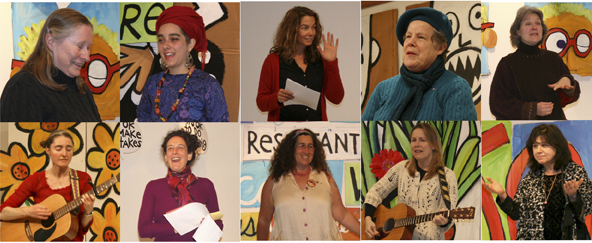
Women sharing their creative visions at the Deb Koffman open mic in Housatonic, MA

Women sharing their creative visions at the Deb Koffman open mic in Housatonic, MA

This is not just about women writers patting each other on the back and trying to advance our individual careers.

This is about women forming what Julia Cameron unabashedly calls “Sacred Circles” to propel humanity beyond the destructive domination-and-extraction model of the human relationship to our Mother Earth.

Next year’s Festival will have a special focus on women, creativity and environmental sustainability, to help us train our focus on the most urgent matter at hand: the destruction and contamination of the planet, with the resulting drastic climate change shifts that are coming in this century no matter what we do now.

Women and men worldwide need to rise to this challenge with every ounce of our creative energies.  On this International Women’s Day, 2013, I call on women, especially, to make a commitment to using our creative power for the good of the planet and all her denizens.

Holding the Fort for the Humanities

Michael Berube

Michael Berube

In a recent address to the American Council on Graduate Schools, out-going Modern Language Association president Michael Bérubé argues trenchantly that American graduate education in the humanities is in a state of crisis, and in urgent need of structural revision.

But to my mind, he does not go nearly far enough in his thinking.

“Graduate programs in the humanities have been designed precisely to replenish the ranks of the professoriate; that is why they have such a strong research component, also known as the dissertation,” Bérubé says.

But “the overall job system in the humanities has been in a state of more or less permanent distress for more than 40 years,” with doctoral programs “producing many more job candidates than there are jobs; and yet this is not entirely a supply-side problem, because over those 40 years, academic jobs themselves have changed radically. Of the 1.5 million people now employed in the profession of college teaching, more than one million are teaching off the tenure track, with no hope or expectation of ever winding up on the tenure track.”

So, he asks, how can we, in good conscience, continue to encourage students to enter graduate programs in the humanities, knowing the grim future that awaits most of them?

Bérubé reminds us that “the study of the humanities is more vibrant, more exciting, and (dare I say it) more important than it was a generation ago….The sheer intellectual excitement of the work, whether it is on globalization or subjectivity or translation or sustainability or disability, is one thing. This work is so valuable—and it offers such sophisticated and necessary accounts of what “value” is.

“And yet when we look at the public reputation of the humanities; when we compare the dilapidated Humanities Cottage on campus with the new $225-million Millennium Science Complex (that’s a real example, from my home institution); when we look at the academic job market for humanists, we can’t avoid the conclusion that the value of the work we do, and the way we theorize value, simply isn’t valued by very many people, on campus or off.”

Unfortunately, Bérubé doesn’t bring up the deeper questions about why our society currently values science and business so much more highly than the humanities.

Why is it that professors in the humanities make a fraction of what professors in business, law or science earn?

Why is it that academic programs in the humanities are under constant threat of the budget ax, while programs in business and science continue to attract huge inputs of resources?

Is it any surprise that students take a look at the depressed adjunct faculty in their dingy offices and take the nearest exit for the shiny new science building?

To me it’s pretty obvious: in our capitalist society, the academic fields that are most highly valued are those that create the possibility of more profit—with profit crudely conceived of as dollars in the bank.

My work in the field of comparative literature over the past 20 years, for example, has little to show for it in terms of money in the bank.

I’ve been focused on bringing the voices of marginalized or lesser-known women writers and activists to wider audiences within and outside of the Ivory Tower, because I believe that the perspectives offered by these women writers bring important, under-recognized and certainly under-valued ideas to the intellectual table.

For example, writers I study, like Rigoberta Menchu (technically not a “writer,” as her texts are transcriptions of her oral testimony), Vandana Shiva, Audre Lorde and Gloria Anzaldua, have been arguing for many years that human society must begin to honor our differences and value our interconnections with each other and with the natural world, in order to create a just and sustainable society.

Lorde, long ago, recognized that the “masters” are interested in keeping the oppressed divided, competitive, fighting with each other for the crumbs.  She urged us to think outside the box, “for the master’s tools will never dismantle the master’s house.”

The truth is that the humanities are dangerous ground for the “masters” of Euramerican society, because it is in the various academic terrains of the humanities that moral and human values are debated and interrogated.

It is no accident that critiques of capitalism itself, along with capitalist tools like elitism, militarism and globalization, have found their strongest purchase in the humanities.

Humanists who follow the lines of intellectual inquiry stretching back to the dawn of human written traditions and forward into the speculative reaches of science fiction and futurism, often find ourselves thinking outside the box of the current capitalist structures into which we have been born and indoctrinated to accept.

The moral questions raised in many humanities classrooms are themselves alternatives to “the master’s tools,” and they have the potential to dismantle the master’s house.

That is why, I believe, the humanities are currently being starved and derided by the masters.

That is why adjuncts in the humanities are being paid less than a living wage, discouraging the best and brightest from choosing that educational and career path—unless they are independently wealthy.

Bérubé ends his speech by suggesting that graduate programs in the humanities need to begin to combine the traditional focus on research, writing and teaching with the development of skills and connections that can help Ph.D.s secure good jobs outside of the professoriate, since he does not foresee any change to the current trend of an overwhelmingly low-paid, adjunct humanities workforce.

He points to the “digital humanities” as a prospect, since highly trained academics who can translate their knowledge into digital formats are more likely to find work in business, publishing or media.

I wish he would think a bit more radically.

As one of the humanities thought leaders of our time, I would like to see him come out and say that the deep questions of the humanities–questions about society, ethics and social and ecological justice–are precisely the ones that we need to be asking most urgently today, whether the masters like it and support it or not.

I know, up close and personal, how hard it is to wage this lonely battle, watching all the honors and riches going to colleagues who are willing to do the masters’ bidding more compliantly.

Sure, biotechnologists and creative financiers are going to get more funding and more accolades than someone like me, who studies ethics via personal narratives by little-known women writers.

But in the long run—or what is increasingly, in our era of climate change, seeming like the short run!—I believe that the wisdom these women have to offer will be more important than the latest patent on bio-engineered corn, or the most ingenious restructuring of debt derivatives.

Humanities education is one of the last outposts of oppositional thinking within the Academy.

Let’s hold our positions with honor, knowing that even if the material rewards are scant, we do get to keep our integrity, and do our best on behalf of the planet and all its denizens.

Climate change is no joke

What a totally spurious pro-Keystone pipeline column from Joe Nocera in the New York Times today!  He doesn’t even bother to mention the 35,000-plus people who turned out in Washington to protest, focusing instead on “boneheaded” Bill McKibben and James Hansen and others who got themselves arrested at the White House last week as though that were the end of the story of citizen protest of this issue.

He dismisses the idea of a carbon tax on fossil fuel companies as ineffective, arguing, inexplicably, that this would “make expensive tar sands more viable.”  Huh?  Is anyone fact-checking this columnist, NYT?

“If you really want to eliminate expensive new fossil fuel sources, the best way is to lower the price of oil, which would render them uneconomical.”  Anyone follow that logic?

Nocera does not once mention the real reason for the protest against the tar sands extraction, which is the environmental hazards, from toxic waterways to exponential increase in the greenhouse gases causing global heating.  If that isn’t an insidious, dishonest omission, I don’t know what would be.

His only mention of climate change is dismissive: “Like it or not, fossil fuels are going to remain the dominant energy source for the foreseeable future, and we are far better off getting our oil from Canada than, say, Venezuela.  And the climate change effects of tar sands oil are, all in all, pretty small.”

There are so many things wrong in this sentence I hardly know where to start, and most of my readers probably can do the parsing themselves anyway.

The truth is that if, as Joe would have it, “fossil fuels are going to remain the dominant energy source for the foreseeable future,” then our foreseeable future is going to be very brief.

Yesterday while in DC I went back to the Smithsonian Museum of Natural History to see the Human Origins exhibit, which is, strangely enough, funded by the climate-change denying billionaire Koch brothers.

Once again I lingered at the opening display, a huge poster depicting the changes in Earth’s climate over the past few hundred thousand years, showing how the swings between extremes of hot and cold forced our ancestors to adapt or die.

The last inch or so of the immense timeline (I’m guessing it’s 12 feet wide) shows the last 10,000 years, the era of homo sapiens.  The swings between hot and cold get more jagged as we get closer to the present, with the last hundred years–a mere quarter-inch of the vast scale of human history–showing aggressive upward spikes of heat.

There is no mistaking the message of this chart.  We are now in a period of rapidly escalating climate change.  If we don’t adapt just as rapidly, a major correction to our population will ensue. Millions, even billions of humans may die off, very much in the “foreseeable future.”

For those left to tell the tale, one thing is for sure: the Keystone Pipeline, rusting and derelict on the western plains, will be a less-than-useless monument to the immense folly of men like Joe Nocera, who thought climate change was just a joke.

Dispatch from the heart of the American clean energy movement


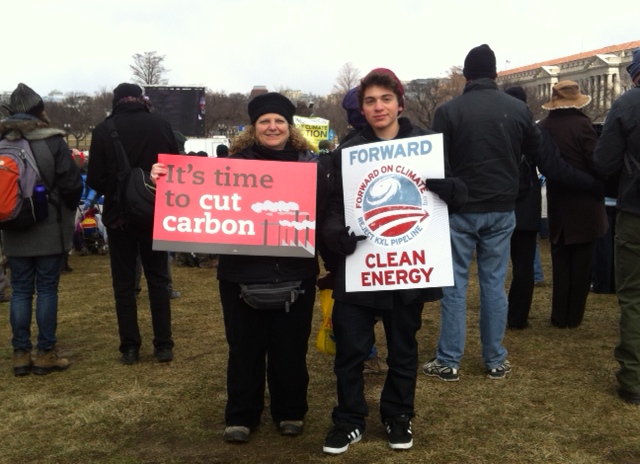
My son Eric and I at the rally

My son Eric and I at the rally

On this cold, blustery day in Washington D.C., thousands of people braved the elements to send a resounding message that we will not stand idly by and let Big Oil continue to run the great ship Earth straight on to the reef of global heating.

Although my body feels battered and tense from standing clenched against the wind so many hours, my physical discomforts pale beside the sheer joy of the memories of today’s climate rally.

The most exciting part was when the whole huge, enthusiastic, orderly crowd began marching from the meet-up point by the Washington Monument, signs and banners and flags flying high, drumbeats and chants rising up into the clear sky above Washington, winding ourselves into a huge coiling serpent wrapping itself around the White House, parading and prancing and stomping and making all the joyful news we could as we passed by the iron gates under the watchful eyes of security.

On the march!

On the march!

It was somewhat deflating to know that the President was not home–and even worse to get word that he was golfing in Florida, no less (my regular readers will recall how much I detest golf courses and consider them symbolic of all that is wrong with humanity’s relation to the natural world).

But it was gratifying to see the media out in fairly substantial numbers covering the march; many, many video cameras were rolling and iphones were snapping and people were even wandering around the crowd doing spot interviews about what had drawn the protestors to DC this fine, cold Sunday.

I think I can speak for many when I say that what drew us out was a deep concern for our planet, and a desire to draw a line in the sand–in this case, the Keystone XL serving as that iconic line–to indicate our opposition to the continued rape and pillage of our Mother Earth.

No more impunity! If the fossil fuel magnates win this round and the Keystone is built, let it not be with impunity. Let our whote-hearted opposition to this misguided investment be duly registered in Washington, today and at re-election time next November.

At one point today as the wind whipped over the crowd the speaker observed wryly that “we like wind!” and everyone waved their “Forward with Clean Energy!” signs vigorously and laughed.

Standing up for the Sandhill Cranes of North Dakota!

Standing up for the Sandhill Cranes of North Dakota!

A small tribe of seagulls circled overhead for a while, wondering if there would be potato chips on offer at this gathering, and a young woman dressed in a lifesize Sandhill Crane outfit poked her long, elegant neck way above the crowd.

The gong has rung to signal the start of another round in the long struggle for a transition to a sustainable human relationship with the planet.

A good 35,000 people turned out today to tell the President and Congress, loud and clear, that we want real action on the climate disaster-in-the-making, and we want it to start RIGHT NOW.

If the New York Times is any indication of whether those in the mainstream halls of power are getting our message, the prospects look good, because the front-page story this evening is precisely about the Keystone XL issue and today’s big rally.

We the people do have the power to direct our elected officials to safeguard our interests. Our interests, not the corporate “persons'” interests.

As the chant went in the march today, “This is what democracy looks like!”

YES!

r-RALLY-huge

Postscript, President’s Day 2013:

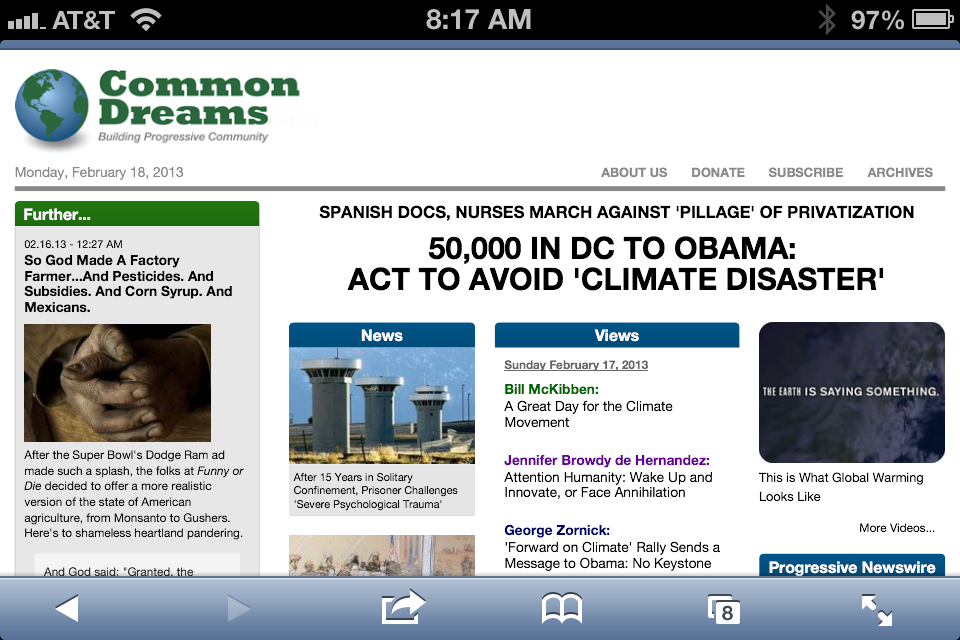
Even the MSM press was on to this rally!  The New York Times covered it, as did The Washington Post.  HuffPost Green did a good job, and of course we could count on Common Dreams to be one of the first to cover Bill McKibben’s victory speech at the end of the day!  Right next to yours truly, I am truly honored to say.

photo

I have a dream…for President Obama and our nation

There is a fair amount of speculation today over what President Obama will say at tomorrow’s Inauguration speech, which coincides with Martin Luther King Jr. Day.

Obama, like King, is a great orator, especially when he allows himself to lose his cool and display the inner fire that animates him.

President Obama arriving in Newtown last month

President Obama arriving in Newtown last month

I hope that tomorrow he will allow us to see his human, emotional side, as he did when he shed unscripted tears the night he visited the bereaved parents in Newtown last month.

It’s true that many of his followers have lost the starry-eyed sense of possibility that made his first Inauguration such a joyful affair.

The romance of our first Black president, an outsider who dodged all the slings and arrows lobbed at him by his opponents to sprint his way to victory, has settled into a more realistic relationship.

We know he’s not superhuman.  He’s not infallible, and he cannot please all of us all the time.

But I hope that in this second term he will be bolder in his governance of the country.  Now that he doesn’t have to worry about running for office again, he can afford to take more risks to get his agenda through.

We’re seeing him do this with gun control, as—to give him due credit—he did in the first term with the Affordable Health Care Act.

It looks like he’s poised to make a positive move on immigration.

These are all important issues.

But they pale by contrast with the single most important issue of our time, restabilizing our climate.

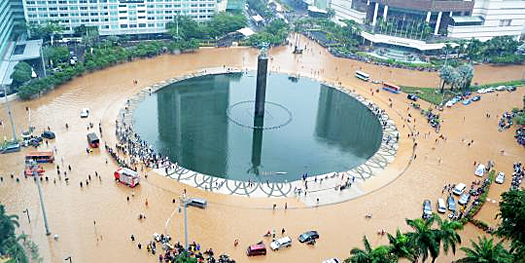
Severe flooding in Jakarta this week from unusually heavy monsoon rains

Severe flooding in Jakarta this week from unusually heavy monsoon rains

An image shot in Jakarta this week gives a snapshot into what is ahead for us, as a nation and as a global human civilization, as the oceans warm, the glaciers and poles melt and release trapped methane and the climate becomes more extreme and erratic.

Scientists tell us that the die has already been cast; the planet is set on a warming course that cannot be reversed.  But it can be mitigated.  We can still keep the average rise in temperature to 4C rather than the 10C that is the current worst-case scenario for the next hundred years.

I have a dream that President Obama surprises the nation and the world on Inauguration Day by announcing a plan to divert current government subsidies to the fossil fuel industry into a new federal fund to promote:

  • a shift to distributed energy (rooftop solar arrays, town wind turbines, local geothermal, etc);
  • new incentives for the manufacturers and installers of renewable energy components;
  • a new R&D push to improve batteries and design data centers and other industrial plants that use less energy;
  • an initiative in urban planning and architectural design to begin the arduous, expensive but necessary process of refitting our cities, towns and individual dwellings for our new climate reality;
  • a strong push to improve the environmental component of our education at every level and in every subject—not just science and technology, but medicine, philosophy, history, sociology, literature and of course economics and business.

This is my dream for the Inauguration speech, but I will not be holding my breath waiting for it.

tumblr_mguif6Qltd1qzsjkco1_400I won’t be in Washington for the Inauguration, but I want to be there for the Presidents’ Day (Feb. 17) climate change rally in DC, sponsored by 350.org and the Sierra Club, to pressure our politicians to do the right thing for us and for our children.

President Obama, I know the tears you shed in Newtown were real—I know you are a feeling, caring human being who does not like to see innocent people suffer.

You have an opportunity in this second term to make a historic difference in our nation’s stance on climate change.

Instead of being one of the world’s biggest polluters and consumers of energy, we can become one of the world’s biggest innovators in renewable energy and energy conservation.

We can once again resume our historic position in the world as a moral and practical leader, doing what’s right for our planet and its beleaguered denizens.

The people elected you, Mr. President, not the corporations.

Do it for us.  Now.

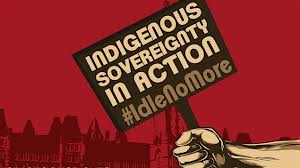
Idle No More: Exposing the Suicidal Cult of Global Capitalism

Once again we are seeing how the democratic power of social media can thwart the efforts of the state political apparatus to keep the people in line.

This time it’s happening in Indian Country, beginning in northernmost Canada and spreading like wildfire through social media networks down south and out into the broader world.

The movement is called Idle No More, and it was started by a coalition of four indigenous and non-indigenous women from Saskatchewan—Sylvia McAdam, Jess Gordon, Nina Wilson and Sheelah Mclean—who decided last fall that enough was enough with the steady assault on the environment and protections for First Nations lands in Canada.

Idle No More Founders

Idle No More Founders

Taking specific aim at an omnibus bill in the Canadian Parliament, known as Bill C45, the women began teach-ins and protests around their homes in northern Canada.  Word spread quickly across North America and beyond via social media channels, and a global solidarity movement was born.

Idle No More protest in Toronto last month

Idle No More protest in Toronto last month

According to the Idle No More website, this is what happened:

 Bill C45 brings forward changes specifically to the Indian Act that will lower the threshold of community consent in the designation and surrender process of Indian Reserve Lands. 

Sheelah McLean reminds us that the bill is about everyone.  She says “the changes they are making to the environmental legislation is stunning in terms of the protections it will take away from the bodies of water – rivers and lakes, across the country.”  She further adds, “ how can we not all be concerned about that?”

The Idle No More efforts continued in Alberta with an informational meeting held at the Louis Bull Cree Nation.  The organizer for that event, Tanya Kappo, took to Twitter and Facebook to help generate awareness on the matter as the passage of Bill C45 was imminent. 

Kappo says, “the people in our communities had absolutely no idea what we were facing, no idea what plans Stephen Harper had in store for us.”  The events leading up to the National Day of Action have been focused on bringing awareness to people in First Nations communities and the rest of Canada. 

Jess Gordon says, “The essence of the work we are doing and have been doing will remain a grassroots effort, and will continue to give a forum to the voices of our people.”

When Bill C45 was brought to the House of Commons for a vote, First Nations leaders demonstrated that they are hearing these voices loud and clear.  They joined the efforts against Bill C 45 and went to Parliament Hill where they were invited into the House of Commons by the New Democratic Party. 

However, they were refused entry.  This refusal to allow First Nations leadership to respectfully enter the House of Commons triggered an even greater mobilization of First Nation people across the country. 

Nina Wilson says, “what we saw on Parliament Hill was a true reflection of what the outright disregard the Harper Government has towards First Nation people.”

With the passage of Bill C45, Idle No More has come to symbolize and be the platform to voice the refusal of First Nations people to be ignored any further by any other Canadian government.

Unknown

Yesterday I happened to catch a call-in program on the CBC (Canadian Broadcasting Co.) on the Idle No More protests, which have apparently taken most Canadians by surprise.  The host interviewed a representative of the Canadian environmental protection agency, and it was shameful to listen to the way he sputtered when asking whether the bill in question really would result in damaged waters and fisheries.

Although he refused to come out and say it, the short answer was clearly, “Yes.”

As always, for mainstream politicians and businessmen the lure of short-term profits outweighs longterm planning for the health and welfare of the planet and her denizens.

Some of the callers on the CBC program displayed evident racism in their attitudes towards the Native peoples behind the Idle No More protests, which have blockaded railways and highways in recent weeks, in an effort to gain the attention of the Canadian prime minister, Stephen Harper.

Attawapiskat Chief Theresa Spence

Attawapiskat Chief Theresa Spence

One Native Chief, Theresa Spence, has been on a hunger strike for nearly a month now, her immediate goal simply being an audience with Mr. Harper and a chance to present the First Nations case.  Harper has finally agreed to meet with Spence and other chiefs, on January 11, 2013, one month after she started her hunger strike.

Spence is a controversial figure in this movement, which began with a grassroots coalition and has displayed some reluctance to let the indigenous chiefs steal the thunder.

There have been rumors of corruption among the chiefs, including Spence herself, who has just now, conveniently enough, been subjected to a humiliating government audit of her finances.

It’s not clear whether all the chiefs are truly after the protection of the environment, or if they just want to have their fair share of the economic action when it comes to the rapid development of Canada’s northern territories.

What is clear is that the immense land and resource grab in the Americas, which began with the colonial conquests and has continued to the present day, provides short-term financial gains for the few—mostly non-indigenous corporations and financiers—while the majority of Native peoples languish in poverty, sitting on environmentally devastated lands.

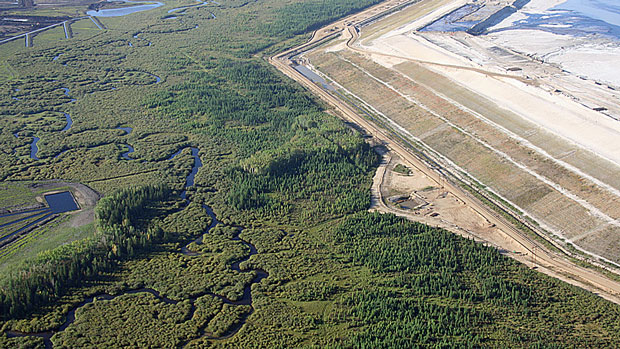
Aerial view of Alberta tar sands development, aka the destruction of the Alberta boreal forest. (Global Forest Watch Canada)

Aerial view of Alberta tar sands development, aka the destruction of the Alberta boreal forest. (Global Forest Watch Canada)

In case after case worldwide, rapacious corporations sweep in, negotiate favorable leases on the land, extract the resources and move on, leaving behind a toxic, degraded landscape and a broken people.

Now we have finally come to the time when it is becoming obvious that the damage that is being wreaked on people and their environments in specific parts of the world is not just “their own problem.”

As the founders of the Idle No More movement correctly perceived, if the waters of Canada are not protected, it will affect all Canadians, not just the First Nations folk who sit closest to those waterways.

If the boreal forests of northern Canada are razed, it will affect the entire planet, just as the steady destruction of the rainforests in the southern latitudes is inexorably destabilizing our climate worldwide.

It appears that our politicians only understand the language of dollars and cents.  In New York and New Jersey now, a serious discussion is underway about how to pay for the cost of adapting to the climate change that almost everyone sees now as inevitable.

Yes, we have to adapt, we have to mitigate the damage by changing the way we develop our coastlines.

But we also have to adapt our mindsets when it comes to “development of natural resources”—a green-washed euphemism for what has really been “the wholesale destruction of the planet.”

This is as true for the destruction of the boreal forests of Canada as it is for the fracking of the Marcellus Shale in the U.S.

If the real costs of this kind of destructive “development” were added up, no sane financier or politician would be able to support such a suicidal undertaking.

If our politicians and business leaders want to commit hari-kari by reckless short-term myopic thinking, good riddance to them.

But they have no right to take the rest of us along with them.

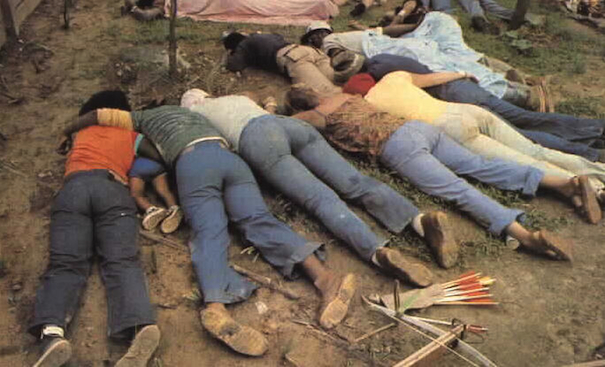
It reminds me of suicide cults like the infamous one in Jonestown, Guyana, in the 1970s.  A whole group of people was so taken in by the charismatic leadership of their guru, Jim Jones, that they obeyed his order to commit ritual suicide.

Victims of the Jonestown suicide cult

Victims of the Jonestown suicide cult

In our case, it’s the entire global capitalist leadership that has us all in thrall. We have been seduced, charmed and entranced by the siren call of “development,” which has given mainstream North Americans—the ones who agree to play by the rules—the benefits of a comfortable lifestyle.

The hidden underbelly of this lifestyle—the environmental destruction, the extermination of thousands of species annually, the annihilation of entire groups of indigenous peoples worldwide, the irrevocable destabilization of our climate—is now coming into view, thanks in large part to the democratization of the media through the World Wide Web.

I continue to believe that when ordinary, good-hearted people understand their own role in this planetary destruction, they will stand up and insist, like the four women who founded Idle No More, that enough is enough.

The question is, how far will we be willing to go to insist that our leaders respect our values and stop dragging us down the road to ruin?

How far will we have to go?

“Never doubt that a small group of thoughtful, committed citizens can change the world. Indeed, it is the only thing that ever has.”

–Margaret Mead