I have a dream: the 20th century visions of King and Obama and the “fierce urgency” of our time

mlkihaveadreamgogoFifty years ago today Dr. Martin Luther King Jr. shared his dreams with the American nation:

“I have a dream that one day this nation will rise up and live out the true meaning of its creed: We hold these truths to be self-evident, that all men are created equal.’

“I have a dream that one day on the red hills of Georgia, the sons of former slaves and the sons of former slave owners will be able to sit down together at the table of brotherhood.

“I have a dream that one day even the state of Mississippi, a state sweltering with the heat of injustice, sweltering with the heat of oppression, will be transformed into an oasis of freedom and justice.

“I have a dream that my four little children will one day live in a nation where they will not be judged by the color of their skin but by the content of their character.

“I have a dream today!”

Today President Obama, himself the fulfillment of Dr. King’s dream, honored the legacy of the Civil Rights movement, telling us that because people in Dr. King’s generation marched for justice, “America changed. Because they marched, the civil rights law was passed. Because they marched, the voting rights law was signed. Because they marched, doors of opportunity and education swung open so their daughters and sons could finally imagine a life for themselves beyond washing somebody else’s laundry or shining somebody else’s shoes. Because they marched, city councils changed and state legislatures changed and Congress changed and, yes, eventually the White House changed.”

967-16eslj.AuSt.55

But Obama’s dream remains too limited.  He is still dreaming a 20th century dream of middle class jobs and security: the longing for a society offering  “decent wages, fair working conditions, livable housing, old age security, health and welfare measures — conditions in which families can grow, have education for their children and respect in the community.”

Such a scenario assumes the stability of the real workers of our economy: the trees and plankton that supply our oxygen and the microorganisms that make our crops grow.  It takes for granted steady, predictable rains and moderate temperatures.

We can no longer make such assumptions, and President Obama is wrong to preach to the nation as though 20th century problems and concerns were still paramount today.

Yes, the problem of the color line still exists in 21st century America.  The unemployed still need jobs.  The racial disparity in prison populations is disgraceful.  But these are not the most pressing issues of our time.

President Obama lauded the young of the 1960s for being “unconstrained by habits of fear, unconstrained by the conventions of what is. They dared to dream different and to imagine something better.”

He argued that “that same imagination, the same hunger of purpose serves in this generation.   We might not face the same dangers as 1963, but the fierce urgency of now remains.”

In fact, we face even greater dangers today than in 1963, and it was dishonest of our President not to allude to the much more serious problems now bearing down on us full force: the juggernaut of global climate change.

The wildfires burning in California this week are the among largest ever recorded in the United States.

The rate of species extinction is faster now than it ever has been in the history of human civilization.

The ice melting at the poles promises to release heat-trapping methane gas at rates not seen since prehistoric eras.

Human population is on track to reach 9 billion or more in this century, way beyond the carrying capacity of the Earth.

We don’t know where all this is leading, but surely we cannot expect positive outcomes from these dramatic planetary shifts.

These interconnected environmental issues are the great challenges of our time, and it is to them that President Obama should have alluded, if he was being honest with himself and with the American people.

Whether or not the Syrians used chemical weapons against their own people; whether or not African Americans get to the voting booth; whether or not the American middle class sinks into poverty…all this will not matter at all when accelerating climate change begins to bring food shortages even to the most cosseted Americans.

Here is what our President should have said today:

‘I have a dream that Americans will step into a leadership role in the great fight of our time, the transition to a sustainable, renewable-energy-based society.

‘I have a dream that people of all nations, all creeds and from every culture on Earth will embrace our common challenge of finding ways to mitigate human damage to the planet, and adapt to the changes that are rapidly coming our way.

‘I have a dream that men and women from all over the globe will stand together, knowing that divided we will fall, but united we have a chance to safely ride out the storms that face us.’

My own personal dream is that our political leaders will stop lying to us, and will summon us to step up to the great ethical and empirical challenge of our time: creating lifeboats on which our children and grandchildren may sail safely into a sustainable future.

World on fire

I had to dig deep into the New York Times, my usual go-to source for “all the news that’s fit to print,” to find any mention of this weekend’s train explosion in the province of Quebec, not far from the Maine border.

canada-floater-articleLarge

Lac-Megantic on fire July 6, 2013

I knew about it only because here in Canada it’s at the top of the headlines, with Prime Minister Stephen Harper taking the time this Sunday to journey to the small town of Lac-Megantic, where the disaster occurred, to size up the situation and offer his condolences.

Officially, so far, five have been confirmed dead, with scores still missing; Lac-Megantic, pop. 6,000, is said to look like a war zone, with black fumes rising from the burning crude oil carried by the 73-car train.

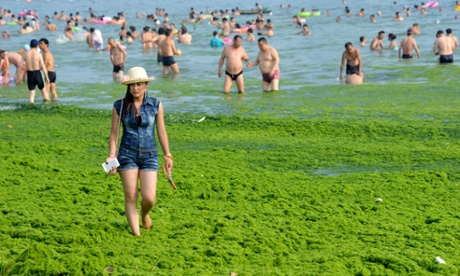
This on a weekend when temperatures in the Canadian Maritimes soared to record-breaking heights, and harmful algal blooms worldwide choked out marine life along all the coasts.

91fb3c94-086c-4470-a98e-23ec4ff993d8-460x276

Algae bloom on the Yellow Sea in China, July 2013

Astoundingly, at least one Canadian pundit responded to the burning crude and the smoldering township by calling for increased building of pipelines!

Another columnist, in the very same newspaper that reported on Nova Scotia’s unprecedented heat wave, had the nerve to call for more drilling and fracking for oil and natural gas on land and sea in the province.

If there are no more fish in the sea, we can at least extract the last of the fossil fuels, eh?

It’s time to get a grip, people.

What we need is not more oil and gas, but more wind and solar.

We need clean sources of energy, and we need to lower our consumption dramatically.

The window of possibility is smaller and tighter than most of us care to realize.

The tipping point is upon us.

This is not another action movie, a “White House Down”-style disaster flick, ending with the good guys reliably saving the day.

As we saw with the Arizona fires the other day, even the most hot-shot of heroes can go down in a blaze of glory when the fires burn out of control.

Do we really want to wait until the entire world is going up in flames, literally and figuratively speaking, before we act?

This is not a rhetorical question.  And the answer, I believe, is NO.  We can’t afford to sit on our hands any longer.

The time to act is NOW.

No more fish in the sea?

Last summer when I was in Nova Scotia, I wrote about how startled I was to struggle, in the local supermarket, to find anything but frozen fish with origin stamps of China and Southeast Asia.  The fresh fish offerings were meager, taking up just a small portion of the case allotted to them, and besides the lobsters, only the ocean trout and small haddock filets were wild caught.

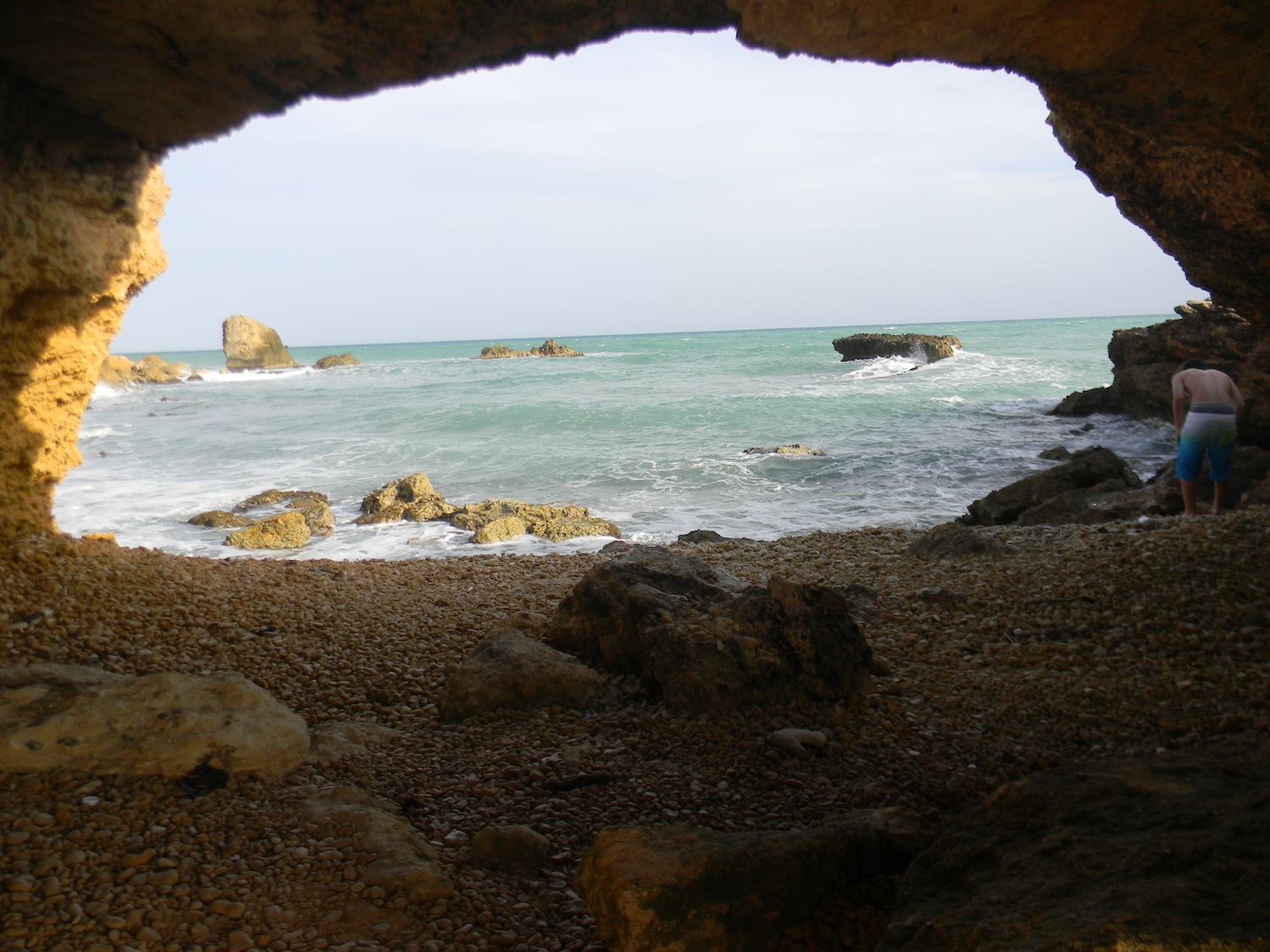
product-lg-seafoodLast week, in a Puerto Rican supermarket, I had an unhappy feeling of déjà vu as I searched in vain for any locally caught seafood at all.  There was no fresh fish counter there, just a case of packaged frozen filets and shellfish, every one of them with their label pointing to China or India.

When I asked the locals about whether it was possible to get fresh fish on the island, they shook their heads.  “Maybe if you meet the fishing boats at the dock, they might sell you something,” one man told me.  “But it all goes to the restaurants and resorts.”

Other than crabs, there were few sea creatures to be seen on the beach, either.  One morning we watched a local man with snorkel gear and a fishing spear go back and forth in front of the beach collecting lobsters—undoubtedly illegally.

The only coral we saw was bleached and dead.

The amount of plastic garbage on the beach and in the coastal waters was depressing.

And although there was some bird life, it was thin, even in the beautiful coastal land designated as a “national wildlife refuge”: a single frigate bird, a couple of pelicans, a handful of herons and sandpipers.

DSCN3856

What frightens me is how quickly we normalize whatever situation we live in.

It’s normal now to live on an island surrounded by magnificent turquoise waters and not be able to find fresh local seafood to eat.

DSCN3895

It’s normal to buy water in plastic bottles and throw them casually away, without any clue of what happens to them once they’re deposited on the curb for the garbage men to pick up, and it’s normal to find those bottles washing up at the beach.

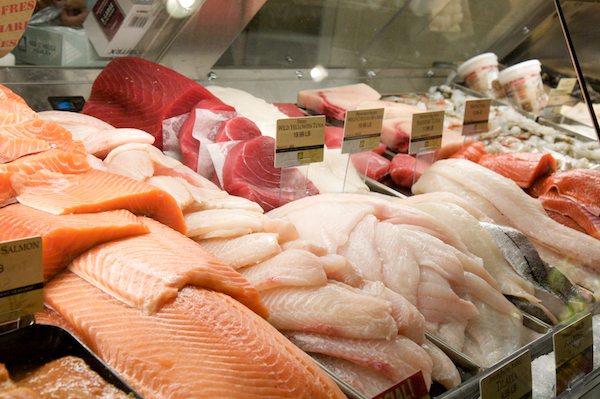
I_Fresh_Market_FishIt’s normal to return to the U.S. and find, in the local gourmet food store, a big gleaming fresh fish counter, with huge slabs of “sustainably farmed” salmon, leaner wild-caught Alaskan salmon ($25 a pound!), swordfish steaks, flounder filets, sea bass from Chile, fresh shellfish of every description.

Here in the heart of Empire, it’s normal to remain ignorant of the fact that this kind of abundance is rare, and carefully manufactured.

And when those who can afford that $25 a pound fish go abroad, they travel in bubbles of luxury that keep them cushioned in the comfortable delusion that all is well.

After all, in the restaurants at the resorts, there’s fresh salmon on the menu.  Never mind that it arrived on this Caribbean island packed in ice, on a flight from a fish farm in New Brunswick, New Zealand, or Scotland.

It’s normal, now, to feel sad but resigned to the fact that fish and seafood is becoming a rarity.

As omnivorous human beings, we have other choices. No seafood available?  Eat chicken then, or vegetables.

But what about the shorebirds and the ocean food chains that have evolved in tight symbiosis over millions of years?

Try telling a pelican or a seal to go eat some chicken.

DSCN3836

On the southern California coast this spring, there has been a wave of emaciated, starving sea lion pups washing up on the beaches.

baby-sea-lion-2edit

Starving sea lion pup being transferred to a rescue center for rehabilitation.

They’re starving because the fish their parents and grandparents caught so easily have been trawled up by factory fish vessels, frozen in plastic pouches and sent around the world on ice.

This is the new normal.

I am not resigned, and I will never get used to it.

Becoming part of Gaia’s cure, instead of what ails her

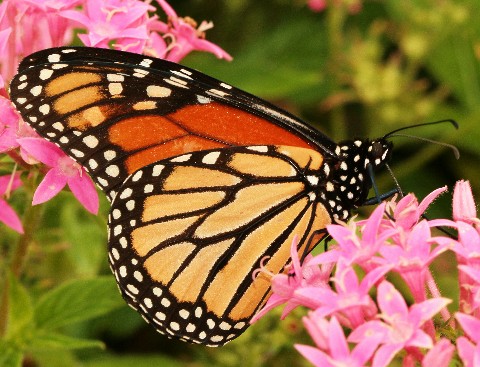
Milkweed-with-Monarch-ButterflyI will never forget one hot summer day when I was about eight years old, and a Monarch butterfly took it into its head to land on my arm and delicately lick up my sweat with its long, probing tongue.

I froze, wanting the Monarch to stay with me as long as possible, and watched with total fascination and delight as it balanced on my warm brown skin and enjoyed the salty treat I had to offer.

Eventually, with a graceful swish of its elegant wings, it rose up in the air and twirled off to land on a nearby stand of sweet-smelling pink milkweed flowers.

I felt blessed by the encounter, and ever after, when I see a Monarch I approach cautiously and respectfully proffer my arm, hoping to feel again the light touch of those fragile black legs and tiny tongue.

My childhood connection with Monarchs came to mind this week as I read the deeply disturbing news that “the number of monarch butterflies that completed an annual migration to their winter home in a Mexican forest sank this year to its lowest level in at least two decades, due mostly to extreme weather and changed farming practices in North America.”

Mexican conservation authorities report that “The area of forest occupied by the butterflies, once as high at 50 acres, dwindled to 2.94 acres in the annual census conducted in December,” which is “a 59 percent decline from the 7.14 acres of butterflies measured in December 2011.”

So now, along with the bats and the goldfinches and so many other species that I have known and loved in my 50 years on the planet, I must bid farewell to the Monarch butterflies too?

Carolyn Baker

Carolyn Baker

Trying to find a way to cope with the pervasive sense of grief I feel on a daily basis, I turned this week to the works of Carolyn Baker, who has self-published two books that have been striking a chord with thousands of people.

In 2009, she published Sacred Demise: Walking the Spiritual Path of Industrial Civilization’s Collapse, followed in 2011 by Navigating the Coming Chaos: A Handbook for Inner Transition.

Baker comes out of a psychology background, having served as a consulting psychotherapist for many years, but she draws on a wide range of sources that I too have been poring over in recent years, from Joanna Macy to Derrick Jensen to James Lovelock and many more.  Andrew Harvey, author of two books on “spiritual activism,” wrote the forward to her second book.

What all these folks have in common is the strong, level-headed recognition that human civilization is headed for a collapse.

The butterflies and the bats may be going first into the void, but we will not be far behind.

The current noise and controversy over questions like “to frack or not to frack,” “to build wind turbine generators or deep-sea oil rigs in the Arctic,” or “to erect solar arrays or thousand-mile oil pipelines” are just that—so much noise, which obscures our ability to focus on what is driving the debate on all these issues: the fact that our planet cannot and will not support 7 billion people at current levels of consumption.

James Lovelock

James Lovelock

The eminent eco-scientist James Lovelock, who, with Lynne Margulis, developed the theory of Earth as a complex living system he calls Gaia, has just published what may be his final book (he was born in 1919, making him now just seven years short of 100 years old).

Grimly titled The Vanishing Face of Gaia, Lovelock sadly predicts that global heating will force the die-off of much of humanity, and a retreat of the survivors to “lifeboat” places on the planet that will remain habitable on a subsistence basis for those able to live close to the land.

Lovelock uses the metaphor of disease to describe what is happening to our planet these days.  This passage is worth quoting in full:

“When we are first infected by fatal disease organisms, they grow in our bodies without our noticing.  We call this the incubation period, and it can be as long as several weeks.  Then at some stage in their growth, or in our bodily reaction to it, we feel unwell, with fever and pain.  Soon, a matter of hours with the most virulent influenza, homeostasis starts to fail and we collapse and die.  This is when physicians speak of massive organ failure.  In the whole course of fatal disease there is no tipping point but instead a downslide that starts imperceptibly and then grows ever steeper until we fall.

“We became the Earth’s infection a long and uncertain time ago when we first used fire and tools purposefully.  But it was not until about two hundred years ago that the long incubation period ended and the Industrial Revolution began; then the infection of the Earth became irreversible….

“The disease that afflicts the Earth is not just climate change—manifest by drought, heat, and an ever-rising sea.  Added to this there is the changing chemistry of the air and the oceans, and the way the sea grows acidic.  Then there is the shortage of food for all consumers of the animal kingdom.  As important is the loss of that vital biodiversity that enables the working of an ecosystem.  All these affect the working of the Earth’s operating system and are the consequences of too many people.  Individuals occasionally suffer a disease called polycythanemia, an overpopulation of red blood cells.  By analogy, Gaia’s illness could be called polyanthroponemia, where humans overpopulate until they do more harm than good” (232-33).

Lovelock sees the demise of the current terrestrial epoch as inevitable.  But he also reminds us that Gaia is a tough old planet, who has survived many other total collapses of biodiversity in her past.  “After every one of these catastrophes Gaia recovered, taking her own time—sometimes as long as millions of years,” Lovelock says.  “During these periods of convalescence there was always somewhere on Earth a refuge for living organisms, a place where the climate and the chemistry still favored life.  And so it surely will be when polyanthroponemia resolves” (235).

Lovelock faults our human tribalism and the selfish, competitive shortsightedness of a predator species for our current predicament, quoting the biologist E.O. Wilson, who said towards the end of his life, “How unfortunate that the Earth’s first intelligent social animal is a tribal carnivore” (239).

This is “our agonizing condition,” Lovelock says; “we have the intelligence to begin to expand our minds to understand life, the universe and ourselves; we can communicate and exchange our deep thoughts and keep them outside our minds as a permanent record.  We have all this but are quite unable to live with one another or with our living planet.  Our inherited urge to be fruitful and multiply and to ensure that our own tribe rules the Earth thwarts our best intentions” (240).

Lovelock ends his book by looking ahead to a mythical time in the future, when the survivors of the collapse of human civilization “evolve to become as beneficial a part of Gaia as were the photosynthesizers and the methanogens,” who “might serve within her as our brains do in each of us.  We would be an important part of what had become in effect an intelligent planet better able to sustain habitability” (248).

It is our duty, he says, as human beings living through these great Transition Times to ensure that enough of us survive to pass on our genes to the future, in the hopes that future iterations of human beings will overcome our tribalism and selfishness and put our remarkable creative intelligence to work for the good of the planet and all her denizens.

The question becomes then, what should we be doing now to prepare for the future that awaits?

This is where Carolyn Baker’s work becomes so important.  Navigating the Coming Chaos is nothing less than a workbook for inner and outer transition where the focus is on strengthening one’s resilience and connection with a sense of purpose and meaning in a world gone increasingly mad.

“I am not a survivalist,” Baker says.  “I have never believed that the prime objective in preparing for the Long Emergency is to remain alive.  None of us is enthusiastic about death, but we will all die.  To deny this fact and focus primarily on survival is to embrace the heroic perspective and, in my opinion, to miss the point….

“I believe that navigating a collapsing world will entail constant observation of various forms of death—the death of infrastructure, the death of abundance, the increasing absence of goods and services that we now take for granted, the death of institutions, the disappearance of employment and shelter, the increased scarcity of food and water, the death of landscapes and yes, the literal deaths of people and animals.  The collapse of industrial civilization and the lifestyle it has provided is a catastrophic death of a paradigm and a way of life.  While we may look ahead to the ultimate blessings unleashed by this death, it will nevertheless be traumatic to live through the magnitude of losses it will manifest.

“If, however, we can begin now to make friends with death, as the Buddhist tradition has taught for thousands of years, we may be better prepared emotionally and spiritually to navigate a civilization dying on myriad levels….

“Simply put, the essential question is not: How can I survive the collapse of industrial civilization?  But rather: Why am I here, right now, in this place, at this time, experiencing the end of the world as I and my species have known it? (166).

Much of Baker’s book, like Starhawk’s most recent book The Empowerment Manual, is dedicated to prompting self-reflection leading to the recognition of what we are here on this Earth to do—and how we can successfully work with other awakened humans to accomplish our purpose.

The biggest challenge seems to be how to learn to work together harmoniously with each other and with the other living elements of our planetary home.

Gaia callingFor me, it seems clear that what I need to be doing now is to rekindle the instinctive sense of kinship I had with the natural world as a little girl; to find ways to become a channel for the love I felt, and still feel, for the gaudy Monarch butterflies who sailed regally through the fields of my childhood.

Sooner or later I will be following them into oblivion. But let it not be before I’ve had a chance to do my utmost to wake up my fellow travelers on this planet to the state of emergency we now face, and to help create the community structures that will enable at least a critical few of us to survive into the distant future.

Morning pages for humanity…and the Earth

Julia Cameron

Julia Cameron

This week, in preparation for Julia Cameron’s presentation at the Berkshire Festival of Women Writers, I have been doing quite a bit of thinking about creativity.

Cameron’s great insight, back in the late 1980s when she was doing the teaching that led to her blockbuster creativity self-help guide The Artist’s Way, was that human beings are all naturally creative.  We just tend to get “blocked” by our upbringing, and need to work on ourselves in a systematic way to unlearn bad habits of self-doubt and defeatism, so that our creative juices can flow freely out into the world.

One question I wish I’d asked Julia at her lecture last night at Kripalu is this: I wonder whether women have any particular creative challenges, different from those faced by men?

The Artist’s Way does not seem to draw any distinction. Cameron uses the gender-neutral term “creatives” and her examples are drawn from the experiences of both men and women.

And yet it seems to me that women are particularly susceptible to the kind of distraction, hyperactive multi-tasking and withering self-doubt that Cameron says are anathema to artists.

One woman in the audience at Cameron’s lecture described herself as “frantic,” or maybe she said “panicked,” facing such a huge to-do list of projects she’d like to accomplish that she was paralyzed by the enormity of it all.

Julia’s response was characteristically calm and pragmatic: slow down, write your morning pages faithfully, ask for guidance from your higher self, and be patient—it will come.

This is certainly good advice for anyone who wants to accomplish creative goals, but it seems especially relevant for me, and all the busy women like me who so often do not take the time out for ourselves, to recharge our own creative batteries.

Cameron’s “morning pages” are deliberately unfocused.  They are not meant to be a to-do list, or an outline for a project, or a mission statement.  They are simply meant to provide a regular, rhythmic opening for the creative spirit, which Cameron clearly conceptualizes as coming from a higher source.

“I learned to turn my creativity over to the only god I could believe in, the god of creativity,” she says in The Artist’s Way, “the life force Dylan Thomas called “the force that through the green fuse drives the flower.”

By allowing ourselves the time and space to be open to the creative life force that gave birth to us, we are allowing ourselves to become channels through which those creative juices can flow out into the world, manifesting all in kinds of ways, depending on our particular gifts.

As Cameron said last night, this can sound a bit “woo-woo.”

But the life force is in a way the final frontier for human understanding, the one mystery we still have not been able to penetrate via science.

We argue about when life begins—at conception?  in utero?  at birth?—and we recognize that there seems to be much more to the universe than we can measure with our physical senses or scientific instruments.

We know in an intuitive way that when we are “in the flow,” allowing ourselves to be creative channels, things can start happening that seem entirely beyond our control, and not at all coincidental.

Julia Cameron calls this synchronicity: “we change, and the universe furthers and expands that change….It is my experience both as an artist and as a teacher that when we move out on faith into the act of creation,” she says, “the universe is able to advance.”

The thing is that not all creations are equal.

Human creativity is not always a good thing.

It’s fair to say that over the past 500 years, since the Catholic Inquisition began its war on the older, nature-based religions and the European powers began their colonial assault on the rest of the world, the dominant paradigm of human creativity on the planet has been materialistic, channeled by our rulers into paths shaped by greed and lust.

Domination and aggression have driven the leading edges of human invention: we have proven very adept at creating guns, machinery and synthetic chemicals, haven’t we?
We have also created a might-makes-right philosophy that has literally bulldozed away any impediments to the harnessing of the natural resources of our planet, including the vast majority of humankind, in the service of short-term gain for the elite.

But at the same time, human creativity has always flowered anew, with each new generation having the potential to choose a different way of channeling that divine universal flow.

We stand at a juncture in history when it seems that the planet is poised to hit the evolutionary reset button, sweeping human beings away to make room for the emergence of new physical vessels for its irrepressible life force.

I believe there is still time for human beings to come to our collective senses and begin to shape our creative output into inventions and ethical paradigms that support and enhance life, rather than torture and destroy it.

I worry about the role the media plays today in limiting and predefining children’s creative imagination.  Little children who used to spend hours playing pretend games, making up elaborate stories complete with visualizations and acting, now spend those same hours playing violent video games or passively watching commercial television, with its monotonous message that consumption equals happiness.

But I take heart from the teenagers I teach, who continually show themselves able to see through the mesmerizing power of the media and think creatively for themselves.

We human beings all need to be doing our “morning pages” in these crucial final years of the modern era, seeking to tap into the “pure positive energy of the universe” and open ourselves to the possibility of different, more harmonious and balanced creative forms.

Because I believe that women have an important role to play in this shift, I am totally dedicated to the work I’m undertaking in this month’s Berkshire Festival of Women Writers, opening up lots of opportunities for women to share their creative visions.

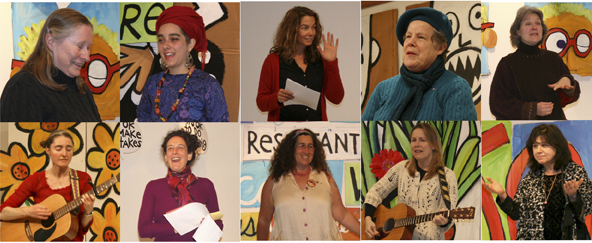
Women sharing their creative visions at the Deb Koffman open mic in Housatonic, MA

Women sharing their creative visions at the Deb Koffman open mic in Housatonic, MA

This is not just about women writers patting each other on the back and trying to advance our individual careers.

This is about women forming what Julia Cameron unabashedly calls “Sacred Circles” to propel humanity beyond the destructive domination-and-extraction model of the human relationship to our Mother Earth.

Next year’s Festival will have a special focus on women, creativity and environmental sustainability, to help us train our focus on the most urgent matter at hand: the destruction and contamination of the planet, with the resulting drastic climate change shifts that are coming in this century no matter what we do now.

Women and men worldwide need to rise to this challenge with every ounce of our creative energies.  On this International Women’s Day, 2013, I call on women, especially, to make a commitment to using our creative power for the good of the planet and all her denizens.

Late-night thoughts on human hubris

It’s 7 a.m.

Do you know where the songbirds are?

I have been struck by the silence of the woods as I take my daily walks.

Once in a while a chickadee will call in a high hemlock.

More rarely, I’ll see a nuthatch making its way sideways up a tree trunk.

Goldfinch

Goldfinch

But for the most part, the forest is eerily silent, and even at my bird feeder the once lively ranks of brightly colored birds—goldfinches, purple finches, blue jays, cardinals, woodpeckers, juncos, titmice—have thinned.

It’s not an illusion, and it’s not an anomaly.

The Silent Spring predicted by Rachel Carson 50 years ago is well on its way to becoming a reality.

And the emptiness of the air is being mirrored in the waters.

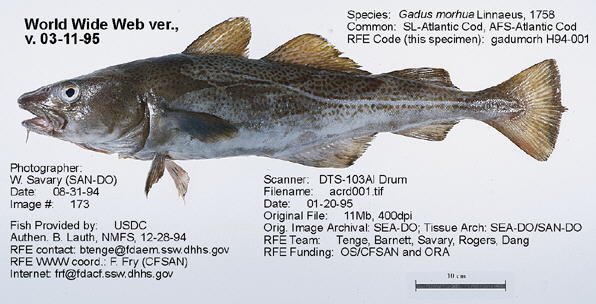
Last week, over the protests of commercial fisherman, New England fishery management officials voted to sharply reduce the catch limits on cod, in the hope of saving this iconic Atlantic fish from extinction.

Cod was once the passenger pigeon of the sea, so numerous it was used as farm fertilizer and treated as if it were in endless supply.

cod

After just a few years of commercial trawling—a blink of the eye in relation to cod’s million-year history on the planet—the cod, along with so many other fish species, is almost gone.

“The United States has watched the near total collapse of cod stocks in Canada,” reports The New York Times. “The demise of the fish populations was hastened by the widespread use of big trawlers equipped with radar and sonar systems that enhanced the ability to catch the fish. They expanded the area and depths that could be fished and sped up the process, diminishing the ability of the remaining fish stocks to replenish themselves.

“The big trawlers also swept up other fish that had little commercial value but played important predator-prey roles in maintaining the ecological balance of the species. Today the cod stock in the Gulf of Maine is at 18 percent of what scientists deem to be a healthy population; in Georges Bank, it is 7 percent.”

I well remember my sons’ disappointment when they threw some fishing lines into the glistening ocean off the coast of Nova Scotia.  Not a fish was to be had, and when we asked local people about it, they just shook their heads sadly.

The fish are gone.

Because we don’t eat songbirds, there is no “management agency” keeping track of their populations.

At best, there are conservationists and wildlife biologists trying to sound the alarm.

But the truth is that the collapse of biodiversity is too huge a problem for any one agency to deal with.  In the ocean it’s about greedy, reckless trawling; on land it’s about the relentless destruction of the forests and the poisoning of farmland and fresh water.

It’s about the continuing reliance on dirty fossil fuels, despite the robust evidence of the impact of climate change on planetary health.

It’s about the hubris of human beings, thinking that we alone can survive the biodiversity collapse we have engineered.

buffalofThe saddest story I’ve read in a long time is about the bison in Montana.

You remember, the ones that were shot and left to rot by the hundreds of thousands in the late 19th century?

The ones that were a hairs-breath from extinction, but were painstakingly brought back by breeders, and now roam “free” in national parks?

Well, the Montana legislature is proposing to restore the 19th century practice of shooting bison on sight, treating any who dare to stray onto private property as “vermin.”

The once noble buffalo herds that thundered across the open prairies and mountain valleys of North America, reduced to a tiny fraction of their original population, are now to be shot for daring to step across an invisible property boundary to eat the green grass on the other side.

In the 1980s and 1990s, reports The New York Times, “Department of Livestock officials gunned down hundreds of famished Yellowstone bison that migrated into Montana in search of forage.”

Now a group of landowners and ranchers in Montana wants their state Legislature to make this practice law.

If Americans cared about the demise of the innocent creatures of the natural world a fraction as much as they care about their oh-so-beloved Superbowl, we would find the will and the way to solve the slow-motion nightmare of extinction.

We would figure out how to live sustainably on the magnificent planet that has enabled our remarkable rise as a species.

The truth is that human beings are the ultimate invasive species.

We are over-populating to the point where everything else is being crowded out beneath our monolithic spread.

What will happen when there are no more coral reefs, no more fish, no more forests, no more birds?

I’d like to give myself some comfort by saying I won’t live to see that day.

But realistically I have to face the fact that that day is just around the corner.

I have a dream…for President Obama and our nation

There is a fair amount of speculation today over what President Obama will say at tomorrow’s Inauguration speech, which coincides with Martin Luther King Jr. Day.

Obama, like King, is a great orator, especially when he allows himself to lose his cool and display the inner fire that animates him.

President Obama arriving in Newtown last month

President Obama arriving in Newtown last month

I hope that tomorrow he will allow us to see his human, emotional side, as he did when he shed unscripted tears the night he visited the bereaved parents in Newtown last month.

It’s true that many of his followers have lost the starry-eyed sense of possibility that made his first Inauguration such a joyful affair.

The romance of our first Black president, an outsider who dodged all the slings and arrows lobbed at him by his opponents to sprint his way to victory, has settled into a more realistic relationship.

We know he’s not superhuman.  He’s not infallible, and he cannot please all of us all the time.

But I hope that in this second term he will be bolder in his governance of the country.  Now that he doesn’t have to worry about running for office again, he can afford to take more risks to get his agenda through.

We’re seeing him do this with gun control, as—to give him due credit—he did in the first term with the Affordable Health Care Act.

It looks like he’s poised to make a positive move on immigration.

These are all important issues.

But they pale by contrast with the single most important issue of our time, restabilizing our climate.

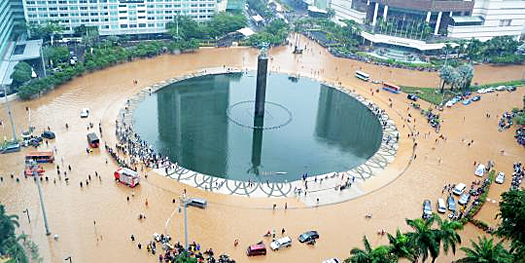
Severe flooding in Jakarta this week from unusually heavy monsoon rains

Severe flooding in Jakarta this week from unusually heavy monsoon rains

An image shot in Jakarta this week gives a snapshot into what is ahead for us, as a nation and as a global human civilization, as the oceans warm, the glaciers and poles melt and release trapped methane and the climate becomes more extreme and erratic.

Scientists tell us that the die has already been cast; the planet is set on a warming course that cannot be reversed.  But it can be mitigated.  We can still keep the average rise in temperature to 4C rather than the 10C that is the current worst-case scenario for the next hundred years.

I have a dream that President Obama surprises the nation and the world on Inauguration Day by announcing a plan to divert current government subsidies to the fossil fuel industry into a new federal fund to promote:

  • a shift to distributed energy (rooftop solar arrays, town wind turbines, local geothermal, etc);
  • new incentives for the manufacturers and installers of renewable energy components;
  • a new R&D push to improve batteries and design data centers and other industrial plants that use less energy;
  • an initiative in urban planning and architectural design to begin the arduous, expensive but necessary process of refitting our cities, towns and individual dwellings for our new climate reality;
  • a strong push to improve the environmental component of our education at every level and in every subject—not just science and technology, but medicine, philosophy, history, sociology, literature and of course economics and business.

This is my dream for the Inauguration speech, but I will not be holding my breath waiting for it.

tumblr_mguif6Qltd1qzsjkco1_400I won’t be in Washington for the Inauguration, but I want to be there for the Presidents’ Day (Feb. 17) climate change rally in DC, sponsored by 350.org and the Sierra Club, to pressure our politicians to do the right thing for us and for our children.

President Obama, I know the tears you shed in Newtown were real—I know you are a feeling, caring human being who does not like to see innocent people suffer.

You have an opportunity in this second term to make a historic difference in our nation’s stance on climate change.

Instead of being one of the world’s biggest polluters and consumers of energy, we can become one of the world’s biggest innovators in renewable energy and energy conservation.

We can once again resume our historic position in the world as a moral and practical leader, doing what’s right for our planet and its beleaguered denizens.

The people elected you, Mr. President, not the corporations.

Do it for us.  Now.

Don’t be fooled…now is no time to relax

Usually there is one image every week that burns itself into my memory and won’t let go.  That’s the one I have to write about.

This week, this is it:

Beijing, January 17, 2013

Beijing, January 17, 2013

It’s coupled with a small, unheralded story, which I’m sure many people missed, about how soot is a much more dangerous contributor to the greenhouse effect than had previously been estimated.

I paid attention to this because I remember soot well.

In the luxurious enclaves in Manhattan where I lived as a child and young adult, soot was omnipresent.

It lay, black and unrepentant, on the white painted windowsills of our apartments.  It got into your eyes when the wind blew.  It came off black on the cotton balls I’d use to clean my face at night.  It gradually turned the white starched window curtains and the elegant rugs and carpets a dingy gray.

Looking at the images from Beijing this week, I can hardly bear to imagine how heavily besmirched with soot everything in that city must be.

air pollution in Beijing, China

I have vivid memories of standing on the corner of 86th Street and Park Avenue in Manhattan as a child, and being totally engulfed with the hot black diesel smoke belching out of one of the public buses that ran the crosstown route.

It happened on a daily basis, and never failed to disgust me.  I felt some small, inner part of myself wilting, just like I saw the spindly trees planted in iron cages on 86th street gradually giving up and dying, a little more each day.

I also had to contend with cigarette smoke at home.  I remember long winter car rides in which my parents would pass a lighted cigarette back and forth between them in the front seat.  I detested the smell of cigarette smoke, it made me feel like I was going to either faint or explode.  I did neither, of course; just cracked my window in the back seat and sat there miserably with my nose to the wind, grateful for the short periods between cigarettes, when I could relax.

I’m in one of those short periods now.

Hurricane Sandy did not hit us here in the interior Northeast, and the weather has been relatively mild so far this winter.

Food prices are going up, for sure, but there are no shortages, no bread lines as of yet.

IMG_1160When I look around me the air is clear, the sun is bright, and everything still seems rather “normal.”

Except that every year there are fewer and fewer songbirds at my bird feeder.

Every summer fewer butterflies make it to the butterfly bush in my garden.

Every fall the leaves on the sugar maples get a little smaller and less shapely.

It’s a slow, steady decline that many people, less tuned into the natural world, probably don’t see at all.

But it’s there.

I don’t know if we in the US will ever get to the dramatic, disgusting air pollution levels of Beijing.  But there will come a time when we can no longer count on the kind of abundance we’ve become accustomed to in the supermarkets.

Floods, droughts, lack of pollinators and an increase of superbugs will take their toll.

The climate thermometer will creep ever higher.

It will all accelerate—don’t think that we won’t see the beginnings of destabilization in our lifetimes.  We are seeing them now.

Chris Hedges recently interviewed Ronald Wright, the author of A Short History of Progress and other books, and here is what he had to say about the juncture at which we find ourselves:

“If we continue to refuse to deal with things in an orderly and rational way, we will head into some sort of major catastrophe, sooner or later,” Wright said. “If we are lucky it will be big enough to wake us up worldwide but not big enough to wipe us out. That is the best we can hope for.

“We must transcend our evolutionary history. We’re Ice Age hunters with a shave and a suit. We are not good long-term thinkers. We would much rather gorge ourselves on dead mammoths by driving a herd over a cliff than figure out how to conserve the herd so it can feed us and our children forever. That is the transition our civilization has to make. And we’re not doing that.”

What we need now is a rapid evolutionary acceleration of consciousness, so that we become the kind of long-term thinkers that can size up the terrible circumstances in which we find ourselves now, and do what needs to be done to successfully solve the problems.

We have the technology, we have the know-how, we have the ethical framework.  We just need the will and determination to make it happen.

I am happy to see President Obama forging ahead on the gun control issue in the US.  That is important work.

But it will be irrelevant and forgotten when climate destabilization leads to deprivation and social chaos.

I’ve said it before and I’ll say it again til I’m blue in the face: there is no more important issue to work on now than shifting to renewable energy and ending our cultural addiction to fossil fuels.

Not later.  Now.

Seeking solidarity in the environmental justice movement

Source: BBC

Source: BBC

It’s hard to wrap my mind around 129 degrees Farenheit, a temperature so hot that meteorologists have had to add a new color to the heat spectrum to represent it.

The pictures coming out of Australia this week have been nightmarish.

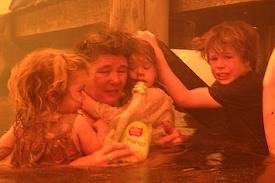
You’ve probably seen them too: the charred sheep, the family taking desperate shelter under a dock while ash and sparks fly around them, the huge red sandstorm wall looming over the ocean.

This is the push-back of Mother Earth.

There is only so far you can push her, and 2012 seems to have been the threshold beyond which there can be no further illusion of business as usual continuing.


Family in Tasmania seek shelter from wildfires

Family in Tasmania seek shelter from wildfires

Even some of the most hard-nose politicians are getting it now: I was heartened to hear Governor Andrew Cuomo of New York speak of the urgent need to plan for climate change disasters in his State of the State speech this week.

But he is still on the fence as far as fracking New York goes, which shows he has yet to fully put two and two together.

Two and two cannot equal two, Mr. Cuomo.

In other words, you can’t continue to expand the fossil fuel industry and not expect the blowback of climate change to worsen.

A lot of people are getting this now.

Not the ones who have their heads so deeply buried in the technology sands that all they can think about is the excitement of the next app, MOOC or tablet.

Not the ones who are riding the current stock market wave to scary new heights, buoyed by who knows what fictitious understanding of the relationships between real people and real goods—referred to in finance-speak as “market shares” and “bundled securities.”

Not the 1%, still sitting comfortably above it all, looking down on the disturbances below like vultures surveying the activities of scurrying mice.

But down here at ground level, people are starting to look at each other and know, even without speaking, not only that things are wrong, but that we cannot rely on others to make it right.

Wildfires are killing thousands of sheep in Australia

Wildfires are killing thousands of sheep in Australia

That can be the only explanation for the sudden groundswell of support for the Idle No More movement, which, just like Occupy, tapped into the resistance of ordinary people to the bulldozers of global capitalism, now coming to a forest or a farm field near you.

The lure of short-term gains has led many a politician, businessman, landowner or Native tribe down the daisy path of signing off on legislation and leases giving Big Fossil Fuel the right to do whatever the hell they want.

But we’re wising up now.

Toxic wastes from Texaco-Chevron are poisoning people and animals alike in Ecuador

Toxic wastes from Texaco-Chevron are poisoning people and animals alike in Ecuador

We look at the way Chevron left Ecuador when it was done extracting all the oil it could, and we listen to the story of how relentlessly their lawyers fought against giving even the least amount of their vast profits towards reparations for the toxic environment they created, and we know we could be next.

Now they’re coming right here in the Northeast—in the watersheds of New York and Pennsylvania, buying up those fallow farm fields and bringing in their huge fracking drills.

They’re down in Texas, building the first leg of the proposed transAmerican oil pipeline that will bring the dirty sludge of tar sands oil down to the Gulf of Mexico refineries, crossing over aquifers and farmland, by cities and pristine national parks.

And they’re up in Alberta with their giant bulldozers and dump trucks, razing the fragile boreal forest to get at the oozing tar underneath.

But in all these places, people are stirring.  People are rising in protest.  People are seeing that the short-term gains from these destructive fossil-fuel driven industries are going to quickly burn up, driving the stock market temporarily higher only to set up an even bigger crash in the future; keeping our homes warm and light today, only to set up bigger and worse climate-related disasters down the road.

Tree-sitters in Texas

Tree-sitters in Texas

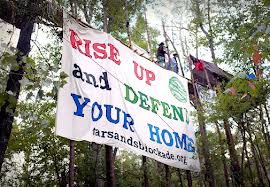
A few brave souls have been sitting in the trees in Texas to block the pipeline, a resistance strategy pioneered in the 1990s when Julia Butterfly Hill sat in Luna, a giant California redwood, for more than a year to keep the loggers from cutting her and her neighbors down.

The First Nations are on the march in Canada in a movement that is spreading like wildfire across the world, protesting the poisoning of the environment by the fat cats in boardrooms who arrogantly believe that they exist on another plane, a modern-day Mount Olympus that is impervious to the environmental destabilization they are wreaking on the world.

Students are rolling out an urgent campaign to get their college and university trustees to divest their portfolios from the fossil fuel industry.

Thanks to the World Wide Web, these efforts can be beamed across the globe instantly, refracted and amplified through the networks of hundreds of millions of kindred spirits worldwide.

The dissenting power of the many that Hannah Arendt wrote of back in the late 20th century has never been more powerful, in part because resistance can now take place virtually.

We don’t have to go out and brave the guns and tear-gas, although probably in the end it will have to come to that.

We can build our networks at home, working quietly but steadily until they are so big that to arrest us all would be, as Marx predicted, to undermine the capitalist structure itself—throw all the workers in jail, and who’s going to do the work?

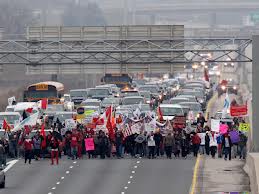
Idle No More protesters on Highway 401 in London, Ont., in December.  THE CANADIAN PRESS/Dave Chidley

Idle No More protesters on Highway 401 in London, Ont., in December.
THE CANADIAN PRESS/Dave Chidley

Right now all of these protest movements are disparate, each working on their own perceived goals.  What I hope to see in the coming year is more solidarity, more recognition that we’re all really fighting the same grand battle to keep our planet from being so devastated that it can no longer support life as we know it.

Life will continue on Earth, there is no doubt of that.  But whether humans, elephants, songbirds and frogs will be able to persist on a super-heated planet is quite uncertain.

It is imperative that we build an unstoppable grassroots movement to prevail on our elected representatives to represent the people rather than the corporations, and do what’s right.

How many catastrophic hurricanes, out-of-control wildfires, drought-stricken fields, bleached out corals will it take before we make use of our power as denizens of the world and say NO MORE?

images-1

Idle No More: Exposing the Suicidal Cult of Global Capitalism

Once again we are seeing how the democratic power of social media can thwart the efforts of the state political apparatus to keep the people in line.

This time it’s happening in Indian Country, beginning in northernmost Canada and spreading like wildfire through social media networks down south and out into the broader world.

The movement is called Idle No More, and it was started by a coalition of four indigenous and non-indigenous women from Saskatchewan—Sylvia McAdam, Jess Gordon, Nina Wilson and Sheelah Mclean—who decided last fall that enough was enough with the steady assault on the environment and protections for First Nations lands in Canada.

Idle No More Founders

Idle No More Founders

Taking specific aim at an omnibus bill in the Canadian Parliament, known as Bill C45, the women began teach-ins and protests around their homes in northern Canada.  Word spread quickly across North America and beyond via social media channels, and a global solidarity movement was born.

Idle No More protest in Toronto last month

Idle No More protest in Toronto last month

According to the Idle No More website, this is what happened:

 Bill C45 brings forward changes specifically to the Indian Act that will lower the threshold of community consent in the designation and surrender process of Indian Reserve Lands. 

Sheelah McLean reminds us that the bill is about everyone.  She says “the changes they are making to the environmental legislation is stunning in terms of the protections it will take away from the bodies of water – rivers and lakes, across the country.”  She further adds, “ how can we not all be concerned about that?”

The Idle No More efforts continued in Alberta with an informational meeting held at the Louis Bull Cree Nation.  The organizer for that event, Tanya Kappo, took to Twitter and Facebook to help generate awareness on the matter as the passage of Bill C45 was imminent. 

Kappo says, “the people in our communities had absolutely no idea what we were facing, no idea what plans Stephen Harper had in store for us.”  The events leading up to the National Day of Action have been focused on bringing awareness to people in First Nations communities and the rest of Canada. 

Jess Gordon says, “The essence of the work we are doing and have been doing will remain a grassroots effort, and will continue to give a forum to the voices of our people.”

When Bill C45 was brought to the House of Commons for a vote, First Nations leaders demonstrated that they are hearing these voices loud and clear.  They joined the efforts against Bill C 45 and went to Parliament Hill where they were invited into the House of Commons by the New Democratic Party. 

However, they were refused entry.  This refusal to allow First Nations leadership to respectfully enter the House of Commons triggered an even greater mobilization of First Nation people across the country. 

Nina Wilson says, “what we saw on Parliament Hill was a true reflection of what the outright disregard the Harper Government has towards First Nation people.”

With the passage of Bill C45, Idle No More has come to symbolize and be the platform to voice the refusal of First Nations people to be ignored any further by any other Canadian government.

Unknown

Yesterday I happened to catch a call-in program on the CBC (Canadian Broadcasting Co.) on the Idle No More protests, which have apparently taken most Canadians by surprise.  The host interviewed a representative of the Canadian environmental protection agency, and it was shameful to listen to the way he sputtered when asking whether the bill in question really would result in damaged waters and fisheries.

Although he refused to come out and say it, the short answer was clearly, “Yes.”

As always, for mainstream politicians and businessmen the lure of short-term profits outweighs longterm planning for the health and welfare of the planet and her denizens.

Some of the callers on the CBC program displayed evident racism in their attitudes towards the Native peoples behind the Idle No More protests, which have blockaded railways and highways in recent weeks, in an effort to gain the attention of the Canadian prime minister, Stephen Harper.

Attawapiskat Chief Theresa Spence

Attawapiskat Chief Theresa Spence

One Native Chief, Theresa Spence, has been on a hunger strike for nearly a month now, her immediate goal simply being an audience with Mr. Harper and a chance to present the First Nations case.  Harper has finally agreed to meet with Spence and other chiefs, on January 11, 2013, one month after she started her hunger strike.

Spence is a controversial figure in this movement, which began with a grassroots coalition and has displayed some reluctance to let the indigenous chiefs steal the thunder.

There have been rumors of corruption among the chiefs, including Spence herself, who has just now, conveniently enough, been subjected to a humiliating government audit of her finances.

It’s not clear whether all the chiefs are truly after the protection of the environment, or if they just want to have their fair share of the economic action when it comes to the rapid development of Canada’s northern territories.

What is clear is that the immense land and resource grab in the Americas, which began with the colonial conquests and has continued to the present day, provides short-term financial gains for the few—mostly non-indigenous corporations and financiers—while the majority of Native peoples languish in poverty, sitting on environmentally devastated lands.

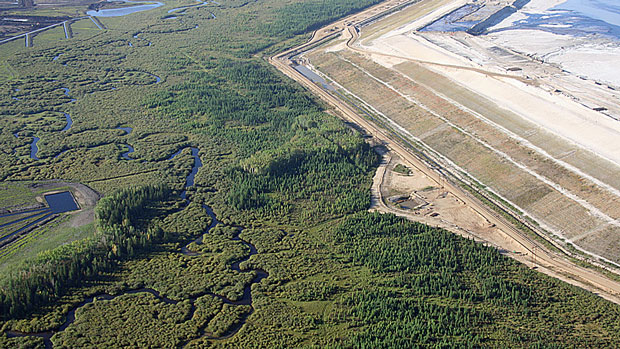
Aerial view of Alberta tar sands development, aka the destruction of the Alberta boreal forest. (Global Forest Watch Canada)

Aerial view of Alberta tar sands development, aka the destruction of the Alberta boreal forest. (Global Forest Watch Canada)

In case after case worldwide, rapacious corporations sweep in, negotiate favorable leases on the land, extract the resources and move on, leaving behind a toxic, degraded landscape and a broken people.

Now we have finally come to the time when it is becoming obvious that the damage that is being wreaked on people and their environments in specific parts of the world is not just “their own problem.”

As the founders of the Idle No More movement correctly perceived, if the waters of Canada are not protected, it will affect all Canadians, not just the First Nations folk who sit closest to those waterways.

If the boreal forests of northern Canada are razed, it will affect the entire planet, just as the steady destruction of the rainforests in the southern latitudes is inexorably destabilizing our climate worldwide.

It appears that our politicians only understand the language of dollars and cents.  In New York and New Jersey now, a serious discussion is underway about how to pay for the cost of adapting to the climate change that almost everyone sees now as inevitable.

Yes, we have to adapt, we have to mitigate the damage by changing the way we develop our coastlines.

But we also have to adapt our mindsets when it comes to “development of natural resources”—a green-washed euphemism for what has really been “the wholesale destruction of the planet.”

This is as true for the destruction of the boreal forests of Canada as it is for the fracking of the Marcellus Shale in the U.S.

If the real costs of this kind of destructive “development” were added up, no sane financier or politician would be able to support such a suicidal undertaking.

If our politicians and business leaders want to commit hari-kari by reckless short-term myopic thinking, good riddance to them.

But they have no right to take the rest of us along with them.

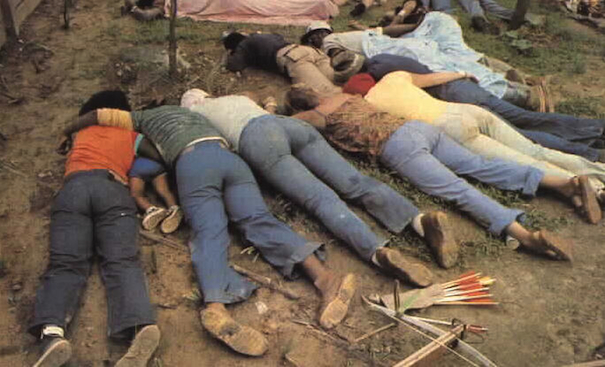
It reminds me of suicide cults like the infamous one in Jonestown, Guyana, in the 1970s.  A whole group of people was so taken in by the charismatic leadership of their guru, Jim Jones, that they obeyed his order to commit ritual suicide.

Victims of the Jonestown suicide cult

Victims of the Jonestown suicide cult

In our case, it’s the entire global capitalist leadership that has us all in thrall. We have been seduced, charmed and entranced by the siren call of “development,” which has given mainstream North Americans—the ones who agree to play by the rules—the benefits of a comfortable lifestyle.

The hidden underbelly of this lifestyle—the environmental destruction, the extermination of thousands of species annually, the annihilation of entire groups of indigenous peoples worldwide, the irrevocable destabilization of our climate—is now coming into view, thanks in large part to the democratization of the media through the World Wide Web.

I continue to believe that when ordinary, good-hearted people understand their own role in this planetary destruction, they will stand up and insist, like the four women who founded Idle No More, that enough is enough.

The question is, how far will we be willing to go to insist that our leaders respect our values and stop dragging us down the road to ruin?

How far will we have to go?

“Never doubt that a small group of thoughtful, committed citizens can change the world. Indeed, it is the only thing that ever has.”

–Margaret Mead