Dancing in the end times

And so here we find ourselves, finally, on the cusp of a great turning in solar time, the fabled 12-21-12.  It is a dark, wet, windy, wild morning here in the hills of western Massachusetts.

Since I started this blog back in the summer of 2011, with the optimistic URL “bethechange2012,” I have found many others who have beckoned to me like beacons of strength and inspiration on my somewhat lonely path of inquiry and discovery.

In the early days of Transition Times my own light was quite tentative and often overwhelmed with fear and distress, the product of my dawning realization of the tremendous gravity of the situation in which we find ourselves.

We cannot pretend to each other that the news is good for humanity, any more than for the rest of the living beings on the planet.

These are the transition times: the end of a long era of existence, as the ancient Mayan shamans rightly foresaw, and the beginning of something new.

I cannot and will not shy away from diving into the heart of the wreck that is our human civilization on this planet in the early 21st century.  Exposing what I find there is part of my mission with this blog.

However, it is also my purpose to be a channel and a beacon of hope for others who are searching for  meaning in these troubled times we live in.

We are all caught up in a vortex much greater than any individuals among us could produce, an accelerating forward surge that is hurtling humanity, and the planet we share with so many other life forms, towards a new era.

We cannot know what this means for each of us as individuals.  But I am coming to realize that the most important thing we can be doing in these transition times is to serve each other, and the other beings on the planet, as a form of shelter and anchor in the storm.

I will close with an image taken on one of my many thoughtful rambles over the past few months.  To me it represents the planet calling to me, and to all of us who love her, to continue to push back against the forces that would despoil and blight her.

The rocks, earth and waters of the Earth remind us that geological time is slow and very, very long.  Our dance on the planet as humans is so brief.  Let us enjoy our time here passionately, and turn our dancing to good works.

Benedict Pond, Monterey, November 2012

Benedict Pond, Monterey MA, November 2012

Telling the story of climate change: a call to action

You probably didn’t notice, but this past week another round of major international climate talks were held in Doha, Qatar, surely one of the least “green” locations on the globe.

The mainstream press barely bothered to give a nod to what has come to be a mind-numbing ritual of bait, switch and dodge.

The alternative press knew better than to look to the assembled ministers in Doha for any real news, focusing instead on the grim report released early last week by the Potsdam Institute for Climate Impact Research and Climate Analytics.

The 84-page report, titled “Turn Down the Heat” and funded by that radical fringe group known as the World Bank, demonstrates that if we continue our reckless heating of the planet at the present rate, all the scenarios of which readers of this blog are well aware—sea level rise, droughts and floods leading to severe food shortages, more frequent and more severe storms, loss of biodiversity and loss of human life on a biblical scale—will come to pass.

The executive summary of the report concludes with a measure of urgency:

“A 4C world is likely to be in which communities, cities and countries would experience severe disruptions, damage and dislocation, with many of these risks spread unequally.  It is likely that the poor will suffer most and the global community could become more fractured and unequal than today.  The projected 4C warming simply must not be allowed to occur–the heat must be turned down.  Only early, cooperative, international actions can make that happen.”

But this takes us in circular fashion back to Doha, where as we know, nothing substantive is going on.

Those of us who are aware of what’s happening on the climate front—and let’s face it, there aren’t that many of us, we probably form our own little 1% club—find it frustrating and frightening to have to sit by and watch as our beloved planet goes into drastic human-induced traumatic shock while our leaders bicker and fiddle and run down the clock.

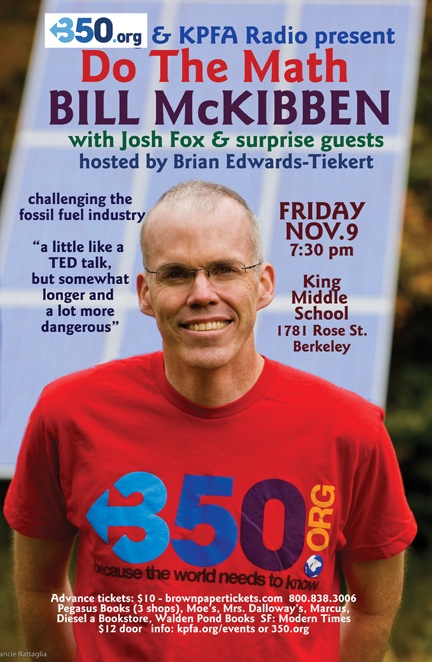
I find myself constantly pulled between A) wanting to support political efforts like Bill McKibben’s “Do the Math” tour, which aims to educate and inspire action (specifically, divestment from fossil fuel companies to pressure them to reinvent themselves as bonafide green energy companies) and B) wanting to simply hunker down and build resilience at the local level, perhaps enrolling myself and my sons in a crash course in how to survive a disaster.

For the moment, I am focusing on doing what I can within my purview as a teacher to help the upcoming generation of young adults get a handle on what’s happening to our climate, and do their own productive thinking about how to engage in the struggle to turn things around.

Yesterday I was fortunate to have had a chance to participate in a small way in my colleague Eban Goodstein’s C2C Fellows Workshop, a national program based at Bard College that seeks to give young people the skills and understanding to become successful leaders in the global effort to stabilize our climate and create a sustainable economy.
Eban Goodstein

Eban Goodstein

This is an ambitious undertaking, and Goodstein is going at it full tilt, holding weekend workshops several times a year at college campuses across the country, and bringing graduate students to Bard, with generous funding, to undertake Master’s degree programs in environmental policy with a special emphasis on climate-related policy and advocacy.

As Goodstein puts it, “Stabilizing the climate is not the work of a year, of a presidential term, or of a decade. It is the work of a generation.”

I see it as an essential commitment and responsibility to use my skills as a writer, scholar and teacher to help equip the upcoming generation for this great work we must all undertake now.

Goodstein is a unique blend of science policy wonk and communications guru, and I’m convinced that it’s at this very nexus that real change on the climate front will be forged.

All the dire scientific reports in the world won’t get people to wake up and change their daily habits, or insist that policy changes are made at the local, state, national and international levels, if the information is not presented in clear, compelling language.

A significant portion of the C2C Workshop, therefore, is spent in developing students’ storytelling skills.

It was interesting, and somewhat disheartening, to watch the students’ puzzled reaction when asked by Goodstein to talk about a favorite storyteller in their family.  Very few hands went up.

This is because most Americans today are reared listening to the TV tell us stories, not cherished individuals in our actual lives.  We are avid but passive consumers of prepackaged stories, and as a result most of us—unless we have the ambition to become stand-up comedians—don’t see storytelling as a skill we need to master.

Goodstein’s important insight is that storytelling is key to getting people’s attention, and telling a good story is essential to success in environmental advocacy and politics.

Good persuasive communication, he said, starts with a personal story, and then moves into the political.  Hook your audience with a personal anecdote, keep their attention with a strong narrative, and then finish up with a call to action.  And once you’ve got a strong story developed, practice telling it, over and over again, until you can do it in your sleep.

Armed with this advice, the group of some 80 students broke into smaller groups of five, each accompanied by a faculty or graduate student facilitator, for a two-hour intensive storytelling workshop.  Our task was to each come up with a short story about an inspiring person or event, write it up and tell it three times, to three different partners, then refine it and tell it again to the whole group.

The stories would be refined further the next day, told again to new audiences, and several would be singled out for telling to the entire big group, and given awards.

This is the kind of work for which I have been preparing my whole life.  There is nothing I would rather do than facilitate a writing workshop on inspiring stories!  And it gives me special joy to do it as part of a program aimed at giving young people the skills and mojo to tell the climate change story in a way that galvanizes action.

It may be that in the end, I would have been better served by spending my time learning survival tactics in the woods, but the truth is that even in the most dire circumstances, human beings have always needed their storytellers.  A good story well told can keep us warm in ways that may not be measurable, but that are profound nevertheless.

Here is the story that I wrote and told the students yesterday in our workshop.  I offered it to them—and now to you—with love and an earnest desire that it may inspire us all to each get to work on the climate change issue—in our own ways and spheres—before it’s too late.

My friend Pauline tells the story of how she came home from work one day and discovered that a civil war had started in her country, Congo-Brazzaville.  Suddenly she had ten people, mostly women and children, sheltering in her house as gunfire and bombs shook the streets of the city. 

When a bomb hit the house, she and her family and friends knew they needed to make a run for it.  They gathered what food and supplies they could carry, and left the house in the middle of the night, heading for the countryside. 

What followed was weeks of deprivation and terror as they huddled in the forest waiting for the conflict to die down so that it would be safe to return home.

I tell this story because it is emblematic of the many stories I have studied over the years, in which women and children are disproportionately affected as victims of social conflict and war. 

I tell it because I fear that in the age of climate change this is a story that will be repeated over and over again. Whether the violence is human—men with guns—or natural—hurricanes or droughts—the effects will be the same: women and children on the run, vulnerable and afraid.

Recent studies indicate that hundreds of millions of people will become climate refugees in the next half-century.  And they won’t all be in Bangladesh or the Maldives, either.  Just ask a former resident of Breezy Point in New York City, devastated by Hurricane Sandy, how it feels.

In our lifetimes we will all witness–and many of us will likely experience—the kind of fear and hardship that Pauline lived through, when the social order disintegrated and violence became the norm. 

There are many, many guns in America.  It would not take much in the way of food and energy shortages to trigger violence.

Sometimes I find myself wondering whether I should be learning and then teaching others survival skills, instead of critical thinking and writing. 

What good will my PhD in literature do me in an age of relentless, recurring Hurricane Sandys?  What good will a vaunted college degree do my students?

But I do continue to believe that the stories of survivors like Pauline matter, and increasingly these are the stories I offer students in my classes on human rights, environmental justice, politics and literature.

We all need to learn from Pauline and other survivors about the amazing resilience of the human spirit.  Even in the face of terror and chaos, people can choose to be compassionate, generous and respectful of one another. We don’t all choose the violent path. 

It will not help any of us to focus on fear right now, as the climate change crisis gains momentum and threatens to engulf us.  What we must concentrate on instead is hope, resilience and solidarity.  That’s what the world needs from us now.

Honoring the wisdom of Native Americans on Thanksgiving

Before I understood the real history behind the American tradition of Thanksgiving, I used to just innocently enjoy the chance to gather with family and friends to share a delicious meal.

I believed the story taught to me in grade school, about how the Pilgrims and their Native hosts sat down to a feast together, and lived happily ever after.

Such innocence, once lost, is impossible to recapture.

Now I know that the same Pilgrims who gave thanks for their delivery from starvation by the generous Native people of the region that would come to be known as New England would be the ones to turn on their benefactors and do their utmost to exterminate them.

My own ancestors were still fighting their own battles back in Europe at this time, but as an American, this is a shameful legacy that I need to confront and acknowledge.

As I wrote in my Thanksgiving post last year, the holiday of Thanksgiving should really be more of a day of atonement than a celebration of abundance, especially as we begin to realize that the abundance of food and natural resources that Americans have enjoyed over the past 500 years is not endless.

As we hit up against the limits to growth predicted years ago by Donella Meadows and others, we must recognize that the Native peoples who were so unceremoniously shoved aside during the Conquest of the Americas had so much more to offer Europeans than corn, squash, beans and turkey.

Indigenous worldviews, the world over, privilege balance over growth and accumulation, and this is the wisdom we need to pay attention to now.

Some argue that such a conservative position would not support the kind of technological innovation in which Europeans have excelled.

But I would ask whether our technological innovations have succeeded in making us happy as a culture, or as individuals within our culture?

Isn’t it true that the vast majority of our technological inventions have been used to foment and practice ever-more violent warfare?

Even our vaunted advances in medicine are primarily used, these days, to try to heal us from the sicknesses and imbalances our own technological inventions have afflicted upon us, by the poisoning of our food, air, water and earth with toxic chemicals and the byproducts of burning fossil fuels.

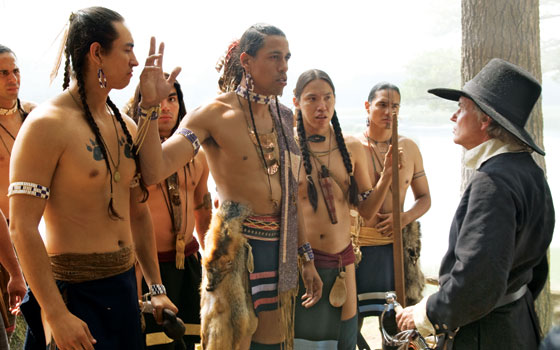
This image, from the PBS series “American Experience,” depicts members of the Wampanoag tribe meeting a white settler.

Before the Pilgrims landed in Massachusetts and started their inexorable push west, the indigenous people living here were happy, healthy, strong and long-lived.  They enjoyed the abundant food stocks of the ocean, rivers and forests, and lived in harmony with the land.

Yes, there were territorial skirmishes, but there were also strong intertribal councils and confederations, in many cases led by matriarchs who valued peace and did not want to lose their sons and grandsons to needless warfare.

This Thanksgiving, I give thanks that the Native peoples of this continent are still with us, despite all the brutality visited upon them by the European conquerors.

This Thanksgiving, I pray that all Americans begin to honor indigenous people as they deserve to be honored, by giving credence to the Native value of harmony with the Earth, and actually trying to live it.

The Audacity of Hope, c. 2012

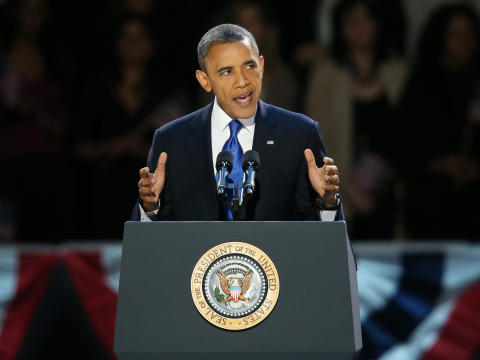
For those of us who supported President Obama, the last 24 hours or so have been positively giddy.

There were the nail-biting first few hours of the election results…followed by the glad tidings of more and more of the big electoral states turning a glorious blue…capped by the wonderful thrill of seeing the President stride out onto the stage in Chicago to give the most rousing acceptance speech most of us have ever heard.

What a big heart this man has, to include in his acceptance speech itself the invitation to his opponents to meet him in the aisle and try to seek common ground!

In the very first words of his speech, before he even thanked his running mate, he reached out to Mitt Romney, offering to work with him to move the country forward onto a better, firmer footing:

I just spoke with Governor Romney and I congratulated him and Paul Ryan on a hard-fought campaign. 

We may have battled fiercely, but it’s only because we love this country deeply and we care so strongly about its future. From George to Lenore to their son Mitt, the Romney family has chosen to give back to America through public service and that is the legacy that we honor and applaud tonight.

In the weeks ahead, I also look forward to sitting down with Governor Romney to talk about where we can work together to move this country forward.

And then, towards the end of the speech, he said so memorably:

America, I believe we can build on the progress we’ve made and continue to fight for new jobs and new opportunity and new security for the middle class. I believe we can keep the promise of our founders, the idea that if you’re willing to work hard, it doesn’t matter who you are or where you come from or what you look like or where you love. It doesn’t matter whether you’re black or white or Hispanic or Asian or Native American or young or old or rich or poor, able, disabled, gay or straight, you can make it here in America if you’re willing to try.

I believe we can seize this future together because we are not as divided as our politics suggests. We’re not as cynical as the pundits believe. We are greater than the sum of our individual ambitions, and we remain more than a collection of red states and blue states. We are and forever will be the United States of America.

This audacity of optimism is why we elected Barack Obama back in 2008, and why we continue to love him.

Whatever his personal or political failings, Barack Obama stands for the best hope of the USA: the raw immigrant passion and drive that founded this country and still makes it great.

He also represents, in his very skin, the polyglot future of the USA, the inexorable movement away from the European aristocracy of our founders to the broad multicultural diversity of our descendants.

Mitt Romney’s concession speech 2012

The Republicans are still stuck back in the good old days of the good old guys’ party.  As one commentator aptly noted, Republican political rallies look suspiciously like Ku Klux Klan rallies of the early 20th century.

For those who might rather not recall, let us remember that the Klan not only hated and lynched African Americans; they also hated and lynched Jews.  And they didn’t liked the Irish or the Italians much either!

Let’s not even talk about gay folk.  And women?  For the Klan and many contemporary conservatives, they belong in the kitchen or in the bed.

This is not the country we want to be as we move into the 21st century.

Although I thought the Obama campaign’s slogan “Forward, not back” was a little hokey when I heard it trotted out at various rallies, it does have the ring of truth to it.

We do not want to go back to the intolerance and violent hatred of our past.

We need to move forward, and we will need all hands on deck to confront the deeply unstable, uncertain future that awaits us in the age of climate change.

I want to see Barack Obama rise to the challenges of our time with all the power of his big heart.

I want to see him not just think about jobs, but think about green jobs, about jobs that will move our country forward into a longterm, sustainable future.

Enough kow-towing to Big Oil, Big Agriculture and Big Chemical.  It’s time to force these industries to bend to the winds of change, to adapt to the new paradigm of sustainability sweeping our country and our planet.

I applaud Bill McKibben for waiting until the election was over to come out swinging—and I applaud his continuing efforts to get the climate change issue into the center of political discourse.

Those who are still suffering from the after-effects of Hurricane Sandy, along with their insurers, should be his best allies.

We need to face the truth that all the matters of social justice that concern us will be moot if we don’t face the pressing need to get our planetary civilization onto a sustainable footing.

We need to convince our President of this, post-haste.

But let’s take a moment to breathe a big sigh of relief that it is Barack Obama we’re dealing with, and not Mitt Romney!

This election proves that Big Money is not infallible.

Democracy still matters; individual votes still matter; as a country, we are not as corrupt as many of us feared.

Now is the time for all of us to embrace the President’s big heart and let it reach out even further to encompass our entire beautiful planet and all of her creatures.

This is the task we humans were born to undertake: to become the thoughtful, compassionate stewards of our planet, and the collaborative leaders of our own multifarious tribes.

It is so good to see more and more women stepping up to the plate now.  We are sorely needed, but we can’t do it alone.

Men and women of all heritages must work together as never before to reestablish the equilibrium needed to move our civilization forward sustainably into the 21st century.

These are not just words.  This is our urgent reality.

Barack Obama has answered the call.

Will you?

Will Frankenstorms Become the New Normal?

Yesterday’s images of the NY Stock Exchange with sandbags at the front doors, or cars floating by on Wall Street, were not taken from the latest science fiction disaster movie, not this time.

This time they were real.  And next time the storm could be worse.

But despite all the dramatic headlines declaring Hurricane Sandy the worst storm to hit the East Coast in human memory, there has been barely a whisper of climate change in any of the top weather-related news stories.

I was hoping that Sandy would prove to be a big wake-up call for the privileged denizens of the East Coast, many of whom hold influential positions in business, finance and government.

But instead of people acknowledging the climate elephant in the room and starting to talk about proactive steps we can take to avoid such scenarios in the future, they are just following the usual reactionary script: marshalling disaster relief, urging the citizenry to donate to the American Red Cross, assessing the cost of the clean-up and how long it will take to put Humpty back together again.

A storm like Sandy—or Irene, or Katrina—should prompt reflections on the awesome power of natural forces, and the puniness of human structures.

Take our power away and we are suddenly rocketed back into the early 19th century.  Take our food supplies away, and we become an angry mob in no time.  Do it on a scale that impacts millions of people all living crowded together, and you have a recipe for unprecedented horror.

This is not a pitch for the next action thriller film, and it’s not idle chatter.  These are the kinds of scenarios our governors and national leaders were worrying about yesterday when they authorized the shutting down of mass transit, schools and businesses.

We were lucky this time.  Sandy weakened as she came ashore and the damage, while serious, is manageable.

What we know is that with each passing month and year of inaction on global heating, the storms will become more frequent and more intense.  In the years to come, we will look back on Sandy as child’s play, just a warning of what is yet to come.

What should we be doing now, as individuals, as a nation, and as a global human community?

  • We should be starting a massive shift to renewable, clean energy sources.  And I’m not talking about “clean coal.”  Wind, solar, geothermal, tidal—these are the sources that can safely feed our energy addiction, without driving our climate into ruin.
  • We should be shifting away from cars and highways to trains and mass transit.  Bicycles, too.  And we should embrace the shift to online commerce and education, to avoid the need for a great portion of the horrendous morning commute.
  • We should start a concerted effort, especially in densely populated areas like the northeast corridor, to bury the power lines.  Tangled mats of downed overhead wires should become a thing of the past, and quickly.  We need to become much more resilient at surviving big storms, and our electric grid is a 19th century anachronism in need of immediate upgrade to the 21st century.
  • We need to start a serious citizens’ movement to resist the tripartite junta of the fossil fuel industry, Big Agriculture and Big Chemical.  These three industries must be held accountable for the tremendous destruction they are wreaking on our environment, and on us as individuals.  I’d like to see Big Insurance take our side in this battle; I am sure they’re getting tired of always being stuck holding the bill when the next disaster strikes….

These storms are not random events.  They are getting bigger and closer together and less predictable.  The hotter the climate, the more the ice melts at the poles, the more freakish our weather will become—except that freakish is going to be our new normal.

It’s time to stop the denial, stop allowing ourselves to be distracted from the very serious questions that face us now.

It boils down to this: are we going to leave a livable Earth to our children and grandchildren?  Or are we going to go down in history (if there are any left to carry history forward) as the most criminal generation of all time?

Earth to Obama: Come in please! Or do we have to take to the trees to get your attention?

Of course I knew it would be too much to expect President Obama, during the second Presidential debate on Tuesday, to actually break the great taboo of contemporary American politics and mention—Shhhh—climate change.

But I didn’t expect him to come out pandering so shamelessly to Big Fossil Fuel.

Yes, he managed to create a mild distinction between his position and his opponent’s.

Romney is 100% for exploiting fossil fuels as fast as we can possibly get them up out of the ground.

Obama, on the other hand, is 100% for exploiting fossil fuels as fast as we can possibly get them up out of the ground.

And oh yeah, he’s not against throwing a little money at solar, wind and biofuels (let’s not even talk about how destructive existing biofuels like ethanol have actually been on multiple levels—let’s give the guy a break).

While Romney just wants to hammer home the assertion that his Administration will bring us lower gas prices (no doubt as a result of all the frantic drilling he intends to support), Obama is interested in encouraging conservation by raising fuel economy standards, an idea right out of the late 1970s if I ever heard one.

A 21st century idea would be to get rid of oil subsidies and insist that the price of gas and oil reflect the true costs of its production and consumption, which are actually way higher than whatever the current price of a gallon of crude might be.

Then there’s coal, which both of these guys are apparently in favor of continuing to exploit.  Did someone say “mountaintop removal”?  Just point Romney/Obama at the mountain, and let’s go!

The nadir of the whole energy discussion of the second Presidential debate came when, in response to a little goading from Romney, Obama said he was “all for pipelines.”

In nearly the same breath, he proudly proclaimed that his Administration has supported lots of oil and gas drilling on public lands—how many leases, and what percentage of increase or decrease they may represent from the Bush years, may be a bit fuzzy, but the gist is clear: both Romney and Obama are all for opening up our public lands to drilling, in the name of energy independence from foreign fuel sources.

Oh Lord. The truth is that our dependence on so-called foreign fuel suppliers (who are mostly multinational corporations anyway) is the least of our worries.

The one thing we most need to be focusing on is the one thing that no one wants to deal with at all.

The effect of global heating, caused by the ever-escalating burning of fossil fuels worldwide.

And instead of working soberly and swiftly to turn the climate juggernaut around, our politicians are acting like easy-going traffic cops, just waving those bulldozers and oil rigs right on through.

***

Take the Keystone pipeline, which both Romney and Obama were unabashed in supporting.

Did you know that right at this moment, there are dedicated Earth defenders sitting in trees in Texas, trying to block the construction of the southern leg of the Keystone XL Pipeline?

Daryl Hannah at Keystone XL Pipeline protest, October 2012

Why?

Well, you probably realize that the bitumen that pipeline is designed to carry is so thick and sludgy that it has to be mixed with toxic chemicals in order to make it flow.

You’ve probably heard about the damage that could be caused by a spill from a pipeline like this, if the chemicals leaked into the major aquifers that are along the way.

This on top of the destruction of the forests that is already happening on a vast scale to get those “tar sands” out.

On top of the chemical contamination of our aquifers from hydro-fracking for gas.

On top of mountain-top removal and strip-mining for coal.

On top of the whole lousy cap and trade system, by which dirty Northern-hemisphere commercial polluters can continue to pollute as long as they buy credits in Southern hemisphere forest preserves—except that what’s actually been happening is that first they buy the preserves, then they log them, then they replant with palm oil trees, heavily sprayed with pesticide, herbicide and fungicide to keep the rainforest from returning, and then they proudly collect their credits for having maintained some semblance of soylent green!

All this is the reality behind the puffery that passed for politics at the debate last night.

What is our national energy policy?  For both the Republicans and the Democrats, it’s drill faster!  Drill harder!  Drill everywhere possible!

President Obama chided his opponent at one point for thinking only of short-term prospects.

“We have to think about what’s coming in 10, 20, 30 years,” he said, the implication being that we shouldn’t entirely neglect the prospects of wind and solar energy.

But the truth is that if we continue drilling at the rate both candidates support, there won’t be a stable environment left to build an alternative energy future for our grandchildren and future generations.

They won’t be building wind turbines and solar panels in 2050, they’ll be building underground shelters and modern-day Noah’s arks.

***

Still, yes, I am going to go grumbling to the polls on Nov. 6 and pull the lever for Obama.  There is no question in my mind that he is the better man.

I understand that right now he is trying to walk the centrist line and please as many American constituencies as he can.

But once re-elected, he must be pushed to take a stronger stand on environmental policy, including energy policy.

If that means that more of us have to take to the trees in protest, well, so be it.  I always did love climbing trees!

Will the Eagle and the Condor Land Together in the New Millennium?

At the Peace and Justice Studies Association annual conference, held this week at Tufts University with the theme “Anticipating Climate Disruption: Sustaining Justice, Greening Peace,” I presented a paper entitled “Changing the narrative and crafting alliances between Western and indigenous worldviews to create a sustainable global future.”

In it, I sketched out the standard Western triumphalist narrative of technological domination of Nature and the New World, starting with the voyages of Columbus and Darwin, continuing with the Manifest Destiny doctrine of the takeover of North America, and on into the present, where we continue to tell ourselves the story of living happily ever after in the brave new world established by the subduing and harnessing of the natural world, the routing of resistance, and the triumph of a technologically advanced global civilization.

Given that the premise of the conference theme anticipates serious climate disruption that will take the story to a very different, and much less rosy kind of conclusion, it’s clear that we need to start telling ourselves stories that reflect a different kind of understanding of our relation as humans to the natural world.

The kinds of stories we need to embrace are not new; in fact, they are ancient. I believe that the indigenous peoples left on the planet, who have survived the intense onslaught of Western culture over the past 500 years, are in the best position to survive the coming cataclysms, and to teach us how we can survive too. We just need to start listening to the stories they tell, rather than remaining spellbound by our own Western narratives.

I shared with the audience the voices and visions of two indigenous elders, Rigoberta Menchu Tum of Guatemala and Malidoma Some of Burkina Faso, who have both spent much of their adult lives reaching out to Westerners, trying to get us to see our relation to the natural world in a more holistic, less destructive way.

Rigoberta Menchu

Menchu, who won the Nobel Peace Prize in 1992 and ran for President of Guatemala in 2007, was a leader in the pan-indigenous drive to get the Declaration of the Rights of Indigenous Peoples ratified by the General Assembly of the United Nations, which it finally was in 2007.  She has worked tirelessly to promote the rights and improve the living conditions of the indigenous peoples in Guatemala, who are a majority in that country, but have little national political representation or power.

Central to Menchu’s political activism is her Mayan understanding of the importance of ecological balance.  “An indigenous people’s cosmovision is centered on their relationship with Mother Earth and Mother Nature,” Menchu says.  “In contrast, the majority of the world doesn’t give it a thought, doesn’t know what the source of life is.  They pollute the earth and do more and more damage.  One day the earth will exact a price for this disdain and destruction. When this happens, we will see that the earth is not just good and bountiful, it can also be vengeful.

“Indigenous people see Nature as a living mother, not as an inert organism that would allow itself to be destroyed,” she continues.  “All those who violate its laws must accept the consequences, because it is alive and will react. My grandfather always used to say that the day human beings violate our universe, they will receive signs and messages.  These messages will be very forceful, and will bring severe punishment.”

These words of Menchu’s come from her second book, Crossing Borders, in which she tried to reach out to the non-indigenous world with a challenge to the dominant narrative of “development,” which has been so terribly damaging not only to indigenous peoples, but to the ecological web of life itself. As she remarks bitterly in the book, “I often wonder why people criticize the Aztecs for offering human sacrifices to their gods while they never mention how many sons of this America…have been sacrificed over the past 500 years to the god Capital.”

These biting words would no doubt resonate with Dagara shaman Malidoma Somé, who was taken as a child by Catholic missionaries to be educated at their school some hundred miles from his village, and was not allowed to go home to visit his family or village for 20 years.

Malidoma Some

On the point of being sent to France to finish his Catholic education, he rebelled and ran away from the missionary school, somehow finding his way back to his village on foot, unaided.  Once there, he insisted that he be given the initiation he had missed out on, and he started on the path to becoming a traditional shaman, or healer.

His healing practice has taken the form of trying to reconnect Westerners with the indigenous knowledge that our culture long ago left behind and rejected as “primitive.”  Malidoma, whose name means  “he who makes friends with the stranger/enemy,” spends much of his time in the U.S. and traveling around the world, guiding groups of Westerners into a different kind of understanding of self, community, and natural world.

Both Menchu and Malidoma stress that they do not reject all of Western technology —just the way it has been used, and the narrative vision that guides and undergirds it.  “What indigenous and Western peoples have in common is the desire to understand the intricacies and complexities of the world we live in, and to harness the power of nature for certain practical purposes,” Malidoma says in his book The Healing Wisdom of Africa.

“Where we have taken different routes, however, is the context within which we have developed our technologies and the purposes for which we have used them.  In the West, technology is oriented toward industrial, commercial and military uses; among indigenous people, it serves to heal and help people remember and fulfill their purpose in life.”

Malidoma continues, “Individuals, as extensions of Spirit, come into the world with a purpose. At its core, the purpose of an individual is to bring beauty, harmony and communion to Earth.  Individuals live out their purpose through their work.  Thus the human work of maintaining the world, to indigenous people, is an extension of the work that Spirit does to maintain the pulse of nature.  The villager’s quest for wholeness is an extension of nature’s wholeness.”

Both Malidoma and Menchu describe a human relationship to the earth rooted not in dominion and conquest, but in a cyclical give and take that takes ecological balance as a core value.

I believe that theirs is the vision that must animate the narrative arc of our future as a species on the planet, if we are to survive the environmental challenges that are speeding towards us now.

The good news is that though you won’t find much about this in the mainstream media, there is a quiet but forceful movement building on several fronts that is heeding the call to craft a different kind of human life story.

There is the Transition Town movement, which is imagining communities that are less dependent on multinational corporations, and more interdependent as individuals and cooperatives working together to meet needs on the local level.  And there is the Pachamama Alliance, which I talked about in my Tufts presentation, which has been partnering with indigenous peoples to, as they put it, “change the dream” of Western-style domination, development and destruction.

The Pachamama Alliance is quite remarkable in that it sees itself as a solidarity movement guided by its indigenous partners, the Achuar and Shuar peoples of the Amazon rainforest in Ecuador.  It grew out of the connection with indigenous shamans established by John Perkins, who began in the 1990s to bring small groups of Americans and Europeans into the Andes and the rainforest to meet with indigenous shamans to learn a different way of understanding our relationship to the natural world.

Ecuador is one of the most beautiful places on earth, but is also one of the places that has been most devastated by the plundering of oil companies, specifically Texaco and Chevron.  Millions of acres of rainforest have been polluted by oil spills and the byproducts of unregulated drilling—and a landmark case has just been won against Chevron, ordering the company to pay $18 billion in damages to Ecuador for a clean-up.  The case is still in litigation, and meanwhile the people there are coming down with cancers and birth defects in astronomical numbers.  It is truly a place where you can see the worst conclusion of the Western narrative of development in action.

But it is also a place where another story is being told, and broadcast out into the world with increasing urgency.  It is a story that has been told by indigenous peoples of South America and beyond for hundreds of years.

According to the ancient prophecy of the Eagle and the Condor, which animates the work of the Pachamama Alliance, we are at a moment in history when the Eagle – representing intellect and the mind – and the Condor – representing wisdom and the heart – must come together to ensure the continued existence of humankind.

The human intellect and heart must realize that without the natural world we are nothing.  All the computers and synthetic chemicals and megawatts of electricity in the world will not enable us to survive in a world without plants and insects and animals.

It is that simple, and we know it scientifically, but we have not yet absorbed it in our hearts, and put our knowledge into practice in a different way of relating to the natural world.

So the question going forward, as Menchu so pointedly asked, is:

Will we sacrifice ourselves and most of the life forms currently on the planet to the great god Capital?

Or will we begin to understand wealth in a more balanced, ecologically sound way?

Will we have the strength to build a groundswell of resistance to the top-down hierarchies that hold such sway over our lives and the narratives we live by?

I believe we can do it.  I want to believe that we will.

All that solid melts in air: Labor Day reflections on Marx, Darwin and the need for new paradigms

As always around Labor Day, I am getting ready to talk with young people about some old, dead people: Darwin, Marx, Nietzsche, Freud, all of whom loom large in the curriculum of the General Education seminar required of sophomores at my college.

Rereading Darwin and Marx, who we’ll be discussing this week, it’s not hard at all to find ways to make these old thinkers, whose ideas are more than 100 years old now, relevant for our times.

Darwin

Darwin believed that life is a constant battle for limited resources, with the “struggle for existence” being entirely material, rather than spiritual.  When a dominant species overruns a weaker species, it is always for the best:

“It may be said that natural selection is daily and hourly scrutinizing, throughout the world, every variation, even the slightest; rejecting that which is bad, preserving and adding up that which is good; silently and insensibly working, whenever and wherever opportunity offers, at the improvement of each organic being in relation to its organic and inorganic conditions of life.”

He believed that humans are the highest, most important species, and that within the species men are higher than women, and white-skinned, “civilized” people are better than dark-skinned “savages.”  And implicit in his theory of natural selection is the ideology of Manifest Destiny: that strong, rich people got that way because they were “better” than poor, weak people.

It’s the logic that paved the way for the ruthless capitalist paradigm that presided over the industrial revolution of the late 19th and 20th centuries, along with the relentless search for new markets and new sources of raw materials: colonialism, imperialism, globalization.

Marx

Writing back in the mid-19th century, Marx was incredibly prescient.  His description, in “The Communist Manifesto,” of the process of colonial globalization could have been written last week:

The bourgeoisie has through its exploitation of the world market given a cosmopolitan character to production and consumption in every country…. All old-established national industries have been destroyed or are daily being destroyed. They are dislodged by new industries, whose introduction becomes a life and death question for all civilized nations, by industries that no longer work up indigenous raw material, but raw material drawn from the remotest zones; industries whose products are consumed, not only at home, but in every quarter of the globe. In place of the old wants, satisfied by the production of the country, we find new wants, requiring for their satisfaction the products of distant lands and climes. In place of the old local and national seclusion and self-sufficiency, we have intercourse in every direction, universal inter-dependence of nations. And as in material, so also in intellectual production. The intellectual creations of individual nations become common property. National one-sidedness and narrow-mindedness become more and more impossible, and from the numerous national and local literatures, there arises a world literature.

This actually doesn’t sound like much of a critique—Marx describes the positive side of capitalist globalization first.  But then he shows, with remarkable foresight, how the capitalists are unable to control the economic system they have created:

Modern bourgeois society, with its relations of production, of exchange and of property, a society that has conjured up such gigantic means of production and of exchange, is like the sorcerer who is no longer able to control the powers of the nether world whom he has called up by his spells….It is enough to mention the commercial crises that by their periodical return put the existence of the entire bourgeois society on its trial, each time more threateningly. In these crises, a great part not only of the existing products, but also of the previously created productive forces, are periodically destroyed. In these crises, there breaks out an epidemic that, in all earlier epochs, would have seemed an absurdity — the epidemic of over-production. Society suddenly finds itself put back into a state of momentary barbarism; it appears as if a famine, a universal war of devastation, had cut off the supply of every means of subsistence; industry and commerce seem to be destroyed; and why? Because there is too much civilization, too much means of subsistence, too much industry, too much commerce. The productive forces at the disposal of society no longer tend to further the development of the conditions of bourgeois property; on the contrary, they have become too powerful for these conditions, by which they are fettered, and so soon as they overcome these fetters, they bring disorder into the whole of bourgeois society, endanger the existence of bourgeois property. The conditions of bourgeois society are too narrow to comprise the wealth created by them. And how does the bourgeoisie get over these crises? On the one hand by enforced destruction of a mass of productive forces; on the other, by the conquest of new markets, and by the more thorough exploitation of the old ones. That is to say, by paving the way for more extensive and more destructive crises, and by diminishing the means whereby crises are prevented.

We have just lived through one of these episodic crises that Marx is talking about here—the bursting of the housing bubble, and the broad financial crisis that was generated by an over-reliance on debt.

The “enforced destruction of a mass of productive forces” is a nice way of saying “war”; and indeed, our adventures in Iraq and Afghanistan have kept the military-industrial complex humming, along with companies like Halliburton that snapped up all the rebuilding contracts.

Marx believed that the capitalist system would fail because it is structurally unable to support the needs of the masses.  It is built on inequality—on the Darwinian framework of the “struggle for existence” where might makes right, the strong survive and the weak perish, and the spoils of industry are concentrated tightly in the hands of a small dominant class, the bourgeoisie.

The modern laborer… instead of rising with the process of industry, sinks deeper and deeper below the conditions of existence of his own class. He becomes a pauper, and pauperism develops more rapidly than population and wealth. And here it becomes evident, that the bourgeoisie is unfit any longer to be the ruling class in society, and to impose its conditions of existence upon society as an over-riding law. It is unfit to rule because it is incompetent to assure an existence to its slave within his slavery, because it cannot help letting him sink into such a state that it has to feed him, instead of being fed by him. Society can no longer live under this bourgeoisie, in other words, its existence is no longer compatible with society.

Marx thought it inevitable that the middle class would sink into the proletariat as wealth became more and more concentrated in the hands of the few capitalists controlling government and industry.  And the proletariat, having nothing left to lose, would eventually rise up and seize power, overthrowing the capitalist system and instituting a new economic system, more truly “by the people, for the people.”

However, Marx was still a prisoner of his time as regards his understanding of humans’ relation to our natural environment.  He was not able to foresee that industrial growth, whether under the leadership of the bourgeoisie or the proletariat, would bump up against the carrying capacity of the planet, providing a natural (in Darwin’s terms) limit to growth.

Darwin would look out at what’s happening to our planet today, in the age of climate change, and see it quite dispassionately, as part of the process of natural selection. People in low-lying areas will have to migrate or die. We will figure out ways to adapt to our new climate reality, or we will be swept away.  The strong will survive, the weak will perish.

Marx, on the other hand, would be ranting about how the bourgeoisie have, in his own words, “dug their own graves,” and taken everyone along with them.  He would be calling for the international proletariat to rise up and fight for a better social system, in which labor is rewarded with well-being and the profits circulate among the many, rather than being concentrated in the hands of the few at the top.

We know with the power of hindsight that no Communist system has ever actually been successful at making people happy.

This is because the old hierarchical structures that have pervaded human civilizations for thousands of years still tend to creep back, no matter what name we give our socio-economic structure.

The challenge of our time is to envision a social structure that is horizontal, circular and interdependent, rather than vertical, linear and unidirectional.

A social structure in a harmonious give and take with the natural world, rather than one that only takes and takes to feed the maw of human industry.

Darwin may be right that the strong will survive and the weak will perish, but our concept of strength needs to change to meet our new reality.

Strength is not about domination and the ability to force others to bend, it is about cooperation and the ability to bring people and the natural world into productive harmony.

Black Elk

What we need now is a renaissance of indigenous tribal social systems, based on reverence for the natural world, and respect for one another.

Those people Darwin dismissed as “savages” may turn out to be the only ones who are able to survive in our new planetary epoch, as “All that is solid melts into air, all that is holy is profaned, and man is at last compelled to face with sober senses his real conditions of life, and his relations with his kind.”


Canadian High

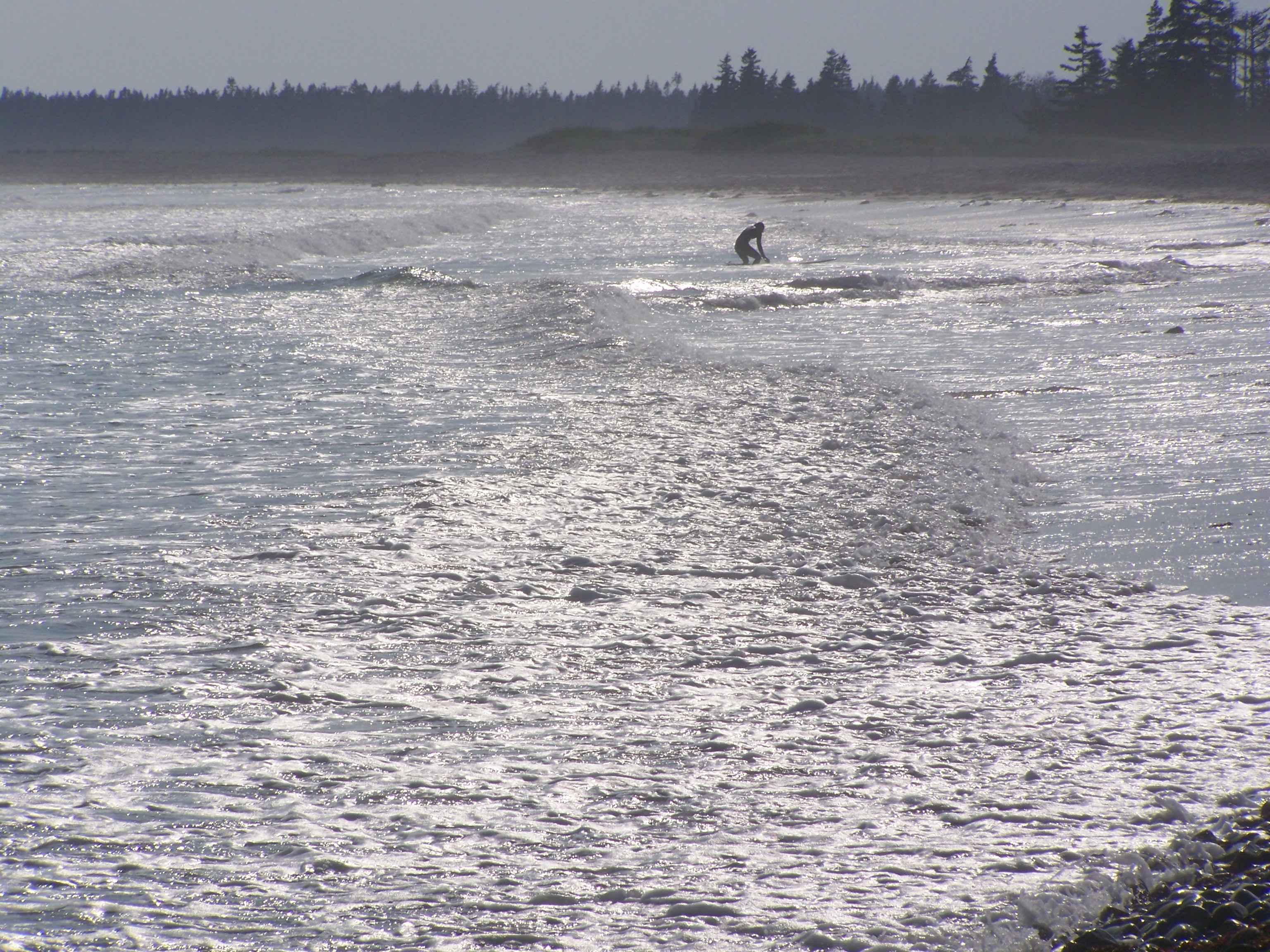
Driving north up the Atlantic coast, the sunscreened crowds fade away as you pass through Bangor, ME, entering the no man’s land of narrow highway heading towards the Canadian border at Calais/St. Stephen.  There’s nothing to stop for, other than some grand, flat vistas of endless balsam fir forests, and once you’re over the border into New Brunswick the landscape is even emptier, rolling plateaus heading out unhindered to the deep, restless tides of the Bay of Fundy.

Whizzing on over the land bridge to Nova Scotia, the din of American politics, entertainment and consumerism gradually fades away, and now, having been almost a week here under the hypnotic spell of the rhythmic tides, rolling waves and balsam-scented breezes, my mind feels cleansed and curiously blank, reluctant to be drawn in again to any particular focus.

This morning dawned foggy, and now the sun is burning through, setting sparkles glittering on the gray, barely visible sea.  The twisted firs stand sentinel on the edge of the cliff, and a small group of sea ducks bob peacefully around the rocks, diving now and then to grab a tasty morsel.

Such has been the scene for millennia, minus the alien intrusion of this house and my people here on these shores.

I felt sad and disturbed to read in the Halifax Chronicle Herald that the natives of this region, mostly Mi’kmaq, are struggling to provide decent housing for their people.  It doesn’t seem right that the placid, prosperous Euro-Canadians, who have benefited so mightily from the ownership of this land, are not at minimum giving back to the native peoples in the form of decent housing.

Of course it’s the same in the U.S., where the only way the tribes are able to become self-sufficient is by setting up casinos to collect tariffs from the colonizers.

Somehow I expect more of the Canadians, but they too are only human. They are clear-cutting their forests, strip-mining for coal, oil and minerals, and they’ve already decimated the marine life in their waters through over-fishing.

The saving grace of Canada so far has been its low human population density, as compared to so many other parts of the world. With its vast land mass, Canada only has an average of about 3 people per square kilometer—higher here on the Atlantic coast, and lower in most of the interior.

Perhaps that’s why it’s easier to imagine a scenario here where the humans and non-humans live in harmony, as the Mi’kmaq ancestors did just a few generations back.

We must face the fact that it’s human over-population that is driving our current environmental crises, worldwide.

If we don’t scale back population growth ourselves, the planet will do it for us, self-correcting the imbalance with a few violent shakes: climate disruptions, epidemics, famine.

Here in Nova Scotia I am able to get a taste of what it feels like to live in a more balanced, uncluttered environment.

It feels like the way things should be.

Climate Change: What do we tell our children?

This has been a big week for change agents in the U.S.

First Annie Leonard came out with her new movie, The Story of Change.

Annie Leonard

Then David Brancaccio released his new movie, “ Fixing the Future,” with a two-day nationwide roll-out starting on July 18.

David Brancaccio

And today Bill McKibben made the cover of Rolling Stone, confirming him, at least in my eyes, as the true rock star of the environmental movement.

In the same week, radical economist Gar Alperovitz gave a historic keynote address to the Green Party National Convention, arguing that you can’t have a democratic society unless you democratize the ownership of wealth as well.

The big question is, will the best efforts of all these good folks make a difference in what is happening to our precious planet?

Or is it just so much more hot air, to add to an already too-hot summer?

This week I am teaching a class in media studies for middle schoolers.  While I’m amazed and delighted at the facility of the students with the technology of digital communications, I am also struck by the narrow focus of their concerns.

Three of the students have started blogs about fashion trends.  Another has started a blog about anime and manga characters.  Of the three others in the class, one is using her blog to do movie reviews, another is talking about hard science issues (the Higgs Boson discovery), and the third is writing about the stock market and the technological age we live in.

Absolutely nothing wrong with any of that.

Except that if we don’t solve the climate crisis, it will all be completely moot.

Runway fashions, movie stars, cartoons and stocks will all be swept away before the onslaught of food insecurity, economic instability and violently unpredictable storms.

No, this is not the stuff of Hollywood fantasy.  It is real, and as McKibben points out in the intro to his Rolling Stone article, it’s already happening.

As a teacher, what am I supposed to do?  If I remind my students (and my own children, for that matter) just how grave and portentous a time we are living through, aren’t I placing an enormous burden on them?  And isn’t it true that it is my generation, not theirs, that bears the brunt of the responsibility for where we are now?

And yet, if I say nothing and let them proceed as if fashion and anime were the most compelling topics of the moment, am I not being dishonest?

It really is quite a dilemma, for any parent and every teacher who is aware of what is really at stake in the times we live in.

I imagine it must have been similar for principled people in other times of crisis.  Do we try to shelter the children, keep their lives as normal as possible, for as long as we can?  Or do we let them know what is going on, and enlist them in the urgent struggle for positive change?

I don’t believe in lying to young people, and I have never been very good at lying, anyway.

The truth is that we are living through times unlike any faced by human beings before, in the 10,000 years of our history on the planet.

What we do in the next decade will make the difference between our continued existence on the planet, or the extinction or radical reduction of human civilizations on Earth.

I love Bill McKibben because so far, at least, he never gives up.

He’s got a true fighting spirit that refuses to take no for an answer.

Still, eventually even Bill may have to concede that the fossil fuel industry, with the politicians in their back pockets, is simply not going to give.

When that moment occurs, it will be game over for human beings on the planet, and so many other of our fellow Holocene travelers too—birds, fish, plants, and mammals.

But it’s not over til it’s over.    And I, at least, will never give up hope that people of all ages, from every corner of the world, will see the crucial urgency of this moment; that they will act upon their new awareness;  that the politicians will be compelled to listen; and that we will be able to turn this great climate change juggernaut around.