Embracing the Monster of Climate Change

Finally, a mainstream media reporter has the courage to bring up the elephant in the newsroom: CLIMATE CHANGE!!!

In a blog post—not a front page or prime time news story, alas–ABC News reporter Bill Blakemore writes candidly of the fear that a realistic assessment of the threat of climate change must raise in anyone who cares about the future of human civilization on this planet.

“Established scientists, community and government leaders and journalists, as they describe the disruptions, suffering and destruction that manmade global warming is already producing, with far worse in the offing if humanity doesn’t somehow control it, are starting to allow themselves publicly to use terms like “calamity,” “catastrophe”, and “risk to the collective civilization,” Blakemore writes.

“Sooner or later, everyone who learns about the rapid advance of manmade global warming must deal with the question of fear.”

Blakemore advises us to take a page out of the U.S. Air Force playbook and learn to “hug the monster” of climate change, rather than recoiling into fearful paralysis.

“If you freeze or panic — if you go into merely reactive “brainlock” — you’re lost,” he says.

“But if your mind has been prepared in advance to recognize the psychological grip of fear, focus on it, and then transform its intense energy into action — sometimes even by changing it into anger — and by also engaging the thinking part of your brain to work the problem, your chances of survival go way up.”

It is absolutely clear that we stand on the edge of the greatest crisis ever to confront human civilization.

It is also quite clear that almost NO ONE WANTS TO TALK ABOUT IT.

Sometimes when I bring up the reality of impending climate change I really feel like the drip, the drone, the total wet blanket in the room.  People actually give me dirty looks and do their best to change the topic ASAP.

Okay, people.  You go your way and I’ll go mine.

I don’t know whether it’s possible for humanity to survive the coming catastrophe of global heating.

If we survive, it will only be through a drastic change in our ethos and way of life.

We cannot continue to treat the planet as our private killing field, burning and hacking at all other life forms as if they did not matter a damn.

We in the Western world cannot continue to pretend that our wasteful, profligate lifestyles are a given that cannot be questioned, touched or changed.

To me the monster in the room is not so much global heating itself, as the destructive, predatory mindset that has brought it about.

If we are going to embrace the monster, as the Air Force suggests, and even employ anger as a tool of resistance, than we need to start getting angry at ourselves.

We Americans and Europeans have brought the planet to the brink of the next “global extinction event”—aka, the brink of total annihilation for the majority of current life forms on Earth.

Where is the anger? Where is the outrage?  Where is the will to change?

First step: acknowledge that the problem exists.

Thanks, Bill Blakemore, for getting us just a little bit closer to taking that first baby step.

Loving Earth

To save the Earth, we must fall in love with her, writes Robert Koehler, taking his inspiration from the work of Charles Eisenstein, author of Sacred Economics.

Koehler and Eisenstein say that in the trajectory of human evolution, we have been locked in the selfish adolescent phase for a long, long time, just seeking to take what we need from our Earth mother, without thought of giving much in return, or of the reality of finite limits.

When we fall in love, Eisenstein says, “perfect selfishness falls apart as the self expands to include the beloved within its bounds.”

I remember falling in love like that as an adolescent, and as a young adult too.

It’s true that when you’re in love, the boundaries between the self and other dissolve, and you exist in a harmonious utopia of mutual beneficence.

But at least for most of us fallen humans, that kind of all-encompassing love doesn’t last forever.

It can’t.  It’s too intense.  Eventually the first ecstatic glow fades and the angelic beloved assumes normal, human proportions, with all the associated warts and odors and quirks of behavior and thought that our human bodies and minds possess.

What happens to love then?

If we are compatible for the longterm, the initial heady crush transforms into a much more solid platform of respect, shared interests, and deep concern for each other.  We care about each other, we enjoy being together no matter what we’re doing, and we respect each other’s views, goals, and talents.

We become partners in the truest sense of the word.

Is it necessary to go through the romantic, boundary-dissolving “falling in love” stage to get to the mature relationship of partnership?

In our culture, we believe it to be.  Our young people, tutored by every aspect of media and pop culture, assume that being swept away with love is a pre-requisite to successful marriage.

And yet how many of their parents, who followed that same script, ended up in bitter divorce fights?

Although I understand the intent behind Koehler’s and Eisenstein’s valorization of “falling in love” as a model for the depth of passion needed to fuel successful environmental action on behalf of the Earth, I am not convinced that this is the right message to be sending.

Young people today may still harbor romantic dreams, but they live day-to-day in a casual hook-up culture that prides itself on separating sexual enjoyment from commitment.

Fifty percent of their parents have made the journey from early romance to disillusioned divorce.

Another 25% or so of adults are either unhappily married, or unhappily single.

The “falling in love” model thus hits home with too few Americans to be effective as a rallying call for environmental action, and it is too limited a metaphor for the depth and breadth of passion that we must summon now to be effective Earth stewards and activists.

Instead we must love with the unconditional devotion of a mother for her child, with the sincere, selfless wish to see that new life grow and prosper and move forward beyond us.

We must love the Earth with the intensity of devotion that recognizes that for her to thrive, it may be necessary for us to part.

Earth has loved us with this kind of pure altruism all these many years of human emergence.  Now, as in the terrifying story of The Giving Tree, she has given so much that she has practically sacrificed herself entirely.

Nothing we can do to the Earth will wreck her forever.  Forever is a long, long time, in geologic terms.

But there is still time to shift from heedless destruction to the kind of loving tending that the Earth herself has modeled for us all these years.

There is still time to develop the kind of deeply caring reciprocal partnership that will last a lifetime, and beyond.

L’Chaim! This spring, let us commit ourselves to Life

Both Passover and Easter “celebrate” truly horrendous acts committed by men against men.

Passover commemorates how the Jews were spared by the grace of God from the Pharaoh’s evil plan to kill all first-born sons.  Easter celebrates the Resurrection of Christ after he was brutally martyred on the cross—a not-uncommon practice at the time.

Of course, both the Christian and the Jewish holidays also build on the much earlier pagan rites of Spring, the welcoming of warmth and rebirth after a season of winter.

I have to wonder why dominant human civilization has moved away from the earlier, simpler pagan celebrations, keyed to the natural world rather than to human doings and misdeeds.

Both Passover and Easter celebrate life—the lives of Jewish children, the miraculous resurrection of Christ, who gave his life in sacrifice for humanity.  Hence all the eggs, chicks and bunnies that populate the secular reinterpretations of these holidays, especially the American secular Easter.

Life is indeed something to be celebrated, as the Jewish cheer “L’Chaim!” proclaims.

Celebrated and protected.

As we move forward into the 21st century, into the auspicious year of 2012, let our aim be to reconnect with our prehistoric roots, to the simpler ages when we instinctively celebrated the return of the Light, the annual swing of our planet back towards the Sun.

For much too long, we have allowed religious politics to push us into conflicts and cruelties that do not serve the purpose of Life.  In claiming to worship the Divine, we actually find ourselves serving the dark side, the side of Death and Destruction.

I use these capital letters advisedly, to emphasize the symbolism inherent in all these word-concepts.

Beyond the symbolic realm there is the literal bedrock of reality.  We are hitting up against that reality now, as the patterns of power-hungry conflict, fueled by greed and a willingness to press on with destruction of the living world no matter the cost to systemic ecological health, play out with relentless precision.

This Easter and Passover season, let us do more than just toast to life.  Let us commit ourselves to the service of the divine spark animating our planet, which circulates without distinction through every blade of grass, every insect, and every human being.

It is only in our positive reciprocal commitment to Life that we can consider ourselves truly blessed.


Looking catastrophe in the eye

Denial of climate change is deep and it is wide.

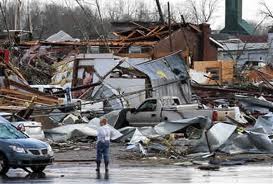
We woke up this morning to news of record-breaking tornadoes touching down across a wide swath of the American Midwest, flattening entire townships and leaving behind multiple trails of devastation.

Reading the mainstream media reports, the focus was all on the damage; very little was said about the cause.

Again, a case of focusing on symptoms rather than on the motivating problems.  The news media focuses on the “what” but ignores the “why.”

And they are even further away from what’s most important: looking for solutions.

Senator Bernie Sanders

Yesterday, thanks to the ever-impressive leadership of Senator Bernie Sanders, representatives of the national and international insurance industry came together in Washington to discuss the business implications of climate change.

Co-sponsored by the Ceres Foundation, which has been working to bring business into the sustainable future fold, the meeting was unequivocal in its acknowledgement that climate change is here, it is real, and it must be dealt with head on, before it runs right over us like a tornado.

The reinsurance industry reps were pretty blunt.

“We need a national policy related to climate change and weather,” said Franklin Nutter, president of the Reinsurance Association of America.

Pete Thomas of Willis Re, a global reinsurance broker, cited an alarming statistic: 4 out of 5 Americans now live in federally declared disaster areas.  “”Demographics and coastal urbanization are catastrophic force multipliers, making weather events increasingly costly,” he said.

In case you didn’t know, reinsurance companies are the ones that insure the insurers.

A difficult industry, in the age of climate change.

If I were an economist, I would be doing the math to figure out whether we are really coming out ahead as a society when we fight to pay less than $5 a gallon for oil.

What may seem cheap up front is often outrageously expensive in the long run.

Like eating cheap food laced with chemicals to keep costs down, to find yourself paying the exorbitant bills for chemotherapy in midlife.

It just doesn’t make sense.

There has never been a more important time to come forward and demand that government and industry work together to ensure (not insure!) our future.

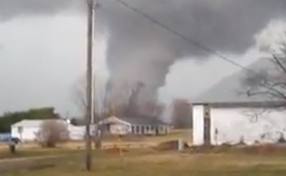
Indiana Tornado, March 2, 2012

Let’s stop hiding our heads in the sand and pretending that everything will be all right–until the next tornado, hurricane, wildfire or drought rides roughshod over our house and town.

Sitting at home worrying is of no use at all.

If you want to be of use to your grandchildren and all future generations, you should be out on the frontlines, insisting that:

a) the media does its job as a watchdog and reports the whole story;

b) our elected representatives do their job and create policy aimed at saving lives by mitigating and adapting to the effects of climate change; and

c) our fellow citizens get off their butts and start taking responsibility for our collective future.

Get going now, before “catastrophic force multipliers” blow us all away.

Cancer blues

This is a post about cancer.

This is a post in honor of all the men, women and children who have died from cancer in the post-industrial age.

This is a post that acknowledges, fully, the extent to which American society has led the way in the extermination of these people–these cancer victims.

How many cancer victims do you know?  According to the World Health Organization, cancer accounts for millions of deaths worldwide each year (7.6 million deaths in 2008, more than died from the Nazi Holocaust).

Cancer is a Holocaust.  It is a disease, or disorder, that cuts across every economic boundary.  It is just as prevalent among the 1% as among the 99%.  It is just as prevalent among the highly educated as among the working class, although of course certain professions are more risky: industrial agriculture, factory work, anything involving radiation.

The truth is that most of the technologies we Americans love the most–cell phones, smart phones, wireless, for starters–are hazardous to our health.  Just like junk food, which we also love.  Or the wanton burning of fossil fuels in our beloved SUVs.

When climate change activists tell us we have to give up our fossil fuels to save the planet, we act like spoiled toddlers.  NO! We will NOT give up our toys!  NO!  We will NOT turn down our themostats, or buy smaller cars, or make a concerted effort to switch to solar.

As parents, we Americans are generally pretty permissive.  We let our kids have what they want, unless it is dangerous for them, or detrimental to their health.

I never let my kids drink Kool-Aid or eat Cheetos, because I knew very well that the junky chemicals in those products were harmful.

But I have let them have cell phones. We have wireless throughout our house.  From what I understand, smart meters, which communicate wirelessly, via electro-magnetic radio frequencies, are in the process of being installed on every home in America.

We can’t afford to eat exclusively organic in my home.  We live near a river polluted with PCBs by GE.  We breathe air labeled “hazardous” on many summer days.

And as a result, we are at risk for cancer, just like everyone else in the developed world.  Everywhere that chemicals are dumped into the environment, everywhere that the ozone layer is thinning, everywhere that the winds blow radiation around, living organisms, including human beings, are dying of cancer at elevated rates.

Last week my Human Rights, Activism and the Arts class at Bard College at Simon’s Rock watched a TED Talk by Eve Ensler, who has (so far) survived a run-in with cancer.  Eve brilliantly makes the point that the inner landscape of cancer mirrors the outer landscape.  What we do to the environment comes back to haunt us in our own bodies.

If we humans, of every class background, are now falling sick in record numbers, it’s a reflection of our sick our environment is.  How sick we have made our environment.

Heal our world, heal ourselves.

Eve Ensler has spent years fighting against the violence that men perpetrate on women’s bodies.  A survivor of an abusive father herself, she has waged a heroic battle against her own demons, and the demons that beset patriarchal cultures worldwide.

She is gearing up now for her biggest effort ever, One Billion Rising, a campaign by V-Day to galvanize men and women to stand up against violence, especially violence against women.

I salute Eve Ensler’s ground-breaking efforts to put her art in the service of social justice, and to link the quest for social justice to environmental health.

If we can’t heal our planet, we will not be able to heal ourselves.

We are the cancer on our planet.

Our own treatment approaches would dictate our eradication.  Radiation therapy: burn it out.  Chemotherapy: poison it to death.

But there is another way.

Look upstream, as Sandra Steingraber has been telling us for the past 20 years.

Find out what is causing the cancer, and CHANGE IT.

Find out why so many women are suffering from violence, and CHANGE IT.

CHANGE.

Where there is a will there is a way.  How sick do we have to become, how sick does our world have to become, before we find the will to change our ways?

Out of the mouths of babes….

One of the most interesting aspects to me of Carol Gilligan’s research on childhood psychological development is her finding that as girls and boys mature, they lose touch with the instinctive, joyful, totally honest voice they were born with.

To some extent, this is necessary.  No one would want to live in a chaotic society of adult two-year-olds all shouting and crying and singing at the top of their lungs whenever they felt like it!

But it’s the loss of honesty that I find troubling, because it appears that when we lose touch with our own honest assessment of people and situations, we also lose the belief in our power to effect change.

***

When I was a young girl I was very sensitive to others’ pain, and it didn’t matter to me whether I was witnessing a tree being cut or a seal being tortured by a fishing net, I felt the pain so deeply that it became a wound in the innermost recesses of my own soul.

I’ll never forget one beautiful spring morning, when I was about nine years old. My family lived in the city, and we always arrived at our country house on Friday nights, in the dark.  On Saturday mornings it was my habit to get up early and go out for a walk by myself, reveling in the woods and fields and birdsong that I had missed during the week in the concrete canyons of New York.

On this particular May morning, full of sunshine and the fresh, moist air of spring, my buoyant good cheer was suddenly shattered by a shocking sight by the side of our driveway.  The telephone company had come during the week while we were away and cut down a big swath of young trees underneath the cables that ran along the road, leaving behind heaps of dying limbs and saplings, heavy with oozing sap and shriveling new leaves.

A gut-wrenching feeling of horror clutched at me; I began crying, crooning to the trees, overwhelmed with a feeling of shame and guilt—why were my people, humans, so destructive, so wanton, so careless and thoughtless? I was outraged, upset, furious, and went running back up the driveway to tell my parents, assuming they would share my reaction.

But instead they shrugged, resigned—it was too bad, but there was nothing to be done about it.

***

And of course now, as an adult, my reaction would be the same.  I witness road crews cutting back perfectly healthy trees all the time, and think nothing of it.

As we grow up, we get inured to the pain and suffering we visit on the natural world day after day.  We learn to tolerate injustice with casual lack of attention.  We lose the moral sensitivity with which we are born, and with it the fire within that impels little children to speak their truths and demand that the adults in their lives listen.

Told that it doesn’t matter whether some trees are cut, or a cell tower goes up, or a dam is built, or that there is so much artificial light at night that we can no longer see the stars, we are gradually lulled, as adults, into complacency, from which it takes a lot to dislodge us.

This is no accident.  Most educational practices consist of training the young to conform to authority and feed back the right answers to the questions asked.

It’s not about learning how to ask the questions that haven’t yet been formulated; the questions that come from one’s deepest reservoirs of knowledge.

Socrates believed that human beings enter the world already knowing everything we need to know, but we forget it in the first weeks of life.  We spend the rest of our lives, he believed, trying to remember.

As children, we know that we humans were born to live in harmony with the other living beings on this planet; to be a productive and positive part of the web of life that surrounds and sustains us.

Adults, I’m speaking to you: this is crucial knowledge that we need to remember, and act upon.

Coming to Voice, Saving the Planet

Yesterday acclaimed psychologist Carol Gilligan paid a visit to the class I am currently co-teaching at Bard College at Simon’s Rock with theater professor Karen Beaumont, “Human Rights, Activism and the Arts.”

Gilligan’s ground-breaking book, In A Different Voice, was the first to examine the psychological development of girls.

Yes, you read that right.  Before Carol Gilligan, American psychologists who studied child development based their model of the stages of human psychological development on their studies of boys.  Not until Carol came along in the early 1980s did anyone think to point out that girls and boys develop differently.

In her new book, Joining the Resistance, Gilligan explains that while girls start to silence their own voices in their early teen years, in conformity with social dictates about proper behavior for “good girls,” boys go through this self-regulation much earlier, around 5 or 6, when they learn that “crying is for sissies.”

Boys learn to suppress their caring, nurturing side because it’s too “feminine,” while girls learn to suppress their active, aggressive side because it’s too “masculine.”  In the process, both genders lose something crucial to their humanity, and our society as a whole is impoverished as a result.

Lately, Gilligan has been relating boys’ and girls’ resistance to the suppression of their natural androgynous voices to adults’ resistance to what she sees as a very destructive patriarchal culture.

She defines patriarchy as “those attitudes and values, moral codes and institutions, that separate men from men as well as from women and divide women into the good and the bad,” and argues that “as long as human qualities are divided into masculine and feminine, we will be alienated from one another and from ourselves.  The aspirations we hold in common, for love and for freedom, will continue to elude us.”

So much depends on whether we can come to voice.  And how we do so.  In the context of my human rights seminar, coming to voice may mean being able to speak out in an informed, passionate way about justice and injustice in specific circumstances, both here in the U.S. and abroad.

In the personal sphere too, we need to learn to express our needs clearly, without apology.  We women need to learn to value ourselves and insist on being treated fairly and with respect whether in the home or in the workplace.  Men need to demand that their emotional, nurturing sides be honored.

If it is hard for men to express emotions, it is hard for women to speak with authority.  As sociologist Michael Kimmel has shown, boys and men tend to over-estimate their own abilities while girls and women tend to have less self-confidence than their skills and talents warrant.

Boys and men need to learn to listen, to others and to their own innermost voices, the voices of compassion that were shut down when they were just little guys and learned that boys don’t cry.

Girls need to learn to speak up, to let their innermost voices out, to share freely what they know and what they imagine with the world.

My mother reminded me recently that when I was a young girl of 9 or 10, she considered me a “know-it-all.”  I used to read Ranger Rick and the National Wildlife magazines with voracious attention, and apparently I had a lot to say about the natural world and human beings’ role in it.

As I shared with my class yesterday, sometime around age 14, just as Carol Gilligan saw with her research subjects, I lost my voice.  I became the quiet girl in class.  I earned A’s on every literature paper I wrote, straight through grad school; but it was so hard for me to say out loud what I knew.  It’s taken me years to overcome that self-silencing and begin to recover the spunky, feisty voice that came pouring out of me naturally when I was a child.

As adults, knowing what we now know about the importance of voice to healthy psychological development, we should be working hard to encourage the boys in our lives to stay in touch with their emotional, caring, listening side; and the girls in our lives to continue to speak their truths even when they enter the maelstrom of puberty.

As Audre Lorde wrote long ago, “My silences had not protected me.  Your silence will not protect you…. We can sit in our corners mute forever while our sisters and ourselves are wasted, while our children are distorted and destroyed, while our earth is poisoned; we can sit in our safe corners mute as bottles, and we will still be no less afraid….

“We can learn to work and speak when we are afraid the same way we have learned to work and speak when we are tired.  For we have been socialized to respect fear more than our own needs for language and definition, and while we wait in silence for that final luxury of fearlessness, the weight of that silence will choke us.”

You got that right, Audre.  If anything, the dangers that you perceived back then–before you, like so many others, succumbed to cancer–have gotten worse.

If we care about our children, if we care about our Earth, we cannot afford to stay silent.  Indeed, there is more risk to staying quiet than to speaking out, with all the passion, emotion and authority we can muster as men and as women.

Cat got your tongue? Not mine.  Not any longer.

An Unlikely Environmental Evangelist

There were two reasons, many years ago, why I ended up choosing literature as my field of study rather than environmental studies or law.

I was turned off from environmental studies, my initial choice for an undergraduate major, by a scary required statistics class and no options for getting remedial help to bring my weak math skills up to speed.  I ended up with a B.A. in English and Journalism.

I briefly flirted with the idea of law school after college, but could not fathom spending the rest of my life reading and writing legalese.

So I gravitated towards literature, comparative literature, literature of the world, and my dissertation focused on testimonials and political personal narratives of the Americas.  I knew early on that what interested me most about literature was opportunity it presents for passionate narratives about the intersections of the personal and the political.

That has remained my interest all these years later.  But it has finally become clear to me, over the longer arc of my life, that my early, instinctive connection to the natural world, my recognition of the importance of law, and my duck-in-water ease with the discourses of both journalism and personal narrative, are all finally coming together in what I see as the imperative task to which I must dedicate the last third of my life: awakening my fellow and sister human beings to the urgency of heading off climate catastrophe.

If this sounds like a moral crusade, well, so be it.

I was not raised in any religion, nor do I follow any religious practices now.  I don’t believe in God as a benevolent white man in the sky, nor do I believe that one needs to sit in a particular building, listening to a particular preacher, to reach out to the divine.

But I have always felt a deep spiritual connection to the natural world.  When I was 8 or 9, I used to go out into the woods and sit alone in my “spot,” which was a circle of mossy stones at the top of a big stone ridge, ringed by maples and centered around a grassy glade.  It was a small circle, no bigger than 10 feet in diameter.  I would just sit there and look and listen to the birds in the trees above me, the small insects on patrol in the grass, feeling the wind ruffling against my face and a kind of inner exultation and delight that I can only describe as religious ecstasy.

No one taught me to do this, and it wasn’t until much later, reading personal narratives by indigenous elders, that I was able to put this early spiritual connection with nature into a broader polytheistic cultural framework.

I believe that everything in our world is tinged with spiritual significance.  And I believe that human beings, because we are unique among animals in being able to see the effects of our actions on the larger landscape of the planet, and to both predict and alter the future, have a special moral imperative to do what we can to be the responsible stewards of the natural world of which we are a part.

I have never said that out loud.

But thanks to environmental activist educator Eban Goodstein, I now recognize that this is exactly what I should be doing, whenever I can, as urgently and passionately as possible.

Goodstein, who founded the national organization Focus the Nation and now heads up the Center for Environmental Policy at Bard College, writes in his 2007 book Fighting for Love in the Century of Extinction that it is crucial that people who understand the seriousness of the pivotal moment at which we stand begin to speak up—not in legalese or scientific jargon, but in the clear, ringing tones of moral conviction.

“The real problem that nontheistic environmentaists face is not a depth of passion, but a failure of moral language with which to cultivate and nuture that passion,” Goodstein says.  “Unless passion about life on Earth is nurtured, and mass extinction is understood clearly in terms of good and evil, then political opposition to the great extinction wave of our generation will be weak and it will sweep across the next century unabated.”

Goodstein recommends that each of us “develop a thirty-second ‘elevator speech’ that is a response to the question: ‘Why do you care about global heating?’” What you say won’t be convincing or memorable to people unless you can quickly tell them why this issue is deeply important to you, and why they should also care.

It can’t be a laundry list of words that have been so often used they’ve become clichés: sustainability, clean energy, even droughts or wildfires.  Goodstein suggests that when it comes right down to it, we should care about global heating because it is “just plain MORALLY WRONG” to ignore the prospect of the sixth great extinction of life on Earth, when we not only know it’s coming, but have a pretty good idea of how to head it off.

Given my non-religious upbringing, I’m not that comfortable with the language of good and evil or moral righteousness.  And yet it is no accident that all human religions do codify a moral code that seems to be hardwired into our species.

Goodstein refers to Harvard biologist E.O. Wilson’s 1984 book Biophilia, which set the stage for evolutionary psychology in arguing that human beings have evolved to love life and work to extend life by interacting positively with our environment.

Whether we come at the issue of climate change from a religious perspective (God made us the stewards of life on Earth, we have a moral injunction to protect all God’s creatures) or a nontheistic but nevertheless spiritual reverence for the natural world, or even a simple scientific recognition that the current fabric of our ecosystem will live or die depending on human choices now, there is no doubt at all that each of us needs to get our elevator speech nailed down and go out to become evangelists for the natural world.

I don’t use the term evangelist lightly.  Christian evangelists have a reputation for single-mindedness bordering on fanaticism.  They believe deeply, and they are willing to take the risk of expressing their beliefs out loud, and actively trying to convert others.

I am someone who has been known to hide in my own house when the Jehovah’s Witnesses knocked at the door.  I have never followed any preacher or religious dictate, nor have I ever considered trying to persuade others to any given point of view.

But the situation we face now is unprecedented in my lifetime, or human history as a whole.  It demands an unprecedented degree of commitment.  It demands taking the risk of climbing up on a soapbox and speaking out loudly and passionately enough to draw a crowd.

Those of us who are awake to the gravity of the coming environmental catastrophe need to be getting out there trying to instigate change through every possible channel: electoral politics, grassroots activism, legal challenges, moral persuasion, standing on our heads–whatever it takes to wake people up and get them moving.

So what’s your elevator speech about?  Mine, I think, is about love.

Whether we call it love for God’s green earth, or the love for the natural world, what we mean is the same: love for our children and future generations, who should not be denied the pleasure of listening to birdsong in the trees on a peaceful spring morning, knowing that their world is stable and secure.
Canaries in the Roundup Ready Fields

This morning I woke up with the phrase “canaries in the coal mine” playing over and over in my mind.

Maybe it’s because one of the last things I read before going to sleep last night was an article about the harmful effects of methylmercury in songbirds.  Methylmercury is the organic form of mercury, a biproduct of coal burning, which falls to the ground with rain, gets into the groundwater and begins to make its way through the food chain, starting with leaves, snails and worms, and going up into birds, fish and mammals.

Mercury poison is slow and insidious, showing up in erratic behavior and a kind of deadly dullness in birds and other animals.

“Songbirds with blood mercury levels of just 0.7 parts per million generally showed a 10 percent reduction in the rate at which eggs successfully hatched,” writes Anthony DePalma in the New York Times. “As mercury increases, reproduction decreases. At mercury levels of greater than 1.7 parts per million, the ability of eggs to hatch is reduced by more than 30 percent, according to the study.

“Over all, birds in contaminated sites were found to be three times as likely to abandon their nests or exhibit abnormal incubation or feeding behavior. In some nests, the chicks seemed to have been affected most; they vocalized less and did not beg as aggressively to be fed.

“Such consequences mimic the effects of mercury on humans whose primary contact with the toxin is through the consumption of fish. The contamination can be passed to children in the womb or while they are nursing, damaging their nervous systems and impairing their ability to learn.”

Still mulling this information over, thinking about the mysteriously rising rates of autism, Asberger’s and other neurological disorders in our children, I poured myself a cup of coffee and opened up Facebook, often a good source of information about what is on people’s minds on any given morning.

At the top of my news feed, I found several glaring stories about Monsanto, the biggest and baddest of the industrial agriculture corporations.  Much has been written about the evils of GMO crops, terminator seeds, and the effects of Roundup on the environment.  But now, as with mercury poisoning, we’re beginning to realize how glyphosate, one of the main ingredients of Roundup, is infiltrating water and food and making its way up the food chain—to us.

Glyphosate is being blamed for infertility, mental illness, decreases in beneficial gut bacteria, and cancer.  Of course, it’s hard to find large-scale, reliable studies documenting these side effects, because no one spends more money than Monsanto in discouraging research that might affect its sales.

And Big Pharma is also along for the ride, since the more sick people, the merrier the cash register rings.

Yesterday I went for a walk on the golf course that sits in one of the most beautiful pieces of land in my neighborhood, a flat plain with the Housatonic River looping through it.  As always, I was struck by the complete absence of broadleaved plants in the thick grass of the course.  Not a dandelion; not a plantain; nada.  And nary a bird, either, except for a few stray chickadees chirping in one of the few thickets remaining by the river.  A microcosm of the Roundup Ready world we live in.

It strikes me that we are far beyond the canary in the coal mine moment now.  The canaries have died…but we are still advancing into the darkness, taking our chances, going on a toxic mixture of blind faith, naïve optimism and sheer stupidity.

The politicians have been paid to keep their eyes shut, and the rest of us don’t want to see what’s right in front of us.  Most of us who do see don’t act.

Until now.  Tomorrow there will be a big protest in lower Manhattan, in front of the Courthouse on Foley Square, where a major lawsuit has been brought against Monsanto by the Organic Seed Growers and Trade Association (OSGATA).

It’s no secret that Monsanto has used harsh bullying tactics to force farmers to use its expensive artificial seeds, fertilizers, pesticides and herbicides—the rash of farmer suicides in places like India and South Korea have borne mute testimony to the despair that comes of the resulting debt bondage.

European farmers have been more savvy about keeping Monsanto and its GMO crops at bay, and although we in the U.S. have been fairly passive until now, the times they are a’changing.

Listen to the combative tone in OSGATA President Jim Gerritsen’s voice as he rallies his 300,000 members to stand up for their rights:

“Today is Independence Day for America.  Today we are seeking protection from the Court and putting Monsanto on notice.  Monsanto’s threats and abuse of family farmers stops here.  Monsanto’s genetic contamination of organic seed and organic crops ends now.  Americans have the right to choice in the marketplace – to decide what kind of food they will feed their families – and we are taking this action on their behalf to protect that right to choose.  Organic farmers have the right to raise our organic crops for our families and our customers on our farms without the threat of invasion by Monsanto’s genetic contamination and without harassment by a reckless polluter. Beginning today, America asserts her right to justice and pure food.”

A bus for farmers and allies from Columbia County will be leaving for New York at 6 a.m. tomorrow morning (meeting at the old Walmart parking lot at 351 Fairview Ave in Hudson) to join the protest in front of the federal courthouse.  I’ll be in my classroom tomorrow, but my heart will be at Foley Square.

How many canaries have to die before we wake up?

Green Teaching: What the World Needs Now

In President Obama’s speech last night, he talked a fair amount about the importance of making higher education affordable for all Americans, and about how essential a highly skilled workforce is to America’s future.

I felt like I was in some kind of time warp.  Wasn’t Bill Clinton talking about just the same things, almost generation ago? Not only has insufficient progress been made, but while we’ve been fiddling and squabbling amongst ourselves, the whole landscape behind us has shifted radically.

It reminds me of one of those cartoon scenes where the mice are fighting amongst themselves and don’t even notice the huge cat face looming over them licking its chops.

The huge cat face, today, is the drastic heating of the planet.  Obama went on and on last night about manufacturing—we need a skilled workforce to support American manufacturing, we need to bring outsourced manufacturing back home, we need to adjust the tax code to benefit workers and manufacturers.

All the while, looming above the statehouse, is the runaway monster of climate change, which is at on the one hand fattened by all this manufacturing, while at the same time threatening to blow it all away.

I quite agree with Obama that we need to be pouring resources into education.  The question is, what kind of education is going to be most valuable for today’s children, tomorrow?

At the very least, we need an education that does not have its “eyes wide shut” about the fact of global heating and the impact this will have on us all in the near future.

I was encouraged this week when I picked up a print copy of the journal Green Teacher, and found an article by David Selby and Fumiyo Kagawa entitled “Unleashing Blessed Unrest as the Heating Happens.”  In it, the authors offer concrete curricular suggestions for how to introduce students in grades 5-12 to the reality of climate change, without sugar-coating it but also without leaving them so devastated that they lapse into denial or despair.  Since the article is not available online, I’m going to quote from it liberally in what follows, because this is news we can use.

The authors quote Jess Worth, who likens climate change denial to “finding out that you have cancer, but then delaying going to the doctor’s for treatment for a few months because you want to repaint your house.”

Selby and Kagawa speculate that because the “ever more dire accounts of a global climate lurching towards ever-deepening crisis” are so frightening, we tend to practice a kind of avoidance, which in education takes the form of “characterizing climate change as a technical problem that can be managed by a mix of technological innovation and policy solutions that avoid challenge to ‘business as usual.’”

For example, they say, “the recycling bin in most classrooms is…often cited as evidence of the school’s commitment to sustainability,” but “it can easily convey the subliminal message that consumerism approached responsibly can be benign.”

Reviewing American curricular materials for K-12, the authors found “a reluctance to investigate the culpability of neo-liberal economic growth models and to explore slow growth or no growth alternatives…. There is, too, an avoidance of envisioning and addressing personal and societal climate change scenarios that are likely to be played out in the learner’s lifetimes.”

This is certainly the kind of education I see my own son getting in his American public middle school.  The focus in his social studies, English and science classes has so far been squarely on the distant past.  There has been no discussion that I’m aware of about the fact that here we are at the end of January, and we are still seeing green grass outside.  NASA has just confirmed that nine of the ten warmest winters on record have occurred since the year 2000, and 2011 was the 9th warmest since 1880. Excuse me, shouldn’t we talk about that?

Selby and Kagawa say that instead of maintaining an “eyes wide shut” avoidance pattern with our youngsters, we need to engage in “an honest education facing up to the onset of what Alastair McIntosh describes as ‘a great dying time of evolutionary history’” and “overturning…the comfortable delusion that major disruption of Earth’s climate can be avoided or neutralized.

“Recognizing that present and future generations need hope, we have to ask what the hope is grounded in and what kind of hope it is.  Is it a spurious optimism, a comfortable fiction based on what we would prefer to see happen while keeping our ‘eyes wide shut’?  Or is it a pared down and realistically straitened optimism born of confronting the present and future earth condition?”

We have a responsibility as educators, parents, and elders to tell our children the truth about where we are as a global civilization, and where we are likely headed.  Wouldn’t you rather be forewarned, rather than bowled over by surprise when the shocks start coming?  Don’t you see it as the responsible thing to do to start preparing for those shocks now, both emotionally and practically?

The educators brought together in Selby and Kagawa’s new anthology Education and Climate Change advocate for a transformative learning agenda, involving “conscious, deep and sustained processes of engaging with pain, despair and grief over what we are losing, moving towards acceptance while searching for radically new meaning and values, and equipping ourselves for personal and collective empowerment and action.”

Concretely, they offer classroom exercises to guide students through these stages, including some pretty heavy-duty visioning of possible future scenarios that we may all have to live through.  The goal is not to depress students, but to empower them by moving from the disaster scenarios to hopeful plans of action to stave off the worst effects of climate change, or adapt successfully to whatever comes.

“A citizenship education for “blessed unrest” in a time of rampant climate change,” the authors say, “needs to be shaped by engagement in community-based action that creates, resists and transgresses in the name of sustainability.”

The time to start talking about these issues with our students and children is now, while we still have options as to how to confront the changes that are coming.  To do any less is to fail in our responsibility as the adults who should be out blazing the trail for the kids following behind us.  If we know there’s white water up ahead, let’s at least give those behind us a heads-up and see what we can do to ride out the rapids safely, together.