“Our lives begin to end the day we become silent about things that matter.”

So OK, having slept fitfully and woken up resigned to accepting the basic premise that it is unlikely that the world as I have always known it will continue into the foreseeable future…what then?

How do I spend my one wild and precious life on the planet?

I am quite clear that I want to put my time, talents and energies into doing my best to head off catastrophe for the natural world.

But this often feels like trying to stick my finger in a huge roaring dyke of bad news—how can I, a small and ordinary person, make a difference for the trees and animals and birds and bees that I so want to protect?

All I can say is that making the attempt is better than giving up.

My gift has always been writing, and so I am using that gift to try to reach out to others, in the hope that if many of us, in our small, ordinary lives, can join our voices together, the resulting chorus could indeed change the world.

I am continually amazed at how the technological innovation of the World Wide Web has facilitated the meeting of minds and the catalyzing of movements.  There has never been a better moment for human progress and connected intellectual growth.

I wake up with a new thought, write it down and send it out into the gushing waters of the internet, where, within the hour, it will be read by someone living on the other side of the planet, who will bat it back to me with comments that will cause me to see the idea from a whole new perspective.  All within the space of an hour! How remarkable is that?

But sadly, it is precisely our reliance on and success with technology that is causing our demise, from simple overpopulation to the poisoning of our environment.

This is the challenge of our time: to very quickly learn to adapt to our rapidly changing climate, and to find environmentally sustainable ways to hang on to our positive technological inventions.

I believe it can be done, which is why I am totally invested in the challenge of waking people up and getting them engaged in fighting the good fight to make our epoch, which many call the Anthropocene, a positive transition to a better human relationship with the Earth, rather than a nightmare ending in the dark night of extinction.

If we were to shift our resources from weapons of destruction–guns, bombs and missiles, chemical poisons, and ever-bigger drills, earth-movers and chain saws—to implements of cultivation and the harmless harvesting of the bounty of our natural world, what a huge difference that would make!

People say that over-population will continue no matter what, but I know from years of studying women’s issues worldwide that when women are educated and respected in a society, they have fewer children.

Between fewer children in the developing world, a lower rate of consumption in the developed world, and the invention of new technologies that act in harmony with nature rather than against her, we could transform our planet within a generation or two.

J.R.R. Tolkien’s classic fantasy The Lord of the Rings is looking more and more prophetic, and it’s surely no accident that the films have come out now, to appeal to the current generation of young people.

We are the ones who must enter the fight to hold off the dark forces of Mordor, in order to preserve the happy, healthy lives in the Shire that all humans are meant to live.

tumblr_m9hm5vDG2h1qzhkvho1_500Today is the anniversary of Dr. Martin Luther King Jr.’s assassination, and I invoke his memory to remind us that although it is true that by ourselves each one of us is puny and limited, it is also true that if we pool our resources and act together we have tremendous power.

We must each start by determining what gifts we can bring to the table of this new movement, and then start where we are, doing what we can, and sharing our insights and passions by all the channels of communication that are open to us, from talking face to face with friends and neighbors to sending our ideas out into the World Wide Web.

Now is the time, and we are the ones we’ve been waiting for.

I will close with two quotes from Dr. King:

“Our lives begin to end the day we become silent about things that matter.”

“If you can’t fly then run, if you can’t run then walk, if you can’t walk then crawl, but whatever you do you have to keep moving forward.”

Amen, brother.

Don’t be fooled…now is no time to relax

Usually there is one image every week that burns itself into my memory and won’t let go.  That’s the one I have to write about.

This week, this is it:

Beijing, January 17, 2013

Beijing, January 17, 2013

It’s coupled with a small, unheralded story, which I’m sure many people missed, about how soot is a much more dangerous contributor to the greenhouse effect than had previously been estimated.

I paid attention to this because I remember soot well.

In the luxurious enclaves in Manhattan where I lived as a child and young adult, soot was omnipresent.

It lay, black and unrepentant, on the white painted windowsills of our apartments.  It got into your eyes when the wind blew.  It came off black on the cotton balls I’d use to clean my face at night.  It gradually turned the white starched window curtains and the elegant rugs and carpets a dingy gray.

Looking at the images from Beijing this week, I can hardly bear to imagine how heavily besmirched with soot everything in that city must be.

air pollution in Beijing, China

I have vivid memories of standing on the corner of 86th Street and Park Avenue in Manhattan as a child, and being totally engulfed with the hot black diesel smoke belching out of one of the public buses that ran the crosstown route.

It happened on a daily basis, and never failed to disgust me.  I felt some small, inner part of myself wilting, just like I saw the spindly trees planted in iron cages on 86th street gradually giving up and dying, a little more each day.

I also had to contend with cigarette smoke at home.  I remember long winter car rides in which my parents would pass a lighted cigarette back and forth between them in the front seat.  I detested the smell of cigarette smoke, it made me feel like I was going to either faint or explode.  I did neither, of course; just cracked my window in the back seat and sat there miserably with my nose to the wind, grateful for the short periods between cigarettes, when I could relax.

I’m in one of those short periods now.

Hurricane Sandy did not hit us here in the interior Northeast, and the weather has been relatively mild so far this winter.

Food prices are going up, for sure, but there are no shortages, no bread lines as of yet.

IMG_1160When I look around me the air is clear, the sun is bright, and everything still seems rather “normal.”

Except that every year there are fewer and fewer songbirds at my bird feeder.

Every summer fewer butterflies make it to the butterfly bush in my garden.

Every fall the leaves on the sugar maples get a little smaller and less shapely.

It’s a slow, steady decline that many people, less tuned into the natural world, probably don’t see at all.

But it’s there.

I don’t know if we in the US will ever get to the dramatic, disgusting air pollution levels of Beijing.  But there will come a time when we can no longer count on the kind of abundance we’ve become accustomed to in the supermarkets.

Floods, droughts, lack of pollinators and an increase of superbugs will take their toll.

The climate thermometer will creep ever higher.

It will all accelerate—don’t think that we won’t see the beginnings of destabilization in our lifetimes.  We are seeing them now.

Chris Hedges recently interviewed Ronald Wright, the author of A Short History of Progress and other books, and here is what he had to say about the juncture at which we find ourselves:

“If we continue to refuse to deal with things in an orderly and rational way, we will head into some sort of major catastrophe, sooner or later,” Wright said. “If we are lucky it will be big enough to wake us up worldwide but not big enough to wipe us out. That is the best we can hope for.

“We must transcend our evolutionary history. We’re Ice Age hunters with a shave and a suit. We are not good long-term thinkers. We would much rather gorge ourselves on dead mammoths by driving a herd over a cliff than figure out how to conserve the herd so it can feed us and our children forever. That is the transition our civilization has to make. And we’re not doing that.”

What we need now is a rapid evolutionary acceleration of consciousness, so that we become the kind of long-term thinkers that can size up the terrible circumstances in which we find ourselves now, and do what needs to be done to successfully solve the problems.

We have the technology, we have the know-how, we have the ethical framework.  We just need the will and determination to make it happen.

I am happy to see President Obama forging ahead on the gun control issue in the US.  That is important work.

But it will be irrelevant and forgotten when climate destabilization leads to deprivation and social chaos.

I’ve said it before and I’ll say it again til I’m blue in the face: there is no more important issue to work on now than shifting to renewable energy and ending our cultural addiction to fossil fuels.

Not later.  Now.

Seeking solidarity in the environmental justice movement

Source: BBC

Source: BBC

It’s hard to wrap my mind around 129 degrees Farenheit, a temperature so hot that meteorologists have had to add a new color to the heat spectrum to represent it.

The pictures coming out of Australia this week have been nightmarish.

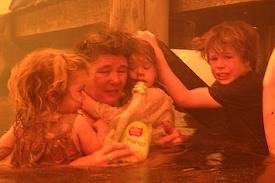
You’ve probably seen them too: the charred sheep, the family taking desperate shelter under a dock while ash and sparks fly around them, the huge red sandstorm wall looming over the ocean.

This is the push-back of Mother Earth.

There is only so far you can push her, and 2012 seems to have been the threshold beyond which there can be no further illusion of business as usual continuing.


Family in Tasmania seek shelter from wildfires

Family in Tasmania seek shelter from wildfires

Even some of the most hard-nose politicians are getting it now: I was heartened to hear Governor Andrew Cuomo of New York speak of the urgent need to plan for climate change disasters in his State of the State speech this week.

But he is still on the fence as far as fracking New York goes, which shows he has yet to fully put two and two together.

Two and two cannot equal two, Mr. Cuomo.

In other words, you can’t continue to expand the fossil fuel industry and not expect the blowback of climate change to worsen.

A lot of people are getting this now.

Not the ones who have their heads so deeply buried in the technology sands that all they can think about is the excitement of the next app, MOOC or tablet.

Not the ones who are riding the current stock market wave to scary new heights, buoyed by who knows what fictitious understanding of the relationships between real people and real goods—referred to in finance-speak as “market shares” and “bundled securities.”

Not the 1%, still sitting comfortably above it all, looking down on the disturbances below like vultures surveying the activities of scurrying mice.

But down here at ground level, people are starting to look at each other and know, even without speaking, not only that things are wrong, but that we cannot rely on others to make it right.

Wildfires are killing thousands of sheep in Australia

Wildfires are killing thousands of sheep in Australia

That can be the only explanation for the sudden groundswell of support for the Idle No More movement, which, just like Occupy, tapped into the resistance of ordinary people to the bulldozers of global capitalism, now coming to a forest or a farm field near you.

The lure of short-term gains has led many a politician, businessman, landowner or Native tribe down the daisy path of signing off on legislation and leases giving Big Fossil Fuel the right to do whatever the hell they want.

But we’re wising up now.

Toxic wastes from Texaco-Chevron are poisoning people and animals alike in Ecuador

Toxic wastes from Texaco-Chevron are poisoning people and animals alike in Ecuador

We look at the way Chevron left Ecuador when it was done extracting all the oil it could, and we listen to the story of how relentlessly their lawyers fought against giving even the least amount of their vast profits towards reparations for the toxic environment they created, and we know we could be next.

Now they’re coming right here in the Northeast—in the watersheds of New York and Pennsylvania, buying up those fallow farm fields and bringing in their huge fracking drills.

They’re down in Texas, building the first leg of the proposed transAmerican oil pipeline that will bring the dirty sludge of tar sands oil down to the Gulf of Mexico refineries, crossing over aquifers and farmland, by cities and pristine national parks.

And they’re up in Alberta with their giant bulldozers and dump trucks, razing the fragile boreal forest to get at the oozing tar underneath.

But in all these places, people are stirring.  People are rising in protest.  People are seeing that the short-term gains from these destructive fossil-fuel driven industries are going to quickly burn up, driving the stock market temporarily higher only to set up an even bigger crash in the future; keeping our homes warm and light today, only to set up bigger and worse climate-related disasters down the road.

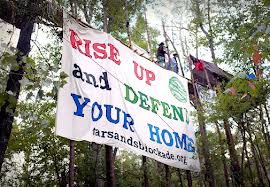
Tree-sitters in Texas

Tree-sitters in Texas

A few brave souls have been sitting in the trees in Texas to block the pipeline, a resistance strategy pioneered in the 1990s when Julia Butterfly Hill sat in Luna, a giant California redwood, for more than a year to keep the loggers from cutting her and her neighbors down.

The First Nations are on the march in Canada in a movement that is spreading like wildfire across the world, protesting the poisoning of the environment by the fat cats in boardrooms who arrogantly believe that they exist on another plane, a modern-day Mount Olympus that is impervious to the environmental destabilization they are wreaking on the world.

Students are rolling out an urgent campaign to get their college and university trustees to divest their portfolios from the fossil fuel industry.

Thanks to the World Wide Web, these efforts can be beamed across the globe instantly, refracted and amplified through the networks of hundreds of millions of kindred spirits worldwide.

The dissenting power of the many that Hannah Arendt wrote of back in the late 20th century has never been more powerful, in part because resistance can now take place virtually.

We don’t have to go out and brave the guns and tear-gas, although probably in the end it will have to come to that.

We can build our networks at home, working quietly but steadily until they are so big that to arrest us all would be, as Marx predicted, to undermine the capitalist structure itself—throw all the workers in jail, and who’s going to do the work?

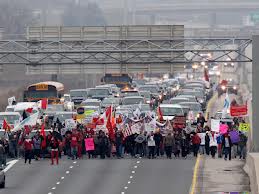
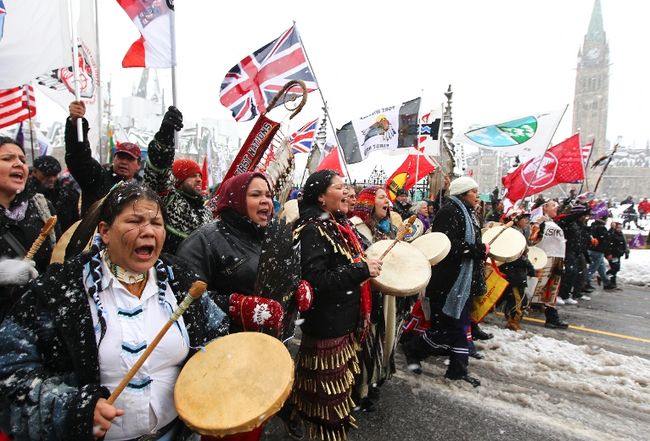
Idle No More protesters on Highway 401 in London, Ont., in December.  THE CANADIAN PRESS/Dave Chidley

Idle No More protesters on Highway 401 in London, Ont., in December.
THE CANADIAN PRESS/Dave Chidley

Right now all of these protest movements are disparate, each working on their own perceived goals.  What I hope to see in the coming year is more solidarity, more recognition that we’re all really fighting the same grand battle to keep our planet from being so devastated that it can no longer support life as we know it.

Life will continue on Earth, there is no doubt of that.  But whether humans, elephants, songbirds and frogs will be able to persist on a super-heated planet is quite uncertain.

It is imperative that we build an unstoppable grassroots movement to prevail on our elected representatives to represent the people rather than the corporations, and do what’s right.

How many catastrophic hurricanes, out-of-control wildfires, drought-stricken fields, bleached out corals will it take before we make use of our power as denizens of the world and say NO MORE?

images-1

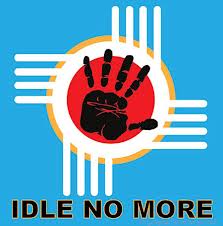
Idle No More: Exposing the Suicidal Cult of Global Capitalism

Once again we are seeing how the democratic power of social media can thwart the efforts of the state political apparatus to keep the people in line.

This time it’s happening in Indian Country, beginning in northernmost Canada and spreading like wildfire through social media networks down south and out into the broader world.

The movement is called Idle No More, and it was started by a coalition of four indigenous and non-indigenous women from Saskatchewan—Sylvia McAdam, Jess Gordon, Nina Wilson and Sheelah Mclean—who decided last fall that enough was enough with the steady assault on the environment and protections for First Nations lands in Canada.
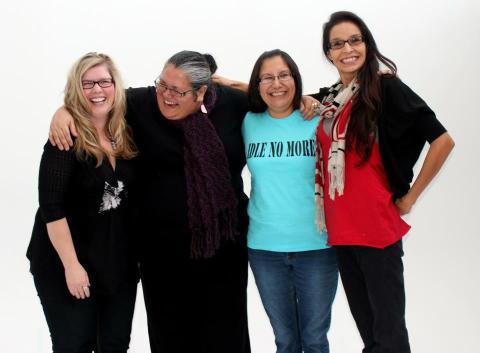
Idle No More Founders

Idle No More Founders

Taking specific aim at an omnibus bill in the Canadian Parliament, known as Bill C45, the women began teach-ins and protests around their homes in northern Canada.  Word spread quickly across North America and beyond via social media channels, and a global solidarity movement was born.

Idle No More protest in Toronto last month

Idle No More protest in Toronto last month

According to the Idle No More website, this is what happened:

 Bill C45 brings forward changes specifically to the Indian Act that will lower the threshold of community consent in the designation and surrender process of Indian Reserve Lands. 

Sheelah McLean reminds us that the bill is about everyone.  She says “the changes they are making to the environmental legislation is stunning in terms of the protections it will take away from the bodies of water – rivers and lakes, across the country.”  She further adds, “ how can we not all be concerned about that?”

The Idle No More efforts continued in Alberta with an informational meeting held at the Louis Bull Cree Nation.  The organizer for that event, Tanya Kappo, took to Twitter and Facebook to help generate awareness on the matter as the passage of Bill C45 was imminent. 

Kappo says, “the people in our communities had absolutely no idea what we were facing, no idea what plans Stephen Harper had in store for us.”  The events leading up to the National Day of Action have been focused on bringing awareness to people in First Nations communities and the rest of Canada. 

Jess Gordon says, “The essence of the work we are doing and have been doing will remain a grassroots effort, and will continue to give a forum to the voices of our people.”

When Bill C45 was brought to the House of Commons for a vote, First Nations leaders demonstrated that they are hearing these voices loud and clear.  They joined the efforts against Bill C 45 and went to Parliament Hill where they were invited into the House of Commons by the New Democratic Party. 

However, they were refused entry.  This refusal to allow First Nations leadership to respectfully enter the House of Commons triggered an even greater mobilization of First Nation people across the country. 

Nina Wilson says, “what we saw on Parliament Hill was a true reflection of what the outright disregard the Harper Government has towards First Nation people.”

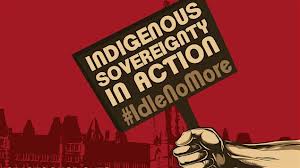
With the passage of Bill C45, Idle No More has come to symbolize and be the platform to voice the refusal of First Nations people to be ignored any further by any other Canadian government.
Unknown

Yesterday I happened to catch a call-in program on the CBC (Canadian Broadcasting Co.) on the Idle No More protests, which have apparently taken most Canadians by surprise.  The host interviewed a representative of the Canadian environmental protection agency, and it was shameful to listen to the way he sputtered when asking whether the bill in question really would result in damaged waters and fisheries.

Although he refused to come out and say it, the short answer was clearly, “Yes.”

As always, for mainstream politicians and businessmen the lure of short-term profits outweighs longterm planning for the health and welfare of the planet and her denizens.

Some of the callers on the CBC program displayed evident racism in their attitudes towards the Native peoples behind the Idle No More protests, which have blockaded railways and highways in recent weeks, in an effort to gain the attention of the Canadian prime minister, Stephen Harper.

Attawapiskat Chief Theresa Spence

Attawapiskat Chief Theresa Spence

One Native Chief, Theresa Spence, has been on a hunger strike for nearly a month now, her immediate goal simply being an audience with Mr. Harper and a chance to present the First Nations case.  Harper has finally agreed to meet with Spence and other chiefs, on January 11, 2013, one month after she started her hunger strike.

Spence is a controversial figure in this movement, which began with a grassroots coalition and has displayed some reluctance to let the indigenous chiefs steal the thunder.

There have been rumors of corruption among the chiefs, including Spence herself, who has just now, conveniently enough, been subjected to a humiliating government audit of her finances.

It’s not clear whether all the chiefs are truly after the protection of the environment, or if they just want to have their fair share of the economic action when it comes to the rapid development of Canada’s northern territories.

What is clear is that the immense land and resource grab in the Americas, which began with the colonial conquests and has continued to the present day, provides short-term financial gains for the few—mostly non-indigenous corporations and financiers—while the majority of Native peoples languish in poverty, sitting on environmentally devastated lands.

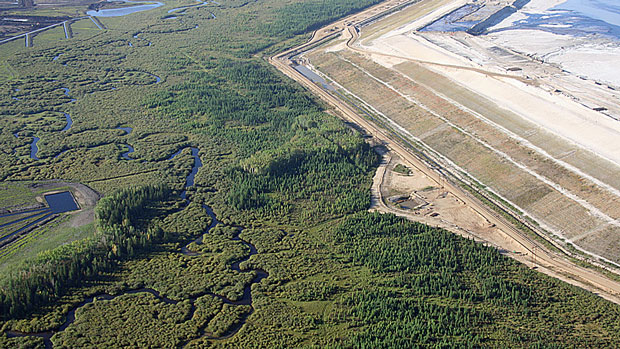
Aerial view of Alberta tar sands development, aka the destruction of the Alberta boreal forest. (Global Forest Watch Canada)

Aerial view of Alberta tar sands development, aka the destruction of the Alberta boreal forest. (Global Forest Watch Canada)

In case after case worldwide, rapacious corporations sweep in, negotiate favorable leases on the land, extract the resources and move on, leaving behind a toxic, degraded landscape and a broken people.

Now we have finally come to the time when it is becoming obvious that the damage that is being wreaked on people and their environments in specific parts of the world is not just “their own problem.”

As the founders of the Idle No More movement correctly perceived, if the waters of Canada are not protected, it will affect all Canadians, not just the First Nations folk who sit closest to those waterways.

If the boreal forests of northern Canada are razed, it will affect the entire planet, just as the steady destruction of the rainforests in the southern latitudes is inexorably destabilizing our climate worldwide.

It appears that our politicians only understand the language of dollars and cents.  In New York and New Jersey now, a serious discussion is underway about how to pay for the cost of adapting to the climate change that almost everyone sees now as inevitable.

Yes, we have to adapt, we have to mitigate the damage by changing the way we develop our coastlines.

But we also have to adapt our mindsets when it comes to “development of natural resources”—a green-washed euphemism for what has really been “the wholesale destruction of the planet.”

This is as true for the destruction of the boreal forests of Canada as it is for the fracking of the Marcellus Shale in the U.S.

If the real costs of this kind of destructive “development” were added up, no sane financier or politician would be able to support such a suicidal undertaking.

If our politicians and business leaders want to commit hari-kari by reckless short-term myopic thinking, good riddance to them.

But they have no right to take the rest of us along with them.

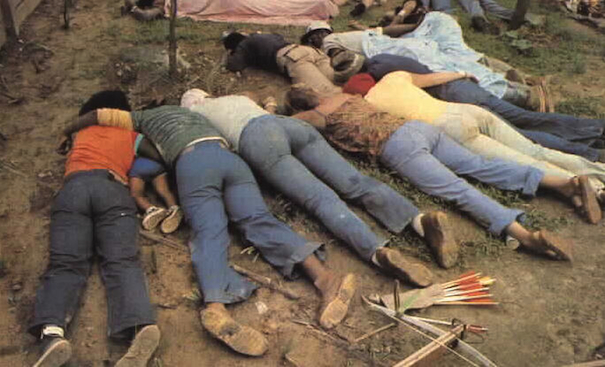
It reminds me of suicide cults like the infamous one in Jonestown, Guyana, in the 1970s.  A whole group of people was so taken in by the charismatic leadership of their guru, Jim Jones, that they obeyed his order to commit ritual suicide.

Victims of the Jonestown suicide cult

Victims of the Jonestown suicide cult

In our case, it’s the entire global capitalist leadership that has us all in thrall. We have been seduced, charmed and entranced by the siren call of “development,” which has given mainstream North Americans—the ones who agree to play by the rules—the benefits of a comfortable lifestyle.

The hidden underbelly of this lifestyle—the environmental destruction, the extermination of thousands of species annually, the annihilation of entire groups of indigenous peoples worldwide, the irrevocable destabilization of our climate—is now coming into view, thanks in large part to the democratization of the media through the World Wide Web.

I continue to believe that when ordinary, good-hearted people understand their own role in this planetary destruction, they will stand up and insist, like the four women who founded Idle No More, that enough is enough.

The question is, how far will we be willing to go to insist that our leaders respect our values and stop dragging us down the road to ruin?

How far will we have to go?

“Never doubt that a small group of thoughtful, committed citizens can change the world. Indeed, it is the only thing that ever has.”

–Margaret Mead

Earth to Obama: Come in please! Or do we have to take to the trees to get your attention?

Of course I knew it would be too much to expect President Obama, during the second Presidential debate on Tuesday, to actually break the great taboo of contemporary American politics and mention—Shhhh—climate change.

But I didn’t expect him to come out pandering so shamelessly to Big Fossil Fuel.

Yes, he managed to create a mild distinction between his position and his opponent’s.

Romney is 100% for exploiting fossil fuels as fast as we can possibly get them up out of the ground.

Obama, on the other hand, is 100% for exploiting fossil fuels as fast as we can possibly get them up out of the ground.

And oh yeah, he’s not against throwing a little money at solar, wind and biofuels (let’s not even talk about how destructive existing biofuels like ethanol have actually been on multiple levels—let’s give the guy a break).

While Romney just wants to hammer home the assertion that his Administration will bring us lower gas prices (no doubt as a result of all the frantic drilling he intends to support), Obama is interested in encouraging conservation by raising fuel economy standards, an idea right out of the late 1970s if I ever heard one.

A 21st century idea would be to get rid of oil subsidies and insist that the price of gas and oil reflect the true costs of its production and consumption, which are actually way higher than whatever the current price of a gallon of crude might be.

Then there’s coal, which both of these guys are apparently in favor of continuing to exploit.  Did someone say “mountaintop removal”?  Just point Romney/Obama at the mountain, and let’s go!

The nadir of the whole energy discussion of the second Presidential debate came when, in response to a little goading from Romney, Obama said he was “all for pipelines.”

In nearly the same breath, he proudly proclaimed that his Administration has supported lots of oil and gas drilling on public lands—how many leases, and what percentage of increase or decrease they may represent from the Bush years, may be a bit fuzzy, but the gist is clear: both Romney and Obama are all for opening up our public lands to drilling, in the name of energy independence from foreign fuel sources.

Oh Lord. The truth is that our dependence on so-called foreign fuel suppliers (who are mostly multinational corporations anyway) is the least of our worries.

The one thing we most need to be focusing on is the one thing that no one wants to deal with at all.

The effect of global heating, caused by the ever-escalating burning of fossil fuels worldwide.

And instead of working soberly and swiftly to turn the climate juggernaut around, our politicians are acting like easy-going traffic cops, just waving those bulldozers and oil rigs right on through.

***

Take the Keystone pipeline, which both Romney and Obama were unabashed in supporting.

Did you know that right at this moment, there are dedicated Earth defenders sitting in trees in Texas, trying to block the construction of the southern leg of the Keystone XL Pipeline?

Daryl Hannah at Keystone XL Pipeline protest, October 2012

Why?

Well, you probably realize that the bitumen that pipeline is designed to carry is so thick and sludgy that it has to be mixed with toxic chemicals in order to make it flow.

You’ve probably heard about the damage that could be caused by a spill from a pipeline like this, if the chemicals leaked into the major aquifers that are along the way.

This on top of the destruction of the forests that is already happening on a vast scale to get those “tar sands” out.

On top of the chemical contamination of our aquifers from hydro-fracking for gas.

On top of mountain-top removal and strip-mining for coal.

On top of the whole lousy cap and trade system, by which dirty Northern-hemisphere commercial polluters can continue to pollute as long as they buy credits in Southern hemisphere forest preserves—except that what’s actually been happening is that first they buy the preserves, then they log them, then they replant with palm oil trees, heavily sprayed with pesticide, herbicide and fungicide to keep the rainforest from returning, and then they proudly collect their credits for having maintained some semblance of soylent green!

All this is the reality behind the puffery that passed for politics at the debate last night.

What is our national energy policy?  For both the Republicans and the Democrats, it’s drill faster!  Drill harder!  Drill everywhere possible!

President Obama chided his opponent at one point for thinking only of short-term prospects.

“We have to think about what’s coming in 10, 20, 30 years,” he said, the implication being that we shouldn’t entirely neglect the prospects of wind and solar energy.

But the truth is that if we continue drilling at the rate both candidates support, there won’t be a stable environment left to build an alternative energy future for our grandchildren and future generations.

They won’t be building wind turbines and solar panels in 2050, they’ll be building underground shelters and modern-day Noah’s arks.

***

Still, yes, I am going to go grumbling to the polls on Nov. 6 and pull the lever for Obama.  There is no question in my mind that he is the better man.

I understand that right now he is trying to walk the centrist line and please as many American constituencies as he can.

But once re-elected, he must be pushed to take a stronger stand on environmental policy, including energy policy.

If that means that more of us have to take to the trees in protest, well, so be it.  I always did love climbing trees!

Will the Eagle and the Condor Land Together in the New Millennium?

At the Peace and Justice Studies Association annual conference, held this week at Tufts University with the theme “Anticipating Climate Disruption: Sustaining Justice, Greening Peace,” I presented a paper entitled “Changing the narrative and crafting alliances between Western and indigenous worldviews to create a sustainable global future.”

In it, I sketched out the standard Western triumphalist narrative of technological domination of Nature and the New World, starting with the voyages of Columbus and Darwin, continuing with the Manifest Destiny doctrine of the takeover of North America, and on into the present, where we continue to tell ourselves the story of living happily ever after in the brave new world established by the subduing and harnessing of the natural world, the routing of resistance, and the triumph of a technologically advanced global civilization.

Given that the premise of the conference theme anticipates serious climate disruption that will take the story to a very different, and much less rosy kind of conclusion, it’s clear that we need to start telling ourselves stories that reflect a different kind of understanding of our relation as humans to the natural world.

The kinds of stories we need to embrace are not new; in fact, they are ancient. I believe that the indigenous peoples left on the planet, who have survived the intense onslaught of Western culture over the past 500 years, are in the best position to survive the coming cataclysms, and to teach us how we can survive too. We just need to start listening to the stories they tell, rather than remaining spellbound by our own Western narratives.

I shared with the audience the voices and visions of two indigenous elders, Rigoberta Menchu Tum of Guatemala and Malidoma Some of Burkina Faso, who have both spent much of their adult lives reaching out to Westerners, trying to get us to see our relation to the natural world in a more holistic, less destructive way.

Rigoberta Menchu

Menchu, who won the Nobel Peace Prize in 1992 and ran for President of Guatemala in 2007, was a leader in the pan-indigenous drive to get the Declaration of the Rights of Indigenous Peoples ratified by the General Assembly of the United Nations, which it finally was in 2007.  She has worked tirelessly to promote the rights and improve the living conditions of the indigenous peoples in Guatemala, who are a majority in that country, but have little national political representation or power.

Central to Menchu’s political activism is her Mayan understanding of the importance of ecological balance.  “An indigenous people’s cosmovision is centered on their relationship with Mother Earth and Mother Nature,” Menchu says.  “In contrast, the majority of the world doesn’t give it a thought, doesn’t know what the source of life is.  They pollute the earth and do more and more damage.  One day the earth will exact a price for this disdain and destruction. When this happens, we will see that the earth is not just good and bountiful, it can also be vengeful.

“Indigenous people see Nature as a living mother, not as an inert organism that would allow itself to be destroyed,” she continues.  “All those who violate its laws must accept the consequences, because it is alive and will react. My grandfather always used to say that the day human beings violate our universe, they will receive signs and messages.  These messages will be very forceful, and will bring severe punishment.”

These words of Menchu’s come from her second book, Crossing Borders, in which she tried to reach out to the non-indigenous world with a challenge to the dominant narrative of “development,” which has been so terribly damaging not only to indigenous peoples, but to the ecological web of life itself. As she remarks bitterly in the book, “I often wonder why people criticize the Aztecs for offering human sacrifices to their gods while they never mention how many sons of this America…have been sacrificed over the past 500 years to the god Capital.”

These biting words would no doubt resonate with Dagara shaman Malidoma Somé, who was taken as a child by Catholic missionaries to be educated at their school some hundred miles from his village, and was not allowed to go home to visit his family or village for 20 years.

Malidoma Some

On the point of being sent to France to finish his Catholic education, he rebelled and ran away from the missionary school, somehow finding his way back to his village on foot, unaided.  Once there, he insisted that he be given the initiation he had missed out on, and he started on the path to becoming a traditional shaman, or healer.

His healing practice has taken the form of trying to reconnect Westerners with the indigenous knowledge that our culture long ago left behind and rejected as “primitive.”  Malidoma, whose name means  “he who makes friends with the stranger/enemy,” spends much of his time in the U.S. and traveling around the world, guiding groups of Westerners into a different kind of understanding of self, community, and natural world.

Both Menchu and Malidoma stress that they do not reject all of Western technology —just the way it has been used, and the narrative vision that guides and undergirds it.  “What indigenous and Western peoples have in common is the desire to understand the intricacies and complexities of the world we live in, and to harness the power of nature for certain practical purposes,” Malidoma says in his book The Healing Wisdom of Africa.

“Where we have taken different routes, however, is the context within which we have developed our technologies and the purposes for which we have used them.  In the West, technology is oriented toward industrial, commercial and military uses; among indigenous people, it serves to heal and help people remember and fulfill their purpose in life.”

Malidoma continues, “Individuals, as extensions of Spirit, come into the world with a purpose. At its core, the purpose of an individual is to bring beauty, harmony and communion to Earth.  Individuals live out their purpose through their work.  Thus the human work of maintaining the world, to indigenous people, is an extension of the work that Spirit does to maintain the pulse of nature.  The villager’s quest for wholeness is an extension of nature’s wholeness.”

Both Malidoma and Menchu describe a human relationship to the earth rooted not in dominion and conquest, but in a cyclical give and take that takes ecological balance as a core value.

I believe that theirs is the vision that must animate the narrative arc of our future as a species on the planet, if we are to survive the environmental challenges that are speeding towards us now.

The good news is that though you won’t find much about this in the mainstream media, there is a quiet but forceful movement building on several fronts that is heeding the call to craft a different kind of human life story.

There is the Transition Town movement, which is imagining communities that are less dependent on multinational corporations, and more interdependent as individuals and cooperatives working together to meet needs on the local level.  And there is the Pachamama Alliance, which I talked about in my Tufts presentation, which has been partnering with indigenous peoples to, as they put it, “change the dream” of Western-style domination, development and destruction.

The Pachamama Alliance is quite remarkable in that it sees itself as a solidarity movement guided by its indigenous partners, the Achuar and Shuar peoples of the Amazon rainforest in Ecuador.  It grew out of the connection with indigenous shamans established by John Perkins, who began in the 1990s to bring small groups of Americans and Europeans into the Andes and the rainforest to meet with indigenous shamans to learn a different way of understanding our relationship to the natural world.

Ecuador is one of the most beautiful places on earth, but is also one of the places that has been most devastated by the plundering of oil companies, specifically Texaco and Chevron.  Millions of acres of rainforest have been polluted by oil spills and the byproducts of unregulated drilling—and a landmark case has just been won against Chevron, ordering the company to pay $18 billion in damages to Ecuador for a clean-up.  The case is still in litigation, and meanwhile the people there are coming down with cancers and birth defects in astronomical numbers.  It is truly a place where you can see the worst conclusion of the Western narrative of development in action.

But it is also a place where another story is being told, and broadcast out into the world with increasing urgency.  It is a story that has been told by indigenous peoples of South America and beyond for hundreds of years.

According to the ancient prophecy of the Eagle and the Condor, which animates the work of the Pachamama Alliance, we are at a moment in history when the Eagle – representing intellect and the mind – and the Condor – representing wisdom and the heart – must come together to ensure the continued existence of humankind.

The human intellect and heart must realize that without the natural world we are nothing.  All the computers and synthetic chemicals and megawatts of electricity in the world will not enable us to survive in a world without plants and insects and animals.

It is that simple, and we know it scientifically, but we have not yet absorbed it in our hearts, and put our knowledge into practice in a different way of relating to the natural world.

So the question going forward, as Menchu so pointedly asked, is:

Will we sacrifice ourselves and most of the life forms currently on the planet to the great god Capital?

Or will we begin to understand wealth in a more balanced, ecologically sound way?

Will we have the strength to build a groundswell of resistance to the top-down hierarchies that hold such sway over our lives and the narratives we live by?

I believe we can do it.  I want to believe that we will.

If I had been asked to speak at Commencement….

This is what I would have said:

It’s become a cliché to say that every day is the first day of the rest of your life, and yet like most clichés this one holds truth to it.

When you walk down that aisle today holding your B.A. diploma, achieving a goal which you have worked towards for many years, you will be stepping into your adulthood with all the rights and privileges, but also all the responsibilities that this maturity brings.

The year 2012, long prophesied as a time of great change and transition, is not an easy time to be reaching adulthood.

I don’t have to tell you that times are tough economically, or that our planetary environment is facing its own severe shifts due to anthropogenic global heating.  You have probably heard tell of a “sixth great extinction event” on the horizon, if climate change projections continue unabated on their current course, causing the heating and acidification of the oceans and resulting drought, floods and violent storms on land.

Most of us “know” about these issues the same way we “know” that toxic chemicals in our food, water, air and household products cause cancer.

We do our best not to think about it too much, because thinking about it just makes us scared and depressed, and what can we do about it, anyway?

I want to suggest to you, as you step out into the world this afternoon with your newly minted B.A., that you are stepping into an unprecedented opportunity to do more than any previous human generation has ever done.

It is not an exaggeration to say that you have the opportunity to turn this great Titanic of an earthship around, sailing her away from the iceberg and into safer waters.

There have been “greatest generations” before now.  But their challenges have been far less global and all-encompassing than the challenges we face now.

Now it’s not just a nation or even a group of nations that are faced with disaster.  It is the entire globe, human civilization writ large, which could in fact be toppled if the earth gives a great climatic shrug of her shoulders and goes back to the evolutionary drawing board.

Even the most sober earth scientists are predicting that if we do not change our habits of carbon emission, the resulting global heating will make the world uninhabitable for some 90% of current species on the planet by the year 2050, including 90% of current human populations.

I lay this out for you starkly not to depress you on what should be a happy and auspicious day, but to impress upon you the importance of the decisions you will be making and actions you will be taking in the coming years.

While it is true that lifestyle changes of individuals can only have limited effect on climate change, they are a start.  We can choose to support alternative energy whenever and however possible.  We can choose to push our elected representatives to shift subsidies and incentives away from fossil fuels and towards renewables.  We can encourage sustainable agricultural practices in our own communities and through our consumer choices.

What I would ask of you above all is to stay informed and engaged with these issues as you move forward into adulthood, and seize all opportunities to push governments and corporations to do the right thing not just for the bottom line or the national interest, but for the good of our planetary home and her current life forms, including humanity.

I am not proud of the condition of the world that my generation is now handing off to you.  I am not proud of what I and my cohort have allowed to happen on our watch.

The past cannot be undone.  But the future is yours to shape.

Don’t be afraid to try out completely new ideas. Listen to your dreams, listen to your intuition.  Be alert, be thoughtful, be creative.  Tune out the background buzz that will try to lull you into complacency and inaction.

I hope that when it’s your turn to witness your children stepping out into their adulthood, you will be able to be proud of the world you have created for them.

Truly, their future is in your hands.

Occupy Earth

In the week since the Occupy May Day General Strike, I’ve been thinking a lot about the impact of the event.

Friends who were in New York City that day say it was tremendously exciting, especially the permitted march from Union Square to Wall Street, which apparently stretched out strong over some 30 blocks.

As far as I could tell, mainstream media reported only the arrests that occurred, and that fairly grudgingly.  There has been little effort to explain or explore the anger and frustration that propelled hundreds of thousands worldwide out into the streets on May Day.

Maybe that’s because it’s an old story.  Yesterday’s news!  We know that students are unhappy about being $1 trillion in debt; we know that millions of homeowners are unhappy about being “underwater” with their mortgages, or losing their homes due to foreclosures.  We know that there aren’t enough jobs to lift our economy out of the doldrums.  It’s old news, people!  Tell us something we don’t know!

So the question becomes, is a protest effective if it is ignored by the mainstream media?

I would say yes: the fact that the MSM treated May Day as unimportant is more revealing of how out of touch the editors are than of whether or not the protest was real and meaningful.

On social media, May Day was well covered, especially at interactive, citizen journalism-type venues like Livestream and Twitter.

And if you go on the Occupy Wall Street site now, you’ll find that the organizers are already bounding on to the next action.

May Day was just one in a whole series of protests planned. It was an opening volley of what promises to be an intense, engaging spring.

But it opened up a question that is not likely to go away any time soon.

How important is it to actually show up, in the flesh, for a protest?

I was berated by one reader for choosing to stay in my classroom on May Day rather than joining the protests.

Other readers expressed their support for my decision to “occupy my classroom,” where my individual presence was perhaps more important than it would have been as an anonymous member of the crowd on Broadway.

I have been pondering this question in the past week.  As someone who is deeply involved with new media, I have to say that I believe that what happens in cyberspace is at least as important as what happens in physical space.

Maybe it’s even more important.

It is no exaggeration to say that millions of people participated in the May Day protests online, via Facebook, Twitter, Livestream and so many other interactive platforms.

The protests spread around the world, just like the May 5 “Connect the Dots” climate change awareness events.

Through the magic of cyberspace, we were all united in a common goal: expressing our outrage over the cynical manipulation and impoverishment of the 99% by the 1%, and demanding that the interests of the 99% be taken into account in matters of political and economic policy.

Although I have no doubt that face-to-face General Assemblies and marches are important, it is ridiculous to discount the impact of what goes around and comes around in cyberspace.

Are we approaching the weird tipping point when our cyber-selves will be more important than our physical selves?

As I keep reminding people, cyberspace is totally dependent on electricity for its existence.

So if we want to preserve cyberspace as a place of radical openness, communitarianism and oppositionality, it behooves us to pay attention to the real 99% in the current equation: the natural world that has been providing us with the means to create the current that runs the virtual world.

I might be tempted to buck my agoraphobia (fear of crowds) and make the leap from cyber-protest to physical protest if the goal were defending not just jobs or homes or social equality, but the underpinning of it all, the great mother herself, our beloved community, our Earth.

To Avert Climate Change Disaster, Connecting the Dots Must Go Viral

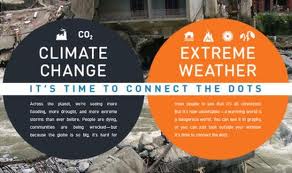
As of 8:30 a.m. EST this morning, 10,000 Facebook folks had already “liked” the new 350.org “Connect the Dots” campaign, which encourages people around the world to connect the dots between climate change and extreme weather.

That’s a good number of “likes.” But what we really need is for the concept to go viral, the way the Kony 2012 campaign did a few weeks back.

It will require the attention of millions of people, particularly those in the driver’s seat of climate change—that’s you and me, my fellow Americans—to turn this global heating juggernaut around.

Lately I can’t seem to stop asking myself why it is that so few people I know are willing to focus their attention on the crucial issues of our time: climate change, the chemical poisoning of our environment, the steadily accelerating wave towards what scientists call “the sixth great extinction event on Earth.”

I often feel like Cassandra of Troy, who was able to see disaster in the future of her beloved community, but was under a curse, imposed by the god Apollo, of never being believed or listened to.

It’s not so much that people don’t believe what’s coming (although we certainly have our share of climate change deniers in the U.S.)—it’s that they just don’t want to hear it.  They don’t want to know.

Maybe this is simply the animal in us coming out.  Like my peaceful dog, who sleeps by my side without any thought or concern for the future, we humans focus on the immediate tasks at hand—making a living, bringing up children, keeping the house clean, exercising, shopping, planning birthday parties, you name it—and we get so wrapped up in all that busyness that we are able to blot out the daily dying screams of millions of birds and animals, the rip and tear of millions of acres of forest going down before the chain saw and bulldozer, the sobbing of millions of children who go to bed hungry every night, the ever-increasing militarization of our world civilization, and the sinking knowledge that those in control of all those weapons and surveillance systems do not stand for good.

Sometimes I really envy my friends and neighbors who are able to cheerfully ignore what’s going on in the background, and focus on making the best of each day they’re given.

Sometimes I think that’s what I should be doing too.

Why torment myself with the constant awareness of spiraling crisis, especially if I can’t do anything about it anyway?

But there’s the rub.  I do have something to offer to the fight to connect the dots and raise the necessary momentum to push Americans, potentially the most powerfully innovative, can-do people on earth, off their couches and out into the trenches of turning this crisis around.

I have my voice, which thanks to the internet can be amplified around the world and swelled into a great chorus that cannot be ignored.

Over the last few years, I have made a study of change agents—otherwise known as activists.  I know full well that every single one began as I am beginning, just sitting with the burning knowledge that things are not right, and that change is possible.

The great Bill McKibben began his climate change work in his classroom, working with a group of tech-savvy college students who realized that the Web could be used to raise awareness about the necessity of keeping carbon emissions to under 350 ppm in order to head off extreme and irrevocable climate change.

In 2007, Bill and his students launched the first iteration of 350.org and were off and running, using the incredible tools of social media to connect people, places and events all over the world.

This is the thing.  We have the ability, as never before, to see the Earth as a whole system; to understand that every creature and community on the planet is vital to the functioning of the whole and has the right to a peaceful, prosperous life.

We as humans have the ability to distinguish between right and wrong, and we know full well that the damage we are causing with our reckless, destructive, indifferent ways is wrong.

We need people from all over the world, but especially Americans and Europeans, who have been responsible for so much of the damage, to come down on the side of right, on the side of life, on the side of justice.

Yes, it’s going to mean making lifestyle changes.

Yes, it’s going to take some focused attention on the local, national and international levels.

But if we do nothing—if we continue in our unconcerned merry ways, too busy and distracted to get involved—then we will wake up one morning facing some much more severe lifestyle changes.

One morning it will be us waking up to a howling tornado flattening our town, or a raging flood sweeping away our Main Street, or an oil slick blackening our local beach, or a spike in food prices that makes even the basics no longer affordable.

It’s time to connect the dots, people, and pay attention.  Add your voice to mine, and let’s go viral with a campaign for a sustainable planetary future that cannot be ignored.

Loving Earth

To save the Earth, we must fall in love with her, writes Robert Koehler, taking his inspiration from the work of Charles Eisenstein, author of Sacred Economics.

Koehler and Eisenstein say that in the trajectory of human evolution, we have been locked in the selfish adolescent phase for a long, long time, just seeking to take what we need from our Earth mother, without thought of giving much in return, or of the reality of finite limits.

When we fall in love, Eisenstein says, “perfect selfishness falls apart as the self expands to include the beloved within its bounds.”

I remember falling in love like that as an adolescent, and as a young adult too.

It’s true that when you’re in love, the boundaries between the self and other dissolve, and you exist in a harmonious utopia of mutual beneficence.

But at least for most of us fallen humans, that kind of all-encompassing love doesn’t last forever.

It can’t.  It’s too intense.  Eventually the first ecstatic glow fades and the angelic beloved assumes normal, human proportions, with all the associated warts and odors and quirks of behavior and thought that our human bodies and minds possess.

What happens to love then?

If we are compatible for the longterm, the initial heady crush transforms into a much more solid platform of respect, shared interests, and deep concern for each other.  We care about each other, we enjoy being together no matter what we’re doing, and we respect each other’s views, goals, and talents.

We become partners in the truest sense of the word.

Is it necessary to go through the romantic, boundary-dissolving “falling in love” stage to get to the mature relationship of partnership?

In our culture, we believe it to be.  Our young people, tutored by every aspect of media and pop culture, assume that being swept away with love is a pre-requisite to successful marriage.

And yet how many of their parents, who followed that same script, ended up in bitter divorce fights?

Although I understand the intent behind Koehler’s and Eisenstein’s valorization of “falling in love” as a model for the depth of passion needed to fuel successful environmental action on behalf of the Earth, I am not convinced that this is the right message to be sending.

Young people today may still harbor romantic dreams, but they live day-to-day in a casual hook-up culture that prides itself on separating sexual enjoyment from commitment.

Fifty percent of their parents have made the journey from early romance to disillusioned divorce.

Another 25% or so of adults are either unhappily married, or unhappily single.

The “falling in love” model thus hits home with too few Americans to be effective as a rallying call for environmental action, and it is too limited a metaphor for the depth and breadth of passion that we must summon now to be effective Earth stewards and activists.

Instead we must love with the unconditional devotion of a mother for her child, with the sincere, selfless wish to see that new life grow and prosper and move forward beyond us.

We must love the Earth with the intensity of devotion that recognizes that for her to thrive, it may be necessary for us to part.

Earth has loved us with this kind of pure altruism all these many years of human emergence.  Now, as in the terrifying story of The Giving Tree, she has given so much that she has practically sacrificed herself entirely.

Nothing we can do to the Earth will wreck her forever.  Forever is a long, long time, in geologic terms.

But there is still time to shift from heedless destruction to the kind of loving tending that the Earth herself has modeled for us all these years.

There is still time to develop the kind of deeply caring reciprocal partnership that will last a lifetime, and beyond.