Opening to the energy that can change the world

In the course of any given day, I swing from hope to despair and back again at least three or four times.

On the one hand, it’s such an amazingly hopeful and alive time in terms of communication and discovery.  We are constantly learning so much more about our relationship with the natural world and with each other.  Every day brings fresh evidence of the myriad ways in which we are deeply interconnected with all Earth systems and with other Earth-based creatures.

On the other hand, that knowledge does not seem to be adding up to practical change in the real world.  Every day thousands of acres of virgin forests are cut and bulldozed.  Every day drills open up new spigots for deeply buried oil and gas deposits, which can only be extracted at great risk to the surrounding environment. Every day more chemicals are wantonly spread over the landscape and taken up in the bodies of mammals like us, as well as birds, fish and all the other creatures of the land and sea.  Every day hundreds of species, including us humans, move inexorably closer to extinction.

Why is it that despite all we know about the crucial importance of protecting our planetary home, we continue to desecrate and destroy it at ever-increasing speed?

Maybe the answer has something to do with that “we.”  Maybe the “we” who know that our survival as a species depends entirely on our responsible stewardship of the environment just isn’t the same “we” that is out there with the chain saws and the bulldozers.

Maybe the great challenge of our time is getting through to those other people, the destructive ones, the violent ones, the ones who do not seem to be able to perceive the bigger picture and how urgent it is now that we—as a global human civilization, united in our desire to survive and thrive on our finite planet—begin to practice radical sustainability at an accelerated pace.

The stakes are huge.  At this week’s international “Planet Under Pressure” conference in London, the stark statistics were rehearsed yet again.  They’ve gotten so familiar to me that I probably mumble them in my sleep every night.  The new video “Welcome to the Anthropocene” does an excellent 3-minute job at summarizing what we’re up against.

Still image from "Welcome to the Anthropocene"

But knowing the statistics and seeing what’s wrong is not at all the same as knowing what to do to make things right.

It’s so hard to know where to put one’s energies.

Do I go full-bore at the sustainable energy issue, following Bill McKibben?  Maybe a hunger strike in front of the White House would be an effective protest against the Keystone XL pipeline?

Do I go chain myself to a tree in the Amazon or in the rainforest of Indonesia, to protest the deforestation that is depriving us of the vital lungs of our planet?

Should I use my skills as a teacher to try to rouse the young people from their media stupor, using whatever scare tactics are necessary to get their attention and galvanize them to action?

Should I just be out there practicing “re-skilling,” in the Transition Town vernacular: relearning the old skills of surviving off the grid, living leaner and closer to the land that sustains us? Is it time to learn to keep chickens and pigs in my backyard, and finally set up the bee hives I’ve always wanted?

Or maybe I should be up on a mountaintop meditating and communing with the natural world, seeking the vision that will eventually show me the light?

What is it that I should be doing with this one wild and precious life I’ve been granted, in this fast-moving, tumultuous, unpredictable time in our planetary history?

Asking these questions is all I can do right now, just keep asking them and pondering and feeling my way towards my role in what lies ahead of us all.

I want to make an offering of my life.  I want to be a channel through which the positive, loving energy of the universe can flow out and make things right again with our world.

An Unlikely Environmental Evangelist

There were two reasons, many years ago, why I ended up choosing literature as my field of study rather than environmental studies or law.

I was turned off from environmental studies, my initial choice for an undergraduate major, by a scary required statistics class and no options for getting remedial help to bring my weak math skills up to speed.  I ended up with a B.A. in English and Journalism.

I briefly flirted with the idea of law school after college, but could not fathom spending the rest of my life reading and writing legalese.

So I gravitated towards literature, comparative literature, literature of the world, and my dissertation focused on testimonials and political personal narratives of the Americas.  I knew early on that what interested me most about literature was opportunity it presents for passionate narratives about the intersections of the personal and the political.

That has remained my interest all these years later.  But it has finally become clear to me, over the longer arc of my life, that my early, instinctive connection to the natural world, my recognition of the importance of law, and my duck-in-water ease with the discourses of both journalism and personal narrative, are all finally coming together in what I see as the imperative task to which I must dedicate the last third of my life: awakening my fellow and sister human beings to the urgency of heading off climate catastrophe.

If this sounds like a moral crusade, well, so be it.

I was not raised in any religion, nor do I follow any religious practices now.  I don’t believe in God as a benevolent white man in the sky, nor do I believe that one needs to sit in a particular building, listening to a particular preacher, to reach out to the divine.

But I have always felt a deep spiritual connection to the natural world.  When I was 8 or 9, I used to go out into the woods and sit alone in my “spot,” which was a circle of mossy stones at the top of a big stone ridge, ringed by maples and centered around a grassy glade.  It was a small circle, no bigger than 10 feet in diameter.  I would just sit there and look and listen to the birds in the trees above me, the small insects on patrol in the grass, feeling the wind ruffling against my face and a kind of inner exultation and delight that I can only describe as religious ecstasy.

No one taught me to do this, and it wasn’t until much later, reading personal narratives by indigenous elders, that I was able to put this early spiritual connection with nature into a broader polytheistic cultural framework.

I believe that everything in our world is tinged with spiritual significance.  And I believe that human beings, because we are unique among animals in being able to see the effects of our actions on the larger landscape of the planet, and to both predict and alter the future, have a special moral imperative to do what we can to be the responsible stewards of the natural world of which we are a part.

I have never said that out loud.

But thanks to environmental activist educator Eban Goodstein, I now recognize that this is exactly what I should be doing, whenever I can, as urgently and passionately as possible.

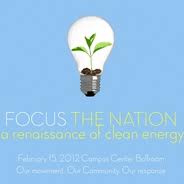
Goodstein, who founded the national organization Focus the Nation and now heads up the Center for Environmental Policy at Bard College, writes in his 2007 book Fighting for Love in the Century of Extinction that it is crucial that people who understand the seriousness of the pivotal moment at which we stand begin to speak up—not in legalese or scientific jargon, but in the clear, ringing tones of moral conviction.

“The real problem that nontheistic environmentaists face is not a depth of passion, but a failure of moral language with which to cultivate and nuture that passion,” Goodstein says.  “Unless passion about life on Earth is nurtured, and mass extinction is understood clearly in terms of good and evil, then political opposition to the great extinction wave of our generation will be weak and it will sweep across the next century unabated.”

Goodstein recommends that each of us “develop a thirty-second ‘elevator speech’ that is a response to the question: ‘Why do you care about global heating?’” What you say won’t be convincing or memorable to people unless you can quickly tell them why this issue is deeply important to you, and why they should also care.

It can’t be a laundry list of words that have been so often used they’ve become clichés: sustainability, clean energy, even droughts or wildfires.  Goodstein suggests that when it comes right down to it, we should care about global heating because it is “just plain MORALLY WRONG” to ignore the prospect of the sixth great extinction of life on Earth, when we not only know it’s coming, but have a pretty good idea of how to head it off.

Given my non-religious upbringing, I’m not that comfortable with the language of good and evil or moral righteousness.  And yet it is no accident that all human religions do codify a moral code that seems to be hardwired into our species.

Goodstein refers to Harvard biologist E.O. Wilson’s 1984 book Biophilia, which set the stage for evolutionary psychology in arguing that human beings have evolved to love life and work to extend life by interacting positively with our environment.

Whether we come at the issue of climate change from a religious perspective (God made us the stewards of life on Earth, we have a moral injunction to protect all God’s creatures) or a nontheistic but nevertheless spiritual reverence for the natural world, or even a simple scientific recognition that the current fabric of our ecosystem will live or die depending on human choices now, there is no doubt at all that each of us needs to get our elevator speech nailed down and go out to become evangelists for the natural world.

I don’t use the term evangelist lightly.  Christian evangelists have a reputation for single-mindedness bordering on fanaticism.  They believe deeply, and they are willing to take the risk of expressing their beliefs out loud, and actively trying to convert others.

I am someone who has been known to hide in my own house when the Jehovah’s Witnesses knocked at the door.  I have never followed any preacher or religious dictate, nor have I ever considered trying to persuade others to any given point of view.

But the situation we face now is unprecedented in my lifetime, or human history as a whole.  It demands an unprecedented degree of commitment.  It demands taking the risk of climbing up on a soapbox and speaking out loudly and passionately enough to draw a crowd.

Those of us who are awake to the gravity of the coming environmental catastrophe need to be getting out there trying to instigate change through every possible channel: electoral politics, grassroots activism, legal challenges, moral persuasion, standing on our heads–whatever it takes to wake people up and get them moving.

So what’s your elevator speech about?  Mine, I think, is about love.

Whether we call it love for God’s green earth, or the love for the natural world, what we mean is the same: love for our children and future generations, who should not be denied the pleasure of listening to birdsong in the trees on a peaceful spring morning, knowing that their world is stable and secure.

Climate Change Denial at the NY Times

I opened up Joe Nocera’s column in today’s NY Times, “The Poisoned Politics of the Keystone XL,” with anticipation, thinking that at last the Times was going to deliver a column roundly critiquing the pipeline and the oil-drenched politics from which it sprang.

My expectations could not have been more disappointed.

To put it mildly, Joe Nocera does not know what the hell he is talking about.  And I have to wonder whether some clumps of sticky tar-sandy dollars might have found their way into his pockets in return for the little PR gift he just gave, with flourishes, to the Canadian oil industry.

You will have to read Nocera’s column for yourself–I really can’t bear to summarize it.  Suffice it to say that he believes that:

  • 1) extracting the Canadian tar sands will make the US, and North America generally, “energy secure”;
  •  2) there is no point in pushing for energy conservation or a shift to renewable energy;
  • 3) Canadian tar sand oil “may be a little dirtier than the crude that pours forth from the Saudi Arabian desert…but is hardly the environmental disaster many suppose”;
  • 4) the US is foolish to cede our interest in this oil to the Chinese.

To which I (and some 300 other respondents to his column on NYT.com, as of this writing) have to say, Joe, are you out of your mind????  Or are you just being willfully blind?

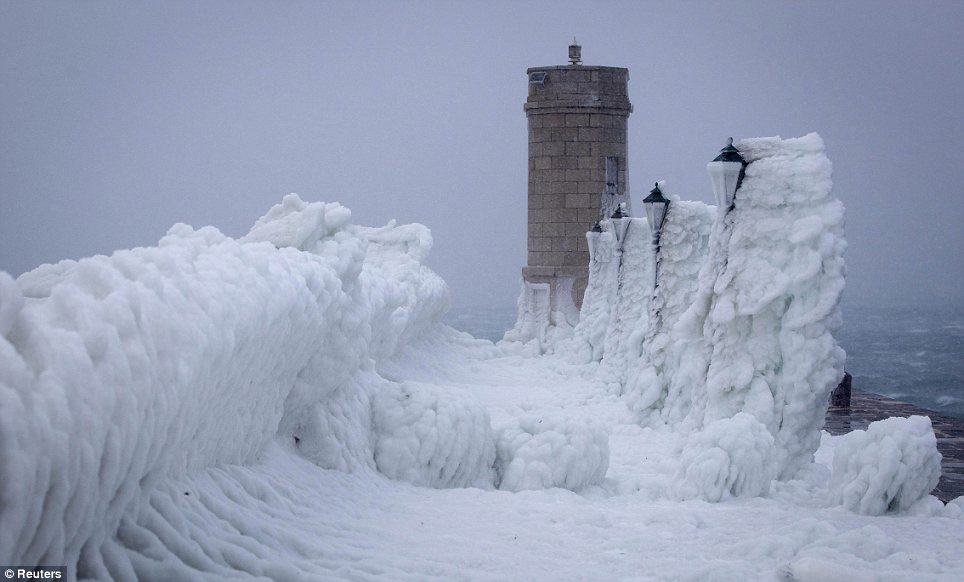
Yesterday I was writing about the holocaust of harp seals in the Gulf of St. Lawrence, where for the past decade global heating has been melting the ice at an alarming rate, leaving newly born seal pups at the mercy of thin, fragile ice floes.  I have also been thinking a great deal about the Little Ice Age that seems to be occurring in Europe this winter.  While we here in New England are enjoying springlike temperatures and a total lack of snowfall, Europe is getting dumped on with snow, and frigid temperatures to boot.

You’ll be hard-pressed to find solid information about this in the NY Times or other mainstream press outlets, but if you look hard enough, it’s there.  Climate scientists are pointing to the steadily melting Arctic ice cap as the culprit in the change in wind and weather patterns that are bringing more extreme weather to Europe–remember the 2010 hot spells that cost hundreds of lives?  This severe cold is also to blame for hundreds of deaths.

Let’s connect the dots.  Tar sands extraction can only be done by burning lots more fossil fuels.  That’s why environmentalists oppose it.  Not so much because of the destruction of millions of acres of pristine wildlife habitat, though that is generally acknowledged as sad collateral damage.

No, the main problem with extracting the Alberta tar sands is that doing so will speed the heating of the planet.  Heating the planet will lead to melting polar ice, rising sea levels, and ever more bizarre and destructive weather patterns.

Heating the planet will lead to death and destruction on a vast scale.

As the authors of a recent Royal Society special issue on climate change put it, if temperatures rise 4°C , “the limits for human adaptation are likely to be exceeded in many parts of the world, while the limits for adaptation for natural systems would largely be exceeded throughout the world. Hence, the ecosystem services upon which human livelihoods depend would not be preserved.”

This is science-speak for a basic premise I think anyone could understand: if the temperatures continue to rise, human beings, and the ecosystems that have evolved alongside us, are TOAST (expletive deleted).

Going full-bore at the Alberta tar sands is signing the final death sentence for millions and millions of living beings on this planet, including millions of human beings.

Humans in heretofore privileged spots on the globe, like Europe and the USA, will not be excepted from the general ecocide.

Do you have any children or grandchildren, Joe?

Can you really in good conscience assure them that selling the Alberta tar sands, to the US or the Chinese, will contribute to their “energy security”?

If you answer yes, then my original hypothesis is confirmed.

You are out of your (expletive deleted) mind.

Dare to love

Like most people I know, I have just a very narrow sphere of knowledge that I’m willing to let penetrate my consciousness at any given time.

There’s so much I know but don’t want to know. So much I choose not to acknowledge.

It’s a form of self-preservation, because if I were to allow myself to really feel the unnecessary pain and suffering that floods our world like an endless terrorized scream into the night wind, all the time…I could not bear it.  I would go insane.

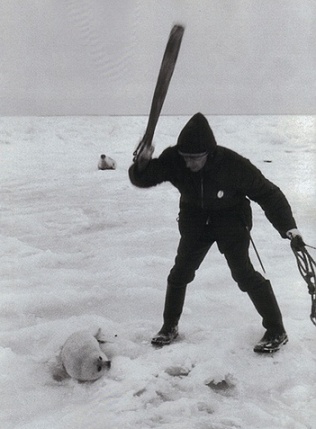
What prompts these reflections today is the news that hundreds of thousands of seal pups are drowning in the Gulf of St. Lawrence this season, after a straight run of disastrously warm winters where the pack ice on which harp seal moms give birth has been too thin to provide the shelter the pups need to survive.

Add to this the fact that the Canadian government, knowing full well that the harp seal populations are in dramatic decline due to global heating, is still going ahead with the annual seal pup hunt, allowing as many as 330,000 pups to be clubbed to death by hunters this season.

This despite the fact that Russia and the European Union, the principal clientele for seal fur, have banned imports this year.  Despite the fact, too, that a huge backlog of seal pelts is sitting in warehouses.

It’s one thing to kill animals for food. Human beings are carnivores, after all.  But killing for sport…killing for unnecessary furs…killing for no good reason makes me feel deeply ashamed of my species, and heartsick for the loss of life.

I don’t know what to do with these feelings.  Signing yet another online petition or sending yet another contribution to a Save the Seals campaign does not seem anywhere near adequate.

I am not capable of practicing tonglen, taking in the suffering and sending out lovingkindness to both the victims and the perpetrators, as Buddhists like Pema Chodrun recommend.  I can neither bear to take in the suffering, nor stomach sending anything akin to kindness to the perpetrators.

So I do what most people do.  I close my eyes.  I grow some kind of hard shell around my heart.  I choose, without even consciously realizing what I’m doing, to ignore news and information that will upset me.

I remember clearly that as a child, I was not yet capable of this degree of callousness.  I very rarely was exposed to any suffering, since I grew up in a very sheltered environment, but every so often something would manage to get through into my sweetly padded cocoon, and leave me gasping in empathetic pain.

Once I was standing outside on the lawn in front of the house, and a bird whizzed by me and flew straight into a window.  It fell to the ground, stunned.  I ran to it and picked it up, cradling its trembling body in my arms.  Its neck was probably broken…it died within an hour.  I held it and cried over it and mourned it so deeply that even now, so many years later, I still tear up thinking about the sorrow that small death called up in me.

I can’t live with that kind of sorrow all the time; I would be paralyzed with grief.  And so I compartmentalize.  I go about my business and actively avoid thinking about the thousands of seal pups dying today.  Or the wolf pups being poisoned by the Canadian government to clear out the boreal forest in preparation to extract oil.  Or the millions of songbirds and waterfowl killed each year by US federal government agencies because they get in the way of industrial agriculture or airplanes or golf courses.

Just for a moment, let’s dare to imagine what the world could be like if adults like me did not deliberately silence and smother our empathy for the creatures who need our help to survive.

Love might just be the most radical gift we could bring to the world.

What could be more potent than action fueled by love?  Do we dare?  Can we afford not to?

Planetary Superbowl

So it’s Superbowl Sunday in the US, a day that millions of Americans look forward to for months.  I am always amazed at the passion with which sports fans engage in following teams, and I often think: if only we could harness that energy, dedication and drive and put it towards more important things like saving the planet, why, we’d do just that, right away!

If even a fraction of the money spent on sports teams, sports telecasting, sports advertising and sports merchandise were put towards improving children’s education, nutrition and health worldwide, we’d make giant strides towards achieving the Millennium Development Goals.

If we could get fans to analyze climate and biodiversity statistics the way they analyze the minutia of sports wins and losses, what a brain trust we could call upon to solve the pressing environmental problems of our time!

In the 21st century, the same goes for video game aficionados.  When I hear teenage boys talking with such enthusiasm about the latest iteration of World of War or Grand Theft Auto, I think wistfully that if only they were as engaged with the real, natural world as they are with these violent artificial environments, their incredible warrior energy could be channeled to such positive purposes.

No amount of wishful thinking is going to change the fact that testosterone and aggressive energy go together.  But aggressive energy does not have to be used to hurt people or destroy animals and the environment. Aggressive energy does not have to be hierarchical, meaning that I can only raise myself up by pushing you down.

The truth is that the multiple crises that are staring us in the face right now need aggressive, bold tactics to solve.  Putting the brakes on global heating, shifting to renewable energy, ending our romance with biochemically engineered agriculture and halting the deforestation of the great lungs of our planet will take all the creativity, ingenuity and yes, aggressive, take-charge energy that we can muster as a species.

It will also take something that the testosterone-fueled among us are less proficient at: collaboration, negotiation, cooperation.  That’s where we women come in.

I recently noticed a tweet from Desmond Tutu to Nick Kristof, two men for whom I have the highest admiration, in which the archbishop said to the journalist that if women were given more political power, the world would be a safer, more peaceful place.

Absolutely.  But what is really needed is an androgynous fusion of the best of masculine and feminine attributes.

We need our menfolk to fight for our species, and indeed our entire planetary ecosystem, with the same kind of enthusiastic passion that they lavish on sports and video games.

And we need our womenfolk to insist on getting engaged at every level of politics, business and education, not as token men, but true to our own deepest, estrogen-driven instincts for nurturing communities and societies.

On this Superbowl Sunday, I call on Americans to think about the bigger picture.  How important will it be which team wins or loses once climate change starts taking us all down?

Green Teaching: What the World Needs Now

In President Obama’s speech last night, he talked a fair amount about the importance of making higher education affordable for all Americans, and about how essential a highly skilled workforce is to America’s future.

I felt like I was in some kind of time warp.  Wasn’t Bill Clinton talking about just the same things, almost generation ago? Not only has insufficient progress been made, but while we’ve been fiddling and squabbling amongst ourselves, the whole landscape behind us has shifted radically.

It reminds me of one of those cartoon scenes where the mice are fighting amongst themselves and don’t even notice the huge cat face looming over them licking its chops.

The huge cat face, today, is the drastic heating of the planet.  Obama went on and on last night about manufacturing—we need a skilled workforce to support American manufacturing, we need to bring outsourced manufacturing back home, we need to adjust the tax code to benefit workers and manufacturers.

All the while, looming above the statehouse, is the runaway monster of climate change, which is at on the one hand fattened by all this manufacturing, while at the same time threatening to blow it all away.

I quite agree with Obama that we need to be pouring resources into education.  The question is, what kind of education is going to be most valuable for today’s children, tomorrow?

At the very least, we need an education that does not have its “eyes wide shut” about the fact of global heating and the impact this will have on us all in the near future.

I was encouraged this week when I picked up a print copy of the journal Green Teacher, and found an article by David Selby and Fumiyo Kagawa entitled “Unleashing Blessed Unrest as the Heating Happens.”  In it, the authors offer concrete curricular suggestions for how to introduce students in grades 5-12 to the reality of climate change, without sugar-coating it but also without leaving them so devastated that they lapse into denial or despair.  Since the article is not available online, I’m going to quote from it liberally in what follows, because this is news we can use.

The authors quote Jess Worth, who likens climate change denial to “finding out that you have cancer, but then delaying going to the doctor’s for treatment for a few months because you want to repaint your house.”

Selby and Kagawa speculate that because the “ever more dire accounts of a global climate lurching towards ever-deepening crisis” are so frightening, we tend to practice a kind of avoidance, which in education takes the form of “characterizing climate change as a technical problem that can be managed by a mix of technological innovation and policy solutions that avoid challenge to ‘business as usual.’”

For example, they say, “the recycling bin in most classrooms is…often cited as evidence of the school’s commitment to sustainability,” but “it can easily convey the subliminal message that consumerism approached responsibly can be benign.”

Reviewing American curricular materials for K-12, the authors found “a reluctance to investigate the culpability of neo-liberal economic growth models and to explore slow growth or no growth alternatives…. There is, too, an avoidance of envisioning and addressing personal and societal climate change scenarios that are likely to be played out in the learner’s lifetimes.”

This is certainly the kind of education I see my own son getting in his American public middle school.  The focus in his social studies, English and science classes has so far been squarely on the distant past.  There has been no discussion that I’m aware of about the fact that here we are at the end of January, and we are still seeing green grass outside.  NASA has just confirmed that nine of the ten warmest winters on record have occurred since the year 2000, and 2011 was the 9th warmest since 1880. Excuse me, shouldn’t we talk about that?

Selby and Kagawa say that instead of maintaining an “eyes wide shut” avoidance pattern with our youngsters, we need to engage in “an honest education facing up to the onset of what Alastair McIntosh describes as ‘a great dying time of evolutionary history’” and “overturning…the comfortable delusion that major disruption of Earth’s climate can be avoided or neutralized.

“Recognizing that present and future generations need hope, we have to ask what the hope is grounded in and what kind of hope it is.  Is it a spurious optimism, a comfortable fiction based on what we would prefer to see happen while keeping our ‘eyes wide shut’?  Or is it a pared down and realistically straitened optimism born of confronting the present and future earth condition?”

We have a responsibility as educators, parents, and elders to tell our children the truth about where we are as a global civilization, and where we are likely headed.  Wouldn’t you rather be forewarned, rather than bowled over by surprise when the shocks start coming?  Don’t you see it as the responsible thing to do to start preparing for those shocks now, both emotionally and practically?

The educators brought together in Selby and Kagawa’s new anthology Education and Climate Change advocate for a transformative learning agenda, involving “conscious, deep and sustained processes of engaging with pain, despair and grief over what we are losing, moving towards acceptance while searching for radically new meaning and values, and equipping ourselves for personal and collective empowerment and action.”

Concretely, they offer classroom exercises to guide students through these stages, including some pretty heavy-duty visioning of possible future scenarios that we may all have to live through.  The goal is not to depress students, but to empower them by moving from the disaster scenarios to hopeful plans of action to stave off the worst effects of climate change, or adapt successfully to whatever comes.

“A citizenship education for “blessed unrest” in a time of rampant climate change,” the authors say, “needs to be shaped by engagement in community-based action that creates, resists and transgresses in the name of sustainability.”

The time to start talking about these issues with our students and children is now, while we still have options as to how to confront the changes that are coming.  To do any less is to fail in our responsibility as the adults who should be out blazing the trail for the kids following behind us.  If we know there’s white water up ahead, let’s at least give those behind us a heads-up and see what we can do to ride out the rapids safely, together.

I Won’t Go Quietly

So the question arises, how seriously should we be taking the prospect of imminent climate crisis and environmental collapse?  How serious is the threat?  What should we be doing to meet it?

On the one hand, there are the Deep Green Resistance folks, who advocate a guerilla warfare approach to industrial civilization: sabotage to infrastructure, with the goal of saving the planet from the destructive predation of human society.

The DGR point of view is that the salmon and the frogs and the polar bears can’t wait; if we hesitate, they will go extinct, and there is no coming back from extinction.  And by the way, we homo sapiens are next in line.

Well yes but…blowing up bridges, cell towers and power lines is hardly in a day’s work for most of us.  I can’t see myself heading for the hills with a knapsack of dynamite on my back!  And could such a resistance effort work? As the example of Tim DeChristopher shows, it doesn’t take much pushback to land in jail.

At the other end of the spectrum are the people who just don’t see that there’s any problem.

That’s most of us Americans.  Most of my peers really seem to see nothing at all to be concerned about, ecosystem-wise.  I often feel  paranoid and ridiculous to worry about global warming leading to conditions of scarcity that will destabilize the social order. No one else is worrying about this, why should I?

People who love me warn me not to go too far; my neighbor wonders when the FBI surveillance will start on our block.

Really, am I nuts to be even thinking about all this?

But I can’t forget historical scenarios where the majority maintained a go-with-the-flow, maintain-the-status-quo position, and were stunned when their efforts at conformity landed them in the gas chambers.

This was only a generation ago, my friends.

Today our fear is not so much gas chambers as it is mass poisonings by other means: for instance, fungicide in the orange juice, heavy metals in the well water, or mega-hurricanes caused by global warming.

It is already happening.  Of course the powers that be, the powers that are profiting from the status quo, don’t want us to question.  They don’t want us to wonder whether saving the salmon is more important than, say, mining for gold in a pristine river.  They don’t want us to demand cars that run on hydrogen.  They don’t want us to insist on a moratorium on Round-up ready seed and fertilizer.

I’m sorry, but I can’t stand down and go back to minding my own business like a good little girl.  I won’t go quietly into the night.  I won’t be one of the capos who cooperates and shepherds the others to their doom.

But maybe we don’t have to choose between these two extreme scenarios: conformity or resistance.  Maybe we can take a middle route, a resistance movement that works with the conformists to bring about change.

Yes, it’s a reformist hope that refuses to die in me.  It’s a hope that I find echoed in the recently published conversation between imprisoned activist Tim DeChristopher and the writer Terry Tempest Williams:

“TIM: Well there’s no hope in avoiding collapse. If you look at the worst-case consequences of climate change, those pretty much mean the collapse of our industrial civilization. But that doesn’t mean the end of everything. It means that we’re going to be living through the most rapid and intense period of change that humanity has ever faced. And that’s certainly not hopeless. It means we’re going to have to build another world in the ashes of this one. And it could very easily be a better world. I have a lot of hope in my generation’s ability to build a better world in the ashes of this one. And I have very little doubt that we’ll have to. The nice thing about that is that this culture hasn’t led to happiness anyway, it hasn’t satisfied our human needs. So there’s a lot of room for improvement.”

DeChristopher says something surprising towards the end of this interview.  He says that going to prison was the most freeing thing that could have happened to him.

“TIM: I thought I was sacrificing my freedom, but instead I was grabbing onto my freedom and refusing to let go of it for the first time, you know? Finally accepting that I wasn’t this helpless victim of society, and couldn’t do anything to shape my own future, you know, that I didn’t have that freedom to steer the course of my life. Finally I said, “I have the freedom to change this situation. I’m that powerful.” And that’s been a wonderful feeling that I’ve held onto since then.”

A lot of us are scared and angry and depressed for precisely this reason: we feel we don’t have control over our futures.  We are like the salmon and the polar bears and the bats, facing an ever more inhospitable environment, with no way to fight back.

But what if we did have control?  What if we have a lot more power than we realize?

This is the lesson of the Occupy movement.  Another world is possible.  And we can welcome her into existence.  We don’t have to go quietly wherever the powers that be lead us.

Not yet, anyway.  There’s still time.  Let’s seize it.

Methane Burps and Political Disenfranchisement: People, Wake Up!

There are two pieces of news that have me really worried today, one environmental, the other political.

The environmental news, predictably, is about global warming.  I suppose most people have heard by now about the giant methane plumes being released into the atmosphere from the melting Arctic permafrost, but did you realize the scale of what is going on?  Here is a quote from the scientist who has spent more time than anyone else actually observing this issue in the Arctic, Dr. Igor Semiletov:

“In a very small area, less than 10,000 square miles, we have counted more than 100 fountains, or torch-like structures, bubbling through the water column and injected directly into the atmosphere from the seabed,” Dr Semiletov said. “We carried out checks at about 115 stationary points and discovered methane fields of a fantastic scale – I think on a scale not seen before. Some plumes were a kilometre or more wide and the emissions went directly into the atmosphere – the concentration was a hundred times higher than normal.”

As Andrew Revkin notes in his excellent Dot Earth NY Times blog, ““Given that methane, molecule for molecule, has at least 20 times the heat-trapping properties of carbon dioxide, it’s important to get a handle on whether these are new releases, the first foretaste of some great outburst from thawing sea-bed stores of the gas, or simply a longstanding phenomenon newly observed.”

Dr. Semiletov and his team caution that it’s too soon in their research to answer this question definitively.  But it stands to reason that melting permafrost and sea ice would provide an escape hatch for methane that had previously remained sequestered for millennia.  It seems likely that this trend will continue and worsen in the coming years.  Global warming, here we come.

The other news I’m fretting over this morning is the massive Republican attack on voter franchise in the U.S.–also on a vast scale, and with potentially disastrous results.  As Amy Goodman spells out in a column today on Truthdig,  “Across the country, state legislatures and governors are pushing laws that seek to restrict access to the voting booth, laws that will disproportionately harm people of color, low-income people, and young and elderly voters.”

This has been going on for at least a year now, and only last week did Attorney General Eric Holder finally act to declare one such state action, in South Carolina, unconstitutional.  The Democratic Party is finally waking up to the sinister plot afoot by the Republicans to steal the election they are unlikely to win in a fair fight.

We know what right-wing Republicans stand for: unfettered big business, dismantling of social safety net programs, Boss Tweed-style oligarchy of the wealthy, and an “are there no workhouses” Scrooge mentality towards everyone else.

Is this the country we want to become?

The United States needs to regain its stature as a beacon of hope in dark and dangerous times.  The stakes are so high now; the danger is so real and so close.  Although I have been writing about the importance of strengthening local “transition town” resources, we cannot afford to ignore big politics, because of the undeniable power possessed by federal and state governments, which can be used for good or for ill.

Although we can’t do anything to control those methane burps, we can work to shape and direct our political systems towards moving full steam ahead to transition to renewable energy and prepare for the systemic climate change that is already upon us, whether we want to admit it or not.

As the Occupy movements regroup in the New Year, I want to see the young people of this country stand up for their rights and the sane governance of our country and our planet.

Occupy the Elections must become a rallying cry for the coming months.

De-coupling our wagons from the locomotive of global capitalism

There is a clear spectrum of response to the urgency of the environmental and economic challenges that face us.

On the one end is the Deep Green Resistance movement, calling for a complete take-down of industrialized civilization, violently if necessary (and it would be necessary, of course–industrial civilization won’t go down without a fight, unless it’s wiped out by natural disasters).

On the other end are those who believe we will be able to find our way into a sustainable world order via technology, ie, renewable energy sources that will keep the capitalist engines burning bright.

On this spectrum, I would have to locate myself somewhere in the middle.  While I see the necessity of deindustrialization, I don’t really want to live through the violent havoc a strong de-civ movement would cause.

But I know things can’t go on as they have been.  We must shift from an economic model built on endless growth to one that seeks to maintain a steady state, both for human societies and for the natural world (as if there were a separation between these two).

We must also shift from the capitalist system of accumulated wealth for the few based on the commodified labor of the masses, to a system in which people’s labor is more directly connected to their well-being, and wealth is not allowed to concentrate in a few disproportionately powerful, distant hands.

The only movement I’ve found so far that is actively working to accomplish a vision similar to what I’ve sketched out above is the Transition Town movement.  The brainchild of UK visionary activist Rob Hopkins, the movement describes itself as follows:

“The Transition Movement is comprised of vibrant, grassroots community initiatives that seek to build community resilience in the face of such challenges as peak oil, climate change and the economic crisis.

“Transition Initiatives differentiate themselves from other sustainability and “environmental” groups by seeking to mitigate these converging global crises by engaging their communities in home-grown, citizen-led education, action, and multi-stakeholder planning to increase local self reliance and resilience.

“They succeed by regeneratively using their local assets, innovating, networking, collaborating, replicating proven strategies, and respecting the deep patterns of nature and diverse cultures in their place.

“Transition Initiatives work with deliberation and good cheer to create a fulfilling and inspiring local way of life that can withstand the shocks of rapidly shifting global systems.”

What appeals to me about the Transition Town movement as a strategy for change is that it’s locally based and collaborative.  The first step is getting to know your neighbors, finding out what skills you can share, and taking stock of how you can prepare intelligently to cope with whatever environmental and economic shocks may lie ahead in our future.  It doesn’t dictate a one-size-fits-all model, but rather gives communities credit for being smart enough to figure out their own, locally adapted solutions.

As a society, America seems to be in collective denial about the reality of climate change.  We don’t want to hear that if we continue down the path of capitalist growth based on fossil fuels, the planet will heat up past the point where we could expect life as we know it to continue.  We don’t want to put the pieces together, because if we do, we will be forced to face the fact that we need to change. 

If we could accept this fact, we could begin to talk seriously about directions to take to make that change happen.  It would be nice if we could count on our world leaders to step up and face the challenge squarely, in a concerted effort.  But given the reality of global politics, still based on competition and armed power struggles, it seems very unlikely that we can look to the United Nations, or individual national governments, for the kind of decisive leadership we need now.

So we need to turn to each other, on the local level, and begin asking, as the Transition Town movement envisions, what can we do right here, together, to become more resilient?  What resources do we have, right here, that are not dependent on current systems of international or long-distance national trade?  How can we plan together for a sustainable future?

In a way, it’s an effort to de-couple our personal wagons from the locomotive of capitalist growth, which is proving so destructive to everything in its path, and seems to be on the verge of careening out of control.

I’ve been hearing a fair amount of fear expressed about “going backwards.” When people imagine stepping down from the capitalist growth model, they picture having to give up modern conveniences like advanced medical technologies, ready access to electricity, indoor plumbing, etc.

It doesn’t have to be that way.  We have to work on developing new ways of generating those conveniences, that are less destructive to the planet (the technological fix) and also work swiftly to dismantle those features of industrial civilization that are throwing our whole ecological system out of balance (de-industrialization).

The Transition Town movement calls this “the great re-skilling” approach.  We need to remember older, more sustainable ways of doing things, while also keeping the best of new technologies and learning how to apply them in smarter, more efficient and ecologically sound ways.

There are over 100 full-fledged Transition Town initiatives in the U.S., and hundreds more worldwide, along with many start-up groups forming all the time.  Although all of us seem to have so much to do, and so little time these days, this is really a movement we need to be focusing on now to prepare for the decade ahead.

Given the lack of effective top-down leadership, should we really be wasting our time worrying about national elections, for example?  Or bothering to go to international conferences on climate change?

Or is the smarter thing to do to begin, quietly and with determination and hopeful good cheer, to make our own preparations for a very different sort of future, in our own transition towns?

Outsourced pollution rides the trade winds home

How timely, that just as the U.N.-sponsored climate talks are going on in Durban, a new report comes out  from the Global Carbon Project informing us that global greenhouse gas emissions grew by a whopping 5.9 percent last year, the largest leap in any year since the Industrial Revolution began.

The U.S. remains the world’s second-largest greenhouse gas emitter, trailing only China.  But as we all know, China has become a factory state of the U.S. and Europe–isn’t virtually every manufactured thing you own “made in China”?

As I hear all the time from travelers to China, air quality is noticeably bad there.  Most cities seem to be in a permanent miasma of smog, sometimes approaching the sooty fog Charles Dickens used to describe as veiling London in the coal-burning 19th century.

Here in the U.S., air quality has improved since I was a kid in New York, when smog was a daily occurrence and you just learned to live with noxious blue bus fumes blown in your face on every street corner.

But apparently what we’ve done is simply outsource our pollution to China.  Let them deal with the smog over there; we’re paying for the goods they produce aren’t we?  If they can’t figure out how to manufacture cleanly, that’s not our problem.

So goes the smug line of American entitlement.

But welcome to the new century.

First of all, the great American credit bubble has burst, and the middle class is having trouble affording those imported manufactured goods, no matter how “cheap” they are.

Second, it’s obvious that the trade winds are blowing Chinese smog our way, in the form of global climate change that will affect us here as much as it affects them over there.

Politicians the world over continue to take a short-sighted view of both of these issues, imagining that a little re-tooling is going to get us past the bumps in the road.

The media isn’t helping matters–you will have to peer deeply into the New York Times this morning to find the small buried news story about the biggest leap in global carbon emissions on record.

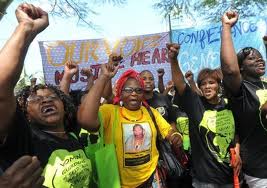
People who are already living on the edge understand the stakes.  Thousands of African women farmers have been marching in Durban, along with indigenous forest defenders from around the globe.  They’ve been kept away from the politicians inside the gates by riot police.

Guess what?  All the riot police in the world cannot keep climate change havoc from our doorstep.  Here in the U.S., in China, in Africa, and all over the world.

It’s time to deal with it.