“Let your life be a counter-friction to stop the machine”

I believe that we are coming to a crossroads as a nation.

Since 9/11, we’ve been traveling down a road bristling with guns, military technology, paranoia and fear.  Though most of our aggressive energy has been aimed outside our borders, there has also been a steady preparation for mass violence within the U.S. as well.  In the decade since 9/11, our national police forces have been armed with military hardware, and have trained extensively in riot control, with the results that we saw for the first time during the recent Occupy protests.

In the peaceful town of Fargo, North Dakota, report Andrew Becker and G.W. Schulz of the Center for Investigative Reporting, “Every city squad car is equipped today with a military-style assault rifle, and officers can don Kevlar helmets able to withstand incoming fire from battlefield-grade ammunition. And for that epic confrontation—if it ever occurs—officers can now summon a new $256,643 armored truck, complete with a rotating turret.”

Billions of federal tax dollars have been spent nationwide on this kind of military hardware for police, in the name of Homeland Security.

Security from what?  Security for whom?

Short of an all-out military invasion by a foreign force, which seems hugely unlikely, these weapons can only be meant to confront an insurgency within our own borders.

Are we thinking about a civil war, then?

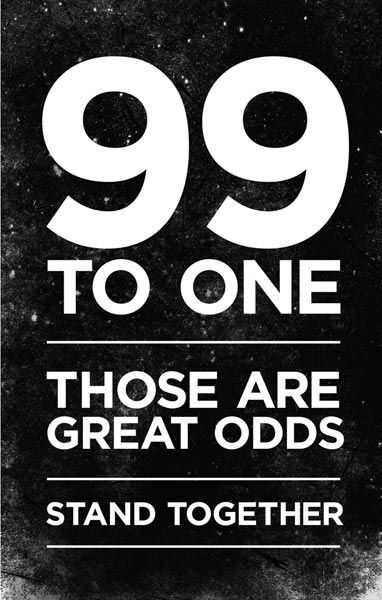
Are these police being armed and trained to protect the interests of the 1% against the raging anger of the 99%?

A year ago it would not have occurred to me to ask these questions.  But obviously the Homeland Security crowd was already thinking ahead and planning for a time when such armor and weapons would be necessary to “maintain security” and “uphold law and order” on the home front.

Yes, they must have been aware, even as they were cashing in on our ignorance, that there would come a time when no more could be squeezed from the bottom two-thirds of American society.  When there would be so many homeless, so many poor, so many disenfranchised, that these people would feel they had no other recourse than violence, and nothing left to lose.


A new report by the National Center on Family Homelessness found that “more than 1.6 million children – or one in 45 children – are homeless annually in America. This represents an increase of 38% during the years impacted by the economic recession.”

I’m sorry, but that is just unacceptable in this country, which likes to think of itself as the wealthiest and most enlightened society on earth.

When you add up all the trials and tribulations being visited on the poor in this country–and “the poor” is a vast category that gets bigger day by day–and you weigh billions in Homeland Security anti-terrorism outfits for police against dwindling food and shelter for children–well, something just isn’t right here.  There’s something rotten in the state of America.

And yes, we are at a crossroads.

It may seem to some that I am over-reacting, but this is the way it feels to me: if we continue following along docilely on this daisy path that we’ve been led down by the architects of corporate capitalism, we are like the Jews of Germany in 1940, peacefully gathering our belongings and getting on that train to Auschwitz, or marching cooperatively out to the forest to be mowed down by machine guns into the mass grave.

We know enough now to know that the powers that be do not have our best interests at heart.

We’ve been sickened by their chemicals, and our health care system seems geared to treat sickness (at a profit) rather than to promote wellness.  Our oceans, air, soils and drinking water have been contaminated and rendered toxic. Our taxes have been used for guns and landmines instead of schools and social welfare.  Those who have gotten rich in this system have done so on the backs of the poor and those who cannot defend themselves: the natural world above all.

Are we going to continue down this path?

Or are we going to gather our courage at this crossroads, and strike off in a new direction?

A lot of people are asking this question now.  Over on the New Clear Vision blog, Charles Imboden suggests that the Occupy movement has ignited a renewed “commitment to direct democracy and shunning of ‘representative,’ republican forms of decision-making (so often susceptible to corruption and corporate influence) [which] can be further strengthened as the foundation of the egalitarian, ecological society.”

As one of my readers commented today, what would happen if they held an election and we just didn’t show up?

I don’t know if there is a way to cut ourselves loose from the federal government and its taxpayer-supported state terror apparatus.  Thoreau tried, back in the 19th century, and was promptly thrown in jail.

His letter from prison is worth re-reading today.

“Unjust laws exist: shall we be content to obey them, or shall we endeavor to amend them, and obey them until we have succeeded, or shall we transgress them at once? Men, generally, under such a government as this, think that they ought to wait until they have persuaded the majority to alter them. They think that, if they should resist, the remedy would be worse than the evil. But it is the fault of the government itself that the remedy is worse than the evil. It makes it worse. Why is it not more apt to anticipate and provide for reform? Why does it not cherish its wise minority?

“If the injustice is part of the necessary friction of the machine of government, let it go, let it go: perchance it will wear smooth—certainly the machine will wear out. If the injustice …is of such a nature that it requires you to be the agent of injustice to another, then I say, break the law. Let your life be a counter-friction to stop the machine. What I have to do is to see, at any rate, that I do not lend myself to the wrong which I condemn.”

Let your life be a counter-friction to stop the machine.

As we gear up for next year’s Presidential elections, we must take these wise words of Thoreau’s to heart.

But we must also be aware, as Thoreau certainly was, that there are other paths to take, outside of the machine.

We stand at a crossroads.  Each of us must make up our own minds, in our own time.

How much longer will we continue to docilely feed the machine our tax dollars, and march peacefully where they lead us?


Methane Burps and Political Disenfranchisement: People, Wake Up!

There are two pieces of news that have me really worried today, one environmental, the other political.

The environmental news, predictably, is about global warming.  I suppose most people have heard by now about the giant methane plumes being released into the atmosphere from the melting Arctic permafrost, but did you realize the scale of what is going on?  Here is a quote from the scientist who has spent more time than anyone else actually observing this issue in the Arctic, Dr. Igor Semiletov:

“In a very small area, less than 10,000 square miles, we have counted more than 100 fountains, or torch-like structures, bubbling through the water column and injected directly into the atmosphere from the seabed,” Dr Semiletov said. “We carried out checks at about 115 stationary points and discovered methane fields of a fantastic scale – I think on a scale not seen before. Some plumes were a kilometre or more wide and the emissions went directly into the atmosphere – the concentration was a hundred times higher than normal.”

As Andrew Revkin notes in his excellent Dot Earth NY Times blog, ““Given that methane, molecule for molecule, has at least 20 times the heat-trapping properties of carbon dioxide, it’s important to get a handle on whether these are new releases, the first foretaste of some great outburst from thawing sea-bed stores of the gas, or simply a longstanding phenomenon newly observed.”

Dr. Semiletov and his team caution that it’s too soon in their research to answer this question definitively.  But it stands to reason that melting permafrost and sea ice would provide an escape hatch for methane that had previously remained sequestered for millennia.  It seems likely that this trend will continue and worsen in the coming years.  Global warming, here we come.

The other news I’m fretting over this morning is the massive Republican attack on voter franchise in the U.S.–also on a vast scale, and with potentially disastrous results.  As Amy Goodman spells out in a column today on Truthdig,  “Across the country, state legislatures and governors are pushing laws that seek to restrict access to the voting booth, laws that will disproportionately harm people of color, low-income people, and young and elderly voters.”

This has been going on for at least a year now, and only last week did Attorney General Eric Holder finally act to declare one such state action, in South Carolina, unconstitutional.  The Democratic Party is finally waking up to the sinister plot afoot by the Republicans to steal the election they are unlikely to win in a fair fight.

We know what right-wing Republicans stand for: unfettered big business, dismantling of social safety net programs, Boss Tweed-style oligarchy of the wealthy, and an “are there no workhouses” Scrooge mentality towards everyone else.

Is this the country we want to become?

The United States needs to regain its stature as a beacon of hope in dark and dangerous times.  The stakes are so high now; the danger is so real and so close.  Although I have been writing about the importance of strengthening local “transition town” resources, we cannot afford to ignore big politics, because of the undeniable power possessed by federal and state governments, which can be used for good or for ill.

Although we can’t do anything to control those methane burps, we can work to shape and direct our political systems towards moving full steam ahead to transition to renewable energy and prepare for the systemic climate change that is already upon us, whether we want to admit it or not.

As the Occupy movements regroup in the New Year, I want to see the young people of this country stand up for their rights and the sane governance of our country and our planet.

Occupy the Elections must become a rallying cry for the coming months.

1% > 99%: Don’t Mess with the Rich, and Leave Inequality Alone

Why does it not surprise me that no comments were allowed on this op-ed piece from Sunday’s NY Times, which has been rankling at me for the past couple of days?

The authors, one a prof of law at Yale, the other UC Berkeley professor of law and economics, pose as compassionate conservatives who are concerned about the growing gap between the fabulously wealthy 1% and the rest of us 99%.

Their solution?  Impose a new, automatic tax on 1-percenters whose income exceeds $330,000—currently 36 times the median American household income.

“This new tax…would apply only to income in excess of the poorest 1-percenter — currently about $330,000 per year,” the authors (who admit to being part of this bracket) say. Their aim is not to “reverse the gains of the wealthy in the last 30 years,” but just to “assure that things don’t get worse.”

Ahem.  How about making things better???

A stark picture of the lives of those in the median (full disclosure: you’ll find me in this social landscape) was painted in today’s NYT editorial on the middle class: 

“Recent government data show that 100 million Americans, or about one in three, are living in poverty or very close to it. Of 13.3 million unemployed Americans now searching for work, 5.7 million have been looking for more than six months, while millions more have given up altogether. Even a job is no guarantee of middle-class security. The real median income of working-age households has declined, from $61,600 in 2000 to $55,300 in 2010 — the result of abysmally slow job growth even before the onset of the recession.”

You would think that our elected representatives in Congress would be concerned about this dismal state of affairs, and would be doing everything in their power to make things better for those hundreds of millions of troubled Americans, wouldn’t you?

Hah!  No, our reps in the House couldn’t be bothered to pass a bill giving us a very modest payroll tax cut, amounting to about $1,000 per year per median paycheck…because they’re holding out for strings attached that will, for example, fast-track the construction of the Keystone XL pipeline.

Let’s connect more dots here.  According to a recent report by the non-partisan group Public Campaign, “30 multi-million dollar American corporations expended more money lobbying Congress than they paid in federal income taxes between 2008 and 2010, ultimately spending approximately $400,000 every day — including weekends — during that three-year period to lobby lawmakers and influence political elections.”

You know, there would be nothing so wrong with corporations lobbying Congress IF they had the best interests of society as a whole at heart.  But we all know that’s not true. While 2010 was a “record year for executive compensation,” it was also a record year for lay-offs. And don’t even get me started about corporate sins against the environment.

It all comes back to the greed of the 1%.

In an unusual personal aside, the Yale and Berkeley profs confess that their “grandparents would be shocked to learn that the average income of the 1-percent club has skyrocketed to more than 30 times the median income — just as we will be shocked if 20 years from now 1-percenters make 80 times the median, which is where we will be if inequality continues to grow at the current rate unabated.”

So they want to hold inequality to its current levels.  That’s like saying let’s hold global warming to where it is now.  Hello-o?  Both inequality and global warming are at deadly levels right now.  Maintaining the status quo is like setting the throttle in full gear and leaving the wheel to have a drink, while the bus rolls off the cliff.

Professors, you should be ashamed of not having had the courage to enable the comments on your brilliant proposal.

Let me just put a little spin on your title, may I?  Instead of “Don’t Tax the Rich, Tax Inequality Itself,” how about: “Don’t Mess with the Rich, and Leave Inequality Alone.”  Let’s call a spade a spade–and let the debate begin!

An Eco-Humynist Manifesto for the 21st Century

Having watched with dismay as the Durban climate talks sputtered to a disappointing conclusion, with all parties knowing that every day that goes by without concerted international effort to address climate change means the inexorable shifting of life as we know it on Earth, I was moved yesterday to put fingers to keyboard and come up with a Manifesto for change.

Even as I was writing it, I was thinking that such radical changes would not be possible to put into place without resistance from the status quo powers that be; therefore bloodshed, which is specifically antithetical to the principles I lay out, would be inevitable.

But if a World War III must commence, I would rather it be for a good cause like this one, than for the petty greed, bigotry and hatred that have propelled humanity into previous wars.

If we want not only ourselves, but our entire eco-system to survive, do we have any other choice but to take decisive action now?

An Eco-Humynist Manifesto for the 21st Century

Whereas human beings have acted in a dominating fashion towards each other and towards other living species on this planet, using the excuse of difference to justify aggressive and destructive behavior;

Whereas competition has been used as a rationale for economic systems based on hierarchical systems of power;

Whereas social exclusion and systematic discrimination has been seen as the normative right of dominant groups;

Whereas privileged groups have felt entitled to take more than their fair share from the environmental commons, and to deprive less powerful groups, whether human or of other species, of the resources necessary for well-being;

Whereas it is quickly becoming apparent, in the age of climate change, that the dominant paradigm of capitalist patriarchal social relations is resulting in the dangerous destabilization of the entire natural ecosystem;

The time has come to take action to change this paradigm in the following ways:

1. Move from a top-down hierarchical system to a horizontal, egalitarian model of social relations based on inclusivity across all of the traditional boundaries used to keep different groups apart, including race, class, gender, sex, nationality, ethnicity, religion, and also opening up the possibility for cross-species collaboration based on respect and stewardship;

2. Shift the worldwide economic system to a model of global cooperation and collaboration, with the focus of human industry and government on providing a baseline of well-being for all life forms on this planet, regardless of geographic origin or antiquated ideas of relative importance (ie, who is to say that a human being is more important than a songbird, or a sardine?);

3. Tailor the education system to teaching the history of the destructive cultural practices of homo sapiens up to the 21st century, and opening up constructive conversations across disciplines, where alternatives to these traditions can be envisioned and developed;

4. Model egalitarian, collaborative, respectful social relations in the private sphere of the family as well as the public spheres of education, the profession, government and law;

5. Shift from a violent conflict and punishment model of resolving disagreements to a peaceful persuasive model, with the goal always being the well-being of the community as a whole first, and secondly each member of it.

6. Destroy all weapons of mass destruction, as well as all bio and chemical weapons, and their blueprints.

7. Disallow any one person’s or minority group’s interests (with rich people and businesses or industries rightly being considered minorities)  to take precedence over the interests of the majority, including the non-human majority on this planet.

8. Develop an appropriate representative global governing council to administer these principles.

In the name of Mother Earth and ALL of her children, I call on the peoples of the world to act without delay to become the stewards of the planet and the collaborative, respectful individuals we were always meant to be.

Thanks to the students of Gender, Culture & Society, Fall 2011, for the inspiration to write this Manifesto.

On Human Rights Day, Calling the Next ‘Greatest Generation’

Today, Human Rights Day, I call upon the peoples of the world to understand that if we don’t focus on reducing human impact on the global environment in this new century, all the other more isolated issues will be moot.

Issues from the militarization of the police, to the use of rape as a weapon of war, to the stifling of free speech and democracy, are important—but they’re just minor skirmishes.

The real battle for human rights is taking place in the realm of energy politics.

It’s taking place on the thousands of oil rigs out in the Gulf of Mexico.

It’s taking place in the hundreds of new hydro-fracking wells being dug in upstate New York and Pennsylvania.

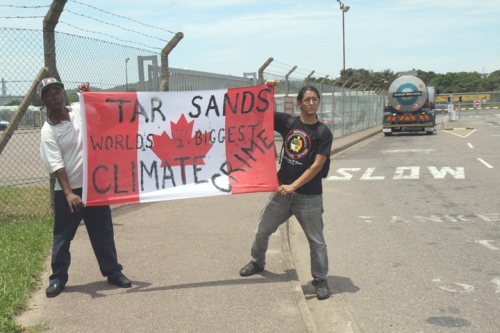
It’s taking place in the coal mines of China and the tar sands of Canada.

All of us are players in this deadly game.  Every time we turn the key in the ignition of our car, or buy food produced by a factory farm, or pay our electric bill.  We participate as consumers, and as consumers, we have more power than we realize.

On Human Rights Day, we need to remember three things:

•   The Universal Declaration of Human Rights guarantees the human right to health

•   A healthy environment, including healthy food, water and air, is essential to human health

•   Corporations, not being people, must not be allowed to trample on human rights.

Indeed, corporations, being human creations, should be serving human rights.

If a healthy environment is essential to human rights, then corporations should be working on making our environment as healthy as possible.  Corporations work for us.  They need to meet our needs, and uphold our rights.

There is a new movement afoot to define and uphold the Rights of Nature, which is a totally laudable goal. But in my view, the rights of the natural world and the rights of human beings are inextricably intertwined.

To truly uphold human rights would be to truly uphold the rights of Nature.

We are animals.  We are part of the natural environment of this planet.  If we foul and destroy our environment, we will die, along with countless other living beings: animals, insects, marine life, birds and plants.

This is a big battle; these are momentous times. We need to step up and be the new “greatest generation.”  We need to hold corporations accountable for their destructive, life-threatening actions.  We need to insist on change.

If we don’t, will anyone be left to lament our failure?

Swept away for the holidays? C’mon, Occupy, Let’s Go!

Looking back over the week, it seems like we’ve settled into some kind of holding pattern. The Occupy protests keep spinning, including a jubilant rally in Boston last night, but there is a feeling that we’re all waiting for the next shoe to drop…the next big push, the next new thing.

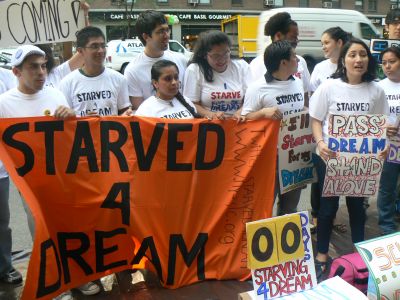
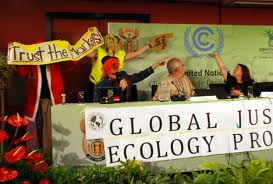
This week saw Occupy Foreclosures; next Monday there is a plan afoot to shut down the West Coast ports. The student protests are still sputtering; there is a group of hunger strikers in New York demanding a home for OWS;  and a stalwart group of climate activists has been braving relentless hostility to protest in at the COP 17 talks in Durban.

I’m glad to see all this stirring of outrage and energy.  I’m just starting to get confused by all the different tangents the movement is taking, and wishing for more focus and concentrated action.

I want the 99% to be like a biblical flood that will wash all the corruption and evil away, leaving a sparkling new world ready for re-occupation.

I know full well that’s unrealistic.  It’s not meant to be taken literally.  It’s just the kind of mood I’m in: impatient, restless, tired of the same old same old.

I have that same feeling about the holidays this year.

Are we really going to go through those motions again?  Are we going to fool our little children into believing in Santa Claus?  Are we going to laugh and clink glasses at innumerable holiday parties?  Are we going to go on shopping sprees for presents at the malls?

Again I’m reminded of the band that was ordered to keep playing as the Titanic sank.  There’s a new 3-D version of the Leo DiCaprio/Kate Winslett Titanic coming out soon–as if what we really needed was to watch that horrible tragedy again, in 3-D.

Folks, I hate to be the bearer of bad tidings, but we need to stop fooling ourselves, we need to get real. If we don’t profoundly change our ways NOW, Mother Earth will do it for us, and she won’t be pussy-footing around.

I was listening to a news report today about how many billions of dollars in damage Hurricane Irene caused back in late August. Then there was the October snowstorm, knocking down trees and powerlines for millions of people in the Northeast.

What’s next?  How bad does it have to get before we stop pouring good money after bad, cleaning up after natural disasters that could perfectly well have been avoided if we focused on prevention rather than on damage control?

We do the same thing with health issues.  We spend billions looking for the “cure” for cancer, when the real issue is lurking upstream, in all the toxic chemicals we’re dumping into the environment and our own bodies.

We know what makes us sick. We know what is making our climate “sick” and out of balance.  We know how to fix it too–we need to start converting to renewable energy as fast as we can, immediately!  All systems go!

And it’s the same with the sociopolitical system.  We know where it’s broken.  Campaign finance reform is not a new idea.  Bank and finance regulation is nothing new.  Social policies that bolster the middle class are obvious.

WHY AREN’T WE DOING THESE THINGS?

The Occupy movement has the potential to fire up enough people to get out there and demand change.  The movement just needs to articulate a few clear, incontestably worthy goals, and pour all the creativity of the 99% into finding ways to pressure the ruling class to get the job done–or be swept away.

I don’t know about you, but I don’t much feel like celebrating this holiday season.  I feel like rolling up my sleeves, joining forces with my neighbors, and getting to work.  There is so much to be done, and so little time.

College climate activists lead the way at COP 17 in Durban

You have to hand it to the college students attending the U.N.-sponsored climate talks in Durban.  They know how to cut through the nonsense and tell it like it is.

Watch 21-year-old Middlebury College junior Abigail Borah telling the august assembly that they can no longer afford to drag their feet on curbing carbon emissions.

“I am speaking on behalf of the United States of America because my negotiators cannot,” said Ms. Borah, a representative of the International Youth Climate Movement. “The obstructionist Congress has shackled justice and delayed ambition for far too long. I am scared for my future. 2020 is too late to wait. We need an urgent path to a fair, ambitious and legally binding treaty.”

The response to her entreaty?  A swift escort off the premises.

Another group of students dressed as “corporate clowns” to bring some levity to the grim discussions.  As documented by the Climate Connections blog, they too were met with hostility by the powers that be.

While talking with the press, student clown Kevin Buckland “was grabbed and hauled away. His badge was taken, and he was barred from the International Conference Center.”

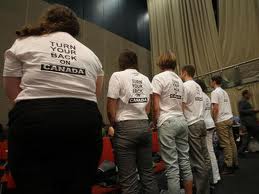
Then there was the group of Canadian students who were removed from the assembly hall just for displaying tee-shirts with the words “Turn Your Back on Canada,” a criticism of the Canadian government’s support for the oil extraction of the Alberta boreal forests (aka “tar sands”).

What kind of message are these young people going to take away from these incidents about the efficacy of trying to participate peacefully in global assemblies?  No wonder they’re turned off and turning to their own “people’s assemblies.”

As Laura Carlsen points out in an article posted on Common Dreams today, climate change activists need to “broaden the focus from once-a-year meetings in high-carbon conference centers, to the fields, communities and town halls where alternatives are already growing and a stronger political consensus can be built from the bottom up.”

The top-down approach favored by the U.N. and the international governmental community is showing itself to be not only ineffectual, but morally bankrupt.

Challenging rape culture

In my Gender Studies class this week, we’ve been talking about “rape culture.”  It’s a term that’s bandied about somewhat cavalierly on college campuses, and is probably much less familiar out in the ordinary workaday world.

Well, wake up world.  Rape culture is here.  And it doesn’t need the ironic scare quotes.  It’s real, and it’s not funny at all.

You know you’re living in a rape culture when women’s bodies are suggestively displayed, commodified, in sexually enticing poses obviously intended for the male gaze.

In the culture of rape, “no” means “try harder” and it’s always the woman’s fault if she doesn’t like what’s going on.  Stupid bitch, if she didn’t want it, she shouldn’t have worn those heels/had that drink/come to the party.

Rape culture sanctions violence when necessary to overcome resistance.  She was asking for it, anyway.

Rape culture oppresses dissenting men, too.  Men who fail to conform to the code of dominant masculinity are “faggots,” and being called out as anything akin to feminine–pussy, for example–is the worst insult you can throw at a guy.

Lately I’ve been realizing that rape culture extends a lot further than women’s bodies.  It’s also responsible for the prevailing attitudes towards our environment–our Mother Earth.

Not for nothing are both Mother Earth and Mother Nature gendered female.

Some patriarchal cultures manage to respect Mother Nature while still maintaining a stranglehold on her female children.  For instance, in Chinua Achebe’s Things Fall Apart, which I’m re-reading now for another class, the all-powerful Oracle of the Hills, a goddess, is interpreted by a priestess whose pronouncements no men dare question.  This doesn’t stop the protagonist, Okonkwo, from beating up his wives on a regular basis.

In Judeo-Christian and Islamic cultures, the patriarchy dispenses with goddesses.  Or at least, goddesses of the truly powerful, fearsome kind.

In Euramerican cultures, we have sex goddesses, who exist to pleasure their men.  Islamic cultures shroud their women in veils, but towards the same end: women exist to please their men.

The explosive growth of the international pornography industry, in which it is still rare for women’s pleasure to be of any interest at all, bears testimony to the extent to which rape culture rules.

In 2006, the pornography industry had larger revenues than Microsoft, Google, Amazon, eBay, Yahoo, Apple and Netflix combined–and it’s only grown in the past five years.

Porn is a vast unregulated jungle.  It’s not all bad.  But some of it is really terrible.  Some of it is sexualized violence–rape–thinly veiled as entertainment.

Yes, the girls get paid.  But many studies have shown that female porn stars often come from sexually abusive childhoods, or are teen runaways, or are lured into the trade through drug addiction and prostitution.

In Euramerican porn, women exist to give men pleasure.  Doesn’t matter if they get fucked over in the process.  Doesn’t matter if all that’s left in the end is a hollow shell.  There’s always another slut waiting in line.

Yeah.  It hurts me to talk like this, but I want to convey the mind-set of this industry.

And then I want you to think about how this mind-set translates to the Euramerican assault on the environment, our Mother Earth.

Or the sub-prime loan scandal (it’s Occupy Foreclosures Day, after all).  Fuck’em over, make a profit and move on.  All that matters is the bottom line, baby.

Sometimes it seems as though the more powerful actual women become in real life–ie, successful at playing the formerly all-male games of education and career–the more frantically obsessive men’s consumption of pornography becomes.  The power they miss in real life, they can find acted out for them in porn fantasies.

But the environment is another story.  Mother Earth is not going to play men’s games–that is, she doesn’t care to beat them at their own game.  When she starts to resist, the game will be over.

In porn, women go along with the game for a variety of reasons.  Generally speaking, women do it to survive.

Likewise, women collude with the patriarchy in the rape of the Earth because it’s just easier to go along than to resist.  And the lifestyle has been pretty comfortable over the last 50 years, hasn’t it.

I would like to see a frank discussion of the connections between rape culture as played out in porn and rape culture as played out between humans and the environment.

We need to acknowledge that there is a serious problem in both the private and the public realms (along these lines, we are just beginning to see confessions of “sex addiction” hit the media.  How about “fossil fuel addiction”?).

The problem is a symptom of much deeper ills in human social relations, which transgress the usual boundaries of race, class, gender & nation.

Why are porn and energy extraction biggest, the fastest growing industries in the world?

What does it mean to live in a rape culture?  Who benefits, and who loses?

Most importantly, how can a rape culture be transformed?  And what is our alternative vision?

My vision is this:

The one-sided model of domination and extraction (“getting some”) needs to shift to a dialogic model of sustainable mutual pleasure.

Human beings should serve in a steward relation to our Mother Earth, tending and enriching her in exchange for the nourishment and pleasure she can afford us.

Likewise, sex should not be about domination and debasement, but about mutual pleasure and uplift.

In these transition times, such a transformative shift should be possible, if each of us begins with our own selves, our own backyards, and lets the ripples of range move outward.

Let it be so.

Outsourced pollution rides the trade winds home

How timely, that just as the U.N.-sponsored climate talks are going on in Durban, a new report comes out  from the Global Carbon Project informing us that global greenhouse gas emissions grew by a whopping 5.9 percent last year, the largest leap in any year since the Industrial Revolution began.

The U.S. remains the world’s second-largest greenhouse gas emitter, trailing only China.  But as we all know, China has become a factory state of the U.S. and Europe–isn’t virtually every manufactured thing you own “made in China”?

As I hear all the time from travelers to China, air quality is noticeably bad there.  Most cities seem to be in a permanent miasma of smog, sometimes approaching the sooty fog Charles Dickens used to describe as veiling London in the coal-burning 19th century.

Here in the U.S., air quality has improved since I was a kid in New York, when smog was a daily occurrence and you just learned to live with noxious blue bus fumes blown in your face on every street corner.

But apparently what we’ve done is simply outsource our pollution to China.  Let them deal with the smog over there; we’re paying for the goods they produce aren’t we?  If they can’t figure out how to manufacture cleanly, that’s not our problem.

So goes the smug line of American entitlement.

But welcome to the new century.

First of all, the great American credit bubble has burst, and the middle class is having trouble affording those imported manufactured goods, no matter how “cheap” they are.

Second, it’s obvious that the trade winds are blowing Chinese smog our way, in the form of global climate change that will affect us here as much as it affects them over there.

Politicians the world over continue to take a short-sighted view of both of these issues, imagining that a little re-tooling is going to get us past the bumps in the road.

The media isn’t helping matters–you will have to peer deeply into the New York Times this morning to find the small buried news story about the biggest leap in global carbon emissions on record.

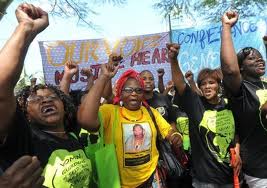
People who are already living on the edge understand the stakes.  Thousands of African women farmers have been marching in Durban, along with indigenous forest defenders from around the globe.  They’ve been kept away from the politicians inside the gates by riot police.

Guess what?  All the riot police in the world cannot keep climate change havoc from our doorstep.  Here in the U.S., in China, in Africa, and all over the world.

It’s time to deal with it.

Carbon Colonialism: Just Say No!

Do ordinary people need to commit suicide to gain the attention of the global elites?

You may remember, back in 2003, a Korean farmer named Lee Kyung Hae committed suicide outside the grounds of the World Trade Organization meetings in Cancun, Mexico, as a protest against the impact of first world subsidies of grain production, which effectively pushed small farmers in developing countries out of business.

He set himself on fire right in front of the police barricades keeping him and others like him outside of the WTO talks.

Afterwards, there was a movement by the representatives of developing countries to form a bloc of resistance to the demands of the global elites.  It worked, for a while.

But now, 8 years later, the global elites are at it again, worse than ever.

At this year’s climate talks in Durban, South Africa, representatives of indigenous communities worldwide are protesting at the barricades again, locked out of the talks on complex trade negotiations over carbon offsets, sequestration and deforestation.

It’s not easy to understand the documents produced by the U.N. and government agencies, laying out what’s called the REDD accords: Reducing Emissions from Deforestation and Forest Degradation.

It all sounds very nice when you read the summary on the U.N. website.

“Reducing Emissions from Deforestation and Forest Degradation (REDD) is an effort to create a financial value for the carbon stored in forests, offering incentives for developing countries to reduce emissions from forested lands and invest in low-carbon paths to sustainable development. “REDD+” goes beyond deforestation and forest degradation, and includes the role of conservation, sustainable management of forests and enhancement of forest carbon stocks.

“It is predicted that financial flows for greenhouse gas emission reductions from REDD+ could reach up to US$30 billion a year. This significant North-South flow of funds could reward a meaningful reduction of carbon emissions and could also support new, pro-poor development, help conserve biodiversity and secure vital ecosystem services.”

Yes, well, it does sound nice.  But in fact, when that much money is at stake, corruption is not far behind.

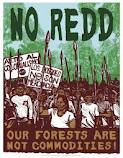
As detailed in an important new report called the No REDD Papers, what’s been happening in the name of REDD is a gigantic forest grab, with major multinational energy corporations ruthlessly buying up and bullying their way into land rights to forests in the global south, so that they can not only make money by going on their merry way of fostering carbon emissions in the North, but also make money by collecting the rewards for forest conservation in the south.

And there’s more.  Under REDD+, reforestation is also potentially a growth industry.  But there are insufficient regulations on what constitutes reforestation.  A complex rainforest environment could be harvested, destroyed, and “reforested” with a monocultural non-native cash crop, like bamboo or eucalyptus or palm, which will be “sustainably harvested,” yes, but will actually store a fraction of the carbon of the original rainforest, and will support a tiny fraction of the original biodiversity.

It also results in Native people being pushed off their ancestral lands, by swindle or by force.

The indigenous people, from Niger to Alberta to the Amazon, are not stupid.  They’re wise to what they’re calling “carbon colonialism.”

“REDD/ REDD+ is bad for people, bad for politics and bad for the climate,” says Tom B.K. Goldtooth of the Indigenous Environmental Network. “It will inevitably give more control over Indigenous Peoples’ forests to state forest departments, loggers, miners, plantation companies, traders, lawyers, speculators, brokers, Washington conservation organisations and Wall Street, resulting in violations of rights, loss of livelihoods—and, ultimately, more forest loss.”

I don’t want to be part of this scheme.  To me, as to the indigenous forest defenders, it’s all quite simple.  We must reduce carbon emissions.  We must not only reduce deforestation, but encourage forest regeneration–and not of plantations, but of natural biodiverse forest habitats.

It’s not about making money any more.  It’s about sustaining life–our lives, our children’s lives, the entire web of life upon which we depend.

This time the neocolonial cowboys are not going to be able to get away with murder.  The glare of the internet is upon them.  We will not stand by passively and let a new era of displacement and exploitation take place under the euphemism of “conservation.”

Not this time.  Never again.

And we shouldn’t have to be committing suicide to get attention, either.  There has been enough death and destruction in our world these first years of the 21st century.  Let’s go forward under the banner of Eros, not Thanatos.

Let’s work together for Life.