Who, me? Depressed?

Sometimes you just have to wonder if there will ever be good news again.

I mean, really good news.  The kind that makes you want to just lift up your face to the sun and grin like a sunflower.

Lately I cringe inwardly every time I open the newspaper.

In my local paper, drunk driving routinely kills kids and people fight endlessly about town budgets and whose backyard should get the wind turbines or the PCB dredging from the contaminated river.

The national news is warning darkly of a coming “Taxmageddon” in January 2013, when, according to The New York Times, “the federal tax bill for a typical middle-class household — making in the neighborhood of $50,000 — is scheduled to rise by about $1,750. This increase, which would come from the expiration of both the Bush tax cuts and the Obama stimulus, would follow a decade of little to no income growth for many people. As a result, inflation-adjusted, after-tax income for the median household could fall next year to its 1998 level.”

And then there’s international news, where we learn that suicides are up sharply in Europe as a result of the economic downturn, while over in Afghanistan suicide bombers have just struck hard in a coordinated attack on supposedly secure neighborhoods in Kabul—a taste of the summer fighting season to come.

April 14, 2012. Photo: Reuters

Never mind the weather, which is showing no signs of getting back to normal.  Did you hear about the massive hailstorm in Texas last week?  Or the tornadoes whipping across the Midwest?  Or the fact that there is a fire watch almost every day now here in Massachusetts, because of the extremely unusual springtime drought conditions?

A motorist sits in a truck partially buried in slushy hail near Amarillo, Texas. The Texas Panhandle storm dumped several feet of nickel-sized hail, stranded motorists in muddy, hail drifts and closed a highway for several hours.
(AP Photo/Courtesy of Amarillo/Potter/Randall Office of Emergency Management)
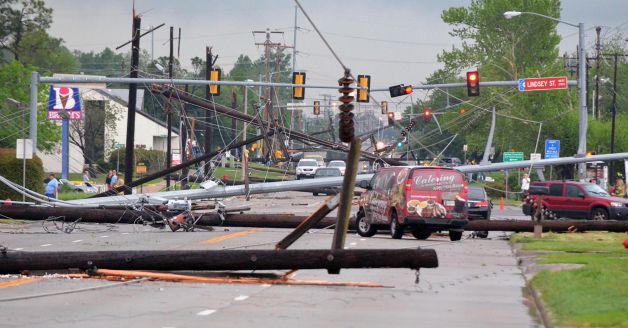
Downed power lines litter 24th Avenue Southwest at the Lindsey Street intersection after a tornado hit Friday afternoon April 13, 2012 in Norman, Okla. Photo: The Norman Transcript, Kyle Phillips / AP

I have been squinting at all this out of the corner of my eye as I rush off to teach, to meet with students and colleagues, to bring my younger son to soccer practice or piano lesson, to cram in some exercise for myself…all the various commitments that make my days and weeks a blur of action.

Today for the first time, and by design, I did not schedule a single appointment.  I left the day wide open so I could finally get out into my garden to fertilize and prepare the beds and plant the spring greens and herbs.

I spent most of the day doing just that, all the while worrying to myself about what will happen if the rains don’t come at all this spring. Already the river is as low as I’ve ever seen it; the ground is so dry it’s dusty.  In April!

Between the bad news and the scary weather, it’s enough to drive anyone to anti-depressants.

According to the U.S. Center for Disease Control (CDC), today one in 10 Americans over age 12 is taking an antidepressant.  Twenty-three percent of American women between the ages of 40 and 59 are on anti-depressants. That’s nearly one in four middle-aged women.

Do I need an anti-depressant?

I do feel depressed when I think about what’s going on in the world around me.

I am not happy to look ahead to 2013 and foresee a tax increase that, together with the double-digit health insurance premium increase my employer anticipates, is going to mean yet another year where my real income goes down, while the cost of living just goes up and up and up.

I feel depressed when I read that Rick Santorum just took out a lifetime NRA membership for his 3-year-old daughter (who, by the way, suffers from a generally fatal chromosomal disorder), while Mitt Romney is courting assault weapons fans at the 2012 NRA convention.

There’s just so much to be depressed about!

But it’s a legitimate depression.  If I were to get on the anti-depressant bandwagon and dull the edge of my depression with drugs, I would fear losing my grip on reality and becoming just another Brave New World-type soma addict.  What kind of life is that?

Allowing the full scope of the world’s problems to sink in to my psyche is painful, but hiding from it would be cowardly and useless.

On this quiet Sunday I will take the measure of my own melancholy.  And then I will rise again on Monday, determined to keep fighting the good fight for a better world.

Give mothers the respect–and the financial compensation–they deserve

Hilary Rosen

It truly is disheartening to hear a supposedly progressive woman proclaim that a fulltime mother “never worked a day in her life.” Democratic strategist Hilary Rosen deserves all the flack she’s been getting since she made that statement yesterday on national media.

On the other hand, it’s also disheartening to see how the male-dominated Democratic and Republican campaigns have wasted no time in turning Motherhood into a political football.

The truth is that American motherhood has never been more demanding, or more complicated.

Romney married a rich man and settled in to raise five sons. She had the enormous privilege of not also having the responsibility of earning money to put food on the table.

Today there are fewer and fewer women who can afford to stay at home as fulltime moms, especially if they have big families.

More kids mean more housework—but also mean more mouths to feed, shoes to buy, college tuitions to pay for.

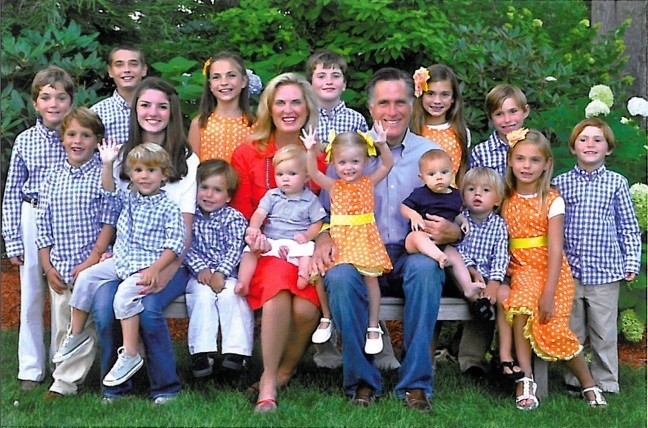
Mitt and Ann Romney with their 16 grandchildren

As part of the 1%, Ann Romney got to choose to stay home with her children.  For the rest of us, this is just not an option.

Especially the many of us who are single moms, or whose husbands have been out of work for months and years.

But the firestorm over Hilary Rosen’s miscalculated remark speaks to an even deeper issue that remains unaddressed in our society.

Mothers still do more housework and child care than fathers.  Housework and childcare still remains not only unpaid labor, but labor that is not recognized as having any monetary value in our very commercially oriented society.

A recent NY Times article interviewed some nannies who work for the 1%, whose labor is valued in the high six figures.

But the labor of a mother who stays home is not even deemed worthy of accruing social security.

At minimum, all mothers, whether they stay at home fulltime or struggle doing the second shift at home after the day job, should be entitled to accrue social security and expect some retirement compensation from the nation in their old age.

At minimum, all mothers should have the right to subsidized maternal health care.

At minimum, in a rich country like ours, no mother should have to worry about whether her children are going to have enough to eat.

Instead, our country is going in the opposite direction.

We are making it harder and harder for mothers to qualify for welfare assistance.  We are cutting back on public education, and failing to create incentives for doctors to work in public health clinics.

And many, many states are actively working to curb women’s access to contraception, while at the same time demonizing abortion.

So what’s a poor woman to do?

The media controversy over the non-issue of whether Ann Romney’s “work” as a fulltime mother qualifies as such is entirely misplaced.

What we need to get worked up about are the circumstances of the millions of American mothers who work hard, both in and out of the home, without the household help that the Romneys undoubtedly enjoyed, and who are not fairly compensated or recognized for their efforts.

It may sound corny, but it’s true: without the hard work of mothers to bear and care for children, our great nation would simply cease to be.

We need to cut the political chicanery and not only give Motherhood the respect it deserves, but put our money where our mouths are, too.

Bill McKibben, our environmental Pied Piper, is at it again

Bill McKibben

You gotta admire Bill McKibben. And you gotta wonder, where the frack does the guy get his indefatigable energy??

Off he goes again this week, starting a new campaign to protest hydraulic fracking in Ohio—you know, the state where natural gas drill rigs caused manmade earthquakes.

I think we all have a pretty good idea of how bad it is to have flammable toxic fumes coming out of your water faucets, earthquakes rumbling in your backyard, and tons of toxic waste building up above and below ground level.

Fracking sucks and we know it. It must be stopped. The question is, are we going to follow Pied Piper Bill to Ohio to occupy the Statehouse and make our demands known?

No doubt there will be plenty of Ohioans and even ardent out-of-state environmentalists who rally to the call, just as they did last summer when Bill led them down to Washington DC for sit-ins to protest the Keystone XL.

That battle did score some points, although more recently it seems that the southern portion of the titanic pipeline is going to be built after all, another huge investment in 20th century thinking and technology that can lead us in one direction only: over the nearest cliff.

***

In the Grimm fairytale, “The Pied Piper of Hamelin,” the town suffers from a plague of rats, which only the Pied Piper can solve.  When the town councilmen refuse to give the Piper his just reward for destroying all the rats, he takes his revenge, leading all the children of the town into a mountain cave, from which they are never recovered.  The moral of the story: don’t cheat the Piper!

Today the rats we suffer from are precisely the fossil fuel industry and their military-industrial, Big Ag, Big Finance brethren, which are, as in the Grimm story, destroying our homeland and eating us alive.

Even if Bill McKibben could lead all those rats into the river, we would still be left with the greedy councilmen, our politicians, who would very likely continue playing by the old rules, and would bring further disasters upon us.

When the Piper wanted to punish the town fathers, he did so not by attacking them directly, but by attacking their children.

Truly, there can be nothing worse than being forced to watch your children suffer and die.

Sometimes I think that the only way the rich and privileged are going to listen to reason and stop their destructive, world-killing ways is if they are forced to confront the reality of what their children will have to live with in the future, because of the lifestyles they themselves are living now.

I say “they” but I should be saying “we,” because I certainly have participated in this destructive lifestyle my whole life.  We humans, especially privileged Americans and Europeans, have been the rats that have been destroying the global village for decades now.

Unlike rats, though, we humans generally respond to reason.  We can be persuaded to change our ways, especially if we can be made to understand that the future survival of our precious children is at stake.

What sort of tune would the Piper need to play to change the hearts and minds of the frackers, for example?  Or the loggers, or the tar sands extractors, or the nuclear power plant engineers?

Bill McKibben has been tireless in his efforts to hit the right notes to attract enough people to follow him—not over a cliff or into a mountain tomb, but into a sustainable future.

You gotta admire the guy.  You gotta think—maybe I should get on that bus for Ohio.

Cupid, you devil–go home!

I find it really poignant that so many people are Googling “love” and turning up my Valentine’s Day blog post on how I was very happy, last February, to be awash in family love, even though romantic love was absent from my life.

That my Valentine’s Day post is the single most popular post on Transition Times is just evidence of how many people are yearning for love, and happy to find affirmations that there are alternatives to the stereotypical “and they lived happily ever after.”

As the 50% divorce rate in the U.S. attests, very few of us live happily ever after.

For the other 50% who stay married, well—I would like to know how many of you folks consider yourselves truly happy.

My guess is that something like 25% of the people who dutifully marry in their twenties find themselves compatible enough to live happily ever after.

So what does that mean for the institution of marriage?

Is it good enough that a quarter of those who marry in their prime child-bearing years are likely to stay together through the rigors of raising children?

What are the alternatives?

Unfortunately, in our society, there are few alternatives.  Women of means can choose to have children via artificial insemination or surrogate motherhood, without needing the fathers in the picture.

But this is the exception, not the norm.

For most mothers, having the financial, emotional and practical support of fathers (or co-parents, in the case of lesbian couples) is essential.

Raising children is hard.  Raising them alone is much harder.  I can say this with conviction since I’ve been a single mother since 2009, and going it unofficially on my own for longer than that.

For the most part, divorcing women tend to argue hard for custody of our children. We can’t imagine being separated from the little ones we once carried in our bellies—even when they’ve become big hulking teenagers.  They are ours in a way that must be honored.

And yet…they are their father’s children too.  It never ceases to amaze me how fathers can be so casual about their offspring.  They will insist on custody to stick it to their divorcing spouses, but for the most part they don’t have the emotional attachment to their children that we women have.  Or if they do, it is something they are willing and able to forego if need be.

Please correct me if I’m wrong, guys—this is just what I’ve perceived from very unofficial observations of my own family and friends.

All this to say that those who are avidly reading my Valentine’s Day post should be aware that my feelings about love are very complicated indeed.

I love my children.  I love my parents.  I love my brother and his family.  My ex-spouse?  Well, I am grateful to him for the good times we shared, including bringing our two boys into the world.

I wish we could have survived as a couple.

And I am ready to move on.

L’Chaim! This spring, let us commit ourselves to Life

Both Passover and Easter “celebrate” truly horrendous acts committed by men against men.

Passover commemorates how the Jews were spared by the grace of God from the Pharaoh’s evil plan to kill all first-born sons.  Easter celebrates the Resurrection of Christ after he was brutally martyred on the cross—a not-uncommon practice at the time.

Of course, both the Christian and the Jewish holidays also build on the much earlier pagan rites of Spring, the welcoming of warmth and rebirth after a season of winter.

I have to wonder why dominant human civilization has moved away from the earlier, simpler pagan celebrations, keyed to the natural world rather than to human doings and misdeeds.

Both Passover and Easter celebrate life—the lives of Jewish children, the miraculous resurrection of Christ, who gave his life in sacrifice for humanity.  Hence all the eggs, chicks and bunnies that populate the secular reinterpretations of these holidays, especially the American secular Easter.

Life is indeed something to be celebrated, as the Jewish cheer “L’Chaim!” proclaims.

Celebrated and protected.

As we move forward into the 21st century, into the auspicious year of 2012, let our aim be to reconnect with our prehistoric roots, to the simpler ages when we instinctively celebrated the return of the Light, the annual swing of our planet back towards the Sun.

For much too long, we have allowed religious politics to push us into conflicts and cruelties that do not serve the purpose of Life.  In claiming to worship the Divine, we actually find ourselves serving the dark side, the side of Death and Destruction.

I use these capital letters advisedly, to emphasize the symbolism inherent in all these word-concepts.

Beyond the symbolic realm there is the literal bedrock of reality.  We are hitting up against that reality now, as the patterns of power-hungry conflict, fueled by greed and a willingness to press on with destruction of the living world no matter the cost to systemic ecological health, play out with relentless precision.

This Easter and Passover season, let us do more than just toast to life.  Let us commit ourselves to the service of the divine spark animating our planet, which circulates without distinction through every blade of grass, every insect, and every human being.

It is only in our positive reciprocal commitment to Life that we can consider ourselves truly blessed.


Round up the chemicals–for our children’s sake

When I was pregnant with my second son, born in 1998, I was living out in the country in a small house next to my parents’ bigger house.  My son was born in late August, and all through that third trimester I spent a lot of time outside.

In those years, my mother had the habit of having her pebble driveway sprayed with Round-up a few times during the summer to keep the grass and weeds at bay.  Since the pebbles came right up by the front door of our little house, the Round-up was there too.  I complained to her that it was toxic, bad for our pets, not to mention us, but it took many years for her to pay enough attention to this issue to rate health more highly than a neat appearance for the driveway.

I was thinking about this today as I read the news that finally, at long last, the medical research establishment is beginning to go public in announcing the link between the use of Round-up, skyrocketing rates of autism among children, and colony collapse disorder among bees.

My mother will remember that when my second son was born, we began to worry about him when, by his second and third month of life, he was still not making eye contact, and not returning a smile. He was a sweet, calm baby who slept and ate well, and loved to be cuddled…but unlike his older brother, who was laughing and smiling in his first month, he had a curious detachment about him that was unsettling.

Just like everyone knows someone with cancer, everyone knows someone who has had the hardship of bringing up an autistic child.  It’s a heartbreaker, and in those early months with my second son I was truly frightened that I might be in for that kind of ride with him.

And then, just like that, he started to smile, make eye contact, and all was well.

Could it be that his development was delayed because of the local spraying of Round-up during the last months of my pregnancy with him?

Recent research suggests that this is quite possible indeed.

It’s common knowledge that the Monsantos and Dows of the world use their immense fortune to suppress negative research when at all possible.

Source: U.S. Center for Disease Control

But at this point, with our bee population in serious crisis and the U.S. Center for Disease Control (CDC) telling us that 1 in 88 children is now diagnosed with autism (a figure that does not include all the many, many children who are diagnosed “on the spectrum” with some form of mental impairment), it is impossible for the corporate honchos to keep the lid on this story any longer.

It is an international scandal, bigger even than the Big Tobacco scandals of a generation ago, because in this case there is no way that a defense team could argue that it is a child’s choice to expose herself to toxic chemicals.

France, Germany, Italy and other European countries have already taken steps to ban these harmful pesticides and herbicidesThe U.S. Environmental Protection Agency, finally acting under extreme pressure from concerned citizens, is in the process of “reconsidering” its approval for “Poncho,” one of the most dangerous pesticides, proven to have a negative impact on bees.

Dr. Brian Moench, President of Utah Physicians for a Healthy Environment and a member of the Union of Concerned Scientists this week had the courage to defy Big Ag and describe—I believe for the first time—the missing link between bee colony collapse disorder, human autism, and widespread toxic chemical use in agriculture.

In an article published Monday on Common Dreams, Dr. Moench wrote: “The brain of insects is the intended target of these insecticides.  They disrupt the bees homing behavior and their ability to return to the hive, kind of like “bee autism.”   But insects are different than humans, right?   Human and insect nerve cells share the same basic biologic infrastructure.  Chemicals that interrupt electrical impulses in insect nerves will do the same to humans.  But humans are much bigger than insects and the doses to humans are  miniscule, right?

“During critical first trimester development a human is no bigger than an insect so there is every reason to believe that pesticides could wreak havoc with the developing brain of a human embryo.   But human embryos aren’t out in corn fields being sprayed with insecticides, are they?  A recent study showed that every human tested had the world’s best selling pesticide, Roundup, detectable in their urine at concentrations between five and twenty times the level considered safe for drinking water.”

Just down the road from the house where I lived while pregnant with my second son are fields of corn that are maintained by a local farmer.  It’s nowhere near the scale of agriculture in the Midwest or California, but still, if the wind was blowing while they were spraying the herbicides and pesticides in the spring, or while they were harvesting the corn in the fall, we would certainly be inhaling a toxic brew, that undoubtedly found its way into our well water.

And that’s beside the voluntary Round-up spraying of the driveway, and the fact that in those days I was not aware enough to be making a strong effort to buy organic fruits and vegetables, and avoid commercial meat.

So all in all I must consider myself and my family very lucky to have so far avoided autism or cancer.

This should not be left to luck.  Allowing Monsanto, Dow and the other agricultural chemical companies to continue to profit from poisoning our land and our food supply is absolutely unconscionable.

It’s even worse than allowing the cigarette industry to advertise to young people, which we no longer permit.

The bees are the canaries in the gold mine, and they’re dropping fast.

Are we going to delay until the statistics tell us that 1 in 50 children in the U.S. are born autistic?

This is a national and international outrage that must be addressed now.

More words for my son, a warrior for Good

My son read my last post and said that’s very nice, Mom, but it’s all about you!  I thought you were going to write something nice about me, or give me some words of wisdom.

As usual, he was right.

I had actually sat down to write about him, but ended up getting so caught up in the story of his birth that I ran with that instead.

Also, the idea of offering him “words of wisdom” is intimidating.  Most of the time I am just trying to ask the right questions…I am wise enough to know I don’t have the answers.

But let me not shy from the challenge.

What do I wish for my son as he steps out into his third decade of life and enters adulthood?  What do I have to offer him for the journey?

It makes me sad to think about how the actions and inactions of previous generations, my own included, have led to the current threshold upon which he stands, looking out at his future.

My son often talks about looking forward to raising his own children, trying to be the best father he can possibly be.

As I look into the future and try to imagine my grandchildren, I am saddened by all the pressures that they will face, due to global heating, overpopulation and the contamination of the environment.

Will my grandchildren know what it’s like to sit under a blooming apple tree filled with merrily buzzing bees on a perfect May morning?

Will they be able to lie in the tall grass of June without fear of a plague of disease-bearing ticks?

Will they have the pleasure of watching a noble blue heron stalking the riverbank, reaching down with a merciless snap to grab a frog from under a lilypad?

My son wants to be a marine biologist, and has already spent quite a bit of time and energy pursuing that goal out on the water and in the lab.  But every day brings fresh reports of how damaged our oceans are due to overfishing, toxic contamination and ever-acidifying water.

The upcoming corps of marine biologists will have the grim task of monitoring inevitable species decline and habitat degradation, and perhaps suggesting ways to remediate and hold off the destruction.  Rather than celebrating life, they’ll be bearing witness to death.

In my most pessimistic moments, I fear that the havoc of climate change will lead to knock-out storms, epidemics and food shortages that will make huge portions of our planet dismal versions of post-earthquake Haiti.

How can I bear to watch my son stepping out into this apocalyptic landscape, so strong and healthy, so full of energy and hope, so motivated to live his life with high spirits and good grace?

I know there have been many moments in human history when mothers have looked out at the future with similar trepidation.

We simply have to stand back and let them go, trying not to encumber them with our fears, or even with our hopes.

My son’s life is his own to live.  I know that as we cross this Year 20 milestone together, he will begin to pull out ahead of me, leaping boldly and fearlessly into the future.

I hope that during these years when I’ve been nurturing him, I’ve given him some good tools for the journey; some rich memories, and sound habits of body and mind.

The world is waiting for you, my son, and she needs you to stand up and be the warrior for good you were born to be.

Go.


Ode to my firstborn, on his 20th birthday

Twenty years ago tonight I was going into labor with my firstborn son.  I was 29 years old and had been married to his dad for four years.  We were living in Manhattan, and the plan was to give birth at New York Hospital.

When the labor pains started, around midnight, I felt an odd sense of calm.  It was like having some kind of ocean tide within me, pulsing with the ebb and flow of the contractions.

All through the morning they continued, getting very gradually stronger and more painful, until I would gasp when the full cramp bore down on me.  My husband left for work; my mother wanted to take me to the hospital right away, but I knew it wasn’t time yet.  I asked her to make me the filling for stuffed grape leaves, and I sat, pushed away from the edge of the kitchen table by my huge belly, methodically stuffing and rolling the grape leaves, training my mind and hands on that simple task as the great rolling breakers of contractions surged through my body.

Eventually, my mother and I got into a yellow cab to go to the hospital, and she called my husband to meet us there.  I was admitted, but there was apparently a fair amount of dilation yet to go.  Despite my plan not to have an epidural, the waves of pain became so great, as I lay there on my back on the gurney, strapped to a fetal monitor, that I quickly accepted one when it was offered.  Thereafter, it was quite surreal: I could watch the contractions on the monitor, each one higher and more intense than the last, but I could not feel anything.

For hours, I lay on the gurney in that disassociated, semi-vegetal state. A nurse came and went, giving me a catheter when I could not manage to pee on my own, and coaching me about pushing when the epidural started to wear off and it was time to begin serious labor.  “Push like you’re really constipated!” she urged, and soon I was bearing down like a pro, like my life depended on it.

Then all of a sudden the doctor was there telling me to stop pushing, because the baby was coming and the operating room wasn’t ready for me.

Stop pushing?  He had to be kidding.  My body had taken on a life of its own, quite independent of my rational will.  There was no way I could stop pushing.

So there I was, groaning and pushing, as they rolled me down the hall on the gurney to the operating room.

No, this was not 1952.  It was 1992.  But I had the misfortune to be giving birth at New York Hospital just a year or two before the maternity ward was renovated to allow for modern birthing rooms.  I gave birth in a dark, windowless operating room painted a dismal hospital green, without a trace of softness or warmth anywhere.

When my son appeared, they showed him to me and my husband and then quickly whisked him off for tests or treatments.  I was left on the operating table waiting for the anesthesiologist, who took his time getting there.  The doctor had done an episiotomy (without consulting me; this was something else I did not intend to have done) and now we had to wait for anesthesia so he could sew me up.

The anesthesiologist, a cocky young man, must have given me too much, because afterwards I could not feel my legs at all, and I was not allowed out of the recovery room until I could feel my legs.  My son was not allowed to stay with me in the recovery room.

So there I was, sobbing my heart out because I had lost my baby—he was off on another floor somewhere by himself, screaming his head off, with my husband running back and forth between us, distraught.

Finally, after a couple of hours, I began to feel prickles in my legs, and was allowed out of the recovery room.  I got into a bed in a communal nursery room, and at last could hold my newborn baby in my arms. He was upset, still crying—it took him hours to calm down, and both of us were so stressed that nursing was difficult.

During the first night, the nurses began to give him a bottle of formula, and as a new mother I got the impression that I would have to supplement with formula; that I did not have enough milk to satisfy him.

So began months of a colicky baby who screamed every night from around 11 p.m. until 2 a.m.  There was nothing I could do to stop it—I tried everything I could think of, but in the end all I could do was hold him.

It was hard, that first birth.  I learned so much about how important it is, as a mother, to protect oneself and one’s child: to make sure one has a birth plan, a doctor one can really communicate with (my OB-GYN did not show up at the hospital for the birth, she sent her partner instead—a man I had never met and who seemed quite uninterested in me as a human being) and preferably a doula; to investigate the hospital and make sure it has birthing rooms; to stand firm about pain medications and cuts.

My second son was born under entirely different, polar opposite conditions.  No meds, gurneys or fetal monitors; a nurse-midwife and a doula in attendance; a birthing room I could walk around in comfortably while in advanced labor; giving birth squatting rather than flat on my back.  My second son came into the world very peacefully, nestled in my arms and immediately started to nurse.  He never screamed or cried, not until much later, when he was around 11 months old and got pneumonia, and then asthma…but that is another story.

My first child has taught me so much about how to be a mother.  I wish I had known more about it before he was born, so that he would not have had to go through some of the hardships caused by my ignorance.

He will forgive me, I know, because that’s what the unconditional reciprocal love between mother and child is all about.  It is unshakeable, unbreakable.  It is an elemental force that springs from that deep, uterine connection and runs forward, rich with emotion, through a lifetime.