Cupid, you devil–go home!

I find it really poignant that so many people are Googling “love” and turning up my Valentine’s Day blog post on how I was very happy, last February, to be awash in family love, even though romantic love was absent from my life.

That my Valentine’s Day post is the single most popular post on Transition Times is just evidence of how many people are yearning for love, and happy to find affirmations that there are alternatives to the stereotypical “and they lived happily ever after.”

As the 50% divorce rate in the U.S. attests, very few of us live happily ever after.

For the other 50% who stay married, well—I would like to know how many of you folks consider yourselves truly happy.

My guess is that something like 25% of the people who dutifully marry in their twenties find themselves compatible enough to live happily ever after.

So what does that mean for the institution of marriage?

Is it good enough that a quarter of those who marry in their prime child-bearing years are likely to stay together through the rigors of raising children?

What are the alternatives?

Unfortunately, in our society, there are few alternatives.  Women of means can choose to have children via artificial insemination or surrogate motherhood, without needing the fathers in the picture.

But this is the exception, not the norm.

For most mothers, having the financial, emotional and practical support of fathers (or co-parents, in the case of lesbian couples) is essential.

Raising children is hard.  Raising them alone is much harder.  I can say this with conviction since I’ve been a single mother since 2009, and going it unofficially on my own for longer than that.

For the most part, divorcing women tend to argue hard for custody of our children. We can’t imagine being separated from the little ones we once carried in our bellies—even when they’ve become big hulking teenagers.  They are ours in a way that must be honored.

And yet…they are their father’s children too.  It never ceases to amaze me how fathers can be so casual about their offspring.  They will insist on custody to stick it to their divorcing spouses, but for the most part they don’t have the emotional attachment to their children that we women have.  Or if they do, it is something they are willing and able to forego if need be.

Please correct me if I’m wrong, guys—this is just what I’ve perceived from very unofficial observations of my own family and friends.

All this to say that those who are avidly reading my Valentine’s Day post should be aware that my feelings about love are very complicated indeed.

I love my children.  I love my parents.  I love my brother and his family.  My ex-spouse?  Well, I am grateful to him for the good times we shared, including bringing our two boys into the world.

I wish we could have survived as a couple.

And I am ready to move on.

L’Chaim! This spring, let us commit ourselves to Life

Both Passover and Easter “celebrate” truly horrendous acts committed by men against men.

Passover commemorates how the Jews were spared by the grace of God from the Pharaoh’s evil plan to kill all first-born sons.  Easter celebrates the Resurrection of Christ after he was brutally martyred on the cross—a not-uncommon practice at the time.

Of course, both the Christian and the Jewish holidays also build on the much earlier pagan rites of Spring, the welcoming of warmth and rebirth after a season of winter.

I have to wonder why dominant human civilization has moved away from the earlier, simpler pagan celebrations, keyed to the natural world rather than to human doings and misdeeds.

Both Passover and Easter celebrate life—the lives of Jewish children, the miraculous resurrection of Christ, who gave his life in sacrifice for humanity.  Hence all the eggs, chicks and bunnies that populate the secular reinterpretations of these holidays, especially the American secular Easter.

Life is indeed something to be celebrated, as the Jewish cheer “L’Chaim!” proclaims.

Celebrated and protected.

As we move forward into the 21st century, into the auspicious year of 2012, let our aim be to reconnect with our prehistoric roots, to the simpler ages when we instinctively celebrated the return of the Light, the annual swing of our planet back towards the Sun.

For much too long, we have allowed religious politics to push us into conflicts and cruelties that do not serve the purpose of Life.  In claiming to worship the Divine, we actually find ourselves serving the dark side, the side of Death and Destruction.

I use these capital letters advisedly, to emphasize the symbolism inherent in all these word-concepts.

Beyond the symbolic realm there is the literal bedrock of reality.  We are hitting up against that reality now, as the patterns of power-hungry conflict, fueled by greed and a willingness to press on with destruction of the living world no matter the cost to systemic ecological health, play out with relentless precision.

This Easter and Passover season, let us do more than just toast to life.  Let us commit ourselves to the service of the divine spark animating our planet, which circulates without distinction through every blade of grass, every insect, and every human being.

It is only in our positive reciprocal commitment to Life that we can consider ourselves truly blessed.


Round up the chemicals–for our children’s sake

When I was pregnant with my second son, born in 1998, I was living out in the country in a small house next to my parents’ bigger house.  My son was born in late August, and all through that third trimester I spent a lot of time outside.

In those years, my mother had the habit of having her pebble driveway sprayed with Round-up a few times during the summer to keep the grass and weeds at bay.  Since the pebbles came right up by the front door of our little house, the Round-up was there too.  I complained to her that it was toxic, bad for our pets, not to mention us, but it took many years for her to pay enough attention to this issue to rate health more highly than a neat appearance for the driveway.

I was thinking about this today as I read the news that finally, at long last, the medical research establishment is beginning to go public in announcing the link between the use of Round-up, skyrocketing rates of autism among children, and colony collapse disorder among bees.

My mother will remember that when my second son was born, we began to worry about him when, by his second and third month of life, he was still not making eye contact, and not returning a smile. He was a sweet, calm baby who slept and ate well, and loved to be cuddled…but unlike his older brother, who was laughing and smiling in his first month, he had a curious detachment about him that was unsettling.

Just like everyone knows someone with cancer, everyone knows someone who has had the hardship of bringing up an autistic child.  It’s a heartbreaker, and in those early months with my second son I was truly frightened that I might be in for that kind of ride with him.

And then, just like that, he started to smile, make eye contact, and all was well.

Could it be that his development was delayed because of the local spraying of Round-up during the last months of my pregnancy with him?

Recent research suggests that this is quite possible indeed.

It’s common knowledge that the Monsantos and Dows of the world use their immense fortune to suppress negative research when at all possible.

Source: U.S. Center for Disease Control

But at this point, with our bee population in serious crisis and the U.S. Center for Disease Control (CDC) telling us that 1 in 88 children is now diagnosed with autism (a figure that does not include all the many, many children who are diagnosed “on the spectrum” with some form of mental impairment), it is impossible for the corporate honchos to keep the lid on this story any longer.

It is an international scandal, bigger even than the Big Tobacco scandals of a generation ago, because in this case there is no way that a defense team could argue that it is a child’s choice to expose herself to toxic chemicals.

France, Germany, Italy and other European countries have already taken steps to ban these harmful pesticides and herbicidesThe U.S. Environmental Protection Agency, finally acting under extreme pressure from concerned citizens, is in the process of “reconsidering” its approval for “Poncho,” one of the most dangerous pesticides, proven to have a negative impact on bees.

Dr. Brian Moench, President of Utah Physicians for a Healthy Environment and a member of the Union of Concerned Scientists this week had the courage to defy Big Ag and describe—I believe for the first time—the missing link between bee colony collapse disorder, human autism, and widespread toxic chemical use in agriculture.

In an article published Monday on Common Dreams, Dr. Moench wrote: “The brain of insects is the intended target of these insecticides.  They disrupt the bees homing behavior and their ability to return to the hive, kind of like “bee autism.”   But insects are different than humans, right?   Human and insect nerve cells share the same basic biologic infrastructure.  Chemicals that interrupt electrical impulses in insect nerves will do the same to humans.  But humans are much bigger than insects and the doses to humans are  miniscule, right?

“During critical first trimester development a human is no bigger than an insect so there is every reason to believe that pesticides could wreak havoc with the developing brain of a human embryo.   But human embryos aren’t out in corn fields being sprayed with insecticides, are they?  A recent study showed that every human tested had the world’s best selling pesticide, Roundup, detectable in their urine at concentrations between five and twenty times the level considered safe for drinking water.”

Just down the road from the house where I lived while pregnant with my second son are fields of corn that are maintained by a local farmer.  It’s nowhere near the scale of agriculture in the Midwest or California, but still, if the wind was blowing while they were spraying the herbicides and pesticides in the spring, or while they were harvesting the corn in the fall, we would certainly be inhaling a toxic brew, that undoubtedly found its way into our well water.

And that’s beside the voluntary Round-up spraying of the driveway, and the fact that in those days I was not aware enough to be making a strong effort to buy organic fruits and vegetables, and avoid commercial meat.

So all in all I must consider myself and my family very lucky to have so far avoided autism or cancer.

This should not be left to luck.  Allowing Monsanto, Dow and the other agricultural chemical companies to continue to profit from poisoning our land and our food supply is absolutely unconscionable.

It’s even worse than allowing the cigarette industry to advertise to young people, which we no longer permit.

The bees are the canaries in the gold mine, and they’re dropping fast.

Are we going to delay until the statistics tell us that 1 in 50 children in the U.S. are born autistic?

This is a national and international outrage that must be addressed now.

More words for my son, a warrior for Good

My son read my last post and said that’s very nice, Mom, but it’s all about you!  I thought you were going to write something nice about me, or give me some words of wisdom.

As usual, he was right.

I had actually sat down to write about him, but ended up getting so caught up in the story of his birth that I ran with that instead.

Also, the idea of offering him “words of wisdom” is intimidating.  Most of the time I am just trying to ask the right questions…I am wise enough to know I don’t have the answers.

But let me not shy from the challenge.

What do I wish for my son as he steps out into his third decade of life and enters adulthood?  What do I have to offer him for the journey?

It makes me sad to think about how the actions and inactions of previous generations, my own included, have led to the current threshold upon which he stands, looking out at his future.

My son often talks about looking forward to raising his own children, trying to be the best father he can possibly be.

As I look into the future and try to imagine my grandchildren, I am saddened by all the pressures that they will face, due to global heating, overpopulation and the contamination of the environment.

Will my grandchildren know what it’s like to sit under a blooming apple tree filled with merrily buzzing bees on a perfect May morning?

Will they be able to lie in the tall grass of June without fear of a plague of disease-bearing ticks?

Will they have the pleasure of watching a noble blue heron stalking the riverbank, reaching down with a merciless snap to grab a frog from under a lilypad?

My son wants to be a marine biologist, and has already spent quite a bit of time and energy pursuing that goal out on the water and in the lab.  But every day brings fresh reports of how damaged our oceans are due to overfishing, toxic contamination and ever-acidifying water.

The upcoming corps of marine biologists will have the grim task of monitoring inevitable species decline and habitat degradation, and perhaps suggesting ways to remediate and hold off the destruction.  Rather than celebrating life, they’ll be bearing witness to death.

In my most pessimistic moments, I fear that the havoc of climate change will lead to knock-out storms, epidemics and food shortages that will make huge portions of our planet dismal versions of post-earthquake Haiti.

How can I bear to watch my son stepping out into this apocalyptic landscape, so strong and healthy, so full of energy and hope, so motivated to live his life with high spirits and good grace?

I know there have been many moments in human history when mothers have looked out at the future with similar trepidation.

We simply have to stand back and let them go, trying not to encumber them with our fears, or even with our hopes.

My son’s life is his own to live.  I know that as we cross this Year 20 milestone together, he will begin to pull out ahead of me, leaping boldly and fearlessly into the future.

I hope that during these years when I’ve been nurturing him, I’ve given him some good tools for the journey; some rich memories, and sound habits of body and mind.

The world is waiting for you, my son, and she needs you to stand up and be the warrior for good you were born to be.

Go.


Ode to my firstborn, on his 20th birthday

Twenty years ago tonight I was going into labor with my firstborn son.  I was 29 years old and had been married to his dad for four years.  We were living in Manhattan, and the plan was to give birth at New York Hospital.

When the labor pains started, around midnight, I felt an odd sense of calm.  It was like having some kind of ocean tide within me, pulsing with the ebb and flow of the contractions.

All through the morning they continued, getting very gradually stronger and more painful, until I would gasp when the full cramp bore down on me.  My husband left for work; my mother wanted to take me to the hospital right away, but I knew it wasn’t time yet.  I asked her to make me the filling for stuffed grape leaves, and I sat, pushed away from the edge of the kitchen table by my huge belly, methodically stuffing and rolling the grape leaves, training my mind and hands on that simple task as the great rolling breakers of contractions surged through my body.

Eventually, my mother and I got into a yellow cab to go to the hospital, and she called my husband to meet us there.  I was admitted, but there was apparently a fair amount of dilation yet to go.  Despite my plan not to have an epidural, the waves of pain became so great, as I lay there on my back on the gurney, strapped to a fetal monitor, that I quickly accepted one when it was offered.  Thereafter, it was quite surreal: I could watch the contractions on the monitor, each one higher and more intense than the last, but I could not feel anything.

For hours, I lay on the gurney in that disassociated, semi-vegetal state. A nurse came and went, giving me a catheter when I could not manage to pee on my own, and coaching me about pushing when the epidural started to wear off and it was time to begin serious labor.  “Push like you’re really constipated!” she urged, and soon I was bearing down like a pro, like my life depended on it.

Then all of a sudden the doctor was there telling me to stop pushing, because the baby was coming and the operating room wasn’t ready for me.

Stop pushing?  He had to be kidding.  My body had taken on a life of its own, quite independent of my rational will.  There was no way I could stop pushing.

So there I was, groaning and pushing, as they rolled me down the hall on the gurney to the operating room.

No, this was not 1952.  It was 1992.  But I had the misfortune to be giving birth at New York Hospital just a year or two before the maternity ward was renovated to allow for modern birthing rooms.  I gave birth in a dark, windowless operating room painted a dismal hospital green, without a trace of softness or warmth anywhere.

When my son appeared, they showed him to me and my husband and then quickly whisked him off for tests or treatments.  I was left on the operating table waiting for the anesthesiologist, who took his time getting there.  The doctor had done an episiotomy (without consulting me; this was something else I did not intend to have done) and now we had to wait for anesthesia so he could sew me up.

The anesthesiologist, a cocky young man, must have given me too much, because afterwards I could not feel my legs at all, and I was not allowed out of the recovery room until I could feel my legs.  My son was not allowed to stay with me in the recovery room.

So there I was, sobbing my heart out because I had lost my baby—he was off on another floor somewhere by himself, screaming his head off, with my husband running back and forth between us, distraught.

Finally, after a couple of hours, I began to feel prickles in my legs, and was allowed out of the recovery room.  I got into a bed in a communal nursery room, and at last could hold my newborn baby in my arms. He was upset, still crying—it took him hours to calm down, and both of us were so stressed that nursing was difficult.

During the first night, the nurses began to give him a bottle of formula, and as a new mother I got the impression that I would have to supplement with formula; that I did not have enough milk to satisfy him.

So began months of a colicky baby who screamed every night from around 11 p.m. until 2 a.m.  There was nothing I could do to stop it—I tried everything I could think of, but in the end all I could do was hold him.

It was hard, that first birth.  I learned so much about how important it is, as a mother, to protect oneself and one’s child: to make sure one has a birth plan, a doctor one can really communicate with (my OB-GYN did not show up at the hospital for the birth, she sent her partner instead—a man I had never met and who seemed quite uninterested in me as a human being) and preferably a doula; to investigate the hospital and make sure it has birthing rooms; to stand firm about pain medications and cuts.

My second son was born under entirely different, polar opposite conditions.  No meds, gurneys or fetal monitors; a nurse-midwife and a doula in attendance; a birthing room I could walk around in comfortably while in advanced labor; giving birth squatting rather than flat on my back.  My second son came into the world very peacefully, nestled in my arms and immediately started to nurse.  He never screamed or cried, not until much later, when he was around 11 months old and got pneumonia, and then asthma…but that is another story.

My first child has taught me so much about how to be a mother.  I wish I had known more about it before he was born, so that he would not have had to go through some of the hardships caused by my ignorance.

He will forgive me, I know, because that’s what the unconditional reciprocal love between mother and child is all about.  It is unshakeable, unbreakable.  It is an elemental force that springs from that deep, uterine connection and runs forward, rich with emotion, through a lifetime.


 

Occupying Leadership: What will it take to accomplish real change?

Environmental activist Tim DeChristopher and Jamphel Yeshi, the young Tibetan monk who set himself on fire last week, are more alike than might first meet the eye.

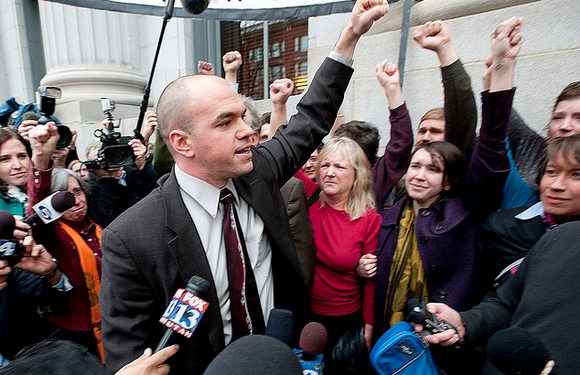
Tim DeChristopher outside a Salt Lake City, UT Federal Court

DeChristopher, one of the founders of the group Peaceful Uprising, took direct action to disrupt the sale of wilderness to mining companies in a closed Federal auction.  He ended up in prison, but he also did a tremendous amount to raise public awareness about the issue of land sales to corporate industry, and inspired the PeaceUp folks to greater activism.

Jamphel Yeshi also took a dramatic personal action at huge cost to himself—he lost not just his liberty, but his life. He and the 30 other monks who have taken this drastic step in the past have succeeded in letting the world know how deeply the Tibetan people are suffering under Chinese repression, and how passionately they yearn for autonomy to practice their religion and preserve their culture.

A monk looks at posters of Jamphel Yeshi in Dharamsala, India

Dramatic personal action is definitely a good tool to use in raising public awareness about an issue.

The problem with it is that one leader standing alone is an easy target—and if the action is a suicide, that heroic action is always going to be a one-time event.

That the Occupy movement has so far eschewed the single, high-profile leader model is a sign of the solidity of this nascent social movement.

Despite demands from the media and others for a leader to step out of the shadows and announce himself (the leader is always presumed to be male), Occupy has held firm to its founding principle of being a “leaderless movement.”

Occupy Oakland GA

This is true in the way the different “chapters” of Occupy, springing up at will anywhere in the world, are completely autonomous from the Occupy Wall Street folks who initially launched the movement last August; and it is true in the way that any passerby can join a General Assembly and have a chance to speak and influence or inspire the group. It’s true in the various Occupy online platforms that give anyone with an internet connection the ability to communicate with the world, and it’s true with the Occupy media, which are collective and often anonymous publications of strategies, theories and praxes of resistance.

I feel a tremendous sense of loss and rage that obvious, powerful leaders like Tim DeChristopher and Jamphel Yeshi are driven by frustration with the system and anger at injustice to commit acts of activist resistance that are either outright suicidal, or land them swiftly behind bars.

We in the West howl about human rights violations every time the Chinese throw another idealistic young activist in jail.

But we do the same thing here.

We reward the best and brightest of our young people as long as they play by the rules of the game and never question the wisdom of their elders in setting up those rules.

The Ivy league grads who will go on to become Goldman Sachs executives or corporate CEOs or weapons systems engineers—they are our golden children who can do no wrong.

But those young people who look out at what is and see the waste, the greed, the desecration of the planet, the horrendous danger in which the old game has placed us, as we cross the threshold of the 21st century into the new era of global heating, overpopulation, extreme inequality, toxic chemical poisoning, militarization…those young people are considered by the power elites to be annoying, pie-in-the-sky, unreasonable idealists who need to grow up and get a job.

In other words, they need to shut up and join the system.

The reason the Occupy movement is gaining steam is because the system no longer has enough places for all the smart, talented young people we are producing.

We can’t all join Goldman Sachs, now can we?

We can’t all join Greenpeace either.

When young people can’t pay off their student loans and can’t find jobs, and their parents can’t help them because they themselves can barely keep up with the mortgage payments…these young people are naturally going to be much more open to the possibility that something is quite wrong with the established system.

That’s where we are now.  That’s why suddenly we have not one or two extraordinary young leaders like Tim DeChristopher or Jamphel Yeshi stepping up, but a whole tide of young people who have the time, the talent and the energy to tackle the problems of our American society, and our global human civilization, head on.

One General Assembly at a time, they are creating a new vision of society and a new model of leadership.

It couldn’t be more different from the corrupt talking heads they grew up watching on TV.

It is, as Tom Hayden shared with us eloquently this week in The Nation, a return to the SDS and SNCC vision of true participatory democracy in action.

This spring and summer, it’s the numbers that will make all the difference.  They can’t lock up a million idealistic Americans whose only crime was to want to change our country for the better.

Did I say a million?  Let’s make it 10 million, all across the country, coming out and taking a stand for new rules to the game of life that are based above all on respect for the planet and her creatures.

Do unto others as you would have them do unto you, says the Scripture.

No wiser words have ever been spoken.  Let’s stop the hypocrisy and start practicing what we preach.  Let’s do it soon, before any more brave young leaders have to martyr themselves on our account, trying so desperately to wake us up.

Burning for change

Sometimes an image just leaves me speechless.  Here’s one like that:

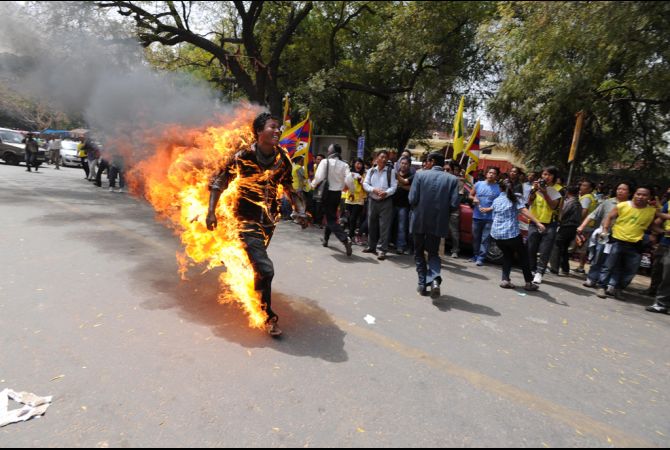
Tibetan monk self-immolates

Here’s another view of the same scene:

Jamphel Yeshi, a Tibetan exile, set himself afire in New Delhi, India, this week to protest China's repression of Tibet

The smile on the face of the burning man continues to haunt me.  It is like the beatific smile of an angel–or of a martyr who goes happily to his death hoping to advance a worthy cause.

Jamphel, who died of his burns, is one of 30 Tibetans who have set themselves on fire to protest China’s brutal treatment of Tibet, and to call for the return of the Dalai Lama to his homeland. Twenty of those incidents occurred in the past year, and of those 18 of the victims have died of their wounds.

As Melinda Liu reports in The Daily Beast, “Committing suicide is a last-resort measure in any society, but it’s seen as especially extreme for Tibetan Buddhists. Because their religion reveres all living beings, many Tibetans believe those who take their own lives will not be reincarnated. That’s a grim fate for religious devotees who aspire to be reborn, again and again, in more enlightened forms. “But what else can people do? We don’t have guns. We don’t want to harm other human beings. Yet we can’t stand to see our religion and culture being crushed,” lamented one Tibetan man from Lhasa, who requested anonymity because he feared China’s massive security crackdown.”

Hana Shalabi

There are other examples around the world of people taking drastic stands to protest brutality and stand up for civil liberties and human rights.  In Israel, several Palestinian prisoners who are being held without trial have begun hunger strikes, the most extreme of which has been carried out by Hana Shalabi, who just today agreed to end her 44-day hunger strike in exchange for being released to the Gaza Strip.

In the U.S., such extreme tactics are very rare, probably because we are led to believe that we have other avenues of protest open to us.

It’s true, we do have other avenues of protest open to us.  We can rally in the streets, we can sign online petitions, we can call our elected representatives, we can pressure the media into reporting on issues we deem important.

We can write blogs like this one, without fear of being summarily arrested and imprisoned for criticizing the powers that be, as happens routinely in many other countries.

But when it comes right down to it, I wonder whether all these various forms of protest really get us anywhere, or whether they are so many steam valves, designed to allow us to vent our frustrations without really rocking the boat.

What do we have to do to accomplish the big changes we want to see in the world? How far do we have to go?  To what degree to we have to put our own security and well-being on the line?

Tim DeChristopher

Tim DeChristopher, the environmentalist activist who disrupted a federal mining auction to protest the sale of public lands to corporate interests, made his point, but landed swiftly behind bars.  He emerged into the news again this week when prison authorities, for some unknown reason, transferred him from minimum security to a lockdown cell.  His friends and allies went ballistic, beseiged Congress with calls and online petitions, and got him transferred back to more comfortable quarters.

But he’s still behind bars.

And the mining companies are still out there digging up the wilderness as we speak.

Obviously his action, however noble, was not enough to truly change the rules of the game.

If we want to see deep, systemic change in the way governments and corporations do business, especially in regards to human rights and environmental justice, we may need to take a giant leap forward in our radicalism.

I am not saying we should set ourselves afire.  Heaven forbid!  But it’s going to take more than weekend protests or online petitions to drive a wedge into the status quo power structures and open up new pathways that will lead us to real transformation.

What will it take? I wish I had the answers; I don’t.  All I know is that enough of us have to get deeply dissatisfied and fed up with the way things are, and be willing to run the serious risk of undertaking revolutionary action for change.

It happened back in 1776; it happened in 1865; it happened in 1968; and it may very well happen again in this magical year of 2012, the prophesied beginning of the Age of Aquarius.

We know we are at a transition time; every indicator points to it, whether social, financial, political, scientific, astrological, astronomical…you name it.

We know where we’re coming from.  The question of the moment remains: where are we going?

Homage to Adrienne Rich

Adrienne Rich

Adrienne Rich has just died at 82 years of age.  That is a good long life, and it is truly inspiring how active she remained until the end, publishing and mentoring so many of us who follow in her path.

Although she was primarily a poet, there is an essay of hers that has remained very powerful for me, being the autobiography junkie that I am.  It’s “Notes Towards a Politics of Location,” the one where she talks about growing up as a Jew in the American South, and how she always felt like such an outsider.  It connects very much with her general recommendation for women, that we consider our outsider status a blessing, rather than a curse.  That we continue to see things with outsider’s eyes, rather than assimilating to the dominant mode of seeing and being.

This message has resonated strongly with me because I have always felt myself to be an outsider.  It doesn’t seem to matter which group I am with, or how long I have been affiliated with them, or even if I am, in name at least, the principal of that group.

I am the perennial outsider.

And thanks to Adrienne Rich, I no longer feel that as a handicap or a slur.  Rather, I wear it as a badge of pride.

Rich was someone who could have chosen to take her privileged status as a white American Jew and spend her life comfortably at the country club.

Instead, she chose to ally herself with Black Americans (notably Audre Lorde), gay Americans, and anyone who needed a powerful and articulate ally.

Alliance is a tricky business. A would-be ally from a more powerful social class needs to be very careful to offer help without coming on too strong; to use one’s power to open up spaces for one’s allies to speak and act independently. It’s not about us—it’s about them. Adrienne Rich made it look easy, but it’s not.

Three of my most important mentors have now passed on: Audre Lorde, Gloria Anzaldua and now Adrienne Rich.

Such a huge legacy to try to continue and move forward.

Sisters, I promise each of you that I will do my best to keep your spirits alive.

Opening to the energy that can change the world

In the course of any given day, I swing from hope to despair and back again at least three or four times.

On the one hand, it’s such an amazingly hopeful and alive time in terms of communication and discovery.  We are constantly learning so much more about our relationship with the natural world and with each other.  Every day brings fresh evidence of the myriad ways in which we are deeply interconnected with all Earth systems and with other Earth-based creatures.

On the other hand, that knowledge does not seem to be adding up to practical change in the real world.  Every day thousands of acres of virgin forests are cut and bulldozed.  Every day drills open up new spigots for deeply buried oil and gas deposits, which can only be extracted at great risk to the surrounding environment. Every day more chemicals are wantonly spread over the landscape and taken up in the bodies of mammals like us, as well as birds, fish and all the other creatures of the land and sea.  Every day hundreds of species, including us humans, move inexorably closer to extinction.

Why is it that despite all we know about the crucial importance of protecting our planetary home, we continue to desecrate and destroy it at ever-increasing speed?

Maybe the answer has something to do with that “we.”  Maybe the “we” who know that our survival as a species depends entirely on our responsible stewardship of the environment just isn’t the same “we” that is out there with the chain saws and the bulldozers.

Maybe the great challenge of our time is getting through to those other people, the destructive ones, the violent ones, the ones who do not seem to be able to perceive the bigger picture and how urgent it is now that we—as a global human civilization, united in our desire to survive and thrive on our finite planet—begin to practice radical sustainability at an accelerated pace.

The stakes are huge.  At this week’s international “Planet Under Pressure” conference in London, the stark statistics were rehearsed yet again.  They’ve gotten so familiar to me that I probably mumble them in my sleep every night.  The new video “Welcome to the Anthropocene” does an excellent 3-minute job at summarizing what we’re up against.

Still image from "Welcome to the Anthropocene"

But knowing the statistics and seeing what’s wrong is not at all the same as knowing what to do to make things right.

It’s so hard to know where to put one’s energies.

Do I go full-bore at the sustainable energy issue, following Bill McKibben?  Maybe a hunger strike in front of the White House would be an effective protest against the Keystone XL pipeline?

Do I go chain myself to a tree in the Amazon or in the rainforest of Indonesia, to protest the deforestation that is depriving us of the vital lungs of our planet?

Should I use my skills as a teacher to try to rouse the young people from their media stupor, using whatever scare tactics are necessary to get their attention and galvanize them to action?

Should I just be out there practicing “re-skilling,” in the Transition Town vernacular: relearning the old skills of surviving off the grid, living leaner and closer to the land that sustains us? Is it time to learn to keep chickens and pigs in my backyard, and finally set up the bee hives I’ve always wanted?

Or maybe I should be up on a mountaintop meditating and communing with the natural world, seeking the vision that will eventually show me the light?

What is it that I should be doing with this one wild and precious life I’ve been granted, in this fast-moving, tumultuous, unpredictable time in our planetary history?

Asking these questions is all I can do right now, just keep asking them and pondering and feeling my way towards my role in what lies ahead of us all.

I want to make an offering of my life.  I want to be a channel through which the positive, loving energy of the universe can flow out and make things right again with our world.

Occupy Health–Our Planet’s, Our Own–this May Day

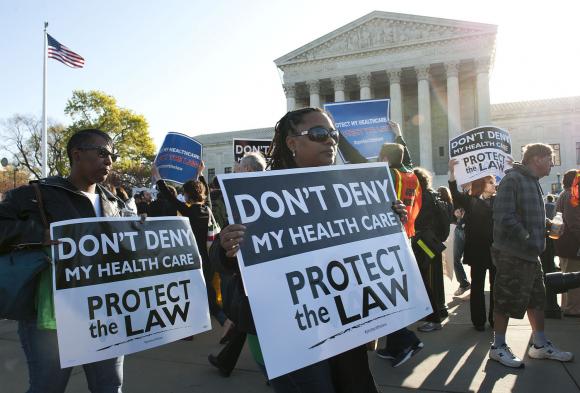
It doesn’t take a genius to understand the premise of the new health care law, which is that all Americans should buy health insurance so that the healthy can help subsidize the sick.

I don’t hear anyone whining about the fact that we are all required to buy car insurance, even though many of us, like me, hardly ever have cause to use it.

Health insurance could and should operate under the same principle. If everyone pays their share, the costs will also be shared.

And the so-called individual health insurance mandate will most likely be much less expensive for society in the long run, since it will result in increased preventive care and far fewer expensive emergency room visits.

Of course a universal single-payer system—Medicare for all—would be much better than the “free-market” insurance system that is under discussion today.  But at least having everyone insured, with subsidies to help those who can’t afford to pay, is a good step in the right direction.

The new law also prevents insurance companies from denying people health care because they’re sick, a truly barbaric Americanism, and allows families to continue to cover their children’s insurance up to age 26.  Who could argue with that?

The truth is that our nation could easily afford to cover all its citizens’ health care, and then some, if we took several crucial steps:

  • Properly tax the rich: close tax loopholes, tax financial transactions, make a genuine commitment to closing the abyss between the 10% at the top and everyone else.
  • Shut down the war machine; spend money on butter, not guns—or better yet, on organic vegetables that will keep people healthy.  It’s insane to put so many trillions into weapons aimed at blowing people up, and then throw a hissy fit about government spending on keeping people healthy.
  • Raise the minimum wage substantially, so that people can afford to eat healthy food, live a healthy lifestyle, and buy own their health insurance policies.

We live in a nation besieged with ill health.  From cancer to diabetes to heart disease and asthma, not to mention depression, ADHD and autism, we are a country of chronically ill people.  I blame much of this on the toxic food that has been sold to us over the past 60 years, since the end of World War II, by the industrial agriculture and food packaging giants, which have irresponsibly poisoned our waters, air, soil—and our bodies.

The powers that be want us to believe that the solutions are very, very complicated. So much so that we should just leave it to the experts—go back home and eat some more antibiotic-laced hamburgers, why don’t you, and watch some more mind-numbing reality TV.

Actually, it’s just the opposite. It is not complicated at all, it’s very simple.

We the people pay our taxes so that our government will work for us.  We have a right to healthy food, water and air.  We have a right to health care.  We have a right to expect that our elected representatives, as well as our Supreme Court Justices, will act in our best interests.

Since the Citizens United decision, it has become starkly apparent that corporations, not people, get preference when it comes to rights.  Money talks: they have the billions to buy the politicians and the media, and the rest of us be damned.

Well, enough is enough.  This is exactly where the Occupy movement has to step in and show that Americans have not become the catatonic stooges that the media giants aimed to produce.

We know what’s going on.

We have been so, so patient. So law-abiding.  So earnestly hopeful, with each election, that things would get better.

Things have only gotten worse, and there is no end in sight.

President Obama has done far better than a President McCain would have done, but he is no knight in shining armor.

No one politician can do this on his or her own.

It’s going to take the collective will of a great coalition of ordinary folks to get this nation to focus on what’s really important in this new century.

And let me tell you, it does not have to do with health insurance.

It has to do with climate.

Tonight in New England a bitter wind is blowing, and the temperature is expected to drop to the single digits, with a wind chill below zero Farenheit.  After a week of balmy summery temperatures in the 80s, the blooming trees and flowers are going to get a harsh night of frost.

This is apparently the new normal as regards our climate.  Even if we were to immediately do everything possible to slow down carbon emissions, a ship the size of our planet would take several of our little lifetimes to rectify itself.

So we need to get used to it.  And if we don’t want it to get worse—that is, absolutely uninhabitable for most current life forms—we need to roll up our sleeves and put all our intelligence to work at creating new, sustainable forms of agriculture, industry and lifestyle.

It can be done.

But not while we fritter away our precious time in begging the entrenched powers to give us some crumbs.

No, we need to unseat those powers and dramatically reorganize our social priorities.

It can be done.

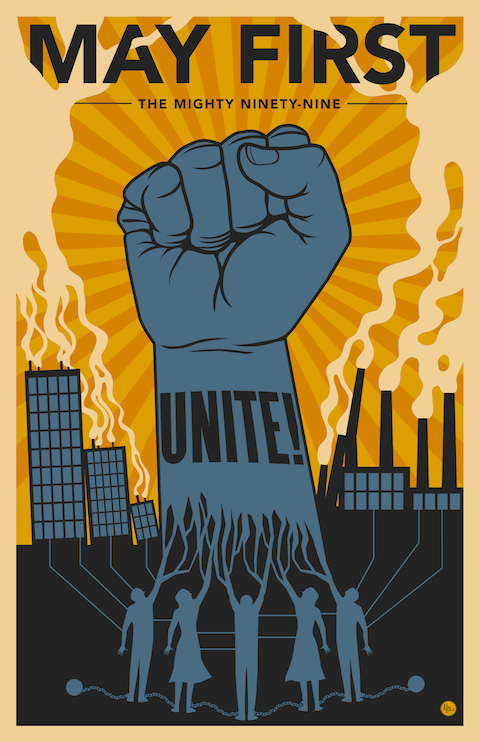
May Day is coming.  It must be a day of reckoning, the gateway to a hot summer of the hard work needed to provoke serious, transformative change.