The Solutions are Hidden in Plain Sight–if you look through 21st century eyes

IMG_4806A lot of us in the Northeast are doing our share of grumbling this year about the Arctic air that just won’t go away.  Usually March is the time when the winds start to blow, the sap starts to rise, the snow melts into the thawing earth and our thoughts turn to snowdrops and crocus.

This year, we’re still in the deep freeze with a hardpack of snow on the ground, and no end in sight.

It’s all part of the erratic weather of our climate change era.  The question for all of us now is, how, beyond bitching and moaning, are we going to respond?

Most of us just shrug and turn the dial on the heater up a little higher, not thinking about what that very small, ordinary act really entails.

If your thermostat is wired into an oil burner or a natural gas furnace, like most homes and apartment buildings in the Northeast, then when you turn up the dial in response to the bitter cold you are, perhaps unwittingly, enabling, supporting and becoming an integral part of the very industry that is relentlessly destroying our climate.

The fossil fuel industry is not some demonic force outside of our control.  It’s just a human business that is responding to human needs for energy—lots and lots of energy.

We Americans are used to getting what we want, and what we’ve wanted, in the 50 years I’ve been on the planet, is ease.  What could be easier than turning a dial to make your house warmer in the winter or cooler in the summer, or gassing up your comfy car before you get on the freeway?

1_RussetLikewise in terms of agricultural production—we like to get our vegetables pre-washed and sometimes even pre-cut, all even-sized, no blemishes, laid out attractively in faux crates under spotlights in our upscale grocery stores.

When we buy that bag of potatoes or carrots, we’re not thinking about the tons of pesticide, herbicide, fungicide and fossil fuels that went into making it easy for us to throw these items in our shopping cart.

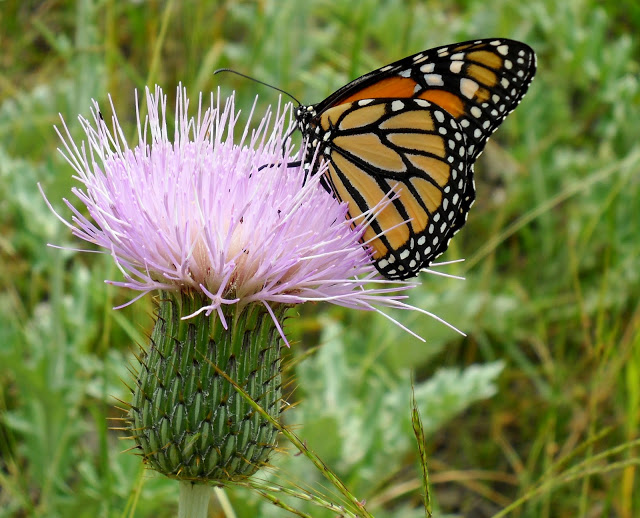
We’re not thinking about the bees, butterflies and other valuable insects that have been driven to population collapse by industrial agricultural practices; or the huge dead zones in the ocean at the mouth of the Mississippi River, where fertilizer and chemical run-off from the Midwest runs down to the sea; or the millions of birds that are affected each year by the toxic chemicals we spread over the landscape.

We’re just throwing that bag of veggies into the cart, or turning up that dial.

Well, the time of such oblivious innocence is over.

The curtain has been pulled back, and the Wizard of Industrial Capitalism has been revealed—and lo and behold, he wears the ordinary face of each one of us.

Every step we take on this beautiful, battered planet of ours matters.

Eric and me at the February 2013 Forward on Climate rally in DC

Eric and me at the February 2013 Forward on Climate rally in DC

I am heartened to know that this very weekend, one year after the big climate change rally in Washington DC that I attended in the hopes of pressuring the Obama Administration to block the Keystone XL pipeline, thousands of activists, most of them college students, will be raising a ruckus at the White House gates to insist that the politicians stop gambling away their future.

Here in my backyard, in the Massachusetts-New York region, people have woken up to the fact that mile-long trains of crude oil and gas are being run through heavily populated neighborhoods.

We’re moving to block gas fracking in western Massachusetts as the sight of contaminated tap water in fracking regions brings the dangers right home.

We’re also starting to get serious about making solar energy accessible to homeowners and businesses.

UnknownThis week’s New Yorker magazine has a fascinating article about a little-known scientific program to create a controlled thermonuclear fusion power plant.  Unlike the current fission plants, which burn radioactive fuel and generate dangerous waste, the fusion plant, if it were successful, would run indefinitely on seawater and lithium, with no waste.  It would be ten times hotter than the core of the Sun.

Talk about an audacious plan!  You have to hand it to human beings, we are nothing if not hubristic.  It is our greatest strength and our most glaring weakness.

Why spend billions on creating an artificial sun here on earth?  Why not just learn from our cousins the plants, and start to use the sunlight we have more efficiently?

It’s time to take off our grimy 20th century glasses and start looking at the world and ourselves through 21st century eyes.  When we do, we’re going to find that the solutions to all the problems that beset us have been hidden in plain sight all along.

Ronan Farrow’s Beacon of Hope

“One of the most difficult things to do is to infuse in young people a sense of empathy and a larger world…to give them a perspective that is more macro and less narcissistic,” Jon Stewart said in his recent interview with Ronan Farrow.

Ronan Farrow

Ronan Farrow

Farrow, when asked how he came by his desire to make a positive difference in the world, replied that it was growing up in a “mini-United Nations” sort of family (many of his 13 siblings were adopted from all over the world, some with serious physical or mental disabilities) that gave him the desire to become an agent for positive change on a worldwide scale.

Mia did something right to have set such a force in motion!

Ronan Farrow was a prodigy, going to college at my home institution, Bard College at Simon’s Rock, at the tender age of 11.  Although I never had him in class, I remember seeing him on campus, his bright blond hair always a stand-out, his small frame bent beneath a heavy backpack of books.

He went on to Yale Law School at 18, after serving a two-year stint as a youth ambassador at the United Nations; then became a Rhodes Scholar, worked at the State Department, and is now about to launch his own cable news show.

At 26, he’s done more than most of us will ever do.

I am quite impressed by the agenda he’s set for his show.  It will be news aimed at a youth audience, specifically designed to spark the empathy Stewart referred to, and not only that but to give his audience concrete options for taking action on the issues and situations presented.

Every show will have a “call to action,” Farrow said, and “a menu of things to do”; ways “to move the needle” on important issues.

I have noticed from my years of working with young people on social and environmental justice issues that they get very impatient and turned-off by discussions of problems that don’t also include solutions, preferably along with ways that they can get involved in moving the solutions forward.

It must be his twenty-something instinct that is prompting Ronan Farrow to put his talents and connections to work in creating just the kind of show his own generation is longing for.

It will have the celebrity pizzazz that his handsome face and famous name brings; the erudition and seriousness of purpose that his education and professional experience has provided; and with any luck, it will be a real beacon of active hope for millions of potential young change agents.

Go Ronan!  It is great to see a young person who is so clearly in the flow of living his purpose.

Infectious Hope

One of the things we are thinking about in my classes on social and environmental justice is whether it’s better, as an activist, to put your energies into a top-down or a bottom-up strategy.

Should we be trying to pressure governments, politicians and international organizations to do the right thing when it comes to, say, climate change policies?

Or should we be trying to ignite a whole series of grassroots, local, community-based changes?

Obviously it’s not an either-or proposition—it’s important to work at all levels.

But I notice that when I think about the big picture, I feel impotent and despairing.  Who is going to stop the massive deforestation of the planet?  How are we going to get the fat cats in corporations, governments and the United Nations to understand how critical it is to maintain forests and healthy agricultural soils so that they can function as the effective carbon sinks they are meant to be in our delicately balanced terrestrial eco-system?

It’s remarkable to note how my despair turns to hope when I turn my attention to the many local initiatives that I know are going on all over the globe.

When I think about how my hometown, Great Barrington MA, will be one of the first in the world to actually BAN PLASTIC BAGS in stores, my heart swells with pride.

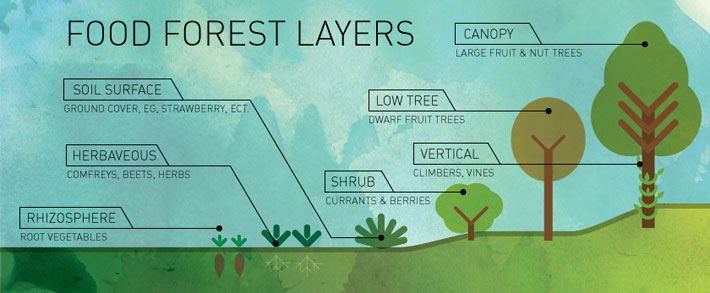
Hope fills me to learn that Seattle is creating an innovative “Food Forest” in a city park, aiming to improve public health by regenerating public land into an edible forest ecosystem created using permaculture principles to reduce agricultural climate impact, improve local food security, provide educational opportunities, and celebrate growing food for the benefit of all species.

And when I hear that some of the incredibly powerful billionaires on the planet are using their money to try to turn the climate change juggernaut around—for example, Tom Steyer, Michael Bloomberg and Richard Branson—it makes me believe that all is not lost.

Both despair and hope are highly contagious.

It is easy to pay attention to the constant stream of depressing news and believe that the game is over, so there’s no point in trying anymore.

In fact, nothing could be further from the truth.

imagesJust as green plants poke their way stubbornly through asphalt and even the most blighted landscapes are always striving to regenerate, our Earth always tends towards life.

Every single species alive on the planet today, from humans to microbes, has survived many cataclysms and tough times in the past.  Just as we have before, we can rise to the challenges that face us today.

It really doesn’t matter whether your preferred approach is lobbying Washington DC or starting a Transition movement in your town.

The important thing is to stay alert, stay active and engage with others who understand that the choices we make day by day can, cumulatively, have a critical impact on our planetary future.

We cannot afford to be complacent or ignorant, and neither can we afford the luxury of despair.

Put your hope into action, one day at a time.  I truly believe that the bridge of hope we build together can take us over these dangerous times, into a future bright with promise.

Love is all we need

Most people I know don’t pay a whole lot of attention to Valentine’s Day.

In its pop culture guise, it’s pretty trite, after all—candy, flowers, champagne perhaps, aimed at seducing the beloved into bed at the end of the evening….

Eve Ensler has tried hard to put a harder, more political edge on V-Day.  She’s got thousands of women dancing for freedom—rejecting the pervasive violence against women that forms the backdrop of so many of our lives.

Unknown-3

But for most of us, well, we’re just here in the trenches, and we may or may not have a loved one to honor as a Valentine this year.

Me, I’ve got no particular human Valentine at present. Such love as I have to give, I want to dedicate to the forests and the birds, the butterflies and the flowers that are, to me, the most beautiful manifestations of LOVE on this planet.

DSCN2252

Any expression of love is far and away more potent than expressions of hatred and violence.

If you love someone, you should, by all means, shower them with kisses and caresses.  You should be extravagant in your appreciation.

Likewise, if the object of your affection is a tree or a landscape or a bright, joyful living thing—say, a tadpole or a fish or a magnificent coral—go ahead and shower that being with the love it deserves.

The only meaningful counter to the hatred, disrespect and violence that has become the norm in Western culture is the intentional distribution of LOVE.

Love is all you need, crooned the Beatles.  Maybe they were on to something.

Against Mono-cropping, both Agricultural and Cultural

Did you know that there are more living organisms in a cup of healthy soil than there are humans on this blessed planet of ours?

This week I’ve been reading Judith Schwartz’s book Cows Save the Planet with my classes (“Women Write the World” and “Writing for Social and Environmental Justice”); the book makes a strong case for the importance of maintaining biodiversity not just in the plants and animals we can see (big ones like trees and polar bears) but also in all the infinitesimal life that crowds into every square inch of our Tierra Madre, Mother Earth.

As I think about the teeming life in a teaspoon of soil, what really strikes me is how biological loss of diversity is a mirror of cultural diversity loss.

Human beings are relentlessly narrowing the sphere of possibility for many life forms on the planet.  And at the same time, our global culture is becoming more homogenous and limited.

Take the consolidation of the media, whether it be in publishing, TV and radio channels, or newspapers.  Where a thousand different voices used to sound, now there are only the monolithic behemoths: Comcast, TimeWarner, Random House, Bloomberg.

UnknownWhere there used to be a thousand different ideals of female beauty, now there is just this.

How different is this from the reduction of thousands of different varieties of corn, rice, wheat and other seeds, to just the One Great GMO Variety?

Well, as hard as the intellectual property lawyers try to clamp down on diversity, the unauthorized weeds spring up anew.

I feel like the work I’m doing to create the Berkshire Festival of Women Writers is part of the resistance to cultural mono-cropping.

Instead of bowing to conventional celebrity culture, where the only important voices are the ones that have been anointed by the media gatekeepers, the Festival insists that every woman who writes from the heart has a story to tell that matters.

Conventional media dictates that anyone who gets a microphone must be media-pretty, articulate under pressure, and non-threatening to the political and cultural status quo.

Those who don’t fit this mold are consigned to the margins.

At the Berkshire Festival of Women Writers, the margins come to the center, with spectacular results!

The Festival aims to provide platforms for those would not otherwise be heard—teenage women alongside older women, women who have never published before alongside seasoned published authors in a wide variety of genres.

Unknown-1

Festival presenter Amber Chand

While few of the 150 women presenting in the Festival have celebrity status or “name recognition,” they have something more special: they are women who write and present from their hearts, not for financial gain but for the pleasure and the power of sharing their perspectives and ideas with others.

The Festival aims to change the world one woman at a time by shifting from a celebrity-based mono-crop cultural landscape dominated by centralized media, to a diverse, vibrant, locally grown environment in which women are celebrated not for how they look but for what they think and write about the most important issues of our time.

Could it be that as more women speak from outside the mold of popular culture, the external world will change as well?

Changing the storyline: from limitless growth to sustainable planetary happiness

Today in my Writing for Social and Environmental Justice class we began to talk about the power of storytelling.

The challenge for the students in my class is to figure out the best narrative strategy, the best rhetorical approach, the best genre and format to inspire others to work with them for positive social change.

To get people’s attention, especially in the media-saturated social landscapes many of us inhabit, the story has to be well-narrated, fast-paced and compelling.  It has to deliver information succinctly and have a memorable “take-away” line.  It has to give us interesting, admirable protagonists and a complex plot, complete with tragedy, catharsis and antagonists we can love to hate.

It’s a pretty tall order!

The first step, of course, is being clear on your own values—what you think is important, what issue is the one that most grabs your own heart and mind.  Great change writing speaks out of a place of passionate commitment.

Great change writing says: “I believe this so deeply I am going to open my heart and let you see how this great injustice or destructive practice is tearing me apart.  I am going to let you see me in all the vulnerability of my rage, grief and passion…and I am going to convince you to care about this issue too—enough to be willing to stand up and take action.”

That’s the second part of great change writing—you have to give people a clear call to action, and at least show them the starting point of a path towards change.

It’s not enough to wail and point blaming fingers at all the injustices of the world.  You have to point the way towards remedies, solutions, action.

I ended both my classes today declaring my feeling of optimism in the future. I feel more optimistic today than I have in a long time that we will be able to solve all the many problems human civilization has created in its childhood—the past 500 years or so.

The tremendous challenges that beset us, particularly the environmental challenges which have the potential to completely wipe us out, can be solved.

We already know what we have to do.  Reduce emissions, yes, but also restore the ability of the planet to absorb the emissions we do produce.

Judith D. Schwartz

Judith D. Schwartz

We are reading Judith Schwartz’s book Cows Save the Planet this week, which is all about the potential of soil to become an incredibly effective carbon sink, if we just stop our bad agricultural practices and let the billions of microbes that inhabit each teaspoon of healthy soil do their work.

If we were to stop killing our soil, plants and forests with herbicides, fungicides, fertilizer-dependent agriculture and clear-cutting, it is possible that we could radically shift the whole disaster-scenario of climate change—fast enough to make a difference.

What we need is to start telling a new story, to which the broadest possible base of people can hear and respond.

It will be a story about how a beleaguered, tired, hungry, thirsty, oppressed people—that is, the majority of people on this Earth—realized that with just a few adjustments, they could live a much richer, happier life in harmony with the natural world.

It will be a story about how the economics of endlessly growing national product gave way to the economics of sustainable planetary happiness. How competition gave way to collaboration, with the recognition that we have the capacity to give everyone on this planet a good life if we shift our focus from rising profits for the few to steady well-being for the many.

If we were to start telling this story loud and clear, in beautiful, compelling, persuasive and well-researched ways, broadcast over the billion megaphones of the World Wide Web, how could people fail to listen?

Especially if we backed up the vision with concrete strategies for making it happen down on the ground.

345570804_640I am heartened by initiatives such as the C40 Cities Climate Leadership Group, a working group of mayors from the major cities of the world who have decided not to wait around for the United Nations to get its act together, but to start working together independently towards a sustainable future.

C40 is changing the dominant narrative of gridlock and impossibility with its muscular can-do insurgency.

We can’t wait around for others to do it for us.  Each one of us has the power to be the starting point for ripples of change that can reach further than ever before in our brave new interconnected world.

What story will you tell?  What life will you lead?  What are you waiting for?

Coming your way: the first-ever Sustainable Civilization Olympics

I know I’m exposing myself to hailstorms of rotten tomatoes and eggs, but I’m going to say it anyway: I don’t care about the Super Bowl, or the Winter Olympics either!

Every time one of these big annual sports events come around, all I can think about is if only people would put the same energy and enthusiasm into sustainable living on our planet, what a beautiful world it would be!

It’s fine that people want to spend all their time and energy toning up their bodies and becoming world-class athletes.  Hey, whatever floats your boat!

But if you’re going to become a badass athlete, why don’t you put your strength and prowess to work for the planet, super-hero style, rather than settling for winning medals and giving your ego some strokes?

The bare truth is that if we human beings put our collective minds to it, we can solve any problem.

Melting-Glaciers_in_Himalayas_top-10-list.org_-300x198Global warming, water shortages, acidification of the oceans, clean energy, you name it, we can handle it—if we just focus our time, resources and energies behind being part of the solution instead of part of the problem.

Here’s an idea: why don’t we have a Sustainable Civilization Olympics, complete with livestreams in the labs and testing grounds so that we can all follow along as various teams make progress on solving our global problems?

For those who can’t get excited about anything unless competition is involved, well, go for it!  We can have teams, play-offs, Super Bowls, you name it!

Just let’s get the job done, for heaven and earth’s sake!

And then, once we’re back on an even planetary keel, maybe we can spare the time for the kind of mindless entertainment that floods our airwaves each year on SuperBowl Sunday.

We Are All Noah Now

We are all Noah now.

These words have been sounding in my head like a mantra these past few weeks, and this morning I woke from strong dreams of animals in trouble—a big lone fox, a frantically hopping toad—and felt the need to make my inchoate awareness of danger and responsibility more tangible by writing it down and sharing it with others.

Derrick Jensen asks with desperate, angry sadness how long it will take us to finally wake up and start resisting the accelerating extinction of species happening on our watch.

How can we love our pets so much (I ask with my purring cat on my lap and my snoring dog at my feet) and remain unmoved by the news that hundreds of sweet, innocent reptiles and amphibians, many of them from fragile, endangered species, were cruelly murdered by callous neglect last week, crushed into hot plastic tubs without food or water for days in a crate bound from Madagascar to the U.S. pet store market?

_72676565_mada3

_72680861_mada4

How can we continue to give our children adorable stuffed lions and tigers and bears to hug and cuddle (my own boys were devoted to their respective stuffed animal friends, a gray kitty and a green froggy) while turning a blind eye to the fact that all of the large animals on Earth are staring extinction in the face?

Indonesian palm oil plantation.  First the forest was bulldozed.  Never mind all the fragile species that called it home, including our primate cousins, the highly endangered orangutans.

Indonesian palm oil plantation. First the forest was bulldozed. Never mind all the fragile species that called it home, including our primate cousins, the highly endangered orangutans.

How can we blithely talk about international agreements like REDD and cap-and-trade markets, ignoring the fact that when these lofty agreements are translated into action on the ground in the remote tropical forests that most need protection, they too often result in the worst kinds of greedy destruction—for example, so-called protected forests being bulldozed, sprayed with herbicides and turned into palm oil plantations, but still sold as “protected forest” in the international carbon market.

Americans spend royally on landscaping around our own homes, but fail to appreciate that if we don’t snap out of our trance and start acting forcefully on behalf of the planet as a whole, the storms and droughts that are coming will make short work of all our careful planting and pruning.

Wake up people!  We are all Noah now.  The Ark that will help us weather the storms we have brought upon ourselves is the Mother Ship, sweet Gaia herself.

Headlands, Puerto Rico. Photo by Eric B. Hernandez

Headlands, Puerto Rico.
Photo by Eric B. Hernandez

It’s past time to start focusing on doing all we can to conserve the living beings on this planet—ours to protect, not to destroy.

We are all Noah now.

Respecting Our Elders

I was fascinated to learn recently that trees, especially big old trees, can communicate with each other and with their entire grove or forest of younger ones.

Apparently they do this through a network of fungi that grow in a symbiotic relationship with tree roots.  The larger the tree, the bigger the root network, and the more other trees the old one is in contact with.

What do they talk about? According to forest ecologist Dr. Suzanne Simard of the University of British Columbia, trees share nutrients and chemical signals through the network.  A big old tree can help the younger ones who may be less able to withstand drought, for example, or an insect onslaught.

That’s what we know for sure now, but who knows what other wisdom the trees may be sharing?

IMG_3928 copy

I was reminded of this forest phenomenon this week as two things happened simultaneously: the news broke that folk music giant Pete Seeger had died, and I started discussing with students in my Women Write the World class the first book of the semester, The Legacy of Luna by Julia Butterfly Hill.

juliahillLuna, you may recall, is a 200-foot-high California redwood that Julia Hill single-handedly saved from the chainsaw by obstinately camping out on a platform high in the tree, for more than two years.

In the book she wrote later, Julia describes how she came to regard Luna as a living consciousness, a kindred spirit with whom she could connect.

I thought the students in my class would pooh-pooh that idea, but many of them were willing to entertain the notion that there might have been some actual cross-species communication going on between the massive old tree and the young woman perched in its branches.

What is certain is that living in Luna taught young Julia Butterfly Hill many lessons that she never could have learned elsewhere.

If Luna had been cut down, as so many of the great old trees have been in forests around the world, all her accumulated wisdom would have been lost too, an incalculable loss to the younger trees around her.

We are fortunate that Pete Seeger and other great old ones like him—Nelson Mandela springs to mind, and Wangari Maathai and Rachel Carson, both of whom died of cancer far too young—have been able to leave a written and recorded legacy to us younger ones coming along in their wake.

We will be listening to Pete sing, watching Mandela give speeches, and reading the books of Maathai and Carson for years to come.

But when we cut down a wise old tree, we silence its network entirely.

Forests can  regenerate—if they are not sprayed with herbicides, if their topsoil doesn’t wash away and if they’re not turned into artificial factory-style plantations.

In many tropical countries the natural forest is destroyed and replanted like this.

In many tropical countries the natural forest is destroyed and replanted like this.

But even in the best of circumstances, the younger trees will be more vulnerable and less resilient without the oldest trees to shelter and guide them.

During the European colonial period, it was an accepted strategy for would-be conquerors to kill or enslave the tribal leaders first, under the theory that their followers would be less able to resist.

The Americans took a page out of the same playbook in their treatment of Native Americans, trying to demoralize the tribes by killing, imprisoning and humiliating their leaders.

It has been no different with logging.  The big old trees are the most highly prized, and are chopped down first, with longstanding and poorly understood consequences.

IMG_4053 copy 2

Dr. Simard is arguing for a different kind of forest management plan, one that is respectful of what she calls “the mother trees”—those old survivors who can help the regenerate the forest after the loggers have moved on.

Just as we honor outstanding human elders like Seeger and Mandela, we should be honoring the most ancient living things among us, the old trees.

It makes scientific sense (older, larger trees trap more carbon and hence help reduce global warming) and it also makes moral sense.

It’s the right thing to do.

Photo by Patxi Pierce

Julia at the top of Luna
Photo by Patxi Pierce

It’s Up to Us Now: Carrying on the Work of Pete Seeger

Unknown-1When I heard the news that Pete Seeger had died, my first thought was “oh no!” and my second thought was “now there goes a man who lived a good life.”

At 94, he had accomplished so much and lived so fully.  Even during his final months and weeks on the planet, he was still playing concerts to packed houses and inspiring people everywhere with his unwavering dedication to using music as a means of raising awareness and fomenting social change.

The New York Times obituary quotes him as saying in 2009 (the year he sang at President Obama’s Inauguration): “My job is to show folks there’s a lot of good music in this world, and if used right it may help to save the planet.”

Pete’s gift was for making music and getting others to sing along with him, and he used it not for fame, fortune or glory, but for the good of those who most needed him.

Whether he was singing in support of the Civil Rights Movement or the anti-war movement, singing for freedom against the red-baiting of the McCarthy era, singing against apartheid or singing for the environmental movement, he was always out in front leading the charge and showing others what true courage and conviction looked like—in a joyous register.

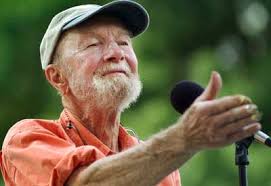
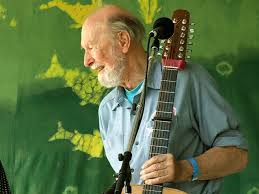
Image: File photo of Pete Seeger and his grandson Tao attending the We Are One - Inaugural Celebration at the Lincoln Memorial in Washington

That upbeat, “we-shall-overcome” personality probably played a big role in Pete’s longetivity—research shows that people who think positively tend to live longer, happier lives than those who tend to see the glass half-empty.

When I saw Pete play, at one of his last concerts last fall, there was a joyous glow about him that lit up the whole stage, and those of us in the audience would have followed him anywhere.

Well, it’s up to us now.  Pete has moved on, and we are left to carry on his legacy—to keep singing his songs and working for the positive social change he believed in and created.

Unknown-2Pete was so deeply engaged with humanity during his lifetime that in death he will still stay lodged in our hearts.

His is the kind of soul that will rise into heaven showering sparks and spores of bright beckoning energy, encouraging us to carry his tune, to keep his good spirit alive.

Today I start a new semester of classes, and I am excited to be teaching two classes that will enable me to do just that: “Women Write the World” and “Writing for Social and Environmental Justice.”

Pete, I’ll be thinking of you with love and admiration as I go to greet my students this morning.  I hope a little of your sweet, positive, hardworking energy will carry us forward this year, and forever.


If you get there before I do

Comin’ for to carry me home

Tell all my friends I’m comin’ too

Comin’ for to carry me home.


Swing low, sweet chariot

Comin’ for to carry me home

Swing low, sweet chariot

Comin’ for to carry me home.