Give mothers the respect–and the financial compensation–they deserve

Hilary Rosen

It truly is disheartening to hear a supposedly progressive woman proclaim that a fulltime mother “never worked a day in her life.” Democratic strategist Hilary Rosen deserves all the flack she’s been getting since she made that statement yesterday on national media.

On the other hand, it’s also disheartening to see how the male-dominated Democratic and Republican campaigns have wasted no time in turning Motherhood into a political football.

The truth is that American motherhood has never been more demanding, or more complicated.

Romney married a rich man and settled in to raise five sons. She had the enormous privilege of not also having the responsibility of earning money to put food on the table.

Today there are fewer and fewer women who can afford to stay at home as fulltime moms, especially if they have big families.

More kids mean more housework—but also mean more mouths to feed, shoes to buy, college tuitions to pay for.

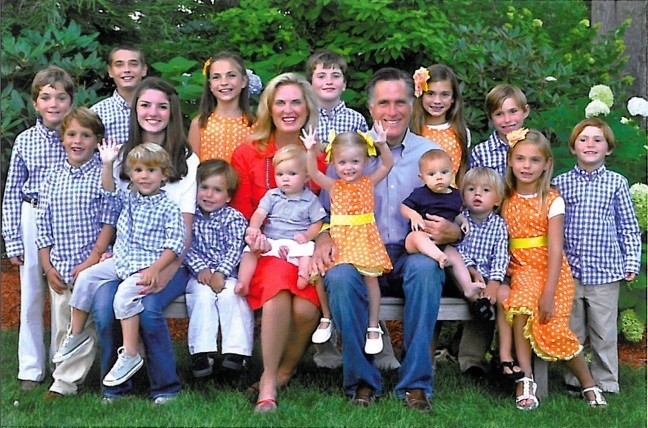
Mitt and Ann Romney with their 16 grandchildren

As part of the 1%, Ann Romney got to choose to stay home with her children.  For the rest of us, this is just not an option.

Especially the many of us who are single moms, or whose husbands have been out of work for months and years.

But the firestorm over Hilary Rosen’s miscalculated remark speaks to an even deeper issue that remains unaddressed in our society.

Mothers still do more housework and child care than fathers.  Housework and childcare still remains not only unpaid labor, but labor that is not recognized as having any monetary value in our very commercially oriented society.

A recent NY Times article interviewed some nannies who work for the 1%, whose labor is valued in the high six figures.

But the labor of a mother who stays home is not even deemed worthy of accruing social security.

At minimum, all mothers, whether they stay at home fulltime or struggle doing the second shift at home after the day job, should be entitled to accrue social security and expect some retirement compensation from the nation in their old age.

At minimum, all mothers should have the right to subsidized maternal health care.

At minimum, in a rich country like ours, no mother should have to worry about whether her children are going to have enough to eat.

Instead, our country is going in the opposite direction.

We are making it harder and harder for mothers to qualify for welfare assistance.  We are cutting back on public education, and failing to create incentives for doctors to work in public health clinics.

And many, many states are actively working to curb women’s access to contraception, while at the same time demonizing abortion.

So what’s a poor woman to do?

The media controversy over the non-issue of whether Ann Romney’s “work” as a fulltime mother qualifies as such is entirely misplaced.

What we need to get worked up about are the circumstances of the millions of American mothers who work hard, both in and out of the home, without the household help that the Romneys undoubtedly enjoyed, and who are not fairly compensated or recognized for their efforts.

It may sound corny, but it’s true: without the hard work of mothers to bear and care for children, our great nation would simply cease to be.

We need to cut the political chicanery and not only give Motherhood the respect it deserves, but put our money where our mouths are, too.

Bill McKibben, our environmental Pied Piper, is at it again

Bill McKibben

You gotta admire Bill McKibben. And you gotta wonder, where the frack does the guy get his indefatigable energy??

Off he goes again this week, starting a new campaign to protest hydraulic fracking in Ohio—you know, the state where natural gas drill rigs caused manmade earthquakes.

I think we all have a pretty good idea of how bad it is to have flammable toxic fumes coming out of your water faucets, earthquakes rumbling in your backyard, and tons of toxic waste building up above and below ground level.

Fracking sucks and we know it. It must be stopped. The question is, are we going to follow Pied Piper Bill to Ohio to occupy the Statehouse and make our demands known?

No doubt there will be plenty of Ohioans and even ardent out-of-state environmentalists who rally to the call, just as they did last summer when Bill led them down to Washington DC for sit-ins to protest the Keystone XL.

That battle did score some points, although more recently it seems that the southern portion of the titanic pipeline is going to be built after all, another huge investment in 20th century thinking and technology that can lead us in one direction only: over the nearest cliff.

***

In the Grimm fairytale, “The Pied Piper of Hamelin,” the town suffers from a plague of rats, which only the Pied Piper can solve.  When the town councilmen refuse to give the Piper his just reward for destroying all the rats, he takes his revenge, leading all the children of the town into a mountain cave, from which they are never recovered.  The moral of the story: don’t cheat the Piper!

Today the rats we suffer from are precisely the fossil fuel industry and their military-industrial, Big Ag, Big Finance brethren, which are, as in the Grimm story, destroying our homeland and eating us alive.

Even if Bill McKibben could lead all those rats into the river, we would still be left with the greedy councilmen, our politicians, who would very likely continue playing by the old rules, and would bring further disasters upon us.

When the Piper wanted to punish the town fathers, he did so not by attacking them directly, but by attacking their children.

Truly, there can be nothing worse than being forced to watch your children suffer and die.

Sometimes I think that the only way the rich and privileged are going to listen to reason and stop their destructive, world-killing ways is if they are forced to confront the reality of what their children will have to live with in the future, because of the lifestyles they themselves are living now.

I say “they” but I should be saying “we,” because I certainly have participated in this destructive lifestyle my whole life.  We humans, especially privileged Americans and Europeans, have been the rats that have been destroying the global village for decades now.

Unlike rats, though, we humans generally respond to reason.  We can be persuaded to change our ways, especially if we can be made to understand that the future survival of our precious children is at stake.

What sort of tune would the Piper need to play to change the hearts and minds of the frackers, for example?  Or the loggers, or the tar sands extractors, or the nuclear power plant engineers?

Bill McKibben has been tireless in his efforts to hit the right notes to attract enough people to follow him—not over a cliff or into a mountain tomb, but into a sustainable future.

You gotta admire the guy.  You gotta think—maybe I should get on that bus for Ohio.

L’Chaim! This spring, let us commit ourselves to Life

Both Passover and Easter “celebrate” truly horrendous acts committed by men against men.

Passover commemorates how the Jews were spared by the grace of God from the Pharaoh’s evil plan to kill all first-born sons.  Easter celebrates the Resurrection of Christ after he was brutally martyred on the cross—a not-uncommon practice at the time.

Of course, both the Christian and the Jewish holidays also build on the much earlier pagan rites of Spring, the welcoming of warmth and rebirth after a season of winter.

I have to wonder why dominant human civilization has moved away from the earlier, simpler pagan celebrations, keyed to the natural world rather than to human doings and misdeeds.

Both Passover and Easter celebrate life—the lives of Jewish children, the miraculous resurrection of Christ, who gave his life in sacrifice for humanity.  Hence all the eggs, chicks and bunnies that populate the secular reinterpretations of these holidays, especially the American secular Easter.

Life is indeed something to be celebrated, as the Jewish cheer “L’Chaim!” proclaims.

Celebrated and protected.

As we move forward into the 21st century, into the auspicious year of 2012, let our aim be to reconnect with our prehistoric roots, to the simpler ages when we instinctively celebrated the return of the Light, the annual swing of our planet back towards the Sun.

For much too long, we have allowed religious politics to push us into conflicts and cruelties that do not serve the purpose of Life.  In claiming to worship the Divine, we actually find ourselves serving the dark side, the side of Death and Destruction.

I use these capital letters advisedly, to emphasize the symbolism inherent in all these word-concepts.

Beyond the symbolic realm there is the literal bedrock of reality.  We are hitting up against that reality now, as the patterns of power-hungry conflict, fueled by greed and a willingness to press on with destruction of the living world no matter the cost to systemic ecological health, play out with relentless precision.

This Easter and Passover season, let us do more than just toast to life.  Let us commit ourselves to the service of the divine spark animating our planet, which circulates without distinction through every blade of grass, every insect, and every human being.

It is only in our positive reciprocal commitment to Life that we can consider ourselves truly blessed.


Round up the chemicals–for our children’s sake

When I was pregnant with my second son, born in 1998, I was living out in the country in a small house next to my parents’ bigger house.  My son was born in late August, and all through that third trimester I spent a lot of time outside.

In those years, my mother had the habit of having her pebble driveway sprayed with Round-up a few times during the summer to keep the grass and weeds at bay.  Since the pebbles came right up by the front door of our little house, the Round-up was there too.  I complained to her that it was toxic, bad for our pets, not to mention us, but it took many years for her to pay enough attention to this issue to rate health more highly than a neat appearance for the driveway.

I was thinking about this today as I read the news that finally, at long last, the medical research establishment is beginning to go public in announcing the link between the use of Round-up, skyrocketing rates of autism among children, and colony collapse disorder among bees.

My mother will remember that when my second son was born, we began to worry about him when, by his second and third month of life, he was still not making eye contact, and not returning a smile. He was a sweet, calm baby who slept and ate well, and loved to be cuddled…but unlike his older brother, who was laughing and smiling in his first month, he had a curious detachment about him that was unsettling.

Just like everyone knows someone with cancer, everyone knows someone who has had the hardship of bringing up an autistic child.  It’s a heartbreaker, and in those early months with my second son I was truly frightened that I might be in for that kind of ride with him.

And then, just like that, he started to smile, make eye contact, and all was well.

Could it be that his development was delayed because of the local spraying of Round-up during the last months of my pregnancy with him?

Recent research suggests that this is quite possible indeed.

It’s common knowledge that the Monsantos and Dows of the world use their immense fortune to suppress negative research when at all possible.

Source: U.S. Center for Disease Control

But at this point, with our bee population in serious crisis and the U.S. Center for Disease Control (CDC) telling us that 1 in 88 children is now diagnosed with autism (a figure that does not include all the many, many children who are diagnosed “on the spectrum” with some form of mental impairment), it is impossible for the corporate honchos to keep the lid on this story any longer.

It is an international scandal, bigger even than the Big Tobacco scandals of a generation ago, because in this case there is no way that a defense team could argue that it is a child’s choice to expose herself to toxic chemicals.

France, Germany, Italy and other European countries have already taken steps to ban these harmful pesticides and herbicidesThe U.S. Environmental Protection Agency, finally acting under extreme pressure from concerned citizens, is in the process of “reconsidering” its approval for “Poncho,” one of the most dangerous pesticides, proven to have a negative impact on bees.

Dr. Brian Moench, President of Utah Physicians for a Healthy Environment and a member of the Union of Concerned Scientists this week had the courage to defy Big Ag and describe—I believe for the first time—the missing link between bee colony collapse disorder, human autism, and widespread toxic chemical use in agriculture.

In an article published Monday on Common Dreams, Dr. Moench wrote: “The brain of insects is the intended target of these insecticides.  They disrupt the bees homing behavior and their ability to return to the hive, kind of like “bee autism.”   But insects are different than humans, right?   Human and insect nerve cells share the same basic biologic infrastructure.  Chemicals that interrupt electrical impulses in insect nerves will do the same to humans.  But humans are much bigger than insects and the doses to humans are  miniscule, right?

“During critical first trimester development a human is no bigger than an insect so there is every reason to believe that pesticides could wreak havoc with the developing brain of a human embryo.   But human embryos aren’t out in corn fields being sprayed with insecticides, are they?  A recent study showed that every human tested had the world’s best selling pesticide, Roundup, detectable in their urine at concentrations between five and twenty times the level considered safe for drinking water.”

Just down the road from the house where I lived while pregnant with my second son are fields of corn that are maintained by a local farmer.  It’s nowhere near the scale of agriculture in the Midwest or California, but still, if the wind was blowing while they were spraying the herbicides and pesticides in the spring, or while they were harvesting the corn in the fall, we would certainly be inhaling a toxic brew, that undoubtedly found its way into our well water.

And that’s beside the voluntary Round-up spraying of the driveway, and the fact that in those days I was not aware enough to be making a strong effort to buy organic fruits and vegetables, and avoid commercial meat.

So all in all I must consider myself and my family very lucky to have so far avoided autism or cancer.

This should not be left to luck.  Allowing Monsanto, Dow and the other agricultural chemical companies to continue to profit from poisoning our land and our food supply is absolutely unconscionable.

It’s even worse than allowing the cigarette industry to advertise to young people, which we no longer permit.

The bees are the canaries in the gold mine, and they’re dropping fast.

Are we going to delay until the statistics tell us that 1 in 50 children in the U.S. are born autistic?

This is a national and international outrage that must be addressed now.

Occupying Leadership: What will it take to accomplish real change?

Environmental activist Tim DeChristopher and Jamphel Yeshi, the young Tibetan monk who set himself on fire last week, are more alike than might first meet the eye.

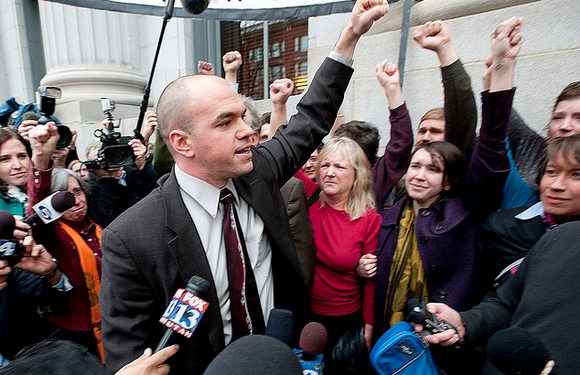
Tim DeChristopher outside a Salt Lake City, UT Federal Court

DeChristopher, one of the founders of the group Peaceful Uprising, took direct action to disrupt the sale of wilderness to mining companies in a closed Federal auction.  He ended up in prison, but he also did a tremendous amount to raise public awareness about the issue of land sales to corporate industry, and inspired the PeaceUp folks to greater activism.

Jamphel Yeshi also took a dramatic personal action at huge cost to himself—he lost not just his liberty, but his life. He and the 30 other monks who have taken this drastic step in the past have succeeded in letting the world know how deeply the Tibetan people are suffering under Chinese repression, and how passionately they yearn for autonomy to practice their religion and preserve their culture.

A monk looks at posters of Jamphel Yeshi in Dharamsala, India

Dramatic personal action is definitely a good tool to use in raising public awareness about an issue.

The problem with it is that one leader standing alone is an easy target—and if the action is a suicide, that heroic action is always going to be a one-time event.

That the Occupy movement has so far eschewed the single, high-profile leader model is a sign of the solidity of this nascent social movement.

Despite demands from the media and others for a leader to step out of the shadows and announce himself (the leader is always presumed to be male), Occupy has held firm to its founding principle of being a “leaderless movement.”

Occupy Oakland GA

This is true in the way the different “chapters” of Occupy, springing up at will anywhere in the world, are completely autonomous from the Occupy Wall Street folks who initially launched the movement last August; and it is true in the way that any passerby can join a General Assembly and have a chance to speak and influence or inspire the group. It’s true in the various Occupy online platforms that give anyone with an internet connection the ability to communicate with the world, and it’s true with the Occupy media, which are collective and often anonymous publications of strategies, theories and praxes of resistance.

I feel a tremendous sense of loss and rage that obvious, powerful leaders like Tim DeChristopher and Jamphel Yeshi are driven by frustration with the system and anger at injustice to commit acts of activist resistance that are either outright suicidal, or land them swiftly behind bars.

We in the West howl about human rights violations every time the Chinese throw another idealistic young activist in jail.

But we do the same thing here.

We reward the best and brightest of our young people as long as they play by the rules of the game and never question the wisdom of their elders in setting up those rules.

The Ivy league grads who will go on to become Goldman Sachs executives or corporate CEOs or weapons systems engineers—they are our golden children who can do no wrong.

But those young people who look out at what is and see the waste, the greed, the desecration of the planet, the horrendous danger in which the old game has placed us, as we cross the threshold of the 21st century into the new era of global heating, overpopulation, extreme inequality, toxic chemical poisoning, militarization…those young people are considered by the power elites to be annoying, pie-in-the-sky, unreasonable idealists who need to grow up and get a job.

In other words, they need to shut up and join the system.

The reason the Occupy movement is gaining steam is because the system no longer has enough places for all the smart, talented young people we are producing.

We can’t all join Goldman Sachs, now can we?

We can’t all join Greenpeace either.

When young people can’t pay off their student loans and can’t find jobs, and their parents can’t help them because they themselves can barely keep up with the mortgage payments…these young people are naturally going to be much more open to the possibility that something is quite wrong with the established system.

That’s where we are now.  That’s why suddenly we have not one or two extraordinary young leaders like Tim DeChristopher or Jamphel Yeshi stepping up, but a whole tide of young people who have the time, the talent and the energy to tackle the problems of our American society, and our global human civilization, head on.

One General Assembly at a time, they are creating a new vision of society and a new model of leadership.

It couldn’t be more different from the corrupt talking heads they grew up watching on TV.

It is, as Tom Hayden shared with us eloquently this week in The Nation, a return to the SDS and SNCC vision of true participatory democracy in action.

This spring and summer, it’s the numbers that will make all the difference.  They can’t lock up a million idealistic Americans whose only crime was to want to change our country for the better.

Did I say a million?  Let’s make it 10 million, all across the country, coming out and taking a stand for new rules to the game of life that are based above all on respect for the planet and her creatures.

Do unto others as you would have them do unto you, says the Scripture.

No wiser words have ever been spoken.  Let’s stop the hypocrisy and start practicing what we preach.  Let’s do it soon, before any more brave young leaders have to martyr themselves on our account, trying so desperately to wake us up.

Burning for change

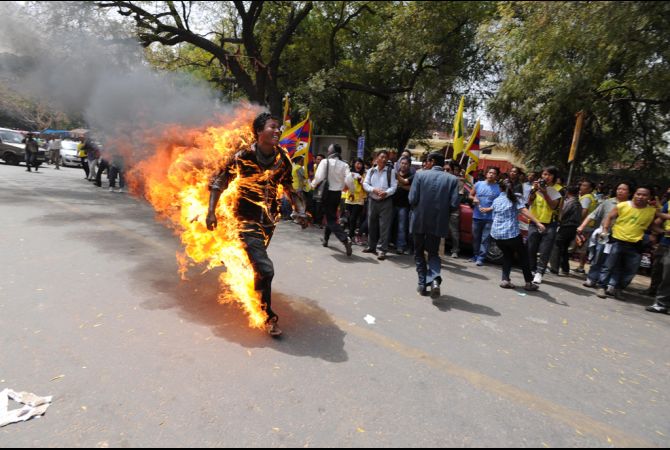
Sometimes an image just leaves me speechless.  Here’s one like that:

Tibetan monk self-immolates

Here’s another view of the same scene:

Jamphel Yeshi, a Tibetan exile, set himself afire in New Delhi, India, this week to protest China's repression of Tibet

The smile on the face of the burning man continues to haunt me.  It is like the beatific smile of an angel–or of a martyr who goes happily to his death hoping to advance a worthy cause.

Jamphel, who died of his burns, is one of 30 Tibetans who have set themselves on fire to protest China’s brutal treatment of Tibet, and to call for the return of the Dalai Lama to his homeland. Twenty of those incidents occurred in the past year, and of those 18 of the victims have died of their wounds.

As Melinda Liu reports in The Daily Beast, “Committing suicide is a last-resort measure in any society, but it’s seen as especially extreme for Tibetan Buddhists. Because their religion reveres all living beings, many Tibetans believe those who take their own lives will not be reincarnated. That’s a grim fate for religious devotees who aspire to be reborn, again and again, in more enlightened forms. “But what else can people do? We don’t have guns. We don’t want to harm other human beings. Yet we can’t stand to see our religion and culture being crushed,” lamented one Tibetan man from Lhasa, who requested anonymity because he feared China’s massive security crackdown.”

Hana Shalabi

There are other examples around the world of people taking drastic stands to protest brutality and stand up for civil liberties and human rights.  In Israel, several Palestinian prisoners who are being held without trial have begun hunger strikes, the most extreme of which has been carried out by Hana Shalabi, who just today agreed to end her 44-day hunger strike in exchange for being released to the Gaza Strip.

In the U.S., such extreme tactics are very rare, probably because we are led to believe that we have other avenues of protest open to us.

It’s true, we do have other avenues of protest open to us.  We can rally in the streets, we can sign online petitions, we can call our elected representatives, we can pressure the media into reporting on issues we deem important.

We can write blogs like this one, without fear of being summarily arrested and imprisoned for criticizing the powers that be, as happens routinely in many other countries.

But when it comes right down to it, I wonder whether all these various forms of protest really get us anywhere, or whether they are so many steam valves, designed to allow us to vent our frustrations without really rocking the boat.

What do we have to do to accomplish the big changes we want to see in the world? How far do we have to go?  To what degree to we have to put our own security and well-being on the line?

Tim DeChristopher

Tim DeChristopher, the environmentalist activist who disrupted a federal mining auction to protest the sale of public lands to corporate interests, made his point, but landed swiftly behind bars.  He emerged into the news again this week when prison authorities, for some unknown reason, transferred him from minimum security to a lockdown cell.  His friends and allies went ballistic, beseiged Congress with calls and online petitions, and got him transferred back to more comfortable quarters.

But he’s still behind bars.

And the mining companies are still out there digging up the wilderness as we speak.

Obviously his action, however noble, was not enough to truly change the rules of the game.

If we want to see deep, systemic change in the way governments and corporations do business, especially in regards to human rights and environmental justice, we may need to take a giant leap forward in our radicalism.

I am not saying we should set ourselves afire.  Heaven forbid!  But it’s going to take more than weekend protests or online petitions to drive a wedge into the status quo power structures and open up new pathways that will lead us to real transformation.

What will it take? I wish I had the answers; I don’t.  All I know is that enough of us have to get deeply dissatisfied and fed up with the way things are, and be willing to run the serious risk of undertaking revolutionary action for change.

It happened back in 1776; it happened in 1865; it happened in 1968; and it may very well happen again in this magical year of 2012, the prophesied beginning of the Age of Aquarius.

We know we are at a transition time; every indicator points to it, whether social, financial, political, scientific, astrological, astronomical…you name it.

We know where we’re coming from.  The question of the moment remains: where are we going?

Opening to the energy that can change the world

In the course of any given day, I swing from hope to despair and back again at least three or four times.

On the one hand, it’s such an amazingly hopeful and alive time in terms of communication and discovery.  We are constantly learning so much more about our relationship with the natural world and with each other.  Every day brings fresh evidence of the myriad ways in which we are deeply interconnected with all Earth systems and with other Earth-based creatures.

On the other hand, that knowledge does not seem to be adding up to practical change in the real world.  Every day thousands of acres of virgin forests are cut and bulldozed.  Every day drills open up new spigots for deeply buried oil and gas deposits, which can only be extracted at great risk to the surrounding environment. Every day more chemicals are wantonly spread over the landscape and taken up in the bodies of mammals like us, as well as birds, fish and all the other creatures of the land and sea.  Every day hundreds of species, including us humans, move inexorably closer to extinction.

Why is it that despite all we know about the crucial importance of protecting our planetary home, we continue to desecrate and destroy it at ever-increasing speed?

Maybe the answer has something to do with that “we.”  Maybe the “we” who know that our survival as a species depends entirely on our responsible stewardship of the environment just isn’t the same “we” that is out there with the chain saws and the bulldozers.

Maybe the great challenge of our time is getting through to those other people, the destructive ones, the violent ones, the ones who do not seem to be able to perceive the bigger picture and how urgent it is now that we—as a global human civilization, united in our desire to survive and thrive on our finite planet—begin to practice radical sustainability at an accelerated pace.

The stakes are huge.  At this week’s international “Planet Under Pressure” conference in London, the stark statistics were rehearsed yet again.  They’ve gotten so familiar to me that I probably mumble them in my sleep every night.  The new video “Welcome to the Anthropocene” does an excellent 3-minute job at summarizing what we’re up against.

Still image from "Welcome to the Anthropocene"

But knowing the statistics and seeing what’s wrong is not at all the same as knowing what to do to make things right.

It’s so hard to know where to put one’s energies.

Do I go full-bore at the sustainable energy issue, following Bill McKibben?  Maybe a hunger strike in front of the White House would be an effective protest against the Keystone XL pipeline?

Do I go chain myself to a tree in the Amazon or in the rainforest of Indonesia, to protest the deforestation that is depriving us of the vital lungs of our planet?

Should I use my skills as a teacher to try to rouse the young people from their media stupor, using whatever scare tactics are necessary to get their attention and galvanize them to action?

Should I just be out there practicing “re-skilling,” in the Transition Town vernacular: relearning the old skills of surviving off the grid, living leaner and closer to the land that sustains us? Is it time to learn to keep chickens and pigs in my backyard, and finally set up the bee hives I’ve always wanted?

Or maybe I should be up on a mountaintop meditating and communing with the natural world, seeking the vision that will eventually show me the light?

What is it that I should be doing with this one wild and precious life I’ve been granted, in this fast-moving, tumultuous, unpredictable time in our planetary history?

Asking these questions is all I can do right now, just keep asking them and pondering and feeling my way towards my role in what lies ahead of us all.

I want to make an offering of my life.  I want to be a channel through which the positive, loving energy of the universe can flow out and make things right again with our world.

Occupy Health–Our Planet’s, Our Own–this May Day

It doesn’t take a genius to understand the premise of the new health care law, which is that all Americans should buy health insurance so that the healthy can help subsidize the sick.

I don’t hear anyone whining about the fact that we are all required to buy car insurance, even though many of us, like me, hardly ever have cause to use it.

Health insurance could and should operate under the same principle. If everyone pays their share, the costs will also be shared.

And the so-called individual health insurance mandate will most likely be much less expensive for society in the long run, since it will result in increased preventive care and far fewer expensive emergency room visits.

Of course a universal single-payer system—Medicare for all—would be much better than the “free-market” insurance system that is under discussion today.  But at least having everyone insured, with subsidies to help those who can’t afford to pay, is a good step in the right direction.

The new law also prevents insurance companies from denying people health care because they’re sick, a truly barbaric Americanism, and allows families to continue to cover their children’s insurance up to age 26.  Who could argue with that?

The truth is that our nation could easily afford to cover all its citizens’ health care, and then some, if we took several crucial steps:

  • Properly tax the rich: close tax loopholes, tax financial transactions, make a genuine commitment to closing the abyss between the 10% at the top and everyone else.
  • Shut down the war machine; spend money on butter, not guns—or better yet, on organic vegetables that will keep people healthy.  It’s insane to put so many trillions into weapons aimed at blowing people up, and then throw a hissy fit about government spending on keeping people healthy.
  • Raise the minimum wage substantially, so that people can afford to eat healthy food, live a healthy lifestyle, and buy own their health insurance policies.

We live in a nation besieged with ill health.  From cancer to diabetes to heart disease and asthma, not to mention depression, ADHD and autism, we are a country of chronically ill people.  I blame much of this on the toxic food that has been sold to us over the past 60 years, since the end of World War II, by the industrial agriculture and food packaging giants, which have irresponsibly poisoned our waters, air, soil—and our bodies.

The powers that be want us to believe that the solutions are very, very complicated. So much so that we should just leave it to the experts—go back home and eat some more antibiotic-laced hamburgers, why don’t you, and watch some more mind-numbing reality TV.

Actually, it’s just the opposite. It is not complicated at all, it’s very simple.

We the people pay our taxes so that our government will work for us.  We have a right to healthy food, water and air.  We have a right to health care.  We have a right to expect that our elected representatives, as well as our Supreme Court Justices, will act in our best interests.

Since the Citizens United decision, it has become starkly apparent that corporations, not people, get preference when it comes to rights.  Money talks: they have the billions to buy the politicians and the media, and the rest of us be damned.

Well, enough is enough.  This is exactly where the Occupy movement has to step in and show that Americans have not become the catatonic stooges that the media giants aimed to produce.

We know what’s going on.

We have been so, so patient. So law-abiding.  So earnestly hopeful, with each election, that things would get better.

Things have only gotten worse, and there is no end in sight.

President Obama has done far better than a President McCain would have done, but he is no knight in shining armor.

No one politician can do this on his or her own.

It’s going to take the collective will of a great coalition of ordinary folks to get this nation to focus on what’s really important in this new century.

And let me tell you, it does not have to do with health insurance.

It has to do with climate.

Tonight in New England a bitter wind is blowing, and the temperature is expected to drop to the single digits, with a wind chill below zero Farenheit.  After a week of balmy summery temperatures in the 80s, the blooming trees and flowers are going to get a harsh night of frost.

This is apparently the new normal as regards our climate.  Even if we were to immediately do everything possible to slow down carbon emissions, a ship the size of our planet would take several of our little lifetimes to rectify itself.

So we need to get used to it.  And if we don’t want it to get worse—that is, absolutely uninhabitable for most current life forms—we need to roll up our sleeves and put all our intelligence to work at creating new, sustainable forms of agriculture, industry and lifestyle.

It can be done.

But not while we fritter away our precious time in begging the entrenched powers to give us some crumbs.

No, we need to unseat those powers and dramatically reorganize our social priorities.

It can be done.

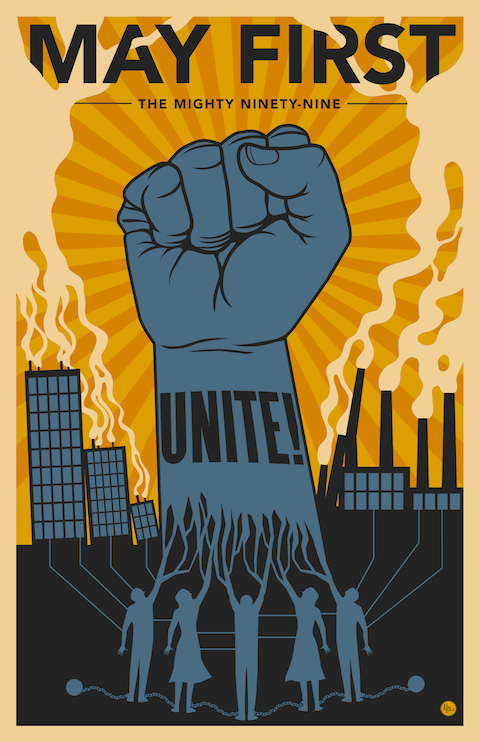
May Day is coming.  It must be a day of reckoning, the gateway to a hot summer of the hard work needed to provoke serious, transformative change.

Women Must Stand Up For Peace & Security

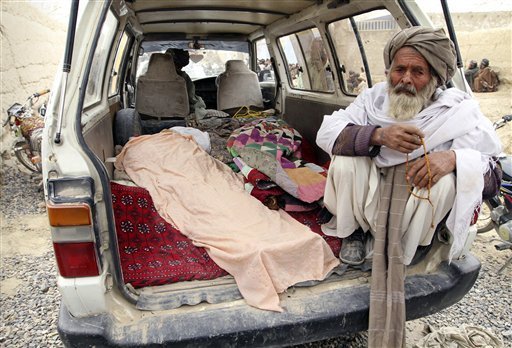
A deranged soldier, armed with gun and knife, walks off the base into the nearby small town, and massacres 16 people, including 9 children.

No, it’s not the plot of the latest Schwarzenegger movie.

It’s real life in Afghanistan.

Or Oslo, Norway.

Or Homs, Syria.

Or the local high school or university in Anytown, USA.

What happened in Afghanistan this week is part of an ever-escalating pattern of violence visited on innocent civilians by armed men.

Janjaweed

Whether the men are sponsored by a state (ie, they’re soldiers), are part of armed militias (think Taliban or Janjaweed or Kony’s Lord’s Resistance Army) or individual “rogue” psychopaths is immaterial to the victims of the violence.

The larger point that must be reckoned with is that we cannot expect to live in a global society dripping with arms and saturated with constant virtual and real instances of violence, and come away unscathed.

Americans are always so shocked when the violence happens in our backyard, as in school shootings or Timothy McVeigh-style bombings or police brutality against unarmed Occupy protesters.

We’re shocked when our soldiers, “our boys,” commit atrocities while serving in the armed forces abroad.

But how can we expect our boys to be immune to the general atmosphere of violence that we all live and breathe—young boys and men in particular?

People like to argue about whether playing countless hours of shoot-em-up video games results in more violent youth.

All I can tell you is that the military now uses video game technology to teach warfare to young soldiers, and one of the goals is precisely to overcome the natural human aversion to killing, especially killing those who haven’t done you any harm.

Lt. Col. David Grossman

In the class I teach periodically on gendered violence in military culture and war, we read excerpts from the work of Lt. Col. David Grossman, who maintains a website called “Killology.com.

Grossman, a psychologist who has become one of the most sought-after military and police trainers in the U.S., if not the world, defines “killology” as “the study of the reactions of healthy people in killing circumstances (such as police and military in combat) and the factors that enable and restrain killing in these situations.”

Grossman began his career teaching soldiers and police officers “the psychological techniques needed to develop Mental Toughness, a Survival Mindset, and a Hardened Focus,” integrating “psychological skills with physical and tactical training… to achieve maximal performance excellence as a modern warrior.”

Interestingly, now he not only offers training in the psychological “hardening” necessary to become a socially sanctioned killer—ie, a soldier–but also has begun to write and speak out against media violence, which, he says, teaches children to kill.

I think he would agree that what happened at Abu Ghraib a few years back, or in Afghanistan this week, when ordinary American soldiers go haywire and start torturing and killing civilians, is not just a case of a few bad apples.

If we allow our kids to grow up playing “harmless” violent games that are ever more realistic, gripping their imaginations and giving them access to the bloodthirsty, adrenalin high of killing, we can’t expect them to be agents of peace, especially when, as soldiers, they are further trained for war and given real weapons and the authority to use them.

My heart bleeds for the victims of this latest massacre in Afghanistan.  I can hardly imagine the pain of the survivors of the family of nine children and their mother annihilated all in one foul blow.

They aren’t the first, and they won’t be the last innocent bystanders to be caught in the crossfire of a senseless war.

I think of the many other places in the world where civilians have been caught in the crossfire of baleful enemies: Central and South America in the 1970s and 80s, when the US and USSR funded proxy wars that wreaked havoc with innocent local communities; current conflicts in Africa and the Middle East that are really about the control—by outsiders, the same old Great Powers–of ever-shrinking resources; the list goes on.

Like the Russians before them, the American military is preparing to throw up its hands and give Afghanistan back to the warlords.

It will be a disaster for the women and girls there, who had begun to hope that a more liberal mindset might prevail and help them shake off the bonds of radical Islamic gender-based oppression.

Perhaps it is up to the women of the world to rise up together to insist that our men and boys stop pouring so much time, energy and money into creating and using lethal weapons, and representations of violence.

We have seen what happens when we let boys be boys and play with their guns, real or virtual.

Can we afford to stand by and watch the endless replay of rapes, homicides, massacres, the endless parade of crippled bombing victims, the burned, the sightless, the psychologically damaged for life?

I am losing faith in the ability of the men in charge to solve this problem.

Back to Lysistrata!

If we want life, we women have to walk boldly forward and manifest our visions of peace, security and cooperation.

We need to create a procession of the world’s women, those who will stand up for peace and nonviolence—a procession so long, so wide and so loud that it cannot be ignored.

Women of the world, the future is in your hands.  What will you do with it?


May Day Mutiny: Radical Transformation Rises

Today is our “spring forward” day in the U.S., when we move the clocks forward an hour thus “losing an hour” in the morning, but gaining an additional hour of light at the end of the day.

It’s a beautiful sunny day here in Massachusetts, with birds singing their love songs in the trees, and the sap rising steadily in the thick sugar maple forests.

It’s hard to feel gloomy or pessimistic on a day like today, with our great source energy, the Sun, shining so brilliantly and steadily down on us.

Even contemplating the social landscape, it seems that there are reasons to be hopeful.

Last night I attended a brilliant one-act play by a Bard College at Simon’s Rock senior, sensitively and with almost painful honesty focusing on the relationship between a pair of best friends, 15-year-old girls, as one of them goes through a secretive, excruciating home abortion.

At the talk-back after the play, the author, who also played the lead, said she wrote the play because it was so clear to her that young women’s voices need to be heard more broadly in the theatrical world—not just as love objects written by men.

To me this is a hopeful sign, because as more women’s voices find their way into the great collective unconscious of the human public sphere, they will have an impact on the way we think and act as a social body.

The shame, secrecy and psychic anguish felt by the lead character of the play is so unnecessary, as is the fact that although it took two to implant that fetus, the other teen parent, the guy, was entirely absent from the drama that followed.

If young men were more aware of what an abortion entails, I dare say that many of them would be more responsible in doing their part to avoid pregnancy until they were ready to assume the mantle of fatherhood.

If high school sex ed included sessions on abortion the way drivers’ ed includes sessions on the consequences of driving drunk, complete with graphic images and re-enactments, abortion might become a rarity, and having teen sex without contraception as stigmatized as driving a bunch of friends home from a party dead drunk.

***

I am feeling hopeful today too because yesterday I read Tidal 2, the second journal put out by a group calling itself Occupy Theory.

The journal, entirely web-based, includes articles by Judith Butler and Gayatri Spivak, written in as accessible a voice as I have ever heard those two formidable theorists muster.

It also includes articles by unnamed CUNY Graduate Center students on a variety of issues, as well as a wealth of other interesting short pieces and vivid photos and artwork of the Occupy movement.

Judith Butler

Butler makes the excellent point, in reference to the call by the political/media establishment for “a list of demands,” that “the appeal or demand that sought to be satisfied by the existing state, global monetary institutions, or corporations, national or transnational, would be giving more power to the very sources of inequality, and in that way aiding and abetting the reproduction of inequality itself.”

Instead, Butler calls for a movement for “radical equality,” the achievement of which would require “the making of new institutions,” rather than trying to push existing institutions to change radically while still maintaining their social dominance.

She also envisions an Occupy strategy that would be strategically “episodic and targeted,” rather than the sitting-duck encampment strategy of last fall.

Gayatri Chakravorty Spivak

Such a strategy might build on the historical model of the General Strike, as Gayatri Spivak discusses in her contribution to Tidal 2.

The General Strike, as undertaken by Gandhi against the British, “has always been special because it is undertaken by those who suffer, not by morally outraged ideologues,” Spivak says.  “It is by definition non-violent…though the repressive apparatus of the state has used great violence against the strikers. Although the results are transformative, the demands are usually focused on laws….If one sees the connection between the General Strike and the Law, one realizes that this is not legal reformism, but a will to social justice….Unlike a party, a general strike refuses to cooperate until things change.”

Tidal 2 ends with a bold call for a General Strike on the symbolically important day of May 1, 2012, May Day.

I have no doubt that it will happen, and that it will be big.

I am sure police forces across the world are already planning their own strategies.

The truth is that if the 99%, “those who suffer” from the structural inequality of globalized capitalism, were to come out in large enough numbers on May Day, and refuse to go home until those in power began a serious dialogue on transformative, institutional change that included the retooling of our political, social and environmental systems for 21st century realities—the truth is that we might actually get somewhere.

Somewhere new, somewhere joyful, somewhere beyond the bruising, gridlocked, decrepit and corrupt politics that currently has our entire planet in a stranglehold.

The social and political elites who have inherited the 20th century reins of power and do not want to let go need to be made aware that they are driving us all over a cliff with their refusal to summon the political will and the technological know-how to adapt to anthropogenic global heating.

They must be made to understand that they and their children will go down with the rest of us!

That is the one blind spot in this issue of Tidal 2: there is very little mention of the impact of climate change and human overpopulation on the carrying capacity of the planet.

This awareness shows up more in metaphor than head-on, but metaphor is powerful too.

At one point, the anonymous authors of Tidal 2 describe the 1% as the captain of a ship “who steers while we shovel coal and  swab decks.  He seems to have us headed towards a typhoon.

“The captain stares at the impending doom on the horizon and grins ecstatically.  He’s clearly thrilled to be captain.  He faces down a storm that we can only wincingly glance at with one squinting eye, and he jabbers incessantly about hope and destiny.  We realize that he does not see as a normal person, by passively receiving light through his pupils.  Rather he uses his eyes offensively to project what he wants to see on the world.  He has become so practiced at his fantasia that he can no longer recognize what we, cringing on deck, see as certain catastrophe.”

Well, my friends, it is time to stop cringing on deck.

Mutiny is justified if the captain is a raving maniac and the alternative to mutiny is catastrophe.

On this sunny day, let’s pledge to take a great leap forward this spring, take charge and steer ourselves into safer waters.

See you on May Day.