Staring down the crystal ball

I really want to believe it’s all a hoax.

Why else would not one mainstream media outlet be reporting on the massive danger posed by the unused fuel rods in Fukushima Reactor 4?

Today I learned (through a link posted by on Facebook by my friend, the author Susan Griffin) that a group of high-level scientists, diplomats and civil society organizations has issued an urgent call to U.N. Secretary General Ban Ki-Moon, requesting U.N. leadership in an international effort to stabilize the fuel the wrecked Fukushima plant.

This call has been endorsed by U.S. Senator Roy Wyden, who visited the plant in April and reiterated the call for urgent international action.

If the fuel in the plant were released into the atmosphere, which would be almost inevitable in the event of another earthquake, “this could result in a catastrophic radiological fire involving nearly 10 times the amount of Cesium-137 released by the Chernobyl accident,” according to the letter to Secretary Ban.

Fukushima burning

Given the climatological realities of wind and ocean currents, this could potentially put hundreds of millions of people at risk of radiation poisoning—not to mention the devastating effects on flora and fauna.

Remember the reports of thousands seals with fatal skin lesions washing up in the Arctic? Apparently polar bears and whales are also known to be affected.

Imagine that multiplied tenfold, and affecting not just marine life, but humans as well.

And then ask yourself, why is only one U.S. Senator engaged with this issue?

Why are we frittering away our precious time on White House Correspondents Dinners and sports events, when in so many ways our future hangs in the balance, connected by a very short fuse to multiple forms of total catastrophe?

Sometimes I look down at my peacefully sleeping dog and think, maybe he has the right idea.

Why fret and worry about the future?  It will come soon enough…might as well enjoy life while it lasts.

But that is what separates us humans from other species.  We can see into the future.  We can spin out possible future scenarios based on how we act today.

And given these crystal balls of ours, can we really in good conscience shrug our shoulders and head off peacefully to bed?

No More Leave it to Beaver

In the lively “Room for Debate” series in this week’s New York Times, provocatively entitled “Motherhood vs. Feminism,” the piece I like best is the one by Annie Urban, who reminds us that “it’s about parenting, not mothering.”

“Too often the discussion about women’s choices (stay at home, go back to work) ignores the role of fathers. To achieve meaningful equality, we need to push for a society that values fathers who strike a balance between their career and their family life too. Women shouldn’t have to be equally uninvolved parents to reach their goals; they should be able to ask their spouses to step up too.”

Hear hear, Annie!

Amazingly, she was the only one of the seven women columnists commenting on Elisabeth Badinter’s slamming indictment of “attachment mothering” who thought to look to the fathers.

Is it because for the six other women, the fathers are so absent from the parenting landscape that their input is immaterial?

Erica Jong, who describes herself as a “zipless gran,” is the only one to point out that the intensive, at-home parenting required of the “attachment” model “takes resources”: “An affluent mom who doesn’t need to earn can afford co-sleeping, making pure food, using cloth diapers and being perfectly ecological,” Jong rightly observes.

She doesn’t say, but it’s easy to assume, that such a mom is supported by a hardworking spouse.  The unspoken assumption about fathers, unchanged since the Leave it to Beaver days, rears its head: the primary function of a father is to pull in the bucks.

But times have changed. For mothers who must work to keep our kids in food and shelter, short-cuts are necessary, and juggling too many responsibilities becomes a fine art. Should I miss the cocktail party after work today, where all the important networking takes place, or should I pick my kid up from day care in time for dinner and a relaxed bedtime story?

How about calling dad to pitch in here? Why can’t he do the bedtime story so mom can go to her cocktail party and chat up the boss?

In my experience, the answer to such a query is too often a flat no—you handle it, honey.  And so she will, making those tough choices day after day, doing the best she can.

It is no accident that women still earn 77 cents on the male dollar.  The other 23 cents go to our unpaid, unsung attention to mothering and family care of all kinds.

Elisabeth Badinter says we should get over our obsession with the “voluntary servitude” of mothering and go play the career game with the boys, giving it all we’ve got.

I’d rather see a kinder, gentler scenario, in which parents, both male and female, work together to balance the conflicting demands of work and child care.

As a society, we could encourage this in a material way by acknowledging the value of parenting via Social Security and other benefits.

By dint of hard struggle we have enshrined the concept of family leave and parental leave in law, but we could do a lot more to support parents through the difficult years when so much is demanded of them on the home front while they are also in their prime career-building years.

Instead, our society seems to be pushing women back into the unpaid homemaker roles, by sinking our efforts to balance career and mothering under the weight of guilt, frustration and sheer exhaustion.

Do we really want to focus the bright minds and creative spirits of 50% of our population exclusively on issues of breast-feeding, diaper rash and what to have for dinner?

Do young men really want to return to the good old days of being the sole provider for a houseful of dependents?

Feminism needs to demand that fathers fully engage in the struggle to make parenting a joyful, cooperative stage of life, rather than a gendered minefield.

And mothers and fathers need to insist on the social support they deserve for the valuable labor they perform every day, both in the home and outside of it.

May Day: Here, There and Everywhere

A reader asks why I did not stay home from work and join the May Day protests today, and I feel like this question deserves a serious response.

Partly, I have always had a phobia about crowds, and never willingly put myself into a crowd situation.  I don’t even like to go to an agricultural fair, or a peaceful parade.  In my Manhattan youth, crowds and violence often went together, or at least crowds and the fear of violence.  I am a wimp.

Partly, I felt like I could do more good in my classroom today than anonymously out on the streets.  It is the last full week of classes at my institution; students are finishing up projects that need response and guidance.  If I didn’t show up to work today, it would throw a monkey wrench in the plans I made for a graceful and productive ending to our semester together.

Partly, I don’t have any beef against my own employer, so not showing up for work today would affect the wrong target, while making no difference at all to the intended target, the 1%.

I guess the biggest reason I felt like my presence was expendable to today’s protest is because no one would notice if I was or was not out there on the street, but I would definitely be missed from my classroom.

However, in at least one of my two classes today, I did spend some time talking about May Day and the reasons for the protest.

I was surprised to learn that very few of my students had any clue as to what May Day signified to the labor movement, or why the protests today were taking place.

I don’t know why I assumed that my students would be more politically aware than I was at their age.

Turns out, few of them even realized there were going to be significant protests today, much less what they were all about.  Some also had their doubts as to whether the Occupy approach was likely to be effective.

Well, I pressed them, if occupying public spaces is not an effective means of protest, what would be more effective?  Joining a political campaign?  Writing a letter to the editor?

No one had an answer to that, but I could see the wheels turning.

And that’s why I am glad I decided to stay at work today.  At least with this one small group of students, I was able to foreground these historic May Day protests in their minds, and ask some questions that no one else probably would have asked them today.

Maybe as a result they will be paying attention to the news in a different way, and thinking more concretely about how the issues blazoned across all those posters and banners are relevant to their own particular lives.

Whether working on the small canvas, in the classroom, or the big canvas, out in the street, we are working together to build up the necessary momentum to blast our way to a better world.


Which Side Are You On?

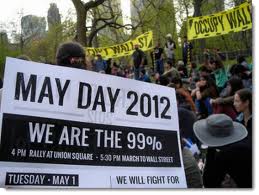
So here we sit on the eve of May Day 2012, and there is an eerie calm-before-the-storm kind of feeling.

The mainstream media is still doing its best to pretend that nothing out of the ordinary is going on.

The only May-Day related event reported in the NY Times today was that a lawsuit was filed in federal court to keep police from using “pen” barricades to hold demonstrators against their will.

Apparently news of the remarkable energy, creativity and defiant spirit showed by the Occupy movement in the countdown to May Day is not fit to print, ie, not important to the intended audience of The Times.

But if you move over to Twitter and search #Occupy, #OccupyWallSt, or #MayDay, you get a whole different picture of what’s going on.

Instead of the nose-in-the-air ho-hum of the fat-cat NY Times, suddenly you’re plunged into a hum of activity, down on the ground with a million twittering mice running around energetically, purposefully and thoughtfully.

There is @OccupyColleges calling for a student strike to protest the debt-bondage of student loans.

#OWS is trumpeting the latest total of 135 U.S. cities where general strikes have been organized for tomorrow.

The Nation, Democracy Now, and Truthout are publishing advance stories preparing for what’s coming.

The media landscape itself bears evidence of the huge and widening gap between the 1%-dominated old guard, napping on its laurels, and the feisty up-and-at-‘em new media webizens, who are vigilant and unafraid to welcome in something new and different.

For make no mistake, the General Strike planned for tomorrow is something new.

International Workers Day has not been celebrated in the U.S. for a long time.  In fact, during most of my lifetime it was demonized as a Communist holiday, which you’d be unpatriotic–unAmerican!–to take seriously.

We’ve come a long way in a very short time.

Thanks to the Occupy movement, being a worker, rather than a boss, is no longer a sign of personal shortcomings, as in: what’s wrong with you, that you’re still only earning minimum wage, bub?  You dumb or something?

Likewise, the Occupy Foreclosures movement has taught us that it’s not that we were stupid to apply for that tempting mortgage, it’s that the banks were predatory and sleazy to talk us into it.

Thanks to the Occupy movement, the onus has shifted to the 1% to prove that what they’re doing is responsible and for the good of all, rather than motivated by naked greed and self-interest.

The rapacious vulture Capitalism that has dominated the U.S., and hence the world, since the end of World War II has been exposed, and there is no going back.

It may be true that many of the strikers are motivated by self-interest rather than pure altruism.  They want jobs, along with affordable housing, education and health care.

But it’s also true that the Capitalist masters of the universe have lost control of the ship and can no longer pull levers to make jobs and other social benefits magically appear.

Unless, that is, the ultra-rich 1% can be persuaded to part with a fair portion of their loot.

History shows that when the gap between the haves and have-nots widens too far, something snaps and the mob takes over to reset the balance.  Think the American, French and Haitian Revolutions.  Think the Communist takeovers of Russia and China.

When it happens, it isn’t pretty.  Haven’t those in power learned their lesson?  Don’t they realize that they can only push the 99% so far before all the police barricades in the world won’t be able to hold us back?

I don’t think we’ve hit that snapping point yet.  But May Day 2012 is going to be something to watch, and something to participate in, too, if the spirit moves you.

Me, I’ll be teaching my classes this May Day, but with a tip of my hat to what’s going on down at the barricades in New York and all across the country.

And you?  Where will you be on this historic International Worker’s Day?

“Which side are you on, boys, which side are you on?”

(AP Photo/John Minchillo)

Stop the holocaust of migrating birds

Lately I have been sitting with the brooding knowledge that at least 7 million migrating songbirds were killed this spring running the gauntlet of 84,000 American communication towers that rise as high as 2,000 feet into the sky, braced by invisible guy wires that garotte the birds right out of the air.

This is actually just a fraction of the number of birds killed each year by running a collision course with human activity.

This spring has been more silent than ever. The traditional dawn chorus of birdsong has ebbed to a few lonely little souls, most belonging to non-migratory species like cardinals, bluejays, chickadees and sparrows.

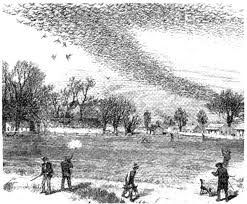
They say that when Europeans first arrived on this continent, the migration of the passenger pigeons would literally darken the sky for minutes on end.

I have never seen a living passenger pigeon, and it seems that my grandchildren will not know what I mean when I talk about the dawn chorus of riotously busy, happy birdsong, any more than they will be able to imagine an apple orchard in full bloom buzzing with the diligent harvest of a million droning bees.

Knowledge like this makes me sick at heart.  My rational side is aware that mourning is not productive, but another side of me knows that it is one of the special gifts of us humans to feel grief; to locate particular sadnesses in the larger landscape of suffering; and to use our sadness and anger at injustice as a lightening rod for change.

Other animals and birds feel grief as well, but you won’t find the great community of birds gathering together to make plans to topple all the communication towers in North America.

No, the birds will go quietly, one by one, into the endless night of extinction.

Just as it was our ingenuity that created those needle-like structures, held up by steel deathwires, it is our job as humans to recognize the destruction we are causing and make sure it changes.

I am not suggesting that we give up our communications towers—that would truly be a quixotic quest!

I am suggesting that we place value on the lives of 7 million birds—the number that scientists estimate are killed annually by communications towers taller than 180 feet.

What can be done?  Well, there must be some way to make those wires visible to the birds.  We could drape them with some kind of fabric, or coat them with a glittering reflective paint.  We could emit some kind of sound signal that would alert the birds to avoid the tower area.

The scientists studying this issue noted that simply changing the lights on the towers from solid red lights, which apparently mesmerize the birds in bad weather, to blinking lights, “could reduce mortality about 45 percent, or about 2.5 million birds. The study also recommended that businesses share towers to reduce their number and build more freestanding towers to reduce the need for guy wires.”

As we saw when Rachel Carson succeeded in getting DDT banned, bird populations can and do rebound if given the chance.

But not once they’re extinct.

We must act now, before the songbirds follow the passenger pigeons into permanent silence.

From Big Tobacco to Big Corn: the time to stand up for the right to health is NOW

Two years ago, I was taking multiple steroid inhalers every day for asthma, which began in the aftermath of a couple of bouts of pneumonia, and was always accompanied by typical seasonable allergy issues—coughing, sneezing, runny nose.

In the summer of 2010, in addition to the usual asthma and allergy symptoms, I also came down with a severe intestinal infection, requiring antibiotics to overcome.

When, in the wake of the course of antibiotics, my digestion was still troubled, I decided to experiment and see if removing gluten from my diet made any difference.

Lo and behold!  After just a month without gluten, my intestinal issues made huge progress.  And even more impressively–and completely unexpectedly–my asthma and allergies also disappeared.

When, after a while, I also decided to give up meat, except for the occasional small portion of chicken, the results were nothing short of miraculous.

Longstanding feelings of intestinal bloating disappeared overnight.  Bleeding hemorrhoids totally cleared up.  And the asthma and allergies, which had sometimes been so severe that I ended up in the ER begging for more drugs, were gone for good.

This remarkable shift in my own personal health, as a result of giving up meat and gluten, really makes me wonder.

Why is it that the gluten-free market is one of the fastest growing packaged food sectors right now?

Why are so many of us getting sick from our food supply?

Could it have something to do with the fact that most of our nation’s food supply is produced by industrial agriculture, relying on GMO seeds, as well as herbicides, fungicides, and pesticides in the growing process, not to mention all kinds of preservatives once the corn and wheat is on its way to the table?

I am heartened by the news that hundreds of thousands of farmers and consumers are pressuring the USDA to reject Dow AgroScience’s 2,4,D-resistant corn.

It is high time that all of us stood up to Big Ag and said enough is enough!  Why should we have to spend top dollar to buy organic, when the truth is that all food should be produced in an organic and sustainable manner?

Big Ag will reply that it would be too expensive to produce tons of corn, wheat and soybeans–not to mention beef and pork– organically.

But you know what?  Being sick is very expensive.  Health care is a huge drain on our national economy, as anyone who has been paying attention knows.

Could it be that the industrial agriculture/pharmaceutical/insurance conglomerates actually want a sick populace?

Imagine the outrage if that story were to break.

Imagine if it were proven that the incredible spike in autistic children is due to pesticide poisoning.

Imagine if we could prove that the asthma epidemic in this country is due to auto-immune problems generated by toxic food.

Imagine if we could nail the chemical companies for the explosive growth in cancers, diabetes and heart disease!

I don’t think this is far-fetched at all.

In fact, it’s low-hanging fruit for a cadre of well-trained lawyers with the guts to go up against the big bad guys.

In our parents’ generation, it happened with Big Tobacco.

The evidence is staring us in the face.

What are we waiting for?

Nuclear famine: the future that must never happen

“I am convinced that nuclear weapons must be abolished. Their use in a military conflict is unthinkable; using them to achieve political objectives is immoral.”

Who said this?  Not your average peacenik hippie.  Not even a pie-in-the-sky anti-war activist.

No, it was Mikhail Gorbachev who called for the total abolishment of nuclear weapons, in a recently released report by the renowned International Physicians for the Prevention of Nuclear War (IPPNW) and its US affiliate, Physicians for Social Responsibility (PSR).

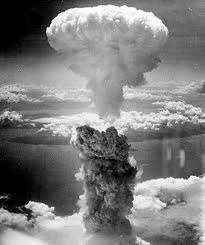
A-bomb on Nagasaki

The report is grimly entitled “Nuclear Famine: A Billion People at Risk—Global Impacts of Limited Nuclear War on Agriculture, Food Supplies, and Human Nutrition.” Its lead author, Dr. Ira Helfand, draws upon new modeling evidence showing that  “even the relatively small nuclear arsenals of countries such as India and Pakistan could cause long lasting, global damage to the Earth’s ecosystems andthreaten hundreds of millions of people….It would not cause the extinction of the human race, but it would bring an end to modern civilization as we know it.”

Even a limited nuclear exchange would affect the production of staple foods like corn and rice worldwide. “Significant agricultural shortfalls over an extended period would almost certainly lead to panic and hoarding on an international scale, further reducing accessible food,” the report says.

It is hard to get a handle on how to stop the steam roller of global carbon consumption, which in itself is a recipe for disaster.

Nuclear weapons, by contrast, are controlled by nation states, and can be precisely counted.

Nuclear weapons can be disabled and destroyed.

There is no sane reason for the U.S. and the U.S.S.R. to maintain hundreds of nuclear warheads ready to go at a moment’s notice.

That 20th century Cold War mentality has to be consigned to the dustbin of a very dangerous, outmoded and counterproductive history.

Imagine what would be possible if instead of investing billions of dollars in nuclear weapons each year, those funds were invested in renewable energy sources, sustainable agriculture, and devising methods of increasing human health and welfare while also creating a sustainable human footprint on the planet.

There is so much to protest these days, and nuclear weapons seem beyond the ken of most ordinary citizens.

But these are our lives the generals are gambling with.

We need a concerted people’s movement to insist that the time of nuclear weaponry has come and gone.

We vote for peace and life. Tell me, Mr. Politician, are you going to vote against us?

Loving Earth

To save the Earth, we must fall in love with her, writes Robert Koehler, taking his inspiration from the work of Charles Eisenstein, author of Sacred Economics.

Koehler and Eisenstein say that in the trajectory of human evolution, we have been locked in the selfish adolescent phase for a long, long time, just seeking to take what we need from our Earth mother, without thought of giving much in return, or of the reality of finite limits.

When we fall in love, Eisenstein says, “perfect selfishness falls apart as the self expands to include the beloved within its bounds.”

I remember falling in love like that as an adolescent, and as a young adult too.

It’s true that when you’re in love, the boundaries between the self and other dissolve, and you exist in a harmonious utopia of mutual beneficence.

But at least for most of us fallen humans, that kind of all-encompassing love doesn’t last forever.

It can’t.  It’s too intense.  Eventually the first ecstatic glow fades and the angelic beloved assumes normal, human proportions, with all the associated warts and odors and quirks of behavior and thought that our human bodies and minds possess.

What happens to love then?

If we are compatible for the longterm, the initial heady crush transforms into a much more solid platform of respect, shared interests, and deep concern for each other.  We care about each other, we enjoy being together no matter what we’re doing, and we respect each other’s views, goals, and talents.

We become partners in the truest sense of the word.

Is it necessary to go through the romantic, boundary-dissolving “falling in love” stage to get to the mature relationship of partnership?

In our culture, we believe it to be.  Our young people, tutored by every aspect of media and pop culture, assume that being swept away with love is a pre-requisite to successful marriage.

And yet how many of their parents, who followed that same script, ended up in bitter divorce fights?

Although I understand the intent behind Koehler’s and Eisenstein’s valorization of “falling in love” as a model for the depth of passion needed to fuel successful environmental action on behalf of the Earth, I am not convinced that this is the right message to be sending.

Young people today may still harbor romantic dreams, but they live day-to-day in a casual hook-up culture that prides itself on separating sexual enjoyment from commitment.

Fifty percent of their parents have made the journey from early romance to disillusioned divorce.

Another 25% or so of adults are either unhappily married, or unhappily single.

The “falling in love” model thus hits home with too few Americans to be effective as a rallying call for environmental action, and it is too limited a metaphor for the depth and breadth of passion that we must summon now to be effective Earth stewards and activists.

Instead we must love with the unconditional devotion of a mother for her child, with the sincere, selfless wish to see that new life grow and prosper and move forward beyond us.

We must love the Earth with the intensity of devotion that recognizes that for her to thrive, it may be necessary for us to part.

Earth has loved us with this kind of pure altruism all these many years of human emergence.  Now, as in the terrifying story of The Giving Tree, she has given so much that she has practically sacrificed herself entirely.

Nothing we can do to the Earth will wreck her forever.  Forever is a long, long time, in geologic terms.

But there is still time to shift from heedless destruction to the kind of loving tending that the Earth herself has modeled for us all these years.

There is still time to develop the kind of deeply caring reciprocal partnership that will last a lifetime, and beyond.

Who’s Afraid of Distance Learning?

It used to be that a smart, motivated young person could work hard, earn a doctorate, do a good job as a junior professor, and live happily ever after as a tenured professor.

It also used to be that a smart young person could work hard, get into a good college, and expect to be taught with passion and enthusiasm by a corps of dedicated professors.

Despite the ever-increasing cost of college tuition, neither of these expectations holds water any more.

Academia, as a profession and as a social landscape, is deeply troubled right now, in ways that are profoundly connected to wider social and economic problems in our society.

In today’s New York Times, pundit David Brooks suggests that colleges need to do more to ensure that their high sticker price is delivering measurable value. However, his solution—standardized exit testing of college seniors—shows how out of touch he is with the real issues and problems facing academia today.

At a recent high-level conference hosted by Lafayette College, ponderously titled “The Future of the Liberal Arts College in America and its Leadership in Education Around the World,” “Lafayette President Daniel H. Weiss laid out four major challenges facing liberal arts colleges — affordability, public skepticism about the value of a liberal arts degree and college in general, decline in the share of U.S population who fit the demographic patterns of students who traditionally attend liberal arts colleges, and questions about how to incorporate technology into the college and serve a generation of students that is increasingly networked.”
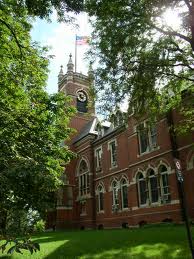
Smith College

At small liberal arts colleges like Bard College at Simon’s Rock, where I teach, we pride ourselves on a low student-faculty ratio. At Simon’s Rock the ratio is only 9 students to each professor.  But of course that’s a big part of why our tuition is so high, to pay for the one-on-one, intensive engagement with each student.

From the perspective of college presidents and administrators trying to make ends meet, this educational model may not be sustainable.

Certainly that was the case at the University at Albany, SUNY, where I taught for nine years in an interdisciplinary first-year seminar program designed to “give a small college experience in the big university.”  The program, which had just received an enthusiastic external review that trumpeted its successes in retention and learning outcomes for the roughly 800 students we served each year, was axed in 2011.

Now those 800 students are sitting in the big lecture halls with 500 others at a time—or, just as likely, not bothering to go to class at all.  It was a common complaint among my SUNY students that the professor wouldn’t know or care if you showed up or not—all it took to pass the course was cramming for the exam with the textbook.

Given this scenario, it’s not surprising that more and more of our large universities are shifting to distance learning.  Why go through the trouble of housing thousands of undergraduates, when you can deliver the lecture and the exam to them in their own bedrooms at home?

There is truth to this, and I have no doubt that networked, globalized distance learning is going to be the standard form of higher education delivery in the years to come.  It’s already happening incredibly fast, and even small liberal arts colleges need to be thinking about how to jump on that train before they miss it entirely.

As someone who teaches media studies, with a special interest in new media, I am in many ways delighted and intrigued by the potential of distance learning in higher education.  I have even been trying to persuade the administrators at my college to give it a try.

While it is never going to be the same as the old-fashioned model of nine students sitting around a seminar table with a professor, with current video capabilities it can come pretty close, as anyone who has tried a Google “hang-out” can attest.

And wouldn’t it be exciting to “hang out” in a seminar classroom with students from around the world?  We higher ed folks like to trumpet the value of diversity and international education—well, distance learning provides the platform to make the dream of a truly diverse and globalized classroom a reality.

However, there is a catch, and it is the same catch that has dogged other American industries as they have leaped on to the globalization bandwagon.

U.S. higher ed is already troubled from within by the shift from stable, tenured fulltime faculty to legions of roving part-time adjunct faculty.  With distance learning, the adjunct model gains even more steam, and goes global.

Why not outsource that first year Calculus course to a professor in India, who will teach 1,000 students for a fraction of what even an adjunct in the U.S. would earn?

Welcome to the knowledge sweatshop of the future.

According to the Inside Higher Ed article on the Lafayette conference, “Williams College President Adam F. Falk argued that the principal reason for adopting technological innovation should be for educational improvement, not just productivity gains. ‘College education isn’t simply about most efficient or innovative means of delivering content,’ he said, arguing that the engagement component of what colleges like his do was over all more important. ‘It’s hard for even the best students to learn on their own.’ Falk’s presentation was warmly received by the crowd.”

But Williams College is one of the richest liberal arts colleges in the nation, with an endowment of nearly $2 billion even after the economic downturn of 2008.

The social stratification that is affecting every aspect of American society is no less marked in higher education.

In the near future, we will be looking at an academic landscape where there will be a few highly paid tenured research professors and a vast majority of poorly paid adjunct professors all over the world, working mostly from their home offices via distance learning networks.  While there will always be a few lucky students who will be able to gain access to ivied classrooms through scholarships, those classrooms will increasingly be reserved for the children of the super-elites of the world.  Ordinary kids who have the motivation and discipline to go to college will do it from home, a financial decision their parents will have no choice but to support.

Distance learning is often lauded as a way to level the playing field, since it makes higher education accessible to kids who would not otherwise be able to go to college.

This may be so.  But it is also going to be yet another way to divide our society into Alphas, Betas, Gammas, Deltas and Epsilons—in other words, to harden the de facto caste walls that are already making the old rags-to-riches, pull-yourself-up-by-the-bootstraps American dream a quaint memory.


L’Chaim! This spring, let us commit ourselves to Life

Both Passover and Easter “celebrate” truly horrendous acts committed by men against men.

Passover commemorates how the Jews were spared by the grace of God from the Pharaoh’s evil plan to kill all first-born sons.  Easter celebrates the Resurrection of Christ after he was brutally martyred on the cross—a not-uncommon practice at the time.

Of course, both the Christian and the Jewish holidays also build on the much earlier pagan rites of Spring, the welcoming of warmth and rebirth after a season of winter.

I have to wonder why dominant human civilization has moved away from the earlier, simpler pagan celebrations, keyed to the natural world rather than to human doings and misdeeds.

Both Passover and Easter celebrate life—the lives of Jewish children, the miraculous resurrection of Christ, who gave his life in sacrifice for humanity.  Hence all the eggs, chicks and bunnies that populate the secular reinterpretations of these holidays, especially the American secular Easter.

Life is indeed something to be celebrated, as the Jewish cheer “L’Chaim!” proclaims.

Celebrated and protected.

As we move forward into the 21st century, into the auspicious year of 2012, let our aim be to reconnect with our prehistoric roots, to the simpler ages when we instinctively celebrated the return of the Light, the annual swing of our planet back towards the Sun.

For much too long, we have allowed religious politics to push us into conflicts and cruelties that do not serve the purpose of Life.  In claiming to worship the Divine, we actually find ourselves serving the dark side, the side of Death and Destruction.

I use these capital letters advisedly, to emphasize the symbolism inherent in all these word-concepts.

Beyond the symbolic realm there is the literal bedrock of reality.  We are hitting up against that reality now, as the patterns of power-hungry conflict, fueled by greed and a willingness to press on with destruction of the living world no matter the cost to systemic ecological health, play out with relentless precision.

This Easter and Passover season, let us do more than just toast to life.  Let us commit ourselves to the service of the divine spark animating our planet, which circulates without distinction through every blade of grass, every insect, and every human being.

It is only in our positive reciprocal commitment to Life that we can consider ourselves truly blessed.