Finding Hope in Heartbreak

There has been a steady beat of heart-breaking news lately from various fronts.  Did you hear that the flame retardants required by law to be sprayed on American sofas are highly toxic chemicals that continue to break down in your living room? And those sofas, by the way, if they’re the nice wood-framed ones from Ikea, are being made from irreplaceable 600-year-old trees.  When you lie on your sofa to breast-feed your baby, you’re getting a whopping dose of PCB-type chemicals, and your infant is too, since toxic chemicals pass right into breast milk.

Or maybe you caught the long article in the New York Times the other day about American zoos becoming Arks for modern-day Noahs, who have to choose which species to try to preserve and which to let go into extinction.  This was one of the most candid acknowledgements I’ve seen in the mainstream media of the explosive pace of extinctions occurring around the world, partly due to the loss of those ancient trees to logging.

And meanwhile, in my corner of the world, there was more bad weather—record heat in May, followed by violent electric storms, complete with hail and the threat of twisters, which knocked out my power last night, including permanent damage to my DSL box, leaving me without internet access this morning.

The relentlessness of this kind of information, combined with the evidence I can see before my eyes of climate change and the contamination of our landscapes, is like a steady drag on my spirit, a weight around my neck.

Even when I’m enjoying myself with friends and family, as I did this past weekend, I have one mental foot in the future, imagining a time when such happy, peaceful and bountiful gatherings will exist only in memory.

I am always giving myself silent pep talks, hanging on to the hope that we will accomplish the switch to renewable energy sources; that we will stop the deforestation and the industrial agriculture; that we will become responsible stewards of our home planet, rather than the armed pirates and chemical warriors that we have come to be in the last hundred years or so.

Joanna Macy

Lately I have been finding some comfort in Joanna Macy’s 1991 volume World as Lover, World as Self, reissued in 2007 by Parallax Press.  When I think of how oblivious I was back in 1991 about global heating and toxic contamination, I am amazed at Macy’s prescience.

Rather than simply bemoaning, or even exhorting her readers to change their ways before it’s too late, Macy offers us a way to understand and process what is happening to our world, principally through coming to the recognition that the traditional human individualist view of the self is a misconception.

“The crisis that threatens our planet, whether seen in its military, ecological or social aspect, derives from a dysfunctional and pathological notion of the self,” she says.  “It derives from a mistake about our place in the order of things.  It is the delusion that the self is so separate and fragile that we must delineate and defend its boundaries; that it is so small and so needy that we must endlessly acquire and endlessly consume; and that as individuals, corporations, nation-states or a species, we can be immune to what we do to other beings.”

In place of this, Macy draws on the work of systems theorists and ecological philosophers like Arne Naess, as well as the Buddhist notion of “inter-being,” to argue for a “greening of the self,” a way of self-understanding that recognizes our essential connectedness with all other life forms on our planet.

Arne Naess

Once we have understood that we are integrals parts in the living system of Earth, we should no longer have to appeal to human beings’ dubious moral sense to prompt a shift to a more sustainable way of living.  We can simply appeal to self-interest, Macy says.

“For example, it would not occur to me to plead with you, “Don’t cut off your leg.  That would be an act of violence.” It wouldn’t occur to me (or to you) because your leg is a part of your body.  Well, so are the trees in the Amazon rain basin.  They are our external lungs.  We are beginning to realize that the world is our body.”

One of the ideas I find most exciting about this part of Macy’s work is her application of the concept of “inter-being” to temporality.

“By expanding our self-interest to include other beings in the body of Earth, the ecological self also widens our window on time.  It enlarges our temporal context, freeing us from identifying our goals and rewards solely in terms of our present lifetime.  The life pouring through us, pumping our heart and breathing through our lungs, did not begin at our birth or conception.  Like every particle in every atom and molecule of our bodies, it goes back through time to the first spinning and splitting of the stars.

“Thus the greening of the self helps us to re-inhabit time and own our story as life on Earth.  We were present in the primal flaring forth, and in the rains that streamed down on this still-molten planet, and in the primordial seas. In our mother’s womb we remembered that journey wearing vestigial gills and tail and fins for hands. Beneath the outer layers of our neocortex and what we learned at school, that story is in us—the story of a deep kinship with all life, bringing strengths that we never imagined.  When we claim this story as our innermost sense of who we are, a gladness comes that will help us survive.”

When I think of my place in time and space in these terms, I do feel that gladness.  It is true that we are living through the sixth great extinction on the planet now.  It is true that we are producing and spreading contaminants in the air, water and soils that will last, some of them, for billions of years.

But the Earth has time.  And who knows, perhaps what we think of today as toxic waste can in time become the building blocks of new forms of life.  Our planet has shown itself to be remarkably adaptive.

Macy is unusual in working across disciplines and discourses that are generally kept apart, speaking fluently and persuasively in the tongues of sociology, systems theory, psychology, neurology, geology, ecology, theology, and even spirituality.  We are going to need the wisdom from all of these avenues of inquiry to begin to understand what will be happening to us in the coming years, as individuals, as a species, and as a part of the living fabric of Earth.

Perhaps that is what most distinguishes us most as human beings.  We want to understand.

And perhaps there is still a chance that if we can understand in time, we can, as Macy says, survive.

A la recherche du temps perdu

I have always been very sensitive to the passage of time.  As a child, I often began a long, golden summer season grieving in advance for its end.

I remember how, during long car rides with my family—my mother, my father, my brother, my dog and cat—I was aware of a sense of perfect contentment, thinking ‘if only this moment could go on forever, for here we all are, everyone I love, complete and whole and happy.’

Now, looking into the future and knowing how close our planet is to a major realignment of living systems, it seems there is always a part of me that is engaged in the long, drawn-out process of grieving in advance.

No moment can last forever.  Grief is inevitable for those of us who open our hearts to attachment.

These thoughts are at the forefront of my mind today because this weekend I am having the odd experience of participating in my 30-year college reunion, seeing people with whom I shared some of my most formative, impressionable teenage moments, now grown older, grayer, wider, hopefully wiser too.

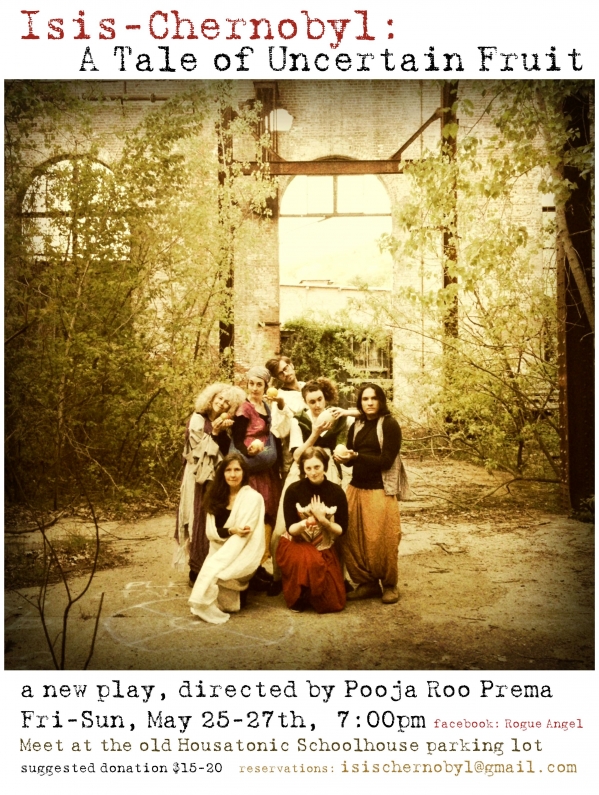
At the start of the weekend, I attended a play written and directed by Simon’s Rock alum Pooja Roo Prema, featuring a cast composed mostly of different generations of Simon’s Rock graduates.  Called “Isis-Chernobyl: A Tale of Uncertain Fruit,” the play is impossible to summarize in a nutshell, other than to say that it is an extended allegory of grief.

Pooja describes it as more a ritual enactment than an entertainment, which is certainly true; it has elements of high Greek tragedy, as well as Shakespearian clowning, but the thread that runs through it all is the resilience of the human spirit in the face of the unimaginable desolation of a post-apocalyptic landscape.

Isis, wandering the earth seeking the lost, dismembered parts of her beloved Osiris, could be any one of us wandering the haunted landscapes of our own memories, seeing people, places and events that once were woven into the warp of our being, but have become lost in the forward rush of life’s unfolding.

Reuniting now with generations of Simon’s Rock alumni, my own cohort past midlife and facing a future likely to be shorter than our past, I am reminded once again of how important it is to seize each moment, make the most of each day, appreciate one’s friends and family before they are torn from us by the relentless cyclical forces of life and death.

Isis can never be satisfied in her quest to feel again the smooth living skin and warm kisses of her lover, but she can reanimate his spirit in her own grieving flesh and mind.

Just as every car ride of my childhood came inevitably to an end, these days too shall pass, living on only in our memories.

This Memorial Day, I celebrate memory: the living memories of past happiness that glow within us like shining stars as well as the dark, grieving memories of people and places lost to us forever.

If I had been asked to speak at Commencement….

This is what I would have said:

It’s become a cliché to say that every day is the first day of the rest of your life, and yet like most clichés this one holds truth to it.

When you walk down that aisle today holding your B.A. diploma, achieving a goal which you have worked towards for many years, you will be stepping into your adulthood with all the rights and privileges, but also all the responsibilities that this maturity brings.

The year 2012, long prophesied as a time of great change and transition, is not an easy time to be reaching adulthood.

I don’t have to tell you that times are tough economically, or that our planetary environment is facing its own severe shifts due to anthropogenic global heating.  You have probably heard tell of a “sixth great extinction event” on the horizon, if climate change projections continue unabated on their current course, causing the heating and acidification of the oceans and resulting drought, floods and violent storms on land.

Most of us “know” about these issues the same way we “know” that toxic chemicals in our food, water, air and household products cause cancer.

We do our best not to think about it too much, because thinking about it just makes us scared and depressed, and what can we do about it, anyway?

I want to suggest to you, as you step out into the world this afternoon with your newly minted B.A., that you are stepping into an unprecedented opportunity to do more than any previous human generation has ever done.

It is not an exaggeration to say that you have the opportunity to turn this great Titanic of an earthship around, sailing her away from the iceberg and into safer waters.

There have been “greatest generations” before now.  But their challenges have been far less global and all-encompassing than the challenges we face now.

Now it’s not just a nation or even a group of nations that are faced with disaster.  It is the entire globe, human civilization writ large, which could in fact be toppled if the earth gives a great climatic shrug of her shoulders and goes back to the evolutionary drawing board.

Even the most sober earth scientists are predicting that if we do not change our habits of carbon emission, the resulting global heating will make the world uninhabitable for some 90% of current species on the planet by the year 2050, including 90% of current human populations.

I lay this out for you starkly not to depress you on what should be a happy and auspicious day, but to impress upon you the importance of the decisions you will be making and actions you will be taking in the coming years.

While it is true that lifestyle changes of individuals can only have limited effect on climate change, they are a start.  We can choose to support alternative energy whenever and however possible.  We can choose to push our elected representatives to shift subsidies and incentives away from fossil fuels and towards renewables.  We can encourage sustainable agricultural practices in our own communities and through our consumer choices.

What I would ask of you above all is to stay informed and engaged with these issues as you move forward into adulthood, and seize all opportunities to push governments and corporations to do the right thing not just for the bottom line or the national interest, but for the good of our planetary home and her current life forms, including humanity.

I am not proud of the condition of the world that my generation is now handing off to you.  I am not proud of what I and my cohort have allowed to happen on our watch.

The past cannot be undone.  But the future is yours to shape.

Don’t be afraid to try out completely new ideas. Listen to your dreams, listen to your intuition.  Be alert, be thoughtful, be creative.  Tune out the background buzz that will try to lull you into complacency and inaction.

I hope that when it’s your turn to witness your children stepping out into their adulthood, you will be able to be proud of the world you have created for them.

Truly, their future is in your hands.

Commencement reflections, 2012

This weekend my first-born son will graduate at age 20 with a B.A. in Biology.  He will join thousands of other graduates across the country marching to the dais to accept his hard-earned degree from school officials dressed in the medieval cap and gowns we still wear for such occasions.

And then he will march out into the world to join the hordes of recently graduated young adults, confronting one of the worst job markets ever seen in American history.

When I graduated college back in 1982, there was also a bit of a recession on, but things quickly rallied, and I had no trouble finding a job in journalism, and working my way up from reporter to staff writer to editor at publications in New York City.

When I chose to go to graduate school, it wasn’t hard to find a part-time job as an assistant editor to make room in my schedule for my studies.

And so it went, one step leading to the next with a steady predictability.

For my son, now, that kind of reliable future is out of the question.

We live in such a fast-changing world that there is no way to predict with certainty what kind of challenges we’ll be facing in, say, the next five years.

Will climate change come to a head and rain environmental devastation down on us?  Will an antibiotic-resistant bacteria strike?  Will the risky behavior of the financial sector finally put us completely at the economic mercy of the Chinese?

We can’t know the answers to any of these big global questions, any more than we can know the answer to the very small, local question that I am sure is in the minds of all the parents and grandparents who will be watching their graduates march this weekend: will s/he be able to find a job next year?

Many of the graduates will choose to put off confronting that question by diving back into graduate school.  That is certainly what my son has in mind, and it is the right thing to do, given his desire to work as a marine biologist.

Even a Ph.D. is no guarantee of a living wage anymore, although things are somewhat brighter in the sciences than for those of us stuck in the doldrums of the humanities.

I am proud of what my son has accomplished in his first two decades, and proud of the fine human being he has become.

I am much less proud of the world we, his elders, have created, into which he’ll now be stepping as a young adult.

As a teacher, I see clearly that what is needed is a collaboration of older, more experienced minds, with the open, energetic and passionate young minds who are now coming into their full powers.

I don’t want my son and all the other graduates to follow blindly in our path, doing things as they’ve always been done, which is largely what I myself did as a young adult.

Knowing how desperately we need to change our habits in order to shift our society on to a sustainable path, we can’t afford to give young people the luxury of just following along the paths that are already established.

We need them to be blazing new trails, and we older folk need to work with them closely in this crucial undertaking.

As my son strides off the dais with his BA in hand on Saturday, this is the blessing that will be in my mind:

May you take your knowledge and talents and use them for the benefit of our planetary home.  May you be a warrior for good, and become a leader in your sphere.  May you prosper and find happiness in working for the prosperity and happiness of all. 

Celebrating the DIY Mom on Mother’s Day

Although I feel it’s my duty to write a celebration of mothers on Mother’s Day, every time I think about what I might write for this post, all that comes up in my mind is a kind of lament.

Becoming a mother was definitely the best thing I’ve done in my life.  When I look at my two big, handsome, talented boys, I am thrilled beyond measure with the knowledge that I nurtured them in my womb for nine months, I gave birth to them, I did all the loving labor a mother must do to successfully bring children up from helpless infants to strong, independent young men.

My boys setting sail

So where does the lament come in?

Shift to a small, smothered voice: I just wish I hadn’t had to do so much of it all by myself.

I suppose I am writing the lament of the single mom, or the “do-it-all” mom, the mom who doesn’t get much help or support from her partner in bringing up baby.

Even when I was married, I did the lioness’s share of the household and child care labor, while also bringing home a paycheck that grew in time to be the larger portion of the family bacon.

My marriage foundered on my partner’s inflexibility when it came to the idea of a man doing housework, and my exhaustion and resentment over having to do it all.

In addition to working two demanding jobs for nine years straight, while also publishing two books and organizing a major annual conference and doing all the other extra labor of being a fulltime academic, I also did all the shopping, cooking, laundry, cleaning and yard work; all the supervising of homework and staying involved with my children’s schools through parent-teacher meetings, volunteer work and car pooling; I made sure all the medical appointments were taken care of, I did all the bill-paying and taxes, and if there was anything left over for a small vacation or a purchase for the house, I handled that too.

I am sure this is sounding very familiar to all those single and DIY moms out there, right?  We know the list could go on and on.

My own mom did all that household stuff too, but without the added pressure of bringing home the paycheck.

It’s probably my traditional upbringing, where my dad went out to earn the money and my mom stayed home to run a smooth, highly functioning household and do her creative work on the side, that makes me feel like having to play both roles myself is somehow too much.

I should be able to do it all with grace and good cheer, without getting crabby with my children or frustrated when things don’t go quite as planned.

That’s what a mother does, right?

At least I can take some comfort in knowing I am not alone.

There were some 10 million single moms in the U.S. as of 2010, and the number keeps climbing.

This Mother’s Day, I want to give a big shout-out to all of us single moms, and the DIY moms who may someday decide that enough is enough, and go down the single mom route.

We need to keep our chins up and not let the pressures, obligations and yes, sacrifices of our position get us down.

We have to just do our best, and not beat ourselves up when we get overwhelmed.

We must remind ourselves that we are doing the most important work in this nation, bringing up the next generation to take their place responsibly and soberly in the difficult social and environmental landscape we must confront together.

I love this picture of me because I look the way I feel: as weathered, but as solid, as the rock behind me

No More Leave it to Beaver

In the lively “Room for Debate” series in this week’s New York Times, provocatively entitled “Motherhood vs. Feminism,” the piece I like best is the one by Annie Urban, who reminds us that “it’s about parenting, not mothering.”

“Too often the discussion about women’s choices (stay at home, go back to work) ignores the role of fathers. To achieve meaningful equality, we need to push for a society that values fathers who strike a balance between their career and their family life too. Women shouldn’t have to be equally uninvolved parents to reach their goals; they should be able to ask their spouses to step up too.”

Hear hear, Annie!

Amazingly, she was the only one of the seven women columnists commenting on Elisabeth Badinter’s slamming indictment of “attachment mothering” who thought to look to the fathers.

Is it because for the six other women, the fathers are so absent from the parenting landscape that their input is immaterial?

Erica Jong, who describes herself as a “zipless gran,” is the only one to point out that the intensive, at-home parenting required of the “attachment” model “takes resources”: “An affluent mom who doesn’t need to earn can afford co-sleeping, making pure food, using cloth diapers and being perfectly ecological,” Jong rightly observes.

She doesn’t say, but it’s easy to assume, that such a mom is supported by a hardworking spouse.  The unspoken assumption about fathers, unchanged since the Leave it to Beaver days, rears its head: the primary function of a father is to pull in the bucks.

But times have changed. For mothers who must work to keep our kids in food and shelter, short-cuts are necessary, and juggling too many responsibilities becomes a fine art. Should I miss the cocktail party after work today, where all the important networking takes place, or should I pick my kid up from day care in time for dinner and a relaxed bedtime story?

How about calling dad to pitch in here? Why can’t he do the bedtime story so mom can go to her cocktail party and chat up the boss?

In my experience, the answer to such a query is too often a flat no—you handle it, honey.  And so she will, making those tough choices day after day, doing the best she can.

It is no accident that women still earn 77 cents on the male dollar.  The other 23 cents go to our unpaid, unsung attention to mothering and family care of all kinds.

Elisabeth Badinter says we should get over our obsession with the “voluntary servitude” of mothering and go play the career game with the boys, giving it all we’ve got.

I’d rather see a kinder, gentler scenario, in which parents, both male and female, work together to balance the conflicting demands of work and child care.

As a society, we could encourage this in a material way by acknowledging the value of parenting via Social Security and other benefits.

By dint of hard struggle we have enshrined the concept of family leave and parental leave in law, but we could do a lot more to support parents through the difficult years when so much is demanded of them on the home front while they are also in their prime career-building years.

Instead, our society seems to be pushing women back into the unpaid homemaker roles, by sinking our efforts to balance career and mothering under the weight of guilt, frustration and sheer exhaustion.

Do we really want to focus the bright minds and creative spirits of 50% of our population exclusively on issues of breast-feeding, diaper rash and what to have for dinner?

Do young men really want to return to the good old days of being the sole provider for a houseful of dependents?

Feminism needs to demand that fathers fully engage in the struggle to make parenting a joyful, cooperative stage of life, rather than a gendered minefield.

And mothers and fathers need to insist on the social support they deserve for the valuable labor they perform every day, both in the home and outside of it.

From Big Tobacco to Big Corn: the time to stand up for the right to health is NOW

Two years ago, I was taking multiple steroid inhalers every day for asthma, which began in the aftermath of a couple of bouts of pneumonia, and was always accompanied by typical seasonable allergy issues—coughing, sneezing, runny nose.

In the summer of 2010, in addition to the usual asthma and allergy symptoms, I also came down with a severe intestinal infection, requiring antibiotics to overcome.

When, in the wake of the course of antibiotics, my digestion was still troubled, I decided to experiment and see if removing gluten from my diet made any difference.

Lo and behold!  After just a month without gluten, my intestinal issues made huge progress.  And even more impressively–and completely unexpectedly–my asthma and allergies also disappeared.

When, after a while, I also decided to give up meat, except for the occasional small portion of chicken, the results were nothing short of miraculous.

Longstanding feelings of intestinal bloating disappeared overnight.  Bleeding hemorrhoids totally cleared up.  And the asthma and allergies, which had sometimes been so severe that I ended up in the ER begging for more drugs, were gone for good.

This remarkable shift in my own personal health, as a result of giving up meat and gluten, really makes me wonder.

Why is it that the gluten-free market is one of the fastest growing packaged food sectors right now?

Why are so many of us getting sick from our food supply?

Could it have something to do with the fact that most of our nation’s food supply is produced by industrial agriculture, relying on GMO seeds, as well as herbicides, fungicides, and pesticides in the growing process, not to mention all kinds of preservatives once the corn and wheat is on its way to the table?

I am heartened by the news that hundreds of thousands of farmers and consumers are pressuring the USDA to reject Dow AgroScience’s 2,4,D-resistant corn.

It is high time that all of us stood up to Big Ag and said enough is enough!  Why should we have to spend top dollar to buy organic, when the truth is that all food should be produced in an organic and sustainable manner?

Big Ag will reply that it would be too expensive to produce tons of corn, wheat and soybeans–not to mention beef and pork– organically.

But you know what?  Being sick is very expensive.  Health care is a huge drain on our national economy, as anyone who has been paying attention knows.

Could it be that the industrial agriculture/pharmaceutical/insurance conglomerates actually want a sick populace?

Imagine the outrage if that story were to break.

Imagine if it were proven that the incredible spike in autistic children is due to pesticide poisoning.

Imagine if we could prove that the asthma epidemic in this country is due to auto-immune problems generated by toxic food.

Imagine if we could nail the chemical companies for the explosive growth in cancers, diabetes and heart disease!

I don’t think this is far-fetched at all.

In fact, it’s low-hanging fruit for a cadre of well-trained lawyers with the guts to go up against the big bad guys.

In our parents’ generation, it happened with Big Tobacco.

The evidence is staring us in the face.

What are we waiting for?

America, land of the brain-damaged and debt-enslaved

Is it any surprise that we Americans treat animals and the natural world so badly, given the way we treat even our own cherished children?

This week there were two grim news stories illustrating the callousness of American society towards its young adults.

The first was a disturbing column by Nicholas Kristof revealing to the public what research scientists have known for a while: the skyrocketing rates of PTSD and suicide among young veterans returning from the Iraq and Afghanistan wars are due not to mental instability, but to the physical effects of repeated exposure to shock waves caused by bomb detonations.

The military is in the process of performing autopsies on veterans who committed suicide, and so far an alarming number of them have shown evidence of chronic traumatic encephalopathy (C.T.E.), a degenerative disease of the brain best known for affecting boxers and football players who endure repeated concussions.

“In people with C.T.E.,” writes Kristof, “an abnormal form of a protein accumulates and eventually destroys cells throughout the brain, including the frontal and temporal lobes. Those are areas that regulate impulse control, judgment, multitasking, memory and emotions.”

In other words, even young soldiers who return home physically intact may in fact be suffering from the hidden effects of shock wave concussions, which will destroy their lives over time; apparently the disease “typically develops in midlife, decades after exposure. If we are seeing C.T.E. now in war veterans, we may see much more in the coming years,” says Kristof.

***

Number two, we learned yesterday that the combined student debt in the United States reached $1 trillion. 

Occupy Wall Street demonstrators participating in a street-theater production wear signs around their neck representing their student debt during a protest against the rising national student debt in Union Square, in New York, April 25, 2012. The protest eventually marched to Wall Street; two people were arrested during the protest. REUTERS/Andrew Burton

I can’t even wrap my mind around a number that big, but one thing I can understand is that this is an egregious example of how we as a society are condemning our best and brightest young people to spending the best years of their lives in debt bondage to the banks.

For the wealthy, college and graduate school continue to serve as playgrounds for the young, a place to have fun, learn a few things and pair up before joining the family business.

For the rest of us, college is an essential step along the road to personal and professional success.  It’s not optional, and the price tag just keeps rising, while the ability of parents to pay for their children’s higher education keeps falling.

And so we find kids still in their teens signing loans for tens of thousands of dollars.  It is not uncommon for these kids to find themselves, just a few years later, with a B.A. and $200,000 worth of debt.

If you have ever tried to pay the interest on that much debt on a typical entry-level salary, you know that it’s nearly impossible.  Certainly it’s daunting to try to achieve the American dream—the car, the house, the spouse and two kids—with that kind of stranglehold of debt around your neck.

***

So this is the way we treat our precious children in America.

In a new twist on “friendly fire,” we send them to war without even realizing the longterm effects that our fancy new bombs will have on them.

And we blithely tell them that a) a college education is the only way to get ahead; and b) if you want one, you have to get in line at the loan office and spend the first 20 years of your working life paying off that interest.

There is something deeply, hauntingly wrong with this picture.

And you know what the worst thing is?  There is no widespread outrage about it!

If you are a young person, a parent, or any person with a conscience, you should be working furiously to end war and to end debt bondage for students.

How?

Well, start by standing up and saying NO MORE!!!!

Let a million local media outlets and citizen journalists bloom

As we head into the 10-day countdown to May Day, once again the mainstream media is snoozing its way into irrelevance.

Check out today’s New York Times and you will find nary a mention of the busy preparations going on now for the day of action in New York and around the country on May 1.

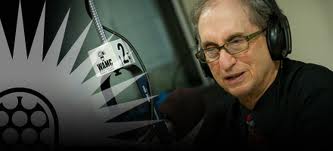
This seems to just prove the point of media pundit Dr. Alan Chartock, founding president and CEO of the 20-station, seven-state Northeast Public Radio Network here in my neck of the woods.

Speaking last Sunday at Bard College at Simon’s Rock, Dr. Chartock depicted a coming media landscape dominated by a few big national and international players, reaching audiences principally through the World Wide Web.

Progressive media analysts have long been concerned about the homogenization of the news that comes as a result of corporate conglomerates controlling vast swaths of the airwaves, as well as almost all print news outlets.

The good news is that at least so far, it has been impossible to impose corporate control over the internet.  Witness the huge outcry over the proposed PIPA and SOPA legislation last winter, which critics said would have limited free speech on the Web.  Millions of signatures were collected on petitions against the legislation, and the proponents backed down—at least for now.

Dr. Alan Chartock

Dr. Chartock is worried about the wholesale media move to the internet for two good reasons.

One, accuracy: it is often impossible to know for sure that the information on a given blog or even larger online media outlet has been carefully and objectively reported.

Two, money: Where is the business model that will support the reporters and editors needed to continue to perform the traditional watchdog role of the press?

It seems to me that his own Northeast Public Radio Network provides a good answer to these issues.  It is supported by local listeners and underwriters who put their dollars behind the station because they recognize a good thing when they see one.  They would start to withdraw their support if the quality of the programming went down.

To counter the drift to a globalized corporate media desert, let’s let a million local radio stations, blogs, vlogs, livestreams, tweets and You-Tube videos bloom!

Let’s not only support our locally owned, locally produced media, let’s start producing it too!

Here in the Berkshires, we not only have WAMC and other Northeast Public Radio affiliate stations, we also have WBCR-LP, which is not only 100% listener-supported but also all-volunteer and open to any citizen journalist who takes the trouble to get trained as a programmer.

We have the Berkshire Record, our hometown print newspaper in Great Barrington, and we also have iBerkshires and various locally produced blogs and small websites.

And let’s not forget the countless Facebook pages, Twitter accounts and You-Tube channels devoted to getting us localized news we can use.

The truth is that the Occupy movement doesn’t need the New York Times to reach its target audience.  The fact that the mainstream media is ignoring the upcoming May Day protests is just one more example of how dominated by the 1% these big media corporations are.

Whose media?  Our media!  Mainstream media?  Who needs’em?

The question your grandchildren will ask: Where were you on May Day 2012?

Although you’d never know it from following the mainstream media, there are big plans afoot for this year’s May Day.

The global General Strike of the 99% called for May 1 is gaining steam as we move into the final days of preparation.

It’s going to be big.  It’s going to be loud.  It is meant to be an unsettling reminder to the 1% of how much their privilege depends on the cooperation and docility of the 99%.

What if everyone just decided to go on strike with their credit card interest payments?  Their student loan interest payments?  Their mortgage interest payments?

What if everyone decided to redirect their energies to revitalizing local economies, forming their own credit cooperatives, issuing their own currencies, reinstating barter and time banks, growing their own food?

What if everyone just opted out of the huge, unwieldy and oppressive structures that corporate globalization has imposed on us?


I am reminded of the Leo Lionni story about the snail who was so entranced with his creative power to build an ever bigger and more intricate shell that eventually he was pinned down by the enormous, gaudy fruits of his labors and had to abandon that monster shell and start anew, humbly admitting that bigger was not better.

Collectively, and with Americans in the lead, human civilization has created a monster that now holds us captive.

Collectively, we can work together to shift course and rebuild a more humane society where the wealth we generate with our creativity and hard work is shared fairly and is not used to destroy our beautiful planetary home.

It is true that the Obama administration has tried to move things in this direction, in important areas like health care and finance reform.  I believe Obama’s heart is in the right place, but he is held captive like all the rest of us by a rigid system created by the 1% to pander to the 1%.

When even our Supreme Court has been coopted to represent the super-elite above the vast majority of Americans, as was quite evident in the Citizens United decision, it becomes clear that working through the system is like swimming in place, swimming against an overwhelming tide.

So we need to try something different.  We are essentially at the same breaking point our American founding fathers were at back in the 1770s, when they knew that the only way they could move forward was to get the King’s boot off their necks—and the only way to do that was to fight.

I don’t want to see another armed revolution or civil war on American soil.  I am a pacifist through and through.

That’s why I support the concept of the General Strike as a peaceful way to withdraw from the system and remind the elites that the gears of their privilege won’t turn without the grease of our labor and cooperation.

This May Day, wherever you are, whatever you’re doing, take up the gauntlet Thoreau threw down back in 1849 in his famous essay on civil disobedience: “Let your life be a counter-friction to stop the machine.”