We eat by the grace of Nature, not by the grace of Monsanto

“Organic, schmorganic,” fumes New York Times columnist Roger Cohen sarcastically in an article entitled “The Organic Fable.”

He bases his sweeping dismissal of the organic foods movement on a new Stanford University study claiming that “fruits and vegetables labeled organic are, on average, no more nutritious than their cheaper conventional counterparts.”

Cohen does grant that “organic farming is probably better for the environment because less soil, flora and fauna are contaminated by chemicals…. So this is food that is better ecologically even if it is not better nutritionally.”

But he goes on to smear the organic movement as “an elitist, pseudoscientific indulgence shot through with hype.

“To feed a planet of 9 billion people,” he says, “we are going to need high yields not low yields; we are going to need genetically modified crops; we are going to need pesticides and fertilizers and other elements of the industrialized food processes that have led mankind to be better fed and live longer than at any time in history.

“I’d rather be against nature and have more people better fed. I’d rather be serious about the world’s needs. And I trust the monitoring agencies that ensure pesticides are used at safe levels — a trust the Stanford study found to be justified.”

Cohen ends by calling the organic movement “a fable of the pampered parts of the planet — romantic and comforting.”

But the truth is that his own, science-driven Industrial Agriculture mythology is far more delusional.

Let me count the ways that his take on the organic foods movement is off the mark:

  • Organic food may not be more “nutritious,” but it is healthier because it is not saturated with pesticides, herbicides, fungicides and preservatives, not to mention antibiotics, growth hormones and who knows what other chemicals.  There are obvious “health advantages” in this, since we know—though Cohen doesn’t mention—that synthetic chemicals and poor health, from asthma to cancer, go hand in hand.
  • Organic food is only elitist if it comes from Whole Foods—the one source Cohen mentions.  I grow organic vegetables in my backyard, and they save me money every summer.  We don’t need the corporatization of organic foods, we need local cooperatives (like the CSAs in my region) to provide affordable organic produce that doesn’t require expensive and wasteful transport thousands of miles from field to table.
  • About feeding 9 billion people: first of all, we should be working hard to curb population growth, for all kinds of good reasons.  We know we’ve gone beyond the carrying capacity of our planet, and we shouldn’t be deluding ourselves that we can techno-fix our way out of the problem.  Industrial agriculture is a big part of the problem.  It will never be part of the solution.  Agriculture must be relocalized and brought back into harmony with the natural, organic cycles of the planet.  If this doesn’t happen, and soon, all the GMO seed and fertilizers in the world won’t help us survive the climate cataclysm that awaits.
  • Mankind is better fed and longer lived now than any time in history?  Here Cohen reveals his own elitist, Whole-Foods myopia.  Surely he must know that some billion people go to bed hungry every night, with no relief in sight?  Mortality statistics are also skewed heavily in favor of wealthy countries.  So yes, those of us in the industrialized nations are—again, depending on our class standing—living longer and eating better than in the past, but only at the cost of tremendous draining of resources from other parts of the world, and at increasing costs in terms of our own health. Just as HIV/AIDS is the scourge of the less developed world, cancer, asthma, heart disease and diabetes are the bane of the developed world, and all are related to the toxic chemicals we ingest, along with too much highly processed, sugary, fatty foods.
  • For someone who is calling the organic movement “romantic,” Cohen seems to have an almost childlike confidence in authority figures.  He says he trusts “the monitoring agencies that ensure pesticides are used at safe levels — a trust the Stanford study found to be justified.” And I suppose he also still believes in Santa Claus?  We cannot trust that the “safe levels” established by the EPA or FDA are in fact safe, given the fact that we operate in an environment where thousands of chemicals enter the market without sufficient testing, presumed innocent unless proven guilty—but to win the case against them, first people must get sick and die.
  • Cohen’s zinger, “I’d rather be against nature and have more people better fed,” displays his own breathtaking blind spot as regards the human relation to the natural world.  Human beings cannot be “against nature” without being “against ourselves.”  We are a part of the natural world just like every other life form on this planet.  Our fantasy that we can use our technological prowess to completely divorce ourselves from our material, physical reality is just that—a fantasy.  We eat by the grace of nature, not by the grace of Monsanto.

For the entire history of homo sapiens, we have always eaten organic.  It’s only been in the last 50-odd years, post World War II, that wartime chemicals and technologies have found new uses in agriculture.

The result has been the rapid and wholesale devastation of vast swaths of our planet—biodiversity giving way to monoculture, killer weeds and pesticide-resistant superbugs going wild, the weakening and sickening of every strand of the ecological web of our planet.

The relevant fable to invoke might be the tale of Jack and the Beanstalk.  We might be able to grow a fantastically huge beanstalk if we fed it with enough chemical fertilizers, and we might even be able to climb it and bring back a goose that lays golden eggs.

But in the end, that beanstalk will prove to be more dangerous to us than it’s worth—we’ll have to chop it down, and go back to the slow but solid organic way of life that has sustained us unfailingly for thousands of years.

Once in a blue moon: thoughts on death and the hereafter

It’s a clear, warm night, breezy and calm with a languorous quality to the air.  A night for strolling arm in arm along the surging beach; a night for hiking to the top of the mountain to gaze out at the moonlit landscape below.

It’s a blue moon night, the second full moon of the month–a rare occurrence, like a leap year, that feels like a gift of cosmic significance.

Such a night makes me want to take a chance and send out into the world some ideas that I have been holding close, not daring to share for fear of—of what?  Being scoffed at or ignored, I suppose.

But once in a blue moon, it’s important to reach beyond those fears and write from the heart.

So here it is.

***

On this quiet, moonlit night, I am thinking about death.

Every near-death experience describes a peaceful opening up to the light in the seconds after death—a state of rapture, a sense of leaving the body with all its frailties behind and moving into a new state of consciousness.

If death is just a transition into a different relation to matter and spiritual consciousness, then it is not something to be afraid of.  It is a change, but not a negative one, except to the extent that we remain attached to those we love and our dear, familiar places.

No other being on the planet frets so over death as does humankind.  All others simply pass, unworried, into the next stage of existence, whatever it may be.

If there is no reason to fear or worry about our individual deaths, then maybe there is no reason to fear or worry about the coming planetary cataclysm.

All of us living beings on the planet now will simply transition into whatever comes next, as we have many many times before in our cosmic journey from stardust to our current terrestrial physical forms.

Even the fear that we have of destroying our planet to such an extent that it will become unlivable is not tenable.  I don’t believe we could do such a thorough job of destruction as to make the environment completely and irrevocably toxic.

It may take millennia, but eventually, as it has in the past, the Earth will regenerate and give birth to new life forms.

And we, because we are part and parcel of this ecological sphere, will be part of those too.

Just as now we “remember” our past as sea creatures through the saltiness of our blood and the way we are able to swim underwater in our mother’s wombs, we will in some way retain the traces of our time as humans on the planet.

Hopefully the traits that have proven so destructive and psychotic will not persist: our violence, our fears and insecurities, our short-sightedness, our competitiveness, our greed.

It is possible that we are now living through a blue moon period of a much greater magnitude than just one lunar cycle.

Once in a blue moon, a dominant species—like the dinosaurs—collapses.  It is our fortune, for better or worse, to be living through this rare epoch, the last days of a closing era—and unlike the dinosaurs, to be conscious of what is taking place as it happens.

Of course, once in a blue moon, too, a species is able to pull back from the brink of extinction and keep going a while longer.

 ***

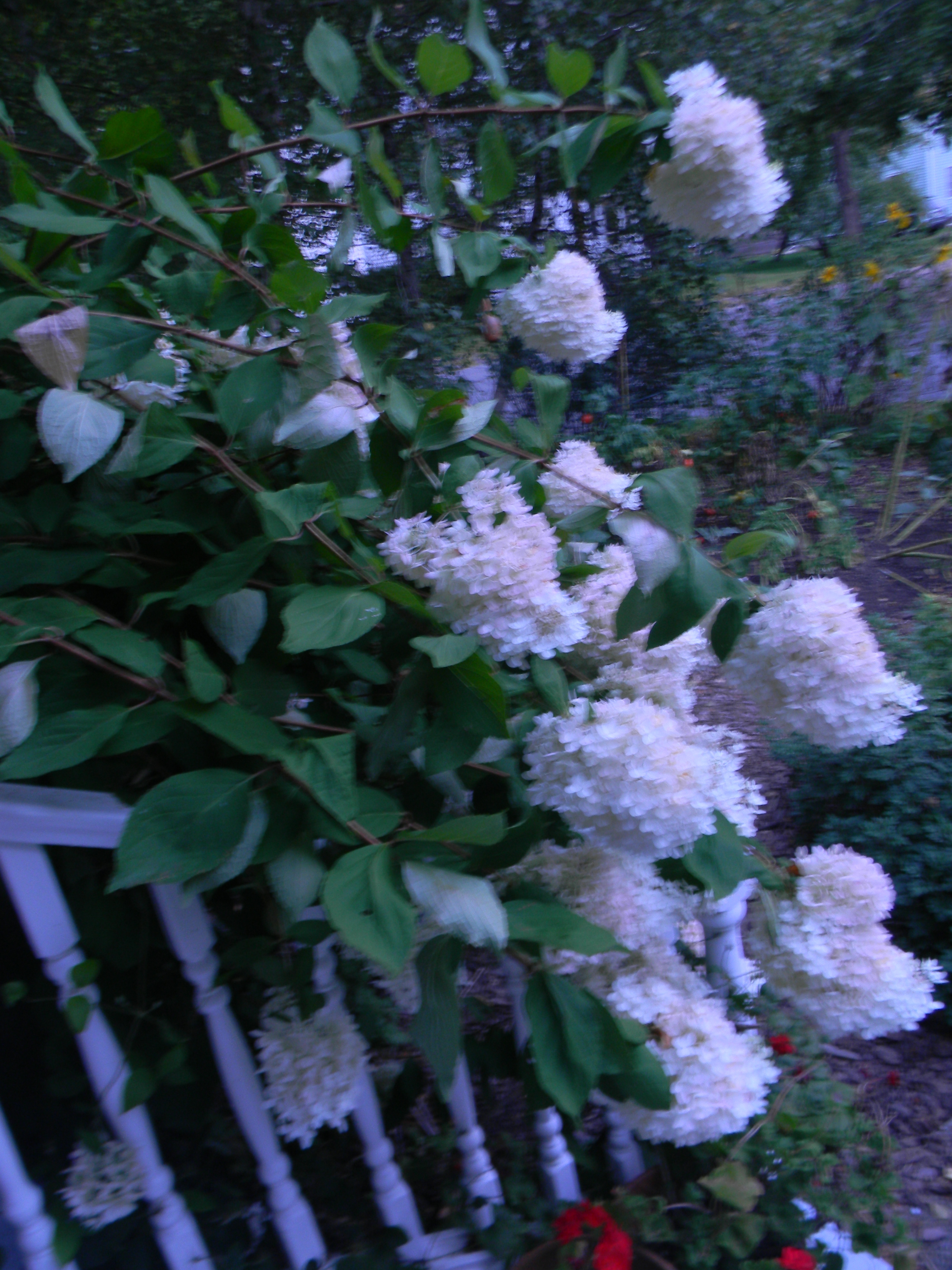
On this blue moon evening, I pay loving homage to the white hydrangeas glowing in the dusky interlude between sunset and moonrise.  The perky round sunflowers, the curly purple kale standing stiff and tall in my garden, the pulsing background chorus of crickets—I gather them round in a loving embrace and give thanks for this quiet blue moment, however long it may last.

Looking backward, looking forward, being here

When I started Transition Times a year ago, I was in a state of emotional turmoil.  I had just become fully awake to the scary reality of climate change, and was allowing myself for the first time to recognize the extent of the terrible environmental degradation of our planet that had taken place in my lifetime, on my watch as it were.

I was also smarting from some direct hits on the economic front, having just lost my second teaching post to state budget cuts.  I was looking at a yearlong evaluation process for a longterm contract at my primary institution (our equivalent of tenure), and the outcome was far from secure.

Added to that, I was just emerging from a yearlong divorce battle—nowhere near as vicious as some I’ve witnessed, but still painful and emotionally debilitating.

So all in all, I was in a pretty distressed and tender state of mind a year ago, when Transition Times grew from the flicker of a thought to a fully formed weblog.

Thinking back over the year, I see that I have grown a lot, and my blog has grown with me.

Many of my posts have charted the ups and downs of my outlook on the future: our planetary future in a time of precipitous loss of biodiversity, rapid, out-of-control global heating, and growing food insecurity for all inhabitants of the planet, humans included; our future as Americans, citizens of a nation that controls the largest military, police and prison forces in the world and seems to revel in showing off its ruthless muscle, even against its own children; and my own future as a newly single mom parenting two teenage boys, working more than fulltime, and trying to keep an even keel through turbulent economic waters.

As I embark on the second year of Transition Times, and close in on my 50th birthday, I am glad to find myself in a fairly calm, even mildly positive state of mind.

Although the past year has given us little to celebrate in terms of the environment, the global economy or the political scene, at least on the home front things are—well—okay.

A year into my life as a divorcee I am finding a comfort level with being on my own that I remember from years ago, before I married.  It’s been 25 years since I was single, which is a long, long time.  But I am beginning to get a remembered twinge of anticipation, the awareness that as a single woman doors may open for me that would have remained closed were I still married.

Stepping through any doors—meeting new people, visiting new places, making new choices—necessarily involves risk.  Twenty-five years ago, I took the risk of marrying—and it paid off in my two handsome, talented, charming (for the most part) sons, as well as many good times with my husband before and during our marriage.

A year ago I was so emotionally battered from the divorce that I could not have imagined opening myself up to that kind of attachment again.

Now I think—well, maybe someday.  There’s no rush.  I am pretty content as I am, just me and my family, as it was for the first 25 years of my life.

In the meantime, I will be doing a lot of thinking aloud on Transition Times about how best to channel my passions, concerns and talents in the coming years.

I am just one small woman with many limitations but I want to give the best of myself to the beautiful world I love so much—the birds and insects, the ocean creatures, the furry mammals and the cool reptiles, and the green forests, waving grasslands and flowering marshes that nourish us all.

Climate Change: What do we tell our children?

This has been a big week for change agents in the U.S.

First Annie Leonard came out with her new movie, The Story of Change.

Annie Leonard

Then David Brancaccio released his new movie, “ Fixing the Future,” with a two-day nationwide roll-out starting on July 18.

David Brancaccio

And today Bill McKibben made the cover of Rolling Stone, confirming him, at least in my eyes, as the true rock star of the environmental movement.

In the same week, radical economist Gar Alperovitz gave a historic keynote address to the Green Party National Convention, arguing that you can’t have a democratic society unless you democratize the ownership of wealth as well.

The big question is, will the best efforts of all these good folks make a difference in what is happening to our precious planet?

Or is it just so much more hot air, to add to an already too-hot summer?

This week I am teaching a class in media studies for middle schoolers.  While I’m amazed and delighted at the facility of the students with the technology of digital communications, I am also struck by the narrow focus of their concerns.

Three of the students have started blogs about fashion trends.  Another has started a blog about anime and manga characters.  Of the three others in the class, one is using her blog to do movie reviews, another is talking about hard science issues (the Higgs Boson discovery), and the third is writing about the stock market and the technological age we live in.

Absolutely nothing wrong with any of that.

Except that if we don’t solve the climate crisis, it will all be completely moot.

Runway fashions, movie stars, cartoons and stocks will all be swept away before the onslaught of food insecurity, economic instability and violently unpredictable storms.

No, this is not the stuff of Hollywood fantasy.  It is real, and as McKibben points out in the intro to his Rolling Stone article, it’s already happening.

As a teacher, what am I supposed to do?  If I remind my students (and my own children, for that matter) just how grave and portentous a time we are living through, aren’t I placing an enormous burden on them?  And isn’t it true that it is my generation, not theirs, that bears the brunt of the responsibility for where we are now?

And yet, if I say nothing and let them proceed as if fashion and anime were the most compelling topics of the moment, am I not being dishonest?

It really is quite a dilemma, for any parent and every teacher who is aware of what is really at stake in the times we live in.

I imagine it must have been similar for principled people in other times of crisis.  Do we try to shelter the children, keep their lives as normal as possible, for as long as we can?  Or do we let them know what is going on, and enlist them in the urgent struggle for positive change?

I don’t believe in lying to young people, and I have never been very good at lying, anyway.

The truth is that we are living through times unlike any faced by human beings before, in the 10,000 years of our history on the planet.

What we do in the next decade will make the difference between our continued existence on the planet, or the extinction or radical reduction of human civilizations on Earth.

I love Bill McKibben because so far, at least, he never gives up.

He’s got a true fighting spirit that refuses to take no for an answer.

Still, eventually even Bill may have to concede that the fossil fuel industry, with the politicians in their back pockets, is simply not going to give.

When that moment occurs, it will be game over for human beings on the planet, and so many other of our fellow Holocene travelers too—birds, fish, plants, and mammals.

But it’s not over til it’s over.    And I, at least, will never give up hope that people of all ages, from every corner of the world, will see the crucial urgency of this moment; that they will act upon their new awareness;  that the politicians will be compelled to listen; and that we will be able to turn this great climate change juggernaut around.

Hocus, Pocus, Focus

I don’t know if it’s that I’m moving ever nearer to that psychologically significant boundary line between my forties and my fifties (I’ll turn 50 in November), or that summer is upon us here in the Northeast, or that I am on circuit overload, but this week I just haven’t been able to get up a good head of steam for a substantial blog post, and thus have stayed silent.

It’s been quite a while since a whole five days have gone by without my posting a single word.

It’s not that I’m not thinking.  And I am certainly keeping abreast of events out in the wide world.

But instead of the steady churning of thoughts and the relentless input of news raising my hackles and prompting me to send another blog-post-bottle out into the high internet seas, I just feel like pulling the covers over my head and rolling over for another hour of sleep.

I find myself longing for a silent weekend retreat, in which I had no access to the internet or phone, and no one around who expected me to speak or respond.

If I could have some good quiet time, maybe I could focus my thoughts, ideas and projects, and figure out which of them are worth carrying with me, and which can be jettisoned.

Perhaps that goes with the time of life I’m in, where every moment seems precious and limited, and you know that you really don’t have that much time to accomplish everything you came here to do in this lifetime.

If I could just figure out where to pour my energies and talents, I have no doubt that I could be very successful—with my success measured not necessarily in money or goods, but in positive impact on the planet.

That is what I am most trying to figure out right now.  Where should I be funneling my limited time and energy?

Generally speaking, there seem to be four spheres in which I am operating at all times, simultaneously:

  • the very up-close-and-personal realm, where my thoughts revolve around such mundane but important matters as my responsibilities to my two sons and the rest of my family, endless house and garden maintenance issues, and how I’d like to reconnect with such-and-such friend next week;
  •  the professional realm, where I am wondering what the outcome will be of my current contract review, feeling guilty because I am months behind in the essay I promised an anthology editor a year ago, pondering how to teach my classes scheduled for the fall, and wishing that I had the drive to get up at 5 a.m. and work on my book project;
  • the broader community, regional and national realm, where I am thinking about how to encourage the adoption of solar panels in my town, wondering about the impact of the new immigration legislation on friends and students, and concerned about the prospect of rabid Republicans gaining control of all three centers of power in Washington, and wondering how I can support both the Democrats and their more radical critics, whose platform is much closer to my heart;
  •  and then there’s the planetary realm, where I see with such pain the big picture of how destructive human beings are to every other life form on Earth, and ask myself how long it will be before the planet gives a big methane burp and sends us all to over-heated hell.

Is it any wonder, with all this (and much more!) churning through my mind day after day, that I end up just wanting to tune out and sit on my porch with a glass of wine on a summer evening and CHILL OUT?

I envy people who can focus all their energy in any one of these spheres.

I seem to be an incorrigible multitasker, and I know it’s not particularly healthy for me, or productive for my goals.

If there is one thing I really want to work on in the coming decade of my fifties, it’s learning how to prioritize tasks, concentrate my energy and GO!

Rio+20: Fiddling While Earth Burns

I am having trouble summoning any enthusiasm over the upcoming Rio+20 UN Conference, which will begin on June 20.

When you go to the conference website, everything sounds so benign, forward-looking and responsible.  For example, talking about food security, the conference framers call for the promulgation of sustainable agriculture, meaning “the capacity of agriculture over time to contribute to overall welfare by providing sufficient food and other goods and services in ways that are economically efficient and profitable, socially responsible, and environmentally sound.”

It sounds marvelous.  But we all know that during the last 20 years, since the first Earth Summit in 1992, industrial agriculture has only gotten bigger and badder, more focused on profit at the expense of social responsibility or environmental stewardship.

Food security for the majority of people on the planet has become a pipe dream, and even the most privileged of us are growing increasingly vulnerable to disruptions in food supplies caused by climate change, monoculture and the superweeds and superbugs that have developed resistance to our chemicals.

I was not surprised to find in my inbox this morning an eloquent position paper from La Via Campesina, seeing right through the rosy language of the “sustainable development” engineers to recognize that “beneath the deceptive and badly intentioned term “green economy”, new forms of environmental contamination and destruction are now rolled out along with new waves of privatization, monopolization, and expulsion from our lands and territories.”

Here is how La Via Campesina, which represents indigenous and peasant farmers worldwide, but particularly in South America, sees the “green economy”:

“The green economy does not seek to reduce climate change or environmental deterioration, but to generalize the principle that those who have money can continue polluting. Up to now, they have used the farce of purchasing carbon bonds to continue emitting greenhouse gases. They are now inventing biodiversity bonds. This is to say, businesses can continue destroying forests and ecosystems, as long as they pay someone to supposedly conserve biodiversity somewhere else. Tomorrow they may invent bonds for water, natural “views”, or clean air.”

I am afraid that this analysis is right on target.  The whole premise of the REDD agreements, under which communities were to be paid for conserving their forests, has only resulted in a land rush to purchase the forests so as to collect the international funding.  And to add insult to injury, REDD has allowed the destruction of virgin forests and replanting of, say, palm oil plantations, to “count” as forest conservation.

So the international capitalists make out like bandits, and the local people who have lived peacefully and harmoniously in the forests for thousands of years suddenly find themselves given the boot.

In the first anthology I edited, Women Writing Resistance: Essays on Latin America and the Caribbean (South End Press, 2004), I included an essay by Rigoberta Menchu, the 1992 Nobel Peace Prize winner from Guatemala, who has become a major voice for global indigenous rights and environmental stewardship.  The essay describes Menchu’s unofficial visit to the Earth Summit in Rio in 1992.

Rigoberta Menchu Tum

“I had gone to find out what their idea of the earth, plants and nature might be, and what I found was a commercial version of ecology,” she said.  “There were T-shirts with tigers, lions and parrots painted on them, and plastic bags with animals’ faces.  It was a case of businessmen making money out of the environment.”

Although Menchu ended on a more hopeful note back in the ‘90s when this essay was first published, I have no doubt that today she is less optimistic, given the way events have played out over the past 20 years.  It is no exaggeration to say that the capitalist assault on the natural world combined with the human population overload of the planet has brought us to the brink of civilization collapse.

The calm, rationalist language of the Rio+20 architects reveals no sign of awareness of the dire state of the planet.  They seem to have constructed their conference materials in an air-conditioned bubble, through which the voices of the billions of ordinary people on the ground cannot penetrate.

La Via Campesina is calling for a return to small-scale agriculture as the solution to the Earth’s problems. They argue that a relocalization of agriculture is necessary, with indigenous and peasant farmers given cooperative control over their lands, as it was for the thousands of years preceding our own unfortunate era.

We will never get the diplomats, technocrats and financial oligarchs in the air-conditioned conference halls to agree to such a simple, unprofitable solution to food security.

But the feedback loops that have made our planet stable since the last Ice Age are now becoming severely disrupted, and so Earth may take matters into her own hands, forcing a relocalization in which only those who still remember how to subsist in small groups close to the land will be able to survive.

Is this the great transition prophesied by the Mayans long ago?  The end of the age of technocratic capitalism, and the return to a simpler way of life?

Global meetings such as Rio+20 should be occasions for making plans, together with the small-scale farmers on the ground all over the world, for intelligent transitions to truly sustainable communities. There is still time to prepare for the coming ecological shocks so as to prevent mass misery.

Instead, governments are using this precious time to build up armies and police forces to ensure the control of ever-shrinking resources by the wealthy, and selling small-scale arms to local gangs to encourage violence and terror outside of the gated communities of the rich nations.

This is a strategy that keeps us all in line—we in the wealthy nations are terrified of the violence we see outside our borders, and so we docilely do as we are told, which is to say, continue to participate in the aggressive policies that are bringing us all to ruin.

I see the twin monsters of the weapons and the chemical industries as the most destructive forces on our planet today.  If these two industries could be stopped, and their destructive products destroyed, imagine what a different world we’d be living in.

We may not be able to put those evil genies back into the bottle ourselves.  But the planet will take care of it, sooner or later.

Right now, it’s looking like it’s going to be soon.

Finding Hope in Heartbreak

There has been a steady beat of heart-breaking news lately from various fronts.  Did you hear that the flame retardants required by law to be sprayed on American sofas are highly toxic chemicals that continue to break down in your living room? And those sofas, by the way, if they’re the nice wood-framed ones from Ikea, are being made from irreplaceable 600-year-old trees.  When you lie on your sofa to breast-feed your baby, you’re getting a whopping dose of PCB-type chemicals, and your infant is too, since toxic chemicals pass right into breast milk.

Or maybe you caught the long article in the New York Times the other day about American zoos becoming Arks for modern-day Noahs, who have to choose which species to try to preserve and which to let go into extinction.  This was one of the most candid acknowledgements I’ve seen in the mainstream media of the explosive pace of extinctions occurring around the world, partly due to the loss of those ancient trees to logging.

And meanwhile, in my corner of the world, there was more bad weather—record heat in May, followed by violent electric storms, complete with hail and the threat of twisters, which knocked out my power last night, including permanent damage to my DSL box, leaving me without internet access this morning.

The relentlessness of this kind of information, combined with the evidence I can see before my eyes of climate change and the contamination of our landscapes, is like a steady drag on my spirit, a weight around my neck.

Even when I’m enjoying myself with friends and family, as I did this past weekend, I have one mental foot in the future, imagining a time when such happy, peaceful and bountiful gatherings will exist only in memory.

I am always giving myself silent pep talks, hanging on to the hope that we will accomplish the switch to renewable energy sources; that we will stop the deforestation and the industrial agriculture; that we will become responsible stewards of our home planet, rather than the armed pirates and chemical warriors that we have come to be in the last hundred years or so.

Joanna Macy

Lately I have been finding some comfort in Joanna Macy’s 1991 volume World as Lover, World as Self, reissued in 2007 by Parallax Press.  When I think of how oblivious I was back in 1991 about global heating and toxic contamination, I am amazed at Macy’s prescience.

Rather than simply bemoaning, or even exhorting her readers to change their ways before it’s too late, Macy offers us a way to understand and process what is happening to our world, principally through coming to the recognition that the traditional human individualist view of the self is a misconception.

“The crisis that threatens our planet, whether seen in its military, ecological or social aspect, derives from a dysfunctional and pathological notion of the self,” she says.  “It derives from a mistake about our place in the order of things.  It is the delusion that the self is so separate and fragile that we must delineate and defend its boundaries; that it is so small and so needy that we must endlessly acquire and endlessly consume; and that as individuals, corporations, nation-states or a species, we can be immune to what we do to other beings.”

In place of this, Macy draws on the work of systems theorists and ecological philosophers like Arne Naess, as well as the Buddhist notion of “inter-being,” to argue for a “greening of the self,” a way of self-understanding that recognizes our essential connectedness with all other life forms on our planet.

Arne Naess

Once we have understood that we are integrals parts in the living system of Earth, we should no longer have to appeal to human beings’ dubious moral sense to prompt a shift to a more sustainable way of living.  We can simply appeal to self-interest, Macy says.

“For example, it would not occur to me to plead with you, “Don’t cut off your leg.  That would be an act of violence.” It wouldn’t occur to me (or to you) because your leg is a part of your body.  Well, so are the trees in the Amazon rain basin.  They are our external lungs.  We are beginning to realize that the world is our body.”

One of the ideas I find most exciting about this part of Macy’s work is her application of the concept of “inter-being” to temporality.

“By expanding our self-interest to include other beings in the body of Earth, the ecological self also widens our window on time.  It enlarges our temporal context, freeing us from identifying our goals and rewards solely in terms of our present lifetime.  The life pouring through us, pumping our heart and breathing through our lungs, did not begin at our birth or conception.  Like every particle in every atom and molecule of our bodies, it goes back through time to the first spinning and splitting of the stars.

“Thus the greening of the self helps us to re-inhabit time and own our story as life on Earth.  We were present in the primal flaring forth, and in the rains that streamed down on this still-molten planet, and in the primordial seas. In our mother’s womb we remembered that journey wearing vestigial gills and tail and fins for hands. Beneath the outer layers of our neocortex and what we learned at school, that story is in us—the story of a deep kinship with all life, bringing strengths that we never imagined.  When we claim this story as our innermost sense of who we are, a gladness comes that will help us survive.”

When I think of my place in time and space in these terms, I do feel that gladness.  It is true that we are living through the sixth great extinction on the planet now.  It is true that we are producing and spreading contaminants in the air, water and soils that will last, some of them, for billions of years.

But the Earth has time.  And who knows, perhaps what we think of today as toxic waste can in time become the building blocks of new forms of life.  Our planet has shown itself to be remarkably adaptive.

Macy is unusual in working across disciplines and discourses that are generally kept apart, speaking fluently and persuasively in the tongues of sociology, systems theory, psychology, neurology, geology, ecology, theology, and even spirituality.  We are going to need the wisdom from all of these avenues of inquiry to begin to understand what will be happening to us in the coming years, as individuals, as a species, and as a part of the living fabric of Earth.

Perhaps that is what most distinguishes us most as human beings.  We want to understand.

And perhaps there is still a chance that if we can understand in time, we can, as Macy says, survive.

A la recherche du temps perdu

I have always been very sensitive to the passage of time.  As a child, I often began a long, golden summer season grieving in advance for its end.

I remember how, during long car rides with my family—my mother, my father, my brother, my dog and cat—I was aware of a sense of perfect contentment, thinking ‘if only this moment could go on forever, for here we all are, everyone I love, complete and whole and happy.’

Now, looking into the future and knowing how close our planet is to a major realignment of living systems, it seems there is always a part of me that is engaged in the long, drawn-out process of grieving in advance.

No moment can last forever.  Grief is inevitable for those of us who open our hearts to attachment.

These thoughts are at the forefront of my mind today because this weekend I am having the odd experience of participating in my 30-year college reunion, seeing people with whom I shared some of my most formative, impressionable teenage moments, now grown older, grayer, wider, hopefully wiser too.

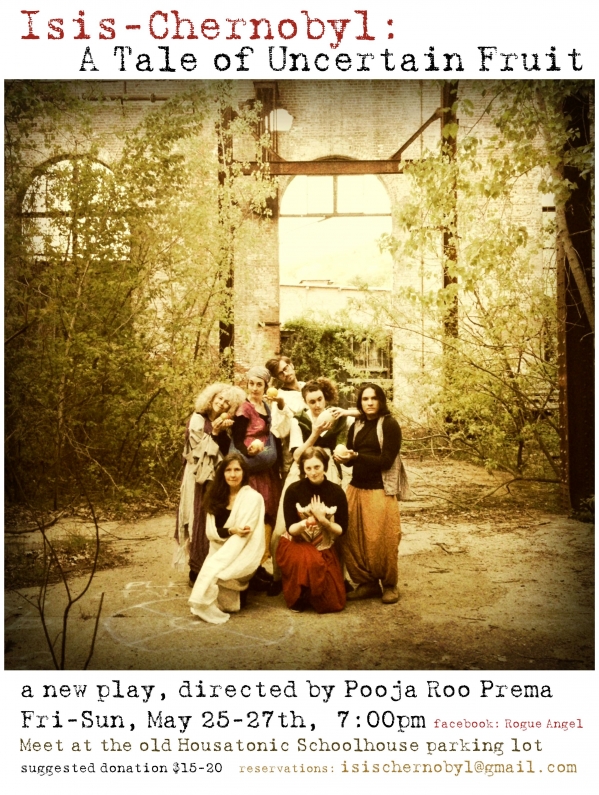
At the start of the weekend, I attended a play written and directed by Simon’s Rock alum Pooja Roo Prema, featuring a cast composed mostly of different generations of Simon’s Rock graduates.  Called “Isis-Chernobyl: A Tale of Uncertain Fruit,” the play is impossible to summarize in a nutshell, other than to say that it is an extended allegory of grief.

Pooja describes it as more a ritual enactment than an entertainment, which is certainly true; it has elements of high Greek tragedy, as well as Shakespearian clowning, but the thread that runs through it all is the resilience of the human spirit in the face of the unimaginable desolation of a post-apocalyptic landscape.

Isis, wandering the earth seeking the lost, dismembered parts of her beloved Osiris, could be any one of us wandering the haunted landscapes of our own memories, seeing people, places and events that once were woven into the warp of our being, but have become lost in the forward rush of life’s unfolding.

Reuniting now with generations of Simon’s Rock alumni, my own cohort past midlife and facing a future likely to be shorter than our past, I am reminded once again of how important it is to seize each moment, make the most of each day, appreciate one’s friends and family before they are torn from us by the relentless cyclical forces of life and death.

Isis can never be satisfied in her quest to feel again the smooth living skin and warm kisses of her lover, but she can reanimate his spirit in her own grieving flesh and mind.

Just as every car ride of my childhood came inevitably to an end, these days too shall pass, living on only in our memories.

This Memorial Day, I celebrate memory: the living memories of past happiness that glow within us like shining stars as well as the dark, grieving memories of people and places lost to us forever.

Who, me? Depressed?

Sometimes you just have to wonder if there will ever be good news again.

I mean, really good news.  The kind that makes you want to just lift up your face to the sun and grin like a sunflower.

Lately I cringe inwardly every time I open the newspaper.

In my local paper, drunk driving routinely kills kids and people fight endlessly about town budgets and whose backyard should get the wind turbines or the PCB dredging from the contaminated river.

The national news is warning darkly of a coming “Taxmageddon” in January 2013, when, according to The New York Times, “the federal tax bill for a typical middle-class household — making in the neighborhood of $50,000 — is scheduled to rise by about $1,750. This increase, which would come from the expiration of both the Bush tax cuts and the Obama stimulus, would follow a decade of little to no income growth for many people. As a result, inflation-adjusted, after-tax income for the median household could fall next year to its 1998 level.”

And then there’s international news, where we learn that suicides are up sharply in Europe as a result of the economic downturn, while over in Afghanistan suicide bombers have just struck hard in a coordinated attack on supposedly secure neighborhoods in Kabul—a taste of the summer fighting season to come.

April 14, 2012. Photo: Reuters

Never mind the weather, which is showing no signs of getting back to normal.  Did you hear about the massive hailstorm in Texas last week?  Or the tornadoes whipping across the Midwest?  Or the fact that there is a fire watch almost every day now here in Massachusetts, because of the extremely unusual springtime drought conditions?

A motorist sits in a truck partially buried in slushy hail near Amarillo, Texas. The Texas Panhandle storm dumped several feet of nickel-sized hail, stranded motorists in muddy, hail drifts and closed a highway for several hours.
(AP Photo/Courtesy of Amarillo/Potter/Randall Office of Emergency Management)

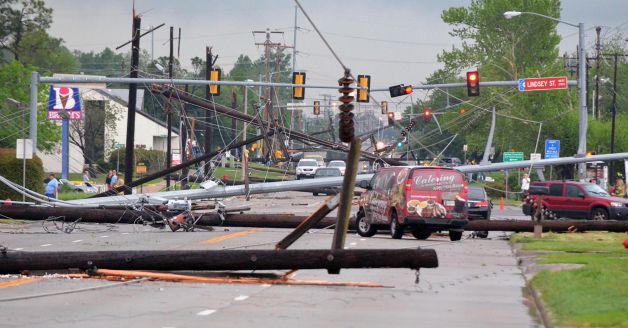
Downed power lines litter 24th Avenue Southwest at the Lindsey Street intersection after a tornado hit Friday afternoon April 13, 2012 in Norman, Okla. Photo: The Norman Transcript, Kyle Phillips / AP

I have been squinting at all this out of the corner of my eye as I rush off to teach, to meet with students and colleagues, to bring my younger son to soccer practice or piano lesson, to cram in some exercise for myself…all the various commitments that make my days and weeks a blur of action.

Today for the first time, and by design, I did not schedule a single appointment.  I left the day wide open so I could finally get out into my garden to fertilize and prepare the beds and plant the spring greens and herbs.

I spent most of the day doing just that, all the while worrying to myself about what will happen if the rains don’t come at all this spring. Already the river is as low as I’ve ever seen it; the ground is so dry it’s dusty.  In April!

Between the bad news and the scary weather, it’s enough to drive anyone to anti-depressants.

According to the U.S. Center for Disease Control (CDC), today one in 10 Americans over age 12 is taking an antidepressant.  Twenty-three percent of American women between the ages of 40 and 59 are on anti-depressants. That’s nearly one in four middle-aged women.

Do I need an anti-depressant?

I do feel depressed when I think about what’s going on in the world around me.

I am not happy to look ahead to 2013 and foresee a tax increase that, together with the double-digit health insurance premium increase my employer anticipates, is going to mean yet another year where my real income goes down, while the cost of living just goes up and up and up.

I feel depressed when I read that Rick Santorum just took out a lifetime NRA membership for his 3-year-old daughter (who, by the way, suffers from a generally fatal chromosomal disorder), while Mitt Romney is courting assault weapons fans at the 2012 NRA convention.

There’s just so much to be depressed about!

But it’s a legitimate depression.  If I were to get on the anti-depressant bandwagon and dull the edge of my depression with drugs, I would fear losing my grip on reality and becoming just another Brave New World-type soma addict.  What kind of life is that?

Allowing the full scope of the world’s problems to sink in to my psyche is painful, but hiding from it would be cowardly and useless.

On this quiet Sunday I will take the measure of my own melancholy.  And then I will rise again on Monday, determined to keep fighting the good fight for a better world.

Cupid, go home!

It’s fascinating to me that the Transition Times blog post that has gotten the most attention, by far, is “There’s more to love than Cupid and his arrows,” my Valentine’s Day 2012 post, which has been read hundreds of times since February 14.

Of course, people are always interested in love and romance.  And this is a positive, peaceful essay about being very thankful for the love I have in my life through my parents and children, to the point where I’m not missing romantic engagement.

Truly, I’m not.

There has been a spate of articles lately about so-called “singletons,” men and women who choose to remain happily single.

Some of the articles fret that such people may have troubles as they age, since they have no companions to help care for them.  A recent New York Times Room for Debate series, “Being Alone Together,” explored both sides of the issue, with many of the writers arguing that solitude has significant benefits.

I am not living alone; I am living with my two teenage sons at the moment.  I have to say that I do enjoy the rare times when I have the house to myself, and have no one but myself to please.

When I was in my early twenties, before I married, I lived on my own in Greenwich Village while I studied as a graduate student at NYU.  Although I had never felt confined or fettered while I lived with my parents, the freedom of living alone was fantastic, as was the convenience of living so close to the NYU campus and the stimulation of the Village.

But nevertheless, during those years I felt a tremendous pressure to marry, to have children—to paraphrase Mrs. Ramsay in Virginia Woolf’s To the Lighthouse.

Did it come straight from my ovaries?

It wasn’t like my parents were pushing me at all. But I felt a kind of insecurity about being single, like I was lacking or missing something. I was incomplete.

In those days, the 1980s, there was a lot of talk about how if you didn’t find a mate in your twenties or early thirties, you’d be over the hill and never find one.  Believe it or not!  Stories of unhappy women in their forties abounded—women who had never been married, and were totally, miserably fixated on finding the ever-elusive Mr. Right.

Although I was living alone and perfectly content with my life, I still felt like it was temporary, and I’d better be constantly on the look-out for the man who would come along to complete me and open the door to my real adult life, which could only begin with those wedding vows.

Now, on the other side of two decades of marriage and a divorce, I am once again single and enjoying the freedom, this time without that little Cupidlike imp sitting on my shoulder warning me that I’d better focus on love and get myself hitched.

I have young friends getting married now and of course I wish them much happiness and fervently hope that they will be better marriage partners than my ex and I were for each other.

But I have to say, from my current vantage point it seems rather miraculous that one’s chosen mate at age 25 could still be the perfect partner at age 50.  What an amazing feat to grow together so harmoniously that you still complement and satisfy each other after so many years of married life.

I know it happens; I have witnessed it for myself with others.

I just suspect it’s the exception, not the norm.

I have no illusions about finding—or being–such an exceptional partner in the next chapter of my life.

And you know what?  That’s just fine.