The Civilization We Grew Up In Is Already Dead. So now what?

“If we want to learn how to live in the Anthropocene, we must first learn how to die.”

This is the last line in a fine essay by Roy Scranton, former U.S. soldier and currently a doctoral candidate in English at Princeton University.  The essay, published in the New York Times philosophy blog “The Stone,” is one of those rare attempts to really lay out the gravity of the situation we face today, as humans on a rapidly destabilizing planet.

Readers of Transition Times have been hearing me give my doom-and-gloom warnings for years now.  But it’s very rare that such grim scenarios break into the gilded precincts inhabited by readers of The New York Times.

Here is Scranton:

“The challenge the Anthropocene poses is a challenge not just to national security, to food and energy markets, or to our “way of life” — though these challenges are all real, profound, and inescapable. The greatest challenge the Anthropocene poses may be to our sense of what it means to be human.

“Within 100 years — within three to five generations — we will face average temperatures 7 degrees Fahrenheit higher than today, rising seas at least three to 10 feet higher, and worldwide shifts in crop belts, growing seasons and population centers.

“Within a thousand years, unless we stop emitting greenhouse gases wholesale right now, humans will be living in a climate the Earth hasn’t seen since the Pliocene, three million years ago, when oceans were 75 feet higher than they are today.
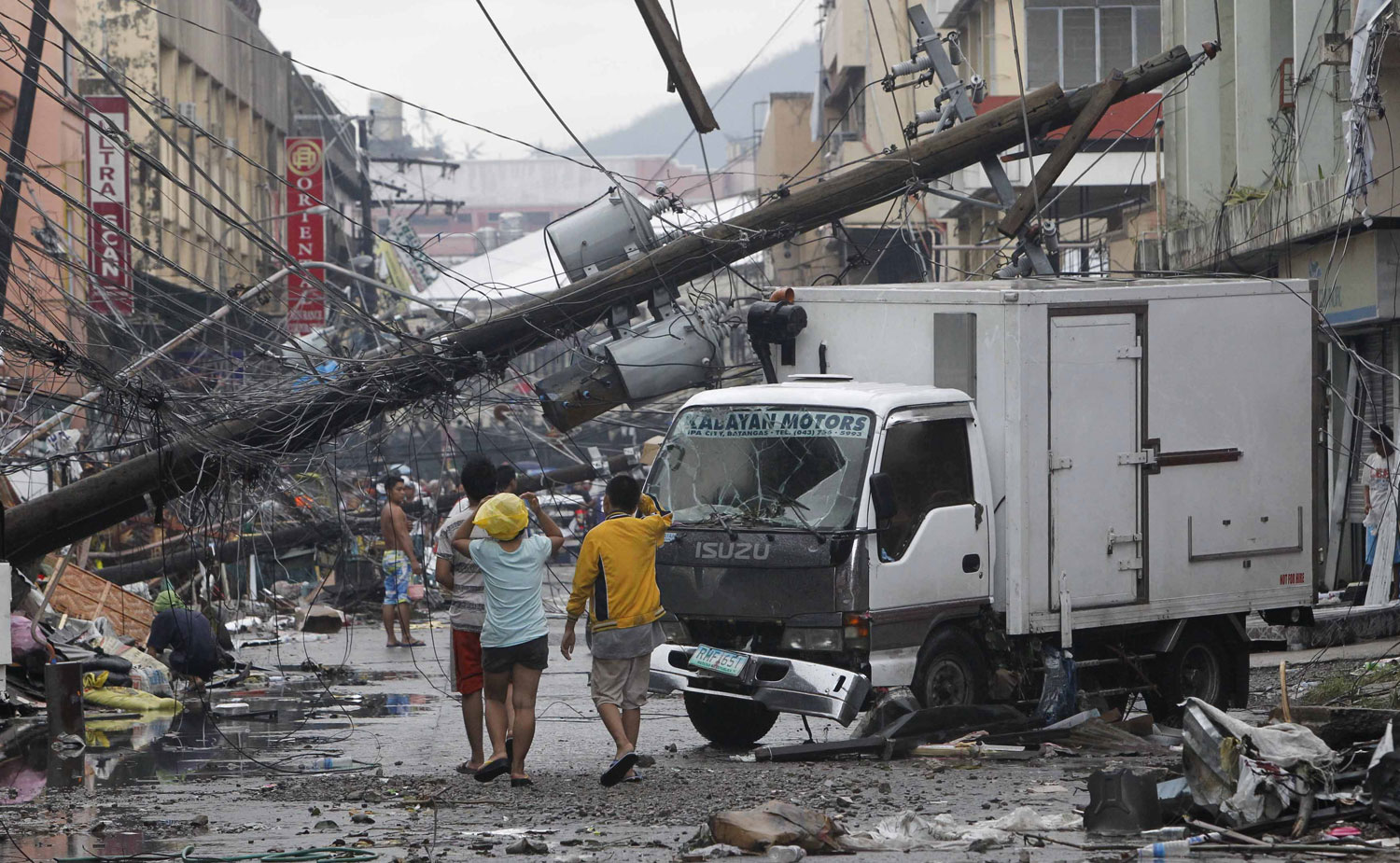
Aftermath of Typhoon Haiyan

Aftermath of Typhoon Haiyan

“We face the imminent collapse of the agricultural, shipping and energy networks upon which the global economy depends, a large-scale die-off in the biosphere that’s already well on its way, and our own possible extinction.

“If homo sapiens (or some genetically modified variant) survives the next millenniums, it will be survival in a world unrecognizably different from the one we have inhabited.”

Yes.  We know this.  It’s actually what Scranton does next in his essay that most interests me.

He makes a turn into the humanities, arguing that since “studying philosophy is about learning how to die,” then we have now “entered humanity’s most philosophical age — for this is precisely the problem of the Anthropocene. The rub is that now we have to learn how to die not as individuals, but as a civilization.”

Scranton reminds us that “the biggest problems the Anthropocene poses are precisely those that have always been at the root of humanistic and philosophical questioning: ‘What does it mean to be human?’ and ‘What does it mean to live?’

“In the epoch of the Anthropocene, the question of individual mortality — ‘What does my life mean in the face of death?’ — is universalized and framed in scales that boggle the imagination. What does human existence mean against 100,000 years of climate change? What does one life mean in the face of species death or the collapse of global civilization? How do we make meaningful choices in the shadow of our inevitable end?”

These are the kind of questions I ruminate about daily.  It comes back to Mary Oliver’s signature question, in her haunting poem “The Summer Day”—“What will I do with my one wild and precious life?”

We never know if our own deaths are right around the corner.  Will the truck driver around the next bend be distracted by his phone, cross the yellow line and blow me to oblivion?  Will my next physical exam reveal a terminal illness?  It could happen any time.

But as Scranton says, the climate change issue is much bigger than any of our individual lives.  It’s about the future of human civilization on the planet.

He ends his essay provocatively, saying that the problem of climate change cannot be solved by “buying a Prius, signing a treaty, or turning off the air-conditioning.” What is needed is a profound philosophical shift; to go from a civilization built on the illusion of endless growth and consumption, to a steady-state civilization that the planet can sustain.

We need to realize, Scranton says, that the human civilization all of us grew up in “is already dead. The sooner we confront this problem, and the sooner we realize there’s nothing we can do to save ourselves, the sooner we can get down to the hard work of adapting, with mortal humility, to our new reality.”

Yeb Sano breaks down speaking about the devastation in the Philippines after Typhoon Haiyan, and begs the climate negotiators to act decisively to curb carbon emissions

Yeb Sano breaks down speaking about the devastation in the Philippines after Typhoon Haiyan, and begs the climate negotiators to act decisively to curb carbon emissions

Watching the desperation on the faces and in the voices of the climate negotiators from sea-level nations like the Philippines, Bangladesh, and the Maldives, it’s clear that these folks have already absorbed the lesson we in the higher-terrain countries have yet to confront.

We cannot go on with business as usual any longer.

Not if we want to bequeath a livable Earth to our descendants.

Severn Suzuki speaking out

Severn Suzuki speaking out

Severn Suzuki said it all, so eloquently, speaking to a climate change summit way back in 1992, when she was just a girl of 12.  Are we ready to listen yet?

The Philippines Today; Where in the World is Next, Tomorrow?

The media silence before Typhoon Haiyan hit was as eerie as the sickly green calm before a violent summer tornado.

In the days while the storm churned its way across the sea to landfall in the Phillippines, only the BBC seemed to be paying attention.

Super-typhoon Haiyan

Super-typhoon Haiyan

I had that familiar tightness in the pit of my stomach, watching the satellite images of the storm’s progress.  I knew that even though there had been evacuations, this was going to be a storm of historic proportions.

And it was.

And now the American media is paying attention, but it’s the usual kind of attention, which is to say, they’re asking the usual questions: how many dead?  How many wounded?  What humanitarian relief effort is being mounted?

I had yet to hear the words CLIMATE CHANGE raised, until this afternoon—and no surprise about who uttered those words.

Bill McKibben sent one of his pithy, no-nonsense emails out to the 350.org list today.

“Lines of communication are in still in chaos, but we managed to get in touch with Zeph, our amazing 350 Southeast Asia Coordinator in the Philippines. Here’s what she just emailed to our team: “This lends urgency to our work. I think we need to be twice as strong as Typhoon Haiyan.”

Concretely, McKibben is asking us to send funds to the survivors, and here’s the link provided by 350.org for more information on humanitarian aid.

Secondly, he says, we need to raise our voices.  The link connects to a petition that will be delivered to negotiators at the UN climate summit going on right now in Warsaw (surprise surprise, I didn’t know that was going on—did you?).

With characteristic bluntness, McKibben says:

“We need to let world leaders know that their inaction is wrecking the world, and the time is long past for mere talk — we need action, and we need it now.”

UnknownPhilippine negotiator Yeb Sano, who has been working for years to persuade the developed world to act aggressively on climate change, is fasting for the two weeks of the talks until and unless countries make real commitments around climate finance and reducing emissions.

McKibben quotes Sano: “Let Poland, let Warsaw, be remembered as the place where we truly cared to stop this madness. Can humanity rise to this occasion? I still believe we can.”

Call me a fool, but I still believe we can too.  One thing is for sure, this is no time to give up.


More Info and Links, courtesy of 350.org


Of Climate Change and the Humanities

This week, most unusually, two topics that are of great interest to me, but which rarely make it into the mainstream media, suddenly surfaced in The New York Times.

It was not glad tidings.

ipcc_altlogo_full_rgbAn article about a “leaked draft” of a report by the United Nations Intergovernmental Panel on Climate Change, strategically placed in the Saturday edition of the NYT–generally the least read—warned that global warming is going to severely disrupt food supplies in the near future.

A burgeoning global human population, expected to reach 9.6 billion by 2050, is going to need more food—but climate change is predicted to reduce agricultural production by as much as 2 percent each decade for the rest of this century, with predictable results in terms of famine and civil unrest.

Meanwhile, back on the higher-education ranch, it was doom and gloom for the humanities this week, with a “Room for Debate” discussion in the New York Times about whether or not the study of the humanities has become vestigial in these science-focused times, just an “academic luxury.”

The answer I liked best to the question “what good are the humanities today” came from Lisa Dolling, an associate professor of philosophy, and dean of the College of Arts and Letters at Stevens Institute of Technology, who said:

“While science and engineering can tell us the “what” and “how” of the world, the humanities and social sciences provide insights to answering the “why” — along with the skills necessary to communicate it all to others.”

i-f38d8b0bf62d6e656f1e4bf2c111d9b2-IPCCScience and engineering can tell us all about the problems we face due to global warming, but it is the humanities that will be able to tell us why it is so impossible for human beings to agree on reducing carbon emissions and shifting into a sustainable economic framework.

And perhaps it is the humanities that will be able to persuade us to overcome our collective inertia…find the necessary fire in our bellies…and insist that corporations and politicians join hands to make a livable future for us all.


Personally, I have never been more excited to be a humanities professor than I am today.

All of my courses this year are focusing on urgent issues of social and environmental justice, giving students the models and tools they need to become the kinds of change agents our world so desperately needs.

In science & engineering courses, students will learn how to measure and impact biofeedback systems.

But in my courses, they will learn how to communicate these statistics in ways that not only inform, but also inspire a thoughtful response in others.

It is not enough today to understand what is going on, although that is a crucial first step.

We must also be able to take the next steps of a) explaining to others why global warming is important and b) creating channels through which people’s fear, passion and courage can flow into positive efforts at social change.

According to the Stanford University website, “the humanities can be described as the study of the myriad ways in which people, from every period of history and from every corner of the globe, process and document the human experience. Since humans have been able, we have used philosophy, literature, religion, art, music, history and language to understand and record our world.”

I find it sad that humanities scholars have to defend the utility and validity of our field today.

Science without the humanities would be a cold social environment indeed, and I think even scientists probably recognize this.

In the age of climate change, we need the humanities more than ever to understand where we are, and to provide the moral framework for where we want to go.

It is not enough to simply describe population growth or agricultural decline. We need to explain why it is imperative that we work to curb human populations and create economic and biological systems for sustainable growth.

We need history to show us how we got here; philosophy to show us our ethical responsibility; and literature and rhetoric to show us how to most effectively communicate with others.

What an impoverished human society it would be if empirical evidence was all we focused on.

Scientists need the humanities, and vice-versa.  To suggest otherwise is to greatly undersell the capacity of human beings to think with both sides of our large, ambidextrous brains—with potentially disastrous results for human society and planet Earth.

We can do better than that.  And we will.

Of Oil, Honey and the Future of Human Civilization

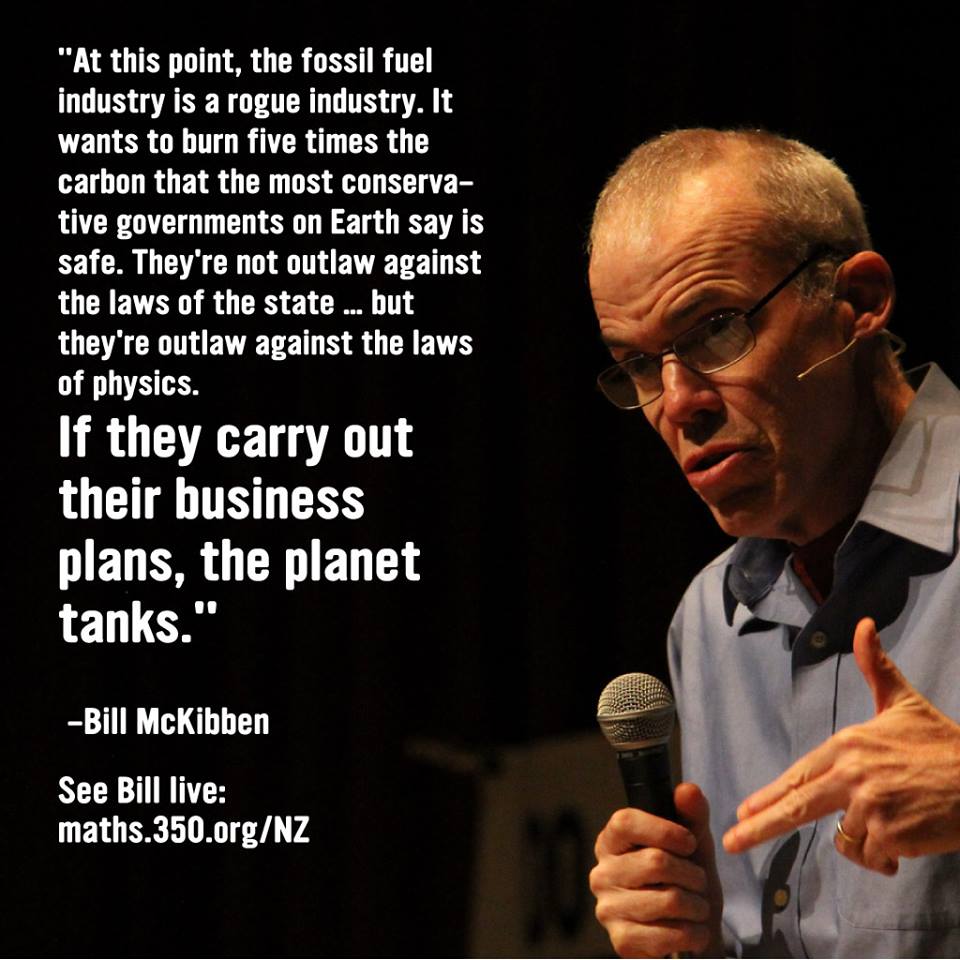
do_the_math_image_1I have been reading Bill McKibben’s new book, Oil and Honey: The Education of an Unlikely Activist, with a group of students in a course called Media Strategies for Social and Environmental Justice Advocacy that I’m offering for the first time this semester at Bard College at Simon’s Rock.

Oil and Honey tells the story of how McKibben founded 350.org with a group of his students at Middlebury College in 2009, and how together they went on to become the most visible American environmental organization of our time, leading the U.S. protests against the Keystone XL pipeline and creating an international movement to put pressure on governments and policy makers to quickly and decisively address the mounting threats of climate change.

Most recently, McKibben has been focusing on divestment as a tactic to push the fossil fuel industry to shift into cleaner forms of energy production.

Taking its cue from the successful anti-apartheid divestment campaigns of the 1980s, the strategy is to awaken enough ordinary citizens–including college students, church-goers and workers of every stripe–to the perils of climate change, and get them to press their hometowns, companies, churches and colleges or schools to divest their endowments, retirement funds and other collectively held investment portfolios from the fossil fuel industry.

It seems like a good strategy, and yet it did not elicit much enthusiasm from the students in my class.

They were more interested in thinking about how to educate younger kids about the beauty and value of the natural world, and moving from that basic platform out into activism.

Kids today spend so much time indoors, in front of screens, that they have little sense of connection to nature, my students said.  And without that connection, it’s very hard to understand why it’s important.  What’s all the fuss about?

This is what it’s about.

Bill McKibben asks us to “do the math” and understand that if we were to actually succeed in burning all the fossil fuels that are currently in the ground, we would heat our planet to a level not seen for millions of years.

It would definitely be game over for human civilization, and it would take millions of years for the planet to restabilize.

What it is about this simple math that human beings today do not want to see and understand?

Part of it is simply that we’re so easily distracted.

The big news yesterday was that Federal Aviation Administration will now allow airline passengers to use their computers and tablets right through take-off and landing.  We can be in front of our screens to the very last second of the day!

Meanwhile, while we’re busy on our computers, not paying attention, the fossil fuel industry is going around the resistance to the Keystone XL pipeline by massively investing in railway terminals, lines and cars for carrying its tar sands oil down to refineries and tankers on the coasts.

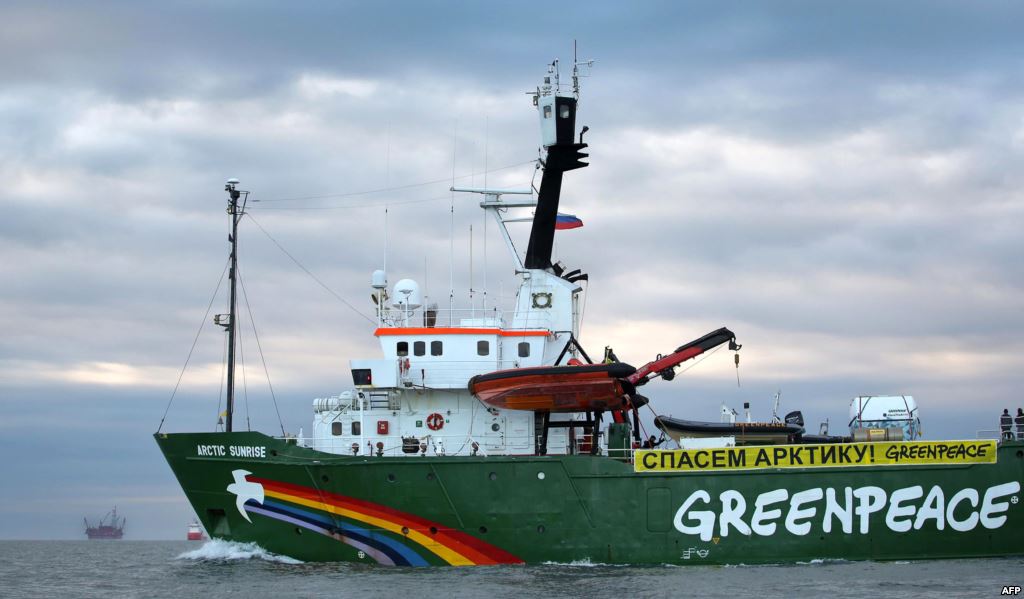
B3029FCC-5228-4E57-B879-F8A83ABF036B_mw1024_n_sAnd up in the darkness of the Russian tundra, 30 Greenpeace activists are languishing in cold solitary prison cells, held without trial for the crime of trying to raise awareness about the destruction of the Arctic by Russian and international oil drilling.

Where is the outrage?

In the book Oil and Honey, McKibben ingeniously compares corporate behavior to bee behavior.  Corporations are like bees, he says, in being relentlessly “simple” and focused on their one crucial task—for bees, making honey; for corporations, making profit.

They don’t change their focus, no matter what.

But humans are more complex than that.  We can change and adapt to new circumstances.  We can recognize and act upon moral imperatives.  We don’t have to follow suicidal corporations blindly over a cliff of their own making.

Although it’s true that the alarming dependence of Americans on screens of every size can get in the way of a connection to the natural world, on the other hand, the fact that so many people are networked together through the media presents great opportunities for activism and change.

With my students this semester, I’ll be thinking about how to harness the power of the media to create a different kind of swarm—not following our current corporate leaders, but moving in an entirely different direction.

We’re not alone—there are many groups working on this now, from the Transition Town movement to the Pachamama Alliance to even such formerly mainstream organizations as the Sierra Club.

The task: to awaken a critical mass of people, worldwide, to the reality that we are living in an end-time of biblical stature; and to get them to understand that we have the power to change the storyline from doom-and-gloom cataclysm to a positive shift into a whole new relationship of humans to our planetary home.

Working cooperatively, bees are able to turn small grains of pollen into vast tubs of honey.  Human beings can do that too–when we work together for a common cause we can do almost anything.

So what are we waiting for?

images-1

What are we waiting for? Violence and climate change in our brave new world.

Finally, in the Sunday New York Times, a report giving empirical evidence of what we already knew intuitively, that climate change leads to violence, and that it’s going to get worse as the planet continues to warm.

For a couple of years now I’ve had a haunting premonition that violence is going to come even to the comfortable, beautiful corner of the world where I live.

We saw how fast tempers flared when Hurricane Sandy created gas shortages down in the New York metropolitan area.

What happens when our industrial food supply starts to fail, given the inevitable and already-occurring wildfires, droughts, tornados and floods?

When people get hungry, survival-of-the-fittest kicks in, and it will take serious riot police to keep order when the supermarkets run out of food.

The authors of the new report say that their findings “are particularly important for what they imply about the future. Many global climate models project global temperature increases of at least 3.6 degrees Fahrenheit (2 degrees Celsius) over the next half-century. Our results imply that if nothing changes, this rise in temperature could amplify the rate of group conflicts like civil wars by an astonishing 50 percent in many parts of the world — a frightening possibility for a planet already awash in conflict.”

Frightening indeed. What to do with this new knowledge?

The authors urge political leaders to “call for new and creative policy reforms designed to tackle the challenge of adapting to the sorts of climate conditions that breed conflict — for instance, through the development of more drought- and heat-resistant agricultural technologies.”

I hardly think that the answer lies in agricultural engineering.

In the time we have left before chaos sets in we should be re-localizing agriculture, setting up distributed energy networks and re-learning the old arts of drying, salting, canning and cold storing agricultural products.

Indian Line CSA, one of the first in the nation

Indian Line CSA, one of the first in the nation

We should also be disarming our civilian population and focusing on creating strong community networks of mutual support.

For all our cleverness, humans are just primitive beasts when our bellies are empty—primitive beasts armed, at least in Fortress America, with deadly assault weapons.

The nightmares of the Congo, Somalia and Sudan, not to mention Afghanistan, Syria and Iraq, could easily start up here too, when food is scarce and sectarian violence begins to flare.

The truth is that we can’t rely on national and international leaders to undertake meaningful “policy reforms”—not when they are being held hostage by Big Carbon, Big Ag, Big Chemical/Pharma and Big Finance.

Delusional these corporate giants may be, but they will be going down with the ship holding fast to their belief in the value of limitless human economic growth, stable climate be damned.

We who believe that another world is possible need to hold fast to our own belief that the world won’t end when those giant glass towers in financial districts worldwide go down.

We can build that new world—not through technology and arms, but through community and collaboration.  Bottom-up, not top-down.

It’s true: we are the ones we’ve been waiting for.  And given the impending climate crisis, there’s no point in waiting anymore.

Harvesting at Indian Line Farm, Berkshire County MA

Harvesting at Indian Line Farm, Berkshire County MA

I have a dream: the 20th century visions of King and Obama and the “fierce urgency” of our time

mlkihaveadreamgogoFifty years ago today Dr. Martin Luther King Jr. shared his dreams with the American nation:

“I have a dream that one day this nation will rise up and live out the true meaning of its creed: We hold these truths to be self-evident, that all men are created equal.’

“I have a dream that one day on the red hills of Georgia, the sons of former slaves and the sons of former slave owners will be able to sit down together at the table of brotherhood.

“I have a dream that one day even the state of Mississippi, a state sweltering with the heat of injustice, sweltering with the heat of oppression, will be transformed into an oasis of freedom and justice.

“I have a dream that my four little children will one day live in a nation where they will not be judged by the color of their skin but by the content of their character.

“I have a dream today!”

Today President Obama, himself the fulfillment of Dr. King’s dream, honored the legacy of the Civil Rights movement, telling us that because people in Dr. King’s generation marched for justice, “America changed. Because they marched, the civil rights law was passed. Because they marched, the voting rights law was signed. Because they marched, doors of opportunity and education swung open so their daughters and sons could finally imagine a life for themselves beyond washing somebody else’s laundry or shining somebody else’s shoes. Because they marched, city councils changed and state legislatures changed and Congress changed and, yes, eventually the White House changed.”

967-16eslj.AuSt.55

But Obama’s dream remains too limited.  He is still dreaming a 20th century dream of middle class jobs and security: the longing for a society offering  “decent wages, fair working conditions, livable housing, old age security, health and welfare measures — conditions in which families can grow, have education for their children and respect in the community.”

Such a scenario assumes the stability of the real workers of our economy: the trees and plankton that supply our oxygen and the microorganisms that make our crops grow.  It takes for granted steady, predictable rains and moderate temperatures.

We can no longer make such assumptions, and President Obama is wrong to preach to the nation as though 20th century problems and concerns were still paramount today.

Yes, the problem of the color line still exists in 21st century America.  The unemployed still need jobs.  The racial disparity in prison populations is disgraceful.  But these are not the most pressing issues of our time.

President Obama lauded the young of the 1960s for being “unconstrained by habits of fear, unconstrained by the conventions of what is. They dared to dream different and to imagine something better.”

He argued that “that same imagination, the same hunger of purpose serves in this generation.   We might not face the same dangers as 1963, but the fierce urgency of now remains.”

In fact, we face even greater dangers today than in 1963, and it was dishonest of our President not to allude to the much more serious problems now bearing down on us full force: the juggernaut of global climate change.

The wildfires burning in California this week are the among largest ever recorded in the United States.

The rate of species extinction is faster now than it ever has been in the history of human civilization.

The ice melting at the poles promises to release heat-trapping methane gas at rates not seen since prehistoric eras.

Human population is on track to reach 9 billion or more in this century, way beyond the carrying capacity of the Earth.

We don’t know where all this is leading, but surely we cannot expect positive outcomes from these dramatic planetary shifts.

These interconnected environmental issues are the great challenges of our time, and it is to them that President Obama should have alluded, if he was being honest with himself and with the American people.

Whether or not the Syrians used chemical weapons against their own people; whether or not African Americans get to the voting booth; whether or not the American middle class sinks into poverty…all this will not matter at all when accelerating climate change begins to bring food shortages even to the most cosseted Americans.

Here is what our President should have said today:

‘I have a dream that Americans will step into a leadership role in the great fight of our time, the transition to a sustainable, renewable-energy-based society.

‘I have a dream that people of all nations, all creeds and from every culture on Earth will embrace our common challenge of finding ways to mitigate human damage to the planet, and adapt to the changes that are rapidly coming our way.

‘I have a dream that men and women from all over the globe will stand together, knowing that divided we will fall, but united we have a chance to safely ride out the storms that face us.’

My own personal dream is that our political leaders will stop lying to us, and will summon us to step up to the great ethical and empirical challenge of our time: creating lifeboats on which our children and grandchildren may sail safely into a sustainable future.

Time for change

Jen light 3 copyIf my blog posts have been a bit few and far between lately, it’s because I’ve been focusing my writing efforts this summer on the bigger project I have underway, the personal/political memoir I’ve been working on for some years now.

The political subtext will be somewhat familiar to followers of my blog these past two years: the necessity for more ordinary folks like me to wake up to the realities of climate change and environmental destruction, and begin to take action in both the personal and the political spheres.

The personal narrative will be somewhat familiar to friends and family who have followed my life, or pieces of my journey, these past 50 years.  Good moments and bad, easy stretches when everything seemed to be going right, followed by inevitable patches of heartache and turmoil.

In the course of charting my experiences in depth through this memoir project, I’ve realized that I have two qualities that have often led me into troubled waters.

One, probably because I grew up in a family with strong values of caring, respect and integrity, I have tended to be very trusting—to believe that people mean well and want to do the right thing by others.

And two, I have been slow to respond to situations that make me unhappy.  I tend to try to stick with whatever I’ve started or gotten myself into, to try make it work even when it’s become quite obvious—even to me!—that things are never going to change for the better.

I’m trying to make some connections between these personal traits of mine, and the larger social landscape that I inhabit.

For example, it seems to me that we have all tended to be too trusting of authority figures like politicians and business leaders, expecting that they have our best interests at heart.

As a kid growing up, it would never have occurred to me that corporations would produce, package and market products aimed to appeal to children, that would, over time at least, make us seriously sick.

I remember begging my mom to buy me Froot Loops and Lucky Charms breakfast cereal, which looked so yummy and appealing on TV.

I wanted Ring Dings, too, and Yodels, and Twinkies.  I wanted Coke, of course, and Dr. Pepper.  I wanted McDonald’s hamburgers, fries, and McMuffins.

I was lucky that my mom was not swayed by the seductive advertising, and went her own way with food, raising my brother and me on fresh fruits and vegetables (often grown in our own garden), premium meats, and homemade, preservative-free desserts.

Others, who bought the advertising and fell for the products, are finding themselves now, at midlife, with diabetes, cancer, asthma, arthritis and all the rest of our common American ailments.  To some degree at least, the explosion of health problems in the developed world can be directly traced back to our societal trust that Big Business, Big Agriculture and Big Government were doing their best to safeguard our health.

Turns out we needed to be more discerning—a theme that runs through both my private and public spheres.

Likewise, I can relate my own slowness to realize and respond to untenable situations in my personal life to our broader social reluctance, as human beings, to go against the flow.

Let’s face it, we humans are herd animals, as Nietzsche saw clearly more than a century ago. We run in packs, and we fear nothing so much as social isolation and disapproval.

For me personally, the kinds of situations that I’ve been slow to wake up to and act upon have been ones in which taking action means going against the grain of social expectations.

For example, my marriage.  It was very hard for me to let go of my own attachment to being married.  There are so many positive perceptions surrounding married people, while divorced people, on the other hand, are perceived as unstable, difficult, dissatisfied, disloyal, probably neurotic, bad parents, bad partners, bad lovers—in short, failures overall.

Even though some 50% of marriages in the U.S. end in divorce, these stigmas still hold a great deal of power, and for me it was hard to finally concede that I could go no further in my marriage.  After more than 20 years, I had to cry uncle and admit that yes, I had failed.  I could not make it work.

The thing is that once I got to that nadir, I didn’t care anymore what people thought, and I came to see the major life change of divorce as a positive liberation, not a failure at all.

Once I’d made the leap and let go of my inertia and fear of change, I discovered that it wasn’t nearly as hard as I’d imagined, nor were the repercussions as severe.

It turns out that most of the fears I’d had around becoming single—and a single parent—at midlife had much more to do with my own perceptions than with any reality out there in the world.

I believe that these kinds of fears in the personal realm apply just as much in the political realm.

CWindmillhome

Wind turbines on the Bay of Fundy, Nova Scotia

For instance, we know that our longterm relationship to fossil fuels is, in the words of JT, “driving us down the road to ruin,” but so many of us feel stuck, afraid to go against the tribe in seeking out new, more positive relations to energy use on the planet.

We tend to just go with the flow, running our AC on hot days, driving our cars, using our oil furnaces for heat in the winter.  Even though we’re beginning to see that this makes us unhappy—who, after all, enjoys prolonged heat waves, out-of-control wildfires, destructive storms and raging floods?—we still stick to what’s familiar, what appears to be socially acceptable, what everyone else is doing.

It’s time for each one of us to stiffen our backbones and be honest with ourselves about the situation we’re in now.

Climate change is upon us.  It’s past time to start working hard to cut carbon emissions by reducing use and switching to cleaner energy like wind, solar and geothermal.  We need to stand with 350.org and other environmental groups to pressure our government to do the right thing—to put the health and welfare of we, the people, ahead of the profits of them, the corporations.

On a personal level, too, we can also make changes.  We can use bicycles more, and AC less.  We can hang out our laundry to dry.  We can start weaning ourselves off disposable plastics, and put some raised beds in our backyards or on our rooftops.

It used to be that only “granola people” did things like this—“granola people” pronounced with a dismissive smirk.

It turns out that those crunchy folks had it right, and we’re the ones who have stayed in our unhappy fossil fuel-based relationship too long.

We may imagine that breaking with the herd and striking out alone on the path of ecological sanity is going to earn us smirks and sneers.  But a) this is probably just in our heads; and b) who cares, if it makes us happier in the long run?

Here’s what I’ve finally realized, at midlife, on both the personal and the political levels: life is way too short to waste time being unhappy if a path toward happiness is available.

Letting go of our attachment to the status quo is the crucial first step on that path, and it’s not easy.  But it is necessary now, given the critical juncture we’re at as a planet and a human civilization.

Think about it.  And then—act.

Being the change–beyond hope, beyond fear

Every time I write an exhortatory post like the last one, I imagine my readers getting to the end and clucking their tongues in frustration.

“OK, we get it, now the is time to act—but what does she want us to DO?  Doesn’t she have any practical suggestions on what to do in this terrible transition time?  Isn’t she going to lead by example?”

Well, yeah.  In relentlessly focusing my attention, and by extension my readers’ attention, on the frightening facts of environmental degradation–from climate change to toxic pollution to the precipitous decline of millions of species—I am doing something.  It may not be much, but at least it’s better than sticking my head in the sand and ignoring the gathering storm, or selfishly trying to live it up as long as possible—let the band play on!

There are many things I dream of doing, but right now simply cannot.

I cannot build myself an environmentally sustainable, off-the-grid house, nor can I pick myself up and move to an eco-village at this time.

I cannot spend all my time sitting in trees to protest logging or marching on Washington D.C. to protest inaction on climate change.

I cannot devote myself 100% to environmental communications work.

And I can’t wave my wand and stop the poles from melting, or make all the toxic chemicals just go away.

What I can do is take the strengths I’ve been given, in writing and communicating, and use them to try to spread awareness among others, in the hope that the little ripple I may be able to start will grow to a mighty wave of positive change.

***

I need to think more about this question of hope, though.

Margaret Wheatley

Margaret Wheatley

Lately I’ve been reading and re-reading Margaret Wheatley’s latest book, So Far From Home, in which she talks, rather surprisingly, about the need for activists to move beyond hope.

The problem with hoping for change, she says, is that “fear is the constant, unavoidable companion of hope. What this simply means is that I hope for a certain outcome and I’m afraid I won’t get it. I hope for a certain result and I’m fearful it won’t happen. This is the way that hope and fear are wedded together….So, it might be that the road to fearlessness is only found by giving up hope. By giving up outcomes, by giving up goals.”

This is a challenging idea.  If we give up on goals, doesn’t it mean that we give up, period?  That we just bow our heads in resignation and accept the anthropogenic destruction of our planet as inevitable?

Not according to Wheatley.

Quoting from Thomas Merton, who says that we need to “concentrate not on the results but on the value, the rightness, the truth of the work itself,” Wheatley gently asks:

“What if we could offer our work as a gift so lightly, and with so much love, that that’s really the source of fearlessness? We don’t need it to be accepted in any one way. We don’t need it to create any certain outcome. We don’t need it to be any one thing. It is in the way we offer it, that the work transforms us. It is in the way we offer our work as a gift to those we love, to those we care about, to the issues we care about. It is in the way we offer the work that we find fearlessness. Beyond hope and fear, I think, is the possibility of love.”

Could this be a kind of answer to those skeptics who would take me to task for writing about environmental issues without doing enough to be the change I want to see?

By giving myself to this work of raising the alarm, motivated by my deep love for the planet and my awareness of the inter-being of all her denizens, am I doing the work I came here to do in this lifetime?

The truth is that I don’t have much hope, anymore, that we will be able to “save the world.”  Nevertheless, I keep on writing, because writing is my way of working through and releasing myself from fear.

Having spent a lot of my life in fear, and having come to know it intimately, I can say with some authority that fear is a useless, paralyzing emotion.  Fear holds us back, it pinions our wings, it pushes us to do things we will later regret.

What we need, Wheatley says, is the clarity that resides beyond fear and its twin sister, hope.  The clarity that comes with knowing that since our time is going to come sooner or later, what’s important is how we spend each one of our days.

We need to do the work we came here to do, as well as we can, without expecting reward or recognition, without depending on external acclaim or tangible, material successes.

Beyond hope, beyond fear, I will keep going on, day to day, raising my children, doing my teaching and writing, enjoying beauty, pleasure and loving-kindness as they cross my path, and conjuring them myself in the way I live my life.  In that sense, yes, I will be the change.

100_2487 copy

World on fire

I had to dig deep into the New York Times, my usual go-to source for “all the news that’s fit to print,” to find any mention of this weekend’s train explosion in the province of Quebec, not far from the Maine border.

canada-floater-articleLarge

Lac-Megantic on fire July 6, 2013

I knew about it only because here in Canada it’s at the top of the headlines, with Prime Minister Stephen Harper taking the time this Sunday to journey to the small town of Lac-Megantic, where the disaster occurred, to size up the situation and offer his condolences.

Officially, so far, five have been confirmed dead, with scores still missing; Lac-Megantic, pop. 6,000, is said to look like a war zone, with black fumes rising from the burning crude oil carried by the 73-car train.

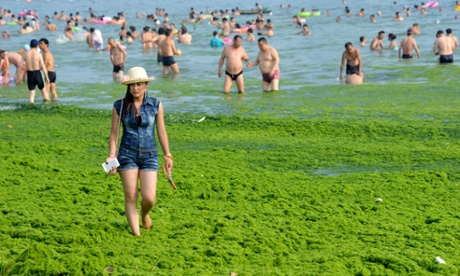
This on a weekend when temperatures in the Canadian Maritimes soared to record-breaking heights, and harmful algal blooms worldwide choked out marine life along all the coasts.

91fb3c94-086c-4470-a98e-23ec4ff993d8-460x276

Algae bloom on the Yellow Sea in China, July 2013

Astoundingly, at least one Canadian pundit responded to the burning crude and the smoldering township by calling for increased building of pipelines!

Another columnist, in the very same newspaper that reported on Nova Scotia’s unprecedented heat wave, had the nerve to call for more drilling and fracking for oil and natural gas on land and sea in the province.

If there are no more fish in the sea, we can at least extract the last of the fossil fuels, eh?

It’s time to get a grip, people.

What we need is not more oil and gas, but more wind and solar.

We need clean sources of energy, and we need to lower our consumption dramatically.

The window of possibility is smaller and tighter than most of us care to realize.

The tipping point is upon us.

This is not another action movie, a “White House Down”-style disaster flick, ending with the good guys reliably saving the day.

As we saw with the Arizona fires the other day, even the most hot-shot of heroes can go down in a blaze of glory when the fires burn out of control.

Do we really want to wait until the entire world is going up in flames, literally and figuratively speaking, before we act?

This is not a rhetorical question.  And the answer, I believe, is NO.  We can’t afford to sit on our hands any longer.

The time to act is NOW.

You can run but you can’t hide

As the heat and humidity of summer bore down on my home turf of New England last week, I made a run for it, spending two days traveling northeast at breakneck speed towards the normally cool coast of Nova Scotia.

I arrived just in time for a rare heat spell here on these windy islands sticking out into the north Atlantic.

Today it was up in the 90s Farenheit, the sun golden-bright and merciless.  Too hot to go out to the beach—a day for staying in the shade and drinking lots and lots of water.

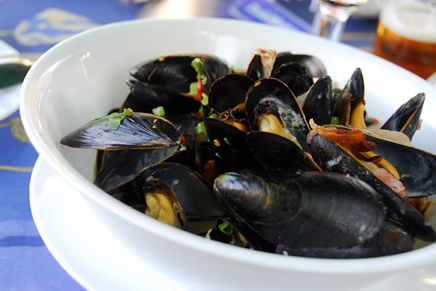
musselsThinking of having something light and cool for dinner, my son and I drove down to the store to get some mussels.

The Canadian Maritimes are a prime source of farmed mussels, and I was eagerly picturing a pot full of the glistening blue-black beauties, steamed in a fragrant shallot and wine sauce.

Ignoring the sad, dried-up looking fish at the Atlantic Superstore fish counter, I confidently asked for a 5-pound net bag of mussels, and placed it in my shopping cart.

I started walking around the store briskly, revived by the freezing air conditioning.  But I kept getting whiffs of a strange smell, like something rotten.  After a few minutes, I realized it was coming from my cart.  It was the mussels.

I returned the bag to the fish counter, where the server took it back without argument.

So much for my fantasy of a mussel dinner.

***

warnsignOn the way home, we stopped to pick up a local newspaper, and while waiting in a long hot road construction line, I noticed a small headline tucked on the inside pages: “Shellfish Harvesting Suspended Due to Red Tide.”

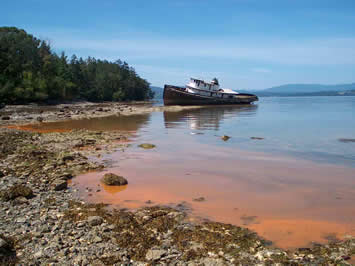
My son and I looked at each other in dismay.  We had already noticed, on our first walk on our normally pristine local beach, that the water was a strange rusty-red color.

We had noticed too that there seemed to be fewer seabirds around, and that when we went down to the rocks to look for the normally numerous crabs, we could hardly find any.

We had been planning to go clamming over the weekend, out on the mud flats at low tide.

That plan would have to go the way of the mussel dinner.

When we got home, we went to the Internet to look up Red Tide, learning that it was more properly known as Harmful Algal Bloom (HAB), and that it was almost ubiquitous along the Atlantic and Pacific coastlines, especially during the summer.

We learned that eating shellfish that have been harvested from HAB water can cause “paralytic toxic poisoning” in humans, characterized by gastrointestinal and respiratory distress.  Good thing I left those stinking mussels at the Superstore!

HABs have disastrous effects on other species like fish, waterfowl, dolphins, whales, and seals.

If I can’t eat mussels I may be piqued, but I can find something else just as good to eat on land.

Ocean denizens have no such options. I began to picture cormorants and seagulls with bad tummy aches.  No wonder we’d seen very few of the big blue herons that used to be so numerous in the salt marshes.

 ***

Red Tide - Mary Mackin 2My admittedly superficial Internet search did not bother to mention the cause of harmful algae blooms, speaking of them as an inconvenient fact of life, like a rip tide or a thunderstorm.

While HABs are sometimes natural, there is nothing normal about the dramatic spike in coastal red tides we’ve been seeing for the past 25 years or so.  They are part of the same phenomenon that causes the dead zones around the mouths of rivers that run through densely populated agricultural regions.  This summer, scientists are forecasting the largest dead zone ever recorded in the Gulf of Mexico—some 8,500 square miles.

It’s human and animal sewage and fertilizer run-off that upsets the natural chemical balance of the coastal waters, feeding the destructive algae at the expense of everything else.

What we humans break, we can also fix.  We could fix this problem if we wanted to.  But I found mention only of closing shellfish beds to harvesting, not of trying to turn the entire problem around by reducing the amount of shit we allow to run off into the sea.

***

I thought that up here in Nova Scotia I might be able to escape from the relentless, depressing awareness of the cascading, ever-quickening destabilization of the natural world.

That’s just another little fantasy I’ll have to give up.  There’s nowhere to run, much less to hide.