Love in the end times

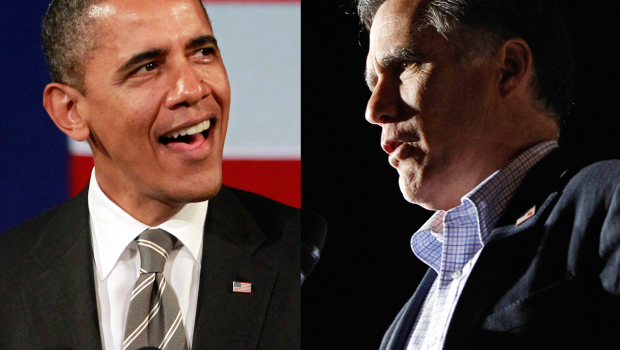
The political horserace in American politics has begun, with both Presidential candidates running full-tilt but ponderously towards each other like armored knights on horseback, wielding the lances of millions of dollars’ worth of attack ads and backed up by slick, smart campaign pages.

Meanwhile, it continues to be hot, hotter and unbearably hot here in the Northeast.  It was a blessing to wake up this morning to a brief soaking rain, breaking weeks of drought.

But there is no way to fool myself into hoping that things will go back to normal, weather-wise.

As many people have been saying lately, this is the new normal.

Just as we’ve gotten used to a political climate in which it’s normal for a Presidential candidate to hide his tax returns, refuse to comment on moving his millions into off-shore tax havens, and totally repudiate everything he once stood for in order to lick the shoes of his political bosses, we’re going to have to get used to a climate that lurches from one extreme to another–from blizzards to heat waves, from floods to droughts.

Those extremes also characterize the new economic normal.  These days, I’m having trouble convincing myself that the global economy that has been built up over my lifetime, since the end of World War II, is ever going to be able to function in such a way as to provide security and prosperity for the majority of the world’s people.

Maybe it never did.  There has always been a vast underclass of the disenfranchised, for whom globalization was just another name for displacement, oppression and exploitation.

The difference is that now we’re seeing a huge spike in the ranks of the poor right in the heart of what used to be called the First World—right in our backyards.

For a middle-class earner like me, it is getting harder and harder to make ends meet, and there are no substantial raises or bonuses in sight.

For the millions who are unemployed or under-employed or scraping by with under-the-table jobs in the informal economy, this new normal has got a distinctly  Dust Bowl feel to it.

Jill Stein and Cheri Honkala

The Occupy encampments have faded away, victims perhaps of effective police surveillance, infiltration and undermining.  The only Presidential candidate who has any new ideas to offer about improving the economy is the one we never see or hear on prime time, Green Party candidate Jill Stein, along with her running mate Cheri Honkala.

Most people aren’t saying much about the panic that runs like a live wire through their interior lives.

We are trying to enjoy this hot summer in the usual ways: going to the beach, having barbecues with friends and family, taking in a nice air-conditioned movie now and then.

But every once in a while a voice will break through our heat-addled stupor, crying to us to Wake up, wake up, before it’s too late!!

So, for example, we hear marine scientist Roger Bradbury shouting out from the Opinion Pages of the New York Times today, telling us to pay attention now, in these crucial last years before the planet’s entire coral reef ecosystem collapses, setting off a chain reaction of events that may very well include the starvation of millions of people, particularly in the tropics, who depend on the ocean for food.

Bleached coral

“Overfishing, ocean acidification and pollution are pushing coral reefs into oblivion,” Bradbury says. “What we will be left with is an algal-dominated hard ocean bottom, as the remains of the limestone reefs slowly break up, with lots of microbial life soaking up the sun’s energy by photosynthesis, few fish but lots of jellyfish grazing on the microbes. It will be slimy and look a lot like the ecosystems of the Precambrian era, which ended more than 500 million years ago and well before fish evolved.”

Bradbury advocates “an enormous reallocation of research, government and environmental effort” towards the “ecological engineering” necessary “to make the economic structural adjustment that communities and industries that depend on coral reefs urgently need.”

Even though Bradbury aims to be pragmatic and forward-thinking with his wake-up call, I still wonder if he’s living in a dream world.

Governments and the United Nations can’t even agree on basic protocols to begin to cut carbon emissions and pump up our renewable energy industries.  They don’t appear to give a damn about the hundreds of millions of poor, hand-to-mouth folk who are already being hard hit by climate change pressures, and they are not even willing to act when it comes to trying to assure the safe passage of the elites into the Anthropocene, air conditioners and all.

What should we be doing in these end times?  Where should we be putting our energies?

Not in the political side show of the Presidential race.

Not in the mindless distractions of our media-saturated cultural environment.

No, I believe we need to do two things above all as the world warms and our precious days of “normal” existence come to a close.

One: stay close to friends and family; strengthen the bonds of community.  We will be needing each other more than ever in the times ahead.

Two: Try to stay in the present moment as much as possible.  We humans are very good at casting our minds forward into the future, but in this case, the scenarios are only going to be pushing our panic buttons.  It’s important to stay calm and focused.

Tend the parts of the earth you can reach.  Keep your love flowing.
Floods, drought: the Earth needs us now

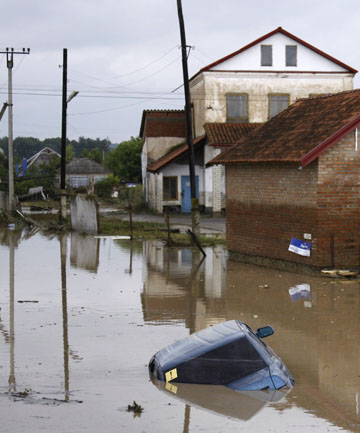
floods in southern Russia

I could hardly believe it when I read in the paper today that major floods in Russia have caused nearly 200 deaths this week.

Floods?

It is bone dry here in the hills of western Massachusetts.  It is so dry that if I did not water my vegetable garden every day, all my beautiful plants would be drying up in the merciless drought.

When I walk by the half-dry river in the afternoons, I am struck by all the yellow and brown leaves on the path—the forest has the golden cast of September now, the dry spell fast-forwarding us from mid-summer to fall.

The first veiled hints of trouble have made their way into the mainstream media, with crop losses due to drought expected to push up the prices of food in the U.S.

Barely a mention of shortages yet.  No rationing.  Just higher prices, which will make it harder for those of us on fixed incomes—not to mention all the unemployed—to afford to buy what we want to eat.

Clearly there is a shocking imbalance between the torrential rains in Europe and the parched drought here in the US.

Clearly it’s anthropogenic climate change rearing its scary hydra head.

I have heard tell of Native Americans calling on the rain gods to bring rain clouds to a dry landscape.

Our own techno-engineers talk about seeding the clouds to provide rain.

In both cases, it’s a matter of human beings applying our great brain power to find solutions to problems that threaten our existence.

Each of us has some gift to contribute to the common cause of survival—remembering that the survival of human beings is entirely intertwined with the survival of every other life form on the planet, from plankton to trees to bees.

Truly, this is no time to wait shyly on the sidelines to be invited, or to wait for others to take the lead.

As the saying goes, we are the ones we’ve been waiting for. If ever a time called for brilliant and dramatic solutions, that time is now.

What Good is a Higgs Boson When the Planet is Burning?

Call me sour, but I really can’t find much to get excited about by the news that physicists have moved one step closer to figuring out how the universe began.

Yes, the Higgs Boson is an amazing phenomenon.  “Without it,” writes Dennis Overbye in The New York Times, “all the elementary forms of matter would zoom around at the speed of light, flowing through our hands like moonlight. There would be neither atoms nor life.”

Yes, it’s an amazing feat, to which hundreds of scientists have dedicated their lives, to have actually nailed the elusive Higgs Boson in the giant particle accelerator built for that purpose.

But while the champagne corks are popping at the physicists’ convention in Melbourne Australia today, all the myriad problems confronting us physical beings still fester unchecked.

What good will it do us to understand how matter formed back at the beginning of the universe while we are succumbing to drought, wildfires, violent storms and floods?

What good will that marvelous particle accelerator do us when the climate is so disrupted that we can no longer rely on a steady stream of electricity, or a steady food supply to keep us going?

We really need all those super-smart people to pull their heads out of the air and start focusing much closer to our own time and place.

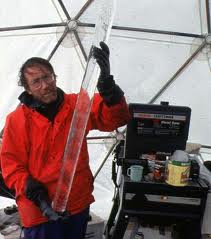
We need more scientists like Lonnie Thompson, who has spent the past forty years traveling to remote glaciers and mountain peaks all over the world to collect ice core samples that give us insight into climate change in the much more recent past—the last 10,000 years or so.

“Dr. Thompson,” writes Justin Gillis in The New York Times, “became one of the first scientists to witness and record a broad global melting of land ice. And his ice cores proved that this sudden, coordinated melting had no parallel, at least not in the last several thousand years.

“To some climate scientists, the Thompson ice core record became the most convincing piece of evidence that the rapid planetary warming now going on was a result of a rise in greenhouse gases caused by human activity.”

Do we really need any more convincing?

The latest storms to hit the U.S. struck the wealthy suburbs of Washington D.C., and surprise surprise, those Beltway folks were just as susceptible to power loss as the rest of us out in the hinterlands.  Forced to cope with triple-digit heat with no air conditioners, their sweat smells no sweeter than ours.

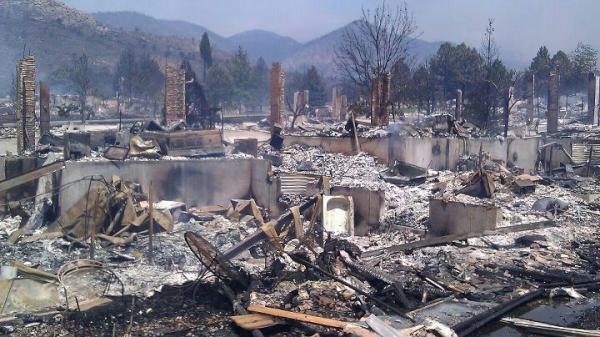
Likewise, the wildfires out West are burning up the homes of the wealthy as fast as they’re burning the millions of acres of dead trees decimated by the surge in the pine bark beetle population, another gift of warmer weather.

Wealth is not going to protect us from climate change.

Abstract particle physics is not going to mean a damn once the extreme weather really sets in, just a few short years from now at our current pace of greenhouse gas emissions.

We have the technology now to engineer a rapid shift to renewable energy sources that will immediately curb the pace of global heating to keep our planet livable.

If the greatest minds of our time trained their attention on this fundamental issue, I have absolutely no doubt that we could solve it.

And if the rest of us not only went along with the technological changes, but actively pressured our political representatives to enact policies that would force big business to do the same, worldwide, we could make sure that the new technology was broadly implemented, quickly.

Hell, it will be good for business! We are potentially at the start of a whole new age, where demand for brand new products like solar panels and geothermal pumps could keep factories running for decades.

We don’t need any more oil rigs or gas wells.  That way lies suicide, on a species-wide scale.

We cannot afford to waste any more time, or to allow ourselves to be distracted by anything less important than the urgent question of survival—our own, and that of all the beautiful life forms on this planet we love.

Let them eat crude!

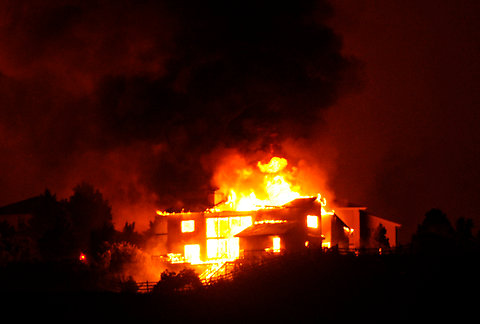
The wildfires burning through densely populated neighborhoods in Colorado this week are on my mind.

Fire burning in Colorado Springs June 26, 2012

I clicked a link about “how to help,” and found the familiar call for financial contributions to aid the dispossessed, as well as the firefighters.

No mention of the underlying cause of these fires—drought brought on by climate disruption.

No mention of how the real way to help would be to insist that our country start converting to renewable energy, immediately, to slow the relentless buildup of greenhouse gases and show international leadership that could be emulated by other nations.

Just send donations, so we can get back to business as usual ASAP.


***

Yesterday I was thinking about going cherry-picking at the local farm where I’ve been picking cherries every summer since I was a little girl.

Going on the website to check the orchard hours, I was aghast to discover that the entire crop had been ruined by a hailstorm last Friday—part of the cold front that broke the excessive heat we were sweltering under last week.

This week it’s been delightfully chilly here in Massachusetts. I love the cool weather, but my tomato plants sure don’t.

***

Is it so far-fetched to imagine a time when it’s impossible to rely on the steady, rhythmic progression of the seasons to bring us just the right sun and rain to grow our crops?

What will we do when the food shortages begin?

Let them eat crude!  ExxonMobil, Shell, BP and the rest will cry, as the climate guillotine puts our entire human civilization on the block.

We’ll be frackin’ whacked then, won’t we.

Time to Meet Your Maker

OK, I admit it.  I love my air conditioners.  I have two window units, one upstairs and one downstairs, and they cool my whole house to a comfortable 70 degrees, no problem.

On a day like today, 95 degrees Farenheit and humid, you’ll find me huddled around the AC, whether it’s in my home, car or office, or out to the movies or a restaurant.

Even though I know full well that my AC addiction is part of the problem of global warming, am I going to go without?

Hell no!

Why should I swelter while everyone else who can afford it, and especially the fat cats who got us into this global warming mess, are sitting cool as cucumbers and pretty as you please?!

Thus you have the tragedy of the commons playing out all over again, all the time.

It will take a crash—a blackout, a total system collapse—to make us give up our creature comforts here in the heart of Empire.

Some people say that crash can’t come soon enough, and I guess I agree with them.

Certainly for the rest of the life forms on the planet, the sooner human beings get lost, and take our asphalt and our AC and our combustion engines with us, the more chance there will be for the planet to recover without turning back the clocks to zero and starting all over again with bacteria and plankton and the other very basic building blocks of life.

But am I going to commit hari-kari right now to speed this process along, playing martyr for the benefit of the songbirds and the orangutans?

No, I am not.

I am going to keep living, keep cranking up my AC and bopping around in my car, until there’s no juice in the wires and no gas in the tank.

***

Trying to keep cool, I just went to see PROMETHEUS, a bizarre movie if there ever was one.

In it, human beings go to meet their Maker, and discover that their alien progenitor is an impatient, violent, sadistic psychopath—at least by human standards—who, immediately upon being revived from an eons-long sleep, greets his human rescuers  with murderous fury and sets course for Earth with a full payload of biological weapons.

As I complained to my son afterwards, why is the human imagination always so dark and destructive?

Why couldn’t the screenwriters have imagined a happier scene, where the Maker showers the Earthlings with stardust and thanks them for waking him up?

No.

We are, it seems, an irredeemably violent species.

We deserve whatever violent end awaits us.

When it comes, we should bow our heads and acknowledge that we totally brought it upon ourselves.

In the meantime, it’s getting hot in here.  Time to crank up the AC.

Scheherezades of the 21st Century

I have been following the progress of the Rio+20 UN Conference on Sustainable Development from a distance, feeling jaded about the process and the possibility of positive outcomes resulting from this gathering of diplomats and social engineers.  It’s good to see the lively and vibrant displays of people passion outside the gates of the conference, but the real question is, when will those gates come down?

Gar Alperovitz

At the Strategies for a New Economy conference earlier this month, veteran progressive economist Gar Alperovitz pointed to our time as the moment when enough people wake up and notice that something is wrong.

“This is a critical moment in history,” he said; “the moment when people realize something is gravely wrong and are willing to think outside the box to find solutions.”

Alperovitz suggested that we are currently in “the prehistory of a major shift,” and that now is the time for those of us who are aware of what’s happening to “lay the foundations for new institutions and new systems” that are tailored to meet the coming challenges.

Who would have thought, a decade ago, that the cell phone would take Africa by storm, Alperovitz reminded us.  In the same way, it could be that distributed solar-generated power—each home and business hosting its own power generator on the roof–will become the standard in the decade to come, particularly if the real costs of fossil fuels are brought home to industries and consumers.

Yesterday in the course of a desultory lunchtime conversation about changing weather patterns, one of the people around the table, a bigtime financial executive, mentioned that he’d heard the Arctic ice was melting at an unprecedented rate.

I took his comment to be about the negative impact of climate change on the environment, and began talking about the methane bubbles that have been rising up out of the deepwater beneath the ice pack, suddenly and disastrously finding access to the open air.

But no—his point was quite different. To him, what was interesting about the melting of the ice was that it put previously inaccessible oil beds suddenly within range of development.

Groan.

What difference will all the UN treaties in the world make to the health of our planet if the power brokers sitting in their comfortable climate-controlled glass towers in New York don’t understand the urgency of moving away from fossil fuels?  My financier friend was actually planning to fly down to Rio this week on business, but it was news to him that the Rio+20 conference was going on at all.

Gar Alperovitz described our current economic system as “stalemated, stagnating and in decay—neither reforming nor collapsing,” and this sounds like an accurate description to me of our tightly intertwined political, financial and industrial sectors.

All of us ordinary people are held like flies in the sticky web of corporate capitalism, which is squeezing us ever more tightly in the bonds of rising prices, scarce jobs and inescapable debt.

Where will it end?  Alperovitz called on the conference attendees to become the historical change agents within our communities—to go home and seize every opportunity to develop the frameworks for the transition to a different kind of future.

To me, as a writer and teacher of literature, it was interesting to hear him calling in particular for an emphasis on new kinds of narrative.  In order to imagine new solutions to what seem like insurmountable problems, he said, “we need to tell new stories.”

Maybe 350.org’s Twitterstorm yesterday, in which hundreds of thousands of people from all over the world besieged Twitter with messages in support of ending the fossil fuel subsidies, is the start of a new story—a global story, authored collectively by kindred spirits worldwide.

It remains to be seen whether we will be able to figure out a way to preserve and extend our current technological sophistication while moving into a sustainable, harmonious relation with our planetary home.  Many who are currently trying to read the future predict a violent collapse of our human civilization, with a dramatic loss of human population and a return to a much simpler, low-tech kind of life for those who survive.

The only way the latter scenario will be avoided is if the technocrats and the bureaucrats and the financiers start listening to the ordinary people outside the gates, and understanding the full implications of their dependence on a capitalist economic system of endless growth fueled by destructive fossil fuels and the despoiling of the environment.

So yes, let’s start telling those new stories by every means possible—by Twitter, by blog, by radio, TV and film—around the lunch table and across the backyard fence.

Tell new stories as though your life depended on it. As in fact, it does.

Bill McKibben: Stand up to the fossil fuel industry, or start growing some gills!

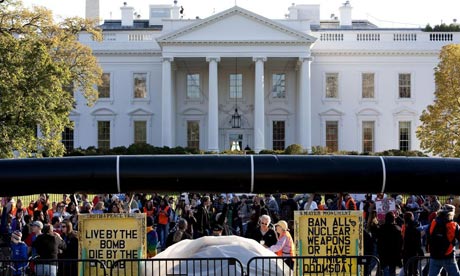
Last summer Bill McKibben and 350.org, the organization he and a group of Middlebury College seniors founded in 2006 to fight global heating, brought thousands of protesters to Washington DC to protest the Keystone XL Pipeline. As you’ll recall, they circled the White House in a ring five people deep; thousands were arrested over the course of two weeks; and the construction of the Keystone was at least delayed, if not entirely crushed.

This summer Bill will be at it again, taking on the fossil fuel companies even more directly. As he told us last night during his keynote address to the Strategies for a New Economy conference, put on by the New Economics Foundation and hosted by Bard College, the focus of this summer’s activism will be joining Sen. Bernie Sanders (I-VT) and Rep. Keith Ellison (D-MN) in pressing for the removal of some $113 billion in annual federal subsidies for American fossil fuel companies.

Bill reminded us that Exxon Mobil and the other big oil, coal and gas companies are by far the richest in the world.  Why should they be getting subsidies for doing business when those funds are sorely needed by citizens for basic services like education, health care and retirement?

And why should we be rewarding companies that not only pollute the environment, but also are responsible for spewing the greenhouse emissions that are rapidly making our planet uninhabitable for many current species, including humans?

“No other industry is allowed to dump its garbage in the streets,” Bill declared.  “Why should it not only be allowed, but subsidized, for the industry that is responsible for the most dangerous product of all, the CO2 that could totally destabilize our planet?”

Bill began his speech by noting apologetically that he has become known as a “professional bummer-outer,” and it was true: it was impossible to come away from his hour-long talk without feeling shaken by the severity of the future he laid out for us.

He gave several hard-hitting statistics and anecdotes of the gathering steamroller of global heating: the melting of the Arctic ice pack, the acidification of the ocean, the increase of floods, droughts, storms and disease.

Bill laid the blame squarely in the laps of the fossil fuel industry, which, he said, has been using its vast wealth to forestall political action on moving to renewable energy.

“Their business model is the problem,” he said.  “It’s either wreck their business model or wreck the planet.”

He’s not talking about destroying Exxon-Mobil and the other oil giants; just about forcing them to re-invent themselves as clean energy companies, and start putting their great resources behind the swift transition to renewable energy technologies.

How to accomplish this sea change?

“We’ll never match their money, so we need to deal in a different currency,” he said, “the currency of movements: passion, spirit, and creativity.”

Bill showed pictures from around the world of climate activists, most of whom, as he observed drily, “do not look like Sierra Club environmentalists, but they care just as passionately about saving our planet.” The movement he envisions must be international, but since Americans and Europeans bear most of the blame for the dramatic rise in greenhouse gases we have a special responsibility to work hard to make things right.

“I’m a writer,” Bill said.  “I’d rather be sitting home in Vermont typing.” Instead, he’s on the road much of the time now, addressing groups and working behind the scenes to build a climate movement powerful enough to take on the fossil fuel lobbies and head off disaster.

At this conference of economists, there were many gray heads in the hall, and many people wearing conservative professional clothing.  Bill called on the older folks, in particular, to join the movement to head off global heating, because “once you’re past a certain age, it doesn’t matter so much if you have an arrest record.”

“We have to get more confrontational,” he said, recalling the civil disobedience campaigns of Dr. Martin Luther King Jr.

Among the confrontational tactics we can look forward to this summer are “Nascar-style” blue blazers for members of Congress, with the logos of all the corporations from which they’ve accepted cash blazoned on their backs. 350.org will also be hosting an online Congressional scoreboard, so that citizens can easily see how each  senator or congressional representative has voted with regard to climate stabilization and environmental health.

“We’re not radicals or militants,” Bill insisted. “We’re actually quite conservative.  We want the planet to stay the way it is, or go back to the way it was when we were born.  The radicals work at the oil companies,” he declared to applause.

Bill ended by reminding the audience that the U.S. Chamber of Commerce recently issued a statement saying that there was no cause for alarm about climate change, because human beings will be able to adapt our behavior and physiology as the planet warms.

“What are they imagining?” Bill asked indignantly. “Are we going to start growing gills?”

It’s not gills we need, but guts—to follow Bill McKibben’s lead and force the politicians to represent the will of the people, rather than the will of the industries that are destroying our planet in the name of the next quarter’s profits.

Something tells me it’s going to be a hot summer.

Rio+20: Fiddling While Earth Burns

I am having trouble summoning any enthusiasm over the upcoming Rio+20 UN Conference, which will begin on June 20.

When you go to the conference website, everything sounds so benign, forward-looking and responsible.  For example, talking about food security, the conference framers call for the promulgation of sustainable agriculture, meaning “the capacity of agriculture over time to contribute to overall welfare by providing sufficient food and other goods and services in ways that are economically efficient and profitable, socially responsible, and environmentally sound.”

It sounds marvelous.  But we all know that during the last 20 years, since the first Earth Summit in 1992, industrial agriculture has only gotten bigger and badder, more focused on profit at the expense of social responsibility or environmental stewardship.

Food security for the majority of people on the planet has become a pipe dream, and even the most privileged of us are growing increasingly vulnerable to disruptions in food supplies caused by climate change, monoculture and the superweeds and superbugs that have developed resistance to our chemicals.

I was not surprised to find in my inbox this morning an eloquent position paper from La Via Campesina, seeing right through the rosy language of the “sustainable development” engineers to recognize that “beneath the deceptive and badly intentioned term “green economy”, new forms of environmental contamination and destruction are now rolled out along with new waves of privatization, monopolization, and expulsion from our lands and territories.”

Here is how La Via Campesina, which represents indigenous and peasant farmers worldwide, but particularly in South America, sees the “green economy”:

“The green economy does not seek to reduce climate change or environmental deterioration, but to generalize the principle that those who have money can continue polluting. Up to now, they have used the farce of purchasing carbon bonds to continue emitting greenhouse gases. They are now inventing biodiversity bonds. This is to say, businesses can continue destroying forests and ecosystems, as long as they pay someone to supposedly conserve biodiversity somewhere else. Tomorrow they may invent bonds for water, natural “views”, or clean air.”

I am afraid that this analysis is right on target.  The whole premise of the REDD agreements, under which communities were to be paid for conserving their forests, has only resulted in a land rush to purchase the forests so as to collect the international funding.  And to add insult to injury, REDD has allowed the destruction of virgin forests and replanting of, say, palm oil plantations, to “count” as forest conservation.

So the international capitalists make out like bandits, and the local people who have lived peacefully and harmoniously in the forests for thousands of years suddenly find themselves given the boot.

In the first anthology I edited, Women Writing Resistance: Essays on Latin America and the Caribbean (South End Press, 2004), I included an essay by Rigoberta Menchu, the 1992 Nobel Peace Prize winner from Guatemala, who has become a major voice for global indigenous rights and environmental stewardship.  The essay describes Menchu’s unofficial visit to the Earth Summit in Rio in 1992.

Rigoberta Menchu Tum

“I had gone to find out what their idea of the earth, plants and nature might be, and what I found was a commercial version of ecology,” she said.  “There were T-shirts with tigers, lions and parrots painted on them, and plastic bags with animals’ faces.  It was a case of businessmen making money out of the environment.”

Although Menchu ended on a more hopeful note back in the ‘90s when this essay was first published, I have no doubt that today she is less optimistic, given the way events have played out over the past 20 years.  It is no exaggeration to say that the capitalist assault on the natural world combined with the human population overload of the planet has brought us to the brink of civilization collapse.

The calm, rationalist language of the Rio+20 architects reveals no sign of awareness of the dire state of the planet.  They seem to have constructed their conference materials in an air-conditioned bubble, through which the voices of the billions of ordinary people on the ground cannot penetrate.

La Via Campesina is calling for a return to small-scale agriculture as the solution to the Earth’s problems. They argue that a relocalization of agriculture is necessary, with indigenous and peasant farmers given cooperative control over their lands, as it was for the thousands of years preceding our own unfortunate era.

We will never get the diplomats, technocrats and financial oligarchs in the air-conditioned conference halls to agree to such a simple, unprofitable solution to food security.

But the feedback loops that have made our planet stable since the last Ice Age are now becoming severely disrupted, and so Earth may take matters into her own hands, forcing a relocalization in which only those who still remember how to subsist in small groups close to the land will be able to survive.

Is this the great transition prophesied by the Mayans long ago?  The end of the age of technocratic capitalism, and the return to a simpler way of life?

Global meetings such as Rio+20 should be occasions for making plans, together with the small-scale farmers on the ground all over the world, for intelligent transitions to truly sustainable communities. There is still time to prepare for the coming ecological shocks so as to prevent mass misery.

Instead, governments are using this precious time to build up armies and police forces to ensure the control of ever-shrinking resources by the wealthy, and selling small-scale arms to local gangs to encourage violence and terror outside of the gated communities of the rich nations.

This is a strategy that keeps us all in line—we in the wealthy nations are terrified of the violence we see outside our borders, and so we docilely do as we are told, which is to say, continue to participate in the aggressive policies that are bringing us all to ruin.

I see the twin monsters of the weapons and the chemical industries as the most destructive forces on our planet today.  If these two industries could be stopped, and their destructive products destroyed, imagine what a different world we’d be living in.

We may not be able to put those evil genies back into the bottle ourselves.  But the planet will take care of it, sooner or later.

Right now, it’s looking like it’s going to be soon.

Finding Hope in Heartbreak

There has been a steady beat of heart-breaking news lately from various fronts.  Did you hear that the flame retardants required by law to be sprayed on American sofas are highly toxic chemicals that continue to break down in your living room? And those sofas, by the way, if they’re the nice wood-framed ones from Ikea, are being made from irreplaceable 600-year-old trees.  When you lie on your sofa to breast-feed your baby, you’re getting a whopping dose of PCB-type chemicals, and your infant is too, since toxic chemicals pass right into breast milk.

Or maybe you caught the long article in the New York Times the other day about American zoos becoming Arks for modern-day Noahs, who have to choose which species to try to preserve and which to let go into extinction.  This was one of the most candid acknowledgements I’ve seen in the mainstream media of the explosive pace of extinctions occurring around the world, partly due to the loss of those ancient trees to logging.

And meanwhile, in my corner of the world, there was more bad weather—record heat in May, followed by violent electric storms, complete with hail and the threat of twisters, which knocked out my power last night, including permanent damage to my DSL box, leaving me without internet access this morning.

The relentlessness of this kind of information, combined with the evidence I can see before my eyes of climate change and the contamination of our landscapes, is like a steady drag on my spirit, a weight around my neck.

Even when I’m enjoying myself with friends and family, as I did this past weekend, I have one mental foot in the future, imagining a time when such happy, peaceful and bountiful gatherings will exist only in memory.

I am always giving myself silent pep talks, hanging on to the hope that we will accomplish the switch to renewable energy sources; that we will stop the deforestation and the industrial agriculture; that we will become responsible stewards of our home planet, rather than the armed pirates and chemical warriors that we have come to be in the last hundred years or so.

Joanna Macy

Lately I have been finding some comfort in Joanna Macy’s 1991 volume World as Lover, World as Self, reissued in 2007 by Parallax Press.  When I think of how oblivious I was back in 1991 about global heating and toxic contamination, I am amazed at Macy’s prescience.

Rather than simply bemoaning, or even exhorting her readers to change their ways before it’s too late, Macy offers us a way to understand and process what is happening to our world, principally through coming to the recognition that the traditional human individualist view of the self is a misconception.

“The crisis that threatens our planet, whether seen in its military, ecological or social aspect, derives from a dysfunctional and pathological notion of the self,” she says.  “It derives from a mistake about our place in the order of things.  It is the delusion that the self is so separate and fragile that we must delineate and defend its boundaries; that it is so small and so needy that we must endlessly acquire and endlessly consume; and that as individuals, corporations, nation-states or a species, we can be immune to what we do to other beings.”

In place of this, Macy draws on the work of systems theorists and ecological philosophers like Arne Naess, as well as the Buddhist notion of “inter-being,” to argue for a “greening of the self,” a way of self-understanding that recognizes our essential connectedness with all other life forms on our planet.

Arne Naess

Once we have understood that we are integrals parts in the living system of Earth, we should no longer have to appeal to human beings’ dubious moral sense to prompt a shift to a more sustainable way of living.  We can simply appeal to self-interest, Macy says.

“For example, it would not occur to me to plead with you, “Don’t cut off your leg.  That would be an act of violence.” It wouldn’t occur to me (or to you) because your leg is a part of your body.  Well, so are the trees in the Amazon rain basin.  They are our external lungs.  We are beginning to realize that the world is our body.”

One of the ideas I find most exciting about this part of Macy’s work is her application of the concept of “inter-being” to temporality.

“By expanding our self-interest to include other beings in the body of Earth, the ecological self also widens our window on time.  It enlarges our temporal context, freeing us from identifying our goals and rewards solely in terms of our present lifetime.  The life pouring through us, pumping our heart and breathing through our lungs, did not begin at our birth or conception.  Like every particle in every atom and molecule of our bodies, it goes back through time to the first spinning and splitting of the stars.

“Thus the greening of the self helps us to re-inhabit time and own our story as life on Earth.  We were present in the primal flaring forth, and in the rains that streamed down on this still-molten planet, and in the primordial seas. In our mother’s womb we remembered that journey wearing vestigial gills and tail and fins for hands. Beneath the outer layers of our neocortex and what we learned at school, that story is in us—the story of a deep kinship with all life, bringing strengths that we never imagined.  When we claim this story as our innermost sense of who we are, a gladness comes that will help us survive.”

When I think of my place in time and space in these terms, I do feel that gladness.  It is true that we are living through the sixth great extinction on the planet now.  It is true that we are producing and spreading contaminants in the air, water and soils that will last, some of them, for billions of years.

But the Earth has time.  And who knows, perhaps what we think of today as toxic waste can in time become the building blocks of new forms of life.  Our planet has shown itself to be remarkably adaptive.

Macy is unusual in working across disciplines and discourses that are generally kept apart, speaking fluently and persuasively in the tongues of sociology, systems theory, psychology, neurology, geology, ecology, theology, and even spirituality.  We are going to need the wisdom from all of these avenues of inquiry to begin to understand what will be happening to us in the coming years, as individuals, as a species, and as a part of the living fabric of Earth.

Perhaps that is what most distinguishes us most as human beings.  We want to understand.

And perhaps there is still a chance that if we can understand in time, we can, as Macy says, survive.

If I had been asked to speak at Commencement….

This is what I would have said:

It’s become a cliché to say that every day is the first day of the rest of your life, and yet like most clichés this one holds truth to it.

When you walk down that aisle today holding your B.A. diploma, achieving a goal which you have worked towards for many years, you will be stepping into your adulthood with all the rights and privileges, but also all the responsibilities that this maturity brings.

The year 2012, long prophesied as a time of great change and transition, is not an easy time to be reaching adulthood.

I don’t have to tell you that times are tough economically, or that our planetary environment is facing its own severe shifts due to anthropogenic global heating.  You have probably heard tell of a “sixth great extinction event” on the horizon, if climate change projections continue unabated on their current course, causing the heating and acidification of the oceans and resulting drought, floods and violent storms on land.

Most of us “know” about these issues the same way we “know” that toxic chemicals in our food, water, air and household products cause cancer.

We do our best not to think about it too much, because thinking about it just makes us scared and depressed, and what can we do about it, anyway?

I want to suggest to you, as you step out into the world this afternoon with your newly minted B.A., that you are stepping into an unprecedented opportunity to do more than any previous human generation has ever done.

It is not an exaggeration to say that you have the opportunity to turn this great Titanic of an earthship around, sailing her away from the iceberg and into safer waters.

There have been “greatest generations” before now.  But their challenges have been far less global and all-encompassing than the challenges we face now.

Now it’s not just a nation or even a group of nations that are faced with disaster.  It is the entire globe, human civilization writ large, which could in fact be toppled if the earth gives a great climatic shrug of her shoulders and goes back to the evolutionary drawing board.

Even the most sober earth scientists are predicting that if we do not change our habits of carbon emission, the resulting global heating will make the world uninhabitable for some 90% of current species on the planet by the year 2050, including 90% of current human populations.

I lay this out for you starkly not to depress you on what should be a happy and auspicious day, but to impress upon you the importance of the decisions you will be making and actions you will be taking in the coming years.

While it is true that lifestyle changes of individuals can only have limited effect on climate change, they are a start.  We can choose to support alternative energy whenever and however possible.  We can choose to push our elected representatives to shift subsidies and incentives away from fossil fuels and towards renewables.  We can encourage sustainable agricultural practices in our own communities and through our consumer choices.

What I would ask of you above all is to stay informed and engaged with these issues as you move forward into adulthood, and seize all opportunities to push governments and corporations to do the right thing not just for the bottom line or the national interest, but for the good of our planetary home and her current life forms, including humanity.

I am not proud of the condition of the world that my generation is now handing off to you.  I am not proud of what I and my cohort have allowed to happen on our watch.

The past cannot be undone.  But the future is yours to shape.

Don’t be afraid to try out completely new ideas. Listen to your dreams, listen to your intuition.  Be alert, be thoughtful, be creative.  Tune out the background buzz that will try to lull you into complacency and inaction.

I hope that when it’s your turn to witness your children stepping out into their adulthood, you will be able to be proud of the world you have created for them.

Truly, their future is in your hands.