Carbon Colonialism: Just Say No!

Do ordinary people need to commit suicide to gain the attention of the global elites?

You may remember, back in 2003, a Korean farmer named Lee Kyung Hae committed suicide outside the grounds of the World Trade Organization meetings in Cancun, Mexico, as a protest against the impact of first world subsidies of grain production, which effectively pushed small farmers in developing countries out of business.

He set himself on fire right in front of the police barricades keeping him and others like him outside of the WTO talks.

Afterwards, there was a movement by the representatives of developing countries to form a bloc of resistance to the demands of the global elites.  It worked, for a while.

But now, 8 years later, the global elites are at it again, worse than ever.
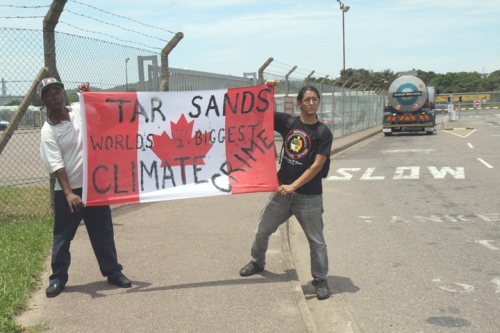
At this year’s climate talks in Durban, South Africa, representatives of indigenous communities worldwide are protesting at the barricades again, locked out of the talks on complex trade negotiations over carbon offsets, sequestration and deforestation.

It’s not easy to understand the documents produced by the U.N. and government agencies, laying out what’s called the REDD accords: Reducing Emissions from Deforestation and Forest Degradation.

It all sounds very nice when you read the summary on the U.N. website.

“Reducing Emissions from Deforestation and Forest Degradation (REDD) is an effort to create a financial value for the carbon stored in forests, offering incentives for developing countries to reduce emissions from forested lands and invest in low-carbon paths to sustainable development. “REDD+” goes beyond deforestation and forest degradation, and includes the role of conservation, sustainable management of forests and enhancement of forest carbon stocks.

“It is predicted that financial flows for greenhouse gas emission reductions from REDD+ could reach up to US$30 billion a year. This significant North-South flow of funds could reward a meaningful reduction of carbon emissions and could also support new, pro-poor development, help conserve biodiversity and secure vital ecosystem services.”

Yes, well, it does sound nice.  But in fact, when that much money is at stake, corruption is not far behind.

As detailed in an important new report called the No REDD Papers, what’s been happening in the name of REDD is a gigantic forest grab, with major multinational energy corporations ruthlessly buying up and bullying their way into land rights to forests in the global south, so that they can not only make money by going on their merry way of fostering carbon emissions in the North, but also make money by collecting the rewards for forest conservation in the south.

And there’s more.  Under REDD+, reforestation is also potentially a growth industry.  But there are insufficient regulations on what constitutes reforestation.  A complex rainforest environment could be harvested, destroyed, and “reforested” with a monocultural non-native cash crop, like bamboo or eucalyptus or palm, which will be “sustainably harvested,” yes, but will actually store a fraction of the carbon of the original rainforest, and will support a tiny fraction of the original biodiversity.

It also results in Native people being pushed off their ancestral lands, by swindle or by force.

The indigenous people, from Niger to Alberta to the Amazon, are not stupid.  They’re wise to what they’re calling “carbon colonialism.”
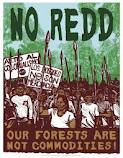
“REDD/ REDD+ is bad for people, bad for politics and bad for the climate,” says Tom B.K. Goldtooth of the Indigenous Environmental Network. “It will inevitably give more control over Indigenous Peoples’ forests to state forest departments, loggers, miners, plantation companies, traders, lawyers, speculators, brokers, Washington conservation organisations and Wall Street, resulting in violations of rights, loss of livelihoods—and, ultimately, more forest loss.”

I don’t want to be part of this scheme.  To me, as to the indigenous forest defenders, it’s all quite simple.  We must reduce carbon emissions.  We must not only reduce deforestation, but encourage forest regeneration–and not of plantations, but of natural biodiverse forest habitats.

It’s not about making money any more.  It’s about sustaining life–our lives, our children’s lives, the entire web of life upon which we depend.

This time the neocolonial cowboys are not going to be able to get away with murder.  The glare of the internet is upon them.  We will not stand by passively and let a new era of displacement and exploitation take place under the euphemism of “conservation.”

Not this time.  Never again.

And we shouldn’t have to be committing suicide to get attention, either.  There has been enough death and destruction in our world these first years of the 21st century.  Let’s go forward under the banner of Eros, not Thanatos.

Let’s work together for Life.

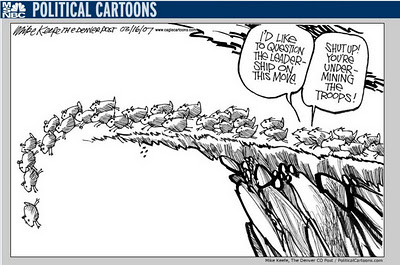
Human beings are not lemmings–so let’s get organized and get away from that cliff!

This happens to be my 100th post on Transition Times, and to mark the occasion I want to reflect on where I’ve come with this blog project, and what themes have emerged along the way.

When I started Transition Times, back in mid-July, I was away in Nova Scotia, trying not to think about the crazy shenanigans going on back home, where the Republicans were threatening to shut down the U.S. government and destroy our credit rating in the world, rather than negotiate reasonably towards consensus with the Democrats (otherwise known as “the debt-ceiling crisis”).

I was also reading Mark Hertsgaard’s Hot: Living Through the Next Fifty Years On Earth, along with Bill McKibben’s Eaarth: Making a Life on a Tough New Planet, both of which paint a stark portrait of how the climate change crisis will be affecting our lives in the foreseeable future.

All in all, I was in a pretty gloomy state of mind.

But then surprising things started to happen.

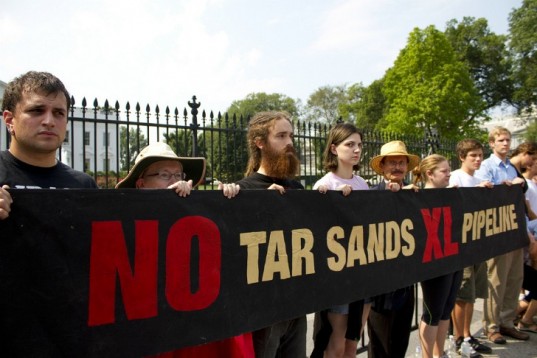
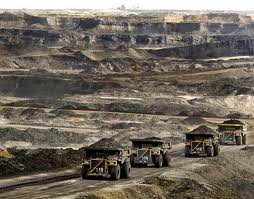
In the middle of the dog days of August, Bill McKibben and 350.org began a sit-in next to the White House, protesting the Keystone XL Pipeline and the development of the boreal forests of Alberta (otherwise known as “the tar sands”).

A month later, the Occupy Wall Street movement sprang up seemingly out of nowhere, protesting the government’s collusion with the super-wealthy (otherwise known as “the 1%”) and abandonment of ordinary Americans (otherwise known as “the 99%”).

The Occupy movement spread like wildfire, and the Keystone XL protest succeeded in at least postponing the pipeline and American support of Alberta tar sands extraction, giving the nascent climate change movement a boost and more of a chance to grow.

Along the way a historic hurricane ripped across the Eastern Seaboard, and a freak snowstorm dumped a good two feet of heavy wet snow on leafy trees in southern New England, knocking out power for some folks for days, and even weeks, and reinforcing the unavoidable reality of climate change.

Most recently, public awareness of the militarization of American policing has suddenly taken a giant leap forward, thanks to images of police brutality inflicted on old and young white people of the well-dressed, college-educated variety.  Over in Europe, the debt crisis threatens the dissolution of the euro zone, something unthinkable just a few months ago.

All in all, it’s been a dramatic few months, and blogging my reactions to and thoughts about all this has been a rewarding experience.

I’ve been struck by the power of the World Wide Web as a vehicle for social communication and movement-building.  Just as the Arab Spring showed us how cell phone texting technology could be used to ignite and build, at lightening speed, an effective resistance movement, the Occupy movement has demonstrated the extent to which Americans are plugged into the vast collective consciousness we call the Web.

While the captains of industry sold us smart phones and tablet computers intending to make us more agile shoppers and financial traders, they unwittingly put into our hands the tools of our liberation from the capitalist machine that has dominated us for the past 50 years or so.

Marx predicted long ago that the very instruments that enabled capitalism–globalization and technological prowess–would also be the instruments with which the bourgeoisie would dig their own graves.

In the age of global warming and climate change, this has never seemed more prescient.

But Marx also imagined that out of the ashes of the old world a new order would arise.  He believed that it would be possible for the proletariat, the working class, to create a better world, based on collaboration and compassion rather than ruthless competition.

It seems like Americans are finally awakening out of a long, dark sleep of obliviousness to the ways in which our corporate capitalist economic and governmental system has been leading us down a blind alley, at the end of which, it turns out, is a steep cliff.

Are we waking up in time to back ourselves out of that alley, away from that fearsome cliff?

It is too soon to tell. But those of us who are aware of the gravity of the situation today not just for our society, but for our species and the planet as a whole, need to be out there on the frontlines, both physical and virtual, making the connections that may enable us to successfully build a movement for change and avert disaster.

Human beings are not lemmings, but we are indeed susceptible to being led.  We want to believe that our leaders are competent and have our best interests at heart.  We hold on to this belief even when all evidence points to the contrary.

It’s time now to stop putting our faith in our elected officials and their paid enforcers, and listen instead to our own hearts and minds.  We know what needs to be done to bring the ecological web of life on this planet back into balance.  It is time to reach out to each other and find the determination to get the job done.

Resisting the Energy Vultures

Today’s New York Times Sunday Review piece by White House correspondent Mark Landler, “A New Era of Gunboat Diplomacy,” gives disturbing insight into the mindset not only of the men and women who preside over national foreign policies, but also into the media lapdogs who cover them.

Landler reports that China and the U.S., along with practically every other country in possession of a serviceable Navy fleet, are entering into “a new type of maritime conflict — one that is playing out from the Mediterranean Sea to the Arctic Ocean, where fuel-hungry economic powers, newly accessible undersea energy riches and even changes in the earth’s climate are conspiring to create a 21st-century contest for the seas.”

Secretary of State Hillary Rodham Clinton, one of Landler’s sources, explains blandly that “This hunt for resources is going to consume large bodies of water around the world for at least the next couple of decades.”

Clinton has got the right metaphor there.  What Landler describes all too flippantly as “a watery Great Game” could well indeed “consume large bodies of water around the world.”

What neither Clinton nor anyone else interviewed for Landler’s article bring up is the cardinal question:  When the game is over, what will be left of the living beings that used to populate those waters in unimaginably vast numbers?

Landler describes the navies and drill ships of countries from China and the U.S. to Turkey and Israel jockeying for control of huge troves of oil and natural gas deposits that have been discovered beneath the sea.

Of especial interest to these circling energy vultures are the deposits beneath the Arctic ice.  Landler reports that “melting ice has opened up the fabled Northwest Passage,” making resource extraction in the Arctic more viable than before.

This offhand and veiled reference to climate change provides a window into the sociopathic mindsets of the men who rule the Energy Kingdoms.  The cowboys of global fossil fuel extraction are essentially warlords, relying on the national armies of their nominal countries of origin to clear the way of opposition to their reckless drilling.

From their warped point of view, global warming can be seen as a bonus.

If the Arctic ice melts, so much the better–it’ll make it easier to get those billions of barrels of oil out of the sea and into the global market.

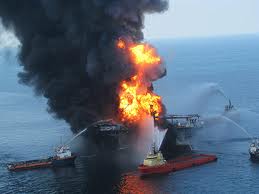
No matter that deep sea drilling has been proven to be highly risky and lethal to the environment.  Hello, does anyone remember BP in the Gulf of Mexico?

Imagine a spill like that going on in frigid northern waters.

Imagine billions of barrels worth of oil or gas gushing into the Arctic Ocean, to be picked up by the currents and spread all over the world.

Imagine the destruction of marine wildlife, and indeed the entire marine food chain, that this would entail.

NY Times reporter Landler doesn’t waste time contemplating such grim scenarios.  The focus of his article is “gunboat diplomacy,” a glamorous new competition among national navies to dominate the oceans, seen strictly in utilitarian terms.  His only mention of fish, or indeed any maritime creature, is a brief aside that icebreakers are being sent into the Arctic circle by countries like China and Korea, “to explore weather patterns and fish migration.”

Landler’s article, which is billed as “news analysis,” reveals the extent to which the chillingly disturbing values of the Energy Kings have permeated not only the governments who are supposed to be regulating their industry and safeguarding the natural world, but also the media “watchdogs,” who are obviously sitting cozily in the laps of Big Oil.

Questions of environmental sustainability and health are simply outside the picture for these folks.  It’s not relevant to them whether or not the polar bears survive.  They don’t care about the coral reefs, or the plankton.  They don’t care about whales.  Their only concern is the bottom line.

What is the most effective opposition to such monomania?

Trying to think of persuasive strategies gives me a touch of hysteria.  We could appeal to their love of seafood!  Wouldn’t they miss their caviar and oysters?

They will figure out how to grow these in tanks.

We could appeal to them as property owners: what’s going to happen to their beachfront homes, not to mention their office towers in coastal cities around the world, when the waters begin to rise?

They will have armies of lawyers figuring out ways to make the taxpayers bear the burden of their lost properties.

We could appeal to their brand image.  Does Exxon-Mobil really want to go down in history as the biggest perpetrator of maritime omnicide in world history?

They will throw this back at us, and rightly so: they were just doing their job of giving the consumer what she wants, a steady supply of affordable energy.

It’s true that we all share the blame for this tragedy unfolding in front of our eyes. It’s also true that we have the power to stop it.

How? We need to demand that the rights of the denizens of the natural world be respected.  A new Declaration of the Rights of Nature has been written–it needs to be circulated, popularized and upheld.

We need to insist that our politicians report to the people, the taxpayers, not to the corporations. Yes, people want energy; we want cars, we want electricity.  But we want to direct our tax dollars into R&D of renewable sources of energy–solar, geothermal, wind–not into dangerous oil and gas extraction or nuclear fission, and not into dirty coal mining either.

We need to call the mainstream media on its dereliction of duty when it presents one-sided reports like Landler’s industry white paper today.

Extracting those billions of barrels of oil buried below the earth’s surface miles beneath the sea would not just be a death sentence for marine life.  It would drive the nails on the human coffin as well, along with all the other species on this planet who will not be able to adapt to the erratic climate extremes of floods, droughts and storms that will inevitably ramp up once the planet heats beyond the point of no return.

Under these circumstances, if the governments won’t listen, radical action may prove a necessity.  The French Resistance to the Nazis were considered criminals in their own time and place, but look like heroes to us today, with the power of hindsight.

We are in the midst of a new, much larger Holocaust now, one that threatens not just one group of people, but all of us, and our natural world as well.

Each of us has a choice to make.  You can go along with the crowd, watching impassively as the train leaves the station for the gas chambers, or you can dare to raise your voice in opposition, and maybe even to throw a wrench in the gears of power.

Each of us is going to die sooner or later.  Wouldn’t you rather die knowing you had done your utmost to make a difference, to safeguard the world for your children and all life on this planet?

An older form of Deep Green Resistance rises from the rainforest. Euramericans, ignore this at your peril.

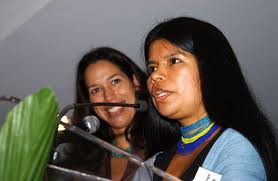
If you want to see something really inspiring, watch and listen to Patricia Gualinga, an Achuar woman from the Ecuadorian rainforest, talking about how her people are standing firm on the frontlines of the siege of the forest by multinational oil extraction companies.

Listening to this indigenous activist, you see shades of all the millions of indigenous peoples around the world who lived in harmony with their environment, respecting and sustainably stewarding their lands.

To say that this balance was altered when the Europeans began their voyages around the world is not to blame or guilt-trip.  It is simply to speak the truth.

To say that the European Enlightenment period, which gave us Manifest Destiny, “I think therefore I am,” the closing off of the commons and the capitalist drive to resource exploitation, was actually a time of deepening darkness, is simply to pronounce the self-evident.

While we contemporary heirs to this 500-year history may be individually blameless, collectively we have been bystanders who have followed the paths of least resistance and allowed the destruction of our planet to proceed apace.

The Pachamama Alliance, on whose behalf Patricia Gualinga spoke last week, is an unusual partnership between Euramericans and these South American indigenous survivors, warriors who are defending the great Amazonian rainforest, the dynamic lungs of the Southern Hemisphere, against rapacious encroachers.

We need another alliance like this between the peoples of the far North and those Euramericans who know that destroying the Canadian boreal forests would be equally catastrophic.

The Pachamama Alliance has developed a powerful model of collaboration across the boundaries of nationality and race in the service of a higher vision of earth-based spiritual activism.

This is a vision that needs to grow exponentially in the coming years.

For too long we have been held captive by the media-induced trance of relentless growth and consumerism.  It’s time to break the spell and allow the pendulum of human evolution on this planet to swing back to balance.

To do this, we need to listen to new voices, heed new calls.  We Euramericans have had our shot at leading the world our way.  It has been a disaster.

It’s time to cede the stage to our indigenous sisters and brothers, and try following their lead for a change.  This is a whole new level of Deep Green Resistance, based on creation rather than destruction.

 It’s time to co-create a new story with the indigenous peoples of the planet, who still know how to live harmoniously with the natural world.

Listen to the Pachamama story, and then it’s up to you–what comes next?  What role will YOU play?

Building on the Keystone “victory”–from endless growth to steady states

In his Op-Ed in today’s NY TimesMichael Levi, senior fellow for energy and the environment at the Council on Foreign Relations, argues that the Administration only agreed to put off the construction of the Keystone XL pipeline because of “not-in-my-backyard” pressure from Nebraskans, which had little or nothing to do with the urgent issue of cutting carbon emissions in order to avert climate disaster.

“For green groups,” Levi says, “the shortest route to blocking fossil fuel development appears to be leveraging local opposition.” The problem with this approach, from Levi’s point of view, is that there is going to be “local opposition” to green energy initiatives like solar and wind farms too.

What Levi, like most Beltway insiders, doesn’t seem to appreciate is that the green movement is not just about opposition.  It’s about positive action.  It’s not just about environmental protection.  It’s about social change.

It’s about a shift from a mentality that seeks to keep growing our energy-dependent economy indefinitely, to a mentality that seeks a sustainable steady state.

Steady states are anathema to capitalism–a quarter without growth is a quarter wasted, as any CEO would tell you.

But steady states are exactly what have made our planet a livable environment for the past several thousand years, during which the human species, along with countless others, has thrived.

Rejecting the Keystone XL Pipeline is just a small step in the right direction, towards a society that puts effort and money first into reducing energy consumption, and second into developing energy infrastructure that has the lowest possible impact on the ecological web of life.

The Michael Levis of America don’t understand that this is the real push behind the green movement today.

Yes, we’ll seek allies where we can find them, and make use of whatever sources of power we can find (even pro-oil Republican Nebraskans) to achieve our goals.

But our movement is not about “leveraging opposition.”  It’s about mobilizing support, through raising awareness about the threats to our civilization and our planet if we continue along with business as usual.

It’s also about leading the way towards the alternatives that are already within reach if we choose to veer off the beaten path into new, much more stable territory.

Endless growth is a social model that has proven itself to be highly unstable, whether we’re talking about national economies or energy systems.

It’s time to use our intelligence as a species for the good of ourselves and our planet.  There is really no other way forward.

Activists circle the White House; Obama plays golf

Mainstream media reports that some 8,000 people showed up in Washington D.C. today to link hands around the White House to protest the Keystone XL pipeline and the development of the Alberta boreal forest (aka “tar sands”).

The energy and determination of this crowd is wonderful. But It’s heartbreaking to learn that President Obama “missed most of the protest while he played golf at Fort Belvoir in Virginia.”

Last week I went for a walk on a golf course near my home, and was reminded again of how terrible these private parks are for the environment.

If lawns are destructive monocultures, just imagine the exponential scale of the golf mono-lanscape: acres and acres of closely cropped, artificially bright green  turf, with not a single broad-leaved plant to be seen.

Golf parks are anathema to butterflies and other insects, of course, since they are regularly treated with pesticides and herbicides.  They suck up precious water for a use that is 100% non-necessary: a pleasant game for the 1%.

I admit it, golf courses are one of my pet peeves.  I have never liked them, and never will.  So I suppose it was a sort of trigger to hear that Obama was off golfing this afternoon, instead of paying his respects to the thousands of activists streaming into Washington to communicate with him–the man we sent to represent us in the White House.

He is not the first American President to dodge attempts by the citizenry to communicate our wishes.  I think of President Bush off on his ranch while activists like Cindy Sheehan, whose son Casey died in the Iraq War, tried to send him an anti-war message.

Mr. President, if your citizens make the effort to go all the way to Washington DC to speak with you, I think the least you could do is show up.  We are depending on you to make the right decision on the tar sands/pipeline issue, which is clearly NO PIPELINE, and no development of the boreal forest.

We expect you to make a decision in favor of the health and well-being of your citizens.  Instead of investing in tired, dirty old energy platforms like oil and pipelines, we should be investing in solar and geothermal.  We need an Apollo Project for renewable energy, and we need it now!

Sure, you deserve your R&R on a Sunday afternoon, Mr. President.  But if you make the wrong call on this issue, those luxurious golf courses you enjoy may soon be relics of the wasteful bygone days.

Future social historians might point to golf as one of the many foolish 20th century habits that left us crouching bewildered in the 21st century in the midst of a full-blown climate crisis.

You’re the Decider now, Mr. President.  We are expecting you to make the right decision–for your precious children, and ours.

Hope, Struggle, Dream, Persist: A Mantra for Dark Times

It is the day after Halloween, the Day of the Dead, and the day before my birthday.  It is one of the darkest days of the year, and a week from now, when American standard time “falls back,” it will seem darker still.

I was born in 1962, just after the Cuban Missile Crisis, as the Civil Rights movement and the Vietnam War began to pick up steam.  Each decade of my life has been marked by war and conflict, by a struggle between the forces of ruthless global capital, and the push-back from those who valued peace and a more equitable sharing of resources.

In my nearly half a century of life, I have witnessed a sharp decline in the ecological health of this planet.  Great flocks of many different types of birds have dwindled to a few sad outliers.  Clouds of multi-colored butterflies and swarms of busily working bees have vanished.  Delicate native wildflowers in the woods have been overrun by voracious invasive weeds, and the woods themselves have been overrun by a stampede of cookie-cutter tract housing in suburb after ugly suburb.

In my time, cancer has become a terrible epidemic, followed closely by diabetes and heart disease.  We humans have been sickened, just like the wild creatures, by the heedless spread of chemical treatments, pesticides, herbicides, fungicides, fertilizers, preservatives, additives and so many other toxins in our diet, soil, air and water.

What is there to celebrate on this birthday, the last in my fifth decade?

I look to my ancestors for hope and guidance, as is traditional on the Day of the Dead.

I see my Grandma Fannie, who believed in the power of the word, and practiced it by writing poems and stories that kept the wisdom of her Yiddish forebears alive.

I see my Grandma Mildred, who raised three kids, hosted and entertained her extended family frequently, and worked fulltime for a salary as well, year after year.  In her retirement she began the work she loved most of all, volunteering in her local public elementary school helping kids learn to read.

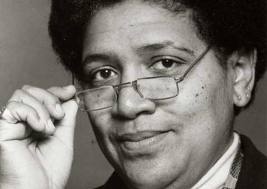
I see the ancestors I claim as kindred spirits, even though we do not share a blood relation: Gloria Anzaldua, who stands there arms akimbo telling me to “put my shit on paper,” no matter what the obstacles; and Audre Lorde, who reminds me constantly that “none of us is free as long as one of us is still shackled.”

As the Scorpio moon wheels overhead and I make my way to bed on my birthday eve, I can celebrate my own place as a link in this chain of strong women who spent their time on Earth trying to make it a better place for those who come after.

This has been a tough half-century, a period of decline and crisis in many ways.  It is a dark time.  But still the lights continue to shine defiantly: young people gather to Occupy the common ground and revive the dream of social equality; a Monarch butterfly sips a last meal at my butterfly bush before spiraling up to find the trade winds down to Mexico; the sun rises once again.

On this Day of the Dead, life goes on.  And while life goes on, we must hope and struggle for our children and their children, and the young creatures all over this planet that are being born today.  For their sakes, we must continue to work for a better future, and insist on our right to dream, and to make our dreams manifest.

This is my birthday mantra: hope, struggle, dream, persist, hope, struggle, dream, persist, endure.  And again.

But what can we DO?

It’s not enough to simply lament the disappearance of species, or the poisoning of the air, water and soil of the planet.  The urgent question of our time is WHAT TO DO ABOUT IT?  How can any of us–how can I–act to staunch the hemorrhage and resuscitate this dying patient, our planet, before it’s too late?

Let’s review the options.

There is political reform, through various channels: appealing to our duly elected representatives and/or supporting environmental groups that lobby these politicians and try to pressure the relevant federal and state agencies charged with protecting the “natural resources” of our country.

I have to say that I am quite skeptical of this approach, which doesn’t seem to have worked at all in the 40 years or so since I first became a Ranger Rick reader and aware of the environmental movement.

Things have gotten much worse for the natural world in my lifetime, despite all the efforts of big, well-funded groups like the National Wildlife Federation, the Sierra Club, the Nature Conservancy, or even Greenpeace, the most radical of them all. Greenpeace is the most willing to go out on a limb to protect species and habitat, but its actions have failed to make the kind of global difference we need.

There is international peer pressure to do the right thing–conventions, treaties and protocols.  Even as I type these words, I inwardly despair.  From Kyoto onward, the U.S. has been the bully who refused to play nice in the community of nations whenever it’s come to putting the common good before the holy Free Market.

There is actually going around the blowing up the worst aspects of civilization, like dams, power plants, cell towers and chemical plants, as the proponents of Deep Green Resistance advocate.  Eco-terrorism, anyone?

Or there’s crowd power of the Occupy Wall Street variety, which certainly seems right now to hold the most promise.  ‘Never doubt that a small group of thoughtful, committed citizens can change the world. Indeed, it is the only thing that ever has,” Margaret Mead said.

But how to convince those crowds that the fate of seals, bees and goldfinches–not to mention the oceans and the boreal forests of North America–is actually more important than the injustices of economic inequality here in the U.S.?

Of course, it’s all important.  I have several friends who are on unemployment now and having serious trouble finding jobs.  If the Tea Party had their way, unemployment itself would be a thing of the past, a quaint relic of the old New Deal.  We can’t let these radical conservatives shred our social safety net, and we do need to start creating jobs again–green jobs, of course.

But there is no single issue more urgent than climate and environmental health, because if our climate goes haywire and our life support systems here on Earth fail, folks, we are all going down with the ship.

How to convey this to the crowds who are willing to turn out to protest economic injustice, but give it a miss when the issue is global warming?  How to convince people that what we should be demanding as we flood the squares and Main Streets of our country are well- subsidized options to reduce our energy consumption?

Doesn’t sound very glamorous, but the truth is that there’s nothing more important to be fighting for right now than subsidies to install solar roof tiles, like they’ve been doing in Europe for a decade already; and solar hot water heaters; and geothermal ducts for large buildings; and affordable green tech cars.

As Mark Hertsgaard and others have been saying, it’s not enough to make individual green lifestyle decisions, like recycling or composting or turning out the lights when you leave the room.  These individual actions are all well and good, but they’re not going to make the dramatic change we need to get our climate back into shape.

For the kind of change that will save the polar bears and the walruses and the coral, we need our government to step up and protect the interests of its people.  Not the interests of the corporations which have collectively driven our planet to the brink of ruin with their shortsighted greedy ethos of extraction and exploitation.

Government by the people, for the people.  And for the environment that sustains these people in a web of life that includes all living beings on this planet.

How to say this in a way that will light up the imaginations of the 99% and ignite an unstoppable movement for change?

I will keep trying.  What more can I do?

Our planet, ourselves: we must wake up to the destruction, before it’s too late

First the honey bee population crashed.  Then it was the bats, dying by the millions in their caves during the winter hibernation, of a strange white fungal infection.

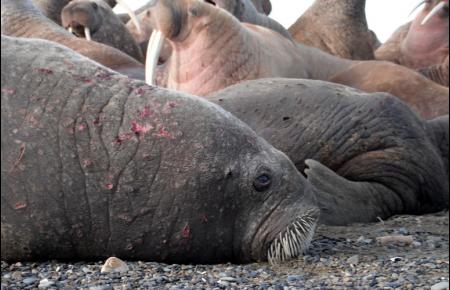
Now marine mammals, including walruses and ringed seals, are turning up dying on the beaches of Alaska and the far north.  Unidentified skin lesions and sores are the visible evidence of an unknown disease that is ravaging them.

Meanwhile, climate change is causing unprecedented surges in the populations of destructive insects like pine borers, which are killing off millions of acres of forests around the world.

I could go on, and on, and on.

Truly, Derrick Jensen is not exaggerating when he says that human civilization is killing our planet.

Last weekend I watched the new film “End:Civ,” by Franklin Lopez, based on Jensen’s book Endgame.  I had put off watching it for several weeks, because I knew it how upsetting it would be, and sure enough, it was disturbing, to say the least.

For me the hardest-hitting part of the film was about human beings’ casual tolerance of cruelty; our willingness to stand by, indifferent, as our fellow travelers on this planet are systematically hunted or poisoned or displaced to extinction.

Part of this detachment of ours may be rooted in the way we tell the stories of how these deaths occur.  We talk about “colony collapse disorder,” for example, rather than narrating the way that entire hives of bees–which are highly evolved, communicative insects–fail to return to the hive one day.

They get lost out there–maybe due to cell phone waves or other forms of chemical interference, we don’t really know–and never come home.  Imagine this happening on a global scale, a whole species of productive, social insects lost, one by one, by the million.

In the same way, it’s far easier to talk about “cancer victims” en masse than to live through the suffering death of your own loved one.  How many vibrant, creative, hardworking people have we lost to cancer the last ten years?  In the last year?  In the last month?  Wangari Maathai and Steve Jobs, to name two famous, very recent cancer victims.  The list goes on and on and on.

But still we remain passive.  We may mourn the disappearance of the honeybees or the songbirds, but we don’t make the effort to connect the dots and come to a true understanding of the extent to which our way of life has been poisoning our planet since the advent of industrialization, and especially since the beginning of the 20th century, which is when synthetic chemical production really took off.

Before she died of cancer, Rachel Carson managed to break through the wall of indifference and make the case against DDT.  Thanks to her efforts, the bald eagle and many other birds have rallied and come back from the brink of extinction.

It’s amazing how resilient life is.  If human civilization would just back off and give our natural systems on the planet a chance, they would heal themselves, and go back to providing the healthy ecological web that made our success as a species possible.

Our planet, ourselves.  We need to understand, in the deepest and most urgent possible terms, that we cannot dissociate ourselves from the poisoning and destruction that is being visited on the forests, oceans, swamps and grasslands of this planet.

The “Wall Street Awakening” cannot be only about jobs, about fixing a broken economy and continuing on our merry path of global domination and “resource extraction.”  The analysis has to go deeper than that, and the change has to be much more dramatic.

All the jobs in the world won’t bring back the walruses or the ringed seals or the polar bears.  What use will jobs be when the ocean is a giant dead zone, and industrial agriculture collapses?  Will we be worrying about jobs when the forests that provide our oxygen are all gone?

We need to focus on what’s important and go all the way this time.  As I keep saying, our future depends on it.  And I am not exaggerating.

Wangari Maathai’s Canopy of Hope: remembering a warrior woman for the planet and role model for us all

Kenyan Wangari Maathai, who died last night of ovarian cancer, was a woman who took everything she learned and used it for the benefit of her local community and the planetary community as a whole.

As a girl, she used to sit by a certain fig tree that grew near her family village.  Beside the fig tree a clear, sparkling stream flowed, planted with arrowroots and hopping with small frogs.  Her mother told her that this was a “tree of God,” which wasn’t to be harvested for firewood.

Later, Wangari realized that “there was a connection between the fig tree’s root system and the underground water reservoirs.  The roots burrowed deep into the ground, breaking through the rocks beneath the surface soil and diving into the underground water table.  The water traveled up along the roots until it hit a depression or weak place in the ground and fushed out as a spring.  Indeed, wherever these trees stood, there were likely to be streams.  The reverence the community had for the fig tree helped preserve the stream and the tadpoles that so captivated me.  The trees also held the soil together, reducing erosion and landslides.  In such ways, without conscious or deliberate effort, these cultural and spiritual practices contributed to the conservation of biodiversity” (Unbowed, 46).

Wangari came of age as the traditional wisdom of the village people was giving way before the onslaught of Western epistemologies.  A girl who excelled in her schooling, she educated by Catholic nuns, and was fortunate enough to be chosen for the so-called Kennedy airlift of 1960, under which the Joseph P. Kennedy Foundation provided scholarships for promising young African students to study in America—the same program that brought Barack Obama’s father to the U.S. to study.

Wangari ended up at Mount St. Scholastica, a Benedictine women’s college in Kansas, where she majored in science, and she went on to earn a Master’s in biology at the University of Pittsburgh. She continued her studies in Germany, and in 1971 earned a Ph.D. in biology from the University College of Nairobi—the first women in East and Central Africa to earn a doctoral degree.

Like so many other highly educated women who join the workforce, Wangari experienced plenty of gender discrimination as she tried to advance her career. Frustrated with her lack of advancement within the university, she joined the National Council of Women of Kenya, which was a group of educated women who sought to improve the living conditions of all Kenyan women.

“We could either sit in an ivory tower wondering how so many people could be so poor and not be working to change their situation, or we could try to help them escape the vicious cycle they found themselves in,” she said.  “This was not a remote problem for us.  The rural areas were where our mothers and sisters still lived.  We owed it to them to do all we could” (124).

For Wangari, the problems were clear:

“The connection between the symptoms of environmental degradation and their causes—deforestation, devegetation, unsustainable agriculture and soil loss—were self-evident.  Something had to be done.  We could not just deal with the manifestations of the problems.  We had to get to the root causes of those problems.

“Now, it is one thing to understand the issues.  It is quite another to do something about them.  But I have always been interested in finding solutions.  This is, I believe, the result of my education as well as my time in America: to think of what can be done rather than worrying about what cannot.  I didn’t sit down and ask myself, ‘Now let me see, what shall I do?’ It just came to me: Why not plant trees?’ The trees would provide a supply of wood that would enable women to cook nutritious foods.  They would also have wood for fencing and fodder for cattle and goals.  The trees would offer shade for humans and animals, protect watersheds and bind the soil, and, if they were fruit trees, provide food.  They would also heal the land by bringing back birds and small animals and regenerate the vitality of the earth.

“That is how the Green Belt Movement began” (125).

 The Green Belt Movement mobilized thousands of ordinary women in Kenya to start tree nurseries, and to plant trees near their homes.  It also became a forest conservation movement, with Wangari leading women in protecting Kenya’s remaining forests against the loggers hired by giant transnational conglomerates.  She made plenty of enemies in the government when her agenda threw a wrench in their greedy plans, and she was often afraid for her life.  She was thrown in jail many times, and frequently confronted violence at the hands of police and goon squads.


 Through it all, she remained, as the title of her memoir suggests, UNBOWED. She would not be browbeaten into submission to authority.  She knew that her cause was not only righteous but right for Kenyans and for the planet she loved, and this gave her the courage to stand firm against intimidation.

Wangari’s activism cost her her marriage: her husband, a Kenyan Member of Parliament, divorced her after she earned her Ph.D. and became more financially successful.  She could have chosen the easy way and lived a very privileged, comfortable existence in Nairobi, if she had been willing to bow her head and put her husband’s needs and career before her own.  Instead, she went through a humiliating public divorce trial:

“It became clear that I was being turned into a sacrificial lamb.  Anybody who had a grudge against modern, educated and independent women was being given an opportunity to spit on me.  I decided to hold my head up high, put my shoulders back, and suffer with dignity: I would give every woman and girl reasons to be proud and never regret being educated, successful and talented.  ‘What I have,’ I told myself, ‘is something to celebrate and not to ridicule or dishonor’” (146).

The divorce trial ended, incredibly enough, with Wangari being sentenced to six months in prison for “contempt of court”; she was hauled off to prison without even having the time to say goodbye to her children. It was clearly an attempt to put this uppity woman in her place, but it did not work: Wangari would not be intimidated, and emerged from prison determined to put her talents to work for her people, come what might for herself personally.

Her Green Belt Movement became a model for sustainable, grassroots-driven development throughout Africa and beyond, which worked not only for environmental sustainability, but also for women’s rights, human rights and participatory democracy.  Wangari consistently provided an upright model of honest, steadfast leadership, leading by example in speaking truth to power and and refusing to be cowed.

“What I have learned over the years,” she said, “is that we must be patient, persistent and committed.  When we are planting trees sometimes people will say to me, “I don’t want to plant this tree, because it will not grow fast enough.” I have to keep reminding them that the trees they are cutting today were not planted by them, but by those who came before.  So they must plant the trees that will benefit communities in the future.  I remind them that like a seedling, with sun, good soil, and abundant rain, the roots of our future will bury themselves in the ground and a canopy of hope will reach into the sky” (289).

Wangari Maathai herself grew that “canopy of hope” for all of us.  May the seedlings she planted be nourished with care by those of us who aspire to walk in her footsteps, for all those who deserve a better world in the future here on our precious planetary home.